

Human–machine partnership with artificial intelligence for chest radiograph diagnosis
Open accessThe DOI matches its Crossref record; 46 of the 50 references it cites were found in a registry or an index.
Abstract
Human-in-the-loop (HITL) AI may enable an ideal symbiosis of human experts and AI models, harnessing the advantages of both while at the same time overcoming their respective limitations. The purpose of this study was to investigate a novel collective intelligence technology designed to amplify the diagnostic accuracy of networked human groups by forming real-time systems modeled on biological swarms. Using small groups of radiologists, the swarm-based technology was applied to the diagnosis of pneumonia on chest radiographs and compared against human experts alone, as well as two state-of-the-art deep learning AI models. Our work demonstrates that both the swarm-based technology and deep-learning technology achieved superior diagnostic accuracy than the human experts alone. Our work further demonstrates that when used in combination, the swarm-based technology and deep-learning technology outperformed either method alone. The superior diagnostic accuracy of the combined HITL AI solution compared to radiologists and AI alone has broad implications for the surging clinical AI deployment and implementation strategies in future practice.
Overview
The claims and statistics of this paper haven’t been checked yet.
Free: it reads the open-access text and checks the first 5 claims that cite a source we can check. Create a free account to check every claim.
Integrity signals
Registry
Cites
Statistics
Figures
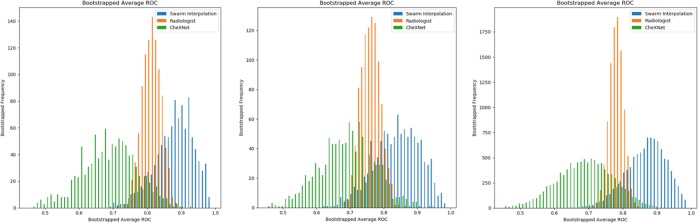
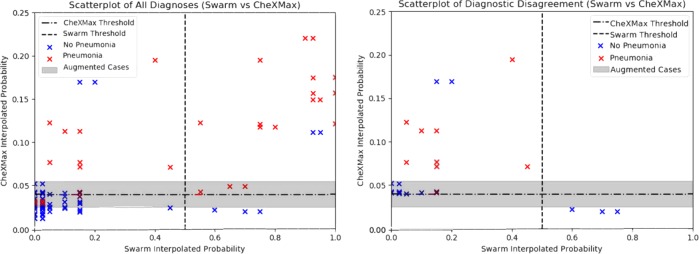
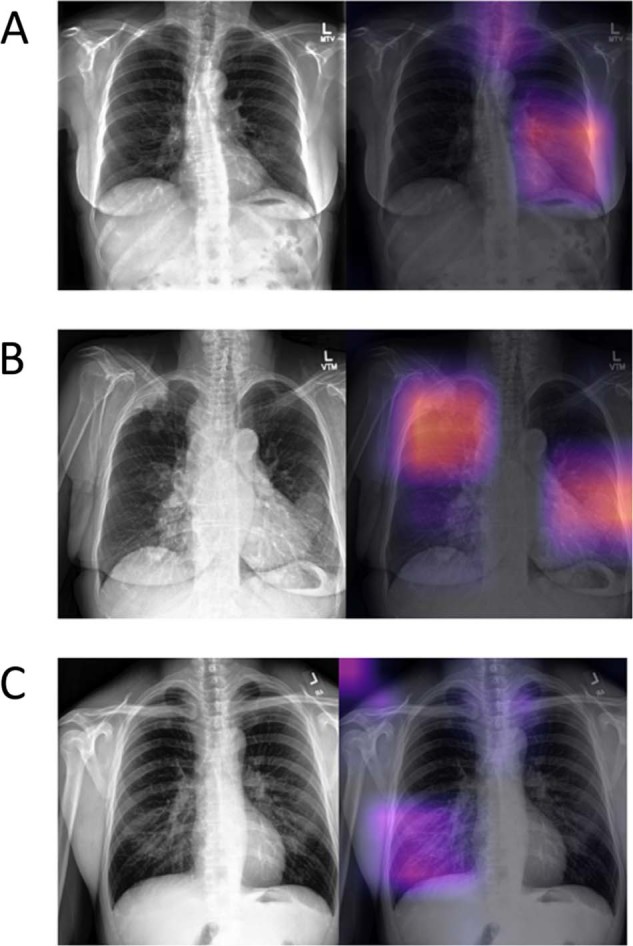
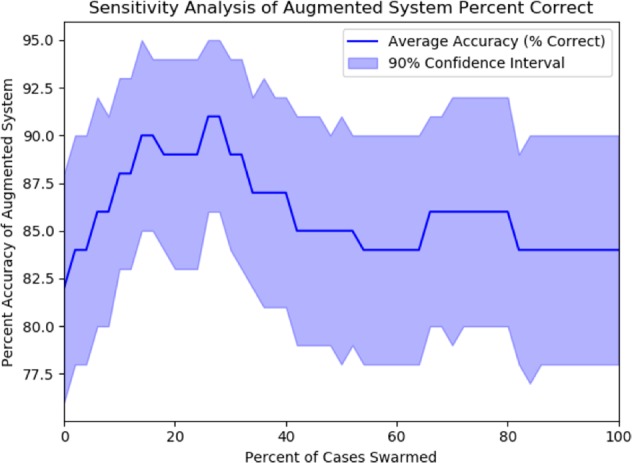
Verification
Claims the paper makes
The claims and statistics of this paper haven’t been checked yet.
Free: it reads the open-access text and checks the first 5 claims that cite a source we can check. Create a free account to check every claim.
Claims other papers make about this one
Each is checked against this paper’s own text: does it say what the citing paper says it does?
The check wasn’t confident either way, so it gives no verdict — never disputed.
In the citing paper
“More critically, recent studies reveal that clinicians’ trust in AI recommendations is fundamentally linked to their ability to understand the underlying reasoning processes [9,10,11].”
From Beyond Post hoc Explanations: A Comprehensive Framework for Accountable AI in Medical Imaging Through Transparency, Interpretability, and Explainability (2025) · cites this paper as [10]
Experimental — accuracy not yet measured
Self-check
Percentages, sums and reported differences re-computed from the paper’s own numbers.
The self-check needs the paper’s full text.
Citations
Cites
Dermatologist-level classification of skin cancer with deep neural networks
Esteva, A., Kuprel, B., Novoa, R. A., Ko, J., Swetter, S. M., Blau, H. M., & Thrun, S. (2017) · Nature · doi:10.1038/nature21056 · Cited by 14,362
Gulshan, V., Peng, L., Coram, M., Stumpe, M. C., Wu, D., Narayanaswamy, A., Venugopalan, S., Widner, K., Madams, T., Cuadros, J., et al. (2016) · JAMA · doi:10.1001/jama.2016.17216 · Cited by 7,697
Wang, X., Peng, Y., Lu, L., Lu, Z., Bagheri, M., & Summers, R. M. (2017) · 2017 IEEE Conference on Computer Vision and Pattern Recognition (CVPR) · doi:10.1109/cvpr.2017.369 · Cited by 4,616
Artificial intelligence in radiology
Hosny, A., Parmar, C., Quackenbush, J., Schwartz, L. H., & Aerts, H. J. W. L. (2018) · Nature Reviews Cancer · doi:10.1038/s41568-018-0016-5 · Cited by 3,803
Predicting the future - big data, machine learning, and clinical medicine
Obermeyer, Z., & Emanuel, E. J. (2016) · New England Journal of Medicine · doi:10.1056/nejmp1606181 · Cited by 3,652
Ehteshami Bejnordi, B., Veta, M., Johannes van Diest, P., van Ginneken, B., Karssemeijer, N., Litjens, G., van der Laak, J. A. W. M., and the CAMELYON16 Consortium, Hermsen, M., Manson, Q. F., et al. (2017) · JAMA · doi:10.1001/jama.2017.14585 · Cited by 3,293
Clinically applicable deep learning for diagnosis and referral in retinal disease
De Fauw, J., Ledsam, J. R., Romera-Paredes, B., Nikolov, S., Tomasev, N., Blackwell, S., Askham, H., Glorot, X., O’Donoghue, B., Visentin, D., et al. (2018) · Nature Medicine · doi:10.1038/s41591-018-0107-6 · Cited by 2,639
Lakhani, P., & Sundaram, B. (2017) · Radiology · doi:10.1148/radiol.2017162326 · Cited by 1,775
Rajpurkar, P., Irvin, J., Ball, R. L., Zhu, K., Yang, B., Mehta, H., Duan, T., Ding, D., Bagul, A., Langlotz, C. P., et al. (2018) · PLOS Medicine · doi:10.1371/journal.pmed.1002686 · Cited by 1,449
Self-citationPotential Biases in Machine Learning Algorithms Using Electronic Health Record Data
Gianfrancesco, M. A., Tamang, S., Yazdany, J., & Schmajuk, G. (2018) · JAMA Internal Medicine · doi:10.1001/jamainternmed.2018.3763 · Cited by 1,395
Cited by
Items 301–334 of 334
Mhyellah, J. H., Vedastus, Y., Rweyendera, A., Kiritta, R. F., Majinge, D. C., & Jaka, H. (2025) · Research Square · doi:10.21203/rs.3.rs-7923452/v1
Measuring Group Personality with Swarm AI
Willcox, G. (2020) · International Journal of Transdisciplinary Artificial Intelligence · doi:10.35708/tai1869-126249
Self-citationKlimov, A. A., Karelin, A. V., Lyapustin, S. B., Rudnitsky, S. I., Tolstova, M. A., Shamonin, A. E., & В., С. В. (2026) · Annals of critical care · doi:10.21320/1818-474x-2026-2-176-185
Human in Loop Machine Learning: A Paradigm Shift
Dange, V. R. (2024) · Panamerican mathematical journal. · doi:10.52783/pmj.v35.i1s.2295
Auditable agentic AI for evidence-grounded thyroid ultrasound diagnosis and reportingPreprint
Li, G., Gong, H., Chen, S., Wang, B., Wang, Y., Wang, S., You, G., Xiong, X., Wang, H., Mao, M., et al. (2026) · Research Square · doi:10.21203/rs.3.rs-10385518/v1
Essays in experimental economics
Çelebi, C. (2024) · MADOC (University of Mannheim)
Ahmed, M. F., Anni, I. K., & Rony, M. M. U. (2026) · arXiv (Cornell University) · doi:10.48550/arxiv.2608.05614
Foundations and Frontiers in Decision Science - Theory, Methods and Applications
Kisku, D. R. (2025) · IntechOpen eBooks · doi:10.5772/intechopen.1008092
Tapia, S. V., Alcaine, P. B., & Hernández, S. O. (2026) · Zaguan (Universidad de Zaragoza)
The Artificial Intelligence: Encoding the Philosophy of Empathy into Business Models
Croucamp, S., & Croucamp, P. (2024) · Boloka Institutional Repository (North-west University)
Essays on Online Platforms and Human-Algorithm Interaction
Moehring, A. (2024) · DSpace@MIT (Massachusetts Institute of Technology)
Closed-Loop Quality Assurance for Production Clinical AI DocumentationPreprint
Napier, A., Wiley, J., & Heslin, M. (2026) · medRxiv · doi:10.64898/2026.05.27.26353977
Yang, Y., Fujii, S., & Nguyen, T. (2025) · International Journal of Environmental Research and Public Health · doi:10.3390/ijerph22091325
Zhang, Y., Wang, L., Yu, Z., Wang, H., Liu, J., & Guo, B. (2025) · International Conference on Mobility, Sensing and Networking (MSN) · doi:10.1109/msn69125.2025.00064
Kunigham, L. M. (2020) · Digital Library of the University of Innsbruck (University of Innsbruck)
Teja, N., Singh, A., Bhatnagar, A., Kumar, A., Kant, P., & Kumar, S. (2026) · The Bioscan. · doi:10.63001/tbs.2026.v21.i02.s.i(2).pp1758-1774
Ruffle, J., Mohinta, S., Pombo, G., Biswas, A., Campbell, A. D., Davagnanam, I., Doig, D., Hammam, A., Hyare, H., Jabeen, F., et al. (2026) · UCL Discovery (University College London)
Evolutionary Optimization of High-Coverage Budgeted ClassifiersPreprint
Hamilton, N. H., & Fulp, E. W. (2021) · arXiv (Cornell University) · doi:10.48550/arxiv.2110.13067
The Role of Personality in Product Recalls
Gass, D. F. (2024) · Kölner Universitäts PublikationsServer (Universität zu Köln)
Deep Learning in Medical Image Interpretation: Recent Advances and Impact on Clinical Practice
Nunes, D. S., Mozdzen, V. F., Gusson, V. P., Cangussú, G. S., Colombo, S. R., Santos, D. S. G., Miranda, A. L. A. D. P., Segato, J. V. B., Botelho, W. C., Júnior, W. C. B., et al. (2024) · International Journal of Health Science · doi:10.22533/at.ed.1594512405067
Harnessing AI builder for intelligent workflow automation in the public health sector
Ajiboye, K. J. (2022) · World Journal of Advanced Research and Reviews · doi:10.30574/wjarr.2022.16.3.1351
Alshlowi, M., Alkhuraij, S., & Alharbi, H. (2026) · Engineering Technology & Applied Science Research · doi:10.48084/etasr.16118
Meta-Learning Mini-Batch Risk FunctionalsPreprint
Tyo, J., & Lipton, Z. C. (2023) · arXiv (Cornell University) · doi:10.48550/arxiv.2301.11724
Seeing Things Differently: The Role of Differing Perspectives in Advice-Taking
Cognitive Science Society 2025, Kumar, A., Steyvers, M., & Tham, R.-H. M. (2025) · eScholarship (California Digital Library) · doi:10.48448/6qq7-hf91 · Cited by 1
Volf, O., Tsarenko, A. V., Velichko, N. M., Tolstykh, O. I., & Bondarchuk, A. M. (2021) · Health of Society · doi:10.22141/2306-2436.9.2.2020.205213
Zucker, E. J. (2024) · American Journal of Roentgenology · doi:10.2214/ajr.24.32185
Self-citationการฟังอย่างลึกซึ้งในการบริบาลทันตกรรมพร้อมมูล
แมนสุมิตร์ชัย, ศ., ศุภอมรกุล, ส., มโนพัฒนกุล, ส., & บูรณชาติ, น. (2021) · SWU eJournals System (Srinakharinwirot University)
Rong, C. (2025) · International Conference on Smart Healthcare and Wearable Intelligent Devices (SHWID) · doi:10.1145/3788112.3788137
Rise of the Augmented Radiologist: A Vision for 2035
Jha, P. K. (2026) · Innovative Journal of Medical Imaging · doi:10.62502/ijmi/v2i3art5
Guérinot, C., Marcon, V., Godard, C., Blanc, T., Verdier, H., Planchon, G., Raimondi, F., Boddaert, N., Alonso, M., Sailor, K., et al. (2022) · doi:10.3389/fbinf.2021.777101.s001
Human–AI Risk Decision-Making: The Effects of Risk-Taking Tendency and Transparency Design
Chen, X., Zhang, Y., & Xu, J. (2026) · International Journal of Human-Computer Studies · doi:10.1016/j.ijhcs.2026.103977
Is the Most Accurate AI the Best Teammate? Optimizing AI for Teamwork
Bansal, G., Nushi, B., Kamar, E., Horvitz, E., & Weld, D. S. (2020) · arXiv · doi:10.48550/arxiv.2004.13102
Metadata
- Authors
- Patel, B. N., Rosenberg, L., Willcox, G., Baltaxe, D., Lyons, M., Irvin, J., Rajpurkar, P., Amrhein, T., Gupta, R., Halabi, S., Langlotz, C., Lo, E., Mammarappallil, J., Mariano, A. J., Riley, G., Seekins, J., Shen, L., Zucker, E., & Lungren, M. P.
- Affiliations
- Stanford Medicine (US)
- Unanimous AI (United States) (US)
- Duke Medical Center (US)
- Corresponding author
- Patel, Bhavik N.
- ORCID
- Venue
- npj Digital Medicine
- Published
- 2019-11-18
- Volume
- 2
- Issue
- 1
- Pages
- 111-111
- ISSN
- 2398-6352 (ISSN-L)
- PMC
- PMC6861262
- OpenAlex
- W2984904339
- Semantic Scholar
- 98634f75c0545f3f2a21463dfa33b3ed75319c96
- Cited by
- 254
- References
- 50
- Citations by year
- 2026: 26 · 2025: 44 · 2024: 32 · 2023: 33 · 2022: 43 · 2021: 42 · 2020: 33 · 2019: 1
- FWCI
- 9.45
- Type
- journal article
- Language
- en
- Update notices
- correction (2019-12-10)
- Open access
- gold
- doi.org
- Licence
- cc-by
- creativecommons.org/licenses/by/4.0 (tdm)
- creativecommons.org/licenses/by/4.0 (vor)
- Locations
- npj Digital Medicine (publishedVersion, cc-by)
- PubMed Central (publishedVersion, cc-by)
- PubMed (publishedVersion)
- DOAJ (DOAJ: Directory of Open Access Journals) (submittedVersion)
- Topics
- Health Sciences › Medicine › Health Informatics › Artificial Intelligence in Healthcare and Education
- Health Sciences › Medicine › Radiology, Nuclear Medicine and Imaging › COVID-19 diagnosis using AI
- Health Sciences › Medicine › Radiology, Nuclear Medicine and Imaging › Radiology practices and education
- Keywords
- human-in-the-loop AI, human-machine collaboration, collective intelligence, swarm intelligence, pneumonia diagnosis, chest radiograph, deep learning, diagnostic accuracy
About these checks
Registry, retraction, Cites and statistics results are computed, not judged, with one exception: a printed reference that no index lists is read once by a model before it counts as a citation error. Claims are extracted by a model and kept only when their quote appears verbatim in the text; each cited source is then checked, with a model’s help, for whether it says what the claim relies on. Those verdicts can be wrong — read the claim’s quote and the cited source before relying on one.
Statistics and arithmetic are recomputed, not judged.
Confidence bands are shown only for fields calibrated on our annotated test set. None is calibrated yet, so no band is shown.
What counts as a claim ›How we measure confidence ›How we check this ›
Are you an author, or do you see a problem with this page? Request a review
Data sources
Bibliographic data: Semantic Scholar, OpenAlex, Crossref.
Contains information from the Semantic Scholar Academic Graph Datasets, made available under the ODC Attribution License (ODC-BY 1.0).
Semantic Scholar’s data is described in: Kinney, R., et al. (2023). The Semantic Scholar Open Data Platform. arXiv:2301.10140.
