

The DOI matches its Crossref record; 45 of the 45 references it cites were found in a registry or an index.
Automating sleep stage classification using wireless, wearable sensors
Open accessAbstract
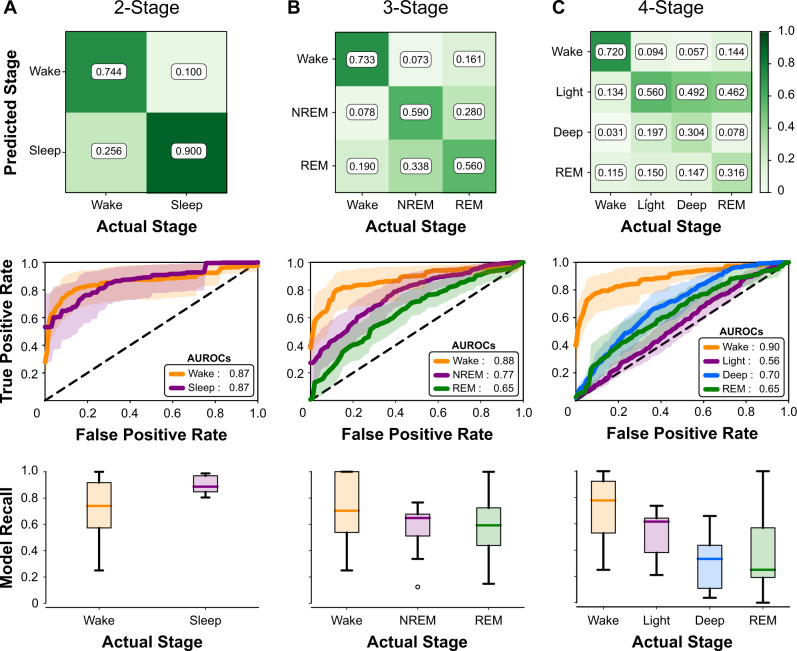
Polysomnography (PSG) is the current gold standard in high-resolution sleep monitoring; however, this method is obtrusive, expensive, and time-consuming. Conversely, commercially available wrist monitors such as ActiWatch can monitor sleep for multiple days and at low cost, but often overestimate sleep and cannot differentiate between sleep stages, such as rapid eye movement (REM) and non-REM. Wireless wearable sensors are a promising alternative for their portability and access to high-resolution data for customizable analytics. We present a multimodal sensor system measuring hand acceleration, electrocardiography, and distal skin temperature that outperforms the ActiWatch, detecting wake and sleep with a recall of 74.4% and 90.0%, respectively, as well as wake, non-REM, and REM with recall of 73.3%, 59.0%, and 56.0%, respectively. This approach will enable clinicians and researchers to more easily, accurately, and inexpensively assess long-term sleep patterns, diagnose sleep disorders, and monitor risk factors for disease in both laboratory and home settings.
Overview
The claims and statistics of this paper haven’t been checked yet.
Free: it reads the open-access text and checks the first 5 claims that cite a source we can check. Create a free account to check every claim.
Integrity signals
Registry
Cites
Statistics
Figures



Verification
Claims the paper makes
The claims and statistics of this paper haven’t been checked yet.
Free: it reads the open-access text and checks the first 5 claims that cite a source we can check. Create a free account to check every claim.
Claims other papers make about this one
Each is checked against this paper’s own text: does it say what the citing paper says it does?
In the citing paper
“sleep assessment algorithms are frequently proprietary and validated in small populations, making their measurement validity unclear5–8”
From Self-supervised learning of accelerometer data provides new insights for sleep and its association with mortality (2024) · cites this paper as [6]
In the citing paper
“This potentially affects health-related outcomes that rely on PPG including a host of sleep-related indices such as sleep duration, architecture [8], diagnosis of sleep apnea [9], long-term sleep patterns, and other sleep disorders [10].”
From Limiting racial disparities and bias for wearable devices in health science research (2020) · cites this paper as [10]
Self-check
Percentages, sums and reported differences re-computed from the paper’s own numbers.
The self-check needs the paper’s full text.
Citations
Cites
The Pittsburgh Sleep Quality Index: a new instrument for psychiatric practice and research
Buysse, D. J., Reynolds, C. F., Monk, T. H., Berman, S. R., & Kupfer, D. J. (1989) · Psychiatry Research · doi:10.1016/0165-1781(89)90047-4 · Cited by 35,234
(2007) · Cited by 6,530
Short- and long-term health consequences of sleep disruption
Medic, G., Wille, M., & Hemels, M. (2017) · Nature and Science of Sleep · doi:10.2147/nss.s134864 · Cited by 1,776
Sympathetic-Nerve Activity during Sleep in Normal Subjects
Somers, V. K., Dyken, M. E., Mark, A. L., & Abboud, F. M. (1993) · New England Journal of Medicine · doi:10.1056/nejm199302043280502 · Cited by 1,574
Monitoring of Vital Signs with Flexible and Wearable Medical Devices
Khan, Y., Ostfeld, A. E., Lochner, C. M., Pierre, A., & Arias, A. C. (2016) · Advanced Materials · doi:10.1002/adma.201504366 · Cited by 1,408
Wearable Sensors for Remote Health Monitoring
Majumder, S., Mondal, T., & Deen, M. (2017) · Sensors · doi:10.3390/s17010130 · Cited by 1,375
Marino, M., Li, Y., Rueschman, M. N., Winkelman, J. W., Ellenbogen, J. M., Solet, J. M., Dulin, H., Berkman, L. F., & Buxton, O. M. (2013) · Sleep · doi:10.5665/sleep.3142 · Cited by 1,056
Buxton, O. M., & Marcelli, E. (2010) · Social Science & Medicine · doi:10.1016/j.socscimed.2010.05.041 · Cited by 818
Further Validation of Actigraphy for Sleep Studies
de Souza, L., Benedito-Silva, A. A., Pires, M. L. N., Poyares, D., Tufik, S., & Calil, H. M. (2003) · Sleep · doi:10.1093/sleep/26.1.81 · Cited by 587
Krauchi, K., & Wirz-Justice, A. (1994) · American Journal of Physiology-Regulatory, Integrative and Comparative Physiology · doi:10.1152/ajpregu.1994.267.3.r819 · Cited by 558
Cited by
Limiting racial disparities and bias for wearable devices in health science research
Colvonen, P. J., DeYoung, P. N., Bosompra, N.-O. A., & Owens, R. L. (2020) · Sleep · doi:10.1093/sleep/zsaa159 · Cited by 137
“This potentially affects health-related outcomes that rely on PPG including a host of sleep-related indices such as sleep duration, architecture [8], diagnosis of sleep apnea [9], long-term sleep patterns, and other sleep disorders [10].”
BackgroundIntelligent Wearable Systems: Opportunities and Challenges in Health and Sports
Yang, L., Amin, O., & Shihada, B. (2024) · ACM Computing Surveys · doi:10.1145/3648469 · Cited by 195
“Boe et al. applied an ML model to monitor five different sleep stages based on a wrist-band ACC and three ECG sensor patches [94].”
BackgroundMethodWearable Sensing Devices for Point of Care Diagnostics
Mondal, S., Zehra, N., Choudhury, A., & Iyer, P. K. (2020) · ACS Applied Bio Materials · doi:10.1021/acsabm.0c00798 · Cited by 104
AI in Rehabilitation Medicine: Opportunities and Challenges
Lanotte, F., O’Brien, M. K., & Jayaraman, A. (2023) · Annals of Rehabilitation Medicine · doi:10.5535/arm.23131 · Cited by 146
“Using multiple sensors on different body locations can increase the accuracy of activity detection [66] or sleep stage monitoring [45], although it may also increase power consumption and reduce patient compliance.”
BackgroundSelf-citationZavanelli, N., Kim, H., Kim, J.-S., Herbert, R., Mahmood, M., Kim, Y., Kwon, S., Bolus, N. B., Torstrick, F. B., Lee, C. S. D., et al. (2021) · Science Advances · doi:10.1126/sciadv.abl4146 · Cited by 96
Metadata
- Authors
- Boe, A. J., McGee Koch, L. L., O’Brien, M. K., Shawen, N., Rogers, J. A., Lieber, R. L., Reid, K. J., Zee, P. C., & Jayaraman, A.
- Affiliations
- Northwestern University (US)
- Corresponding author
- Jayaraman, Arun
- ORCID
- Venue
- npj Digital Medicine
- Published
- 2019-12-20
- Volume
- 2
- Issue
- 1
- Pages
- 131-131
- ISSN
- 2398-6352 (ISSN-L)
- PMC
- PMC6925191
- OpenAlex
- W2996617683
- Cited by
- 98
- References
- 45
- Citations by year
- 2026: 11 · 2025: 6 · 2024: 24 · 2023: 18 · 2022: 15 · 2021: 17 · 2020: 7
- FWCI
- 4.36
- Type
- journal article
- Language
- en
- Open access
- gold
- doi.org
- Licence
- cc-by
- creativecommons.org/licenses/by/4.0 (tdm)
- creativecommons.org/licenses/by/4.0 (vor)
- Locations
- npj Digital Medicine (publishedVersion, cc-by)
- Europe PMC (PubMed Central) (publishedVersion, cc-by)
- PubMed Central (publishedVersion, cc-by)
- PubMed (publishedVersion)
- DOAJ (DOAJ: Directory of Open Access Journals) (submittedVersion)
- Funders
- U.S. Department of Health & Human Services | National Institutes of Health (T32GM008152)
- Topics
- Physical Sciences › Computer Science › Computer Vision and Pattern Recognition › Context-Aware Activity Recognition Systems
- Physical Sciences › Engineering › Biomedical Engineering › Non-Invasive Vital Sign Monitoring
- Social Sciences › Psychology › Experimental and Cognitive Psychology › Sleep and related disorders
- Keywords
- sleep stage classification, wearable sensors, wireless sensors, REM sleep detection, NREM sleep, hand acceleration, electrocardiogram, skin temperature, polysomnography alternative, sleep monitoring, sleep disorders
About these checks
Registry, retraction, Cites and statistics results are computed, not judged, with one exception: a printed reference that no index lists is read once by a model before it counts as a citation error. Claims are extracted by a model and kept only when their quote appears verbatim in the text; each cited source is then checked, with a model’s help, for whether it says what the claim relies on. Those verdicts can be wrong — read the claim’s quote and the cited source before relying on one.
Statistics and arithmetic are recomputed, not judged.
Confidence bands are shown only for fields calibrated on our annotated test set. None is calibrated yet, so no band is shown.
What counts as a claim ›How we measure confidence ›How we check this ›
Are you an author, or do you see a problem with this page? Request a review
How to cite
Cite CoChat for the checks on this page, and the paper for its own findings.
- This page
- CoChat. (2026). Citation check: Automating sleep stage classification using wireless, wearable sensors. https://app.cochat.ai/papers/10.1038/s41746-019-0210-1
- The paper
- Boe, A. J., McGee Koch, L. L., O’Brien, M. K., Shawen, N., Rogers, J. A., Lieber, R. L., Reid, K. J., Zee, P. C., & Jayaraman, A. (2019). Automating sleep stage classification using wireless, wearable sensors. npj Digital Medicine. https://doi.org/10.1038/s41746-019-0210-1
Data sources
Bibliographic data: Semantic Scholar, OpenAlex, Crossref.
Contains information from the Semantic Scholar Academic Graph Datasets, made available under the ODC Attribution License (ODC-BY 1.0).
Semantic Scholar’s data is described in: Kinney, R., et al. (2023). The Semantic Scholar Open Data Platform. arXiv:2301.10140.
