

Development of digital biomarkers for resting tremor and bradykinesia using a wrist-worn wearable device
Open accessThe DOI matches its Crossref record; 57 of the 58 references it cites were found in a registry or an index.
Abstract
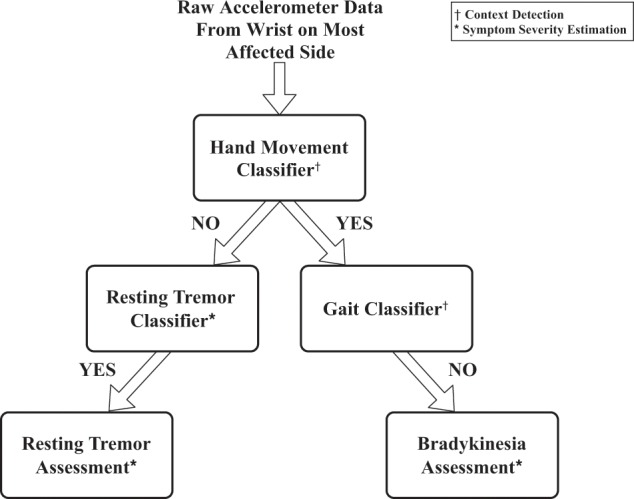
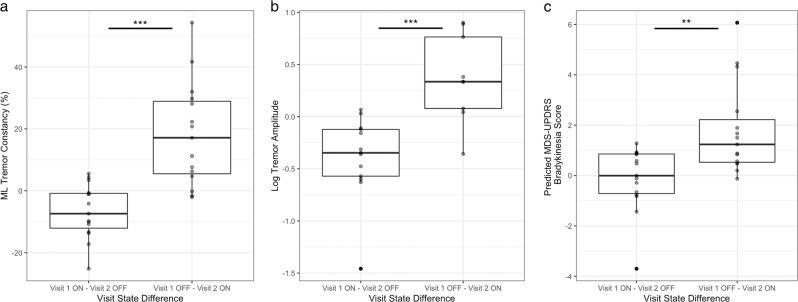
Objective assessment of Parkinson’s disease symptoms during daily life can help improve disease management and accelerate the development of new therapies. However, many current approaches require the use of multiple devices, or performance of prescribed motor activities, which makes them ill-suited for free-living conditions. Furthermore, there is a lack of open methods that have demonstrated both criterion and discriminative validity for continuous objective assessment of motor symptoms in this population. Hence, there is a need for systems that can reduce patient burden by using a minimal sensor setup while continuously capturing clinically meaningful measures of motor symptom severity under free-living conditions. We propose a method that sequentially processes epochs of raw sensor data from a single wrist-worn accelerometer by using heuristic and machine learning models in a hierarchical framework to provide continuous monitoring of tremor and bradykinesia. Results show that sensor derived continuous measures of resting tremor and bradykinesia achieve good to strong agreement with clinical assessment of symptom severity and are able to discriminate between treatment-related changes in motor states.
Overview
The claims and statistics of this paper haven’t been checked yet.
Free: it reads the open-access text and checks the first 5 claims that cite a source we can check. Create a free account to check every claim.
Integrity signals
Registry
Cites
Statistics
Figures
Verification
Claims the paper makes
The claims and statistics of this paper haven’t been checked yet.
Free: it reads the open-access text and checks the first 5 claims that cite a source we can check. Create a free account to check every claim.
Claims other papers make about this one
Each is checked against this paper’s own text: does it say what the citing paper says it does?
The source backs part of the claim, not all of it — or backs it for a different population, condition or comparison.
In the citing paper
“A sensor's location can affect the accuracy of detection22,23,42.”
From Wearable sensors during drawing tasks to measure the severity of essential tremor (2022) · cites this paper as [23]
Experimental — accuracy not yet measuredIn the citing paper
“The quality and quantity of such information depends on the compliance and motivation of patients23.”
From Wearable sensors during drawing tasks to measure the severity of essential tremor (2022) · cites this paper as [23]
Self-check
Percentages, sums and reported differences re-computed from the paper’s own numbers.
The self-check needs the paper’s full text.
Citations
Cites
A guideline of selecting and reporting intraclass correlation coefficients for reliability research
Koo, T. K., & Li, M. Y. (2016) · Journal of Chiropractic Medicine · doi:10.1016/j.jcm.2016.02.012 · Cited by 31,709
Practical Statistics for Medical Research.
Walter, S. D., & Altman, D. G. (1992) · Biometrics · doi:10.2307/2532320 · Cited by 11,668 · cited 1×
“Agreement between the video raters and live rater for tremor constancy and amplitude (which are ordinal ratings from 0 to 4) was assessed using Cohen’s Kappa K with linear weights.(61) The hand bradykinesia score was considered as a continuous variable ranging from 0 to 12, and hence the ICC was computed as a measure…”
MethodPractical Statistics for Medical Research
Altman, D. G. (1990) · doi:10.1201/9780429258589 · Cited by 10,668
Goetz, C. G., Tilley, B. C., Shaftman, S. R., Stebbins, G. T., Fahn, S., Martinez‐Martin, P., Poewe, W., Sampaio, C., Stern, M. B., Dodel, R., et al. (2008) · Movement Disorders · doi:10.1002/mds.22340 · Cited by 7,536 · cited 4×
“The assessment of bradykinesia is based the examiner’s observation of slowness, hesitancy and amplitude of movement as well as poverty or absence of movement.(9) To capture these aspects of bradykinesia, we derived four measures from raw accelerometer data: amplitude of hand movements (amplitude and slowness), smoothn…”
BackgroundMethodInfluentialAdams, J. L., Dinesh, K., Xiong, M., Tarolli, C. G., Sharma, S., Sheth, N., Aranyosi, A. J., Zhu, W., Goldenthal, S., Biglan, K. M., et al. (2017) · Digital Biomarkers · doi:10.1159/000479018 · Cited by 3,171
Lees, A. J., Hardy, J., & Revesz, T. (2009) · The Lancet · doi:10.1016/s0140-6736(09)60492-x · Cited by 1,956
DeMaagd, G. A., & Philip, A. (2015) · PubMed Central · Cited by 956
Normative spatiotemporal gait parameters in older adults
Hollman, J. H., McDade, E. M., & Petersen, R. C. (2011) · Gait & Posture · doi:10.1016/j.gaitpost.2011.03.024 · Cited by 807
Technology in Parkinson’s disease: challenges and opportunities
Espay, A. J., Bonato, P., Nahab, F. B., Maetzler, W., Dean, J. M., Klucken, J., Eskofier, B. M., Merola, A., Horak, F., Lang, A. E., et al. (2016) · Movement Disorders · doi:10.1002/mds.26642 · Cited by 654
Window Size Impact in Human Activity Recognition
Banos, O., Galvez, J.-M., Damas, M., Pomares, H., & Rojas, I. (2014) · Sensors · doi:10.3390/s140406474 · Cited by 648
Research works printed but not linked: 3
- Standaert, D. G. & Roberson, E. D. Treatment of Central Nervous System Degenerative Disorders. in Goodman & Gilman’s: The Pharmacological Basis of Therapeutics, 12e (eds Brunton, L. L., Chabner, B. A. & Knollmann, B. C.) (McGraw-Hill Education, 2015).
- Erb K The BlueSky Project: monitoring motor and non-motor characteristics of people with Parkinson’s disease in the laboratory, a simulated apartment, and home and community settings Mov. Disord. 2018 33 1990 1990
- Guyon I Elisseeff A An introduction to variable and feature selection J. Mach. Learn. Res. 2003 3 1157 1182
Cited by
Items 101–158 of 158
Sigcha, L. (2021) · UPM Digital Archive (Technical University of Madrid) · doi:10.20868/upm.thesis.68904 · Cited by 4
Batista, L. P., Collado, E., & Sáez, Y. (2024) · I+D Tecnológico · doi:10.33412/idt.v20.2.4065 · Cited by 3
Evolution of the Motor Symptoms in Parkinson Disease under Auditory Stimulation
González, D., Sigcha, L., López, J. M., Asensio, C., Pavón, I., Costa, N., Costa, S. P. G., Gago, M. F., Martínez‐Castrillo, J. C., & de Arcas, G. (2025) · International Journal of Neural Systems · doi:10.1142/s0129065725500303 · Cited by 3
Lin, F., Wang, Z., Li, Z., Zhao, H., Shi, X., Liu, R., Li, J., Peng, D., & Ru, B. (2025) · IEEE Transactions on Human-Machine Systems · doi:10.1109/thms.2025.3570704 · Cited by 3
Hou, W., & Zuckermann, G. (2020) · International Conference on Smart Electronics and Communication (ICOSEC) · doi:10.1109/icosec49089.2020.9215265 · Cited by 3
“A reasonable adolescent physical training program is the basis and prerequisite for well maximizing its effectiveness [10-12].”
BackgroundMonitoring Motor Symptoms in Parkinson’s Disease Under Long Term Acoustic Stimulation
Sigcha, L., González, D., Pavón, I., López, J. M., & de Arcas, G. (2022) · Lecture notes in computer science · doi:10.1007/978-3-031-06242-1_19 · Cited by 3
Peña, L., Nieto, R., Ureña, C., Vásquez, L., Collado, E., & Sáez, Y. (2023) · LACCEI International Multi-Conference for Engineering, Education and Technology (LACCEI) · doi:10.18687/laccei2023.1.1.861 · Cited by 3
“Muchos estudios han utilizado dispositivos comerciales con el fin de evaluar su efectividad [2], [4], [9], [10], [13], [16], [20], [22], [25]-[29].”
BackgroundInfluentialInnovations and ongoing challenges in digital technologies for Parkinson’s disease
Roemmich, R. T., Moro, E., & Shull, P. B. (2025) · npj Parkinson s Disease · doi:10.1038/s41531-025-00920-5 · Cited by 3
Commercially available products for the digital tracking of biomarkers in Parkinson's Disease
Cronin, P., Collins, L., & Sullivan, A. M. (2025) · Aging and Health Research · doi:10.1016/j.ahr.2025.100240 · Cited by 2
Hepp, D. H., OCRAN, K. W., Szanto, A., van Hilten, J. J., Exadaktylos, V., & Weijer, R. H. A. (2025) · npj Parkinson s Disease · doi:10.1038/s41531-025-01163-0 · Cited by 2
“Heuristic models, like the one from Salarian et al. used here, are simple to implement and this particular algorithm has been applied in at least two prior studies 23,29 .”
InfluentialZhang, L., Liu, W., Ni, Q., Gao, Z., & Wang, Y. (2026) · IEEE Transactions on Neural Systems and Rehabilitation Engineering · doi:10.1109/tnsre.2026.3668313 · Cited by 2
“• Magnitude Calculation: we computed the vector magnitude ( p x 2 + y 2 + z 2 ) of filtered signals to generate orientation-invariant features, mitigating confounding e ff ects of limb and sensor positioning [34].”
Adaptive Surface Electromyography Normalization for Long-Duration Recordings
Fox, S. R., Gurchiek, R. D., Ursiny, A. T., Meyer, B. M., Boughton, J. M., & McGinnis, R. S. (2021) · Wearable and Implantable Body Sensor Networks · doi:10.1109/bsn51625.2021.9507026 · Cited by 2
Extracting Digital Biomarkers for Unobtrusive Stress State Screening from Multimodal Wearable Data
Saylam, B., & İncel, Ö. D. (2023) · Lecture notes of the Institute for Computer Sciences, Social Informatics and Telecommunications Engineering · doi:10.1007/978-3-031-35982-8_10 · Cited by 2
Jin, X. H., Chang, S., Ling, Y., Chen, Z., Ma, L., Ren, K., Feng, T., & Zhao, J. (2024) · International Conference on Biomedical Signal and Image Processing (ICBIP) · doi:10.1145/3691521.3691528 · Cited by 2
Gerasimou, I., Moustaklis, A., Sotirakis, C., Hadjidimitriou, S., & Hadjileontiadis, L. J. (2025) · Annual International Conference of the IEEE Engineering in Medicine and Biology Society (EMBC) · doi:10.1109/embc58623.2025.11252726 · Cited by 3
“Working towards this direction, Mahadevan et al. [4], have shown that wearable accelerometers can objectively quantify PD-related upper limb motor symptoms in activities of daily-living highlighting its potential in assessing rigidity and bradyki-nesia unobtrusively.”
InfluentialHizeh, H., Chighri, R., Rahman, M. M. U., Bahloul, M. A., Muqaibel, A. H., & Al-Naffouri, T. Y. (2025) · arXiv (Cornell University) · doi:10.48550/arxiv.2511.06036 · Cited by 2
“For instance, band-pass filters are frequently used to separate higher frequency components in order to detect tremor, whereas stride time is used to characterize gait impairments [63].”
IHMF-PD: An interpretable holistic multimodal framework for classifying Parkinson’s disease severity
Singh, N., Tripathi, P., & Kohat, A. K. (2025) · Biomedical Signal Processing and Control · doi:10.1016/j.bspc.2025.108872 · Cited by 1
Wang, X., Peng, X., Xu, Z., Xu, M., Yang, Y., Zhou, M., Zhao, Z., Yue, P., & Yang, P. (2025) · IEEE Transactions on Biomedical Engineering · doi:10.1109/tbme.2025.3648564 · Cited by 1
Reithe, H., Pătraşcu, M., Torrado, J. C., Førsund, E., Husebo, B. S., Kverneng, S. U., Sheard, E., Tzoulis, C., & Marty, B. (2025) · IEEE Journal of Translational Engineering in Health and Medicine · doi:10.1109/jtehm.2025.3648704 · Cited by 1
“Several approaches have been proposed, such as the use of accelerometers in controlled laboratory settings to detect tremor [12], [13], [14] or mobile applications that prompt the participant to complete a battery of tasks and use the sensors of the smart phone to measure tremor, among other…”
Management of Parkinsons Disease Patients based on Smart Wearable Sensor
Mukesh, S., Prabakar, S., M.Moubina, M.Rishya, & S.Swetha (2025) · International Conference on Evolutionary Computing and Mobile Sustainable Networks (ICECMSN) · doi:10.1109/icecmsn68058.2025.11383166 · Cited by 1
“Mahadevan et al. [17] utilized wrist-worn sensors to derive digital biomarkers for tremor and bradykinesia, and Kehnemouyi et al. [18] discussed how multisensor wearable platforms can support both monitoring and therapeutic feedback.”
InfluentialInterpretable features for quantifying motor symptoms of Parkinson’s disease with wearable sensors
Xie, J., Zhao, H., Zhang, M., Deng, Y., Qu, Q., Liao, W.-H., Lei, Y., Zhang, Y., Sarkodie-Gyan, T., & Cao, J. (2026) · Measurement · doi:10.1016/j.measurement.2026.121402 · Cited by 1
Liu, M., Ye, Y., Li, H., Guo, Y., Liang, P., Li, X., Yin, C., Yu, X., Dong, X., Yao, Y., et al. (2026) · Journal of NeuroEngineering and Rehabilitation · doi:10.1186/s12984-026-01979-8 · Cited by 1
“Parkinson’s disease (PD), including symptoms such as masked face, bradykinesia, postural instability, and tremor [1, 2], leads to a significant decline in motor function and in life quality for patients [3, 4].”
Ukasi, S., Hajra, S., Kim, H. J., Sriphan, S., Pongampai, S., Charoonsuk, T., & Vittayakorn, N. (2026) · Advanced Healthcare Materials · doi:10.1002/adhm.71380 · Cited by 1
Wang, J., Hu, Q., Zhang, Y., Zhou, Y., Li, G., & Zhang, Q. (2026) · Proceedings of the ACM on Interactive Mobile Wearable and Ubiquitous Technologies · doi:10.1145/3832039 · Cited by 1
“To support robust assessment, our kinematic regression module extracts features in a motion-agnostic manner.”
InfluentialEarly Stage Detection of Parkinson Disease
Navada, M. M., Mishra, D., Parkar, S., Patil, P., & Jage, C. S. (2021) · ITM Web of Conferences · doi:10.1051/itmconf/20214003050 · Cited by 1
Cuff-Less Blood Pressure Monitoring in a Cohort of People with Parkinson's Disease
Crowe, C., Sica, M., Kenny, L., O’Flynn, B., Mueller, D. S., Timmons, S., Barton, J. J., & Tedesco, S. A. (2023) · IEEE Sensors Applications Symposium (SAS) · doi:10.1109/sas58821.2023.10253995 · Cited by 1
“Numerous research studies have already investigated the accuracy of identifying those motor symptoms using wrist- and/or ankle-worn inertial sensors in combination with machine learning (ML) models [2-5].”
BackgroundPatient diaries in movement disorders
Vizcarra, J. A. (2024) · Elsevier eBooks · doi:10.1016/b978-0-323-99494-1.00010-1 · Cited by 1
Utilizing Flex Sensors for the Evaluation of Parkinson's Disease
Vu, Q., Dao, T.-H., Nguyen, M.-C., & Tran, D. (2022) · Annals of Computer Science and Information Systems · doi:10.15439/2023r75 · Cited by 1
Initial Validation of ELENA: an affordable device for monitoring tremors in Parkinson's patients.
Batista, L. P., Ureña, C., Collado, E., & Sáez, Y. (2024) · LACCEI International Multi-Conference for Engineering, Education and Technology (LACCEI) · doi:10.18687/laccei2024.1.1.1568 · Cited by 1
Aplicaciones de los sensores inerciales de relojes inteligentes en PRL y salud
Pavón, I., Polvorinos-Fernández, C., Asensio, C., Navarro, J. M. L., Sigcha, L., & Castro, G. D. A. (2023) · Tecniacústica · doi:10.67544/ta.2023.067 · Cited by 1
Dias, S. B., Alhussein, G., Alves, B., Fabbri, M., Rascol, O., Almarcha-Menargues, M. L., Urra, M. K., Grammalidis, N., Dimitropoulos, K., Hadjidimitriou, S., et al. (2025) · SSRN Electronic Journal · doi:10.2139/ssrn.5142802 · Cited by 1
Device-embedded accelerometry complements neural signals for tracking parkinsonian motor statesPreprint
Liu, T., Yao, J., Abdi‐Sargezeh, B., Sharma, A., Lasbareilles, C., Ho, T. L., Cheung, J. T. S., Denison, T., Tan, H., Neumann, W., et al. (2026) · bioRxiv (Cold Spring Harbor Laboratory) · doi:10.64898/2026.07.08.737286 · Cited by 1
(2022) · Annals of Computer Science and Information Systems · doi:10.15439/978-83-969601-5-3
High-Tech Personalized Healthcare in Movement Disorders
(2024) · Frontiers research topics · doi:10.3389/978-2-8325-5159-2
Kwon, I.-J., Kim, H., & Ko, J. (2024) · Journal of Mechanics in Medicine and Biology · doi:10.1142/s0219519424400724
High-Configurable Wearable Device Platform for Motor Disability Evaluation
Cai, Y., Chen, J., Ye, Z., He, T., & Wang, W. W. (2024) · IEEE International Conference on Smart Internet of Things (SmartIoT) · doi:10.1109/smartiot62235.2024.00060
“Traditional clinical evaluations, while valuable, often lack the sensitivity and objectivity needed for a thorough analysis [7].”
Smid, A., Elting, J. W. J., van Laar, T., ten Kate, J. M., Oterdoom, D. L. M., Tamási, K., van Dijk, J. M. C., & Drost, G. (2025) · Parkinsonism & Related Disorders · doi:10.1016/j.parkreldis.2025.107446
Memedi, M., Emruli, B., Cao, Y., & Hedström, K. (2024) · JMIR mhealth and uhealth · doi:10.2196/63232
Modeling and Classifying Parkinsonian Tremors With Nonlinear Dynamics and Kalman Optimization
Vanitha, V., Kumar, V. D., Geman, O., Postolache, O. A., Bellam, S. K., & Toderean, R. (2025) · IEEE Access · doi:10.1109/access.2025.3603726
“[5] reviewed the digital biomarkers after evaluating the data obtained from the wrist-worn sensors concerning the PD symptoms in a group of 343 PD patients and 157 healthy controls.”
Zhang, Y., Chen, X., Li, Q., Lin, H., Tao, L., Wu, H., Chen, C., & Chen, W. (2025) · Annual International Conference of the IEEE Engineering in Medicine and Biology Society (EMBC) · doi:10.1109/embc58623.2025.11254362
“Feature Abbreviation Dominant frequency [27] MainF Ratio of the amplitude of the dominant frequency to total energy [27] AF Spectral flatness [27] SF Spectral entropy [27] SET Mean frequency [28] MeanF Cross Correlation between the extremities on the same side [27] Cor Duration [14], [16] T 2)…”
InfluentialKhalil, R. M. (2025) · University Libraries (University of Maryland) · doi:10.13016/ustd-0cfo
Quantifying bradykinesia in Parkinson’s disease
Brzezicki, M. A. (2024) · Oxford University Research Archive (ORA) (University of Oxford) · doi:10.5287/ora-eyoejg4z0
Development and validation of patient-friendly dexterity marker in multiple sclerosis
Gopal, A. (2023) · eScholarship (California Digital Library)
Ghaffari Hadigheh, H. (2025) · MacSphere (McMaster University) · doi:10.71548/15743
Assessment van cognitieve performantie bij oudere personen door betekenisvol spel
Gielis, K. (2021) · Lirias
Beyond the Lab: Challenges to Detect Parkinson’s Disease Symptoms in Remote Smartwatch Data
Schut, I. (. (2024) · Research Repository (Delft University of Technology)
Digital Remote Patient Monitoring in Neurodegenerative Diseases
(2026) · Frontiers research topics · doi:10.3389/978-2-8325-7200-9
Singh, N., Tripathi, P., & Kohat, A. K. (2026) · Lecture notes in networks and systems · doi:10.1007/978-3-032-14044-9_13
Schwendinger, F., Iaquinto, S., Waibl, V. J., Nittas, V., Gruebner, O., & von Wyl, V. (2026) · International Journal of Public Health · doi:10.3389/ijph.2026.1609200
“Instead, wrist-worn wearables are used to develop digital biomarkers for accurately tracking tremor severity over time [35].”
Smid, A., Elting, J. W. J., van Laar, T., ten Kate, J. M., Oterdoom, D. L. M., Tamási, K., van Dijk, J. M. C., & Drost, G. (2026) · Journal of Neural Transmission · doi:10.1007/s00702-026-03132-0
“The notion that inter-and intra-rater variability of the MDS-UPDRS should be reduced, and assessments should be performed uniformly, is shared among PD experts worldwide (Espay et al. 2019; Elble and Ondo 2022; Mahadevan et al. 2020).”
Zhang, Y., Chen, Q., Wu, H., Chen, C., & Chen, W. (2026) · Frontiers in Neuroscience · doi:10.3389/fnins.2026.1774097
CONTRIBUTION TO MOVEMENT MONITORING IN NEUROLOGY
Poleur, M. (2026) · ORBi (University of Liège)
Pavón, I., Polvorinos-Fernández, C., Sánchez-Hernández, I., de Arcas, G., & Sigcha, L. (2026) · AHFE international · doi:10.54941/ahfe1007490
Γιαννακοπούλου, Κ.-Μ., Tsakanikas, P., & Roussaki, I. G. (2026) · BMC Medical Informatics and Decision Making · doi:10.1186/s12911-026-03665-0
“…symptoms, high-frequency tremor, as well as the gravitational force influence and low-frequency sensor drift were filtered out with cut-off frequencies [0.25 Hz, 3.5 Hz], to isolate the signal characteristics that are most indicative of bradykinesia and dyskinesia, in line with prior work [24].”
InfluentialAcústica y neurociencia. Aplicaciones en el campo de las enfermedades neurodegenerativas
Nieto, D. G., García, P., Navarro, J. M. L., Pavón, I., Asensio, C., & Castro, G. D. A. (2023) · Tecniacústica · doi:10.67544/ta.2023.148
Santhosh, A., D, D. M., Muhammed Basil, K., Pavithra, K., & Vijayan, L. (2026) · International Conference on Smart Systems for Electrical, Electronics, Communication and Computer Engineering (ICSSEECC) · doi:10.1109/icsseecc69062.2026.11722128
“…for continuous free-living tremor monitoring are wrist-worn accelerometers validated with clinical tremor scores [18], deep multiple-instance learning on in-the wild IMU recordings [19], and hierarchical machine learning frameworks for wrist-worn digital biomarkers of tremor and bradykinesia [20].”
TulipTender : A Mobile 3D Parkinson's Disease Assessment System Using a Single Camera
Xue, M., Zhang, Y., Wong, H. Y., Yang, Y., Chan, G., Cheung, Y.-F., Ip, N. Y., & Zhang, Q. (2026) · ACM Annual International Conference on Mobile Computing and Networking (MobiCom) · doi:10.1145/3795866.3844160
Geng, H., Li, S., Liang, C., Min, S. Q., Sun, X., Peng, Y., Ding, S., Wang, Z., Liu, Y., Liu, Q., et al. (2026) · Biosensors and Bioelectronics · doi:10.1016/j.bios.2026.119363
Metadata
- Authors
- Mahadevan, N., Demanuele, C., Zhang, H., Volfson, D., Ho, B., Erb, M. K., & Patel, S.
- Affiliations
- Pfizer (United States) (US)
- Tufts Medical Center (US)
- Corresponding author
- Patel, Shyamal
- ORCID
- Venue
- npj Digital Medicine
- Published
- 2020-01-15
- Volume
- 3
- Issue
- 1
- Pages
- 5-5
- ISSN
- 2398-6352 (ISSN-L)
- PMC
- PMC6962225
- OpenAlex
- W2999749474
- Cited by
- 138
- References
- 58
- Citations by year
- 2026: 13 · 2025: 25 · 2024: 24 · 2023: 19 · 2022: 25 · 2021: 24 · 2020: 8
- FWCI
- 7.39
- Type
- journal article
- Language
- en
- Open access
- gold
- doi.org
- Licence
- cc-by
- creativecommons.org/licenses/by/4.0 (tdm)
- creativecommons.org/licenses/by/4.0 (vor)
- Locations
- npj Digital Medicine (publishedVersion, cc-by)
- PubMed Central (publishedVersion, cc-by)
- PubMed (publishedVersion)
- DOAJ (DOAJ: Directory of Open Access Journals) (submittedVersion)
- DOAJ (DOAJ: Directory of Open Access Journals) (submittedVersion, cc-by-sa)
- Funders
- Pfizer
- Topics
- Physical Sciences › Computer Science › Computer Vision and Pattern Recognition › Context-Aware Activity Recognition Systems
- Health Sciences › Medicine › Clinical Neurology › Parkinson's Disease Mechanisms and Treatments
- Physical Sciences › Engineering › Biomedical Engineering › Non-Invasive Vital Sign Monitoring
- Keywords
- Parkinson's disease, resting tremor, bradykinesia, digital biomarkers, wrist-worn accelerometers, wearable sensors, free-living conditions
About these checks
Registry, retraction, Cites and statistics results are computed, not judged, with one exception: a printed reference that no index lists is read once by a model before it counts as a citation error. Claims are extracted by a model and kept only when their quote appears verbatim in the text; each cited source is then checked, with a model’s help, for whether it says what the claim relies on. Those verdicts can be wrong — read the claim’s quote and the cited source before relying on one.
Statistics and arithmetic are recomputed, not judged.
Confidence bands are shown only for fields calibrated on our annotated test set. None is calibrated yet, so no band is shown.
What counts as a claim ›How we measure confidence ›How we check this ›
Are you an author, or do you see a problem with this page? Request a review
Data sources
Bibliographic data: Semantic Scholar, OpenAlex, Crossref.
Contains information from the Semantic Scholar Academic Graph Datasets, made available under the ODC Attribution License (ODC-BY 1.0).
Semantic Scholar’s data is described in: Kinney, R., et al. (2023). The Semantic Scholar Open Data Platform. arXiv:2301.10140.
