

Guidelines and quality criteria for artificial intelligence-based prediction models in healthcare: a scoping review
Open accessThe DOI matches its Crossref record; 77 of the 77 references it cites were found in a registry or an index; 108 of the 519 sources its claims cite were checked for support.
Abstract
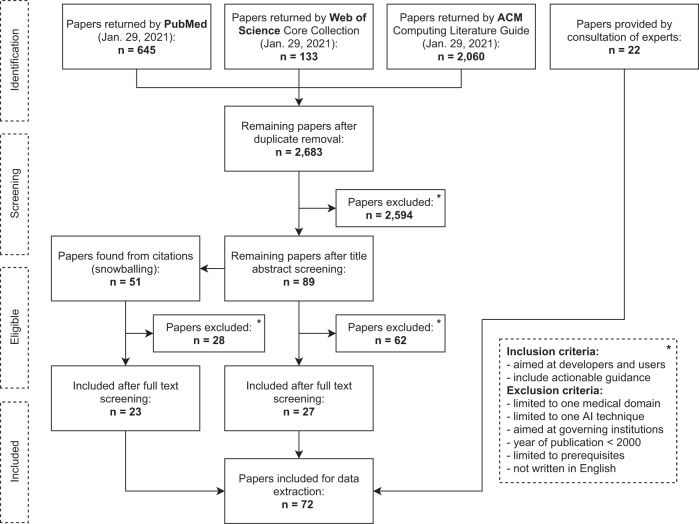
While the opportunities of ML and AI in healthcare are promising, the growth of complex data-driven prediction models requires careful quality and applicability assessment before they are applied and disseminated in daily practice. This scoping review aimed to identify actionable guidance for those closely involved in AI-based prediction model (AIPM) development, evaluation and implementation including software engineers, data scientists, and healthcare professionals and to identify potential gaps in this guidance. We performed a scoping review of the relevant literature providing guidance or quality criteria regarding the development, evaluation, and implementation of AIPMs using a comprehensive multi-stage screening strategy. PubMed, Web of Science, and the ACM Digital Library were searched, and AI experts were consulted. Topics were extracted from the identified literature and summarized across the six phases at the core of this review: (1) data preparation, (2) AIPM development, (3) AIPM validation, (4) software development, (5) AIPM impact assessment, and (6) AIPM implementation into daily healthcare practice. From 2683 unique hits, 72 relevant guidance documents were identified. Substantial guidance was found for data preparation, AIPM development and AIPM validation (phases 1–3), while later phases clearly have received less attention (software development, impact assessment and implementation) in the scientific literature. The six phases of the AIPM development, evaluation and implementation cycle provide a framework for responsible introduction of AI-based prediction models in healthcare. Additional domain and technology specific research may be necessary and more practical experience with implementing AIPMs is needed to support further guidance.
Overview
CoChat Summary
TL;DR
This scoping review identified 72 guidance documents and mapped their recommendations to six phases of the AI-based prediction model lifecycle, from data preparation through implementation. It found substantial guidance for data preparation, development, and validation but less for software development, impact assessment, and implementation, and highlights remaining gaps.
Key findings
- From 2683 unique hits, 72 relevant guidance documents were included; data extraction yielded 138 keywords mapped to 27 phase-specific topics and 6 phase-overarching topics.
- Substantial guidance was found for phases 1–3 (data preparation, AIPM development, AIPM validation), while later phases—software development, impact assessment, and implementation—received clearly less attention in the scientific literature.
- The review provides a six-phase framework for responsible AIPM introduction and identifies gaps including missing a priori sample size guidance for semi-supervised learning, decision trees/random forests, and convolutional neural networks; limited guidance on combining data sources/modalities, non-binary outcomes, AIPM-specific human–AI interaction, workflow integration, cost-effectiveness, accountability, and long-term maintenance/dataset shift.
- Phase-overarching topics included algorithmic bias, transparency and openness, interpretability, team/stakeholders, security, and risks.
Methods
- Scoping review with a multi-stage screening strategy; searched PubMed, Web of Science, and ACM Digital Library for literature published January 2000 to January 2021, supplemented by snowballing reference lists and consultation with a convenience sample of 14 AI experts.
- Inclusion criteria: documents aimed at individuals directly involved in AIPM development, evaluation, and implementation and providing actionable guidance; exclusions included guidance limited to one medical domain or one AI technique, guidance aimed at governing institutions, pre-2000 documents, prerequisites-only guidance, and non-English documents.
- Two reviewers performed title/abstract and full-text screening, resolving conflicts by consensus; keywords extracted from included documents were mapped to phase-specific and phase-overarching topics and validated with three co-authors.
Limitations
- Stated: the definitions of “actionable” guidance and the six phases are somewhat arbitrary and mainly informed by experience; individual AIPM applications may deviate from the presented structure.
- Stated: the databases and sources mostly contain scientific literature and only English documents were included, potentially biasing results toward academic sources and English-speaking countries; this was mitigated by identifying additional gray literature through expert consultation and citation screening.
- Stated: the consulted expert group was a convenience sample predominantly working in the Netherlands, though it included different occupations, healthcare domains, and academia/industry. Evident: no formal quality appraisal or risk-of-bias assessment of the included guidance documents is reported, and the synthesis is narrative/scoping rather than quantitative.
Model-written summary. Check it against the paper before relying on it.
Integrity signals
Registry
Cites
Statistics
Figures
Verification
Claims the paper makes
42 Valid · 1 Not valid · 103 Not checked · 57 Own results and interpretations
The sources with a verdict support this claim; the rest weren’t checked yet, have no full text we could read, or their verdicts aren’t rated yet.
In the paper
“These phases are based on the predominant phases in clinical prediction model research4,5.”
§ Guidelines and quality criteria for artificial intelligence-based prediction models in healthcare: a scoping review > Introduction
What the sources say
- Supportedcites [4] Steyerberg EW Prognosis Research Strategy (PROGRESS) 3: prognostic model research PLoS Med. 2013 10 e1001381 23393430 PMC3564751 source
The Summary Points of PROGRESS 3 state that 'Prognostic model research has three main phases: model development (including internal validation), external validation, and investigations of impact in clinical practice', and that most publications describe model development with few external validation and very few impact studies; the Conclusion repeats the three-phase framing. The paper also explicitly equates prognostic models with 'risk (or clinical) prediction model' in its Introduction, so it does treat these as the predominant phases of clinical prediction model research that the citing authors' AIPM phases are said to build on. The number of citing phases (six) is the citing authors' own construction, not something attributed to this source, so no mismatch arises. (LLM, conf=0.85)
- Not checked yetcites [5] Moons KG Altman DG Vergouwe Y Royston P Prognosis and prognostic research: application and impact of prognostic models in clinical practice BMJ 2009 338 b606 19502216 source
plainstates a cause- Asserted: passes — The authors put it forward as true.
- Checkable: passes — It can be checked against evidence.
- Load-bearing: unclear — It is unclear whether the paper’s conclusions depend on it.
- Based: passes — The paper gives a reason why it holds.
- Supported
The cited sources support only part of this claim — read each source’s verdict below.
In the paper
“It should be noted that when the sample size is simply too small, even penalization methods have been shown ineffective to mitigate overfitting83,84.”
§ Guidelines and quality criteria for artificial intelligence-based prediction models in healthcare: a scoping review > Results > Phase 2. Development of the AIPM
What the sources say
- Partly supportedcites [83] Van Calster B van Smeden M De Cock B Steyerberg EW Regression shrinkage methods for clinical prediction models do not guarantee improved performance: Simulation study Stat. Methods Med. Res. 2020 29 3166 3178 32401702 sourceExperimental — accuracy not yet measured
In the section labeled 3.4 (page not available), the paper says shrinkage is particularly variable at low sample sizes and does not justify developing a model with a smaller sample. But it also says shrinkage works on average and Firth’s penalized likelihood almost surely improved performance over maximum likelihood. The claim overstates this as penalization methods being ineffective to mitigate overfitting. (LLM, conf=0.84)
- Partly supportedcites [84] Riley RD Penalization and shrinkage methods produced unreliable clinical prediction models especially when sample size was small J. Clin. Epidemiol. 2021 132 88 96 33307188 PMC8026952 sourceExperimental — accuracy not yet measured
The Summary says penalization and shrinkage are not a solution to small effective sample sizes, and the Discussion says they may be unreliable when overfitting is greatest. But the Introduction also says penalization may be effective on average; the paper does not establish that it is categorically ineffective at mitigating overfitting in small samples. (LLM, conf=0.86)
boosted- Asserted: passes — The authors put it forward as true.
- Checkable: passes — It can be checked against evidence.
- Load-bearing: unclear — It is unclear whether the paper’s conclusions depend on it.
- Based: passes — The paper gives a reason why it holds.
- Partly supported
The cited sources support only part of this claim — read each source’s verdict below.
In the paper
“Unlike discrimination and calibration, DCA derives the clinical utility from the predictive performance5,6,17,49,68,72.”
§ Guidelines and quality criteria for artificial intelligence-based prediction models in healthcare: a scoping review > Results > Phase 2. Development of the AIPM
What the sources say
- Not checked yetcites [5] Moons KG Altman DG Vergouwe Y Royston P Prognosis and prognostic research: application and impact of prognostic models in clinical practice BMJ 2009 338 b606 19502216 source
- Partly supportedcites [6] Luo W Guidelines for developing and reporting machine learning predictive models in biomedical research: a multidisciplinary view J. Med. Internet Res. 2016 18 e323 27986644 PMC5238707 sourceExperimental — accuracy not yet measured
The Results section (Table 5, item 10; page unavailable) recommends reporting clinical implications derived from predictive performance. It does not identify decision curve analysis (DCA) as the method for doing so or contrast DCA with discrimination and calibration. (LLM, conf=0.78)
- Supportedcites [17] Steyerberg EW Vergouwe Y Towards better clinical prediction models: seven steps for development and an ABCD for validation Eur. Heart J. 2014 35 1925 1931 24898551 PMC4155437 source
The Introduction’s “Decision-curve analysis” section says calibration and discrimination do not assess clinical usefulness, whereas decision thresholds and net benefit can be used to assess whether a model leads to better decisions. Table 2 identifies decision-curve analysis as the clinical-usefulness measure for model performance. (LLM, conf=0.91)
- Not checked yetcites [49] Steyerberg, E. W. Clinical Prediction Models (Springer Nature, 2009). source
- Supportedcites [68] Kappen TH Evaluating the impact of prediction models: lessons learned, challenges, and recommendations Diagn. Progn. Res. 2018 2 11 31093561 PMC6460651 source
The Background says discrimination and calibration can indicate predictive performance but do not guarantee improved clinical decisions or outcomes. In “Design of the impact study” (page unavailable), the paper explains that decision-analytic techniques estimate a model’s potential impact using predictive accuracy together with decision thresholds and other assumptions; its cited examples include decision curve analysis. This supports the distinction, provided “clinical utility” means estimated rather than demonstrated benefit. (LLM, conf=0.83)
- Supportedcites [72] Kelly CJ Karthikesalingam A Suleyman M Corrado G King D Key challenges for delivering clinical impact with artificial intelligence BMC Med. 2019 17 195 31665002 PMC6821018 source
In “Metrics often do not reflect clinical applicability” (page unavailable), the paper contrasts conventional predictive-performance measures with whether a model benefits patient care. It identifies decision curve analysis as an approach that aims to quantify the net benefit of using a model to guide actions, supporting the cited distinction. (LLM, conf=0.87)
plainstates a cause- Asserted: passes — The authors put it forward as true.
- Checkable: passes — It can be checked against evidence.
- Load-bearing: unclear — It is unclear whether the paper’s conclusions depend on it.
- Based: passes — The paper gives a reason why it holds.
The cited sources support only part of this claim — read each source’s verdict below.
In the paper
“One commonly referred strategy is feature selection13,15,27,47,76, for which it is explicitly recommended that selection should work independently of model training (unlike in methods as forward and backward selection) and is best informed - a priori - by medical expert knowledge or existing literature13,17,76.”
§ Guidelines and quality criteria for artificial intelligence-based prediction models in healthcare: a scoping review > Results > Phase 2. Development of the AIPM
What the sources say
- Supportedcites [13] Stevens LM Mortazavi BJ Deo RC Curtis L Kao DP Recommendations for reporting machine learning analyses in clinical research Circ. Cardiovasc Qual. Outcomes 2020 13 e006556 33079589 PMC8320533 source
The Feature Engineering, Selection, and Transformation section (page not provided) says that excessive variables increase spurious findings, models perform best with less redundancy, and feature selection can eliminate that redundancy. This supports the paraphrase that feature selection is a strategy for reducing overfitting risk. (LLM, conf=0.82)
- Not checked yetcites [15] Food and Drug Administration. Computer-assisted detection devices applied to radiology images and radiology device data—premarket notification [510(k)] submissions. Retrieved from https://www.fda.gov/regulatory-information/search-fda-guidance-documents/computer-assisted-detection-devices-applied-radiology-images-and-radiology-device-data-premarket (2012).
- Partly supportedcites [27] Cearns M Hahn T Baune BT Recommendations and future directions for supervised machine learning in psychiatry Transl. Psychiatry 2019 9 271 31641106 PMC6805872 sourceExperimental — accuracy not yet measured
The Model training and evaluation section recommends careful feature selection to avoid data leakage. The Future goals section explains that high-dimensional data and too many model parameters can lead to overfitting, but our copy does not explicitly describe feature selection as a commonly used strategy to prevent overfitting. (LLM, conf=0.78)
- Not checked yetcites [47] Bhaskar H Hoyle DC Singh S Machine learning in bioinformatics: a brief survey and recommendations for practitioners Comput Biol. Med. 2006 36 1104 1125 16226240 source
- Not checked yetcites [76] Aliferis CF Statnikov A Tsamardinos I Challenges in the analysis of mass-throughput data: a technical commentary from the statistical machine learning perspective Cancer Inf. 2007 2 133 162 PMC2675497 19458765
plainstates a cause- Asserted: passes — The authors put it forward as true.
- Checkable: passes — It can be checked against evidence.
- Load-bearing: unclear — It is unclear whether the paper’s conclusions depend on it.
- Based: passes — The paper gives a reason why it holds.
- Supported
The cited sources support only part of this claim — read each source’s verdict below.
In the paper
“Similar to internal validation of the AIPM, external AIPM model validation can be based on discrimination (area under the receiver operating characteristic curve, sensitivity, specificity, positive and negative predictive values), calibration (calibration plot)5,6,13,17,49,56,78, and Decision Curve Analysis5,6,17,49,68,72.”
§ Guidelines and quality criteria for artificial intelligence-based prediction models in healthcare: a scoping review > Results > Phase 3. Validation of the AIPM
What the sources say
- Not checked yetcites [5] Moons KG Altman DG Vergouwe Y Royston P Prognosis and prognostic research: application and impact of prognostic models in clinical practice BMJ 2009 338 b606 19502216 source
- Partly supportedcites [6] Luo W Guidelines for developing and reporting machine learning predictive models in biomedical research: a multidisciplinary view J. Med. Internet Res. 2016 18 e323 27986644 PMC5238707 sourceExperimental — accuracy not yet measured
The Results checklist recommends external validation when possible and lists sensitivity, specificity, predictive values, area under the ROC curve, and a calibration plot as classification validation metrics. It does not identify Decision Curve Analysis as a validation method, so that part of the claim is unsupported by this source. Page numbers are unavailable in our copy. (LLM, conf=0.87)
- Partly supportedcites [13] Stevens LM Mortazavi BJ Deo RC Curtis L Kao DP Recommendations for reporting machine learning analyses in clinical research Circ. Cardiovasc Qual. Outcomes 2020 13 e006556 33079589 PMC8320533 sourceExperimental — accuracy not yet measured
The Study Design section (Determining Measures for Evaluation; page not provided) lists ROC AUC, sensitivity and positive predictive value as supervised-model metrics and discusses calibration in external validation. The External Model Evaluation section also recommends reporting calibration where applicable. Neither passage identifies Decision Curve Analysis or a calibration plot as an external-validation method. (LLM, conf=0.86)
- Supportedcites [17] Steyerberg EW Vergouwe Y Towards better clinical prediction models: seven steps for development and an ABCD for validation Eur. Heart J. 2014 35 1925 1931 24898551 PMC4155437 source
The Introduction’s “An ABCD for model validation” section proposes measures of calibration, discrimination, and clinical usefulness and illustrates them using external validation. Table 2 identifies a calibration plot, ROC-based discrimination, and decision-curve analysis as corresponding measures. (LLM, conf=0.94)
- Not checked yetcites [49] Steyerberg, E. W. Clinical Prediction Models (Springer Nature, 2009). source
- Not checked yetcites [56] Park SH Han K Methodologic guide for evaluating clinical performance and effect of artificial intelligence technology for medical diagnosis and prediction Radiology 2018 286 800 809 29309734 source
- Not checked yetcites [78] Altman DG Vergouwe Y Royston P Moons KGM Prognosis and prognostic research: validating a prognostic model BMJ 2009 338 b605 19477892 source
- Partly supportedcites [68] Kappen TH Evaluating the impact of prediction models: lessons learned, challenges, and recommendations Diagn. Progn. Res. 2018 2 11 31093561 PMC6460651 sourceExperimental — accuracy not yet measured
In the Background section, the paper treats discrimination and calibration as measures of predictive performance in a new setting. In “Design of the impact study,” it discusses decision-analytic studies as a way to estimate the potential impact of an already validated model, not as a measure of external validation. The claim therefore folds a separate assessment into external validation. (LLM, conf=0.86)
- Partly supportedcites [72] Kelly CJ Karthikesalingam A Suleyman M Corrado G King D Key challenges for delivering clinical impact with artificial intelligence BMC Med. 2019 17 195 31665002 PMC6821018 sourceExperimental — accuracy not yet measured
The 'Metrics often do not reflect clinical applicability' section discusses ROC area, sensitivity, specificity, predictive values, and decision curve analysis as ways to assess model performance or clinical benefit. The 'Challenges in generalisation to new populations and settings' section calls for external validation. Our copy does not identify calibration or calibration plots as a basis for that validation, so it supports only part of the attributed list. (LLM, conf=0.87)
plain- Asserted: passes — The authors put it forward as true.
- Checkable: passes — It can be checked against evidence.
- Load-bearing: unclear — It is unclear whether the paper’s conclusions depend on it.
- Based: passes — The paper gives a reason why it holds.
30 more claims · 3 with their cited sources checked
Create a free account to see all 203 claims and to verify the 411 references still open.
- Probably not a substantial claim. 161
- It may state two separate claims as one. 50
Claims other papers make about this one
Each is checked against this paper’s own text: does it say what the citing paper says it does?
The source backs part of the claim, not all of it — or backs it for a different population, condition or comparison.
In the citing paper
“the clinical translation of multimodal fusion models requires rigorous validation through real-world trials, covering experimental design, data processing, modeling, testing, and safety assessment (de Hond et al., 2022).”
From Multimodal neuroimaging and AI integration in cognitive disorders: advances, challenges, and future directions for precision medicine (2026) · cites this paper as de Hond et al., 2022
Experimental — accuracy not yet measuredThe source backs part of the claim, not all of it — or backs it for a different population, condition or comparison.
In the citing paper
“As AI solutions have emerged, a wide variety of governance best practices in the form of frameworks, governance structures, checklists, and guidelines have been proposed7–23.”
From Advancing healthcare AI governance through a comprehensive maturity model based on systematic review (2026) · cites this paper as [14]
Experimental — accuracy not yet measuredThe source backs part of the claim, not all of it — or backs it for a different population, condition or comparison.
In the citing paper
“Most articles briefly addressed the importance of clear objectives for AI implementation in healthcare, with only a few offering actionable guidance9,11,14,17,21.”
From Advancing healthcare AI governance through a comprehensive maturity model based on systematic review (2026) · cites this paper as [14]
Experimental — accuracy not yet measuredThe source backs part of the claim, not all of it — or backs it for a different population, condition or comparison.
In the citing paper
“AI tools that learn from their outputs through feedback loops must be closely monitored, as unchecked adjustments can amplify errors or biases over time14,19.”
From Advancing healthcare AI governance through a comprehensive maturity model based on systematic review (2026) · cites this paper as [14]
Experimental — accuracy not yet measuredThe source backs part of the claim, not all of it — or backs it for a different population, condition or comparison.
In the citing paper
“Existing strategies for testing and evaluating AI models in the context of the workflows they are part of consist primarily of reporting guidelines and checklists that focus on the properties of the model, including performance metrics, how it will be deployed, and potential outcomes 6,7 .”
From Standing on FURM Ground: A Framework for Evaluating Fair, Useful, and Reliable AI Models in Health Care Systems (2024) · cites this paper as [7]
Experimental — accuracy not yet measured
3 more claims about this paper
Create a free account to see every claim other papers make about this one.
Citations
Cites
International Organization for Standardization
(2011) · SpringerReference · doi:10.1007/springerreference_16847 · Cited by 12,534
Arrieta, A. B., Díaz-Rodríguez, N., Del Ser, J., Bennetot, A., Tabik, S., Barbado, A., García, S., Gil-López, S., Molina, D., Benjamins, R., et al. (2019) · arXiv · doi:10.48550/arxiv.1910.10045 · Cited by 11,321 · cited 8×
“…with a possibility to discuss whether the associations on which the AIPM relies are likely to remain stable 8,27,61 , help to identify algorithmic bias 7,22,24,27,40,43 , provide information on where the AIPM could be most easily attacked 27 , or how the AIPM may behave under dataset shift 7 .”
BackgroundMethodInfluentialBarredo Arrieta, A., Díaz-Rodríguez, N., Del Ser, J., Bennetot, A., Tabik, S., Barbado, A., Garcia, S., Gil-Lopez, S., Molina, D., Benjamins, R., et al. (2020) · Information Fusion · doi:10.1016/j.inffus.2019.12.012 · Cited by 10,423 · cited 8×
“…with a possibility to discuss whether the associations on which the AIPM relies are likely to remain stable 8,27,61 , help to identify algorithmic bias 7,22,24,27,40,43 , provide information on where the AIPM could be most easily attacked 27 , or how the AIPM may behave under dataset shift 7 .”
BackgroundMethodInfluentialThe global landscape of AI ethics guidelines
Jobin, A., Ienca, M., & Vayena, E. (2019) · Nature Machine Intelligence · doi:10.1038/s42256-019-0088-2 · Cited by 6,220 · cited 1×
“This sets our review apart from other work that was previously undertaken (e.g., 32,123,124 ).”
Explanation in Artificial Intelligence: Insights from the Social Sciences
Miller, T. (2017) · arXiv · doi:10.48550/arxiv.1706.07269 · Cited by 5,338 · cited 2×
“This may be an important factor in obtaining trust and acceptance by end users (e.g., healthcare professionals and patients) 10,24,26,40,47,72,73,87 .”
BackgroundExplanation in artificial intelligence: Insights from the social sciences
Miller, T. (2019) · Artificial Intelligence · doi:10.1016/j.artint.2018.07.007 · Cited by 5,302
Key challenges for delivering clinical impact with artificial intelligence
Kelly, C. J., Karthikesalingam, A., Suleyman, M., Corrado, G., & King, D. (2019) · BMC Medicine · doi:10.1186/s12916-019-1426-2 · Cited by 3,136 · cited 9×
“…of the AIPM, external AIPM model validation can be based on discrimination (area under the receiver operating characteristic curve, sensitivity, speci fi city, positive and negative predictive values), calibration (calibration plot) 5,6,13,17,49,56,78 , and Decision Curve Analysis 5,6,17,49,68,72 .”
BackgroundMethodInfluentialCalculating the sample size required for developing a clinical prediction model
Riley, R. D., Ensor, J., Snell, K. I. E., Harrell, F. E., Martin, G. P., Reitsma, J. B., Moons, K. G. M., Collins, G., & van Smeden, M. (2020) · BMJ · doi:10.1136/bmj.m441 · Cited by 2,917 · cited 3×
“For regression-based methods 48 , and a selection of machine-learning-based methods 47 , technique-speci fi c a priori sample size calculations are available, although for many model architectures and settings (e.g., semi-supervised learning, decision trees, or convolutional neural networks) no…”
BackgroundMethodSelf-citationAntlanger, M., Aschauer, S., Kopecky, C., Hecking, M., Kovarik, J. J., Werzowa, J., Mascherbauer, J., Genser, B., Säemann, M. D., & Bonderman, D. (2017) · Kidney and Blood Pressure Research · doi:10.1159/000473868 · Cited by 2,808
Calibration: the Achilles heel of predictive analytics
On behalf of Topic Group ‘Evaluating diagnostic tests and prediction models’ of the STRATOS initiative, Van Calster, B., McLernon, D. J., van Smeden, M., Wynants, L., & Steyerberg, E. W. (2019) · BMC Medicine · doi:10.1186/s12916-019-1466-7 · Cited by 2,650 · cited 3×
“Still, AIPM updating, site-speci fi c training or recalibration might be needed to adapt an existing AIPM to a different healthcare setting 3,5,9,60,68,72 .”
BackgroundMethodSelf-citation
Research works printed but not linked: 7
- National Academy of Medicine. Artificial Intelligence In Health Care: The Hope, The Hype, The Promise, The Peril (National Academy of Medicine, 2019). 39146448
- Alonso O Challenges with label quality for supervised learning ACM J. Data Inform. Quality 2015 6 2
- Eggensperger K Lindauer M Hutter F Pitfalls and best practices in algorithm configuration J. Artif. Int. Res. 2019 64 861 893
- Kaur H Pannu HS Malhi AK A systematic review on imbalanced data challenges in machine learning: applications and solutions ACM Comput. Surv. 2019 52 1 36
- Institute of Electrical and Electronics Engineers. IEEE approved draft model process for addressing ethical concerns during system design (IEEE 7000-2021). Retrieved from https://standards.ieee.org/standard/7000-2021.html (2021).
- International Organization for Standardization. Health informatics—Personal health device communication—Part 10418: Device specialization—International Normalized Ratio (INR) monitor (ISO/IEEE 11073-10418:2014). Retrieved from https://www.iso.org/standard/61897.html (2014).
- Food and Drug Administration. Response to NIST workshop and call for position papers on standards and guidelines to enhance software supply chain security. Retrieved from https://www.fda.gov/media/149954/download (2021).
Cited by
Items 301–400 of 570
Li, Y., Ma, X., Gao, L., Ma, Z., & Sun, Y. (2025) · Biomedical Signal Processing and Control · doi:10.1016/j.bspc.2025.107590 · Cited by 4
Cao, Y., Cherng, H. R. R., Kunaprayoon, D., Mishra, M. V., & Ren, L. (2025) · Medical Physics · doi:10.1002/mp.17844 · Cited by 4
“[22]”
Enhancing risk prediction base on health administrative data using high-dimensional prediction model
Hossain, M. B., Sadatsafavi, M., Wong, H., Cook, V. J., Johnston, J. C., & Karim, M. E. (2025) · Journal of Clinical Epidemiology · doi:10.1016/j.jclinepi.2025.111857 · Cited by 4
Designing transparent and accountable AI systems for healthcare
Sharma, T., Dhull, A., Singh, A., & Singh, K. K. (2024) · Elsevier eBooks · doi:10.1016/b978-0-443-24788-0.00004-2 · Cited by 5
Biswas, S., MacArthur, J., Pandit, A. S., McMenemy, L., Sarkar, V., Thompson, H., Saleemi, M. S., Chintzewen, J., Almansoor, Z. R., Chai, X. T., et al. (2023) · Surgical Neurology International · doi:10.25259/sni_1086_2022 · Cited by 4
“[3] us, in accordance with predictive decision-making artificial intelligence guidelines,[17] our ML models were optimized to possess an accurate predictive ability and be easy to interpret.”
MethodCulture intelligent workflow, structure, and steps
Henry, J. A. (2023) · Frontiers in Artificial Intelligence · doi:10.3389/frai.2023.985469 · Cited by 5
“AI laboratory eXaminations predict pathology to personalize intercepts in models when assessed on the validity of the process in the future of healthcare (Barker, 2017; de Hond et al., 2022).”
MethodToward Real-World Computational Nephropathology
Calumby, R. T., Duarte, A. A., Ângelo, M. F., Santos, E., Sarder, P., dos‐Santos, W. L. C., & de Oliveira, L. R. (2023) · Clinical Journal of the American Society of Nephrology · doi:10.2215/cjn.0000000000000168 · Cited by 5
Banda, J. M., Shah, N. H., & Periyakoil, V. S. (2023) · JAMIA Open · doi:10.1093/jamiaopen/ooad043 · Cited by 4
National Multi-Institutional Validation of a Surgical Transfusion Risk Prediction Model
Lou, S. S., Liu, Y., Cohen, M. E., Ko, C. Y., Hall, B. L., & Kannampallil, T. (2023) · Journal of the American College of Surgeons · doi:10.1097/xcs.0000000000000874 · Cited by 4
Driver Drowsy and Yawn System Alert Using Deep Cascade Convolution Neural Network DCCNN
Abbood, Z. A., & Yonan, J. F. (2023) · Iraqi Journal for Computer Science and Mathematics · doi:10.52866/ijcsm.2023.04.04.010 · Cited by 6
“In addition, it is suggested to use more complex algorithms, add more measures and variables, and increase the size of the sample [33].”
MethodZink, A., Boone, C., Maddox, K. E. J., Chernew, M. E., & Neprash, H. T. (2024) · The American Journal of Managed Care · doi:10.37765/ajmc.2024.89556 · Cited by 5
Sauer, C., Boulesteix, A., Hanßum, L., Hodiamont, F., Bausewein, C., & Ullmann, T. (2024) · arXiv (Cornell University) · doi:10.48550/arxiv.2412.03491 · Cited by 5
Provost, C., Broughan, J., McCombe, G., Kelly, M. O., Ledwidge, M. T., Cullen, W., & Gallagher, J. (2025) · medRxiv · doi:10.1101/2025.03.21.25324379 · Cited by 5
Multimodal Artificial Intelligence for Precision Critical Care: A Scoping Review
Yang, M., Shi, N., Chen, H., Po, E. Y. P., Ng, P. Y., Lai, P. C. K., Wu, Y.-C., & Fong, D. Y. T. (2026) · Health Data Science · doi:10.34133/hds.0356 · Cited by 3
“Successful integration therefore relies not only on technical performance but also on interoperability with existing clinical information systems, well-defined decision pathways that connect predictions to actions, and human-centered evaluation designs [ 128 , 129 ].”
van Maurik, I. S., Doodeman, H. J., Nuijens, B. W., Möhringer, R. P. M., Sudiono, D. R., Jongbloed, W., & van Soelen, E. (2024) · JMIR Medical Informatics · doi:10.2196/57035 · Cited by 3
A Systematic Review on the Effectiveness of Machine Learning in the Detection of Atrial Fibrillation
Abdulraheem, L. W., Al-dwa, B., Shchekochikhin, D., Gognieva, D. G., Chomakhidze, P. S., Kuznetsova, N., Kopylov, F. Y., & Bestavashvili, A. (2024) · Current Cardiology Reviews · doi:10.2174/011573403x293703240715104503 · Cited by 3
“Several studies have assessed the association between clinically and automated device-diagnosed AF and ischemic stroke [12, 46-50].”
Artificial intelligence-based algorithms for the diagnosis of retinopathy of prematurity
Chong, P., Young, B. K., McNamara, S., Ng, S. M., Liu, S., Li, T., Campbell, J. P., Kalpathy–Cramer, J., & Singh, P. (2025) · Cochrane Database of Systematic Reviews · doi:10.1002/14651858.cd016047 · Cited by 3
Saini, S. K., & Sunil, D. (2025) · International Journal of Environmental Sciences · doi:10.64252/0e30q322 · Cited by 3
“Learning-health-system practices and rigorous reporting (e.g., DECIDE-AI) are central to trustworthy deployment [40, 41, 73, 74].”
ClinFly: an all-in-one method to translate, de-identify, and summarize medical reports in HPO format
Gauthier, L. W., Willems, M., Chatron, N., Cenni, C., Meyer, P., Ruault, V., Wells, C. F., Gernet, E., Dunoyer, C., Sabbagh, Q., et al. (2025) · NAR Genomics and Bioinformatics · doi:10.1093/nargab/lqaf145 · Cited by 3
“Therefore, recommendations are to keep protected health information (PHI) in-house and processing of medical data offline [ 12 ].”
Sunoqrot, M. R. S., Segre, R., Nketiah, G. A., Davik, P., Sjøbakk, T. E., Langørgen, S., Elschot, M., & Bathen, T. F. (2026) · Insights into Imaging · doi:10.1186/s13244-025-02199-9 · Cited by 4
Asmara, O. D., Steenhuis, E. G. M., de Jong, K., Joseph, A., Timmer, M., Tenda, E. D., Boerma, E. C., Heuvelmans, M. A., & van Geffen, W. H. (2026) · Radiology Artificial Intelligence · doi:10.1148/ryai.250331 · Cited by 3
Discriminative fusion of moments-aligned latent representation of multimodality medical data
Xie, J., Zhong, W., Yang, R., Wang, L., & Zhen, X. (2023) · Physics in Medicine and Biology · doi:10.1088/1361-6560/ad1271 · Cited by 3
Physicians in ACOs Report Greater Documentation Burden
Apathy, N. C., Patel, V., Rolle, T. L., & Holmgren, A. J. (2024) · The American Journal of Managed Care · doi:10.37765/ajmc.2024.89552 · Cited by 4
The future of digital health in the era of space internet
Shirah, B. H., & Zakour, M. O. (2024) · Elsevier eBooks · doi:10.1016/b978-0-443-23637-2.00014-x · Cited by 5
Digital Healthcare: Technologies, Technical and Design Challenges
Mascarenhas, E., Abboute, A., Wayne, R., & Kozlakidis, Z. (2024) · Sustainable development goals series · doi:10.1007/978-3-031-62332-5_20 · Cited by 5
Al-Hgaish, A. M., Atan, R. B., Razali, Y., & Osman, M. H. (2024) · Lecture notes in networks and systems · doi:10.1007/978-981-97-6106-7_7 · Cited by 4
Trustworthy Artificial Intelligence in Healthcare: A Proposed Framework
Lynch, N. S. J., Loughran, R., McHugh, M., & McCaffery, F. (2025) · Communications in computer and information science · doi:10.1007/978-3-032-04288-0_5 · Cited by 4
Explainable and Personalized Medical Cost Prediction Based on Multitask Learning over Mobile Devices
Sun, L., Wang, T., Hui, B., Li, Y., & Tian, L. (2022) · Mobile Information Systems · doi:10.1155/2022/8966266 · Cited by 3
Artificial Intelligence Tools for Early Detection of Product Defects in the Pharmaceutical Industry
Tshehla-Nkuna, M., & Mulongo, N. Y. (2023) · International Conference on Intelligent Systems and Knowledge Engineering (ISKE) · doi:10.1109/iske60036.2023.10481016 · Cited by 3
Sexton, D. J., & Judge, C. S. (2024) · Mayo Clinic Proceedings Digital Health · doi:10.1016/j.mcpdig.2024.09.004 · Cited by 4
Chatton, A., Bally, M., Levesque, R. L., Malenica, I., Platt, R. W., & Schnitzer, M. E. (2024) · Journal of the Royal Statistical Society Series C (Applied Statistics) · doi:10.1093/jrsssc/qlae070 · Cited by 3
“Previous approaches to prediction were mainly based on parametric models, but there is a current trend towards an algorithmic culture (Breiman, 2001a; de Hond et al., 2022) using more flexible machine learning (ML) approaches.”
Artificial Intelligence in medicine: Potential applications and barriers to deployment
Sonawane, U., & Komorowski, M. (2023) · AI critique · doi:10.1515/9783839467664-009 · Cited by 5
Risk scores in anaesthesia: the future is hard to predict
Drayton, D. J., Ayres, M., Relton, S. D., Sperrin, M., & Hall, M. (2022) · BJA Open · doi:10.1016/j.bjao.2022.100027 · Cited by 3
Machine Learning in Heart Failure Research: A Bibliometric Analysis from 2003 to 2023Preprint
Yu, D., Yang, S., Wang, R., Wang, K., Han, W., Wu, H., Wang, W., & Wang, X. (2023) · Research Square · doi:10.21203/rs.3.rs-3024872/v1 · Cited by 8
Bonner, T. J., Ayyanar, P., Milam, A. J., & Blocker, R. C. (2024) · The American Journal of Managed Care · doi:10.37765/ajmc.2024.89547 · Cited by 3
Khene, Z., Bensalah, K., & Morgan Rouprêt, A. (2025) · European Urology · doi:10.1016/j.eururo.2025.11.010 · Cited by 3
Popoff, B., Delange, B., Nicolas, J., Le Gall, A., Dahamna, B., Cuggia, M., Clavier, T., & Bouzillé, G. (2025) · Scientific Reports · doi:10.1038/s41598-025-26774-8 · Cited by 2
“This global approach aligns with modern guidelines for the development of CDSS, emphasizing iterative design, user-centered development, and rigorous evaluation 17,34 .”
Khan, L. M. A., & Ranjitha, U. N. (2024) · International Conference on Innovations in Communications, Electrical and Computer Engineering (ICICEC) · doi:10.1109/icicec62498.2024.10808644 · Cited by 2
Forrester, J., del Río, M., Meyer, C., Paci, S., Rastegar, E., Li, T., Sfakianos, M., Klein, E. N., Bank, M., Rolston, D., et al. (2025) · Journal of Intensive Care Medicine · doi:10.1177/08850666241312614 · Cited by 1
Predicting 10-Year Clinical Outcomes in MS with Radiomics-Based Machine Learning Models
Tranfa, M., Petracca, M., Cuocolo, R., Ugga, L., Morra, V. B., Carotenuto, A., Elefante, A., Falco, F., Lanzillo, R., Moccia, M., et al. (2025) · American Journal of Neuroradiology · doi:10.3174/ajnr.a8912 · Cited by 4
Tou, S., Matsumoto, K., Hashinokuchi, A., Kinoshita, F., Nohara, Y., Yamashita, T., Wakata, Y., Takenaka, T., Soejima, H., Yoshizumi, T., et al. (2025) · JMIR Medical Informatics · doi:10.2196/71617 · Cited by 2
Jabeen, S., Bibi, M., Shah, S., Ali, A. A., & Bahloul, M. A. (2025) · Biomedical Signal Processing and Control · doi:10.1016/j.bspc.2025.108816 · Cited by 2
Shifa, A., Ali, G. G. M. N., & Foulger, R. (2025) · Healthcare · doi:10.3390/healthcare13233052 · Cited by 2
“For instance, identifying urgent messages from patients or distinguishing between appointment requests and medical questions promptly can directly impact healthcare outcomes and staff workload [4].”
Geqeza, A. (2025) · International Journal of Advanced Business Studies · doi:10.59857/hzgnqx47 · Cited by 2
“…in current literature indicate that black-box audits, which typically analyse only inputs and outputs, are insufficient for uncovering deeper systemic risks associated with AI models, such as bias introduced through training data or errors in model development processes (Hond et al., 2022).”
InfluentialPerception of AI Symptom Models in Oncology Nursing: Mixed Methods Evaluation Study
Nicholson, B. L., Sloss, E. A., Smiley, A., Finkelstein, J., & Mooney, K. H. (2026) · JMIR Nursing · doi:10.2196/82283 · Cited by 2
“AI models, paired with ePRO collection, are being developed to enable predictive and anticipatory warnings that may help categorize patients at an increased risk of symptom escalation [8].”
InfluentialA theoretical framework for vineyard irrigation management using AI-driven sensor systems
Capone, D., Agnusdei, L., Miglietta, P. P., Zouari, A., & Agnusdei, G. P. (2026) · Procedia Computer Science · doi:10.1016/j.procs.2026.02.109 · Cited by 2
Integrating Predictive AI Models to Bridge Energy Efficiency Gaps in Smart Building Design
Sugiarto, S., Christopher, L., & Grace, A. (2026) · Civil Engineering Science and Technology · doi:10.51903/2fwp7m63 · Cited by 2
External validation of a machine learning model for delivery mode prediction after induction
Ferreira, I., Simoes, J., Correia, J., & Areia, A. L. (2026) · npj Digital Medicine · doi:10.1038/s41746-026-02384-0 · Cited by 2
“This scenario is possible because a model may be undercalibrated yet still possess adequate discrimination, indicating its capacity to accurately categorize outcomes without invalidating the signi fi cance of external validation 17,22 .”
Nyatuka, D. R., Macharia, P. M., Khakata, E., Siva, F., Muriithi, B., & Jabin, M. S. R. (2026) · JMIR Human Factors · doi:10.2196/94828 · Cited by 2
Guo, S., Si, L., & Liu, X. (2023) · Applied Sciences · doi:10.3390/app13137545 · Cited by 2
Test and Evaluation of Systems with Embedded Machine Learning Components
Smith, M., Martinez, C., Ingram, J., DeBonis, M. J., Cuellar, C., & Jose, D. (2023) · The ITEA Journal of Test and Evaluation · doi:10.61278/itea.44.3.1006 · Cited by 4
Eun, M., Jeon, E., & Jung, J. (2023) · Journal of Medicine and Life Science · doi:10.22730/jmls.2023.20.4.141 · Cited by 2
Thick Data Analytics (TDA): An Iterative and Inductive Framework for Algorithmic Improvement
Nguyen, M., Eulalio, T. Y., Marafino, B. J., Rose, C. C., Chen, J. H., & Baiocchi, M. (2024) · The American Statistician · doi:10.1080/00031305.2024.2327535 · Cited by 2
“Existingguidelines for ML prediction models consist of fitting, testing, and implementing (Debray et al. 2013; van Smeden et al. 2021; de Hond et al. 2022; Luijken, Song, and Groenwold 2022).”
Ramirez, O. J. V., Cruz, J. E., Huaquipaco, S., Mamani, W., Yana-Mamani, V., & Encinas, S. H. (2024) · IEEE Access · doi:10.1109/access.2024.3496728 · Cited by 2
Liu, J., Fu, X., Luo, Z., Yin, C., Li, Q., Fan, X., Li, T., Chen, L., Xu, S., & Zhang, Y. (2024) · Frontiers in Oncology · doi:10.3389/fonc.2024.1463219 · Cited by 2
Nurifin, S. (2025) · Malahayati International Journal of Nursing and Health Science · doi:10.33024/minh.v8i1.666 · Cited by 2
Digital Decision Support for Perioperative Care of Patients With Type 2 Diabetes: A Call to Action
Cai, J., Li, P., Li, W., Hao, X., Li, S., & Zhu, T. (2025) · JMIR Diabetes · doi:10.2196/70475 · Cited by 3
Islam, N., Osman, A. R., & Godfrey, L. (2025) · JMA Journal · doi:10.31662/jmaj.2025-0175 · Cited by 2
Bhayat, A., Hull, R., Chauke-Malinga, N., & Dlamini, Z. (2023) · Springer eBooks · doi:10.1007/978-3-031-21506-3_10 · Cited by 2
ТЕОРЕТИЧНІ АСПЕКТИ ВИКОРИСТАННЯ ШТУЧНОГО ІНТЕЛЕКТУ В УПРАВЛІННІ ПРОЄКТАМИ
Гуржій, В. (2023) · Efektyvna ekonomika · doi:10.32702/2307-2105.2023.12.73 · Cited by 2
An AI-driven risk assessment tool for predicting the severity of illness in acute pancreatitis
Duncan, M. D. (2024) · Baylor University Medical Center Proceedings · doi:10.1080/08998280.2024.2328998 · Cited by 2
“1,2 Though these ML and AI algorithms can achieve remarkably accurate predictions, their adaptability into everyday clinical practice can be challenging.”
BackgroundBopche, R., & Damås, J. K. (2024) · medRxiv · doi:10.1101/2024.04.15.24305877 · Cited by 2
“To build trust and validate the efficacy of ML models in clinical settings, systematic reporting and external validation are essential [67, 68].”
Background[Research progress on electronic health records multimodal data fusion based on deep learning].
(2024) · PubMed Central · doi:10.7507/1001-5515.202310011 · Cited by 1
Human Factor on Artificial Intelligence: The Way to Ethical and Responsible Economic Growth
García‐Mieres, H., Pedrosa, I., & Pascual, J. (2024) · Business, management and economics · doi:10.5772/intechopen.111915 · Cited by 1
Interventional Analytics in Skilled Nursing Facilities Associated With Reduced Readmissions
Kaknes, D., Barbour, T. B., Ji, W., Stein, S. M., Naylor, M. D., & Hanlon, A. L. (2024) · The American Journal of Managed Care · doi:10.37765/ajmc.2024.89557 · Cited by 2
Chen, L. A. (2025) · Evidence-Based Nursing · doi:10.1136/ebnurs-2025-104334 · Cited by 1
Tu, H., Zierow, L., Lennartsson, M., & Schweitzer, S. (2025) · PLoS ONE · doi:10.1371/journal.pone.0321268 · Cited by 1
The Role of Artificial Intelligence in Improving Process Efficiency
Selvakumar, P., Reddy, S. J., Chandra, S., Ranjna, Neena, P. C., Mohit, M., & Manjunath, T. C. (2025) · IGI Global eBooks · doi:10.4018/979-8-3373-3336-6.ch012 · Cited by 1
Early embryo development: the current perspective in molecular evaluation and clinical status
Antonouli, S., Ioannou, D., Nisio, V. D., Messini, C. I., Kokkali, G., Chatzimeletiou, K., Šutovský, P., Daponte, A. I., & Anifandis, G. (2025) · Systems Biology in Reproductive Medicine · doi:10.1080/19396368.2025.2551009 · Cited by 1
“These advancements aim to validate AI applications and facilitate their integration into multicenter studies and clinical practice (de Hond et al. 2022).”
Data Science and Classification of Medical Data for Pharmacovigilance
Vaidya, R., Vyas, B., Joshi, S., Singh, S. K., Desai, D., & Bhatt, P. (2025) · Wiley eBooks · doi:10.1002/9781394287383.ch10 · Cited by 1
Akhtar, A. Y., & Tsang, H. (2025) · Journal of Rock Mechanics and Geotechnical Engineering · doi:10.1016/j.jrmge.2025.06.044 · Cited by 1
The Dark Side of Personalisation: Biases, Filter Bubble, and Impact on Advertising Effectiveness
Mathews, R., Malhotra, A., & Kaur, H. (2025) · IGI Global eBooks · doi:10.4018/979-8-3373-2111-0.ch015 · Cited by 1
Simon, J. E., Kraiński, Ł., Karlinski, M. A., Niewada, M., & On Behalf Of The Vista-Acute Collaboration (2025) · Journal of Clinical Medicine · doi:10.3390/jcm14207327 · Cited by 1
Leveraging data to advance infection prevention programs
Wooten, R., Ching, P. R., Doll, M. E., Freund, A., Cooper, K. D., & Anderson, E. (2025) · American Journal of Infection Control · doi:10.1016/j.ajic.2025.11.010 · Cited by 1
Ridwan, A. R., Suradika, A., Hasanah, H., & Gunawan, R. N. (2025) · Global Management · doi:10.70062/globalmanagement.v2i4.415 · Cited by 1
Leveraging artificial intelligence in advance care planning: A scoping review
Tan, M., Tang, S., Ni, Z., Kan, S., Macharia, P. M., Zhang, H., Yi, H., Li, G., & Ding, J. (2025) · Artificial Intelligence in Medicine · doi:10.1016/j.artmed.2025.103315 · Cited by 1
Datenmodellierung in der Gefäßchirurgie – zwischen Anforderung und Wirklichkeit
Hatzl, J., Bartos, O., Behrendt, C., Dorweiler, B., Heckenkamp, J., Hoffmann, G., Reutersberg, B., Uhl, C., & Gefäßmedizin, K. K. I. U. D. T. D. D. G. F. G. U. (2025) · Gefässchirurgie · doi:10.1007/s00772-025-01290-1 · Cited by 1
A practical guide to the implementation of AI in orthopaedic research—Part 5: Data management
Zsidai, B., Oettl, F. C., Pruneski, J. A., Pánics, G., Winkler, P. W., Senorski, E. H., Hirschmann, M. T., Yu, Y., FELDT, R. H., Samuelsson, K., et al. (2025) · Journal of Experimental Orthopaedics · doi:10.1002/jeo2.70581 · Cited by 1
“While the sample size of datasets to train and evaluate AI systems varies across use ‐ cases and datasets [5, 34], an empirical approach to sample size estimations is recommended for the development of orthopaedic AI systems, including domain ‐ speci fi c generative models [13, 18, 24].”
A development framework for human work integrated AI systems in manufacturing
Yamamoto, Y., Muñoz, Á. A., & Sandström, K. (2025) · Frontiers in Manufacturing Technology · doi:10.3389/fmtec.2025.1601903 · Cited by 1
Hong, R., Hirsch, D. L., Li, K., Pirabhahar, S., Turner, K., Ha, J. T. K., & Katz, I. J. (2025) · Internal Medicine Journal · doi:10.1111/imj.70281 · Cited by 1
Predictive Modeling in Healthcare
Agarwal, T., Jena, L., Mulla, T., Leo, L. M., & Ganesan, S. (2025) · Wiley eBooks · doi:10.1002/9781394386659.ch23 · Cited by 1
von Stackelberg, P., Goedhart, R., Huberts, L. C. E., Lokkerbol, J., & Birbil, Ş. İ. (2025) · Quality and Reliability Engineering International · doi:10.1002/qre.70139 · Cited by 1
AI Systems for Physicians: A Review from Socio-technical and Human-Computer Interaction Perspectives
Young, J. W., & Nah, F. F. (2026) · Lecture notes in computer science · doi:10.1007/978-3-032-13167-6_12 · Cited by 1
Islam, M. S., Anik, M. A., Wasi, A. T., & Bappy, M. M. (2026) · IISE Transactions on Healthcare Systems Engineering · doi:10.1080/24725579.2025.2598578 · Cited by 1
Norbury, A., Fairs, G., Georgescu, A. L., Nour, M. M., Molimpakis, E., & Goria, S. (2026) · Scientific Reports · doi:10.1038/s41598-025-33331-w · Cited by 5
Convolutional Neural Network and Human Age Detection : A Pilot Study
Ogar, J. A., Liman, M. M., & Barka, C. A. (2026) · International Journal of Scientific Research in Computer Science Engineering and Information Technology · doi:10.32628/cseit2612134 · Cited by 1
Evans, R., Bryant, L. D., Russell, G., Wong, D., & Absolom, K. L. (2026) · International Journal of Medical Informatics · doi:10.1016/j.ijmedinf.2026.106360 · Cited by 1
Unal, S., & Unal, M. (2026) · Methods · doi:10.1016/j.ymeth.2026.02.008 · Cited by 1
Käppel, M., Weinzierl, S., Ackermann, L., Matzner, M., & Jablonski, S. (2026) · Information Systems · doi:10.1016/j.is.2026.102717 · Cited by 1
Emakhu, J., Brooks, R. C., Adrianto, I., Bossick, A. S., Haeusler, J., Welchans, M., Miller, J., Levin, A. M., & Su, W. (2026) · BMC Medical Informatics and Decision Making · doi:10.1186/s12911-026-03481-6 · Cited by 1
“Model hyperpa-rameters were chosen based on prior literature and pilot run performance, rather than an extensive grid search, to prioritize reproducibility and ease of implementation [47, 48].”
Saji, J., Sreekumar, A., Abraham, S. V., & Antony, J. (2026) · Artificial Intelligence in Emergency Medicine · doi:10.1016/j.aiemed.2026.100020 · Cited by 1
Vereijken, F., Reps, J., Rijnbeek, P. R., & Williams, R. D. (2026) · Journal of the American Medical Informatics Association · doi:10.1093/jamia/ocag075 · Cited by 2
Tian, P., Maimaiti, A., Zhou, Y., Wang, X. J., Niu, K., Li, J., Guo, T., Liu, L., Aierken, M., & Abudusimu, W. (2026) · International Journal of Infectious Diseases · doi:10.1016/j.ijid.2026.108790 · Cited by 1
Zhang, C. Q., Li, S., Huang, D., Wen, B., 韦世壮, Song, Y., & Wu, X. (2026) · PLoS ONE · doi:10.1371/journal.pone.0349614 · Cited by 1
Predictors of 1-Year Mortality Among Patients With Heart Failure With Preserved Ejection Fraction
Alahdab, F., Lopuszynski, J. B., Alkhateeb, M., Scott, C., & Zahid, M. (2026) · JACC Advances · doi:10.1016/j.jacadv.2026.102847 · Cited by 1
Močnik, S., & Kumperščak, H. G. (2026) · Frontiers in Psychiatry · doi:10.3389/fpsyt.2026.1758535 · Cited by 1
Lin, D., Chen, Y., & Huang, C. (2026) · Metabolites · doi:10.3390/metabo16080530 · Cited by 1
Artificial Intelligence Technologies Supporting Clinical Judgement in Nursing: A Scoping Review
Alves, J., de Azevedo, R. M., Encarnação, R., Pais-Vieira, C., & Alves, P. J. P. (2026) · Journal of Advanced Nursing · doi:10.1111/jan.70670 · Cited by 3
A systematic review of standards on bias and data quality from horizontal and vertical perspectives
Schmitz, A., & Poretschkin, M. (2026) · Journal of Data and Information Quality · doi:10.1145/3832313 · Cited by 1
Hung, M., Nelson, M., Chriss, H., Dhasi, S., Torp, K., & Mohajeri, A. (2026) · Discover Artificial Intelligence · doi:10.1007/s44163-026-02111-4 · Cited by 1
Metadata
- Authors
- de Hond, A. A. H., Leeuwenberg, A. M., Hooft, L., Kant, I. M. J., Nijman, S. W. J., van Os, H. J. A., Aardoom, J. J., Debray, T. P. A., Schuit, E., van Smeden, M., Reitsma, J. B., Steyerberg, E. W., Chavannes, N. H., & Moons, K. G. M.
- Affiliations
- Utrecht University (NL)
- Leiden University Medical Center (NL)
- Corresponding author
- Leeuwenberg, Artuur M.
- ORCID
- Venue
- npj Digital Medicine
- Published
- 2022-01-10
- Volume
- 5
- Issue
- 1
- Pages
- 2-2
- ISSN
- 2398-6352 (ISSN-L)
- PMC
- PMC8748878
- OpenAlex
- W4205805845
- Cited by
- 499
- References
- 71
- Citations by year
- 2026: 93 · 2025: 127 · 2024: 136 · 2023: 105 · 2022: 38
- FWCI
- 6.97
- Type
- journal article
- Language
- en
- Open access
- gold
- doi.org
- Licence
- cc-by
- creativecommons.org/licenses/by/4.0 (tdm)
- creativecommons.org/licenses/by/4.0 (vor)
- Locations
- npj Digital Medicine (publishedVersion, cc-by)
- PubMed Central (publishedVersion, cc-by)
- PubMed (publishedVersion)
- Leiden Repository (Leiden University) (submittedVersion, cc-by)
- Data Archiving and Networked Services (DANS) (submittedVersion, cc-by)
- DOAJ (DOAJ: Directory of Open Access Journals) (submittedVersion, cc-by-sa)
- Utrecht University Repository (Utrecht University) (submittedVersion, other-oa)
- Funders
- This research was funded by the Ministry of Health, Welfare and Sport.
- Topics
- Health Sciences › Medicine › Health Informatics › Artificial Intelligence in Healthcare and Education
- Health Sciences › Health Professions › Health Information Management › Artificial Intelligence in Healthcare
- Physical Sciences › Computer Science › Artificial Intelligence › Machine Learning in Healthcare
- Keywords
- machine learning in healthcare, quality standards, clinical implementation, model validation, data preparation, impact assessment, responsible AI adoption, clinical decision support, software development
About these checks
Registry, retraction, Cites and statistics results are computed, not judged, with one exception: a printed reference that no index lists is read once by a model before it counts as a citation error. Claims are extracted by a model and kept only when their quote appears verbatim in the text; each cited source is then checked, with a model’s help, for whether it says what the claim relies on. Those verdicts can be wrong — read the claim’s quote and the cited source before relying on one.
The claim verdicts this report counts are experimental: their accuracy is not yet measured.
A language model drew the claims from the paper on 2026-10-05, under version 3 of the claim definition (model deepseek-v4.1-flash, prompt extract-v3).
A second model labelled each claim on 2026-10-05 (model jev-1.13-20260917, definition revision gold-guideline-v0.2).
Cited sources are checked with a language model’s help (qwen3.8-omni-flash and gpt-6-sol).
Statistics and arithmetic are recomputed, not judged.
Confidence bands are shown only for fields calibrated on our annotated test set. None is calibrated yet, so no band is shown.
What counts as a claim ›How we measure confidence ›How we check this ›
Are you an author, or do you see a problem with this page? Request a review
Data sources
Bibliographic data: Semantic Scholar, OpenAlex, Crossref.
Contains information from the Semantic Scholar Academic Graph Datasets, made available under the ODC Attribution License (ODC-BY 1.0).
Semantic Scholar’s data is described in: Kinney, R., et al. (2023). The Semantic Scholar Open Data Platform. arXiv:2301.10140.
