

Guidelines and quality criteria for artificial intelligence-based prediction models in healthcare: a scoping review
Open accessThe DOI matches its Crossref record; 77 of the 77 references it cites were found in a registry or an index; 108 of the 519 sources its claims cite were checked for support.
Abstract
While the opportunities of ML and AI in healthcare are promising, the growth of complex data-driven prediction models requires careful quality and applicability assessment before they are applied and disseminated in daily practice. This scoping review aimed to identify actionable guidance for those closely involved in AI-based prediction model (AIPM) development, evaluation and implementation including software engineers, data scientists, and healthcare professionals and to identify potential gaps in this guidance. We performed a scoping review of the relevant literature providing guidance or quality criteria regarding the development, evaluation, and implementation of AIPMs using a comprehensive multi-stage screening strategy. PubMed, Web of Science, and the ACM Digital Library were searched, and AI experts were consulted. Topics were extracted from the identified literature and summarized across the six phases at the core of this review: (1) data preparation, (2) AIPM development, (3) AIPM validation, (4) software development, (5) AIPM impact assessment, and (6) AIPM implementation into daily healthcare practice. From 2683 unique hits, 72 relevant guidance documents were identified. Substantial guidance was found for data preparation, AIPM development and AIPM validation (phases 1–3), while later phases clearly have received less attention (software development, impact assessment and implementation) in the scientific literature. The six phases of the AIPM development, evaluation and implementation cycle provide a framework for responsible introduction of AI-based prediction models in healthcare. Additional domain and technology specific research may be necessary and more practical experience with implementing AIPMs is needed to support further guidance.
Overview
CoChat Summary
TL;DR
This scoping review identified 72 guidance documents and mapped their recommendations to six phases of the AI-based prediction model lifecycle, from data preparation through implementation. It found substantial guidance for data preparation, development, and validation but less for software development, impact assessment, and implementation, and highlights remaining gaps.
Key findings
- From 2683 unique hits, 72 relevant guidance documents were included; data extraction yielded 138 keywords mapped to 27 phase-specific topics and 6 phase-overarching topics.
- Substantial guidance was found for phases 1–3 (data preparation, AIPM development, AIPM validation), while later phases—software development, impact assessment, and implementation—received clearly less attention in the scientific literature.
- The review provides a six-phase framework for responsible AIPM introduction and identifies gaps including missing a priori sample size guidance for semi-supervised learning, decision trees/random forests, and convolutional neural networks; limited guidance on combining data sources/modalities, non-binary outcomes, AIPM-specific human–AI interaction, workflow integration, cost-effectiveness, accountability, and long-term maintenance/dataset shift.
- Phase-overarching topics included algorithmic bias, transparency and openness, interpretability, team/stakeholders, security, and risks.
Methods
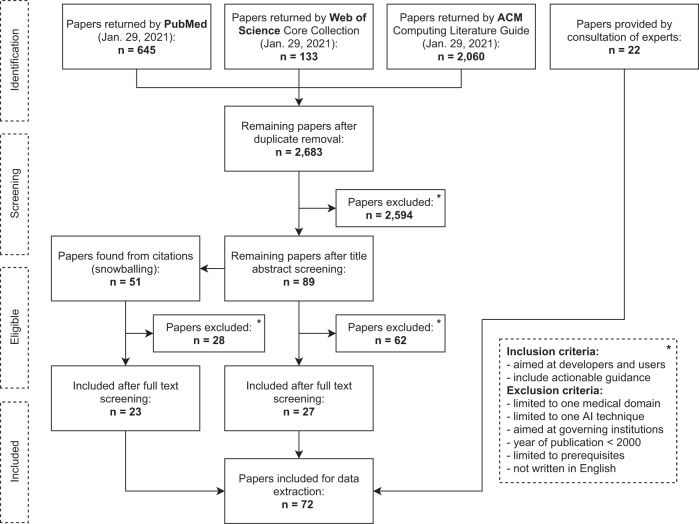
- Scoping review with a multi-stage screening strategy; searched PubMed, Web of Science, and ACM Digital Library for literature published January 2000 to January 2021, supplemented by snowballing reference lists and consultation with a convenience sample of 14 AI experts.
- Inclusion criteria: documents aimed at individuals directly involved in AIPM development, evaluation, and implementation and providing actionable guidance; exclusions included guidance limited to one medical domain or one AI technique, guidance aimed at governing institutions, pre-2000 documents, prerequisites-only guidance, and non-English documents.
- Two reviewers performed title/abstract and full-text screening, resolving conflicts by consensus; keywords extracted from included documents were mapped to phase-specific and phase-overarching topics and validated with three co-authors.
Limitations
- Stated: the definitions of “actionable” guidance and the six phases are somewhat arbitrary and mainly informed by experience; individual AIPM applications may deviate from the presented structure.
- Stated: the databases and sources mostly contain scientific literature and only English documents were included, potentially biasing results toward academic sources and English-speaking countries; this was mitigated by identifying additional gray literature through expert consultation and citation screening.
- Stated: the consulted expert group was a convenience sample predominantly working in the Netherlands, though it included different occupations, healthcare domains, and academia/industry. Evident: no formal quality appraisal or risk-of-bias assessment of the included guidance documents is reported, and the synthesis is narrative/scoping rather than quantitative.
Model-written summary. Check it against the paper before relying on it.
Integrity signals
Registry
Cites
Statistics
Figures
Verification
Claims the paper makes
42 Valid · 1 Not valid · 103 Not checked · 57 Own results and interpretations
The sources with a verdict support this claim; the rest weren’t checked yet, have no full text we could read, or their verdicts aren’t rated yet.
In the paper
“These phases are based on the predominant phases in clinical prediction model research4,5.”
§ Guidelines and quality criteria for artificial intelligence-based prediction models in healthcare: a scoping review > Introduction
What the sources say
- Supportedcites [4] Steyerberg EW Prognosis Research Strategy (PROGRESS) 3: prognostic model research PLoS Med. 2013 10 e1001381 23393430 PMC3564751 source
The Summary Points of PROGRESS 3 state that 'Prognostic model research has three main phases: model development (including internal validation), external validation, and investigations of impact in clinical practice', and that most publications describe model development with few external validation and very few impact studies; the Conclusion repeats the three-phase framing. The paper also explicitly equates prognostic models with 'risk (or clinical) prediction model' in its Introduction, so it does treat these as the predominant phases of clinical prediction model research that the citing authors' AIPM phases are said to build on. The number of citing phases (six) is the citing authors' own construction, not something attributed to this source, so no mismatch arises. (LLM, conf=0.85)
- Not checked yetcites [5] Moons KG Altman DG Vergouwe Y Royston P Prognosis and prognostic research: application and impact of prognostic models in clinical practice BMJ 2009 338 b606 19502216 source
plainstates a cause- Asserted: passes — The authors put it forward as true.
- Checkable: passes — It can be checked against evidence.
- Load-bearing: unclear — It is unclear whether the paper’s conclusions depend on it.
- Based: passes — The paper gives a reason why it holds.
- Supported
The cited sources support only part of this claim — read each source’s verdict below.
In the paper
“It should be noted that when the sample size is simply too small, even penalization methods have been shown ineffective to mitigate overfitting83,84.”
§ Guidelines and quality criteria for artificial intelligence-based prediction models in healthcare: a scoping review > Results > Phase 2. Development of the AIPM
What the sources say
- Partly supportedcites [83] Van Calster B van Smeden M De Cock B Steyerberg EW Regression shrinkage methods for clinical prediction models do not guarantee improved performance: Simulation study Stat. Methods Med. Res. 2020 29 3166 3178 32401702 sourceExperimental — accuracy not yet measured
In the section labeled 3.4 (page not available), the paper says shrinkage is particularly variable at low sample sizes and does not justify developing a model with a smaller sample. But it also says shrinkage works on average and Firth’s penalized likelihood almost surely improved performance over maximum likelihood. The claim overstates this as penalization methods being ineffective to mitigate overfitting. (LLM, conf=0.84)
- Partly supportedcites [84] Riley RD Penalization and shrinkage methods produced unreliable clinical prediction models especially when sample size was small J. Clin. Epidemiol. 2021 132 88 96 33307188 PMC8026952 sourceExperimental — accuracy not yet measured
The Summary says penalization and shrinkage are not a solution to small effective sample sizes, and the Discussion says they may be unreliable when overfitting is greatest. But the Introduction also says penalization may be effective on average; the paper does not establish that it is categorically ineffective at mitigating overfitting in small samples. (LLM, conf=0.86)
boosted- Asserted: passes — The authors put it forward as true.
- Checkable: passes — It can be checked against evidence.
- Load-bearing: unclear — It is unclear whether the paper’s conclusions depend on it.
- Based: passes — The paper gives a reason why it holds.
- Partly supported
The cited sources support only part of this claim — read each source’s verdict below.
In the paper
“Unlike discrimination and calibration, DCA derives the clinical utility from the predictive performance5,6,17,49,68,72.”
§ Guidelines and quality criteria for artificial intelligence-based prediction models in healthcare: a scoping review > Results > Phase 2. Development of the AIPM
What the sources say
- Not checked yetcites [5] Moons KG Altman DG Vergouwe Y Royston P Prognosis and prognostic research: application and impact of prognostic models in clinical practice BMJ 2009 338 b606 19502216 source
- Partly supportedcites [6] Luo W Guidelines for developing and reporting machine learning predictive models in biomedical research: a multidisciplinary view J. Med. Internet Res. 2016 18 e323 27986644 PMC5238707 sourceExperimental — accuracy not yet measured
The Results section (Table 5, item 10; page unavailable) recommends reporting clinical implications derived from predictive performance. It does not identify decision curve analysis (DCA) as the method for doing so or contrast DCA with discrimination and calibration. (LLM, conf=0.78)
- Supportedcites [17] Steyerberg EW Vergouwe Y Towards better clinical prediction models: seven steps for development and an ABCD for validation Eur. Heart J. 2014 35 1925 1931 24898551 PMC4155437 source
The Introduction’s “Decision-curve analysis” section says calibration and discrimination do not assess clinical usefulness, whereas decision thresholds and net benefit can be used to assess whether a model leads to better decisions. Table 2 identifies decision-curve analysis as the clinical-usefulness measure for model performance. (LLM, conf=0.91)
- Not checked yetcites [49] Steyerberg, E. W. Clinical Prediction Models (Springer Nature, 2009). source
- Supportedcites [68] Kappen TH Evaluating the impact of prediction models: lessons learned, challenges, and recommendations Diagn. Progn. Res. 2018 2 11 31093561 PMC6460651 source
The Background says discrimination and calibration can indicate predictive performance but do not guarantee improved clinical decisions or outcomes. In “Design of the impact study” (page unavailable), the paper explains that decision-analytic techniques estimate a model’s potential impact using predictive accuracy together with decision thresholds and other assumptions; its cited examples include decision curve analysis. This supports the distinction, provided “clinical utility” means estimated rather than demonstrated benefit. (LLM, conf=0.83)
- Supportedcites [72] Kelly CJ Karthikesalingam A Suleyman M Corrado G King D Key challenges for delivering clinical impact with artificial intelligence BMC Med. 2019 17 195 31665002 PMC6821018 source
In “Metrics often do not reflect clinical applicability” (page unavailable), the paper contrasts conventional predictive-performance measures with whether a model benefits patient care. It identifies decision curve analysis as an approach that aims to quantify the net benefit of using a model to guide actions, supporting the cited distinction. (LLM, conf=0.87)
plainstates a cause- Asserted: passes — The authors put it forward as true.
- Checkable: passes — It can be checked against evidence.
- Load-bearing: unclear — It is unclear whether the paper’s conclusions depend on it.
- Based: passes — The paper gives a reason why it holds.
The cited sources support only part of this claim — read each source’s verdict below.
In the paper
“One commonly referred strategy is feature selection13,15,27,47,76, for which it is explicitly recommended that selection should work independently of model training (unlike in methods as forward and backward selection) and is best informed - a priori - by medical expert knowledge or existing literature13,17,76.”
§ Guidelines and quality criteria for artificial intelligence-based prediction models in healthcare: a scoping review > Results > Phase 2. Development of the AIPM
What the sources say
- Supportedcites [13] Stevens LM Mortazavi BJ Deo RC Curtis L Kao DP Recommendations for reporting machine learning analyses in clinical research Circ. Cardiovasc Qual. Outcomes 2020 13 e006556 33079589 PMC8320533 source
The Feature Engineering, Selection, and Transformation section (page not provided) says that excessive variables increase spurious findings, models perform best with less redundancy, and feature selection can eliminate that redundancy. This supports the paraphrase that feature selection is a strategy for reducing overfitting risk. (LLM, conf=0.82)
- Not checked yetcites [15] Food and Drug Administration. Computer-assisted detection devices applied to radiology images and radiology device data—premarket notification [510(k)] submissions. Retrieved from https://www.fda.gov/regulatory-information/search-fda-guidance-documents/computer-assisted-detection-devices-applied-radiology-images-and-radiology-device-data-premarket (2012).
- Partly supportedcites [27] Cearns M Hahn T Baune BT Recommendations and future directions for supervised machine learning in psychiatry Transl. Psychiatry 2019 9 271 31641106 PMC6805872 sourceExperimental — accuracy not yet measured
The Model training and evaluation section recommends careful feature selection to avoid data leakage. The Future goals section explains that high-dimensional data and too many model parameters can lead to overfitting, but our copy does not explicitly describe feature selection as a commonly used strategy to prevent overfitting. (LLM, conf=0.78)
- Not checked yetcites [47] Bhaskar H Hoyle DC Singh S Machine learning in bioinformatics: a brief survey and recommendations for practitioners Comput Biol. Med. 2006 36 1104 1125 16226240 source
- Not checked yetcites [76] Aliferis CF Statnikov A Tsamardinos I Challenges in the analysis of mass-throughput data: a technical commentary from the statistical machine learning perspective Cancer Inf. 2007 2 133 162 PMC2675497 19458765
plainstates a cause- Asserted: passes — The authors put it forward as true.
- Checkable: passes — It can be checked against evidence.
- Load-bearing: unclear — It is unclear whether the paper’s conclusions depend on it.
- Based: passes — The paper gives a reason why it holds.
- Supported
The cited sources support only part of this claim — read each source’s verdict below.
In the paper
“Similar to internal validation of the AIPM, external AIPM model validation can be based on discrimination (area under the receiver operating characteristic curve, sensitivity, specificity, positive and negative predictive values), calibration (calibration plot)5,6,13,17,49,56,78, and Decision Curve Analysis5,6,17,49,68,72.”
§ Guidelines and quality criteria for artificial intelligence-based prediction models in healthcare: a scoping review > Results > Phase 3. Validation of the AIPM
What the sources say
- Not checked yetcites [5] Moons KG Altman DG Vergouwe Y Royston P Prognosis and prognostic research: application and impact of prognostic models in clinical practice BMJ 2009 338 b606 19502216 source
- Partly supportedcites [6] Luo W Guidelines for developing and reporting machine learning predictive models in biomedical research: a multidisciplinary view J. Med. Internet Res. 2016 18 e323 27986644 PMC5238707 sourceExperimental — accuracy not yet measured
The Results checklist recommends external validation when possible and lists sensitivity, specificity, predictive values, area under the ROC curve, and a calibration plot as classification validation metrics. It does not identify Decision Curve Analysis as a validation method, so that part of the claim is unsupported by this source. Page numbers are unavailable in our copy. (LLM, conf=0.87)
- Partly supportedcites [13] Stevens LM Mortazavi BJ Deo RC Curtis L Kao DP Recommendations for reporting machine learning analyses in clinical research Circ. Cardiovasc Qual. Outcomes 2020 13 e006556 33079589 PMC8320533 sourceExperimental — accuracy not yet measured
The Study Design section (Determining Measures for Evaluation; page not provided) lists ROC AUC, sensitivity and positive predictive value as supervised-model metrics and discusses calibration in external validation. The External Model Evaluation section also recommends reporting calibration where applicable. Neither passage identifies Decision Curve Analysis or a calibration plot as an external-validation method. (LLM, conf=0.86)
- Supportedcites [17] Steyerberg EW Vergouwe Y Towards better clinical prediction models: seven steps for development and an ABCD for validation Eur. Heart J. 2014 35 1925 1931 24898551 PMC4155437 source
The Introduction’s “An ABCD for model validation” section proposes measures of calibration, discrimination, and clinical usefulness and illustrates them using external validation. Table 2 identifies a calibration plot, ROC-based discrimination, and decision-curve analysis as corresponding measures. (LLM, conf=0.94)
- Not checked yetcites [49] Steyerberg, E. W. Clinical Prediction Models (Springer Nature, 2009). source
- Not checked yetcites [56] Park SH Han K Methodologic guide for evaluating clinical performance and effect of artificial intelligence technology for medical diagnosis and prediction Radiology 2018 286 800 809 29309734 source
- Not checked yetcites [78] Altman DG Vergouwe Y Royston P Moons KGM Prognosis and prognostic research: validating a prognostic model BMJ 2009 338 b605 19477892 source
- Partly supportedcites [68] Kappen TH Evaluating the impact of prediction models: lessons learned, challenges, and recommendations Diagn. Progn. Res. 2018 2 11 31093561 PMC6460651 sourceExperimental — accuracy not yet measured
In the Background section, the paper treats discrimination and calibration as measures of predictive performance in a new setting. In “Design of the impact study,” it discusses decision-analytic studies as a way to estimate the potential impact of an already validated model, not as a measure of external validation. The claim therefore folds a separate assessment into external validation. (LLM, conf=0.86)
- Partly supportedcites [72] Kelly CJ Karthikesalingam A Suleyman M Corrado G King D Key challenges for delivering clinical impact with artificial intelligence BMC Med. 2019 17 195 31665002 PMC6821018 sourceExperimental — accuracy not yet measured
The 'Metrics often do not reflect clinical applicability' section discusses ROC area, sensitivity, specificity, predictive values, and decision curve analysis as ways to assess model performance or clinical benefit. The 'Challenges in generalisation to new populations and settings' section calls for external validation. Our copy does not identify calibration or calibration plots as a basis for that validation, so it supports only part of the attributed list. (LLM, conf=0.87)
plain- Asserted: passes — The authors put it forward as true.
- Checkable: passes — It can be checked against evidence.
- Load-bearing: unclear — It is unclear whether the paper’s conclusions depend on it.
- Based: passes — The paper gives a reason why it holds.
30 more claims · 3 with their cited sources checked
Create a free account to see all 203 claims and to verify the 411 references still open.
- Probably not a substantial claim. 161
- It may state two separate claims as one. 50
Claims other papers make about this one
Each is checked against this paper’s own text: does it say what the citing paper says it does?
The source backs part of the claim, not all of it — or backs it for a different population, condition or comparison.
In the citing paper
“the clinical translation of multimodal fusion models requires rigorous validation through real-world trials, covering experimental design, data processing, modeling, testing, and safety assessment (de Hond et al., 2022).”
From Multimodal neuroimaging and AI integration in cognitive disorders: advances, challenges, and future directions for precision medicine (2026) · cites this paper as de Hond et al., 2022
Experimental — accuracy not yet measuredThe source backs part of the claim, not all of it — or backs it for a different population, condition or comparison.
In the citing paper
“As AI solutions have emerged, a wide variety of governance best practices in the form of frameworks, governance structures, checklists, and guidelines have been proposed7–23.”
From Advancing healthcare AI governance through a comprehensive maturity model based on systematic review (2026) · cites this paper as [14]
Experimental — accuracy not yet measuredThe source backs part of the claim, not all of it — or backs it for a different population, condition or comparison.
In the citing paper
“Most articles briefly addressed the importance of clear objectives for AI implementation in healthcare, with only a few offering actionable guidance9,11,14,17,21.”
From Advancing healthcare AI governance through a comprehensive maturity model based on systematic review (2026) · cites this paper as [14]
Experimental — accuracy not yet measuredThe source backs part of the claim, not all of it — or backs it for a different population, condition or comparison.
In the citing paper
“AI tools that learn from their outputs through feedback loops must be closely monitored, as unchecked adjustments can amplify errors or biases over time14,19.”
From Advancing healthcare AI governance through a comprehensive maturity model based on systematic review (2026) · cites this paper as [14]
Experimental — accuracy not yet measuredThe source backs part of the claim, not all of it — or backs it for a different population, condition or comparison.
In the citing paper
“Existing strategies for testing and evaluating AI models in the context of the workflows they are part of consist primarily of reporting guidelines and checklists that focus on the properties of the model, including performance metrics, how it will be deployed, and potential outcomes 6,7 .”
From Standing on FURM Ground: A Framework for Evaluating Fair, Useful, and Reliable AI Models in Health Care Systems (2024) · cites this paper as [7]
Experimental — accuracy not yet measured
3 more claims about this paper
Create a free account to see every claim other papers make about this one.
Citations
Cites
International Organization for Standardization
(2011) · SpringerReference · doi:10.1007/springerreference_16847 · Cited by 12,534
Arrieta, A. B., Díaz-Rodríguez, N., Del Ser, J., Bennetot, A., Tabik, S., Barbado, A., García, S., Gil-López, S., Molina, D., Benjamins, R., et al. (2019) · arXiv · doi:10.48550/arxiv.1910.10045 · Cited by 11,321 · cited 8×
“…with a possibility to discuss whether the associations on which the AIPM relies are likely to remain stable 8,27,61 , help to identify algorithmic bias 7,22,24,27,40,43 , provide information on where the AIPM could be most easily attacked 27 , or how the AIPM may behave under dataset shift 7 .”
BackgroundMethodInfluentialBarredo Arrieta, A., Díaz-Rodríguez, N., Del Ser, J., Bennetot, A., Tabik, S., Barbado, A., Garcia, S., Gil-Lopez, S., Molina, D., Benjamins, R., et al. (2020) · Information Fusion · doi:10.1016/j.inffus.2019.12.012 · Cited by 10,423 · cited 8×
“…with a possibility to discuss whether the associations on which the AIPM relies are likely to remain stable 8,27,61 , help to identify algorithmic bias 7,22,24,27,40,43 , provide information on where the AIPM could be most easily attacked 27 , or how the AIPM may behave under dataset shift 7 .”
BackgroundMethodInfluentialThe global landscape of AI ethics guidelines
Jobin, A., Ienca, M., & Vayena, E. (2019) · Nature Machine Intelligence · doi:10.1038/s42256-019-0088-2 · Cited by 6,220 · cited 1×
“This sets our review apart from other work that was previously undertaken (e.g., 32,123,124 ).”
Explanation in Artificial Intelligence: Insights from the Social Sciences
Miller, T. (2017) · arXiv · doi:10.48550/arxiv.1706.07269 · Cited by 5,338 · cited 2×
“This may be an important factor in obtaining trust and acceptance by end users (e.g., healthcare professionals and patients) 10,24,26,40,47,72,73,87 .”
BackgroundExplanation in artificial intelligence: Insights from the social sciences
Miller, T. (2019) · Artificial Intelligence · doi:10.1016/j.artint.2018.07.007 · Cited by 5,302
Key challenges for delivering clinical impact with artificial intelligence
Kelly, C. J., Karthikesalingam, A., Suleyman, M., Corrado, G., & King, D. (2019) · BMC Medicine · doi:10.1186/s12916-019-1426-2 · Cited by 3,136 · cited 9×
“…of the AIPM, external AIPM model validation can be based on discrimination (area under the receiver operating characteristic curve, sensitivity, speci fi city, positive and negative predictive values), calibration (calibration plot) 5,6,13,17,49,56,78 , and Decision Curve Analysis 5,6,17,49,68,72 .”
BackgroundMethodInfluentialCalculating the sample size required for developing a clinical prediction model
Riley, R. D., Ensor, J., Snell, K. I. E., Harrell, F. E., Martin, G. P., Reitsma, J. B., Moons, K. G. M., Collins, G., & van Smeden, M. (2020) · BMJ · doi:10.1136/bmj.m441 · Cited by 2,917 · cited 3×
“For regression-based methods 48 , and a selection of machine-learning-based methods 47 , technique-speci fi c a priori sample size calculations are available, although for many model architectures and settings (e.g., semi-supervised learning, decision trees, or convolutional neural networks) no…”
BackgroundMethodSelf-citationAntlanger, M., Aschauer, S., Kopecky, C., Hecking, M., Kovarik, J. J., Werzowa, J., Mascherbauer, J., Genser, B., Säemann, M. D., & Bonderman, D. (2017) · Kidney and Blood Pressure Research · doi:10.1159/000473868 · Cited by 2,808
Calibration: the Achilles heel of predictive analytics
On behalf of Topic Group ‘Evaluating diagnostic tests and prediction models’ of the STRATOS initiative, Van Calster, B., McLernon, D. J., van Smeden, M., Wynants, L., & Steyerberg, E. W. (2019) · BMC Medicine · doi:10.1186/s12916-019-1466-7 · Cited by 2,650 · cited 3×
“Still, AIPM updating, site-speci fi c training or recalibration might be needed to adapt an existing AIPM to a different healthcare setting 3,5,9,60,68,72 .”
BackgroundMethodSelf-citation
Research works printed but not linked: 7
- National Academy of Medicine. Artificial Intelligence In Health Care: The Hope, The Hype, The Promise, The Peril (National Academy of Medicine, 2019). 39146448
- Alonso O Challenges with label quality for supervised learning ACM J. Data Inform. Quality 2015 6 2
- Eggensperger K Lindauer M Hutter F Pitfalls and best practices in algorithm configuration J. Artif. Int. Res. 2019 64 861 893
- Kaur H Pannu HS Malhi AK A systematic review on imbalanced data challenges in machine learning: applications and solutions ACM Comput. Surv. 2019 52 1 36
- Institute of Electrical and Electronics Engineers. IEEE approved draft model process for addressing ethical concerns during system design (IEEE 7000-2021). Retrieved from https://standards.ieee.org/standard/7000-2021.html (2021).
- International Organization for Standardization. Health informatics—Personal health device communication—Part 10418: Device specialization—International Normalized Ratio (INR) monitor (ISO/IEEE 11073-10418:2014). Retrieved from https://www.iso.org/standard/61897.html (2014).
- Food and Drug Administration. Response to NIST workshop and call for position papers on standards and guidelines to enhance software supply chain security. Retrieved from https://www.fda.gov/media/149954/download (2021).
Cited by
Items 501–570 of 570
Abid, M., Jouvet, P. A., Oueslati, E., Regaieg, H., Baklouti, A., Habib, A., & Bedoui, A. (2026) · Elsevier eBooks · doi:10.1016/b978-0-443-36554-6.00005-2
Deep Learning Based Malignancy Classification of Fluid Cytology
Perween, N., Ayazi, S. F., Akhtar, N., & Ahmad, T. (2026) · IEEE International Conference on Communication Systems and Network Technologies (CSNT) · doi:10.1109/csnt69054.2026.11502200
“To address these limitations, cross-validation (CV) was used, in which the model is trained and evaluated across multiple data splits while retaining an independent test set for the final performance evaluation [6], [7].”
A physiology-guided temporal graph learning approach for intensive care mortality prediction
Joseph, J., & Judy, M. V. (2026) · Healthcare Analytics · doi:10.1016/j.health.2026.100467 · Cited by 1
What is artificial intelligence doing to emergency medicine? From hype to real‐world impact
Ng, Y. Y. (2026) · Hong Kong Journal of Emergency Medicine · doi:10.1002/hkj2.70102
Kazem, I. J., Al-Rubaie, M. D., & Radhi, A. G. (2026) · Sustainable civil infrastructures · doi:10.1007/978-3-032-17918-0_33
de Kanter, E., Idema, D. L., Hooft, L., Moons, K. G. M., Vernooij, R. W. M., Schuit, E., & Damen, J. A. (2026) · BMJ Evidence-Based Medicine · doi:10.1136/bmjebm-2025-114164
Self-citationPawuś, D., Porażko, T., Paszkiel, S., & Kułakowska, A. (2026) · Expert Systems with Applications · doi:10.1016/j.eswa.2026.133084
Ghane, M., Elmore, M., Dankwa‐Mullan, I., Stapleton, S., Owens, K., Khalid, S., Delonay, A., Youssef, A., Chisunka, M., Rariy, C., et al. (2026) · The American Journal of Bioethics · doi:10.1080/15265161.2026.2677391
“Cross-validation routines can help surface hidden bias by revealing disparities in performance between subgroups and the full population (de Hond et al. 2022).”
Visconti-Lopez, F. J., & Lozada-Martínez, I. D. (2026) · Medical Education & Clinical Practice · doi:10.21142/mecp.2026.1.2.e017
“Measure clinician interaction effects, including automation bias and alert fatigue risk, using predefined process measures [35,36] .”
Assuring AI safety for managing risk of myocardial infarction for patients with type 2 diabetes
Ozturk, B. (2026) · White Rose eTheses Online (University of Leeds, The University of Sheffield, University of York)
Virtual twins and the future of human developmental biology
Chakra, M. A., & Shakiba, N. (2026) · npj Systems Biology and Applications · doi:10.1038/s41540-026-00771-7
“Black-boxmodels, traditionally statistical, nowleverage machine learning and deep learning methods such as deep neural networks, random forests to recognize complex patterns in large datasets 31 .”
Wei, Q., Cui, M., Qi, Y., Zhang, Q., Liu, Z., Yu, C., Hobbs, F. D. R., Christiani, D. C., Li, Y., Zhang, R., et al. (2026) · The Innovation Medicine · doi:10.59717/j.xinn-med.2026.100229
Chen, S. Y., Song, R., Zeng, P., Chen, Y., Li, X., Wen, B., Gong, Z., Xiaocong, Z., Kanazawa, M., Ivanovski, S., et al. (2026) · Journal of Oral Rehabilitation · doi:10.1111/joor.70250
Uribe, S. E., Carrasco‐Labra, A., Schwendicke, F., & Maldupa, I. (2026) · Caries Research · doi:10.1159/000553309
Almudaimeegh, L., Nazeer, N., Hamd, Z. Y., Alharbi, M., Ahmed, A. M., & Sadikan, M. Z. (2026) · Diagnostics · doi:10.3390/diagnostics16142261
Diagnosis of Portal Hypertension: Advancing Towards Non‐Invasive Solutions
Yin, L., Chu, H., & Yang, L. (2026) · Portal hypertension & cirrhosis · doi:10.1002/poh2.70060
Causality-Informed Machine Learning for ICU Length of Stay Prediction: A Healthcare Case Study
Chen, X., Xu, R., Liu, Y., Huang, W., Huang, M., Chen, W., & Xie, S. (2026) · Communications in computer and information science · doi:10.1007/978-981-95-8447-5_12
Cao, S., Cheng, J., Wang, F., Yi, C., Chen, J., Wang, K., Liu, L., Liu, J., & Li, Y. (2026) · Advanced Science · doi:10.1002/advs.76983
Shukla, S., & Barboi, C. (2026) · IEEE International Conference on Healthcare Informatics (ICHI) · doi:10.1109/ichi69079.2026.00056
A Practice Maturity Model for Moving from Digital Tools to Intelligence-Augmented Pharmacy
Mendoza, R., Cruz, I., & Lopez, C. (2025) · Archives of Pharmacy Practice · doi:10.51847/cfwu1qml8w
Ramirez, C., Torres, E., Ortega, P., & Mendes, S. (2026) · International Journal Of Pharmaceutical Research And Allied Sciences · doi:10.51847/ppht0m5a9h
Larsson, S., Johansson, E., Nilsson, A., & Andersson, L. (2026) · International Journal Of Pharmaceutical Research And Allied Sciences · doi:10.51847/tqergeaspd
Unified deep learning-based multi-dimensional quality evaluation framework for web applications
Alharbi, I. M. (2026) · Automated Software Engineering · doi:10.1007/s10515-026-00662-5
“In particular, transformer architectures have made great strides in the under - standing and detection of source code vulnerabilities by learning representations of code in context (de Hond et al. 2022).”
Liu, P. (2026) · International Conference on Bioinformatics and Intelligent Computing (BIC) · doi:10.1145/3809986.3810053
Hu, H., Ran, L. I., Yin, Y., Liu, Y., & Wang, X. (2026) · Frontiers in Industrial Engineering · doi:10.3389/fieng.2026.1854270
Kon, T. (2026) · Congenital Anomalies · doi:10.1002/cga.70074
“…such models should be regarded as screening or prioritization tools rather than standalone clinical tests, and their future use will require larger and more representative datasets, independent external validation, interpretable outputs, and careful evaluation of false-negative predictions [177].”
Korni, A., & Zandi, E. (2026) · Journal of Experimental Neurology · doi:10.33696/neurol.7.131 · Cited by 1
Rahim, A. A. A., Abdullah, N. E., Shauri, R. L. A., & Janin, Z. (2026) · IEEE International Conference on Innovation, Ethics & Emerging Tech in Engineering and Computing Education (IE2C) · doi:10.1109/ie2c69620.2026.11663032
Algorithmic Legibility and Gendered Epistemic Injustice in AI-Driven Workplace Wellness Systems
Chaturvedi, L., & Singh, A. R. (2026) · Advances in computational intelligence and robotics book series · doi:10.4018/979-8-2600-1232-1.ch006
Song, W., Singh, S., Xiang, W., Baldyga, K., Stevens, K., Qi, W., Matsubara, J. K., Ge, C., Deng, H., Kim, J.-E., et al. (2026) · Molecular Psychiatry · doi:10.1038/s41380-026-03825-8
Huy, N. T., Minh, P. Q., & Bich, L. T. (2022) · Journal of Health Informatics and Digital Systems · doi:10.68159/h117919361
Designing a Scalable Governance Architecture for AI-Enabled Telehealth and Remote Monitoring
Walker, J., & Harris, O. (2025) · Journal of Artificial Intelligence for Healthcare Systems · doi:10.68159/c663699676
Population Health Analytics Infrastructures: AI System Architectures and Governance Models
Meyer, L., Schmid, A., & Kumar, R. (2024) · Journal of Artificial Intelligence for Healthcare Systems · doi:10.68159/g777760419
Temporal and cross-site validation of an AI system for self-harm detection
Rozova, V. S., Chen, L., Witt, K., Conway, M., Robinson, J., & Verspoor, K. M. (2026) · PLOS Digital Health · doi:10.1371/journal.pdig.0001667
“The majority advise validating the candidate model in a new healthcare setting or on data from a different period [34].”
Challenges in clinical translation of laboratory discoveries of tissue engineered products
Mathur, R., Singh, S., Dahiya, D., Mangal, P., Varshney, R., & Sony, S. (2026) · Elsevier eBooks · doi:10.1016/b978-0-443-33455-9.00034-1
Huang, J., Lin, Y., Wang, Q., & Chen, J. (2026) · SSRN Electronic Journal · doi:10.2139/ssrn.7438210
Predicting phase 3 clinical trial outcomes with an evidence-driven large language model
Zhang, W., Meng, X., Jia, X., Yu, E., Lan, J., Wang, T., Chen, G., Guo, Y., Liu, Y., Chu, X., et al. (2026) · The Innovation · doi:10.1016/j.xinn.2026.101574
Qiu, H., Zhuang, L., Dai, J., Shi, Q., Ding, L., & Qiu, W. (2026) · Translational Pediatrics · doi:10.21037/tp-2026-0650
Malini, K. P., Srikanth, M., & Vijayasimha, M. (2026) · Journal of Hospital Infection · doi:10.1016/j.jhin.2026.09.016
Multifaceted Applications of Artificial Intelligence in Vascular Surgery
Lareyre, F., Pena, G., & Raffort, J. (2026) · Springer eBooks · doi:10.1007/978-3-032-31459-8_15
Hu, Q., Yang, Z., Xiang, L., Lu, Q., Duan, X., Bian, H., Feng, J., Xiao, J., & Chen, X. (2026) · Pediatric Surgery International · doi:10.1007/s00383-026-06655-5
Metabolomics for Athlete Monitoring: An Evidence-Readiness Framework for Contextual Validation
Lin, D., Chen, Y., Huang, C., & Zou, Z. (2026) · Metabolites · doi:10.3390/metabo16100704
Sguanci, M. E., Palomares, S. M., Petrelli, F., Sandri, E., Ferrara, G., Mancin, S., & Cangelosi, G. (2026) · Advances in Nutrition · doi:10.1016/j.advnut.2026.100740
Analyzing Attention Patterns in Children with ADHD through Interaction Data from Educational Games
Hai, D. M., & Minh, H. T. H. (2026) · International Journal of Artificial Intelligence and Machine Learning · doi:10.51483/ijaiml.6.10s.2026.1500-1511
Silva, M., Santos, B., Pinto, R., & Teixeira, L. (2026) · Journal of Health Informatics and Digital Systems · doi:10.68159/f309521630
Ma, Y., Achiche, S., Lessard, D., Engler, K., Vicente, S., Tu, G., Lemire, B., Balso, L. D., Paisible, N., & Lebouché, B. (2026) · JAMIA Open · doi:10.1093/jamiaopen/ooag169
Artificial Intelligence in European Healthcare
Cole-Hunter, T., Abboud, L., Knottnerus, J. A., Martí-Bonmatí, L., Barua, I., Boman, M., Fialová, E., Mihalaş, G., Komadina, R., Korja, M., et al. (2026) · doi:10.1553/easac-feam_report_ai-in-healthcare_2026
Self-citationHong, Y., Hu, W., Tang, J., & Xiong, F. (2026) · Frontiers in Neurology · doi:10.3389/fneur.2026.1837085
Nyatuka, D. R., Macharia, P. M., Kakhata, E., Siva, F., Muriithi, B., & Jabin, M. S. R. (2026) · Research Square · doi:10.21203/rs.3.rs-10792831/v1
Hasani, N., Hamid, M., & Nasiri, M. M. (2026) · Human Factors and Ergonomics in Manufacturing & Service Industries · doi:10.1002/hfm.70063
Sikandar, Ali, J., Akhtar, B., Raza, A., & Hamza, T. (2026) · Pakistan Journal of Medical & Cardiological Review · doi:10.66021/pakmcr1280
Barkaoui, A., Bettaibi, S., Ouldasine, R., Jamart‐Grégoire, B., & Ezbakhe, A. (2026) · Discover Education · doi:10.1007/s44217-026-02069-6
Adeoye, J., & Su, Y.-X. (2026) · Oral and Maxillofacial Surgery Clinics of North America · doi:10.1016/j.coms.2026.09.001
An analytics framework for timing-aware evaluation of prediction-triggered clinical alerts
Toffaha, K. M., de Saad, A. M. S., Simsekler, M. C. E., Kortt, M. A., & Chapman, J. (2026) · Healthcare Analytics · doi:10.1016/j.health.2026.100504
Köse, A., & Çiftçi, B. (2026) · World Journal of Psychiatry · doi:10.5498/wjp.126199
Pasaleron, R., Wira, A., Remiswal, R., Darmansyah, D., Samad, D., Rehani, R., Sabri, A., & Bara, J. B. (2026) · GHAITSA Islamic Education Journal · doi:10.62159/ghaitsa.v7i3.2812
“Data collection is carried out in stages according to the stages of development research to obtain information regarding the needs, validity, practicality and effectiveness of the Model (Haakman et al., 2021; de Hond et al., 2022) .”
Kakamad, K. K., Aminifar, S. A., Muhamad, S. S., Abd, M. H. M., Jader, R. F., & Ahmed, J. O. (2026) · International Journal of Fuzzy Systems · doi:10.1007/s40815-026-02353-5
Li, F., Fu, K., Zhou, S., Gong, Z., Du, C., Zhao, Y., Yang, W., Zhang, C., Zhou, W., & Li, W. (2026) · Brain and Behavior · doi:10.1002/brb3.71869
“Patients were divided into the hydrocephalus group and the non-hydrocephalus group according to whether they met the above endpoint within 3 weeks after aneurysm treatment (de Hond et al. 2022 ; Panciani et al. 2025 ; Eide et al. 2020 ).”
Song, Y., Wu, B., & Song, Y. (2026) · Physiological Measurement · doi:10.1088/1361-6579/aebae2
Stroke‐Heart Syndrome: Mechanisms, Temporal Phenotypes, and Diagnostic Reasoning
Lin, F., Lyu, J., Liu, Y., Feng, Z., Bao, J., Song, W., Zhu, B., Liu, M., Xue, J., Weng, J., et al. (2026) · Advanced Science · doi:10.1002/advs.78548
Kırmacı, Y. Ş., & Uzun, A. (2026) · Bidge Yayınları eBooks · doi:10.70269/10.70269/4332628192
Ramachandran, R., Muthusamy, A., Balaji, C., & Gupta, S. K. (2026) · Scientific Reports · doi:10.1038/s41598-026-72522-x
Lv, H., Chen, Y., Ren, Q., Liu, S., peng, X., Chen, C., & Zhang, Y. (2026) · Mathematics · doi:10.3390/math14213978
Clinical Explainable AI as Evidence: Quantifying Claim–Evidence Gaps and a Practical Audit
Frez, J., Baloian, N. A., & Ahumada, L. (2026) · doi:10.1109/codassca69992.2026.00030
Bulbul, N., Çiftçi, R., Atık, İ., Eken, Ö., Weiss, K., Rosemann, T. J., & Knechtle, B. (2026) · Life · doi:10.3390/life16111877
Okoye, G. C., Bolaji, P., Aderinto, N., Akinsulire, D., Ighodaro, O. T., & Olawade, D. B. (2026) · Brain Hemorrhages · doi:10.1016/j.hest.2026.11.002
Kim, Y., & Park, J. (2026) · Medical Sciences · doi:10.3390/medsci14070766
Artificial Intelligence for sepsis prediction: A review of real-world clinical implementation
Ashok, A., Maćešić, N., & Peleg, A. Y. (2026) · Clinical Microbiology and Infection · doi:10.1016/j.cmi.2026.10.036
Impact of Healthcare Applications in AI Systems
Kalal, D., & Roy, S. C. (2026) · doi:10.1109/icssetes69816.2026.11764150
Metadata
- Authors
- de Hond, A. A. H., Leeuwenberg, A. M., Hooft, L., Kant, I. M. J., Nijman, S. W. J., van Os, H. J. A., Aardoom, J. J., Debray, T. P. A., Schuit, E., van Smeden, M., Reitsma, J. B., Steyerberg, E. W., Chavannes, N. H., & Moons, K. G. M.
- Affiliations
- Utrecht University (NL)
- Leiden University Medical Center (NL)
- Corresponding author
- Leeuwenberg, Artuur M.
- ORCID
- Venue
- npj Digital Medicine
- Published
- 2022-01-10
- Volume
- 5
- Issue
- 1
- Pages
- 2-2
- ISSN
- 2398-6352 (ISSN-L)
- PMC
- PMC8748878
- OpenAlex
- W4205805845
- Cited by
- 499
- References
- 71
- Citations by year
- 2026: 93 · 2025: 127 · 2024: 136 · 2023: 105 · 2022: 38
- FWCI
- 6.97
- Type
- journal article
- Language
- en
- Open access
- gold
- doi.org
- Licence
- cc-by
- creativecommons.org/licenses/by/4.0 (tdm)
- creativecommons.org/licenses/by/4.0 (vor)
- Locations
- npj Digital Medicine (publishedVersion, cc-by)
- PubMed Central (publishedVersion, cc-by)
- PubMed (publishedVersion)
- Leiden Repository (Leiden University) (submittedVersion, cc-by)
- Data Archiving and Networked Services (DANS) (submittedVersion, cc-by)
- DOAJ (DOAJ: Directory of Open Access Journals) (submittedVersion, cc-by-sa)
- Utrecht University Repository (Utrecht University) (submittedVersion, other-oa)
- Funders
- This research was funded by the Ministry of Health, Welfare and Sport.
- Topics
- Health Sciences › Medicine › Health Informatics › Artificial Intelligence in Healthcare and Education
- Health Sciences › Health Professions › Health Information Management › Artificial Intelligence in Healthcare
- Physical Sciences › Computer Science › Artificial Intelligence › Machine Learning in Healthcare
- Keywords
- machine learning in healthcare, quality standards, clinical implementation, model validation, data preparation, impact assessment, responsible AI adoption, clinical decision support, software development
About these checks
Registry, retraction, Cites and statistics results are computed, not judged, with one exception: a printed reference that no index lists is read once by a model before it counts as a citation error. Claims are extracted by a model and kept only when their quote appears verbatim in the text; each cited source is then checked, with a model’s help, for whether it says what the claim relies on. Those verdicts can be wrong — read the claim’s quote and the cited source before relying on one.
The claim verdicts this report counts are experimental: their accuracy is not yet measured.
A language model drew the claims from the paper on 2026-10-05, under version 3 of the claim definition (model deepseek-v4.1-flash, prompt extract-v3).
A second model labelled each claim on 2026-10-05 (model jev-1.13-20260917, definition revision gold-guideline-v0.2).
Cited sources are checked with a language model’s help (qwen3.8-omni-flash and gpt-6-sol).
Statistics and arithmetic are recomputed, not judged.
Confidence bands are shown only for fields calibrated on our annotated test set. None is calibrated yet, so no band is shown.
What counts as a claim ›How we measure confidence ›How we check this ›
Are you an author, or do you see a problem with this page? Request a review
Data sources
Bibliographic data: Semantic Scholar, OpenAlex, Crossref.
Contains information from the Semantic Scholar Academic Graph Datasets, made available under the ODC Attribution License (ODC-BY 1.0).
Semantic Scholar’s data is described in: Kinney, R., et al. (2023). The Semantic Scholar Open Data Platform. arXiv:2301.10140.
