

Guidelines and quality criteria for artificial intelligence-based prediction models in healthcare: a scoping review
Open accessThe DOI matches its Crossref record; 77 of the 77 references it cites were found in a registry or an index; 108 of the 519 sources its claims cite were checked for support.
Abstract
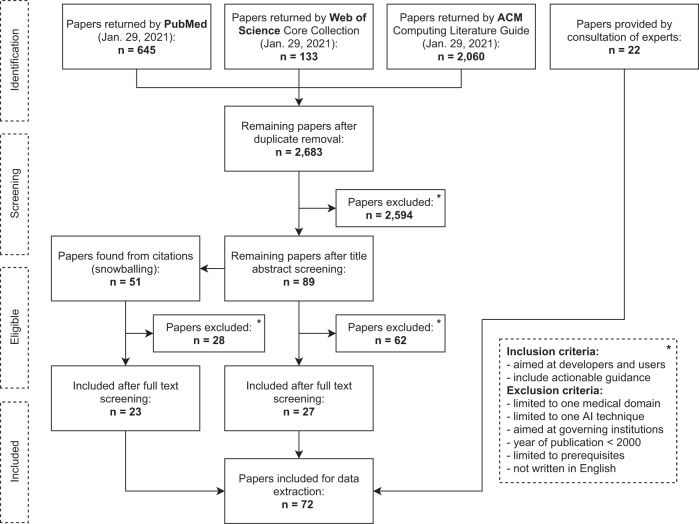
While the opportunities of ML and AI in healthcare are promising, the growth of complex data-driven prediction models requires careful quality and applicability assessment before they are applied and disseminated in daily practice. This scoping review aimed to identify actionable guidance for those closely involved in AI-based prediction model (AIPM) development, evaluation and implementation including software engineers, data scientists, and healthcare professionals and to identify potential gaps in this guidance. We performed a scoping review of the relevant literature providing guidance or quality criteria regarding the development, evaluation, and implementation of AIPMs using a comprehensive multi-stage screening strategy. PubMed, Web of Science, and the ACM Digital Library were searched, and AI experts were consulted. Topics were extracted from the identified literature and summarized across the six phases at the core of this review: (1) data preparation, (2) AIPM development, (3) AIPM validation, (4) software development, (5) AIPM impact assessment, and (6) AIPM implementation into daily healthcare practice. From 2683 unique hits, 72 relevant guidance documents were identified. Substantial guidance was found for data preparation, AIPM development and AIPM validation (phases 1–3), while later phases clearly have received less attention (software development, impact assessment and implementation) in the scientific literature. The six phases of the AIPM development, evaluation and implementation cycle provide a framework for responsible introduction of AI-based prediction models in healthcare. Additional domain and technology specific research may be necessary and more practical experience with implementing AIPMs is needed to support further guidance.
Overview
CoChat Summary
TL;DR
This scoping review identified 72 guidance documents and mapped their recommendations to six phases of the AI-based prediction model lifecycle, from data preparation through implementation. It found substantial guidance for data preparation, development, and validation but less for software development, impact assessment, and implementation, and highlights remaining gaps.
Key findings
- From 2683 unique hits, 72 relevant guidance documents were included; data extraction yielded 138 keywords mapped to 27 phase-specific topics and 6 phase-overarching topics.
- Substantial guidance was found for phases 1–3 (data preparation, AIPM development, AIPM validation), while later phases—software development, impact assessment, and implementation—received clearly less attention in the scientific literature.
- The review provides a six-phase framework for responsible AIPM introduction and identifies gaps including missing a priori sample size guidance for semi-supervised learning, decision trees/random forests, and convolutional neural networks; limited guidance on combining data sources/modalities, non-binary outcomes, AIPM-specific human–AI interaction, workflow integration, cost-effectiveness, accountability, and long-term maintenance/dataset shift.
- Phase-overarching topics included algorithmic bias, transparency and openness, interpretability, team/stakeholders, security, and risks.
Methods
- Scoping review with a multi-stage screening strategy; searched PubMed, Web of Science, and ACM Digital Library for literature published January 2000 to January 2021, supplemented by snowballing reference lists and consultation with a convenience sample of 14 AI experts.
- Inclusion criteria: documents aimed at individuals directly involved in AIPM development, evaluation, and implementation and providing actionable guidance; exclusions included guidance limited to one medical domain or one AI technique, guidance aimed at governing institutions, pre-2000 documents, prerequisites-only guidance, and non-English documents.
- Two reviewers performed title/abstract and full-text screening, resolving conflicts by consensus; keywords extracted from included documents were mapped to phase-specific and phase-overarching topics and validated with three co-authors.
Limitations
- Stated: the definitions of “actionable” guidance and the six phases are somewhat arbitrary and mainly informed by experience; individual AIPM applications may deviate from the presented structure.
- Stated: the databases and sources mostly contain scientific literature and only English documents were included, potentially biasing results toward academic sources and English-speaking countries; this was mitigated by identifying additional gray literature through expert consultation and citation screening.
- Stated: the consulted expert group was a convenience sample predominantly working in the Netherlands, though it included different occupations, healthcare domains, and academia/industry. Evident: no formal quality appraisal or risk-of-bias assessment of the included guidance documents is reported, and the synthesis is narrative/scoping rather than quantitative.
Model-written summary. Check it against the paper before relying on it.
Integrity signals
Registry
Cites
Statistics
Figures
Verification
Claims the paper makes
42 Valid · 1 Not valid · 103 Not checked · 57 Own results and interpretations
The sources with a verdict support this claim; the rest weren’t checked yet, have no full text we could read, or their verdicts aren’t rated yet.
In the paper
“These phases are based on the predominant phases in clinical prediction model research4,5.”
§ Guidelines and quality criteria for artificial intelligence-based prediction models in healthcare: a scoping review > Introduction
What the sources say
- Supportedcites [4] Steyerberg EW Prognosis Research Strategy (PROGRESS) 3: prognostic model research PLoS Med. 2013 10 e1001381 23393430 PMC3564751 source
The Summary Points of PROGRESS 3 state that 'Prognostic model research has three main phases: model development (including internal validation), external validation, and investigations of impact in clinical practice', and that most publications describe model development with few external validation and very few impact studies; the Conclusion repeats the three-phase framing. The paper also explicitly equates prognostic models with 'risk (or clinical) prediction model' in its Introduction, so it does treat these as the predominant phases of clinical prediction model research that the citing authors' AIPM phases are said to build on. The number of citing phases (six) is the citing authors' own construction, not something attributed to this source, so no mismatch arises. (LLM, conf=0.85)
- Not checked yetcites [5] Moons KG Altman DG Vergouwe Y Royston P Prognosis and prognostic research: application and impact of prognostic models in clinical practice BMJ 2009 338 b606 19502216 source
plainstates a cause- Asserted: passes — The authors put it forward as true.
- Checkable: passes — It can be checked against evidence.
- Load-bearing: unclear — It is unclear whether the paper’s conclusions depend on it.
- Based: passes — The paper gives a reason why it holds.
- Supported
The cited sources support only part of this claim — read each source’s verdict below.
In the paper
“It should be noted that when the sample size is simply too small, even penalization methods have been shown ineffective to mitigate overfitting83,84.”
§ Guidelines and quality criteria for artificial intelligence-based prediction models in healthcare: a scoping review > Results > Phase 2. Development of the AIPM
What the sources say
- Partly supportedcites [83] Van Calster B van Smeden M De Cock B Steyerberg EW Regression shrinkage methods for clinical prediction models do not guarantee improved performance: Simulation study Stat. Methods Med. Res. 2020 29 3166 3178 32401702 sourceExperimental — accuracy not yet measured
In the section labeled 3.4 (page not available), the paper says shrinkage is particularly variable at low sample sizes and does not justify developing a model with a smaller sample. But it also says shrinkage works on average and Firth’s penalized likelihood almost surely improved performance over maximum likelihood. The claim overstates this as penalization methods being ineffective to mitigate overfitting. (LLM, conf=0.84)
- Partly supportedcites [84] Riley RD Penalization and shrinkage methods produced unreliable clinical prediction models especially when sample size was small J. Clin. Epidemiol. 2021 132 88 96 33307188 PMC8026952 sourceExperimental — accuracy not yet measured
The Summary says penalization and shrinkage are not a solution to small effective sample sizes, and the Discussion says they may be unreliable when overfitting is greatest. But the Introduction also says penalization may be effective on average; the paper does not establish that it is categorically ineffective at mitigating overfitting in small samples. (LLM, conf=0.86)
boosted- Asserted: passes — The authors put it forward as true.
- Checkable: passes — It can be checked against evidence.
- Load-bearing: unclear — It is unclear whether the paper’s conclusions depend on it.
- Based: passes — The paper gives a reason why it holds.
- Partly supported
The cited sources support only part of this claim — read each source’s verdict below.
In the paper
“Unlike discrimination and calibration, DCA derives the clinical utility from the predictive performance5,6,17,49,68,72.”
§ Guidelines and quality criteria for artificial intelligence-based prediction models in healthcare: a scoping review > Results > Phase 2. Development of the AIPM
What the sources say
- Not checked yetcites [5] Moons KG Altman DG Vergouwe Y Royston P Prognosis and prognostic research: application and impact of prognostic models in clinical practice BMJ 2009 338 b606 19502216 source
- Partly supportedcites [6] Luo W Guidelines for developing and reporting machine learning predictive models in biomedical research: a multidisciplinary view J. Med. Internet Res. 2016 18 e323 27986644 PMC5238707 sourceExperimental — accuracy not yet measured
The Results section (Table 5, item 10; page unavailable) recommends reporting clinical implications derived from predictive performance. It does not identify decision curve analysis (DCA) as the method for doing so or contrast DCA with discrimination and calibration. (LLM, conf=0.78)
- Supportedcites [17] Steyerberg EW Vergouwe Y Towards better clinical prediction models: seven steps for development and an ABCD for validation Eur. Heart J. 2014 35 1925 1931 24898551 PMC4155437 source
The Introduction’s “Decision-curve analysis” section says calibration and discrimination do not assess clinical usefulness, whereas decision thresholds and net benefit can be used to assess whether a model leads to better decisions. Table 2 identifies decision-curve analysis as the clinical-usefulness measure for model performance. (LLM, conf=0.91)
- Not checked yetcites [49] Steyerberg, E. W. Clinical Prediction Models (Springer Nature, 2009). source
- Supportedcites [68] Kappen TH Evaluating the impact of prediction models: lessons learned, challenges, and recommendations Diagn. Progn. Res. 2018 2 11 31093561 PMC6460651 source
The Background says discrimination and calibration can indicate predictive performance but do not guarantee improved clinical decisions or outcomes. In “Design of the impact study” (page unavailable), the paper explains that decision-analytic techniques estimate a model’s potential impact using predictive accuracy together with decision thresholds and other assumptions; its cited examples include decision curve analysis. This supports the distinction, provided “clinical utility” means estimated rather than demonstrated benefit. (LLM, conf=0.83)
- Supportedcites [72] Kelly CJ Karthikesalingam A Suleyman M Corrado G King D Key challenges for delivering clinical impact with artificial intelligence BMC Med. 2019 17 195 31665002 PMC6821018 source
In “Metrics often do not reflect clinical applicability” (page unavailable), the paper contrasts conventional predictive-performance measures with whether a model benefits patient care. It identifies decision curve analysis as an approach that aims to quantify the net benefit of using a model to guide actions, supporting the cited distinction. (LLM, conf=0.87)
plainstates a cause- Asserted: passes — The authors put it forward as true.
- Checkable: passes — It can be checked against evidence.
- Load-bearing: unclear — It is unclear whether the paper’s conclusions depend on it.
- Based: passes — The paper gives a reason why it holds.
The cited sources support only part of this claim — read each source’s verdict below.
In the paper
“One commonly referred strategy is feature selection13,15,27,47,76, for which it is explicitly recommended that selection should work independently of model training (unlike in methods as forward and backward selection) and is best informed - a priori - by medical expert knowledge or existing literature13,17,76.”
§ Guidelines and quality criteria for artificial intelligence-based prediction models in healthcare: a scoping review > Results > Phase 2. Development of the AIPM
What the sources say
- Supportedcites [13] Stevens LM Mortazavi BJ Deo RC Curtis L Kao DP Recommendations for reporting machine learning analyses in clinical research Circ. Cardiovasc Qual. Outcomes 2020 13 e006556 33079589 PMC8320533 source
The Feature Engineering, Selection, and Transformation section (page not provided) says that excessive variables increase spurious findings, models perform best with less redundancy, and feature selection can eliminate that redundancy. This supports the paraphrase that feature selection is a strategy for reducing overfitting risk. (LLM, conf=0.82)
- Not checked yetcites [15] Food and Drug Administration. Computer-assisted detection devices applied to radiology images and radiology device data—premarket notification [510(k)] submissions. Retrieved from https://www.fda.gov/regulatory-information/search-fda-guidance-documents/computer-assisted-detection-devices-applied-radiology-images-and-radiology-device-data-premarket (2012).
- Partly supportedcites [27] Cearns M Hahn T Baune BT Recommendations and future directions for supervised machine learning in psychiatry Transl. Psychiatry 2019 9 271 31641106 PMC6805872 sourceExperimental — accuracy not yet measured
The Model training and evaluation section recommends careful feature selection to avoid data leakage. The Future goals section explains that high-dimensional data and too many model parameters can lead to overfitting, but our copy does not explicitly describe feature selection as a commonly used strategy to prevent overfitting. (LLM, conf=0.78)
- Not checked yetcites [47] Bhaskar H Hoyle DC Singh S Machine learning in bioinformatics: a brief survey and recommendations for practitioners Comput Biol. Med. 2006 36 1104 1125 16226240 source
- Not checked yetcites [76] Aliferis CF Statnikov A Tsamardinos I Challenges in the analysis of mass-throughput data: a technical commentary from the statistical machine learning perspective Cancer Inf. 2007 2 133 162 PMC2675497 19458765
plainstates a cause- Asserted: passes — The authors put it forward as true.
- Checkable: passes — It can be checked against evidence.
- Load-bearing: unclear — It is unclear whether the paper’s conclusions depend on it.
- Based: passes — The paper gives a reason why it holds.
- Supported
The cited sources support only part of this claim — read each source’s verdict below.
In the paper
“Similar to internal validation of the AIPM, external AIPM model validation can be based on discrimination (area under the receiver operating characteristic curve, sensitivity, specificity, positive and negative predictive values), calibration (calibration plot)5,6,13,17,49,56,78, and Decision Curve Analysis5,6,17,49,68,72.”
§ Guidelines and quality criteria for artificial intelligence-based prediction models in healthcare: a scoping review > Results > Phase 3. Validation of the AIPM
What the sources say
- Not checked yetcites [5] Moons KG Altman DG Vergouwe Y Royston P Prognosis and prognostic research: application and impact of prognostic models in clinical practice BMJ 2009 338 b606 19502216 source
- Partly supportedcites [6] Luo W Guidelines for developing and reporting machine learning predictive models in biomedical research: a multidisciplinary view J. Med. Internet Res. 2016 18 e323 27986644 PMC5238707 sourceExperimental — accuracy not yet measured
The Results checklist recommends external validation when possible and lists sensitivity, specificity, predictive values, area under the ROC curve, and a calibration plot as classification validation metrics. It does not identify Decision Curve Analysis as a validation method, so that part of the claim is unsupported by this source. Page numbers are unavailable in our copy. (LLM, conf=0.87)
- Partly supportedcites [13] Stevens LM Mortazavi BJ Deo RC Curtis L Kao DP Recommendations for reporting machine learning analyses in clinical research Circ. Cardiovasc Qual. Outcomes 2020 13 e006556 33079589 PMC8320533 sourceExperimental — accuracy not yet measured
The Study Design section (Determining Measures for Evaluation; page not provided) lists ROC AUC, sensitivity and positive predictive value as supervised-model metrics and discusses calibration in external validation. The External Model Evaluation section also recommends reporting calibration where applicable. Neither passage identifies Decision Curve Analysis or a calibration plot as an external-validation method. (LLM, conf=0.86)
- Supportedcites [17] Steyerberg EW Vergouwe Y Towards better clinical prediction models: seven steps for development and an ABCD for validation Eur. Heart J. 2014 35 1925 1931 24898551 PMC4155437 source
The Introduction’s “An ABCD for model validation” section proposes measures of calibration, discrimination, and clinical usefulness and illustrates them using external validation. Table 2 identifies a calibration plot, ROC-based discrimination, and decision-curve analysis as corresponding measures. (LLM, conf=0.94)
- Not checked yetcites [49] Steyerberg, E. W. Clinical Prediction Models (Springer Nature, 2009). source
- Not checked yetcites [56] Park SH Han K Methodologic guide for evaluating clinical performance and effect of artificial intelligence technology for medical diagnosis and prediction Radiology 2018 286 800 809 29309734 source
- Not checked yetcites [78] Altman DG Vergouwe Y Royston P Moons KGM Prognosis and prognostic research: validating a prognostic model BMJ 2009 338 b605 19477892 source
- Partly supportedcites [68] Kappen TH Evaluating the impact of prediction models: lessons learned, challenges, and recommendations Diagn. Progn. Res. 2018 2 11 31093561 PMC6460651 sourceExperimental — accuracy not yet measured
In the Background section, the paper treats discrimination and calibration as measures of predictive performance in a new setting. In “Design of the impact study,” it discusses decision-analytic studies as a way to estimate the potential impact of an already validated model, not as a measure of external validation. The claim therefore folds a separate assessment into external validation. (LLM, conf=0.86)
- Partly supportedcites [72] Kelly CJ Karthikesalingam A Suleyman M Corrado G King D Key challenges for delivering clinical impact with artificial intelligence BMC Med. 2019 17 195 31665002 PMC6821018 sourceExperimental — accuracy not yet measured
The 'Metrics often do not reflect clinical applicability' section discusses ROC area, sensitivity, specificity, predictive values, and decision curve analysis as ways to assess model performance or clinical benefit. The 'Challenges in generalisation to new populations and settings' section calls for external validation. Our copy does not identify calibration or calibration plots as a basis for that validation, so it supports only part of the attributed list. (LLM, conf=0.87)
plain- Asserted: passes — The authors put it forward as true.
- Checkable: passes — It can be checked against evidence.
- Load-bearing: unclear — It is unclear whether the paper’s conclusions depend on it.
- Based: passes — The paper gives a reason why it holds.
30 more claims · 3 with their cited sources checked
Create a free account to see all 203 claims and to verify the 411 references still open.
- Probably not a substantial claim. 161
- It may state two separate claims as one. 50
Claims other papers make about this one
Each is checked against this paper’s own text: does it say what the citing paper says it does?
The source backs part of the claim, not all of it — or backs it for a different population, condition or comparison.
In the citing paper
“the clinical translation of multimodal fusion models requires rigorous validation through real-world trials, covering experimental design, data processing, modeling, testing, and safety assessment (de Hond et al., 2022).”
From Multimodal neuroimaging and AI integration in cognitive disorders: advances, challenges, and future directions for precision medicine (2026) · cites this paper as de Hond et al., 2022
Experimental — accuracy not yet measuredThe source backs part of the claim, not all of it — or backs it for a different population, condition or comparison.
In the citing paper
“As AI solutions have emerged, a wide variety of governance best practices in the form of frameworks, governance structures, checklists, and guidelines have been proposed7–23.”
From Advancing healthcare AI governance through a comprehensive maturity model based on systematic review (2026) · cites this paper as [14]
Experimental — accuracy not yet measuredThe source backs part of the claim, not all of it — or backs it for a different population, condition or comparison.
In the citing paper
“Most articles briefly addressed the importance of clear objectives for AI implementation in healthcare, with only a few offering actionable guidance9,11,14,17,21.”
From Advancing healthcare AI governance through a comprehensive maturity model based on systematic review (2026) · cites this paper as [14]
Experimental — accuracy not yet measuredThe source backs part of the claim, not all of it — or backs it for a different population, condition or comparison.
In the citing paper
“AI tools that learn from their outputs through feedback loops must be closely monitored, as unchecked adjustments can amplify errors or biases over time14,19.”
From Advancing healthcare AI governance through a comprehensive maturity model based on systematic review (2026) · cites this paper as [14]
Experimental — accuracy not yet measuredThe source backs part of the claim, not all of it — or backs it for a different population, condition or comparison.
In the citing paper
“Existing strategies for testing and evaluating AI models in the context of the workflows they are part of consist primarily of reporting guidelines and checklists that focus on the properties of the model, including performance metrics, how it will be deployed, and potential outcomes 6,7 .”
From Standing on FURM Ground: A Framework for Evaluating Fair, Useful, and Reliable AI Models in Health Care Systems (2024) · cites this paper as [7]
Experimental — accuracy not yet measured
3 more claims about this paper
Create a free account to see every claim other papers make about this one.
Citations
Cites
International Organization for Standardization
(2011) · SpringerReference · doi:10.1007/springerreference_16847 · Cited by 12,534
Arrieta, A. B., Díaz-Rodríguez, N., Del Ser, J., Bennetot, A., Tabik, S., Barbado, A., García, S., Gil-López, S., Molina, D., Benjamins, R., et al. (2019) · arXiv · doi:10.48550/arxiv.1910.10045 · Cited by 11,321 · cited 8×
“…with a possibility to discuss whether the associations on which the AIPM relies are likely to remain stable 8,27,61 , help to identify algorithmic bias 7,22,24,27,40,43 , provide information on where the AIPM could be most easily attacked 27 , or how the AIPM may behave under dataset shift 7 .”
BackgroundMethodInfluentialBarredo Arrieta, A., Díaz-Rodríguez, N., Del Ser, J., Bennetot, A., Tabik, S., Barbado, A., Garcia, S., Gil-Lopez, S., Molina, D., Benjamins, R., et al. (2020) · Information Fusion · doi:10.1016/j.inffus.2019.12.012 · Cited by 10,423 · cited 8×
“…with a possibility to discuss whether the associations on which the AIPM relies are likely to remain stable 8,27,61 , help to identify algorithmic bias 7,22,24,27,40,43 , provide information on where the AIPM could be most easily attacked 27 , or how the AIPM may behave under dataset shift 7 .”
BackgroundMethodInfluentialThe global landscape of AI ethics guidelines
Jobin, A., Ienca, M., & Vayena, E. (2019) · Nature Machine Intelligence · doi:10.1038/s42256-019-0088-2 · Cited by 6,220 · cited 1×
“This sets our review apart from other work that was previously undertaken (e.g., 32,123,124 ).”
Explanation in Artificial Intelligence: Insights from the Social Sciences
Miller, T. (2017) · arXiv · doi:10.48550/arxiv.1706.07269 · Cited by 5,338 · cited 2×
“This may be an important factor in obtaining trust and acceptance by end users (e.g., healthcare professionals and patients) 10,24,26,40,47,72,73,87 .”
BackgroundExplanation in artificial intelligence: Insights from the social sciences
Miller, T. (2019) · Artificial Intelligence · doi:10.1016/j.artint.2018.07.007 · Cited by 5,302
Key challenges for delivering clinical impact with artificial intelligence
Kelly, C. J., Karthikesalingam, A., Suleyman, M., Corrado, G., & King, D. (2019) · BMC Medicine · doi:10.1186/s12916-019-1426-2 · Cited by 3,136 · cited 9×
“…of the AIPM, external AIPM model validation can be based on discrimination (area under the receiver operating characteristic curve, sensitivity, speci fi city, positive and negative predictive values), calibration (calibration plot) 5,6,13,17,49,56,78 , and Decision Curve Analysis 5,6,17,49,68,72 .”
BackgroundMethodInfluentialCalculating the sample size required for developing a clinical prediction model
Riley, R. D., Ensor, J., Snell, K. I. E., Harrell, F. E., Martin, G. P., Reitsma, J. B., Moons, K. G. M., Collins, G., & van Smeden, M. (2020) · BMJ · doi:10.1136/bmj.m441 · Cited by 2,917 · cited 3×
“For regression-based methods 48 , and a selection of machine-learning-based methods 47 , technique-speci fi c a priori sample size calculations are available, although for many model architectures and settings (e.g., semi-supervised learning, decision trees, or convolutional neural networks) no…”
BackgroundMethodSelf-citationAntlanger, M., Aschauer, S., Kopecky, C., Hecking, M., Kovarik, J. J., Werzowa, J., Mascherbauer, J., Genser, B., Säemann, M. D., & Bonderman, D. (2017) · Kidney and Blood Pressure Research · doi:10.1159/000473868 · Cited by 2,808
Calibration: the Achilles heel of predictive analytics
On behalf of Topic Group ‘Evaluating diagnostic tests and prediction models’ of the STRATOS initiative, Van Calster, B., McLernon, D. J., van Smeden, M., Wynants, L., & Steyerberg, E. W. (2019) · BMC Medicine · doi:10.1186/s12916-019-1466-7 · Cited by 2,650 · cited 3×
“Still, AIPM updating, site-speci fi c training or recalibration might be needed to adapt an existing AIPM to a different healthcare setting 3,5,9,60,68,72 .”
BackgroundMethodSelf-citation
Research works printed but not linked: 7
- National Academy of Medicine. Artificial Intelligence In Health Care: The Hope, The Hype, The Promise, The Peril (National Academy of Medicine, 2019). 39146448
- Alonso O Challenges with label quality for supervised learning ACM J. Data Inform. Quality 2015 6 2
- Eggensperger K Lindauer M Hutter F Pitfalls and best practices in algorithm configuration J. Artif. Int. Res. 2019 64 861 893
- Kaur H Pannu HS Malhi AK A systematic review on imbalanced data challenges in machine learning: applications and solutions ACM Comput. Surv. 2019 52 1 36
- Institute of Electrical and Electronics Engineers. IEEE approved draft model process for addressing ethical concerns during system design (IEEE 7000-2021). Retrieved from https://standards.ieee.org/standard/7000-2021.html (2021).
- International Organization for Standardization. Health informatics—Personal health device communication—Part 10418: Device specialization—International Normalized Ratio (INR) monitor (ISO/IEEE 11073-10418:2014). Retrieved from https://www.iso.org/standard/61897.html (2014).
- Food and Drug Administration. Response to NIST workshop and call for position papers on standards and guidelines to enhance software supply chain security. Retrieved from https://www.fda.gov/media/149954/download (2021).
Cited by
Collins, G. S., Moons, K. G. M., Dhiman, P., Riley, R. D., Beam, A. L., Van Calster, B., Ghassemi, M., Liu, X., Reitsma, J. B., van Smeden, M., et al. (2024) · BMJ · doi:10.1136/bmj-2023-078378 · Cited by 4,718
Self-citationLekadir, K., Frangi, A. F., Porras, A. R., Glocker, B., Cintas, C., Langlotz, C. P., Weicken, E., Asselbergs, F. W., Prior, F., Collins, G. S., et al. (2025) · BMJ · doi:10.1136/bmj-2024-081554 · Cited by 957
SKCV: Stratified K-fold cross-validation on ML classifiers for predicting cervical cancer
Prusty, S., Patnaik, S., & Dash, S. K. (2022) · Frontiers in Nanotechnology · doi:10.3389/fnano.2022.972421 · Cited by 248
Binuya, M. A. E., Engelhardt, E. G., Schats, W., Schmidt, M. K., & Steyerberg, E. W. (2022) · BMC Medical Research Methodology · doi:10.1186/s12874-022-01801-8 · Cited by 246
“Other designs, such as stepped-wedge trial, before-after study, or crosssectional study, although less preferred, can also be used [17, 41, 44, 50, 61, 67, 68, 78].”
MethodInfluentialSelf-citationHuman-Centered Design to Address Biases in Artificial Intelligence
Chen, Y., Clayton, E. W., Novak, L. L., Anders, S., & Malin, B. (2023) · Journal of Medical Internet Research · doi:10.2196/43251 · Cited by 199
A Scoping Review of Reporting Gaps in FDA-Approved AI Medical Devices
Muralidharan, V., Adewale, B. A., Huang, C. J., Nta, M. T., Ademiju, P. O., Pathmarajah, P., Hang, M. K., Adesanya, O., Abdullateef, R. O., Babatunde, A. O., et al. (2024) · npj Digital Medicine · doi:10.1038/s41746-024-01270-x · Cited by 201
Artificial Intelligence Applications in Health Care Practice: Scoping Review
Sharma, M., Savage, C., Nair, M., Larsson, I., Svedberg, P., & Nygren, J. M. (2022) · Journal of Medical Internet Research · doi:10.2196/40238 · Cited by 198
Roppelt, J. S., Kanbach, D. K., & Kraus, S. (2024) · Technology in Society · doi:10.1016/j.techsoc.2023.102443 · Cited by 168
Hadi, M. U., tashi, Q. A., Qureshi, R., Shah, A., muneer, A., Irfan, M., Zafar, A., Shaikh, M. B., Akhtar, N., Wu, J., et al. (2023) · doi:10.36227/techrxiv.23589741.v4 · Cited by 103
Embryo selection through artificial intelligence versus embryologists: a systematic review
Salih, M., Austin, C., Warty, R. R., Tiktin, C., Rolnik, D. L., Momeni, M., Rezatofighi, H., Reddy, S., Smith, V., Vollenhoven, B. J., et al. (2023) · Human Reproduction Open · doi:10.1093/hropen/hoad031 · Cited by 191
“The addition of different age brackets can help AI models to determine the output produced by patients of different ages and help the model generalize better on the overall sample size (de Hond et al. , 2022).”
Vadapalli, S., Abdelhalim, H., Zeeshan, S., & Ahmed, Z. (2022) · Briefings in Bioinformatics · doi:10.1093/bib/bbac191 · Cited by 196
Fehr, J., Citro, B., Malpani, R., Lippert, C., & Madai, V. I. (2024) · Frontiers in Digital Health · doi:10.3389/fdgth.2024.1267290 · Cited by 188
Ahmed, A., Xi, R., Hou, M., Shah, S. A., & Hameed, S. (2023) · IEEE Access · doi:10.1109/access.2023.3323574 · Cited by 199
“Every year, hundreds of prediction models [81], [101] are published in scientific publications, many of which use datasets too small for the total number of participants or events.”
BackgroundCritical appraisal of artificial intelligence-based prediction models for cardiovascular disease
van Smeden, M., Heinze, G., Van Calster, B., Asselbergs, F. W., Vardas, P. E., Bruining, N., de Jaegere, P., Moore, J. H., Denaxas, S., Boulesteix, A. L., et al. (2022) · European Heart Journal · doi:10.1093/eurheartj/ehac238 · Cited by 139
“For an overview of contemporary detailed guidance for each of these steps, we refer to a recent scoping review.(78) For an overview of ethical guidelines related to AI, see Hagendorff.”
Self-citationMachine and deep learning for longitudinal biomedical data: a review of methods and applications
Cascarano, A., Mur-Petit, J., Hernández-González, J., Camacho, M., Eadie, N. D. T., Gkontra, P., Chadeau‐Hyam, M., Vitria, J. M., & Lekadir, K. (2023) · Artificial Intelligence Review · doi:10.1007/s10462-023-10561-w · Cited by 184
Peer review of GPT-4 technical report and systems card
Gallifant, J., Fiske, A., Levites Strekalova, Y. A., Osorio-Valencia, J. S., Parke, R., Mwavu, R., Martinez, N., Gichoya, J. W., Ghassemi, M., Demner-Fushman, D., et al. (2024) · PLOS Digital Health · doi:10.1371/journal.pdig.0000417 · Cited by 111
Risk stratification and early detection biomarkers for precision HCC screening
Lee, Y., Fujiwara, N., Yang, J. D., & Hoshida, Y. (2022) · Hepatology · doi:10.1002/hep.32779 · Cited by 147
Jacob, C., Brasier, N., Laurenzi, E., Heuss, S., Mougiakakou, S. G., Çöltekin, A., & Peter, M. K. (2025) · Journal of Medical Internet Research · doi:10.2196/67485 · Cited by 146
“Health care organizations must implement local oversight systems, ensuring that the AI tool continues to meet clinical needs without causing disruption or harm [49,64,65,71,83].”
InfluentialTargeted validation: validating clinical prediction models in their intended population and setting
Sperrin, M., Riley, R. D., Collins, G. S., & Martin, G. P. (2022) · Diagnostic and Prognostic Research · doi:10.1186/s41512-022-00136-8 · Cited by 108
“It is also emphasised in the PROBAST risk of bias tool for systematic reviews and meta analyses of CPMs, where the ‘applicability’ domain checks whether included studies consider the same setting and population as the review question [17], emphasised in a recent scoping review of guidance for prediction models using A…”
MethodBilal, H., Khan, M. N., Khan, S., Shafiq, M., Fang, W., Khan, R. U., Rahman, M. U., Li, X., Lv, Q.-L., & Xu, B. (2025) · Computational and Structural Biotechnology Journal · doi:10.1016/j.csbj.2025.01.006 · Cited by 120
Svennberg, E., Han, J. K., Caiani, E. G., Engelhardt, S., Ernst, S., Friedman, P. A., Garcia, R., Ghanbari, H., Hindricks, G., Man, S. H., et al. (2025) · EP Europace · doi:10.1093/europace/euaf071 · Cited by 121
“15,32,33 The proposing team (E.S., D.D., E.G.C.) identified the potential items that could be relevant with a focus on the need for clinical EP experts and listed them as candidate reporting items, including variables, definitions, and rationale.”
Implementation frameworks for end-to-end clinical AI: derivation of the SALIENT framework
van der Vegt, A. H., Scott, I. A., Dermawan, K., Schnetler, R. J., Kalke, V. R., & Lane, P. J. (2023) · Journal of the American Medical Informatics Association · doi:10.1093/jamia/ocad088 · Cited by 109
Perspectives on validation of clinical predictive algorithms
de Hond, A. A. H., Shah, V. B., Kant, I. M. J., Van Calster, B., Steyerberg, E. W., & Hernandez-Boussard, T. (2023) · npj Digital Medicine · doi:10.1038/s41746-023-00832-9 · Cited by 93
“During algorithm development and validation, researchers and developers should adhere to guidelines, speci fi cally TRIPOD or its forthcoming variant, TRIPOD-AI 20,23 .”
Self-citationThe intersection of Artificial Intelligence and cybersecurity: Challenges and opportunities
Sontan, A. D., & Samuel, S. V. (2024) · World Journal of Advanced Research and Reviews · doi:10.30574/wjarr.2024.21.2.0607 · Cited by 98
“Similarly, in vulnerability assessment and management, AI-driven approaches streamline the process of identifying and prioritizing security vulnerabilities within complex IT environments [20].”
BackgroundSystematic reviews of machine learning in healthcare: a literature review
Kolasa, K., Admassu, B. Y., Hołownia-Voloskova, M. E., Kędzior, K. J., Poirrier, J., & Perni, S. (2023) · Expert Review of Pharmacoeconomics & Outcomes Research · doi:10.1080/14737167.2023.2279107 · Cited by 117
Artificial intelligence in hematological diagnostics: Game changer or gadget?
Walter, W., Pohlkamp, C., Meggendorfer, M., Nadarajah, N., Kern, W., Haferlach, C., & Haferlach, T. (2022) · Blood Reviews · doi:10.1016/j.blre.2022.101019 · Cited by 100
Homeyer, A., Geißler, C., Schwen, L. O., Zakrzewski, F., Evans, T., Strohmenger, K., Westphal, M., Bülow, R. D., Kargl, M., Karjauv, A., et al. (2022) · Modern Pathology · doi:10.1038/s41379-022-01147-y · Cited by 96
Wells, B. J., Nguyen, H. M., McWilliams, A., Pallini, M., Bovi, A., Kuzma, A., Kramer, J., Chou, S.-H., Hetherington, T., Corn, P., et al. (2025) · npj Digital Medicine · doi:10.1038/s41746-025-01900-y · Cited by 90
“Given the existence of recent systematic reviews on this topic, our objective was not to comprehensively catalog orcompareexisting frameworks, but tosynthesize insights most relevant to real-world implementation 35,36 .”
Artificial intelligence in salivary biomarker discovery and validation for oral diseases
Adeoye, J., & Su, Y. (2023) · Oral Diseases · doi:10.1111/odi.14641 · Cited by 97
Sajib, A. M., Diganta, M. T. M., Moniruzzaman, M., Rahman, A., Dabrowski, T., Uddin, M. G., & Olbert, A. I. (2024) · Ecological Informatics · doi:10.1016/j.ecoinf.2024.102514 · Cited by 97
Autonomous AI systems in the face of liability, regulations and costs.
Saenz, A. D., Harned, Z., Banerjee, O., Abràmoff, M. D., & Rajpurkar, P. (2023) · npj Digital Medicine · doi:10.1038/s41746-023-00929-1 · Cited by 83
A translational perspective towards clinical AI fairness
Liu, M., Ning, Y., Teixayavong, S., Mertens, M., Xu, J., Ting, D. S. W., Cheng, L. T.-E., Ong, J. C. L., Teo, Z. L., Tan, T. F., et al. (2023) · npj Digital Medicine · doi:10.1038/s41746-023-00918-4 · Cited by 82
“A detailed description of datasets (e.g., time-period and site information for data collection) can provide evidence to detect data bias such as under-representation of any subpopulation 23 for early bias prevention.”
Arina, P., Kaczorek, M. R., Hofmaenner, D. A., Pisciotta, W., Refinetti, P., Singer, M., Mazomenos, E. B., & Whittle, J. (2024) · Anesthesiology · doi:10.1097/aln.0000000000004764 · Cited by 81
Large language models and multimodal foundation models for precision oncology
Truhn, D., Eckardt, J.-N., Ferber, D., & Kather, J. N. (2024) · npj Precision Oncology · doi:10.1038/s41698-024-00573-2 · Cited by 79
“Firstly, the underlying data the model is trained on has to be carefully assessed for quality, quantity, and diversity 25 .”
BackgroundHadi, M. U., tashi, Q. A., Qureshi, R., Shah, A., muneer, A., Irfan, M., Zafar, A., Shaikh, M. B., Akhtar, N., Wu, J., et al. (2023) · doi:10.36227/techrxiv.23589741.v3 · Cited by 53
Herrera, F. (2025) · Information Fusion · doi:10.1016/j.inffus.2025.103133 · Cited by 79
Guidelines and standard frameworks for artificial intelligence in medicine: a systematic review
Shiferaw, K. B., Roloff, M., Balaur, I., Welter, D., Waltemath, D., & Zeleke, A. A. (2024) · JAMIA Open · doi:10.1093/jamiaopen/ooae155 · Cited by 74
Artificial intelligence in smart drug delivery systems: a step toward personalized medicine
Panchpuri, M., Painuli, R., & Kumar, C. (2025) · RSC Pharmaceutics · doi:10.1039/d5pm00089k · Cited by 88
Liu, J., Capurro, D., Nguyen, A., & Verspoor, K. (2023) · Journal of Biomedical Informatics · doi:10.1016/j.jbi.2023.104466 · Cited by 66
Exploring Privacy Practices of Female mHealth Apps in a Post-Roe World
Malki, L. M., Kaleva, I., Patel, D., Warner, M., & Abu-Salma, R. (2024) · CHI Conference on Human Factors in Computing Systems · doi:10.1145/3613904.3642521 · Cited by 77
“However, users’ dependency on a period-tracking app can be expected to grow over time as they increasingly rely on the technology to track their reproductive health [17, 85], and generate historical data which is necessary for accurate predictions [21].”
BackgroundCallahan, A., McElfresh, D., Banda, J. M., Bunney, G., Char, D., Chen, J., Corbin, C. K., Dash, D., Downing, N. L., Jain, S. S., et al. (2024) · NEJM Catalyst · doi:10.1056/cat.24.0131 · Cited by 61
Don't be misled: 3 misconceptions about external validation of clinical prediction models
la Roi-Teeuw, H. M., van Royen, F. S., de Hond, A., Zahra, A., de Vries, S., Bartels, R., Carriero, A. J., van Doorn, S., Dunias, Z. S., Kant, I., et al. (2024) · Journal of Clinical Epidemiology · doi:10.1016/j.jclinepi.2024.111387 · Cited by 54
Self-citationChatGPT and conversational artificial intelligence: Friend, foe, or future of research?
Gottlieb, M., Kline, J. A., Schneider, A. J., & Coates, W. C. (2023) · The American Journal of Emergency Medicine · doi:10.1016/j.ajem.2023.05.018 · Cited by 51
A Systematic Review of Responsible Artificial Intelligence Principles and Practice
Gunasekara, L., El-Haber, N., Nagpal, S., Moraliyage, H., Issadeen, Z., Manic, M., & Silva, D. D. (2025) · Applied System Innovation · doi:10.3390/asi8040097 · Cited by 70
Hassan, N., Slight, R., Morgan, G., Bates, D. W., Gallier, S., Sapey, E., & Slight, S. (2023) · BMJ Health & Care Informatics · doi:10.1136/bmjhci-2023-100784 · Cited by 53
Exploring the Ethical, Legal, and Social Implications of ChatGPT in Urology
Adhikari, K., Naik, N., Hameed, B. M. Z., Raghunath, S. K., & Somani, B. K. (2023) · Current Urology Reports · doi:10.1007/s11934-023-01185-2 · Cited by 57
Schouten, J., Kalden, M. A. C. M., van Twist, E., Reiss, I. K. M., Gommers, D. A. M. P. J., van Genderen, M. E., & Taal, H. R. (2024) · Intensive Care Medicine · doi:10.1007/s00134-024-07629-8 · Cited by 59
Machine Learning Operations in Health Care: A Scoping Review
Rajagopal, A., Ayanian, S., Ryu, A. J., Qian, R., Legler, S. R., Peeler, E. A., Issa, M., Coons, T. J., & Kawamoto, K. (2024) · Mayo Clinic Proceedings: Digital Health · doi:10.1016/j.mcpdig.2024.06.009 · Cited by 52
Dang, V. N., Cascarano, A., Mulder, R. H., Cecil, C. A. M., Zuluaga, M. A., Hernández-González, J., & Lekadir, K. (2024) · Scientific Reports · doi:10.1038/s41598-024-58427-7 · Cited by 57
Howard, A., Aston, S., Gerada, A., Reza, N., Bincalar, J., Mwandumba, H. C., Butterworth, T., Hope, W. W., & Buchan, I. E. (2023) · The Lancet Digital Health · doi:10.1016/s2589-7500(23)00221-2 · Cited by 54
AI in Indian healthcare: From roadmap to reality
Das, S. K., Dasgupta, R. K., Roy, S. D., & Shil, D. (2024) · Intelligent Pharmacy · doi:10.1016/j.ipha.2024.02.005 · Cited by 67
Evaluating transparency in AI/ML model characteristics for FDA-reviewed medical devices
Mehta, V., Komanduri, A., Bhadouriya, R. S., Mehta, V., Johnson, M. D., Shrestha, P., Nikolov, M. C., Jain, B., Shah, N. H., & Schulman, K. A. (2025) · npj Digital Medicine · doi:10.1038/s41746-025-02052-9 · Cited by 61
Meijs, C. M. E. M., Handoko, M. L., Savarese, G., Vernooij, R. W. M., Vaartjes, I. C. H., Banerjee, A., Koudstaal, S., Brugts, J. J., Asselbergs, F. W., & Uijl, A. (2023) · Current Heart Failure Reports · doi:10.1007/s11897-023-00615-z · Cited by 53
Lukkien, D., Stolwijk, N. E., Askari, S. I., Hofstede, B. M., Nap, H. H., Boon, W., Peine, A., Moors, E. H. M., & Minkman, M. M. N. (2024) · JMIR Nursing · doi:10.2196/55962 · Cited by 69
Raising awareness of sex and gender bias in artificial intelligence and health
Buslón, N., Cortés, À., Catuara‐Solarz, S., Cirillo, D., & Rementeria, M. J. (2023) · Frontiers in Global Women s Health · doi:10.3389/fgwh.2023.970312 · Cited by 55
Montezuma, D., Oliveira, S. P., Neto, P. C., Oliveira, D., Monteiro, A., Cardoso, J. S., & Macedo-Pinto, I. (2023) · Modern Pathology · doi:10.1016/j.modpat.2022.100086 · Cited by 54
Artificial intelligence approaches to the biochemistry of oxidative stress: Current state of the art
Pantic, I. V., Paunović-Pantić, J., Pejić, S., Drakulić, D., Todorović, A., Stankovic, S. D., Vučević, D. B., Cumic, J., & Radosavljević, T. S. (2022) · Chemico-Biological Interactions · doi:10.1016/j.cbi.2022.109888 · Cited by 47
de Hond, A. A. H., Kant, I. M. J., Fornasa, M., Cinà, G., Elbers, P. W. G., Thoral, P. J., Sesmu Arbous, M., & Steyerberg, E. W. (2023) · Critical Care Medicine · doi:10.1097/ccm.0000000000005758 · Cited by 44
“Retraining followed upon a process of extensive data preparation and harmonization (11).”
MethodSelf-citationde Hond, A., van Buchem, M. M., & Hernandez‐Boussard, T. (2022) · Journal of the American Medical Informatics Association · doi:10.1093/jamia/ocac156 · Cited by 50
The aspects of running artificial intelligence in emergency care; a scoping review
(2023) · Archives of Academic Emergency Medicine · doi:10.22037/aaem.v11i1.1974 · Cited by 45
Insights into radiomics: a comprehensive review for beginners
Mariotti, F., Agostini, A., Borgheresi, A., Marchegiani, M., Zannotti, A., Giacomelli, G., Pierpaoli, L., Tola, E., Galiffa, E., & Giovagnoni, A. (2025) · Clinical & Translational Oncology · doi:10.1007/s12094-025-03939-5 · Cited by 50
“This step is mandatory because testing cannot be conducted on data already seen by the model during training [77].”
Barboi, C., Tzavelis, A., & Muhammad, L. N. (2022) · JMIR Medical Informatics · doi:10.2196/35293 · Cited by 37
“Once a few models have been trained, they can be internally validated on a split-sample data set or cross-validated; the candidate model chosen is then validated on an unseen test data set to calculate its performance metrics and out of sample error [12].”
Beyond Supervised Learning for Pervasive Healthcare
Gu, X., Deligianni, F., Han, J., Liu, X., Chen, W., Yang, G., & Lo, B. P. L. (2023) · IEEE Reviews in Biomedical Engineering · doi:10.1109/rbme.2023.3296938 · Cited by 52
“This requires building human-centered technologies that are trustworthy by enabling intuitive explanations, uncertainty estimation and privacy preservation in both centralized and distributed frameworks [266], [267].”
BackgroundMcClymont, H., Lambert, S. B., Barr, I., Vardoulakis, S., Bambrick, H., & Hu, W. (2024) · Journal of Epidemiology and Global Health · doi:10.1007/s44197-024-00272-y · Cited by 51
Advanced AI-Driven Cybersecurity: Analyzing Emerging Threats and Defensive Strategies
Khatibi, A., Babaker, S., N, R. P. K., Chohan, J. S., Jadhav, A., Alsoud, A. R., Ramudu, M. J., & Jeet, R. (2025) · National Academy Science Letters · doi:10.1007/s40009-025-01897-8 · Cited by 43
Advancing healthcare AI governance through a comprehensive maturity model based on systematic review
Hussein, R., Zink, A., Ramadan, B., Howard, F. M., Hightower, M., Shah, S., & Beaulieu-Jones, B. K. (2026) · npj Digital Medicine · doi:10.1038/s41746-026-02418-7 · Cited by 96
Establishing organizational AI governance in healthcare: a case study in Canada
Kim, J. Y., Hasan, A., Kueper, J., Tang, T., Hayes, C., Fine, B., Balu, S., & Sendak, M. (2025) · npj Digital Medicine · doi:10.1038/s41746-025-01909-3 · Cited by 42
“The number of AI research publications in healthcare surged from 3569 in 2010 to over 50,000 by 2022 10 .”
Farah, L., Borget, I., Martelli, N., & Vallée, A. (2024) · Journal of Medical Internet Research · doi:10.2196/51514 · Cited by 44
“Clear indicators are needed to measure the organizational readiness for and impact of AI-based medical devices [4,10,67].”
BackgroundNong, P., & Ji, M. (2025) · Journal of the American Medical Informatics Association · doi:10.1093/jamia/ocaf031 · Cited by 40
Rakers, M. M., van Buchem, M. M., Kucenko, S., de Hond, A., Kant, I. M. J., van Smeden, M., Moons, K. G. M., Leeuwenberg, A., Chavannes, N. H., Villalobos-Quesada, M. J., et al. (2024) · JAMA Network Open · doi:10.1001/jamanetworkopen.2024.32990 · Cited by 42
Self-citationvan der Meijden, S. L., de Hond, A. A. H., Thoral, P. J., Steyerberg, E. W., Kant, I. M. J., Cinà, G., & Arbous, M. S. (2023) · JMIR Human Factors · doi:10.2196/39114 · Cited by 39
“A recent scoping review of guidelines for the development of AI-CDS tools concluded that more focus on implementation strategy is needed for effective integration in the clinical setting [29].”
Self-citationManaging Risk and Quality of AI in Healthcare: Are Hospitals Ready for Implementation?
Ranjbar, A., Mork, E. W., Ravn, J., Brøgger, H. M. B., Myrseth, P., Østrem, H. P., & Hallock, H. (2024) · Risk Management and Healthcare Policy · doi:10.2147/rmhp.s452337 · Cited by 42
Ladin, K., Cuddeback, J. K., Duru, O. K., Goel, S., Harvey, W., Park, J. G., Paulus, J. K., Sackey, J., Sharp, R. R., Steyerberg, E. W., et al. (2024) · npj Digital Medicine · doi:10.1038/s41746-024-01245-y · Cited by 41
Self-citationAlmyranti, M., Sutherland, E., Ash, N., & Eiszele, S. (2024) · OECD artificial intelligence papers · doi:10.1787/9a31d8af-en · Cited by 78
Rahimi, A. K., Canfell, O. J., Chan, W., Sly, B. P., Pole, J. D., Sullivan, C. M., & Shrapnel, S. (2022) · International Journal of Medical Informatics · doi:10.1016/j.ijmedinf.2022.104758 · Cited by 41
Adeoye, J., Hui, L., & Su, Y. (2023) · Journal Of Big Data · doi:10.1186/s40537-023-00703-w · Cited by 40
“Incorporating data quality dimensions into methodological and reporting guidelines/checklists may also assist developers and investigators imbibe this practice during ML model development [13].”
BackgroundMethodInfluentialKhan, S. D., Hoodbhoy, Z., Raja, M. H. R., Kim, J. Y., Hogg, H. D. J., Manji, A. A. A., Gulamali, F., Hasan, A., Shaikh, A., Tajuddin, S., et al. (2024) · PLOS Digital Health · doi:10.1371/journal.pdig.0000514 · Cited by 36
Didi, I., Alliot, J., Dumas, P., Vergez, F., Tavitian, S., Largeaud, L., Bidet, A., Rieu, J., Luquet, I., Lechevalier, N., et al. (2024) · Leukemia Research · doi:10.1016/j.leukres.2024.107437 · Cited by 37
Evans, R. P., Bryant, L. D., Russell, G., & Absolom, K. L. (2024) · International Journal of Medical Informatics · doi:10.1016/j.ijmedinf.2024.105342 · Cited by 41
Bartels, R., Dudink, J., Haitjema, S., Oberski, D. L., & Veen, A. V. '. (2022) · Frontiers in Digital Health · doi:10.3389/fdgth.2022.942588 · Cited by 36
Challenges for Data Quality in the Clinical Data Life Cycle: Systematic Review
An, D., Lim, M., & Lee, S. (2025) · Journal of Medical Internet Research · doi:10.2196/60709 · Cited by 41
Hurvitz, N., & Ilan, Y. (2023) · Clinics and Practice · doi:10.3390/clinpract13040089 · Cited by 36
Yuan, T., Edelmann, D., Fan, Z., Alwers, E., Kather, J. N., Brenner, H., & Hoffmeister, M. (2023) · Artificial Intelligence in Medicine · doi:10.1016/j.artmed.2023.102589 · Cited by 36
Pahlevani, M., Taghavi, M., & Vanberkel, P. T. (2024) · Health Care Management Science · doi:10.1007/s10729-024-09682-7 · Cited by 42
Fuzzy-Based Unified Decision-Making Technique to Evaluate Security Risks: A Healthcare Perspective
Attaallah, A., al-Sulbi, K., Alasiry, A., Marzougui, M., Ansar, S. A., Agrawal, A., Ansari, M. T. J., & Khan, R. A. (2023) · Mathematics · doi:10.3390/math11112554 · Cited by 34
“However, integrating security and unearthing vulnerabilities early in the design phase of web applications can reduce the time and cost of development by minimizing the development team’s work [14–16].”
BackgroundSamhammer, D., Roller, R., Hummel, P., Osmanodja, B., Burchardt, A., Mayrdorfer, M., Duettmann, W., & Dabrock, P. (2022) · Frontiers in Medicine · doi:10.3389/fmed.2022.1016366 · Cited by 33
“, making statements about the current or future health status of patients (7).”
BackgroundPrognostic clinical prediction models for acute post‐surgical pain in adults: a systematic review
Papadomanolakis‐Pakis, N., Munch, P. V., Carlé, N., Uhrbrand, C. G., Haroutounian, S., & Nikolajsen, L. (2024) · Anaesthesia · doi:10.1111/anae.16429 · Cited by 36
Big data, machine learning, and population health: predicting cognitive outcomes in childhood
Bowe, A. K., Lightbody, G., Staines, A. S., & Murray, D. M. (2022) · Pediatric Research · doi:10.1038/s41390-022-02137-1 · Cited by 38
Requirements Engineering in Machine Learning Projects
Gjorgjevikj, A., Mishev, K., Antovski, L., & Trajanov, D. (2023) · IEEE Access · doi:10.1109/access.2023.3294840 · Cited by 38
“Through a literature review, De Hond et al. [34] outline guidelines and quality criteria for development and evaluation of AI models for healthcare.”
Yang, M., Chen, H., Hu, W., Mischi, M., Shan, C., Li, J., Long, X., & Liu, C. (2024) · Journal of Medical Internet Research · doi:10.2196/50369 · Cited by 37
Artificial intelligence performance in testing microfluidics for point-of-care
Doganay, M. T., Chakraborty, P., Bommakanti, S. M., Jammalamadaka, S., Battalapalli, D., Madabhushi, A., & Draz, M. S. (2024) · Lab on a Chip · doi:10.1039/d4lc00671b · Cited by 36
An ethics assessment tool for artificial intelligence implementation in healthcare: CARE-AI
Ning, Y., Liu, X., Collins, G. S., Moons, K. G. M., McCradden, M. D., Ting, D. S. W., Ong, J. C. L., Goldstein, B. A., Wagner, S. K., Keane, P. A., et al. (2024) · Nature Medicine · doi:10.1038/s41591-024-03310-1 · Cited by 34
Self-citationModelos predictivos en salud basados en aprendizaje de maquina (machine learning)
Pineda, J. M. (2022) · Revista Médica Clínica Las Condes · doi:10.1016/j.rmclc.2022.11.002 · Cited by 31
Time-Domain Heart Rate Variability Features for Automatic Congestive Heart Failure Prediction
Moses, J. C., Adibi, S., Angelova, M. N., & Islam, S. M. S. (2023) · ESC Heart Failure · doi:10.1002/ehf2.14593 · Cited by 33
Zhao, Y., Coppola, A., Karamchandani, U., Amiras, D., & Gupte, C. M. (2024) · European Radiology · doi:10.1007/s00330-024-10625-7 · Cited by 34
“This is especially critical when using CNN models within clinical settings, given the associated ethical considerations in patient care [15, 16].”
BackgroundGaur, S., & Drewry, D. T. (2024) · Agricultural and Forest Meteorology · doi:10.1016/j.agrformet.2024.109955 · Cited by 33
Oettl, F. C., Pareek, A., Winkler, P. W., Zsidai, B., Pruneski, J. A., Senorski, E. H., Kopf, S., Ley, C., Herbst, E., Oeding, J. F., et al. (2024) · Journal of Experimental Orthopaedics · doi:10.1002/jeo2.12039 · Cited by 32
MLHOps: Machine Learning Health Operations
Khattak, F. K., Subasri, V., Krishnan, A., Pou-Prom, C., Koçak, S. A., Dolatabadi, E., Pandya, D., Seyyed-Kalantari, L., & Rudzicz, F. (2024) · IEEE Access · doi:10.1109/access.2024.3521279 · Cited by 39
Human-centred artificial intelligence for mobile health sensing: challenges and opportunities
Dang, T., Spathis, D., Ghosh, A., & Mascolo, C. (2023) · Royal Society Open Science · doi:10.1098/rsos.230806 · Cited by 30
Metadata
- Authors
- de Hond, A. A. H., Leeuwenberg, A. M., Hooft, L., Kant, I. M. J., Nijman, S. W. J., van Os, H. J. A., Aardoom, J. J., Debray, T. P. A., Schuit, E., van Smeden, M., Reitsma, J. B., Steyerberg, E. W., Chavannes, N. H., & Moons, K. G. M.
- Affiliations
- Utrecht University (NL)
- Leiden University Medical Center (NL)
- Corresponding author
- Leeuwenberg, Artuur M.
- ORCID
- Venue
- npj Digital Medicine
- Published
- 2022-01-10
- Volume
- 5
- Issue
- 1
- Pages
- 2-2
- ISSN
- 2398-6352 (ISSN-L)
- PMC
- PMC8748878
- OpenAlex
- W4205805845
- Cited by
- 499
- References
- 71
- Citations by year
- 2026: 93 · 2025: 127 · 2024: 136 · 2023: 105 · 2022: 38
- FWCI
- 6.97
- Type
- journal article
- Language
- en
- Open access
- gold
- doi.org
- Licence
- cc-by
- creativecommons.org/licenses/by/4.0 (tdm)
- creativecommons.org/licenses/by/4.0 (vor)
- Locations
- npj Digital Medicine (publishedVersion, cc-by)
- PubMed Central (publishedVersion, cc-by)
- PubMed (publishedVersion)
- Leiden Repository (Leiden University) (submittedVersion, cc-by)
- Data Archiving and Networked Services (DANS) (submittedVersion, cc-by)
- DOAJ (DOAJ: Directory of Open Access Journals) (submittedVersion, cc-by-sa)
- Utrecht University Repository (Utrecht University) (submittedVersion, other-oa)
- Funders
- This research was funded by the Ministry of Health, Welfare and Sport.
- Topics
- Health Sciences › Medicine › Health Informatics › Artificial Intelligence in Healthcare and Education
- Health Sciences › Health Professions › Health Information Management › Artificial Intelligence in Healthcare
- Physical Sciences › Computer Science › Artificial Intelligence › Machine Learning in Healthcare
- Keywords
- machine learning in healthcare, quality standards, clinical implementation, model validation, data preparation, impact assessment, responsible AI adoption, clinical decision support, software development
About these checks
Registry, retraction, Cites and statistics results are computed, not judged, with one exception: a printed reference that no index lists is read once by a model before it counts as a citation error. Claims are extracted by a model and kept only when their quote appears verbatim in the text; each cited source is then checked, with a model’s help, for whether it says what the claim relies on. Those verdicts can be wrong — read the claim’s quote and the cited source before relying on one.
The claim verdicts this report counts are experimental: their accuracy is not yet measured.
A language model drew the claims from the paper on 2026-10-05, under version 3 of the claim definition (model deepseek-v4.1-flash, prompt extract-v3).
A second model labelled each claim on 2026-10-05 (model jev-1.13-20260917, definition revision gold-guideline-v0.2).
Cited sources are checked with a language model’s help (qwen3.8-omni-flash and gpt-6-sol).
Statistics and arithmetic are recomputed, not judged.
Confidence bands are shown only for fields calibrated on our annotated test set. None is calibrated yet, so no band is shown.
What counts as a claim ›How we measure confidence ›How we check this ›
Are you an author, or do you see a problem with this page? Request a review
Data sources
Bibliographic data: Semantic Scholar, OpenAlex, Crossref.
Contains information from the Semantic Scholar Academic Graph Datasets, made available under the ODC Attribution License (ODC-BY 1.0).
Semantic Scholar’s data is described in: Kinney, R., et al. (2023). The Semantic Scholar Open Data Platform. arXiv:2301.10140.
