

Integrated multimodal artificial intelligence framework for healthcare applications
Open accessThe DOI matches its Crossref record; 52 of the 53 references it cites were found in a registry or an index; 16 of the 23 sources its claims cite were checked for support.
Abstract
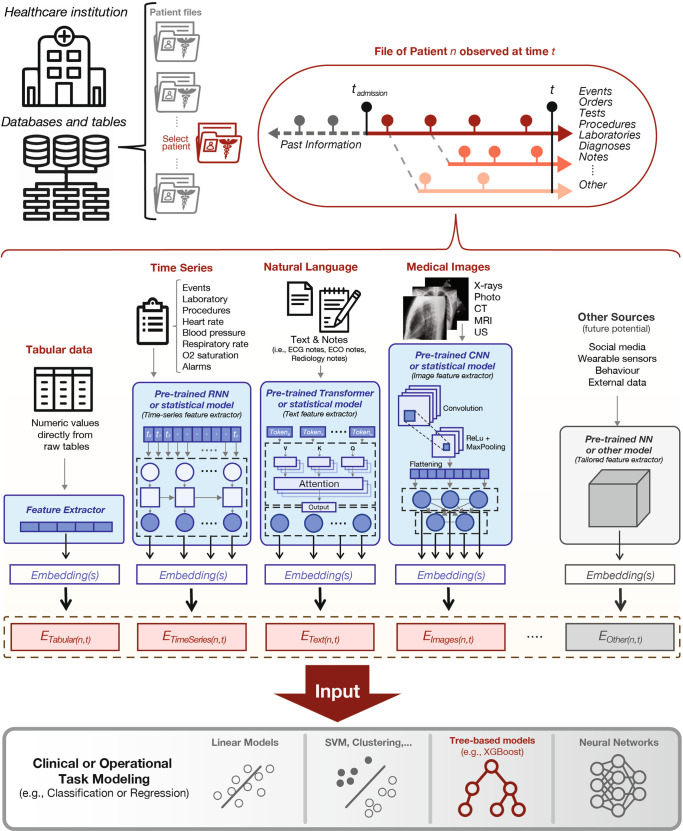
Artificial intelligence (AI) systems hold great promise to improve healthcare over the next decades. Specifically, AI systems leveraging multiple data sources and input modalities are poised to become a viable method to deliver more accurate results and deployable pipelines across a wide range of applications. In this work, we propose and evaluate a unified Holistic AI in Medicine (HAIM) framework to facilitate the generation and testing of AI systems that leverage multimodal inputs. Our approach uses generalizable data pre-processing and machine learning modeling stages that can be readily adapted for research and deployment in healthcare environments. We evaluate our HAIM framework by training and characterizing 14,324 independent models based on HAIM-MIMIC-MM, a multimodal clinical database ( N = 34,537 samples) containing 7279 unique hospitalizations and 6485 patients, spanning all possible input combinations of 4 data modalities (i.e., tabular, time-series, text, and images), 11 unique data sources and 12 predictive tasks. We show that this framework can consistently and robustly produce models that outperform similar single-source approaches across various healthcare demonstrations (by 6–33%), including 10 distinct chest pathology diagnoses, along with length-of-stay and 48 h mortality predictions. We also quantify the contribution of each modality and data source using Shapley values, which demonstrates the heterogeneity in data modality importance and the necessity of multimodal inputs across different healthcare-relevant tasks. The generalizable properties and flexibility of our Holistic AI in Medicine (HAIM) framework could offer a promising pathway for future multimodal predictive systems in clinical and operational healthcare settings.
Overview
CoChat Summary
## TL;DR
The paper proposes HAIM, a modular multimodal AI framework for healthcare that turns heterogeneous EHR data into fixed-size patient embeddings for downstream prediction. On a multimodal MIMIC-based dataset, the framework trained 14,324 XGBoost models and reported consistent AUROC gains over single-source baselines across chest X-ray pathology, length-of-stay, and 48 h mortality tasks.
## Key findings
- The compiled dataset, HAIM-MIMIC-MM, contained 34,537 samples, 7,279 hospitalization stays, and 6,485 unique patients.
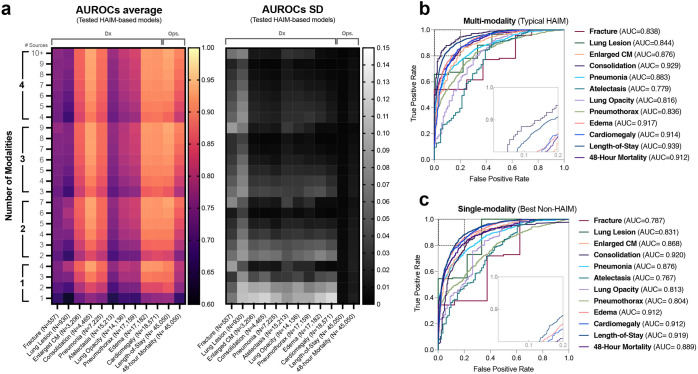
- Across all experiments, the framework evaluated 14,324 independent models: 10,230 for chest pathology diagnosis, 2,047 for length-of-stay, and 2,047 for 48 h mortality prediction.
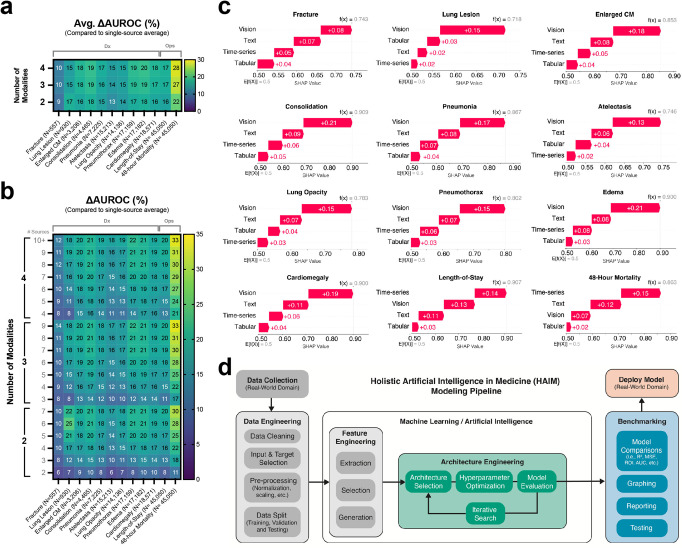
- Multimodal/multi-source inputs improved average performance over canonical single-source systems by 6–22% for chest X-ray pathology prediction, 8–20% for length-of-stay, and 11–33% for 48 h mortality.
- For chest pathology prediction, the minimum per-task AUROC improvements were reported as: Fracture 6%, Lung Lesion 7%, Enlarged cardiomediastinum 9%, Consolidation 10%, Pneumonia 8%, Atelectasis 6%, Lung opacity 7%, Pneumothorax 8%, Edema 10%, and Cardiomegaly 10%.
- Shapley-value analysis showed that vision data contributed most to chest pathology tasks, while historical time-series records were most relevant for length-of-stay and 48 h mortality.
## Methods
- The study built a unified multimodal dataset by combining MIMIC-IV v1.0 and MIMIC-CXR-JPG v2.0.0 using matched patient/admission/imaging identifiers.
- Each patient admission was converted into a patient-centric file and embedded across 4 modalities and 11 data sources: tabular demographics, time-series events, text notes, and images; fixed embeddings were extracted using Clinical BERT for text and Densenet121-res224-chex for images.
- Downstream tasks included 10 chest pathology binary classifications, length-of-stay (discharged alive within 48 h vs otherwise), and 48 h mortality (expired within 48 h vs otherwise). Models were XGBoost, trained with 80/20 splits, repeated 5 times, with 5-fold cross-validated grid search on the training set; performance was reported by test AUROC.
## Limitations
- The paper states that Shapley analysis can reveal small or negative contributions when there is absence of extracted information or error propagation, and that such issues may be addressed by removing modalities or changing feature extractors.
- The paper notes that some improvements showed diminishing returns and local non-monotonic effects due to data source availability, error, and redundancy.
- Evident from the text: the demonstration is based on a single source dataset from MIMIC/BIDMC, so generalization to other hospitals or EHR systems is not directly established by the reported experiments.
Model-written summary. Check it against the paper before relying on it.
Integrity signals
Registry
Cites
Statistics
Figures
Verification
Claims the paper makes
10 Valid · 4 Not valid · 4 Not checked · 58 Own results and interpretations
The cited sources support only part of this claim — read each source’s verdict below.
In the paper
“Such anticipated utility, particularly in AI/ML systems aimed to improve clinical efficiency and patient outcomes, will require knowledge from multiple data sources and various input modalities2–4.”
§ Integrated multimodal artificial intelligence framework for healthcare applications > Introduction
What the sources say
- Partly supportedcites [2] Huang S-C Pareek A Seyyedi S Banerjee I Lungren MP Fusion of medical imaging and electronic health records using deep learning: a systematic review and implementation guidelines NPJ Dig. Med. 2020 3 1 9 PMC7567861 33083571 sourceExperimental — accuracy not yet measured
The Integration section describes medical data from records, imaging, lab results and wearables as potential inputs for AI analysis. The Conclusion links access across independent systems and varied data types to machine-learning strategies. These passages support the value of multiple sources and modalities, but do not establish that AI/ML systems require them to improve clinical efficiency or patient outcomes. (LLM, conf=0.83)
- Not checked — no full text of the sourcecites [3] Gietzelt M Löpprich M Karmen C Ganzinger M Models and data sources used in systems medicine Methods Inf. Med. 2016 55 107 113 26846174 source
- Partly supportedcites [4] Boonn WW Langlotz CP Radiologist use of and perceived need for patient data access J. Dig. imaging 2009 22 357 362 PMC3043710 18459002 sourceExperimental — accuracy not yet measured
The Conclusion calls for an application that retrieves pertinent patient information from multiple clinical systems and presents it efficiently to radiologists, with expected benefits for interpretation and quality of care. The Results identify several useful information sources. The paper does not establish that AI/ML systems require multiple input modalities; that part extends beyond its discussion of radiologists’ access to clinical data. (LLM, conf=0.86)
plainstates a possible cause- Asserted: passes — The authors put it forward as true.
- Checkable: passes — It can be checked against evidence.
- Load-bearing: passes — The paper’s conclusions depend on it.
- Based: passes — The paper gives a reason why it holds.
- Partly supported
The cited sources support only part of this claim — read each source’s verdict below.
In the paper
“For this work, we utilize the Medical Information Cart for Intensive Care (MIMIC)-IV32,33, an openly accessible database that contains de-identified records of 383,220 individual patients admitted to the ICU or emergency department (ED) of Beth Israel Deaconess Medical Center (BIDMC) in Boston, MA, USA, between 2008 and 2019 (inclusive).”
§ Integrated multimodal artificial intelligence framework for healthcare applications > Methods > Dataset
What the sources say
- Partly supportedcites [32] Johnson, A. et al. MIMIC-IV (version 1.0). PhysioNet, 10.13026/s6n6-xd98. (2021). sourceExperimental — accuracy not yet measured
The Methods (page unavailable) confirm that MIMIC-IV draws on de-identified records of BIDMC ICU or emergency-department patients from 2008–2019. The copy does not substantiate the figure of 383,220 individual patients. Its access information also describes the database as restricted to credentialed users who complete training and sign a data-use agreement, rather than openly accessible without qualification. (LLM, conf=0.87)
- Not checked — no full text of the sourcecites [33] Goldberger AL PhysioBank, PhysioToolkit, and PhysioNet: components of a new research resource for complex physiologic signals Circulation 2000 101 e215 e220 10851218 source
plainn = 383,220- Asserted: passes — The authors put it forward as true.
- Checkable: passes — It can be checked against evidence.
- Load-bearing: passes — The paper’s conclusions depend on it.
- Based: passes — The paper gives a reason why it holds.
- Partly supported
The cited sources that could be checked couldn’t confirm or dispute this claim.
In the paper
“However, developing unified and scalable pipelines that can consistently be applied to train multimodal AI/ML systems that leverage and outperform their single-modality counterparts has remained challenging2.”
§ Integrated multimodal artificial intelligence framework for healthcare applications > Introduction
What the sources say
- Could not verifycites [2] Huang S-C Pareek A Seyyedi S Banerjee I Lungren MP Fusion of medical imaging and electronic health records using deep learning: a systematic review and implementation guidelines NPJ Dig. Med. 2020 3 1 9 PMC7567861 33083571 sourceExperimental — accuracy not yet measured
The Conclusion (page not provided) describes a scalable data lake that can store varied healthcare data and support machine learning; the Discussion describes challenges in consolidating medical-record systems. Neither addresses the claimed difficulty of building unified pipelines to train multimodal AI/ML models that outperform single-modality models. Searches for multimodal performance and training-pipeline challenges found no passage on that point. (LLM, conf=0.76)
plain- Asserted: passes — The authors put it forward as true.
- Checkable: passes — It can be checked against evidence.
- Load-bearing: passes — The paper’s conclusions depend on it.
- Based: passes — The paper gives a reason why it holds.
- Could not verify
The cited sources that could be checked couldn’t confirm or dispute this claim.
In the paper
“Furthermore, it has been shown that multimodality in most of these domains can increase the performance of AI/ML systems (accuracy: 1.2–27.7%) compared to single-modality approaches for the same task2.”
§ Integrated multimodal artificial intelligence framework for healthcare applications > Introduction
What the sources say
- Could not verifycites [2] Huang S-C Pareek A Seyyedi S Banerjee I Lungren MP Fusion of medical imaging and electronic health records using deep learning: a systematic review and implementation guidelines NPJ Dig. Med. 2020 3 1 9 PMC7567861 33083571 sourceExperimental — accuracy not yet measured
The Integration and Discussion sections discuss combining health data from different sources for possible AI analysis, but neither reports a comparison with single-modality systems. Searches for multimodality, comparative AI/ML performance, and the 1.2–27.7% accuracy range found no supporting passage in our copy; page numbers were unavailable. (LLM, conf=0.76)
boostedstates a cause- Asserted: passes — The authors put it forward as true.
- Checkable: passes — It can be checked against evidence.
- Load-bearing: passes — The paper’s conclusions depend on it.
- Based: passes — The paper gives a reason why it holds.
- Could not verify
The cited sources support only part of this claim — read each source’s verdict below.
In the paper
“Multimodal architectures for AI/ML systems are attractive because they can emulate the input conditions that clinicians and healthcare administrators currently use to perform predictions and respond to their complex decision-making landscape2,5.”
§ Integrated multimodal artificial intelligence framework for healthcare applications > Introduction
What the sources say
- Partly supportedcites [2] Huang S-C Pareek A Seyyedi S Banerjee I Lungren MP Fusion of medical imaging and electronic health records using deep learning: a systematic review and implementation guidelines NPJ Dig. Med. 2020 3 1 9 PMC7567861 33083571 sourceExperimental — accuracy not yet measured
The Integration and Discussion sections describe combining varied health data, including records and wearables, for AI analysis and physicians’ treatment planning. The Conclusion says the proposed data system could support machine-learning strategies. The paper does not say that multimodal AI/ML architectures emulate clinicians’ or administrators’ existing inputs for prediction and complex decision-making; its architecture is for blockchain-based record management. (LLM, conf=0.84)
- Partly supportedcites [5] Wang W Krishnan E Big data and clinicians: a review on the state of the science JMIR Med. Inform. 2014 2 e1 25600256 PMC4288113 sourceExperimental — accuracy not yet measured
The Results section (Method Development Studies; page unavailable) describes tools that use clinical data to aid analysis and treatment decisions. The Discussion (Methods for Manipulation of Clinical Big Data; page unavailable) also describes diverse data and data integration. Neither passage says that multimodal AI/ML architectures emulate the inputs clinicians or healthcare administrators use, so the claim’s central rationale is unsupported. (LLM, conf=0.78)
plainstates a cause- Asserted: passes — The authors put it forward as true.
- Checkable: passes — It can be checked against evidence.
- Load-bearing: passes — The paper’s conclusions depend on it.
- Based: passes — The paper gives a reason why it holds.
- Partly supported
31 more claims · 1 with their cited sources checked
Create a free account to see all 76 claims and to verify the 1 reference still open.
- It may state two separate claims as one. 21
- Probably not a substantial claim. 24
- The quote only partly states this claim. 1
Claims other papers make about this one
Each is checked against this paper’s own text: does it say what the citing paper says it does?
The cited source doesn’t support the claim as written.
In the citing paper
“MIMIC-IV-MM is generated by joining MIMIC-IV, MIMIC-CXR, and MIMIC-IV-Note on the triplet of patient subject ID, hospital admission ID, and ICU-stay ID.”
From Multimodal risk prediction with physiological signals, medical images and clinical notes (2024) · cites this paper as [25]
Checked by a reasoning model — may be wrong.
Experimental — accuracy not yet measuredThe source backs part of the claim, not all of it — or backs it for a different population, condition or comparison.
In the citing paper
“These approaches combine heterogeneous data sources to improve diagnostic accuracy and contextual understanding in complex clinical scenarios [9].”
From Artificial Intelligence in Clinical Decision-Making: A Comprehensive Review of Diagnostic, Prognostic, and Therapeutic Applications, Validation Gaps, Bias, and Deployment Challenges (2026) · cites this paper as [9]
Experimental — accuracy not yet measuredThe source backs part of the claim, not all of it — or backs it for a different population, condition or comparison.
In the citing paper
“In dermatology, ophthalmology, and radiology, convolutional neural networks have reported performance comparable to specialists in selected controlled tasks, such as skin cancer classification, diabetic retinopathy detection, breast cancer screening, and lung nodule identification [9,12].”
From Artificial Intelligence in Clinical Decision-Making: A Comprehensive Review of Diagnostic, Prognostic, and Therapeutic Applications, Validation Gaps, Bias, and Deployment Challenges (2026) · cites this paper as [9]
Experimental — accuracy not yet measuredThe source backs part of the claim, not all of it — or backs it for a different population, condition or comparison.
In the citing paper
“These systems may improve triage prioritisation, reduce waiting times, and support resource allocation [9,15].”
From Artificial Intelligence in Clinical Decision-Making: A Comprehensive Review of Diagnostic, Prognostic, and Therapeutic Applications, Validation Gaps, Bias, and Deployment Challenges (2026) · cites this paper as [9]
Experimental — accuracy not yet measuredThe source backs part of the claim, not all of it — or backs it for a different population, condition or comparison.
In the citing paper
“When the authors tested their framework in over 14’000 different prediction models, they found that predictions based on multimodal data outperform unimodal comparators by 6-30%.”
From Orchestrating explainable artificial intelligence for multimodal and longitudinal data in medical imaging (2024) · cites this paper as [16]
Experimental — accuracy not yet measured
4 more claims about this paper
Create a free account to see every claim other papers make about this one.
Citations
Cites
Goldberger, A. L., Amaral, L. A. N., Glass, L., Hausdorff, J. M., Ivanov, P. C., Mark, R. G., Mietus, J. E., Moody, G. B., Peng, C.-K., & Stanley, H. E. (2000) · Circulation · doi:10.1161/01.cir.101.23.e215 · Cited by 14,809
Re-epithelialization and immune cell behaviour in an ex vivo human skin model
Rakita, A., Nikolić, N., Mildner, M., Matiasek, J., & Elbe-Bürger, A. (2020) · Scientific Reports · doi:10.1038/s41598-019-56847-4 · Cited by 8,228
MIMIC-III, a freely accessible critical care database
Johnson, A. E. W., Pollard, T. J., Shen, L., Lehman, L.-W. H., Feng, M., Ghassemi, M., Moody, B., Szolovits, P., Anthony Celi, L., & Mark, R. G. (2016) · Scientific Data · doi:10.1038/sdata.2016.35 · Cited by 8,141 · cited 1×
“0) improves on MIMIC-III 34 to provide public access to the EHR data of over 40,000 hospitalized patients based on the BIDMC ’ s MetaVision clinical information system.”
MethodU1 snRNP regulates cancer cell migration and invasion in vitro
Oh, J.-M., Venters, C. C., Di, C., Pinto, A. M., Wan, L., Younis, I., Cai, Z., Arai, C., So, B. R., Duan, J., et al. (2020) · Nature Communications · doi:10.1038/s41467-019-13993-7 · Cited by 7,157
Scalable and accurate deep learning with electronic health records
Rajkomar, A., Oren, E., Chen, K., Dai, A. M., Hajaj, N., Hardt, M., Liu, P. J., Liu, X., Marcus, J., Sun, M., et al. (2018) · npj Digital Medicine · doi:10.1038/s41746-018-0029-1 · Cited by 2,648
Explaining prediction models and individual predictions with feature contributions
Štrumbelj, E., & Kononenko, I. (2014) · Knowledge and Information Systems · doi:10.1007/s10115-013-0679-x · Cited by 2,286
Scalable and accurate deep learning with electronic health records.
Rajkomar, A., Oren, E., Chen, K., Dai, A. M., Hajaj, N., Hardt, M., Liu, P. J., Liu, X., Marcus, J., Sun, M., et al. (2018) · eScholarship (California Digital Library) · Cited by 2,242
MIMIC-CXR, a de-identified publicly available database of chest radiographs with free-text reports
Johnson, A. E. W., Pollard, T. J., Berkowitz, S. J., Greenbaum, N. R., Lungren, M. P., Deng, C.-Y., Mark, R. G., & Horng, S. (2019) · Scientific Data · doi:10.1038/s41597-019-0322-0 · Cited by 1,816
Alsentzer, E., Murphy, J., Boag, W., Weng, W.-H., Jindi, D., Naumann, T., & McDermott, M. (2019) · Proceedings of the 2nd Clinical Natural Language Processing Workshop · doi:10.18653/v1/w19-1909 · Cited by 1,736 · cited 4×
“We obtained embeddings for the unstructured free text (E radn , E ecgn , and E econ ) by concatenating all available text from each of these types of notes as continuous strings and then by processing them using Clinical BERT 39 , a transformer-based bidirectional encoder model pre-trained on a large corpus of biomedi…”
MethodInfluentialA clinically applicable approach to continuous prediction of future acute kidney injury
Tomašev, N., Glorot, X., Rae, J. W., Zielinski, M., Askham, H., Saraiva, A., Mottram, A., Meyer, C., Ravuri, S., Protsyuk, I., et al. (2019) · Nature · doi:10.1038/s41586-019-1390-1 · Cited by 1,086
Research works printed but not linked: 1
- Royalty, J. P. Machine Learning Time-to-Event Mortality Prediction in MIMIC-IV Critical Care Database (Doctoral dissertation). Undergraduate Research Scholars Program. Available electronically from https://hdl.handle.net/1969.1/194429 (2021).
Cited by
The shaky foundations of large language models and foundation models for electronic health records
Wornow, M., Xu, Y., Thapa, R., Patel, B., Steinberg, E., Fleming, S., Pfeffer, M. A., Fries, J., & Shah, N. H. (2023) · npj Digital Medicine · doi:10.1038/s41746-023-00879-8 · Cited by 324
Review of multimodal machine learning approaches in healthcare
Krones, F., Marikkar, U., Parsons, G., Szmul, A., & Mahdi, A. (2025) · Information Fusion · doi:10.1016/j.inffus.2024.102690 · Cited by 235
Singh, A. V., Chandrasekar, V., Paudel, N., Laux, P., Luch, A., Gemmati, D., Tisato, V., Prabhu, K. S., Shahab Uddin, M. S., & Dakua, S. P. (2023) · Biomedicine & Pharmacotherapy · doi:10.1016/j.biopha.2023.114784 · Cited by 182
“Reproduced with permission[21].”
Lin, M., Guo, J., Gu, Z., Tang, W., Tao, H., You, S., Jia, D., Sun, Y., & Jia, P. (2025) · Journal of Translational Medicine · doi:10.1186/s12967-025-06425-2 · Cited by 191
“…the integration of patient cardiac ultrasound and medical history with omics data requires not only consideration of the effects of platform noise, but also the use of autoencoders or deep generative models for feature extraction and dimensionality reduction of high-dimensional omics data [109].”
Integrating multi-omics data with EHR for precision medicine using advanced artificial intelligence
Tong, L., Shi, W., Isgut, M., Zhong, Y., Lais, P., Gloster, L., Sun, J., Swain, A., Giuste, F., & Wang, M. D. (2024) · IEEE Reviews in Biomedical Engineering · doi:10.1109/rbme.2023.3324264 · Cited by 130
Parvin, N., Joo, S., Jung, J. H., & Mandal, T. K. (2025) · Nanomaterials · doi:10.3390/nano15120895 · Cited by 154
Sujit, S. J., Aminu, M., Karpinets, T. V., Chen, P., Saad, M. B., Salehjahromi, M., Boom, J. D., Qayati, M., George, J. M., Allen, H., et al. (2024) · Nature Communications · doi:10.1038/s41467-024-47512-0 · Cited by 125
Multimodal Large Language Models in Medical Imaging: Current State and Future Directions
Nam, Y., Kim, D., Kyung, S., Seo, J., Song, J. M., Kwon, J., Kim, J., Jo, W., Park, H. J., Sung, J., et al. (2025) · Korean Journal of Radiology · doi:10.3348/kjr.2025.0599 · Cited by 154
“…data repositories [45-50,67 ,68 ] and a growing recognition that complex clinical Perhaps most ambitiously, FMs facilitate multimodal data integration, striving to emulate clinical reasoning by synthesizing information from diverse sources like imaging, EHRs, text, and genomics [101,102].”
Pahud de Mortanges, A., Luo, H., Shu, S. Z., Kamath, A., Suter, Y., Shelan, M., Pöllinger, A., & Reyes, M. (2024) · npj Digital Medicine · doi:10.1038/s41746-024-01190-w · Cited by 93
Simon, B. D., Ozyoruk, K. B., Gelikman, D. G., Harmon, S. A., & Türkbey, B. (2024) · Diagnostic and Interventional Radiology · doi:10.4274/dir.2024.242631 · Cited by 73
“Another example study pushing towards generalizable multimodal approaches is proposed by Soenksen et al. 70 They propose and assess a model for Holistic AI in Medicine (HAIM) to support the general development and testing of a variety of multimodal AI systems.”
BackgroundReviewing Multimodal Machine Learning and Its Use in Cardiovascular Diseases Detection
Moshawrab, M., Adda, M., Bouzouane, A., Ibrahim, H., & Raad, A. (2023) · Electronics · doi:10.3390/electronics12071558 · Cited by 85
Liu, J., Capurro, D., Nguyen, A., & Verspoor, K. (2023) · Journal of Biomedical Informatics · doi:10.1016/j.jbi.2023.104466 · Cited by 66
High night-to-night variability in sleep apnea severity is associated with uncontrolled hypertension
Lechat, B., Loffler, K. A., Reynolds, A. C., Naik, G. R., Vakulin, A., Jennings, G., Escourrou, P., McEvoy, R. D., Adams, R., CATCHESIDE, P. G., et al. (2023) · npj Digital Medicine · doi:10.1038/s41746-023-00801-2 · Cited by 66
Hadweh, P., Niset, A., Salvagno, M., Barajraji, M. A., Hadwe, S. E., Taccone, F. S., & Barrit, S. (2025) · Journal of Clinical Medicine · doi:10.3390/jcm14124026 · Cited by 86
“…to specific ICU tasks with relatively small fine-tuning datasets; (II) multimodal integration of text, tabular data, and potentially imaging; (III) more natural interaction through conversational interfaces; and (IV) sophisticated contextual understanding of complex clinical scenarios [90].”
Multimodal risk prediction with physiological signals, medical images and clinical notes
Wang, Y., Yin, C., & Zhang, P. (2024) · Heliyon · doi:10.1016/j.heliyon.2024.e26772 · Cited by 66
“We use MIMIC-IV-MM [25] to train our model.”
MethodInfluentialApplications of AI in multi-modal imaging for cardiovascular disease
Milosevic, M., Jin, Q., Singh, A., & Amal, S. (2024) · Frontiers in Radiology · doi:10.3389/fradi.2023.1294068 · Cited by 63
Machine Learning-Driven Innovations in Microfluidics
Park, J., Kim, Y. W., & Jeon, H. (2024) · Biosensors · doi:10.3390/bios14120613 · Cited by 76
Muse, E. D., & Topol, E. J. (2024) · Cell Metabolism · doi:10.1016/j.cmet.2024.02.002 · Cited by 50
Performance of multimodal artificial intelligence chatbots evaluated on clinical oncology cases
Chen, D., Huang, R. S., Jomy, J., Wong, P., Yan, M., Croke, J., Tong, D., Hope, A., Eng, L., & Raman, S. (2024) · JAMA Network Open · doi:10.1001/jamanetworkopen.2024.37711 · Cited by 49
Transforming sepsis management: AI-driven innovations in early detection and tailored therapies
Papareddy, P., Lobo, T. J., Holub, M., Bouma, H., Maca, J., Strodthoff, N., & Herwald, H. (2025) · Critical Care · doi:10.1186/s13054-025-05588-0 · Cited by 49
“The resulting output representations of the different encoder models can then be combined using relatively shallow prediction models, as demonstrated in ICU/ED contexts [124, 125].”
Rajendran, S., Pan, W., Sabuncu, M. R., Chen, Y., Zhou, J., & Wang, F. (2024) · Patterns · doi:10.1016/j.patter.2023.100913 · Cited by 47
Multiple stakeholders drive diverse interpretability requirements for machine learning in healthcare
Imrie, F., Davis, R. A., & van der Schaar, M. (2023) · Nature Machine Intelligence · doi:10.1038/s42256-023-00698-2 · Cited by 66
“…methods have become de facto approaches in domains such as image analysis 11,12 , natural language processing 13,14 and multi-modal learning 15 , and have been shown to exhibit improved performance compared with white-box models in some other circum-stances 16–18 —although this is far from…”
MethodKolk, M. Z. H., Ruipérez-Campillo, S., Wilde, A. A. M., Knops, R. E., Narayan, S. M., & Tjong, F. V. Y. (2024) · Heart Rhythm · doi:10.1016/j.hrthm.2024.09.003 · Cited by 67
“71,72 This may encompass anatomical image features of substrate and 3D geometry, variants from genome-wide association studies, conduction patterns, electrical physiology, or other modalities (Table 3).”
Schilcher, J., Nilsson, A., Andlid, O., & Eklund, A. (2024) · Computers in Biology and Medicine · doi:10.1016/j.compbiomed.2023.107704 · Cited by 41
Deep Learning Technologies for Time Series Anomaly Detection in Healthcare: A Review
Yang, X., Qi, X., & Zhou, X. (2023) · IEEE Access · doi:10.1109/access.2023.3325896 · Cited by 77
“For instance, Soenksen et al. [67] proposed and evaluated a Healthcare Artificial Intelligence Multimodal (HAIM) framework, demonstrating its consistency and robustness in generating models that out-perform similar single-data-source methods across various healthcare demonstrations.”
A fully open AI foundation model applied to chest radiography
Ma, D., Pang, J., Gotway, M. B., & Liang, J. (2025) · Nature · doi:10.1038/s41586-025-09079-8 · Cited by 116
Automated Ensemble Multimodal Machine Learning for Healthcare
Imrie, F., Denner, S., Brunschwig, L. S., Maier-Hein, K. H., & van der Schaar, M. (2025) · IEEE Journal of Biomedical and Health Informatics · doi:10.1109/jbhi.2025.3530156 · Cited by 57
“HAIM [59] is an early fusion approach using user-defined pre-trained feature-extraction models to extract representations that are concatenated and passed to an XGBoost model.”
MethodApplications of artificial intelligence for adolescent idiopathic scoliosis: mapping the evidence
Goldman, S. N., Hui, A. T., Choi, S., Mbamalu, E., Tirabady, P., Eleswarapu, A. S., Gómez, J. A., Alvandi, L. M., & Fornari, E. D. (2024) · Spine Deformity · doi:10.1007/s43390-024-00940-w · Cited by 49
How can quantum computing be applied in clinical trial design and optimization?
Doğa, H., Bose, A., Sahin, M. E., Bettencourt‐Silva, J. H., Pham, A., Kim, E., Andress, A., Saxena, S., Parida, L., Robertus, J. L., et al. (2024) · Trends in Pharmacological Sciences · doi:10.1016/j.tips.2024.08.005 · Cited by 64
“…x-rays, magnetic resonance imaging, pathology slides), time-series data (e.g., pulse oximetry, ultra-sounds, wearable sensors), structured sequence data (e.g., genomics, proteomics, metabo-lomics) and unstructured sequence data (e.g., notes, forms, written reports, video) among other sources [82].”
Choi, A., Lee, K., Hyun, H., Kim, K. J., Ahn, B. E., Lee, K. H., Hahn, S., Choi, S. Y., & Kim, J. H. (2024) · Scientific Reports · doi:10.1038/s41598-024-80268-7 · Cited by 51
Singh, A., Randive, S., Breggia, A., Ahmad, B., Christman, R., & Amal, S. (2023) · Cancers · doi:10.3390/cancers15235659 · Cited by 41
Privacy-Preserving Machine Learning for Healthcare: Open Challenges and Future Perspectives
Guerra-Manzanares, A., López, L. J. L., Maniatakos, M., & Shamout, F. E. (2023) · Lecture notes in computer science · doi:10.1007/978-3-031-39539-0_3 · Cited by 65
“Current advances in ML for healthcare are moving towards multi-modal learning, where several sources of information are combined to improve performance (Ramachandram & Taylor, 2017; Soenksen et al., 2022).”
BackgroundLarge language models and synthetic health data: progress and prospects
Smolyak, D., Bjarnadóttir, M. V., Crowley, K., & Agarwal, R. (2024) · JAMIA Open · doi:10.1093/jamiaopen/ooae114 · Cited by 60
“48 Augmentation of real data with synthetic data has the potential to improve multi-modality models’ performance, yet current methods cannot generate data across data types.”
BackgroundArdic, N., & Dinc, R. (2025) · Health Informatics Journal · doi:10.1177/14604582251366141 · Cited by 32
Missing-modality enabled multi-modal fusion architecture for medical data
Wang, M., Fan, S., Li, Y., Xie, Z., & Chen, H. (2025) · Journal of Biomedical Informatics · doi:10.1016/j.jbi.2025.104796 · Cited by 31
Perspectives on Advancing Multimodal Learning in Environmental Science and Engineering Studies
Liu, W., Chen, J., Wang, H., Fu, Z., Peijnenburg, W. J. G. M., & Hong, H. (2024) · Environmental Science & Technology · doi:10.1021/acs.est.4c03088 · Cited by 54
Evaluating Large Language Model (LLM) Performance on Established Breast Classification Systems
Haider, S. A., Pressman, S. M., Borna, S., Gomez-Cabello, C. A., Sehgal, A., Leibovich, B. C., & Forte, A. J. (2024) · Diagnostics · doi:10.3390/diagnostics14141491 · Cited by 31
Shi, W., Giuste, F., Zhu, Y., Tamo, B. J., Nnamdi, M. C., Hornback, A. M., Carpenter, A. M., Hilton, C., Iwinski, H. J., Wattenbarger, J. M., et al. (2025) · Communications Medicine · doi:10.1038/s43856-024-00726-1 · Cited by 35
AI-driven nanomedicine for cancer theranostics
Tiwari, A., Widodo, Krisnawati, D. I., Chen, C.-Y., & Kuo, T. (2026) · Molecular Cancer · doi:10.1186/s12943-025-02563-9 · Cited by 49
Multi-modal learning for inpatient length of stay prediction
Chen, J., Wen, Y., Pokojovy, M., Tseng, T.-L., McCaffrey, P., Vo, A. H., Walser, E., & Moen, S. T. (2024) · Computers in Biology and Medicine · doi:10.1016/j.compbiomed.2024.108121 · Cited by 32
AI in Aesthetic/Cosmetic Dermatology: Current and Future
Thunga, S., Khan, M., Cho, S. I., Na, J., & Yoo, J. Y. (2024) · Journal of Cosmetic Dermatology · doi:10.1111/jocd.16640 · Cited by 32
Wu, J., He, K., Mao, R., Shang, X., & Cambria, E. (2025) · Information Fusion · doi:10.1016/j.inffus.2025.103283 · Cited by 40
Park, W. Y., Jeon, K., Schmidt, T. S., Kondylakis, H., Alkasab, T. K., Dewey, B. E., You, S. C., & Nagy, P. G. (2024) · Journal of Imaging Informatics in Medicine · doi:10.1007/s10278-024-00982-6 · Cited by 40
“Increasing need to incorporate multimodal data, such as notes, waveforms, and images, as inputs in the machine learning methods is highlighted by recent studies [1–3].”
MethodComprehensive Review of Multimodal Medical Data Analysis: Open Issues and Future Research Directions
Shetty, S., Ananthanarayana, V. S., & Mahale, A. R. (2022) · Acta Informatica Pragensia · doi:10.18267/j.aip.202 · Cited by 29
Applications of Artificial Intelligence in Medicine
Srivastava, R. (2023) · Exploratory Research and Hypothesis in Medicine · doi:10.14218/erhm.2023.00048 · Cited by 43
Building digital patient pathways for the management and treatment of multiple sclerosis
Wenk, J., Voigt, I., Inojosa, H., Schlieter, H., & Ziemssen, T. (2024) · Frontiers in Immunology · doi:10.3389/fimmu.2024.1356436 · Cited by 27
Leveraging foundation and large language models in medical artificial intelligence
Wong, I. N., Monteiro, O., Baptista‐Hon, D. T., Wang, K., Lu, W.-Y., Sun, Z., Nie, S., & Yin, Y. (2024) · Chinese Medical Journal · doi:10.1097/cm9.0000000000003302 · Cited by 31
Artificial Intelligence in Uveitis: Innovations in Diagnosis and Therapeutic Strategies
Murugan, S., Sanjay, S., Somanath, A., Mahendradas, P., Patil, A., Kaur, K., & Gurnani, B. (2024) · Clinical ophthalmology · doi:10.2147/opth.s495307 · Cited by 26
“11 However, realizing this potential requires concerted efforts from researchers, clinicians, and industry stakeholders to address the existing limitations and ethical considerations.”
HONeYBEE: enabling scalable multimodal AI in oncology through foundation model-driven embeddings
Tripathi, A. G., Waqas, A., Schabath, M. B., Yılmaz, Y., & Rasool, G. (2025) · npj Digital Medicine · doi:10.1038/s41746-025-02003-4 · Cited by 56
Role of Artificial Intelligence in Enhancing Healthcare Delivery
Jeyaraj, P., & AVSM, L. G. T. N. (2023) · International Journal of Innovative Science and Modern Engineering · doi:10.35940/ijisme.a1310.12111223 · Cited by 31
“…will become more sophisticated and will play a central role in patient education, appointment scheduling, and triaging healthcare services [28, 29]. f) AI will continue to advance medical imaging and diagnostics, leading to faster and more accurate diagnoses and improved treatment planning.…”
BackgroundLin, J., Yang, J., Yin, M., Tang, Y., Chen, L., Xu, C., Zhu, S., Gao, J., Liu, L., Liu, X., et al. (2024) · Journal of Imaging Informatics in Medicine · doi:10.1007/s10278-024-01066-1 · Cited by 22
“Soenksen et al. constructed a giant integrated multimodal artificial intelligence framework that automatically predicted 10 distinct chest pathological diagnoses, along with length-of-stay and 48 h mortality predictions [14].”
Artificial Intelligence in Cardiovascular Disease Prevention: Is it Ready for Prime Time?
Parsa, S., Somani, S. S., Dudum, R., Jain, S. S., & Rodríguez, F. (2024) · Current Atherosclerosis Reports · doi:10.1007/s11883-024-01210-w · Cited by 32
“…of data types and modeling techniques, the studies propose future all-in-one algorithms will be capable of streamlining output by assessing several variations of model selection and hyperparameters, or tunable model input criteria, to determine the optimal algorithm for the presented data [35].”
A multimodal dataset for precision oncology in head and neck cancer
Dörrich, M., Balk, M., Heusinger, T., Beyer, S., Mirbagheri, H., Fischer, D. J., Kanso, H., Matek, C., Hartmann, A., Iro, H., et al. (2025) · Nature Communications · doi:10.1038/s41467-025-62386-6 · Cited by 44
Digitalomics, digital intervention, and designing future: The next frontier in cardiology
Tamura, Y., Nomura, A., Kagiyama, N., Mizuno, A., & Node, K. (2023) · Journal of Cardiology · doi:10.1016/j.jjcc.2023.12.002 · Cited by 20
Bhushan, A., & Misra, P. (2025) · npj Digital Medicine · doi:10.1038/s41746-025-01992-6 · Cited by 28
AI and omics technologies in biobanking: Applications and challenges for public health
Venturini, P., de Faria, P. L., & Cordeiro, J. V. (2025) · Public Health · doi:10.1016/j.puhe.2025.105726 · Cited by 23
Artificial Intelligence and Machine Learning in Transfusion Practice: An Analytical Assessment
Li, N., Goel, R., Raza, S., Riazi, K., Pan, J., Nguyen, H. Q., Shih, A. W. Y., D’Souza, A. G., Dubey, R., Tobian, A. A. R., et al. (2025) · Transfusion Medicine Reviews · doi:10.1016/j.tmrv.2025.150926 · Cited by 19
Chen, Y., Rehman, U. U., & Mahmood, T. (2023) · Symmetry · doi:10.3390/sym15112045 · Cited by 17
A Review of Multimodal AI in Veterinary Diagnosis: Current Trends, Challenges, and Future Directions
Gomes, C., Coheur, L., & Tilley, P. (2025) · IEEE Access · doi:10.1109/access.2025.3575343 · Cited by 24
“Multimodal artificial intelligence (AI) systems integrate and analyze heterogeneous data types—such as images, text, audio, and video—to generate comprehensive insights [1].”
Time Series Embedding Methods for Classification Tasks: A Review
Irani, H., Ghahremani, Y., Kermani, A., & Metsis, V. (2025) · Expert Systems · doi:10.1111/exsy.70148 · Cited by 40
“…from finance, as in the work of Zhu and Huang (2022), to healthcare, as demonstrated in Nejedly et al. (2022); Morid et al. (2023); Chen et al. (2021); Lee and Hauskrecht (2021); Soenksen et al. (2022), engineering applications such as machine health monitoring, predictive maintenance, and fault…”
Artificial intelligence in healthcare and medicine technology development review
Chung, D. (2025) · Engineering Applications of Artificial Intelligence · doi:10.1016/j.engappai.2024.109801 · Cited by 22
Artificial intelligence in rheumatoid arthritis
Sun, Y., Lin, J., & Chen, W. (2025) · Rheumatology & autoimmunity · doi:10.1002/rai2.12171 · Cited by 19
Lai, X., Lai, Y., Chen, J., Huang, S., Gao, Q., & Huang, C. (2025) · Journal of Medical Internet Research · doi:10.2196/79217 · Cited by 31
“In the domain of exercise and health coaching, these artificial intelligence (AI) systems are expected to perform complex tasks, including generating adaptive training plans, providing real-time movement feedback, and offering motivational support [1,2].”
Siam, K., Faruk, M. J. H., He, B., Cheng, J. Q., & Gu, H. (2025) · Information · doi:10.3390/info16110971 · Cited by 37
“Overall, integrating structured tabular data with other modalities enhances the reliability and precision of clinical decision support systems [38].”
Healthcare: A Growing Role for Large Language Models and Generative AI
Pahune, S. A., & Rewatkar, N. (2023) · International Journal for Research in Applied Science and Engineering Technology · doi:10.22214/ijraset.2023.55573 · Cited by 24
Environmental impacts of a digital health and well-being service in elderly living schemes
Tarpani, R. R. Z., & Gallego‐Schmid, A. (2023) · Cleaner Environmental Systems · doi:10.1016/j.cesys.2023.100161 · Cited by 24
Wang, D., Hu, Q., Cao, C.-G., Feng, X., Wu, H., Zhu, S., Wang, H., & Yang, C. (2024) · Expert Systems with Applications · doi:10.1016/j.eswa.2024.123869 · Cited by 18
Responsible adoption of multimodal artificial intelligence in health care: promises and challenges
Azarfar, G., Naimimohasses, S., Rambhatla, S., Komorowski, M., Ferro, D., Lewis, P. R., Gates, D., Shara, N. M., Gascon, G. M., Chang, A. C., et al. (2025) · The Lancet Digital Health · doi:10.1016/j.landig.2025.100917 · Cited by 32
Unsupervised pre-training of graph transformers on patient population graphs
Pellegrini, C., Navab, N., & Kazi, A. (2023) · Medical Image Analysis · doi:10.1016/j.media.2023.102895 · Cited by 25
Advancing spine care through AI and machine learning: overview and applications
Cina, A., & Galbusera, F. (2024) · EFORT Open Reviews · doi:10.1530/eor-24-0019 · Cited by 18
“This refers to datasets that integrate multiple types of the aforementioned data modalities, offering a more comprehensive overview of the subject matter (15 ).”
BackgroundThe Role of AI in the Evaluation of Neuroendocrine Tumors: Current State of the Art
Lopez-Ramirez, F., Yasrab, M., Tixier, F., Kawamoto, S., Fishman, E. K., & Chu, L. C. H. (2025) · Seminars in Nuclear Medicine · doi:10.1053/j.semnuclmed.2025.02.003 · Cited by 15
FlexCare: Leveraging Cross-Task Synergy for Flexible Multimodal Healthcare Prediction
Xu, M., Zhu, Z., Li, Y., Zheng, S., Zhao, Y., He, K., & Zhao, Y. (2024) · ACM SIGKDD Conference on Knowledge Discovery and Data Mining (KDD) · doi:10.1145/3637528.3671974 · Cited by 26
“Considering the complementary nature of information within multimodal EHR data, some previous methodologies have been developed to integrate various modalities for enhancing the accuracy of clinical event prediction [6, 15, 23, 28, 37].”
On optimal regression trees to detect critical intervals for multivariate functional data
Blanquero, R., Carrizosa, E., Molero-Río, C., & Morales, D. R. (2023) · Computers & Operations Research · doi:10.1016/j.cor.2023.106152 · Cited by 15
MaRAG: a knowledge graph and retrieval-augmented framework for maritime accident analysis
Zou, Y., Wang, S., Li, G., & Ning, B. (2025) · Ocean Engineering · doi:10.1016/j.oceaneng.2025.123622 · Cited by 14
Multimodal Wearable Biosensing Meets Multidomain AI: A Pathway to Decentralized Healthcare
Liu, C., Fan, H., Kim, M., Zhou, T., Yang, P., Zhao, L., Wang, Y., Che, Z., Liu, C., Li, B., et al. (2026) · Advanced Science · doi:10.1002/advs.202522900 · Cited by 32
Baheti, B., Innani, S., Nasrallah, M., & Bakas, S. (2024) · Frontiers in Neuroscience · doi:10.3389/fnins.2024.1304191 · Cited by 16
mBGT: Encoding Brain Signals With Multimodal Brain Graph Transformer
Peng, C., Guo, T., Xie, C., Bai, X., Zhou, J., Zhao, X., He, E., & Xia, F. (2024) · IEEE Transactions on Consumer Electronics · doi:10.1109/tce.2024.3425478 · Cited by 19
Robust Fusion of Time Series and Image Data for Improved Multimodal Clinical Prediction
Rasekh, A., Heidari, R., Rezaie, A. H. H. M., Sedeh, P. S., Ahmadi, Z., Mitra, P., & Nejdl, W. (2024) · IEEE Access · doi:10.1109/access.2024.3497668 · Cited by 24
“Soenksen et al. [7] take a step further by developing a platform capable of generating embeddings for various modalities, including images, text, and tabular data.”
Giaccone, P., D’Antoni, F., Russo, F., Ambrosio, L., Papalia, G. F., d’Angelis, O., Vadalà, G., Comelli, A., Vollero, L., Merone, M., et al. (2025) · BMC Musculoskeletal Disorders · doi:10.1186/s12891-025-08356-x · Cited by 14
Fahad, S. K. A., Zhengkui, D. W., Ng, P. C., Wong, N., Ng, A. B., & See, S. C. W. (2025) · Studies in computational intelligence · doi:10.1007/978-3-031-80334-5_19 · Cited by 18
MedPromptX: Grounded Multimodal Prompting for Chest X-Ray Diagnosis
Shaaban, M. A., Khan, A., & Yaqub, M. K. (2025) · Lecture notes in computer science · doi:10.1007/978-3-031-84525-3_18 · Cited by 20
“Our methodology involves constructing the MedPromptX-VQA dataset derived from a unified multimodal dataset, denoted as HAIM-MIMIC-MM [20].”
MethodZhou, Y., Khasentino, J., Yun, T., Biradar, M. I., Shreibati, J. B., Lai, D., Schwantes-An, T.-H. L., Luben, R., McCaw, Z. R., Engmann, J., et al. (2025) · The American Journal of Human Genetics · doi:10.1016/j.ajhg.2025.05.015 · Cited by 17
Otsuka, N., Kawanishi, Y., Doi, F., Takeda, T., Okumura, K., Yamauchi, T., Yada, S., Wakamiya, S., Aramaki, E., & Makinodan, M. (2023) · Psychiatry and Clinical Neurosciences · doi:10.1111/pcn.13580 · Cited by 13
AI-Enhanced Lung Cancer Prediction: A Hybrid Model's Precision Triumph
Kesiku, C. Y., & García-Zapirain, B. (2024) · IEEE Journal of Biomedical and Health Informatics · doi:10.1109/jbhi.2024.3447583 · Cited by 13
Hasan, M. J., Rahman, F., & Mohammed, N. (2024) · International Journal of Medical Informatics · doi:10.1016/j.ijmedinf.2024.105764 · Cited by 16
Acoustic and Natural Language Markers for Bipolar Disorder: A Pilot, mHealth Cross-Sectional Study
Crocamo, C., Cioni, R. M., Canestro, A., Nasti, C., Palpella, D., Piacenti, S., Bartoccetti, A., Re, M., Simonetti, V., Pietro, C. B. D. S., et al. (2025) · JMIR Formative Research · doi:10.2196/65555 · Cited by 17
“Thus, for relapse prevention purposes, future research should possibly explore systems combining smartphone-based generated objective acoustics data with additional information, such as from facial expressions and gestures [61].”
Viaña, J. N. M., Pilbeam, C., Howard, M., Scholz, B., Ge, Z., Fisser, C., Mitchell, I., Raman, S., & Leach, J. (2023) · OMICS A Journal of Integrative Biology · doi:10.1089/omi.2023.0120 · Cited by 10
“…then be conducted at the critical stage of an illness (Sun et al., 2021), which can then be integrated with information from digital health modalities using AI (Acosta et al., 2022; Soenksen et al., 2022; Yang et al., 2021), to predict prognosis during intensive care or in the final disease stages.”
Securing AI-Based Healthcare Systems Using Blockchain Technology
Das, S. R., Jhanjhi, N. Z., Asirvatham, D. A. L., Rizwan, F., & Javed, D. (2024) · Advances in human and social aspects of technology book series · doi:10.4018/979-8-3693-8939-3.ch012 · Cited by 12
Rawshani, A., Rawshani, A., Smith, G. J., Borén, J., Bhatt, D. L., Börjesson, M., Engdahl, J., Kelly, P., Louca, A., Råmunddal, T., et al. (2025) · Open Heart · doi:10.1136/openhrt-2025-003185 · Cited by 22
Applications of Federated Large Language Model for Adverse Drug Reactions Prediction: Scoping Review
Guo, D., & Choo, K. R. (2025) · Journal of Medical Internet Research · doi:10.2196/68291 · Cited by 15
Schuurmans, M., Saha, A., Alves, N., Vendittelli, P., Yakar, D., Sabroso‐Lasa, S., Xue, N., Malats, N., Huisman, H. J., Hermans, J. J., et al. (2025) · European Radiology · doi:10.1007/s00330-025-11694-y · Cited by 22
Wiberg, H., Dai, T., Lam, H., & Kulkarni, R. (2025) · INFORMS Journal on Data Science · doi:10.1287/ijds.2025.0077 · Cited by 16
Self-citationAutomated Segmentation of Sacral Chordoma and Surrounding Muscles Using Deep Learning Ensemble
Boussioux, L., Ma, Y., Thomas, N. K., Bertsimas, D., Shusharina, N., Pursley, J., Chen, Y., DeLaney, T. F., Qian, J. M., & Bortfeld, T. R. (2023) · International Journal of Radiation Oncology*Biology*Physics · doi:10.1016/j.ijrobp.2023.03.078 · Cited by 10
Self-citationEnhancing heart failure diagnosis through multi-modal data integration and deep learning
Liu, Y., Li, D., Zhao, J., & Liang, Y. (2023) · Multimedia Tools and Applications · doi:10.1007/s11042-023-17716-5 · Cited by 9
AI-powered microscopy image analysis for parasitology: integrating human expertise
Feng, R., Li, S., & Zhang, Y. (2024) · Trends in Parasitology · doi:10.1016/j.pt.2024.05.005 · Cited by 12
Lakshmanan, R., Balakrishnan, S., Mahendran, A., & Subramanian, A. K. (2024) · Computers & Electrical Engineering · doi:10.1016/j.compeleceng.2024.109614 · Cited by 8
Ip, W., Xenochristou, M., Sui, E., Ruan, E., Ribeira, R., Dash, D., Srinivasan, M., Artandi, M. K., Omiye, J. A., Scoulios, N., et al. (2024) · npj Digital Medicine · doi:10.1038/s41746-024-01375-3 · Cited by 15
Phillips, E., O’Donoghue, O., Zhang, Y., Tsimpos, P., Mallinger, L. A., Chatzidakis, S., Pohlmann, J. E., Du, Y., Kim, I. S. Y., Song, J. J., et al. (2025) · npj Digital Medicine · doi:10.1038/s41746-025-01687-y · Cited by 9
Liu, J., Nguyen, A. N., Capurro, D., & Verspoor, K. M. (2025) · IEEE Journal of Biomedical and Health Informatics · doi:10.1109/jbhi.2025.3574254 · Cited by 12
Machine learning in dentistry and oral surgery: charting the course with bibliometric insights
Liu, S., Hao, Y., Zhu, S., Wan, L., Yi, Z., & Zhang, Z. (2025) · Head & Face Medicine · doi:10.1186/s13005-025-00521-w · Cited by 10
“Multimodal ML models are particularly significant because of their ability to amalgam-ate diverse data sources, enabling a more thorough and precise analysis, diagnosis, and personalized treatment planning [61, 62].”
Metadata
- Authors
- Soenksen, L. R., Ma, Y., Zeng, C., Boussioux, L., Villalobos Carballo, K., Na, L., Wiberg, H. M., Li, M. L., Fuentes, I., & Bertsimas, D.
- Affiliations
- Harvard University (US)
- Massachusetts Institute of Technology (US)
- Corresponding author
- Bertsimas, Dimitris
- ORCID
- Venue
- npj Digital Medicine
- Published
- 2022-09-20
- Volume
- 5
- Issue
- 1
- Pages
- 149-149
- ISSN
- 2398-6352 (ISSN-L)
- PMC
- PMC9489871
- OpenAlex
- W4296776307
- Cited by
- 380
- References
- 47
- Citations by year
- 2026: 141 · 2025: 129 · 2024: 74 · 2023: 33 · 2022: 3
- FWCI
- 19.74
- Type
- journal article
- Language
- en
- Open access
- gold
- doi.org
- Licence
- cc-by
- creativecommons.org/licenses/by/4.0 (tdm)
- creativecommons.org/licenses/by/4.0 (vor)
- Locations
- npj Digital Medicine (publishedVersion, cc-by)
- PubMed Central (publishedVersion, cc-by)
- PubMed (publishedVersion)
- arXiv (Cornell University) (submittedVersion)
- DOAJ (DOAJ: Directory of Open Access Journals) (submittedVersion, cc-by-sa)
- arXiv (Cornell University)
- Funders
- National Science Foundation (174530)
- Harvard T.H. Chan School of Public Health
- Topics
- Physical Sciences › Computer Science › Artificial Intelligence › Machine Learning in Healthcare
- Health Sciences › Medicine › Health Informatics › Artificial Intelligence in Healthcare and Education
- Health Sciences › Health Professions › Health Information Management › Artificial Intelligence in Healthcare
- Keywords
- multimodal AI, multimodal medical data, length of stay prediction, Shapley value, hospitalization data, clinical prediction model
About these checks
Registry, retraction, Cites and statistics results are computed, not judged, with one exception: a printed reference that no index lists is read once by a model before it counts as a citation error. Claims are extracted by a model and kept only when their quote appears verbatim in the text; each cited source is then checked, with a model’s help, for whether it says what the claim relies on. Those verdicts can be wrong — read the claim’s quote and the cited source before relying on one.
The claim verdicts this report counts are experimental: their accuracy is not yet measured.
A language model drew the claims from the paper on 2026-10-09, under version 3 of the claim definition (model deepseek-v4.1-flash, prompt extract-v3).
A second model labelled each claim on 2026-10-09 (model jev-1.13-20260917, definition revision gold-guideline-v0.2).
Cited sources are checked with a language model’s help (gpt-6-sol).
Statistics and arithmetic are recomputed, not judged.
Confidence bands are shown only for fields calibrated on our annotated test set. None is calibrated yet, so no band is shown.
What counts as a claim ›How we measure confidence ›How we check this ›
Are you an author, or do you see a problem with this page? Request a review
Data sources
Bibliographic data: Semantic Scholar, OpenAlex, Crossref.
Contains information from the Semantic Scholar Academic Graph Datasets, made available under the ODC Attribution License (ODC-BY 1.0).
Semantic Scholar’s data is described in: Kinney, R., et al. (2023). The Semantic Scholar Open Data Platform. arXiv:2301.10140.
