

Integrated multimodal artificial intelligence framework for healthcare applications
Open accessThe DOI matches its Crossref record; 52 of the 53 references it cites were found in a registry or an index; 16 of the 23 sources its claims cite were checked for support.
Abstract
Artificial intelligence (AI) systems hold great promise to improve healthcare over the next decades. Specifically, AI systems leveraging multiple data sources and input modalities are poised to become a viable method to deliver more accurate results and deployable pipelines across a wide range of applications. In this work, we propose and evaluate a unified Holistic AI in Medicine (HAIM) framework to facilitate the generation and testing of AI systems that leverage multimodal inputs. Our approach uses generalizable data pre-processing and machine learning modeling stages that can be readily adapted for research and deployment in healthcare environments. We evaluate our HAIM framework by training and characterizing 14,324 independent models based on HAIM-MIMIC-MM, a multimodal clinical database ( N = 34,537 samples) containing 7279 unique hospitalizations and 6485 patients, spanning all possible input combinations of 4 data modalities (i.e., tabular, time-series, text, and images), 11 unique data sources and 12 predictive tasks. We show that this framework can consistently and robustly produce models that outperform similar single-source approaches across various healthcare demonstrations (by 6–33%), including 10 distinct chest pathology diagnoses, along with length-of-stay and 48 h mortality predictions. We also quantify the contribution of each modality and data source using Shapley values, which demonstrates the heterogeneity in data modality importance and the necessity of multimodal inputs across different healthcare-relevant tasks. The generalizable properties and flexibility of our Holistic AI in Medicine (HAIM) framework could offer a promising pathway for future multimodal predictive systems in clinical and operational healthcare settings.
Overview
CoChat Summary
## TL;DR
The paper proposes HAIM, a modular multimodal AI framework for healthcare that turns heterogeneous EHR data into fixed-size patient embeddings for downstream prediction. On a multimodal MIMIC-based dataset, the framework trained 14,324 XGBoost models and reported consistent AUROC gains over single-source baselines across chest X-ray pathology, length-of-stay, and 48 h mortality tasks.
## Key findings
- The compiled dataset, HAIM-MIMIC-MM, contained 34,537 samples, 7,279 hospitalization stays, and 6,485 unique patients.
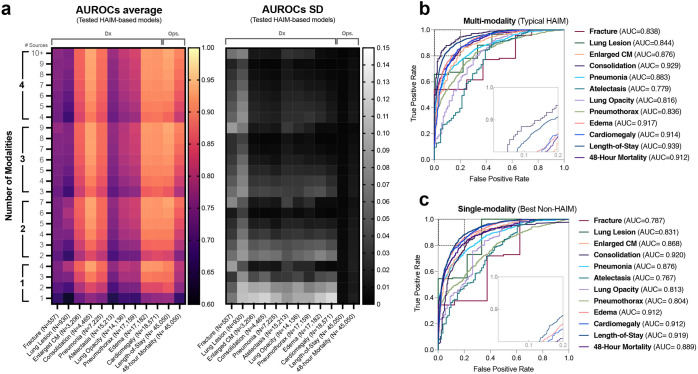
- Across all experiments, the framework evaluated 14,324 independent models: 10,230 for chest pathology diagnosis, 2,047 for length-of-stay, and 2,047 for 48 h mortality prediction.
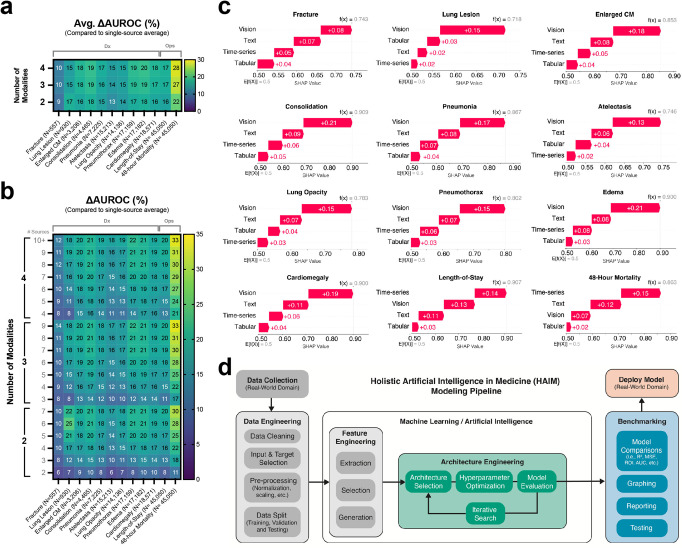
- Multimodal/multi-source inputs improved average performance over canonical single-source systems by 6–22% for chest X-ray pathology prediction, 8–20% for length-of-stay, and 11–33% for 48 h mortality.
- For chest pathology prediction, the minimum per-task AUROC improvements were reported as: Fracture 6%, Lung Lesion 7%, Enlarged cardiomediastinum 9%, Consolidation 10%, Pneumonia 8%, Atelectasis 6%, Lung opacity 7%, Pneumothorax 8%, Edema 10%, and Cardiomegaly 10%.
- Shapley-value analysis showed that vision data contributed most to chest pathology tasks, while historical time-series records were most relevant for length-of-stay and 48 h mortality.
## Methods
- The study built a unified multimodal dataset by combining MIMIC-IV v1.0 and MIMIC-CXR-JPG v2.0.0 using matched patient/admission/imaging identifiers.
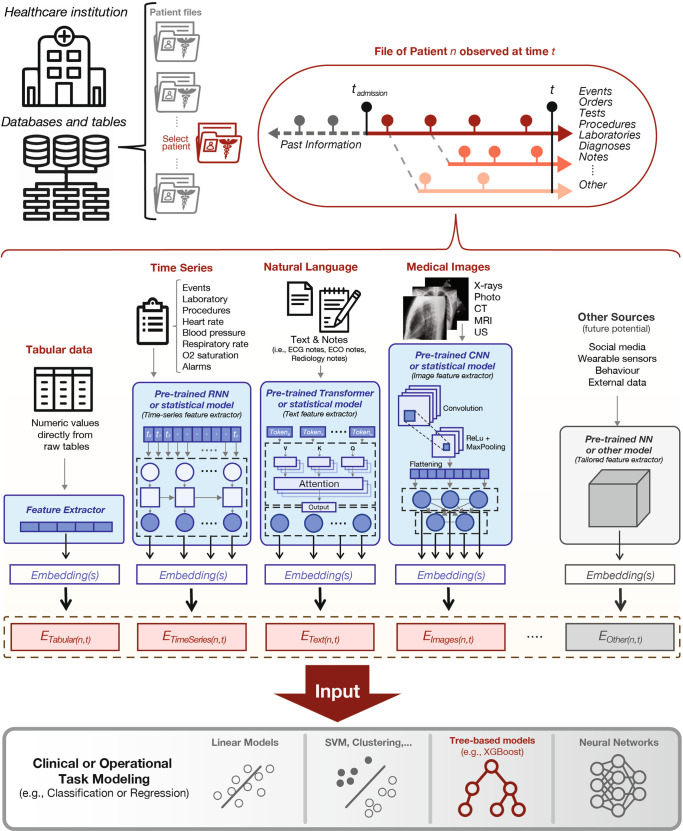
- Each patient admission was converted into a patient-centric file and embedded across 4 modalities and 11 data sources: tabular demographics, time-series events, text notes, and images; fixed embeddings were extracted using Clinical BERT for text and Densenet121-res224-chex for images.
- Downstream tasks included 10 chest pathology binary classifications, length-of-stay (discharged alive within 48 h vs otherwise), and 48 h mortality (expired within 48 h vs otherwise). Models were XGBoost, trained with 80/20 splits, repeated 5 times, with 5-fold cross-validated grid search on the training set; performance was reported by test AUROC.
## Limitations
- The paper states that Shapley analysis can reveal small or negative contributions when there is absence of extracted information or error propagation, and that such issues may be addressed by removing modalities or changing feature extractors.
- The paper notes that some improvements showed diminishing returns and local non-monotonic effects due to data source availability, error, and redundancy.
- Evident from the text: the demonstration is based on a single source dataset from MIMIC/BIDMC, so generalization to other hospitals or EHR systems is not directly established by the reported experiments.
Model-written summary. Check it against the paper before relying on it.
Integrity signals
Registry
Cites
Statistics
Figures
Verification
Claims the paper makes
10 Valid · 4 Not valid · 4 Not checked · 58 Own results and interpretations
The cited sources support only part of this claim — read each source’s verdict below.
In the paper
“Such anticipated utility, particularly in AI/ML systems aimed to improve clinical efficiency and patient outcomes, will require knowledge from multiple data sources and various input modalities2–4.”
§ Integrated multimodal artificial intelligence framework for healthcare applications > Introduction
What the sources say
- Partly supportedcites [2] Huang S-C Pareek A Seyyedi S Banerjee I Lungren MP Fusion of medical imaging and electronic health records using deep learning: a systematic review and implementation guidelines NPJ Dig. Med. 2020 3 1 9 PMC7567861 33083571 sourceExperimental — accuracy not yet measured
The Integration section describes medical data from records, imaging, lab results and wearables as potential inputs for AI analysis. The Conclusion links access across independent systems and varied data types to machine-learning strategies. These passages support the value of multiple sources and modalities, but do not establish that AI/ML systems require them to improve clinical efficiency or patient outcomes. (LLM, conf=0.83)
- Not checked — no full text of the sourcecites [3] Gietzelt M Löpprich M Karmen C Ganzinger M Models and data sources used in systems medicine Methods Inf. Med. 2016 55 107 113 26846174 source
- Partly supportedcites [4] Boonn WW Langlotz CP Radiologist use of and perceived need for patient data access J. Dig. imaging 2009 22 357 362 PMC3043710 18459002 sourceExperimental — accuracy not yet measured
The Conclusion calls for an application that retrieves pertinent patient information from multiple clinical systems and presents it efficiently to radiologists, with expected benefits for interpretation and quality of care. The Results identify several useful information sources. The paper does not establish that AI/ML systems require multiple input modalities; that part extends beyond its discussion of radiologists’ access to clinical data. (LLM, conf=0.86)
plainstates a possible cause- Asserted: passes — The authors put it forward as true.
- Checkable: passes — It can be checked against evidence.
- Load-bearing: passes — The paper’s conclusions depend on it.
- Based: passes — The paper gives a reason why it holds.
- Partly supported
The cited sources support only part of this claim — read each source’s verdict below.
In the paper
“For this work, we utilize the Medical Information Cart for Intensive Care (MIMIC)-IV32,33, an openly accessible database that contains de-identified records of 383,220 individual patients admitted to the ICU or emergency department (ED) of Beth Israel Deaconess Medical Center (BIDMC) in Boston, MA, USA, between 2008 and 2019 (inclusive).”
§ Integrated multimodal artificial intelligence framework for healthcare applications > Methods > Dataset
What the sources say
- Partly supportedcites [32] Johnson, A. et al. MIMIC-IV (version 1.0). PhysioNet, 10.13026/s6n6-xd98. (2021). sourceExperimental — accuracy not yet measured
The Methods (page unavailable) confirm that MIMIC-IV draws on de-identified records of BIDMC ICU or emergency-department patients from 2008–2019. The copy does not substantiate the figure of 383,220 individual patients. Its access information also describes the database as restricted to credentialed users who complete training and sign a data-use agreement, rather than openly accessible without qualification. (LLM, conf=0.87)
- Not checked — no full text of the sourcecites [33] Goldberger AL PhysioBank, PhysioToolkit, and PhysioNet: components of a new research resource for complex physiologic signals Circulation 2000 101 e215 e220 10851218 source
plainn = 383,220- Asserted: passes — The authors put it forward as true.
- Checkable: passes — It can be checked against evidence.
- Load-bearing: passes — The paper’s conclusions depend on it.
- Based: passes — The paper gives a reason why it holds.
- Partly supported
The cited sources that could be checked couldn’t confirm or dispute this claim.
In the paper
“However, developing unified and scalable pipelines that can consistently be applied to train multimodal AI/ML systems that leverage and outperform their single-modality counterparts has remained challenging2.”
§ Integrated multimodal artificial intelligence framework for healthcare applications > Introduction
What the sources say
- Could not verifycites [2] Huang S-C Pareek A Seyyedi S Banerjee I Lungren MP Fusion of medical imaging and electronic health records using deep learning: a systematic review and implementation guidelines NPJ Dig. Med. 2020 3 1 9 PMC7567861 33083571 sourceExperimental — accuracy not yet measured
The Conclusion (page not provided) describes a scalable data lake that can store varied healthcare data and support machine learning; the Discussion describes challenges in consolidating medical-record systems. Neither addresses the claimed difficulty of building unified pipelines to train multimodal AI/ML models that outperform single-modality models. Searches for multimodal performance and training-pipeline challenges found no passage on that point. (LLM, conf=0.76)
plain- Asserted: passes — The authors put it forward as true.
- Checkable: passes — It can be checked against evidence.
- Load-bearing: passes — The paper’s conclusions depend on it.
- Based: passes — The paper gives a reason why it holds.
- Could not verify
The cited sources that could be checked couldn’t confirm or dispute this claim.
In the paper
“Furthermore, it has been shown that multimodality in most of these domains can increase the performance of AI/ML systems (accuracy: 1.2–27.7%) compared to single-modality approaches for the same task2.”
§ Integrated multimodal artificial intelligence framework for healthcare applications > Introduction
What the sources say
- Could not verifycites [2] Huang S-C Pareek A Seyyedi S Banerjee I Lungren MP Fusion of medical imaging and electronic health records using deep learning: a systematic review and implementation guidelines NPJ Dig. Med. 2020 3 1 9 PMC7567861 33083571 sourceExperimental — accuracy not yet measured
The Integration and Discussion sections discuss combining health data from different sources for possible AI analysis, but neither reports a comparison with single-modality systems. Searches for multimodality, comparative AI/ML performance, and the 1.2–27.7% accuracy range found no supporting passage in our copy; page numbers were unavailable. (LLM, conf=0.76)
boostedstates a cause- Asserted: passes — The authors put it forward as true.
- Checkable: passes — It can be checked against evidence.
- Load-bearing: passes — The paper’s conclusions depend on it.
- Based: passes — The paper gives a reason why it holds.
- Could not verify
The cited sources support only part of this claim — read each source’s verdict below.
In the paper
“Multimodal architectures for AI/ML systems are attractive because they can emulate the input conditions that clinicians and healthcare administrators currently use to perform predictions and respond to their complex decision-making landscape2,5.”
§ Integrated multimodal artificial intelligence framework for healthcare applications > Introduction
What the sources say
- Partly supportedcites [2] Huang S-C Pareek A Seyyedi S Banerjee I Lungren MP Fusion of medical imaging and electronic health records using deep learning: a systematic review and implementation guidelines NPJ Dig. Med. 2020 3 1 9 PMC7567861 33083571 sourceExperimental — accuracy not yet measured
The Integration and Discussion sections describe combining varied health data, including records and wearables, for AI analysis and physicians’ treatment planning. The Conclusion says the proposed data system could support machine-learning strategies. The paper does not say that multimodal AI/ML architectures emulate clinicians’ or administrators’ existing inputs for prediction and complex decision-making; its architecture is for blockchain-based record management. (LLM, conf=0.84)
- Partly supportedcites [5] Wang W Krishnan E Big data and clinicians: a review on the state of the science JMIR Med. Inform. 2014 2 e1 25600256 PMC4288113 sourceExperimental — accuracy not yet measured
The Results section (Method Development Studies; page unavailable) describes tools that use clinical data to aid analysis and treatment decisions. The Discussion (Methods for Manipulation of Clinical Big Data; page unavailable) also describes diverse data and data integration. Neither passage says that multimodal AI/ML architectures emulate the inputs clinicians or healthcare administrators use, so the claim’s central rationale is unsupported. (LLM, conf=0.78)
plainstates a cause- Asserted: passes — The authors put it forward as true.
- Checkable: passes — It can be checked against evidence.
- Load-bearing: passes — The paper’s conclusions depend on it.
- Based: passes — The paper gives a reason why it holds.
- Partly supported
31 more claims · 1 with their cited sources checked
Create a free account to see all 76 claims and to verify the 1 reference still open.
- It may state two separate claims as one. 21
- Probably not a substantial claim. 24
- The quote only partly states this claim. 1
Claims other papers make about this one
Each is checked against this paper’s own text: does it say what the citing paper says it does?
The cited source doesn’t support the claim as written.
In the citing paper
“MIMIC-IV-MM is generated by joining MIMIC-IV, MIMIC-CXR, and MIMIC-IV-Note on the triplet of patient subject ID, hospital admission ID, and ICU-stay ID.”
From Multimodal risk prediction with physiological signals, medical images and clinical notes (2024) · cites this paper as [25]
Checked by a reasoning model — may be wrong.
Experimental — accuracy not yet measuredThe source backs part of the claim, not all of it — or backs it for a different population, condition or comparison.
In the citing paper
“These approaches combine heterogeneous data sources to improve diagnostic accuracy and contextual understanding in complex clinical scenarios [9].”
From Artificial Intelligence in Clinical Decision-Making: A Comprehensive Review of Diagnostic, Prognostic, and Therapeutic Applications, Validation Gaps, Bias, and Deployment Challenges (2026) · cites this paper as [9]
Experimental — accuracy not yet measuredThe source backs part of the claim, not all of it — or backs it for a different population, condition or comparison.
In the citing paper
“In dermatology, ophthalmology, and radiology, convolutional neural networks have reported performance comparable to specialists in selected controlled tasks, such as skin cancer classification, diabetic retinopathy detection, breast cancer screening, and lung nodule identification [9,12].”
From Artificial Intelligence in Clinical Decision-Making: A Comprehensive Review of Diagnostic, Prognostic, and Therapeutic Applications, Validation Gaps, Bias, and Deployment Challenges (2026) · cites this paper as [9]
Experimental — accuracy not yet measuredThe source backs part of the claim, not all of it — or backs it for a different population, condition or comparison.
In the citing paper
“These systems may improve triage prioritisation, reduce waiting times, and support resource allocation [9,15].”
From Artificial Intelligence in Clinical Decision-Making: A Comprehensive Review of Diagnostic, Prognostic, and Therapeutic Applications, Validation Gaps, Bias, and Deployment Challenges (2026) · cites this paper as [9]
Experimental — accuracy not yet measuredThe source backs part of the claim, not all of it — or backs it for a different population, condition or comparison.
In the citing paper
“When the authors tested their framework in over 14’000 different prediction models, they found that predictions based on multimodal data outperform unimodal comparators by 6-30%.”
From Orchestrating explainable artificial intelligence for multimodal and longitudinal data in medical imaging (2024) · cites this paper as [16]
Experimental — accuracy not yet measured
4 more claims about this paper
Create a free account to see every claim other papers make about this one.
Citations
Cites
Goldberger, A. L., Amaral, L. A. N., Glass, L., Hausdorff, J. M., Ivanov, P. C., Mark, R. G., Mietus, J. E., Moody, G. B., Peng, C.-K., & Stanley, H. E. (2000) · Circulation · doi:10.1161/01.cir.101.23.e215 · Cited by 14,809
Re-epithelialization and immune cell behaviour in an ex vivo human skin model
Rakita, A., Nikolić, N., Mildner, M., Matiasek, J., & Elbe-Bürger, A. (2020) · Scientific Reports · doi:10.1038/s41598-019-56847-4 · Cited by 8,228
MIMIC-III, a freely accessible critical care database
Johnson, A. E. W., Pollard, T. J., Shen, L., Lehman, L.-W. H., Feng, M., Ghassemi, M., Moody, B., Szolovits, P., Anthony Celi, L., & Mark, R. G. (2016) · Scientific Data · doi:10.1038/sdata.2016.35 · Cited by 8,141 · cited 1×
“0) improves on MIMIC-III 34 to provide public access to the EHR data of over 40,000 hospitalized patients based on the BIDMC ’ s MetaVision clinical information system.”
MethodU1 snRNP regulates cancer cell migration and invasion in vitro
Oh, J.-M., Venters, C. C., Di, C., Pinto, A. M., Wan, L., Younis, I., Cai, Z., Arai, C., So, B. R., Duan, J., et al. (2020) · Nature Communications · doi:10.1038/s41467-019-13993-7 · Cited by 7,157
Scalable and accurate deep learning with electronic health records
Rajkomar, A., Oren, E., Chen, K., Dai, A. M., Hajaj, N., Hardt, M., Liu, P. J., Liu, X., Marcus, J., Sun, M., et al. (2018) · npj Digital Medicine · doi:10.1038/s41746-018-0029-1 · Cited by 2,648
Explaining prediction models and individual predictions with feature contributions
Štrumbelj, E., & Kononenko, I. (2014) · Knowledge and Information Systems · doi:10.1007/s10115-013-0679-x · Cited by 2,286
Scalable and accurate deep learning with electronic health records.
Rajkomar, A., Oren, E., Chen, K., Dai, A. M., Hajaj, N., Hardt, M., Liu, P. J., Liu, X., Marcus, J., Sun, M., et al. (2018) · eScholarship (California Digital Library) · Cited by 2,242
MIMIC-CXR, a de-identified publicly available database of chest radiographs with free-text reports
Johnson, A. E. W., Pollard, T. J., Berkowitz, S. J., Greenbaum, N. R., Lungren, M. P., Deng, C.-Y., Mark, R. G., & Horng, S. (2019) · Scientific Data · doi:10.1038/s41597-019-0322-0 · Cited by 1,816
Alsentzer, E., Murphy, J., Boag, W., Weng, W.-H., Jindi, D., Naumann, T., & McDermott, M. (2019) · Proceedings of the 2nd Clinical Natural Language Processing Workshop · doi:10.18653/v1/w19-1909 · Cited by 1,736 · cited 4×
“We obtained embeddings for the unstructured free text (E radn , E ecgn , and E econ ) by concatenating all available text from each of these types of notes as continuous strings and then by processing them using Clinical BERT 39 , a transformer-based bidirectional encoder model pre-trained on a large corpus of biomedi…”
MethodInfluentialA clinically applicable approach to continuous prediction of future acute kidney injury
Tomašev, N., Glorot, X., Rae, J. W., Zielinski, M., Askham, H., Saraiva, A., Mottram, A., Meyer, C., Ravuri, S., Protsyuk, I., et al. (2019) · Nature · doi:10.1038/s41586-019-1390-1 · Cited by 1,086
Research works printed but not linked: 1
- Royalty, J. P. Machine Learning Time-to-Event Mortality Prediction in MIMIC-IV Critical Care Database (Doctoral dissertation). Undergraduate Research Scholars Program. Available electronically from https://hdl.handle.net/1969.1/194429 (2021).
Cited by
Items 101–200 of 369
Liu, T., Gu, Y., Chen, H., Zhang, Y., Zheng, L., Huang, X., Xu, Y., Wen, C., Chen, M.-S., Lin, J., et al. (2025) · Communications Medicine · doi:10.1038/s43856-025-01052-w · Cited by 21
Hu, J., Ren, L., Wang, T., & Peng, Y. (2025) · Journal of Multidisciplinary Healthcare · doi:10.2147/jmdh.s529190 · Cited by 18
“5,6 Recent advances in machine learning algorithms have facilitated the development of sophisticated risk prediction models and automated monitoring systems, markedly enhancing the efficiency and accuracy of clinical decision-making.”
Kandi, S., Khera, R., Rajagopalan, S., & Neeland, I. J. (2025) · Current Atherosclerosis Reports · doi:10.1007/s11883-025-01356-1 · Cited by 11
“AI’s ability to integrate data from multiple sources including imaging modalities, clinical records, and genetic information has the potential to revolutionize the study of VAT and its relationship with CV risk factors [ 35 ].”
Yu, Y., Hu, X., Rajaganapathy, S., Feng, J., Abdelhameed, A. M., Li, X., Li, J., Liu, X., Liu, Y., Ertekin-Taner, N., et al. (2026) · npj Health Systems · doi:10.1038/s44401-026-00068-1 · Cited by 17
Gorrepati, L. P., Kalapala, R., & Sargam, G. S. (2025) · International Conference on Cyber Physical Systems, Power Electronics and Electric Vehicles (ICPEEV) · doi:10.1109/icpeev67897.2025.11291497 · Cited by 15
“In a companion work published in association with this one, Soenksen et al. (2022) introduced the Holistic Healthcare Modelling (HAIM) framework as a multimodal learning framework integrating structured data sources like laboratory analyses and unstructured ones like clinical text, radiographic…”
A perspective on computer vision in biosensing
Liu, L., & Du, K. (2024) · Biomicrofluidics · doi:10.1063/5.0185732 · Cited by 13
Deep learning-based prediction of cervical canal stenosis from mid-sagittal T2-weighted MRI
Rhee, W., Park, S. C., Kim, H., Chang, B., & Chang, S. Y. (2025) · Skeletal Radiology · doi:10.1007/s00256-025-04917-2 · Cited by 8
Yoon, H., Ahn, J. H., Kim, B. Y., Lee, H., Jo, W.-Y., Yoon, S., Park, H., & Lee, H. (2025) · International Journal of Surgery · doi:10.1097/js9.0000000000003143 · Cited by 12
“80 ] In ECG analysis, ResNet-and Inception-based CNN models have demonstrated good performance and have been widely used in previous studies [81] .”
Archana, M., Jarina Raihan, A., Jothilakshmi, B., et al. (2025) · International Conference on Innovative Mechanisms for Industry Applications · doi:10.1109/icimia67127.2025.11200547 · Cited by 7
“Recent biomedical AI architectures have successfully modelled combinations of clinical, imaging, and behavioural data [6, 7] yet many rely on homogeneous datasets or lack real-time adaptability.”
Holistic AI in medicine; improved performance and explainability
Petridis, P., Margaritis, G., Stoumpou, V., & Bertsimas, D. (2026) · npj Digital Medicine · doi:10.1038/s41746-025-02298-3 · Cited by 17
Self-citationMultimodal artificial intelligence in medicine: a task-oriented framework for clinical translation
Zhang, R.-Y., Chen, Y., Yue, W., Zhang, Y., Li, X., Feng, S., Yuan, F., & Luo, M. (2026) · Frontiers in Medicine · doi:10.3389/fmed.2025.1736272 · Cited by 20
Vázquez, A. G., Verde, J. M., Hernández-Lara, A. H., Mutter, D., & Swanström, L. L. (2024) · Annals of Surgery Open · doi:10.1097/as9.0000000000000459 · Cited by 11
Combining Large Language Models and OR/MS to Make Smarter Decisions
Wasserkrug, S., Boussioux, L., & Sun, W. (2024) · doi:10.1287/educ.2024.0275 · Cited by 15
Self-citationLiu, Y., Zhang, Z., Mi, J., Pan, S., Chen, T., Guo, Y. M., He, X., & Bian, J. (2024) · Journal of Biomedical Informatics · doi:10.1016/j.jbi.2025.104851 · Cited by 11
Turkestani, N. N. A., Cevidanes, L., Bianchi, J., Sugai, J. V., Gurgel, M., Rodríguez, J. P., Hatfield, E. R., Philips, K., Benavides, E., Soki, F. N., et al. (2025) · Osteoarthritis and Cartilage · doi:10.1016/j.joca.2025.08.002 · Cited by 12
A survey on electronic health record driven multimodal representation learning
Dou, Y., Liu, Y., Zou, H., Zeng, W., Xu, K., & Peng, S. (2025) · Information Fusion · doi:10.1016/j.inffus.2025.103810 · Cited by 11
Automated Machine Learning in medical research: A systematic literature mapping study
Castro, G. A., Barioto, L. G., Cao, Y. H., Silva, R. M., Caseli, H. D. M., Machado‐Neto, J. A., Cerri, R., Villavicencio, A., & Almeida, T. A. (2025) · Artificial Intelligence in Medicine · doi:10.1016/j.artmed.2025.103302 · Cited by 15
Chisompola, D., Luwaya, E. L., Nzobokela, J., Mwansa, P., & Chakulya, M. (2026) · Frontiers in Microbiology · doi:10.3389/fmicb.2025.1717859 · Cited by 16
“Whereas logistic regression may detect a few predictors, machine learning models such as random forests or neural networks can uncover intricate interactions to predict patient severity or outbreak hotspots (Soenksen et al., 2022).”
Exploring an AI-First Healthcare System
Gates, A., Ali, A., Conard, S. E., & Dunn, P. J. (2026) · Bioengineering · doi:10.3390/bioengineering13010112 · Cited by 10
Rizi, F. R., Jamadi, M. S., Rahimi, S., Bighamian, M., Paidar, P., Taki, M. J., & Bahmaie, N. (2026) · Frontiers in Oncology · doi:10.3389/fonc.2026.1763359 · Cited by 10
Al-Jebrni, A. H., Jiang, Z., Qin, Y., Qiu, Y., Jiang, N., Li, G., Zheng, Y., Wong, T. Y., Kim, S., Jung, Y., et al. (2026) · Computational Visual Media · doi:10.26599/cvm.2026.9450530 · Cited by 11
Lee, S. Y., Lee, D. Y., & Ahn, J. (2024) · BMC Ophthalmology · doi:10.1186/s12886-024-03510-w · Cited by 6
“When using ML algorithms, the inclusion of multiple variants is essential and performing comparative analysis using multi-source input combinations is imperative to improve ML performance [20].”
MethodBouatmane, A., Daaif, A., Bousselham, A., Bouihi, B., & Bouattane, O. (2025) · IEEE Access · doi:10.1109/access.2025.3556700 · Cited by 13
“A notable limitation highlighted in [46] is the under representation of patients with cardiovascular disease in major cancer trials.”
Doria, A. S. (2023) · Expert Review of Hematology · doi:10.1080/17474086.2023.2192474 · Cited by 11
“To avoid repetition of tasks, it is key that stakeholders develop ubiquitous processes to unify database formats, collection and storage processes for massive volumes of patient information, keeping safeguard quality assurance processes, and multimodal inter-operability platforms in place [45].”
BackgroundXAI-based Data Visualization in Multimodal Medical DataPreprint
Sharma, S., Singh, M., Mcdaid, L. J., & Bhattacharyya, S. (2025) · bioRxiv (Cold Spring Harbor Laboratory) · doi:10.1101/2025.07.11.664302 · Cited by 16
Chappidi, S., Belue, M. J., Harmon, S. A., Jagasia, S., Zhuge, Y., Taşçı, E., Türkbey, B., Singh, J., Camphausen, K. A., & Krauze, A. V. (2025) · PLOS Digital Health · doi:10.1371/journal.pdig.0000755 · Cited by 5
“Some studies have often demonstrated that multi-modal algorithms demonstrate superior performance over unimodal algorithms trained on a singular stream of data [15,16].”
Matsumoto, K., Suzuki, M., Ishihara, K., Tokunaga, K., Matsuda, K., Chen, J., Yamashiro, S., Soejima, H., Nakashima, N., & Kamouchi, M. (2025) · International Journal of Medical Informatics · doi:10.1016/j.ijmedinf.2025.105989 · Cited by 5
Wang, Z., Chen, X., Liu, B., Hai, J., Qiao, K., Yuan, Z., Yang, L., Yan, B., Su, Z., & Lü, H. (2025) · Bioengineering · doi:10.3390/bioengineering12060604 · Cited by 7
“…incorporating multimodal or multi-channel inputs by the application of three-dimensional convolutional neural networks (3D CNNs) could enable more comprehensive spatial feature extraction, potentially enhancing the accuracy and robustness of cervical spinal canal stenosis grading models [29,30].”
Multimodal predictive process monitoring and its application to explainable clinical pathways
Pasquadibisceglie, V., Donadello, I., Appice, A., Lanz, O., Maggi, F. M., Fiameni, G., & Malerba, D. (2026) · Information Systems · doi:10.1016/j.is.2026.102698 · Cited by 5
The third wheel or the game changer? How AI could team up with neurologists in Parkinson's care
Malaguti, M. C., Gios, L., & Jurman, G. (2025) · Parkinsonism & Related Disorders · doi:10.1016/j.parkreldis.2025.107797 · Cited by 7
Lopes, J., Faria, M., & Santos, M. F. (2024) · PLoS ONE · doi:10.1371/journal.pone.0302697 · Cited by 11
Artificial Intelligence in Cancer Diagnosis: A Game-changer in Healthcare
Sahoo, P., Kundu, M., & Begum, J. (2024) · Current Pharmaceutical Biotechnology · doi:10.2174/0113892010298852240528123911 · Cited by 11
Transforming ENT Healthcare: Advancements and Implications of Artificial Intelligence
Pandey, A., Kaur, J., & Kaushal, D. (2024) · Indian Journal of Otolaryngology and Head & Neck Surgery · doi:10.1007/s12070-024-04885-4 · Cited by 7
Multi-Modal Fusion of Routine Care Electronic Health Records (EHR): A Scoping Review
Miled, Z. B., Shebesh, J. A., Su, J., Dexter, P. R., Grout, R. W., & Boustani, M. A. (2025) · Information · doi:10.3390/info16010054 · Cited by 13
“The Holistic AI in Medicine (HAIM [74]) framework is a general decision fusion model that combines multiple data types.”
Liu, S., Kandakji, L., Stupnicki, A., Sumodhee, D., Leucci, M. T., Hau, S., Balal, S., Okonkwo, A. C. O., Moghul, I., Kanda, S. P., et al. (2025) · Translational Vision Science & Technology · doi:10.1167/tvst.14.6.12 · Cited by 9
“The Holistic AI in Medicine (HAIM) framework proposed by Soenksen et al. 77 , demonstrates how leveraging multimodal data sources—including tabular, time-series, text, and image inputs—can significantly improve the performance of AI models in health care, providing more accurate and robust…”
Millimeter-wave radar object classification using knowledge-assisted neural network
Wang, Y., Han, C., Zhang, L., Liu, J., An, Q., & Yang, F. (2022) · Frontiers in Neuroscience · doi:10.3389/fnins.2022.1075538 · Cited by 6
“Neural networks have promoted the development of artificial intelligence (AI) technologies in many fields, such as smart healthcare (Alsubai et al., 2022; Soenksen et al., 2022), intelligent transportation (Zhu et al.”
BackgroundTelehealth’s Role Enabling Sustainable Innovation and Circular Economies in Health
Kalogeropoulos, D. (2023) · Telehealth and Medicine Today · doi:10.30953/thmt.v8.409 · Cited by 7
Amal, S., Sawyer, D. B., & Könik, A. (2024) · Frontiers in Radiology · doi:10.3389/fradi.2024.1412404 · Cited by 5
Deng, W., Zhang, L., Yue, J.-R., & Huang, X.-L. (2026) · Frontiers in Public Health · doi:10.3389/fpubh.2025.1691682 · Cited by 11
“Healthcare 5.0 framework has consistently demonstrated superior performance over unimodal systems in diverse healthcare applications (5, 129).”
InfluentialLeveraging multimodal machine learning for accurate risk identification of intimate partner violence
Gu, J., Carballo, K. V., Ma, Y., Bertsimas, D., & Khurana, B. (2026) · npj Women s Health · doi:10.1038/s44294-025-00126-3 · Cited by 7
Self-citationAguirre, J., & Cha, W. C. (2025) · Applied Sciences · doi:10.3390/app15041796 · Cited by 8
Inpatient Length of Stay and Mortality Prediction Utilizing Clinical Time Series Data
Chen, J., Li, M., Milosevich, M., Le, T., Bahsoun, A., & Wen, Y. (2025) · IEEE Access · doi:10.1109/access.2025.3563199 · Cited by 4
“These methods are widely used in various fields, such as time series prediction tasks, and they have shown SOTA performance in inpatients’ LoS and mortality prediction [39].”
Self-citationExploiting GPT-4 for Multimodal Medical Data Processing in Electronic Health Record Systems
Yuan, J. (2024) · International Conference on Health Big Data and Intelligent Healthcare (ICHIH) · doi:10.1109/ichih63459.2024.11064741 · Cited by 8
“As the fundamental element of the electronic medical record, the electronic medical record (EMR) encompasses the comprehensive data accumulated from the patient throughout the medical process [3] .”
Raj, S., & Bayappu, N. (2024) · BENTHAM SCIENCE PUBLISHERS eBooks · doi:10.2174/9789815305128124010008 · Cited by 8
Luo, J., Huang, S., Lan, L., Yang, S., Cao, T., Yin, J. Y., Qiu, J., Yang, X., Guo, Y., & Zhou, X. (2024) · Computer Methods and Programs in Biomedicine · doi:10.1016/j.cmpb.2024.108521 · Cited by 5
Evidence-based medicine: new in the search for evidence
Verbitskaya, E. V., Belousov, D. Y., & Колбин, А. С. (2023) · Kachestvennaya Klinicheskaya Praktika = Good Clinical Practice · doi:10.37489/2588-0519-2023-3-15-28 · Cited by 4
Advances in Multi‐modal Intelligent Sensing
Rehman, M. U., Jamshed, M. A., & Kalsoom, T. (2024) · Wiley eBooks · doi:10.1002/9781394257744.ch1 · Cited by 14
Ma, M., Wang, M., Wei, L., Fei, X., & Chen, H. (2025) · Journal of Biomedical Informatics · doi:10.1016/j.jbi.2025.104823 · Cited by 4
Ma, D., Pang, J., Velan, S. S., Gotway, M. B., & Liang, J. (2025) · Medical Image Analysis · doi:10.1016/j.media.2025.103828 · Cited by 9
Vita, E. D., Caivano, G., Sciarra, F. M., Bianco, S. L., Messina, P., Cumbo, E. M. G., Caradonna, L., Nigliaccio, S., Fontana, D. A., Scardina, A., et al. (2025) · Applied Sciences · doi:10.3390/app152212005 · Cited by 5
An empirical study on the psychological impact of medical AI on patients undergoing dental surgery
Zhu, N., Bian, J., & Dong, Z. (2025) · Scientific Reports · doi:10.1038/s41598-025-29754-0 · Cited by 3
Erem, M., Mercan, O., Yildirim, S., Selçuk, E., & Unyilmaz, C. (2025) · Frontiers in Pediatrics · doi:10.3389/fped.2025.1694035 · Cited by 6
Sharma, A. C., Azeem, A., Omari, I. H., & Premkumar, A. (2025) · Cureus · doi:10.7759/cureus.100254 · Cited by 16
Explainable multimodal deep learning models for variable-length sequences in critically ill patients
Martin, J., Afshar, M., Afshar, A. S., Caskey, J., Dligach, D., Gao, Y., Gao, J., Chen, G., Mayampurath, A. M., & Churpek, M. M. (2026) · Journal of Biomedical Informatics · doi:10.1016/j.jbi.2026.105001 · Cited by 6
Multimodal models for skin cancer classification using clinical freetext and dermatoscopic images
Watson, M., Winterbottom, T. M., Hudson, G. T., Jones, B., Shum, H. P. H., Atapour-Abarghouei, A., Breckon, T. P., King, J. H., & Moubayed, N. A. (2026) · Communications Medicine · doi:10.1038/s43856-026-01456-2 · Cited by 6
Bhar, A., Sengupta, S., & Choudhury, S. R. (2026) · Discover Artificial Intelligence · doi:10.1007/s44163-026-01223-1 · Cited by 3
“The HAIM framework [4] leverages multimodal AI for clinical predictions but primarily focuses on functional accuracy, overlooking NFRs such as explainability, compliance, or traceability.”
Clinical Application of Artificial Intelligence in Cancer Treatment: A Systematic Literature Review
Shahraki-Mohammadi, A., Aliabadi, A., & Karimi, A. (2025) · Health Scope · doi:10.5812/healthscope-158492 · Cited by 5
Abbas, T., Linjawi, M., Iqbal, I. A., Alghushairy, O., Alsini, R. A. I., & Daud, A. Y. (2025) · Biomedical Signal Processing and Control · doi:10.1016/j.bspc.2025.108391 · Cited by 10
Mungle, T., Naderalvojoud, B., Andrews, C., An, H. S., Bicket, A. K., Zhang, A., Rosenthal, J., Lee, W.-S., Ludwig, C. A., Mekonnen, B., et al. (2025) · JAMIA Open · doi:10.1093/jamiaopen/ooaf080 · Cited by 5
“10,11 14 These approaches involve combining multiple weak classifiers, each trained on different subsets of features or samples.”
Beyond Euphemisms: Rethinking LLMs for SRH in Conservative Contexts
Humayun, A., Zubair, B., & Mustafa, M. (2026) · CHI Conference on Human Factors in Computing Systems · doi:10.1145/3772318.3791315 · Cited by 2
Skorburg, J. A., Kupferschmidt, K. L., & Taylor, G. W. (2023) · The American Journal of Bioethics · doi:10.1080/15265161.2023.2250318 · Cited by 5
“To give just two examples: Soenksen et al. (2022) describe a framework to evaluate medical AI systems that leverage multimodal inputs (tabular data, time-series data, text, and images).”
BackgroundData-driven multivariate time series prediction of in-vehicle equipment failure rates
Guo, Y., Chen, Y. F., Wang, H., et al. (2024) · Journal of Engineering and Applied Science · doi:10.1186/s44147-024-00543-2 · Cited by 3
Timilsina, M., Buosi, S., Torrente, M., Provencio, M., Cobo, M., Rodríguez‐Abreu, D., Castro, R. L., Carcereny, E., Curry, E., & Nováček, V. (2025) · Expert Systems with Applications · doi:10.1016/j.eswa.2025.127641 · Cited by 4
Utilizing multimodal AI to improve genetic analyses of cardiovascular traitsPreprint
Zhou, Y., Cosentino, J., Yun, T., Biradar, M. I., Shreibati, J. B., Lai, D., Schwantes-An, T.-H. L., Luben, R., McCaw, Z. R., Engmann, J., et al. (2024) · medRxiv · doi:10.1101/2024.03.19.24304547 · Cited by 3
A multimodal dataset for precision oncology in head and neck cancerPreprint
Dörrich, M., Balk, M., Heusinger, T., et al. (2024) · medRxiv · doi:10.1101/2024.05.29.24308141 · Cited by 3
A Foundation Model for Intensive Care: Unlocking Generalization across Tasks and Domains at ScalePreprint
Burger, M., Chopard, D., Lichtner, G., Londschien, M., Sergeev, F., Fuchs, M., Yèche, H., Kuznetsova, R., Faltys, M., Gerdes, E., et al. (2025) · medRxiv · doi:10.1101/2025.07.25.25331635 · Cited by 21
“We build on the feature set proposed by Soenksen et al. 82 to process the MIMIC-IV 38 dataset.”
InfluentialKohan, A., Xu, J., Xiao, L., Wu, X., Kukkar, A., Hussain, S., Roshanzamir, M., Alizadehsani, R., & Acharya, U. R. (2026) · Research Square · doi:10.21203/rs.3.rs-8976235/v1 · Cited by 5
MoMA: a mixture-of-multimodal-agents architecture for enhancing clinical prediction modelling
Gao, J., Rahman, M., Caskey, J., Oguss, M., O’Rourke, A., Brown, R., Stey, A., Mayampurath, A., Churpek, M. M., Chen, G., et al. (2025) · npj Digital Medicine · doi:10.1038/s41746-025-02219-4 · Cited by 2
“Published in partnership with Seoul National University Bundang Hospital https://doi.org/10.1038/s41746-025-02219-4 MoMA: a mixture-of-multimodal-agents architecture for enhancing clinical prediction modelling”
InfluentialGuo, E., Sanguinetti, R. D., Boone, L., Deng, J., Shakil, H., & Gupta, M. (2025) · Brain and Spine · doi:10.1016/j.bas.2025.104271 · Cited by 3
Integrated multimodal artificial intelligence framework for healthcare applications
Akkapeddi, S. R. K. (2023) · World Journal of Advanced Engineering Technology and Sciences · doi:10.30574/wjaets.2023.9.1.0111 · Cited by 3
Engelschalk, M., Hamad, K. Q. A., Smeets, R., Molnar, F. T., Bozsonyi, K., & Bán, A. (2025) · European Journal Of Dental Education · doi:10.1111/eje.70048 · Cited by 4
He, W., Luo, J., & Yang, X. (2025) · Journal of Clinical Medicine · doi:10.3390/jcm14248620 · Cited by 3
“HAIM [13] has shown that, through extensive experiments, employing multimodal data fusion would effectively enhance performance in clinical health modeling.”
Fan, J., Sun, L., Chen, S., Si, Y., Ahmadi, M., & Pishgar, M. (2025) · BioMedInformatics · doi:10.3390/biomedinformatics5040071 · Cited by 4
“From this domain, we included features such as the presence of an Arterial Line, central line insertion and mechanical ventilation initiation [22].”
Pragya, Mathivanan, S. K., R., P. K. M., Chandan, R. R., Thakur, K., & Moorthy, U. (2025) · Scientific Reports · doi:10.1038/s41598-025-32498-6 · Cited by 2
Mateus, M., Alho, I., Neves, A. L., Lopes, H. F. M., & Correia, M. M. B. (2026) · BMC Medical Ethics · doi:10.1186/s12910-025-01372-5 · Cited by 10
“Studies related to disease diagnosis, predictive patient outcomes, clinical data management, telemedicine and digital Apps have also been explored [97, 100, 106, 107, 112, 113, 119, 122, 132].”
Beloualid, S., Morino, I., Bajit, A., Benzzine, H., Sahl, S., & Essamri, H. (2026) · Results in Engineering · doi:10.1016/j.rineng.2026.109397 · Cited by 3
Suo, M., Ma, C., Chen, X., Guan, Y., Wang, X., & Li, Z. (2026) · Journal of Orthopaedic Translation · doi:10.1016/j.jot.2026.101062 · Cited by 5
Liu, J., Ding, X., & Gan, Y. (2026) · Clinical Psychology Review · doi:10.1016/j.cpr.2026.102728 · Cited by 3
Abdullah, A., Shahid, M., Ather, M. A., Fatima, Z., Sanchéz-Mejorada, C. G., Torres-Ruiz, M. J., Quintero, R., Mata, F., & Zagal-Flores, R. (2026) · Cancers · doi:10.3390/cancers18121952 · Cited by 2
Generative AI in healthcare: redefining clinical practice through digital transformation
Li, J. Z., Li, X., Wu, Q., Ting, Q., & Lao, Y. (2026) · Health Economics Review · doi:10.1186/s13561-026-00812-1 · Cited by 2
“These results align with prior research by Blezek et al. [17] and Soenksen et al. [92], which highlighted the role of GenAI in optimizing clinical workflows and processing multi-modal medical data.”
Vidal, J. B., Montenegro, I. M., & Iglesias, C. F. (2026) · Via Inveniendi Et Iudicandi · doi:10.15332/19090528.12149 · Cited by 3
Qi, X., Wang, Y., Yang, X.-F., Ren, L., Liu, W., Benedict, S., Xiao, Y., Xing, L., & Naqa, I. E. (2026) · Medical Physics (Lancaster) · doi:10.1002/mp.70616 · Cited by 3
Sonune, M. S., Kadu, R. K., Agrawal, L., Agrawal, P. K., Agrawal, S. S., Kulkarni, M. B., & Bhaiyya, M. L. (2026) · Journal of Food Composition and Analysis · doi:10.1016/j.jfca.2026.109453 · Cited by 2
MuG: A Multimodal Classification Benchmark on Game Data with Tabular, Textual, and Visual Fields
Lu, J., Qian, Y., Zhao, S., Xi, Y., & Yang, C. (2023) · Findings of the Association for Computational Linguistics: EMNLP (Findings of EMNLP) · doi:10.18653/v1/2023.findings-emnlp.354 · Cited by 14
“However, only credentialed users can access HAIM-MIMIC-MM.”
BackgroundMethodInfluentialConstruction and optimization of multi-platform precision pathways for precision medicine
Tran, A., Wang, A. Y.-D., Mickaill, J., Strbenac, D., Larance, M., Vernon, S. T., Grieve, S. M., Figtree, G. A., Patrick, E., & Yang, J. Y. H. (2024) · Scientific Reports · doi:10.1038/s41598-024-54517-8 · Cited by 3
“With so many novel technologies as potential diagnostic platforms 9 , much of current research aims to build a model for a cohort of patients using a single platform in isolation 10–12 , or integratively with other data 13,14 .”
BackgroundMultimodal Medical Image Segmentation Algorithm Based on Convolutional Neural Networks
Han, S., Wang, Y., & Wang, Q. (2024) · doi:10.1109/nmitcon62075.2024.10698930 · Cited by 2
“Considering the size and morphological diversity of lesion areas in the images, multi-scale feature fusion technology was adopted in this paper to enable the network to comprehensively capture the global structure and local details [11-12].”
MethodCai, S., Chen, Y., Hu, Z., Lin, S., Gao, R., Ming, B., Zhong, J., Sun, W., Chen, Q., Stone, J. H., et al. (2024) · Chinese Medical Journal · doi:10.1097/cm9.0000000000003320 · Cited by 4
“[98] The design of multimodal models can be grouped into early fusion, late fusion, and intermediate fusion, according to the extent to which each data input is modeled before encoding joint representations.”
Enhancing Disease Diagnosis: Leveraging Machine Learning Algorithms for Healthcare Data Analysis
Ramteke, M., & Raut, S. (2024) · IETE Journal of Research · doi:10.1080/03772063.2024.2434572 · Cited by 4
“It improves the accuracy and reliability of healthcare predictions and diagnoses by using additional information from different sources [105,106].”
Data-Driven Decision Management: Multi-Modal Analytics in a Health Case Study
Agomuo, O. C., Khan, Z., Otuomasirichi, A. I., Uzoma, A. K., & Muzamal, J. H. (2025) · International Conference on Ubiquitous Information Management and Communication (IMCOM) · doi:10.1109/imcom64595.2025.10857526 · Cited by 3
Towards Holistic Disease Risk Prediction using Small Language Models
Björkdahl, L., Pauli, O., Östman, J., Ceccobello, C., Lundell, S., & Kjellberg, M. (2024) · International Conference on Machine Learning and Applications · doi:10.1109/icmla61862.2024.00125 · Cited by 7
“Following the framework described in [4], we train one single model to perform length of stay-prediction, 48h mortality-prediction, and 10 different prediction tasks associated with chest pathology diagnosis, namely, fracture, lung, lesion, enlarged cardiomedi-astinum, consolidation, pneumonia,…”
InfluentialArtificial Intelligence in Healthcare A Review of Machine Learning Applications
Karajgi, S., R., V., Kumar, K., Tamil Selvi, P., Shankar, B., & S, J. (2025) · ITM Web of Conferences · doi:10.1051/itmconf/20257601012 · Cited by 2
“This can be assured by utilizing bias-7 mitigation methods that tackle fairness in AI to ensure equitable healthcare predictions and decrease disparities in medical AI solutions [11].”
InfluentialLeveraging heterogeneous tabular of EHRs with prompt learning for clinical prediction
Yang, X., Li, L., Wang, C., Zhang, W., Liu, H., & Tang, W. (2025) · Journal of Biomedical Informatics · doi:10.1016/j.jbi.2025.104868 · Cited by 6
Detecting Multi Thoracic Diseases in Chest X-Ray Images Using Deep Learning Techniques
Quevedo, S., Domínguez, F., & Peláez, E. (2023) · International Conference on Pattern Recognition Systems (ICPRS) · doi:10.1109/icprs58416.2023.10179041 · Cited by 2
“By combining these modalities, models can learn the complexity of the diagnostic-making process in healthcare [50].”
BackgroundKim, S., Kang, U., Gu, J., Kim, J., Park, J., Hwang, G. W., Park, S., Jang, H. J., Seong, T., & Lee, S. (2024) · ACS Applied Materials & Interfaces · doi:10.1021/acsami.4c02343 · Cited by 3
Graph-Based Patient Representation for Multimodal Clinical Data: Addressing Data HeterogeneityPreprint
Ghanvatkar, S., & Rajan, V. (2023) · medRxiv · doi:10.1101/2023.12.07.23299673 · Cited by 8
“To compare the predictive performance of our system, we plan to compare with three other baselines: i) HAIM [Soenksen et al., 2022]: uses late-fusion of modality-specific representations, ii) M3Care [Zhang et al., 2022]: missing modality imputation in latent space using similar patients, and iii)…”
ResultHasan, M. J., Rahman, F., & Mohammed, N. (2024) · SSRN Electronic Journal · doi:10.2139/ssrn.4797716 · Cited by 2
Lee, K., Kim, S. J., Kim, D. C., Park, S.-H., Jang, D., Kim, E. H., Kang, Y., Lee, S., & Lee, S. W. (2024) · Health Informatics Journal · doi:10.1177/14604582241259341 · Cited by 1
“27 This new development is expected to exert signi fi cant effect on the progress of multi-modal oxygen saturation sensors in the context of digital medicine and it will be an important topic for future research.”
Shastry, K. A. (2024) · Recent Advances in Computer Science and Communications · doi:10.2174/0126662558297036240527120451 · Cited by 1
Hybrid AI Models for Rare Disease Diagnosis
Gowtham, T. (2025) · International Journal For Multidisciplinary Research · doi:10.36948/ijfmr.2025.v07i02.41436 · Cited by 2
“These models can be trained on large datasets, enabling them to identify novel mutations or biomarkers that human experts might miss [19].”
Should Healthcare Resist AI?: The Transformative Impact of LLMs in Digital Pathology
Mobilio, G., Orlandi, E., Riccio, M. D., Ugolini, F., Grassi, S., Simoncini, A., Massi, D., & Mucchi, L. (2025) · International Symposium on Medical Information and Communication Technology · doi:10.1109/ismict64722.2025.11059396 · Cited by 2
Metadata
- Authors
- Soenksen, L. R., Ma, Y., Zeng, C., Boussioux, L., Villalobos Carballo, K., Na, L., Wiberg, H. M., Li, M. L., Fuentes, I., & Bertsimas, D.
- Affiliations
- Harvard University (US)
- Massachusetts Institute of Technology (US)
- Corresponding author
- Bertsimas, Dimitris
- ORCID
- Venue
- npj Digital Medicine
- Published
- 2022-09-20
- Volume
- 5
- Issue
- 1
- Pages
- 149-149
- ISSN
- 2398-6352 (ISSN-L)
- PMC
- PMC9489871
- OpenAlex
- W4296776307
- Cited by
- 380
- References
- 47
- Citations by year
- 2026: 141 · 2025: 129 · 2024: 74 · 2023: 33 · 2022: 3
- FWCI
- 19.74
- Type
- journal article
- Language
- en
- Open access
- gold
- doi.org
- Licence
- cc-by
- creativecommons.org/licenses/by/4.0 (tdm)
- creativecommons.org/licenses/by/4.0 (vor)
- Locations
- npj Digital Medicine (publishedVersion, cc-by)
- PubMed Central (publishedVersion, cc-by)
- PubMed (publishedVersion)
- arXiv (Cornell University) (submittedVersion)
- DOAJ (DOAJ: Directory of Open Access Journals) (submittedVersion, cc-by-sa)
- arXiv (Cornell University)
- Funders
- National Science Foundation (174530)
- Harvard T.H. Chan School of Public Health
- Topics
- Physical Sciences › Computer Science › Artificial Intelligence › Machine Learning in Healthcare
- Health Sciences › Medicine › Health Informatics › Artificial Intelligence in Healthcare and Education
- Health Sciences › Health Professions › Health Information Management › Artificial Intelligence in Healthcare
- Keywords
- multimodal AI, multimodal medical data, length of stay prediction, Shapley value, hospitalization data, clinical prediction model
About these checks
Registry, retraction, Cites and statistics results are computed, not judged, with one exception: a printed reference that no index lists is read once by a model before it counts as a citation error. Claims are extracted by a model and kept only when their quote appears verbatim in the text; each cited source is then checked, with a model’s help, for whether it says what the claim relies on. Those verdicts can be wrong — read the claim’s quote and the cited source before relying on one.
The claim verdicts this report counts are experimental: their accuracy is not yet measured.
A language model drew the claims from the paper on 2026-10-09, under version 3 of the claim definition (model deepseek-v4.1-flash, prompt extract-v3).
A second model labelled each claim on 2026-10-09 (model jev-1.13-20260917, definition revision gold-guideline-v0.2).
Cited sources are checked with a language model’s help (gpt-6-sol).
Statistics and arithmetic are recomputed, not judged.
Confidence bands are shown only for fields calibrated on our annotated test set. None is calibrated yet, so no band is shown.
What counts as a claim ›How we measure confidence ›How we check this ›
Are you an author, or do you see a problem with this page? Request a review
Data sources
Bibliographic data: Semantic Scholar, OpenAlex, Crossref.
Contains information from the Semantic Scholar Academic Graph Datasets, made available under the ODC Attribution License (ODC-BY 1.0).
Semantic Scholar’s data is described in: Kinney, R., et al. (2023). The Semantic Scholar Open Data Platform. arXiv:2301.10140.
