

Impact of a deep learning sepsis prediction model on quality of care and survival
Open accessThe DOI matches its Crossref record; 48 of the 48 references it cites were found in a registry or an index.
Abstract
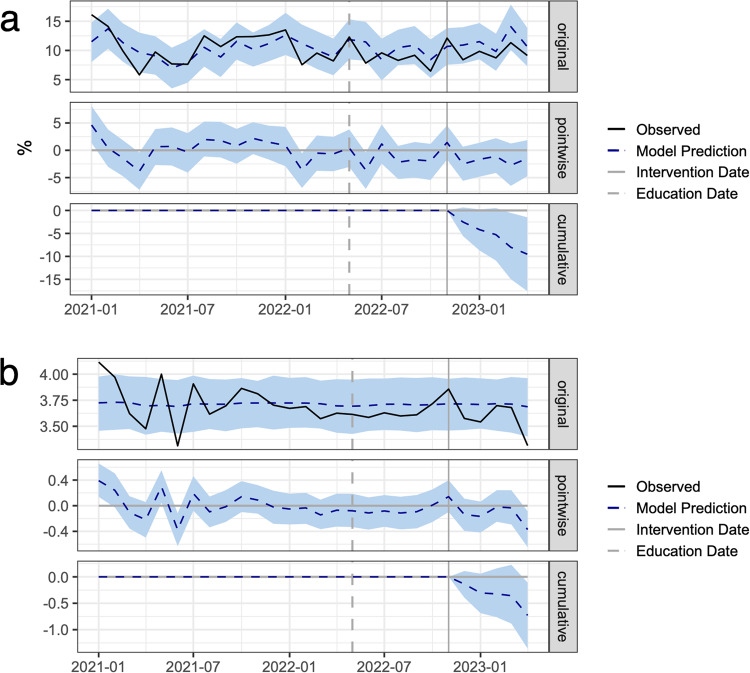
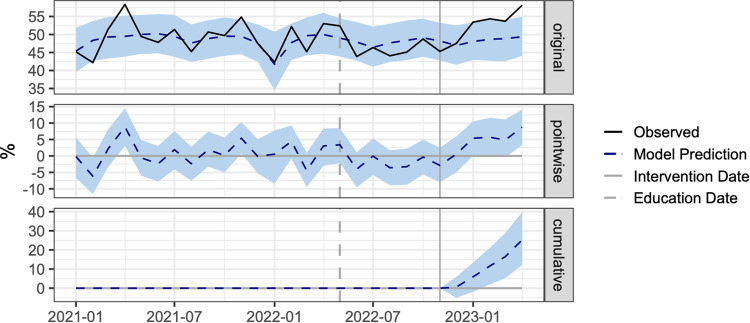
Sepsis remains a major cause of mortality and morbidity worldwide. Algorithms that assist with the early recognition of sepsis may improve outcomes, but relatively few studies have examined their impact on real-world patient outcomes. Our objective was to assess the impact of a deep-learning model (COMPOSER) for the early prediction of sepsis on patient outcomes. We completed a before-and-after quasi-experimental study at two distinct Emergency Departments (EDs) within the UC San Diego Health System. We included 6217 adult septic patients from 1/1/2021 through 4/30/2023. The exposure tested was a nurse-facing Best Practice Advisory (BPA) triggered by COMPOSER. In-hospital mortality, sepsis bundle compliance, 72-h change in sequential organ failure assessment (SOFA) score following sepsis onset, ICU-free days, and the number of ICU encounters were evaluated in the pre-intervention period (705 days) and the post-intervention period (145 days). The causal impact analysis was performed using a Bayesian structural time-series approach with confounder adjustments to assess the significance of the exposure at the 95% confidence level. The deployment of COMPOSER was significantly associated with a 1.9% absolute reduction (17% relative decrease) in in-hospital sepsis mortality (95% CI, 0.3%–3.5%), a 5.0% absolute increase (10% relative increase) in sepsis bundle compliance (95% CI, 2.4%–8.0%), and a 4% (95% CI, 1.1%–7.1%) reduction in 72-h SOFA change after sepsis onset in causal inference analysis. This study suggests that the deployment of COMPOSER for early prediction of sepsis was associated with a significant reduction in mortality and a significant increase in sepsis bundle compliance.
Overview
The claims and statistics of this paper haven’t been checked yet.
Free: it reads the open-access text and checks the first 5 claims that cite a source we can check. Create a free account to check every claim.
Integrity signals
Registry
Cites
Statistics
Figures
Verification
Claims the paper makes
The claims and statistics of this paper haven’t been checked yet.
Free: it reads the open-access text and checks the first 5 claims that cite a source we can check. Create a free account to check every claim.
Claims other papers make about this one
Each is checked against this paper’s own text: does it say what the citing paper says it does?
The source backs part of the claim, not all of it — or backs it for a different population, condition or comparison.
In the citing paper
“Presently, only few AI-based algorithms have shown evidence for improved clinician performance or patient outcomes in clinical studies [6, 16, 17].”
From Use of artificial intelligence in critical care: opportunities and obstacles (2024) · cites this paper as [17]
Experimental — accuracy not yet measuredThe cited source says what the claim attributes to it.
In the citing paper
“A few studies have shown that AI sepsis prediction models were associated with decreased patient mortality; however, they were observational cohorts or before-and-after designs [55,56,57].”
From Artificial Intelligence to Facilitate SEP-1 Measure Compliance and Fluid Management in Sepsis (2026) · cites this paper as [56]
The cited source says what the claim attributes to it.
In the citing paper
“While the overall performance (eg, AUROC) of the new model was generally lower than that reported in other frontier sepsis prediction models, such as COMPOSER,18 Targeted Real-time Early Warning System,19 and SepsisWatch,20”
From Multicenter Prospective Validation of an Updated Proprietary Sepsis Prediction Model (2026) · cites this paper as [18]
Self-check
Percentages, sums and reported differences re-computed from the paper’s own numbers.
The self-check needs the paper’s full text.
Citations
Cites
The third international consensus definitions for sepsis and septic shock (Sepsis-3).
Singer, M., Deutschman, C. S., Seymour, C. W., Shankar-Hari, M., Annane, D., Bauer, M., Bellomo, R., Bernard, G. R., Chiche, J.-D., Coopersmith, C. M., et al. (2016) · JAMA · doi:10.1001/jama.2016.0287 · Cited by 28,250
von Elm, E., Altman, D. G., Egger, M., Pocock, S. J., Gøtzsche, P. C., & Vandenbroucke, J. P. (2007) · The Lancet · doi:10.1016/s0140-6736(07)61602-x · Cited by 21,320
Rudd, K. E., Johnson, S. C., Agesa, K. M., Shackelford, K. A., Tsoi, D., Kievlan, D. R., Colombara, D. V., Ikuta, K. S., Kissoon, N., Finfer, S., et al. (2020) · The Lancet · doi:10.1016/s0140-6736(19)32989-7 · Cited by 7,971 · cited 1×
“Sepsis, a dysregulated host response to infection, is estimated to af fl ict over 48.9 million people a year worldwide of whom approximately 11 million die 1,2 .”
InfluentialSurviving Sepsis Campaign: International guidelines for management of sepsis and septic shock: 2016.
Rhodes, A., Evans, L. E., Alhazzani, W., Levy, M. M., Antonelli, M., Ferrer, R., Kumar, A., Sevransky, J. E., Sprung, C. L., Nunnally, M. E., et al. (2017) · Intensive Care Medicine · doi:10.1007/s00134-017-4683-6 · Cited by 6,621 · cited 3×
“The early recognition of sepsis is critical since interventions such as fl uid resuscitation, antibiotic administration, and source control all have greater bene fi ts when implemented earlier in the disease course 3 – 9 .”
InfluentialKumar, A., Roberts, D., Wood, K. E., Light, B., Parrillo, J. E., Sharma, S., Suppes, R., Feinstein, D., Zanotti, S., Taiberg, L., et al. (2006) · Critical Care Medicine · doi:10.1097/01.ccm.0000217961.75225.e9 · Cited by 6,109
Incidence and trends of sepsis in US hospitals using clinical vs claims data, 2009-2014.
Rhee, C., Dantes, R., Epstein, L., Murphy, D. J., Seymour, C. W., Iwashyna, T. J., Kadri, S. S., Angus, D. C., Danner, R. L., Fiore, A. E., et al. (2017) · JAMA · doi:10.1001/jama.2017.13836 · Cited by 1,884 · cited 1×
“The inclusion of 4 days of non-prophylactic antibiotics to improve the speci fi city of sepsis is similar to what Rhee et al. proposed as a surveillance approach for identifying sepsis from electronic health records which have outperformed reliance on administrative coding of sepsis 39 .”
Ferrer, R., Martin-Loeches, I., Phillips, G., Osborn, T. M., Townsend, S., Dellinger, R. P., Artigas, A., Schorr, C., & Levy, M. M. (2014) · Critical Care Medicine · doi:10.1097/ccm.0000000000000330 · Cited by 1,480
Systematic review of the Exploration, Preparation, Implementation, Sustainment (EPIS) framework
Moullin, J. C., Dickson, K. S., Stadnick, N. A., Rabin, B., & Aarons, G. A. (2019) · Implementation Science · doi:10.1186/s13012-018-0842-6 · Cited by 1,223 · cited 1×
“Implementation of COMPOSER into our electronic health record Implementation was completed in various stages according to the EPIS (exploration, preparation, implementation, sustainment) framework, with frequent feedback provided to nursing staff during the implementation and sustainment periods 42 .”
The timing of early antibiotics and hospital mortality in sepsis.
Liu, V. X., Fielding-Singh, V., Greene, J. D., Baker, J. M., Iwashyna, T. J., Bhattacharya, J., & Escobar, G. J. (2017) · American Journal of Respiratory and Critical Care Medicine · doi:10.1164/rccm.201609-1848oc · Cited by 1,006
Wong, A., Otles, E., Donnelly, J. P., Krumm, A., McCullough, J., DeTroyer-Cooley, O., Pestrue, J., Phillips, M., Konye, J., Penoza, C., et al. (2021) · JAMA Internal Medicine · doi:10.1001/jamainternmed.2021.2626 · Cited by 995 · cited 3×
“20) and an upward trend in ICU-free days (Supplementary Fig.”
Cited by
Items 101–200 of 204
Early Sepsis Detection Using Heterogeneous Structured ICU Data with Explainable Deep Learning
Taparugssanagorn, A., Särestöniemi, M., Hämäläinen, M., & Iinatti, J. (2026) · Sensors · doi:10.3390/s26123648 · Cited by 1
Invisible AI Infrastructure for Safety-Net Healthcare Organizations
Kim, J. Y., Thomas, C., Kpodzro, S., Hasan, A., Patel, M. R., Balu, S., & Sendak, M. (2026) · ACM Conference on Fairness, Accountability, and Transparency (FAccT) · doi:10.1145/3805689.3812211 · Cited by 2
“In this study, we focused on California—a state with an advanced AI development landscape, an early adopter of state AI policies, and a complex and diverse healthcare landscape [7, 24, 38, 45, 58].”
Xu, Y., Veillard, J. H. M., & Kong, J. D. (2026) · Journal of Medical Internet Research · doi:10.2196/95157 · Cited by 1
Can Machine Learning Personalize Cardiovascular Therapy in Sepsis?
Catling, F. J. R., Nagendran, M., Festor, P., Bien, Z., Harris, S. K., Faisal, A. A., Gordon, A. C., & Komorowski, M. (2024) · Critical Care Explorations · doi:10.1097/cce.0000000000001087 · Cited by 3
Just Trial Once: Ongoing Causal Validation of Machine Learning ModelsPreprint
Chen, J. M., & Oberst, M. (2025) · arXiv (Cornell University) · doi:10.48550/arxiv.2502.09467 · Cited by 2
Zhang, R., Zou, J., Beecy, A., Zhang, Y., Bian, J., Melton, G. B., & Tao, C. (2025) · npj Health Systems · doi:10.1038/s44401-025-00014-7 · Cited by 1
Learning Who to Treat When Treatment is MissingPreprint
Sundberg, J., Ghani, R., Ben‐Michael, E., & Kennedy, E. (2026) · arXiv (Cornell University) · doi:10.48550/arxiv.2607.14346 · Cited by 1
Artificial Intelligence to Facilitate SEP-1 Measure Compliance and Fluid Management in Sepsis
Nguyen, H. B., Krishtopaytis, E., Lopez, E., Farnoudi, N., Van, T., Kharalampova, V., & Coz Yataco, A. (2026) · Journal of Clinical Medicine · doi:10.3390/jcm15093477
Haug, J. B. (2024) · Tidsskrift for Den norske legeforening · doi:10.4045/tidsskr.24.0071
Ramesh, K. S., Boussina, A. E., Shashikumar, S. P., Malhotra, A., Longhurst, C., Josef, C. S., Quintero, K., Rosso, J. D., Nemati, S., & Wardi, G. (2024) · doi:10.2196/preprints.62994
Self-citationBejinariu, C. G., Enachescu, V.-A., & Bordianu, A. (2024) · Romanian Journal of Infectious Diseases · doi:10.37897/rjid.2024.2.1
A New Era for the Patient Safety Imperative
VanDenBerg, C. (2024) · Journal of Healthcare Management · doi:10.1097/jhm-d-24-00174
Lower limb salvage in an interesting case of recurrent calf cellulitis
Bejinariu, C. G., Enachescu, V.-A., & Zaharia, I. M. (2024) · Romanian Journal of Infectious Diseases · doi:10.37897/rjid.2024.3.1
Recognizing It Early While Getting It Right: The Value of Novel Sepsis Testing Tools
Shaw, G. (2025) · Emergency Medicine News · doi:10.1097/01.eem.0000000000000009
Leonard, F., Lyttle, M. D., O’Sullivan, D. M., Gilligan, J., Roland, D., & Barrett, M. (2025) · medRxiv · doi:10.1101/2025.07.06.25330977
Wang, Y., Xiong, N., Sheng, M., Wang, S., Cheng, Y., Wang, L., Yang, J., & Wu, Q. (2025) · ETRI Journal · doi:10.4218/etrij.2024-0201
Santamaria, T. (2025) · Primary Care Clinics in Office Practice · doi:10.1016/j.pop.2025.07.006
Quinn, C. E. (2025) · Springer eBooks · doi:10.1007/978-3-032-01613-3_2
Santos, C., Garzón, J. X. R., Pertuz, S. D., & Fajardo, C. A. (2025) · Smart Health · doi:10.1016/j.smhl.2025.100613
Stacked Model Framework for Accurate and Early Sepsis Detection Using Ensemble Learning
Sekar, P., Kapoor, A., Baviskar, S. S., & Gupta, D. (2025) · Communications in computer and information science · doi:10.1007/978-3-032-05144-8_7
The Use of Artificial Intelligence for the Early Detection of Sepsis in the Emergency Department
Ghanam, N., & Paxton, J. H. (2025) · Current Emergency and Hospital Medicine Reports · doi:10.1007/s40138-025-00330-0
Holder, A. L., Abgrall, G., Xiao, R., Kpodonu, J., Nanayakkara, S., Dankwa‐Mullan, I., Zalucky, A. A., Monnet, X., & Goligher, E. C. (2025) · CHEST Critical Care · doi:10.1016/j.chstcc.2025.100215
Role of Nurses in Identifying Early Care Escalation Needs
Alenzi, H. F. H., Alruwaili, S. D., Alruwaili, S. S. S., Alrowily, A. M. H., Alanazi, A. S., Alruwaili, N. G. F., Alhazmi, B. M. M., Alsolabi, A. S. A., Alhazmi, A. N. M., Alanazi, M. B. S., et al. (2024) · International Journal of Computational and Experimental Science and Engineering · doi:10.22399/ijcesen.4652
Cutting Edge Exemplars and Promising Practices
Simms, R. C., Hunt, K. J., & Hill, R. R. (2026) · Springer eBooks · doi:10.1007/978-3-032-12402-9_8
The Role of AI After Cardiac Surgery
Dabbagh, A., Madadi, F., & Sabouri, A. S. (2026) · Springer eBooks · doi:10.1007/978-3-032-01256-2_26
Kilambi, S., & Banavar, M. K. (2026) · Synthesis lectures on technology, management, and entrepreneurship · doi:10.1007/978-3-032-14869-8_7
Reshanjana, R. M. U., Asanka, D., & Rajapaksha, A. D. (2025) · International Conference on Information Technology Research (ICITR) · doi:10.1109/icitr69413.2025.11353655
La metamorfosis de la evidencia: predicciones para la próxima década
Poves‐Álvarez, R., & Tamayo, E. (2026) · Revista Española de Anestesiología y Reanimación · doi:10.1016/j.redar.2026.502050
Ethics Guides Innovation: Reimagining Sepsis Care with Multimodal Generative AI
McGreevy, J., Klang, E., & Nadkarni, G. N. (2026) · The American Journal of Bioethics · doi:10.1080/15265161.2025.2608652
“Similarly, Duke University’s Sepsis Watch achieved a 31 percent mortality reduction and a 62 percent drop in false alarms after introducing a deep-learning workflow combining structured and narrative data (Boussina et al. 2024).”
Pucher, G., Kanjilal, S., Kopp, K., Deep, A., Rostalski, T., Schüler, M., Nensa, F., Kleesiek, J., Reinhardt, C., & Sauer, C. M. (2026) · npj Digital Medicine · doi:10.21203/rs.3.rs-8699032/v1
Real-Time Prediction of Sepsis Onset Using Deep Learning Models on Electronic Health Records (EHR)
Nivashini, G., Jeyasree, D., Chaudhary, V., Preethika, C., Banyal, P., & Illakiya, K. (2025) · DMIHER International Conference on Artificial Intelligence in Healthcare, Education and Industry (IDICAIHEI) · doi:10.1109/idicaihei65991.2025.11378156
Explainable machine learning with routine biomarkers identifies culture-defined bacteremic urosepsis
Zhang, Y.-L., Yu, D.-X., Zheng, Y., Zhang, J., Zhang, S., & Shi, J. (2026) · Scientific Reports · doi:10.1038/s41598-026-42178-8 · Cited by 1
Jin, H., & Lee, H. (2026) · Applied Sciences · doi:10.3390/app16062735
Reshanjana, R. M. U., & Asanka, D. (2025) · International Conference on Innovations in Engineering, Science and Technology for Sustainable Development (ICEST) · doi:10.1109/icest65883.2025.11428516
Arjunan, T., Arjunan, G., Kumar, N. J., Gomathimeena, M., & K., M. B. S. (2026) · International Conference on Computing, Communication, Control and Cyber-Physical Systems (I5CPS) · doi:10.1109/i5cps67958.2026.11452250
Alsuwaiket, M. A. (2026) · Computer Modeling in Engineering & Sciences · doi:10.32604/cmes.2026.078169
Toward a Learning Hospital: The Case for Quality Intelligence Systems
Mate, K. S., Norden, J. G., & Lachs, M. (2026) · The Joint Commission Journal on Quality and Patient Safety · doi:10.1016/j.jcjq.2026.03.010
Billingsley, F. (2026) · Advances in computational intelligence and robotics book series · doi:10.4018/979-8-3373-5906-9.ch009
Federated Learning-Based XGBoost Framework for Privacy-Preserving Sepsis Prediction Using EHRs
Dash, J., Swain, P. K., Satpathy, R. N., & Satpathy, S. (2026) · Lecture notes in networks and systems · doi:10.1007/978-3-032-19529-6_18
AI, Nanobiotechnology, and the Future of Precision Antibiotics: Tailored Therapies for MDR Pathogens
Agustina, D., & Hermansyah, B. (2026) · Advances in computational intelligence and robotics book series · doi:10.4018/979-8-3373-5268-8.ch009
CardioFM: A Multimodal Foundation Model for Joint ECG and PPG Representation LearningPreprint
Hassanuzzaman, M., Choudhary, T., Gent, A., Podgoreanu, M. V., Agarwal, S., Krishnamoorthy, V., Bhavani, S. V., Yang, P., Esper, A. M., & Kamaleswaran, R. (2026) · Research Square · doi:10.21203/rs.3.rs-9652631/v1 · Cited by 3
Walker, J., & Harris, O. (2026) · Bulletin of pioneering researches of medical and clinical science · doi:10.51847/sc1t0nslnl
陈, 丽. (2026) · Advances in Clinical Medicine · doi:10.12677/acm.2026.1651913
The metamorphosis of evidence: Predictions for the next decade
Poves‐Álvarez, R., & Tamayo, E. (2026) · Revista Española de Anestesiología y Reanimación (English Edition) · doi:10.1016/j.redare.2026.502050
Automating infectious disease surveillance and public health reporting
Kim, W., Boussina, A. E., Beatty, M. E., Thomas, H., Shah, S. K., & Aronoff-Spencer, E. S. (2026) · Frontiers in Disaster and Emergency Medicine · doi:10.3389/femer.2026.1804331
Self-citationSameera, K., & Amudhavalli, P. (2026) · Archives for Technical Sciences · doi:10.70102/afts.2026.1835.703
Reis, T. C. (2026) · Artificial Intelligence in Emergency Medicine · doi:10.1016/j.aiemed.2026.100028
Real-time Subgrouping of Sepsis and Systemic Inflammatory Syndromes
McMullan, R. R., Bhavani, S. V., & Sinha, P. (2026) · Critical Care Clinics · doi:10.1016/j.ccc.2026.05.008
Mihailovs, S., Voicehovskis, V., & Pētersons, A. (2026) · Proceedings of the Latvian Academy of Sciences Section B Natural Exact and Applied Sciences · doi:10.2478/prolas-2026-0022
Nellyet, A. N., Kaur, M., & Kaur, N. (2026) · Research Square · doi:10.21203/rs.3.rs-9916580/v1
Chen, X., Wang, L., Qin, W., Yang, M., Yan, Y., Luo, X. P., & Yuan, X. (2026) · Digital Health · doi:10.1177/20552076261466804
Dolmo, S. N., Herrera, K. V., Zúñiga, C., Alfaro, N., Morrison, N., & de Reyes, A. M. M. (2026) · Revista Hispanoamericana de Ciencias de la Salud · doi:10.56239/rhcs.2026.122.1184
Mansour, M., & Donmez, T. B. (2026) · Chaos and fractals. · doi:10.69882/adba.chf.2026072
“…discrimination metrics toward real workflow impact: the COMPOSER deployment study reported that an EHR-integrated deep-learning sepsis predictor was associated with improved sepsis bundle compliance and reduced in-hospital sepsis mortality in two emergency departments (Boussina et al. 2024).”
InfluentialAllison, C., Lu, X., Boussina, A. E., Nemati, S., & Wardi, G. (2026) · npj Health Systems · doi:10.1038/s44401-026-00127-7
Self-citationLi, S., Xie, S., Huang, H., Chen, H., Zhou, M., Zhou, W., Zhang, H., & Wang, X. (2026) · Respiratory Research · doi:10.1186/s12931-026-03860-7
Parzniewski, M., Ostruszka, N., Marusińska, M., Karpiński, M., Czyz, W., Kolawa, S., Markiewicz, W., Borowiec, A., Pilecka, J., & Wojciechowski, J. (2026) · International Journal of Innovative Technologies in Social Science · doi:10.31435/ijitss.3(51).2026.5768
Premkumar, R., Jayaraman, S., Harikrishnan, R., & Visuwasam, L. M. M. (2026) · International Conference on Data Science and Business Systems (ICDSBS) · doi:10.1109/icdsbs69077.2026.11635003
Explainable CaTAHT-Net architecture for early sepsis prediction and frigate bird optimization
Rama, P., Kshirsagar, P. R., Thiagarajan, R., Tak, T. K., & Krishnan, S. B. (2026) · Biomedical Signal Processing and Control · doi:10.1016/j.bspc.2026.111247
The AI Colleague: Reimagining Interprofessional Collaboration and Education in Medicine
Yuh, C., Cho, C., & Lee, Y. (2026) · JMIR Medical Education · doi:10.2196/94034
Integrated rescue: A narrative review of machine learning in hospitalized patient rescue
Koo, C. B. C., Herasevich, V., Diedrich, D. A., Brown, D. R., & Pickering, B. W. (2026) · Intensive Care Science · doi:10.1016/j.iics.2026.08.001
Machine Learning-based Predictive Analytics for Early Detection of Chronic Diseases
Prakash, P. A., Mamtha, C., Manishathri, R., Jimshitha, V., Barani, S., & Mythily., B. (2026) · International Conference on Smart Systems and Inventive Technology (ICSSIT) · doi:10.1109/icssit69151.2026.11656654
Rhee, C., Masur, H., Klompas, M., Bell, T. D., Busch, L. M., Chiotos, K., Classen, D., Gilbert, D., Heil, E. L., Hou, C. H. Y., et al. (2026) · Clinical Infectious Diseases · doi:10.1093/cid/ciag438 · Cited by 2
Artificial Intelligence for Clinical Decision Support in Internal Medicine: A Systematic Review
Taj, M. U., Osman, A. A. M., Habib, F. A. L., Obeid, S. O. E., Babkir, N. O. M., Abdullah, L. M. J., & Mohamed, H. E. A. (2026) · Cureus · doi:10.7759/cureus.115568
Kabil, G., Santos, A. D. L., Ramjan, L. M., Hunt, L., Joseph, H. B., Dungey, J., & Frost, S. A. (2026) · Intensive and Critical Care Nursing · doi:10.1016/j.iccn.2026.104517
Katharakis, G., Rikos, N., Rovithis, M., Papageorgiou, D., & Stavropoulou, A. (2026) · Healthcare · doi:10.3390/healthcare14182887
Al-Sayed, A., & Khalid, O. (2026) · Journal of Artificial Intelligence for Healthcare Systems · doi:10.68159/w932931125
Zheng, C., Chen, H., Jiang, W., Yang, X. Z., Mao, Y., Lan, J., Zhang, X. L., Shi, C., & Chen, Q. (2026) · Journal of Materials Chemistry B · doi:10.1039/d6tb01496h
Finding time zero: how smart diagnostics and AI are reshaping sepsis care
McCurdy, M. T. (2026) · Frontiers in Disaster and Emergency Medicine · doi:10.3389/femer.2026.1898207
Khdir, S. A., & Ahmed, O. H. (2026) · medRxiv · doi:10.64898/2026.09.10.26362699
Belyaev, D. A., Skripkin, I. N., & Smirnov, M. Y. (2026) · Siberian Journal of Life Sciences and Agriculture · doi:10.12731/2658-6649-2026-18-2-1795
Asadollahi, A. (2026) · Research Square · doi:10.21203/rs.3.rs-10989319/v1
Pratiwi, E. S., & Ridhuwan, A. M. A. (2026) · The Indonesian Journal of General Medicine · doi:10.70070/8ev40t44
Anggraini, P. F. (2026) · The Indonesian Journal of General Medicine · doi:10.70070/d6qtne84
Frezza, L. L. C., Borges, L. L. P., Moreira, P. H. M., & Cardoso, R. A. (2026) · Revista Master Ensino Pesquisa e Extensão · doi:10.47224/revistamaster.v11i21.858
Rethinking How We Evaluate Methodological Progress in Health AIPreprint
Pollet, F., & McDermott, M. B. A. (2026) · arXiv (Cornell University) · doi:10.48550/arxiv.2609.18134
Lee, G.-M., Won, J.-Y., Cho, E. Y., Kim, J., Kim, K. J., Lee, Y. S., Lee, H. J., & Kim, J. (2026) · Journal of Medical Internet Research · doi:10.2196/95665 · Cited by 2
In silico biomedicine in the era of artificial intelligence: opportunities and challenges
Mustaffa, F.-E., Sajid, T., Ali, M., & Ashraf, N. M. (2026) · In Silico Research in Biomedicine · doi:10.1016/j.insi.2026.100629
Zhang, Y., Trinh, S. H., Phelan, T., Byrd, T. F., Tourani, R., Kumar, V., Caraballo, P. J., Melton, G. B., & Simon Gyorgy, J. (2026) · Applied Clinical Informatics · doi:10.1055/a-2962-8091
The benefits and biases of artificial intelligence in microbiology
Aransiola, S. A., Onyinoyi, A. H., Akhigbe, J. O., Onoruoiza, S. I., Esenogho, E., & Maddela, N. R. (2026) · Computational Biology and Chemistry · doi:10.1016/j.compbiolchem.2026.109457
Tanji, E., Apu, M. M. H., Rahman, M. S., Tanni, M. M. P., & Hasnain, M. A. (2026) · Frontiers in Applied Engineering and Technology · doi:10.70937/faet.v3i02.116
Shen, Y. H., Zhang, L., Ji, Y., Chen, S., & Shen, W. M. (2026) · PubMed Central · doi:10.3760/cma.j.cn501225-20260519-00200
Ensemble Learning-Based Approach for Proactive Hypoxia Detection in Critical Care Settings
Poleneni, R., Singh, R., Misba, S., Sindhu, M. S., & Kumari, S. (2026) · International Conference on Innovations in Mechanical, Robotics, Computing and Biomedical Engineering (ICIMRBE) · doi:10.1109/icimrbe70745.2026.11710060
Kömürcü, Ö., Durmuşoğlu, Z. D. U., Gümüş, N. E., & Ceylan, T. (2026) · Trends in Anaesthesia and Critical Care · doi:10.1016/j.tacc.2026.101704
Chukuigwe, O., Eribenne, F., & Sydney, E. (2024) · International Journal of Technology Management and Humanities · doi:10.21590/ijtmh20241004416
Komin, Z. J., Kabat, E. Z., Kozłowska, M. J., Konopka, K., Majchrzak, M. K., Kołodziej, F. M., Kwiatkowska, A., Juskowiak, J., Lis, M., & Liasota, M. (2026) · International Journal of Innovative Technologies in Social Science · doi:10.31435/ijitss.4(52).2026.6372
Kosmidis, D., Vlachopoulos, G., Nashwan, A. J., de Carvalho, R. L. R., de Araújo, B. S., Armeni, D., Sertaridou, E. N., & Koutsouki, S. (2026) · Nursing and Health Sciences · doi:10.1111/nhs.70431
Predicting Sepsis in ICU Patients Using GRU-D and LightGBM for Clinical Decision Support
Goel, M., & Popli, R. (2026) · International Journal on Smart Sensing and Intelligent Systems · doi:10.2478/ijssis-2026-0072
Yao, H., Li, Z., Lü, J., & Shen, W. (2026) · Frontiers in Medicine · doi:10.3389/fmed.2026.1942203
Yadgarov, M. Y., Rebrova, O. Y., Shvyrev, S. L., Бондоевич, Б. Л., Polyakov, P. A., Yakovlev, A. А., & Likhvantsev, V. V. (2026) · Vrach i informacionnye tehnologii · doi:10.25881/18110193_2026_3_150
Yu, Y. (2026) · Research Square · doi:10.21203/rs.3.rs-11460866/v1
AI/ML-enabled sepsis prediction systems: laboratory considerations from development to deployment
Durant, T. J. S., Aldewereld, Z., Peaper, D. R., & Wheeler, S. (2026) · Journal of Clinical Microbiology · doi:10.1128/jcm.01461-25 · Cited by 1
“Boussina et al. described a data quality monitoring program implemented alongside COMPOSER, together with a prespecified change control plan (PCCP) to address detected data drift (46).”
Multi-Agent Sepsis Detection and Treatment Planning in ICU Electronic Health Records
Bharath, K., Ravishankar, T. N., Kanagaraj, S., Manimaran, M., Kandasamy, S., & Sindhu, A. (2026) · doi:10.1109/icsl-dsga70378.2026.11736684
Kim, J. H., Kim, Y., Jeong, I., Jung, T., Hong, G., Yoon, H., Lim, K. H., Yoon, H. S., Lim, S., Park, D. H., et al. (2026) · Biomedical Signal Processing and Control · doi:10.1016/j.bspc.2026.111754
Viantoro, Y., & Yuniarmi, F. (2026) · The International Journal of Medical Science and Health Research · doi:10.70070/sehv7w52
Precision Social Medicine: Bridging the Gap Between Social Care and Health Systems Integration
Gabbay, J. M., Garg, A., Cabana, M. D., & Fiori, K. P. (2026) · Hospital Pediatrics · doi:10.1542/hpeds.2026-009715
Luo, J., Luo, J., Wang, F., Cheng, L., Xu, D., Ye, H., Ye, Z., & Qi, Z. (2026) · AI Evidence-Based Medicine · doi:10.1097/ai9.0000000000000017 · Cited by 1
Kanıta Dayalı Hemşirelik ve Yapay Zeka: Kanıtın Klinik Uygulamaya Aktarılması ve Kullanımı
Çağlar, O. (2026) · Özgür Yayınları eBooks · doi:10.58830/ozgur.pub1577.c6490
Yapay Zekâ Çağında Hemşirelik: Dijital Dönüşüm ve Bakım Uygulamaları
Altınbaş, Y. (2026) · Özgür Yayınları eBooks · doi:10.58830/ozgur.pub1577
Metadata
- Authors
- Boussina, A., Shashikumar, S. P., Malhotra, A., Owens, R. L., El-Kareh, R., Longhurst, C. A., Quintero, K., Donahue, A., Chan, T. C., Nemati, S., & Wardi, G.
- Affiliations
- University of California San Diego (US)
- Corresponding author
- Wardi, Gabriel
- ORCID
- Venue
- npj Digital Medicine
- Published
- 2024-01-23
- Volume
- 7
- Issue
- 1
- Pages
- 14-14
- ISSN
- 2398-6352 (ISSN-L)
- PMC
- PMC10805720
- OpenAlex
- W4391168223
- Semantic Scholar
- 6a13c21e115bb54101f07035e556ae8882f7f950
- Cited by
- 170
- References
- 47
- Citations by year
- 2026: 69 · 2025: 80 · 2024: 21
- FWCI
- 51.87
- Type
- journal article
- Language
- en
- Update notices
- correction (2024-06-12)
- Open access
- gold
- doi.org
- Licence
- cc-by
- creativecommons.org/licenses/by/4.0 (tdm)
- creativecommons.org/licenses/by/4.0 (vor)
- Locations
- npj Digital Medicine (publishedVersion, cc-by)
- PubMed Central (publishedVersion, cc-by)
- PubMed (publishedVersion)
- eScholarship (California Digital Library) (submittedVersion, cc-by)
- DOAJ (DOAJ: Directory of Open Access Journals) (submittedVersion, cc-by-sa)
- Funders
- U.S. Department of Health & Human Services | National Institutes of Health (K23GM146092, R01LM013998, R01HL157985, R35GM143121)
- U.S. Department of Health & Human Services | NIH | U.S. National Library of Medicine (2T15LM011271-11)
- Topics
- Health Sciences › Medicine › Critical Care and Intensive Care Medicine › Sepsis Diagnosis and Treatment
- Physical Sciences › Computer Science › Artificial Intelligence › Machine Learning in Healthcare
- Health Sciences › Medicine › Nephrology › Acute Kidney Injury Research
- Keywords
- sepsis, early sepsis prediction, deep learning, composer, clinical decision support, best practice advisory, sepsis bundle compliance, in-hospital mortality, SOFA score, ICU-free days, emergency department, quality of care
About these checks
Registry, retraction, Cites and statistics results are computed, not judged, with one exception: a printed reference that no index lists is read once by a model before it counts as a citation error. Claims are extracted by a model and kept only when their quote appears verbatim in the text; each cited source is then checked, with a model’s help, for whether it says what the claim relies on. Those verdicts can be wrong — read the claim’s quote and the cited source before relying on one.
Statistics and arithmetic are recomputed, not judged.
Confidence bands are shown only for fields calibrated on our annotated test set. None is calibrated yet, so no band is shown.
What counts as a claim ›How we measure confidence ›How we check this ›
Are you an author, or do you see a problem with this page? Request a review
Data sources
Bibliographic data: Semantic Scholar, OpenAlex, Crossref.
Contains information from the Semantic Scholar Academic Graph Datasets, made available under the ODC Attribution License (ODC-BY 1.0).
Semantic Scholar’s data is described in: Kinney, R., et al. (2023). The Semantic Scholar Open Data Platform. arXiv:2301.10140.
