

Impact of a deep learning sepsis prediction model on quality of care and survival
Open accessThe DOI matches its Crossref record; 48 of the 48 references it cites were found in a registry or an index.
Abstract
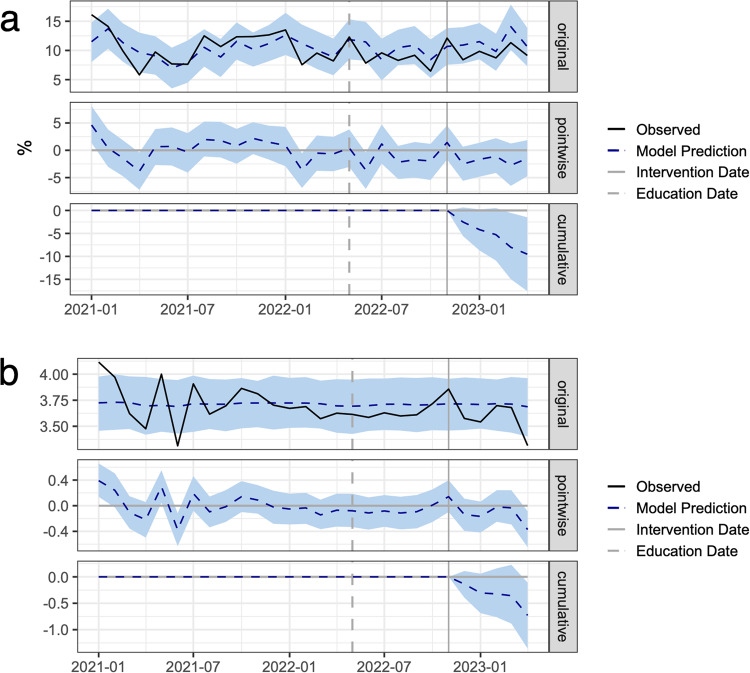
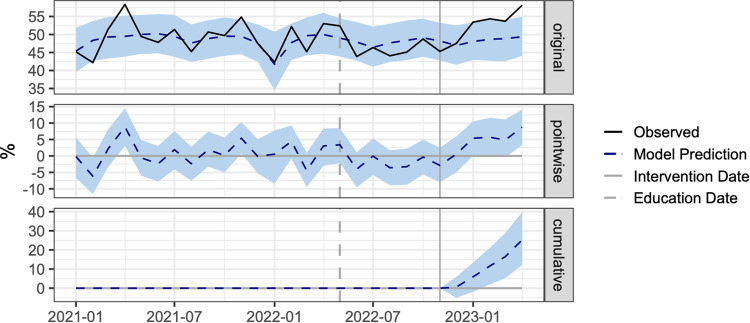
Sepsis remains a major cause of mortality and morbidity worldwide. Algorithms that assist with the early recognition of sepsis may improve outcomes, but relatively few studies have examined their impact on real-world patient outcomes. Our objective was to assess the impact of a deep-learning model (COMPOSER) for the early prediction of sepsis on patient outcomes. We completed a before-and-after quasi-experimental study at two distinct Emergency Departments (EDs) within the UC San Diego Health System. We included 6217 adult septic patients from 1/1/2021 through 4/30/2023. The exposure tested was a nurse-facing Best Practice Advisory (BPA) triggered by COMPOSER. In-hospital mortality, sepsis bundle compliance, 72-h change in sequential organ failure assessment (SOFA) score following sepsis onset, ICU-free days, and the number of ICU encounters were evaluated in the pre-intervention period (705 days) and the post-intervention period (145 days). The causal impact analysis was performed using a Bayesian structural time-series approach with confounder adjustments to assess the significance of the exposure at the 95% confidence level. The deployment of COMPOSER was significantly associated with a 1.9% absolute reduction (17% relative decrease) in in-hospital sepsis mortality (95% CI, 0.3%–3.5%), a 5.0% absolute increase (10% relative increase) in sepsis bundle compliance (95% CI, 2.4%–8.0%), and a 4% (95% CI, 1.1%–7.1%) reduction in 72-h SOFA change after sepsis onset in causal inference analysis. This study suggests that the deployment of COMPOSER for early prediction of sepsis was associated with a significant reduction in mortality and a significant increase in sepsis bundle compliance.
Overview
The claims and statistics of this paper haven’t been checked yet.
Free: it reads the open-access text and checks the first 5 claims that cite a source we can check. Create a free account to check every claim.
Integrity signals
Registry
Cites
Statistics
Figures
Verification
Claims the paper makes
The claims and statistics of this paper haven’t been checked yet.
Free: it reads the open-access text and checks the first 5 claims that cite a source we can check. Create a free account to check every claim.
Claims other papers make about this one
Each is checked against this paper’s own text: does it say what the citing paper says it does?
The source backs part of the claim, not all of it — or backs it for a different population, condition or comparison.
In the citing paper
“Presently, only few AI-based algorithms have shown evidence for improved clinician performance or patient outcomes in clinical studies [6, 16, 17].”
From Use of artificial intelligence in critical care: opportunities and obstacles (2024) · cites this paper as [17]
Experimental — accuracy not yet measuredThe cited source says what the claim attributes to it.
In the citing paper
“A few studies have shown that AI sepsis prediction models were associated with decreased patient mortality; however, they were observational cohorts or before-and-after designs [55,56,57].”
From Artificial Intelligence to Facilitate SEP-1 Measure Compliance and Fluid Management in Sepsis (2026) · cites this paper as [56]
The cited source says what the claim attributes to it.
In the citing paper
“While the overall performance (eg, AUROC) of the new model was generally lower than that reported in other frontier sepsis prediction models, such as COMPOSER,18 Targeted Real-time Early Warning System,19 and SepsisWatch,20”
From Multicenter Prospective Validation of an Updated Proprietary Sepsis Prediction Model (2026) · cites this paper as [18]
Self-check
Percentages, sums and reported differences re-computed from the paper’s own numbers.
The self-check needs the paper’s full text.
Citations
Cites
The third international consensus definitions for sepsis and septic shock (Sepsis-3).
Singer, M., Deutschman, C. S., Seymour, C. W., Shankar-Hari, M., Annane, D., Bauer, M., Bellomo, R., Bernard, G. R., Chiche, J.-D., Coopersmith, C. M., et al. (2016) · JAMA · doi:10.1001/jama.2016.0287 · Cited by 28,250
von Elm, E., Altman, D. G., Egger, M., Pocock, S. J., Gøtzsche, P. C., & Vandenbroucke, J. P. (2007) · The Lancet · doi:10.1016/s0140-6736(07)61602-x · Cited by 21,320
Rudd, K. E., Johnson, S. C., Agesa, K. M., Shackelford, K. A., Tsoi, D., Kievlan, D. R., Colombara, D. V., Ikuta, K. S., Kissoon, N., Finfer, S., et al. (2020) · The Lancet · doi:10.1016/s0140-6736(19)32989-7 · Cited by 7,971 · cited 1×
“Sepsis, a dysregulated host response to infection, is estimated to af fl ict over 48.9 million people a year worldwide of whom approximately 11 million die 1,2 .”
InfluentialSurviving Sepsis Campaign: International guidelines for management of sepsis and septic shock: 2016.
Rhodes, A., Evans, L. E., Alhazzani, W., Levy, M. M., Antonelli, M., Ferrer, R., Kumar, A., Sevransky, J. E., Sprung, C. L., Nunnally, M. E., et al. (2017) · Intensive Care Medicine · doi:10.1007/s00134-017-4683-6 · Cited by 6,621 · cited 3×
“The early recognition of sepsis is critical since interventions such as fl uid resuscitation, antibiotic administration, and source control all have greater bene fi ts when implemented earlier in the disease course 3 – 9 .”
InfluentialKumar, A., Roberts, D., Wood, K. E., Light, B., Parrillo, J. E., Sharma, S., Suppes, R., Feinstein, D., Zanotti, S., Taiberg, L., et al. (2006) · Critical Care Medicine · doi:10.1097/01.ccm.0000217961.75225.e9 · Cited by 6,109
Incidence and trends of sepsis in US hospitals using clinical vs claims data, 2009-2014.
Rhee, C., Dantes, R., Epstein, L., Murphy, D. J., Seymour, C. W., Iwashyna, T. J., Kadri, S. S., Angus, D. C., Danner, R. L., Fiore, A. E., et al. (2017) · JAMA · doi:10.1001/jama.2017.13836 · Cited by 1,884 · cited 1×
“The inclusion of 4 days of non-prophylactic antibiotics to improve the speci fi city of sepsis is similar to what Rhee et al. proposed as a surveillance approach for identifying sepsis from electronic health records which have outperformed reliance on administrative coding of sepsis 39 .”
Ferrer, R., Martin-Loeches, I., Phillips, G., Osborn, T. M., Townsend, S., Dellinger, R. P., Artigas, A., Schorr, C., & Levy, M. M. (2014) · Critical Care Medicine · doi:10.1097/ccm.0000000000000330 · Cited by 1,480
Systematic review of the Exploration, Preparation, Implementation, Sustainment (EPIS) framework
Moullin, J. C., Dickson, K. S., Stadnick, N. A., Rabin, B., & Aarons, G. A. (2019) · Implementation Science · doi:10.1186/s13012-018-0842-6 · Cited by 1,223 · cited 1×
“Implementation of COMPOSER into our electronic health record Implementation was completed in various stages according to the EPIS (exploration, preparation, implementation, sustainment) framework, with frequent feedback provided to nursing staff during the implementation and sustainment periods 42 .”
The timing of early antibiotics and hospital mortality in sepsis.
Liu, V. X., Fielding-Singh, V., Greene, J. D., Baker, J. M., Iwashyna, T. J., Bhattacharya, J., & Escobar, G. J. (2017) · American Journal of Respiratory and Critical Care Medicine · doi:10.1164/rccm.201609-1848oc · Cited by 1,006
Wong, A., Otles, E., Donnelly, J. P., Krumm, A., McCullough, J., DeTroyer-Cooley, O., Pestrue, J., Phillips, M., Konye, J., Penoza, C., et al. (2021) · JAMA Internal Medicine · doi:10.1001/jamainternmed.2021.2626 · Cited by 995 · cited 3×
“20) and an upward trend in ICU-free days (Supplementary Fig.”
Inferring causal impact using Bayesian structural time-series models
Brodersen, K. H., Gallusser, F., Koehler, J., Remy, N., & Scott, S. L. (2015) · The Annals of Applied Statistics · doi:10.1214/14-aoas788 · Cited by 961 · cited 2×
“…and completion of a 30 mL/kg crystalloid fl uid bolus, checking of blood cultures prior to antibiotics, and initiation of intravenous antibiotics within 3 h of time of sepsis), 72-h change in sequential organ failure assessment (SOFA) score following sepsis onset, ICU admission, and ICU-free days.”
An interpretable machine learning model for accurate prediction of sepsis in the ICU
Nemati, S., Holder, A., Razmi, F., Stanley, M. D., Clifford, G. D., & Buchman, T. G. (2018) · Critical Care Medicine · doi:10.1097/ccm.0000000000002936 · Cited by 832
Self-citationA targeted real-time early warning score (TREWScore) for septic shock.
Henry, K. E., Hager, D. N., Pronovost, P. J., & Saria, S. (2015) · Science Translational Medicine · doi:10.1126/scitranslmed.aab3719 · Cited by 598 · cited 1×
“The detection of patients with sepsis can be challenging due to the heterogeneity of the condition; thus, we and others have used predictive analytics to improve the early detection 10 – 14 .”
Lauritsen, S. M., Kristensen, M., Olsen, M. V., Larsen, M. S., Lauritsen, K. M., Jørgensen, M. J., Lange, J., & Thiesson, B. (2020) · Nature Communications · doi:10.1038/s41467-020-17431-x · Cited by 448
Goh, K. H., Wang, L., Yeow, A. Y. K., Poh, H., Li, K., Yeow, J. J. L., & Tan, G. Y. H. (2021) · Nature Communications · doi:10.1038/s41467-021-20910-4 · Cited by 415
Early Prediction of Sepsis From Clinical Data: The PhysioNet/Computing in Cardiology Challenge 2019
Reyna, M. A., Josef, C. S., Jeter, R., Shashikumar, S. P., Westover, M. B., Nemati, S., Clifford, G. D., & Sharma, A. (2020) · Critical Care Medicine · doi:10.1097/ccm.0000000000004145 · Cited by 383
Self-citationShimabukuro, D. W., Barton, C. W., Feldman, M. D., Mataraso, S. J., & Das, R. (2017) · BMJ Open Respiratory Research · doi:10.1136/bmjresp-2017-000234 · Cited by 382 · cited 2×
“18 and 19.”
Adams, R., Henry, K. E., Sridharan, A., Soleimani, H., Zhan, A., Rawat, N., Johnson, L., Hager, D. N., Cosgrove, S. E., Markowski, A., et al. (2022) · Nature Medicine · doi:10.1038/s41591-022-01894-0 · Cited by 365 · cited 2×
“Implementation of the COMPOSER BPA was signi fi cantly associated with an increase in sepsis bundle compliance. was con fi rmed by a provider 16 .”
Sendak, M. P., Ratliff, W., Sarro, D., Alderton, E., Futoma, J., Gao, M., Nichols, M., Revoir, M., Yashar, F., Miller, C., et al. (2020) · JMIR Medical Informatics · doi:10.2196/15182 · Cited by 287 · cited 1×
“To the best of our knowledge, the only deep-learning model previously tested in an ED setting is the Sepsis Watch by investigators at Duke; however, no patient-centered outcomes have been reported thus far 28 .”
Giannini, H. M., Ginestra, J. C., Chivers, C., Draugelis, M., Hanish, A., Schweickert, W. D., Fuchs, B. D., Meadows, L., Lynch, M., Donnelly, P. J., et al. (2019) · Critical Care Medicine · doi:10.1097/ccm.0000000000003891 · Cited by 269
ED door-to-antibiotic time and long-term mortality in sepsis.
Peltan, I. D., Brown, S. M., Bledsoe, J. R., Sorensen, J., Samore, M. H., Allen, T. L., & Hough, C. L. (2019) · Chest · doi:10.1016/j.chest.2019.02.008 · Cited by 243
Seasonal variation in the epidemiology of sepsis*
Danai, P. A., Sinha, S., Moss, M., Haber, M. J., & Martin, G. S. (2007) · Critical Care Medicine · doi:10.1097/01.ccm.0000253405.17038.43 · Cited by 200 · cited 1×
“We included seasons and local trends (e.g., ED volume) as prior data suggest outcomes of sepsis patients are worse in the winter and may be impacted by high patient volumes 48,49 .”
Takyi, P. O., & Bentum-Ennin, I. (2021) · Journal of Economics and Business · doi:10.1016/j.jeconbus.2020.105968 · Cited by 169 · cited 1×
“This approach, pioneered by Brodersen et al. from Google Inc., has been widely used to assess the impact of advertisement campaigns on product sales and the effect of economic changes on markets 45 – 47 .”
Detection of calibration drift in clinical prediction models to inform model updating
Davis, S. E., Greevy, R. A., Lasko, T. A., Walsh, C. G., & Matheny, M. E. (2020) · Journal of Biomedical Informatics · doi:10.1016/j.jbi.2020.103611 · Cited by 160 · cited 1×
“Prospectively deployed algorithms are susceptible to model drift in which their performance degrades overtime due to changes in the patient population or treatment practices 41 .”
McCoy, A., & Das, R. (2017) · BMJ Open Quality · doi:10.1136/bmjoq-2017-000158 · Cited by 148
Artificial intelligence sepsis prediction algorithm learns to say “I don’t know”
Shashikumar, S. P., Wardi, G., Malhotra, A., & Nemati, S. (2021) · npj Digital Medicine · doi:10.1038/s41746-021-00504-6 · Cited by 125
Self-citationMakam, A. N., Nguyen, O. K., & Auerbach, A. D. (2015) · Journal of Hospital Medicine · doi:10.1002/jhm.2347 · Cited by 99 · cited 1×
“These models were associated with occasional improvement in quality metrics (i.e., increased rates of lactate orders or time to antibiotics), but did not improve patient-centered outcomes and had poor PPV 25 – 27 .”
Wardi, G., Carlile, M., Holder, A., Shashikumar, S., Hayden, S. R., & Nemati, S. (2021) · Annals of Emergency Medicine · doi:10.1016/j.annemergmed.2020.11.007 · Cited by 96 · cited 1×
“Additionally, this class of models provides a fl exible framework for transfer learning and continual learning to enable the adoption of such models to local healthcare settings 33 – 35 .”
Self-citationBektaş, M., Tuynman, J. B., Pereira, J. C., Burchell, G. L., & van der Peet, D. L. (2022) · World Journal of Surgery · doi:10.1007/s00268-022-06728-1 · Cited by 83
Effect of an electronic medical record alert for severe sepsis among ED patients
Narayanan, N., Gross, K., Pintens, M., Fee, C. R., & MacDougall, C. (2015) · The American Journal of Emergency Medicine · doi:10.1016/j.ajem.2015.10.005 · Cited by 77 · cited 5×
“These models were associated with occasional improvement in quality metrics (i.e., increased rates of lactate orders or time to antibiotics), but did not improve patient-centered outcomes and had poor PPV 25 – 27 .”
InfluentialCausal impact analysis for app releases in google play
Martin, W., Sarro, F., & Harman, M. (2016) · Proceedings of the 2016 24th ACM SIGSOFT International Symposium on Foundations of Software Engineering · doi:10.1145/2950290.2950320 · Cited by 71 · cited 1×
“This approach, pioneered by Brodersen et al. from Google Inc., has been widely used to assess the impact of advertisement campaigns on product sales and the effect of economic changes on markets 45 – 47 .”
Lyons, P. G., Hofford, M. R., Yu, S. C., Michelson, A. P., Payne, P. R. O., Hough, C. L., & Singh, K. (2023) · JAMA Internal Medicine · doi:10.1001/jamainternmed.2022.7182 · Cited by 62 · cited 2×
“21) although neither reaches statistical signi fi cance.”
What effect did the introduction of Bitcoin futures have on the Bitcoin spot market?
Jalan, A., Matkovskyy, R., & Urquhart, A. (2021) · European Journal of Finance · doi:10.1080/1351847x.2020.1869992 · Cited by 60
The severe sepsis bundles as processes of care: A meta-analysis
Chamberlain, D. J., Willis, E., & Bersten, A. D. (2011) · Australian Critical Care · doi:10.1016/j.aucc.2011.01.003 · Cited by 58
Bending the patient safety curve: how much can AI help?
Classen, D. C., Longhurst, C., & Thomas, E. J. (2023) · npj Digital Medicine · doi:10.1038/s41746-022-00731-5 · Cited by 52 · cited 1×
“The potential to improve care through the use of arti fi cial intelligence is attractive, particularly with advances in machine learning in the past decade 22,23 .”
Self-citationMultiscale network representation of physiological time series for early prediction of sepsis
Shashikumar, S. P., Li, Q., Clifford, G. D., & Nemati, S. (2017) · Physiological Measurement · doi:10.1088/1361-6579/aa9772 · Cited by 51
Self-citationSwamped: Emergency Department Crowding and Patient Mortality
Woodworth, L. (2019) · Journal of Health Economics · doi:10.1016/j.jhealeco.2019.102279 · Cited by 45
Amrollahi, F., Shashikumar, S. P., Holder, A. L., & Nemati, S. (2022) · Scientific Reports · doi:10.1038/s41598-022-12497-7 · Cited by 44 · cited 1×
“Additionally, this class of models provides a fl exible framework for transfer learning and continual learning to enable the adoption of such models to local healthcare settings 33 – 35 .”
Self-citationCarlile, M., Hurt, B., Hsiao, A., Hogarth, M., Longhurst, C. A., & Dameff, C. (2020) · JACEP Open · doi:10.1002/emp2.12297 · Cited by 38
Self-citationContextual Embeddings from Clinical Notes Improves Prediction of SepsisPreprint
Amrollahi, F., Shashikumar, S. P., Razmi, F., & Nemati, S. (2021) · medRxiv · doi:10.1101/2021.03.02.21252779 · Cited by 38
Self-citationBirnbaum, A., Bijur, P., Kuperman, G., Gennis, P., & Berger, T. (2010) · Applied Clinical Informatics · doi:10.4338/aci-2010-09-ra-0054 · Cited by 37 · cited 1×
“Prior work demonstrated that at this sensitivity, the PPV was 20.1%.”
InfluentialLi, R. C., Smith, M., Lu, J., Avati, A., Wang, S., Teuteberg, W. G., Shum, K., Hong, G., Seevaratnam, B., Westphal, J., et al. (2022) · NEJM Catalyst · doi:10.1056/cat.21.0457 · Cited by 37 · cited 1×
“The use of arti fi cial intelligence to facilitate a shared mental model of risk between nursing staff and providers has demonstrated good acceptance and improved use of these models in other clinical areas 36 .”
Wardi, G., Owens, R., Josef, C., Malhotra, A., Longhurst, C., & Nemati, S. (2023) · Critical Care Medicine · doi:10.1097/ccm.0000000000005894 · Cited by 35
Self-citationA Locally Optimized Data-Driven Tool to Predict Sepsis-Associated Vasopressor Use in the ICU
Holder, A. L., Shashikumar, S. P., Wardi, G., Buchman, T. G., & Nemati, S. (2021) · Critical Care Medicine · doi:10.1097/ccm.0000000000005175 · Cited by 26
Self-citationDevelopment & Deployment of a Real-time Healthcare Predictive Analytics Platform
Boussina, A. E., Shashikumar, S. P., Amrollahi, F., Pour, H., Hogarth, M. A., & Nemati, S. (2023) · Annual International Conference of the IEEE Engineering in Medicine and Biology Society (EMBC) · doi:10.1109/embc40787.2023.10340351 · Cited by 18
Self-citationEvaluation of a Sepsis Alert in the Pediatric Acute Care Setting
Gibbs, K. D., Shi, Y. P., Sanders, N., Bodnar, A., Brown, T. L., Shah, M. D., & Hess, L. M. (2021) · Applied Clinical Informatics · doi:10.1055/s-0041-1730027 · Cited by 16 · cited 1×
“This fi nding has been reported in other sepsis clinical decision tools as well 37 .”
Predicting Hospital Readmission among Patients with Sepsis Using Clinical and Wearable Data
Amrollahi, F., Shashikumar, S. P., Boussina, A. E., Yhdego, H., Nayebnazar, A., Yung, N., Wardi, G., & Nemati, S. (2023) · Annual International Conference of the IEEE Engineering in Medicine and Biology Society (EMBC) · doi:10.1109/embc40787.2023.10341165 · Cited by 10 · cited 1×
“Moreover, deep-learning models are capable of handling large quantities of multimodal data from radiology imaging, clinical notes, and wearable sensors, among other 29 – 32 .”
Self-citationPredicting Hospital Readmission among Patients with Sepsis using Clinical and Wearable DataPreprint
Amrollahi, F., Shashikumar, S. P., Yhdego, H., et al. (2023) · medRxiv · doi:10.1101/2023.04.10.23288368 · Cited by 5
Self-citation
Cited by
Poon, E. G., Lemak, C. H., Rojas, J. C., Guptill, J., & Classen, D. (2025) · Journal of the American Medical Informatics Association · doi:10.1093/jamia/ocaf065 · Cited by 143
AI, Health, and Health Care Today and Tomorrow: The JAMA Summit Report on Artificial Intelligence
Angus, D. C., Khera, R., Lieu, T., Liu, V., Ahmad, F. S., Anderson, B., Bhavani, S. V., Bindman, A., Brennan, T., Celi, L. A., et al. (2025) · JAMA · doi:10.1001/jama.2025.18490 · Cited by 195
Self-citationUse of artificial intelligence in critical care: opportunities and obstacles
Pinsky, M. R., Bedoya, A., Bihorac, A., Celi, L., Churpek, M., Economou-Zavlanos, N. J., Elbers, P., Saria, S., Liu, V., Lyons, P. G., et al. (2024) · Critical Care · doi:10.1186/s13054-024-04860-z · Cited by 160
Prediction of sepsis mortality in ICU patients using machine learning methods
Gao, J., Lu, Y., Ashrafi, N., Domingo, I., Alaei, K., & Pishgar, M. (2024) · BMC Medical Informatics and Decision Making · doi:10.1186/s12911-024-02630-z · Cited by 146
Federated learning in intrusion detection: advancements, applications, and future directions
Büyüktanır, B., Altınkaya, Ş., Baydoğmus, G. K., & Yıldız, K. (2025) · Cluster Computing · doi:10.1007/s10586-025-05325-w · Cited by 141
Metadata
- Authors
- Boussina, A., Shashikumar, S. P., Malhotra, A., Owens, R. L., El-Kareh, R., Longhurst, C. A., Quintero, K., Donahue, A., Chan, T. C., Nemati, S., & Wardi, G.
- Affiliations
- University of California San Diego (US)
- Corresponding author
- Wardi, Gabriel
- ORCID
- Venue
- npj Digital Medicine
- Published
- 2024-01-23
- Volume
- 7
- Issue
- 1
- Pages
- 14-14
- ISSN
- 2398-6352 (ISSN-L)
- PMC
- PMC10805720
- OpenAlex
- W4391168223
- Semantic Scholar
- 6a13c21e115bb54101f07035e556ae8882f7f950
- Cited by
- 170
- References
- 47
- Citations by year
- 2026: 69 · 2025: 80 · 2024: 21
- FWCI
- 51.87
- Type
- journal article
- Language
- en
- Update notices
- correction (2024-06-12)
- Open access
- gold
- doi.org
- Licence
- cc-by
- creativecommons.org/licenses/by/4.0 (tdm)
- creativecommons.org/licenses/by/4.0 (vor)
- Locations
- npj Digital Medicine (publishedVersion, cc-by)
- PubMed Central (publishedVersion, cc-by)
- PubMed (publishedVersion)
- eScholarship (California Digital Library) (submittedVersion, cc-by)
- DOAJ (DOAJ: Directory of Open Access Journals) (submittedVersion, cc-by-sa)
- Funders
- U.S. Department of Health & Human Services | National Institutes of Health (K23GM146092, R01LM013998, R01HL157985, R35GM143121)
- U.S. Department of Health & Human Services | NIH | U.S. National Library of Medicine (2T15LM011271-11)
- Topics
- Health Sciences › Medicine › Critical Care and Intensive Care Medicine › Sepsis Diagnosis and Treatment
- Physical Sciences › Computer Science › Artificial Intelligence › Machine Learning in Healthcare
- Health Sciences › Medicine › Nephrology › Acute Kidney Injury Research
- Keywords
- sepsis, early sepsis prediction, deep learning, composer, clinical decision support, best practice advisory, sepsis bundle compliance, in-hospital mortality, SOFA score, ICU-free days, emergency department, quality of care
About these checks
Registry, retraction, Cites and statistics results are computed, not judged, with one exception: a printed reference that no index lists is read once by a model before it counts as a citation error. Claims are extracted by a model and kept only when their quote appears verbatim in the text; each cited source is then checked, with a model’s help, for whether it says what the claim relies on. Those verdicts can be wrong — read the claim’s quote and the cited source before relying on one.
Statistics and arithmetic are recomputed, not judged.
Confidence bands are shown only for fields calibrated on our annotated test set. None is calibrated yet, so no band is shown.
What counts as a claim ›How we measure confidence ›How we check this ›
Are you an author, or do you see a problem with this page? Request a review
Data sources
Bibliographic data: Semantic Scholar, OpenAlex, Crossref.
Contains information from the Semantic Scholar Academic Graph Datasets, made available under the ODC Attribution License (ODC-BY 1.0).
Semantic Scholar’s data is described in: Kinney, R., et al. (2023). The Semantic Scholar Open Data Platform. arXiv:2301.10140.
