

The DOI matches its Crossref record; 32 of the 32 references it cites were found in a registry or an index.
Artificial intelligence-enabled ECG for left ventricular diastolic function and filling pressure
Open accessAbstract
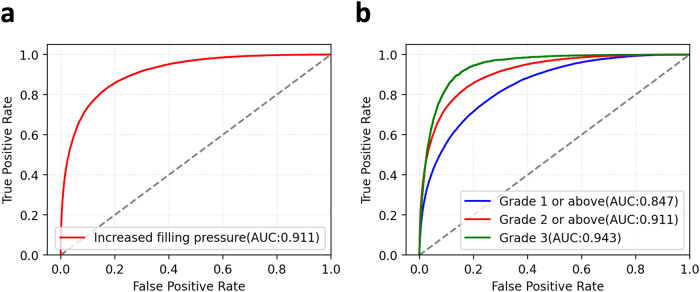
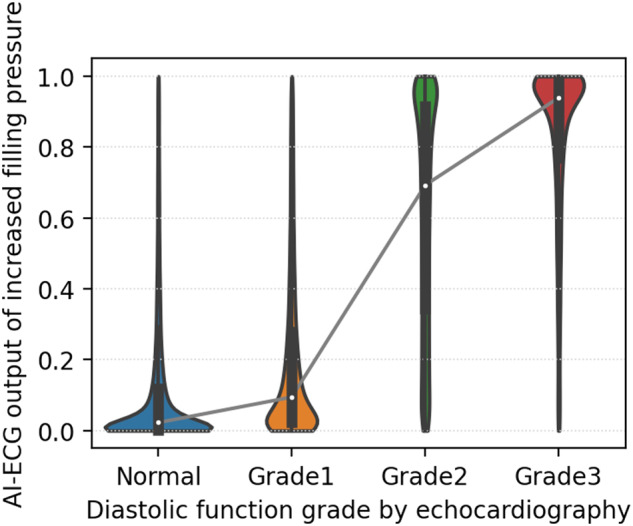
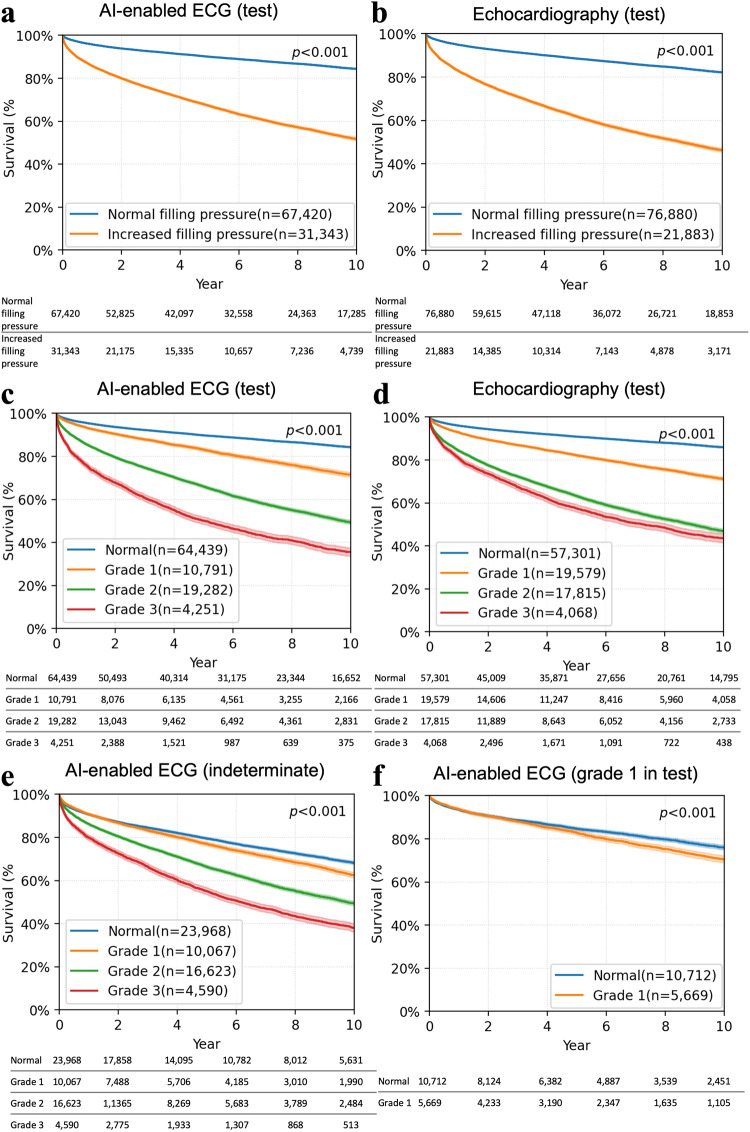
Assessment of left ventricular diastolic function plays a major role in the diagnosis and prognosis of cardiac diseases, including heart failure with preserved ejection fraction. We aimed to develop an artificial intelligence (AI)-enabled electrocardiogram (ECG) model to identify echocardiographically determined diastolic dysfunction and increased filling pressure. We trained, validated, and tested an AI-enabled ECG in 98,736, 21,963, and 98,763 patients, respectively, who had an ECG and echocardiographic diastolic function assessment within 14 days with no exclusion criteria. It was also tested in 55,248 patients with indeterminate diastolic function by echocardiography. The model was evaluated using the area under the curve (AUC) of the receiver operating characteristic curve, and its prognostic performance was compared to echocardiography. The AUC for detecting increased filling pressure was 0.911. The AUCs to identify diastolic dysfunction grades ≥1, ≥2, and 3 were 0.847, 0.911, and 0.943, respectively. During a median follow-up of 5.9 years, 20,223 (20.5%) died. Patients with increased filling pressure predicted by AI-ECG had higher mortality than those with normal filling pressure, after adjusting for age, sex, and comorbidities in the test group (hazard ratio (HR) 1.7, 95% CI 1.645–1.757) similar to echocardiography and in the indeterminate group (HR 1.34, 95% CI 1.298–1.383). An AI-enabled ECG identifies increased filling pressure and diastolic function grades with a good prognostic value similar to echocardiography. AI-ECG is a simple and promising tool to enhance the detection of diseases associated with diastolic dysfunction and increased diastolic filling pressure.
Overview
The claims and statistics of this paper haven’t been checked yet.
Run the check — free, no account needed. It reads the open-access text and checks the sources it cites.
Integrity signals
Registry
Cites
Statistics
Figures
Verification
Claims the paper makes
The claims and statistics of this paper haven’t been checked yet.
Run the check — free, no account needed. It reads the open-access text and checks the sources it cites.
Claims other papers make about this one
Each is checked against this paper’s own text: does it say what the citing paper says it does?
The cited source says what the claim attributes to it.
In the citing paper
“More recent studies have extended this concept by using AI-ECG to predict left ventricular diastolic dysfunction and increased filling pressures [25] and HFpEF-related risk [26].”
From Deep Learning Applied to 12-Lead ECGs for Detection of Structural, Metabolic and Systemic Disease (2026) · cites this paper as [25]
Self-check
Percentages, sums and reported differences re-computed from the paper’s own numbers.
The self-check needs the paper’s full text.
Citations
Cites
Deep Residual Learning for Image Recognition
He, K., Zhang, X., Ren, S., & Sun, J. (2016) · 2016 IEEE Conference on Computer Vision and Pattern Recognition (CVPR) · doi:10.1109/cvpr.2016.90 · Cited by 235,474
Empagliflozin in heart failure with a preserved ejection fraction
Anker, S. D., Butler, J., Filippatos, G., Ferreira, J. P., Bocchi, E., Böhm, M., Brunner–La Rocca, H.-P., Choi, D.-J., Chopra, V., Chuquiure-Valenzuela, E., et al. (2021) · New England Journal of Medicine · doi:10.1056/nejmoa2107038 · Cited by 4,874
Trends in Prevalence and Outcome of Heart Failure with Preserved Ejection Fraction
Owan, T., Hodge, D. O., Herges, R. M., Jacobsen, S. J., Roger, V. L., & Redfield, M. M. (2006) · New England Journal of Medicine · doi:10.1056/nejmoa052256 · Cited by 4,209
Dapagliflozin in Heart Failure with Mildly Reduced or Preserved Ejection Fraction
Solomon, S. D., McMurray, J. J. V., Claggett, B., de Boer, R. A., DeMets, D., Hernandez, A. F., Inzucchi, S. E., Kosiborod, M. N., Lam, C. S. P., Martinez, F., et al. (2022) · New England Journal of Medicine · doi:10.1056/nejmoa2206286 · Cited by 2,884
Nagueh, S. F., Smiseth, O. A., Appleton, C. P., Byrd, B. F., Dokainish, H., Edvardsen, T., Flachskampf, F. A., Gillebert, T. C., Klein, A. L., Lancellotti, P., et al. (2016) · European Heart Journal - Cardiovascular Imaging · doi:10.1093/ehjci/jew082 · Cited by 2,471
Self-citationPieske, B. M., Tschöpe, C., de Boer, R. A., Fraser, A. G., Anker, S. D., Donal, E., Edelmann, F., Fu, M. L. X., Guazzi, M., Lam, C. S. P., et al. (2019) · European Heart Journal · doi:10.1093/eurheartj/ehz641 · Cited by 1,961
Attia, Z. I., Noseworthy, P. A., Lopez-Jimenez, F., Asirvatham, S. J., Deshmukh, A. J., Gersh, B. J., Carter, R. E., Yao, X., Rabinstein, A. A., Erickson, B. J., et al. (2019) · The Lancet · doi:10.1016/s0140-6736(19)31721-0 · Cited by 1,613
Self-citationThe Lancet women and cardiovascular disease Commission: reducing the global burden by 2030
Vogel, B., Mónica Acevedo, B., Appelman, Y., Merz, C. N. B., Chieffo, A., Figtree, G. A., Guerrero, M. E., Kunadian, V., Lam, C. S. P., Maas, A. H. E. M., et al. (2021) · The Lancet · doi:10.1016/s0140-6736(21)00684-x · Cited by 1,587
Attia, Z. I., Kapa, S., Lopez-Jimenez, F., McKie, P. M., Ladewig, D. J., Satam, G., Pellikka, P. A., Enriquez-Sarano, M., Noseworthy, P. A., Munger, T. M., et al. (2019) · Nature Medicine · doi:10.1038/s41591-018-0240-2 · Cited by 1,389
Self-citationThe pathophysiology of heart failure with preserved ejection fraction
Borlaug, B. A. (2014) · Nature Reviews Cardiology · doi:10.1038/nrcardio.2014.83 · Cited by 726
Self-citation
Cited by
Sorted by citations
Nagueh, S. F., Sanborn, D. M. Y., Oh, J. K., Anderson, B. A., Billick, K., Dérumeaux, G., Klein, A. L., Koulogiannis, K. P., Mitchell, C., Shah, A. M., et al. (2025) · Journal of the American Society of Echocardiography · doi:10.1016/j.echo.2025.03.011 · Cited by 474
Self-citationSvennberg, E., Han, J. K., Caiani, E. G., Engelhardt, S., Ernst, S., Friedman, P. A., Garcia, R., Ghanbari, H., Hindricks, G., Man, S. H., et al. (2025) · EP Europace · doi:10.1093/europace/euaf071 · Cited by 98
Self-citationRecent Advances in Wearable Healthcare Devices: From Material to Application
Luo, X., Tan, H., & Wen, W. (2024) · Bioengineering · doi:10.3390/bioengineering11040358 · Cited by 64
Kolk, M. Z. H., Ruipérez-Campillo, S., Wilde, A. A. M., Knops, R. E., Narayan, S. M., & Tjong, F. V. Y. (2024) · Heart Rhythm · doi:10.1016/j.hrthm.2024.09.003 · Cited by 55
Artificial intelligence-enhanced patient evaluation: bridging art and science
Oikonomou, E. K., & Khera, R. (2024) · European Heart Journal · doi:10.1093/eurheartj/ehae415 · Cited by 34
Metadata
- Authors
- Lee, E., Ito, S., Miranda, W. R., Lopez-Jimenez, F., Kane, G. C., Asirvatham, S. J., Noseworthy, P. A., Friedman, P. A., Carter, R. E., Borlaug, B. A., Attia, Z. I., & Oh, J. K.
- Affiliations
- Mayo Clinic (US)
- Corresponding author
- Oh, Jae K.
- ORCID
- Venue
- npj Digital Medicine
- Published
- 2024-01-06
- Volume
- 7
- Issue
- 1
- Pages
- 4-4
- ISSN
- 2398-6352 (ISSN-L)
- PMC
- PMC10770308
- OpenAlex
- W4390630205
- Cited by
- 106
- References
- 32
- Citations by year
- 2026: 42 · 2025: 45 · 2024: 18
- FWCI
- 31.59
- Type
- journal article
- Language
- en
- Open access
- gold
- doi.org
- Locations
- npj Digital Medicine (publishedVersion, cc-by)
- PubMed Central (publishedVersion, cc-by)
- PubMed (publishedVersion)
- DOAJ (DOAJ: Directory of Open Access Journals) (submittedVersion, cc-by-sa)
- Topics
- Health Sciences › Medicine › Cardiology and Cardiovascular Medicine › ECG Monitoring and Analysis
- Health Sciences › Medicine › Cardiology and Cardiovascular Medicine › Cardiovascular Function and Risk Factors
- Health Sciences › Health Professions › Health Information Management › Artificial Intelligence in Healthcare
- Keywords
- left ventricular diastolic function, diastolic dysfunction, filling pressure, heart failure with preserved ejection fraction, echocardiography, mortality prediction, prognostic value, heart disease diagnosis
About these checks
Registry, retraction, Cites and statistics results are computed, not judged, with one exception: a printed reference that no index lists is read once by a model before it counts as a citation error. Claims are extracted by a model and kept only when their quote appears verbatim in the text; each cited source is then checked, with a model’s help, for whether it says what the claim relies on. Those verdicts can be wrong — read the claim’s quote and the cited source before relying on one.
Statistics and arithmetic are recomputed, not judged.
Confidence bands are shown only for fields calibrated on our annotated test set. None is calibrated yet, so no band is shown.
What counts as a claim ›How we measure confidence ›How we check this ›
Are you an author, or do you see a problem with this page? Request a review
