

Bias recognition and mitigation strategies in artificial intelligence healthcare applications
Open accessThe DOI matches its Crossref record; 95 of the 95 references it cites were found in a registry or an index; 53 of the 114 sources its claims cite were checked for support.
Abstract
Artificial intelligence (AI) is delivering value across all aspects of clinical practice. However, bias may exacerbate healthcare disparities. This review examines the origins of bias in healthcare AI, strategies for mitigation, and responsibilities of relevant stakeholders towards achieving fair and equitable use. We highlight the importance of systematically identifying bias and engaging relevant mitigation activities throughout the AI model lifecycle, from model conception through to deployment and longitudinal surveillance.
Overview
CoChat Summary
TL;DR
This critical/narrative review examines the origins of bias in healthcare AI and mitigation strategies across the AI model lifecycle, from conception through deployment and surveillance. It argues that systematically identifying and mitigating bias is necessary to uphold fairness, equity, and equality in clinical AI.
Key findings
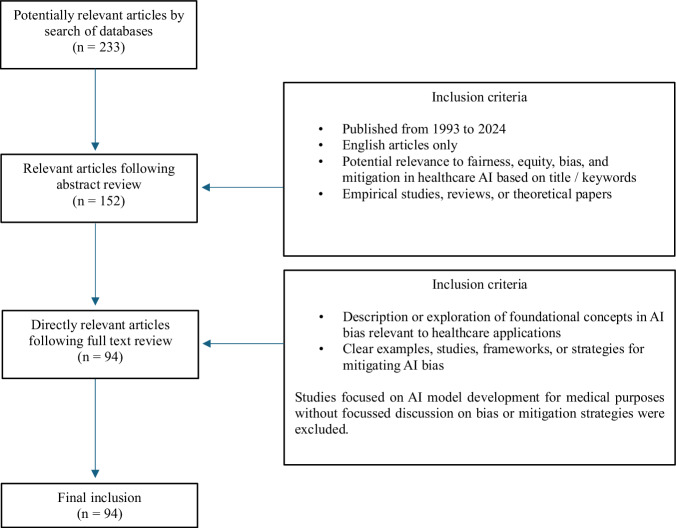
- As of May 13, 2024, the FDA listed 191 new AI-enabled medical devices, reaching 882 total, predominantly in radiology (76%), cardiology (10%), and neurology (4%). The review’s literature search yielded 233 potentially relevant articles, narrowed to 152 after title/abstract screening and 94 after full-text review.
- Cited evidence shows substantial bias burden: Kumar et al. found 50% of 48 sampled healthcare AI studies had high risk of bias and only 20% low risk; Chen et al. found only 86 of 555 neuroimaging-based psychiatric AI models (15.5%) included external validation, 97.5% included only high-income-region subjects, and 83% were rated high risk of bias.
- Case examples include Obermeyer et al.’s algorithm using healthcare costs as a proxy: among 43,539 White and 6,079 Black patients, Black patients had 26.3% more chronic illnesses at the same risk score (4.8 vs. 3.8 conditions); recalibration using direct health indicators nearly tripled high-risk Black patient enrollment from 17.7% to 46.5%. In cardiac MRI segmentation (nnU-Net, 5,903 UK Biobank subjects, 80% White), Dice similarity was 93.5% for White subjects but as low as 84.5% for Black and Mixed-race subjects; protected group models reached 92.15% for Black and 93.17% for Mixed-race subjects.
- Deployment biases are documented: incorrect AI BI-RADS suggestions dropped mammography reporting accuracy from 79.7% to 19.8% for inexperienced radiologists, 81.3% to 24.8% for moderately experienced, and 82.3% to 45.5% for very experienced radiologists; in a COVID-19 decision-support study, only 35% given risk score alone and 52% given risk score plus explanation critically evaluated incorrect recommendations; an ICU alarm study found 1,154,201 unique alarms, 88.8% for arrhythmias, with most false positives.
Methods
- The authors followed a critical review methodology, searching English articles published from 1993 to 2024 in PubMed, Google Scholar, and publisher platforms such as Elsevier, using Boolean operators and keywords including “Medical AI,” “AI bias,” “AI ethics,” “Fairness in medical AI,” and “Bias mitigation strategies in AI.”
- The search yielded 233 potentially relevant articles; after title/abstract screening, 152 were considered directly relevant, and 94 were selected for final review. A thematic-based approach was used to identify and categorize recurring themes, patterns, and insights related to bias types and mitigation strategies.
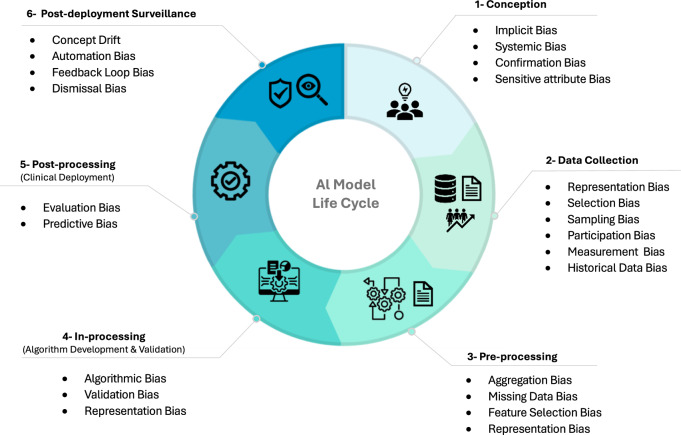
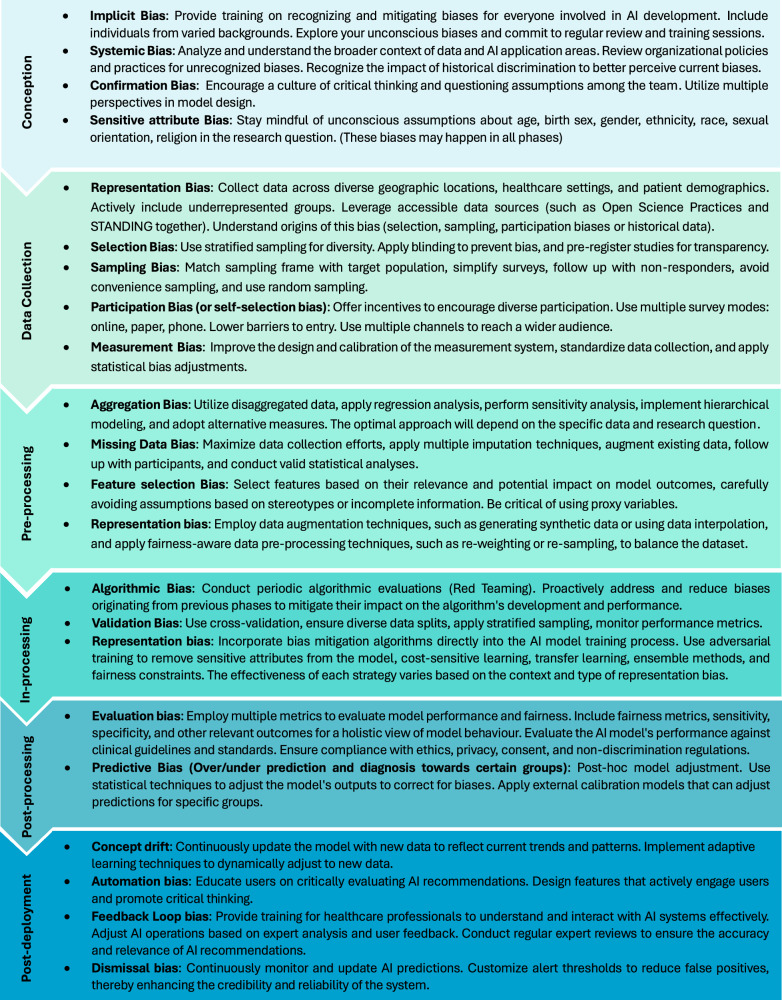
- The review is structured around bias origins and types—human, data, algorithmic, and model deployment—and mitigation recommendations across six AI lifecycle phases: conception, data collection, pre-processing, in-processing, post-processing, and post-deployment surveillance.
Limitations
- The paper states that achieving unbiased, broadly representative healthcare datasets remains formidable: data sparsity for underrepresented populations may not be feasible, prospective data quality improvement is time-consuming, sampling and participation biases are difficult to eliminate, standardizing data collection to reduce measurement bias is resource-intensive, vulnerable groups may remain underrepresented due to abundant WEIRD-population resources, and some socio-demographic features such as gender orientation remain poorly captured.
- The paper states that specific mitigation techniques have limitations: disaggregation can create noisy overly granular datasets; multiple imputation may introduce inaccuracies; data augmentation can generate synthetic data that fails to reflect true diversity; SMOTE can produce unrealistic data points; random under-sampling risks information loss; cost-sensitive learning can overfit; fairness metrics can create a fairness-accuracy trade-off; federated learning limits data pre-processing/quality assurance access; adversarial training can be computationally intensive and reduce accuracy; transfer learning may transfer unrecognized biases; explainability tools can be inconsistent or misleading; external validation data access is often challenging; and shadow deployment can delay implementation.
- The paper does not state limitations of the review itself; evident from the text, it is a critical/narrative review using thematic synthesis and does not report a formal risk-of-bias assessment or meta-analysis of the 94 included articles.
Model-written summary. Check it against the paper before relying on it.
Integrity signals
Registry
Cites
Statistics
Figures
Verification
Claims the paper makes
46 Valid · 4 Not valid · 55 Not checked · 23 Own results and interpretations
Every source the paper cites for this claim was checked and supports it.
In the paper
“Overall, 83% of studies were rated at high ROB18.”
§ Bias recognition and mitigation strategies in artificial intelligence healthcare applications > Methods > Bias
What the sources say
- Supportedcites [18] Chen, Z. et al. Evaluation of Risk of Bias in Neuroimaging-Based Artificial Intelligence Models for Psychiatric Diagnosis: A Systematic Review. JAMA Netw. Open 6, e231671 (2023). 36877519 PMC9989906 source
The Abstract and the 'Overall ROB for AI Models' section of our copy state that 461 of 555 units (83.1%; 95% CI, 80.0%-86.2%) were rated as having a high overall risk of bias by PROBAST, and the Discussion repeats '83.1% of existing AI models exhibited a high ROB for psychiatric diagnosis'. The citing sentence's 83% figure therefore matches the source's headline estimate exactly; the source's unit of appraisal is the neuroimaging-based AI models derived from the included studies (searched for a separate study-level count and found none reported), so the paraphrase carries the same magnitude, population and rating instrument. (LLM, conf=0.85)
plain- Asserted: passes — The authors put it forward as true.
- Checkable: passes — It can be checked against evidence.
- Load-bearing: passes — The paper’s conclusions depend on it.
- Based: passes — The paper gives a reason why it holds.
- Supported
The sources with a verdict support this claim; the rest weren’t checked yet, have no full text we could read, or their verdicts aren’t rated yet.
In the paper
“During model development, developers may consciously or subconsciously select, interpret, or give more weight to data that confirms their beliefs, overemphasizing certain patterns while ignoring other patterns that don’t fit expectations. This form of human-mediated bias is called confirmation bias30,31.”
§ Bias recognition and mitigation strategies in artificial intelligence healthcare applications > Methods > Human Biases
What the sources say
- Not checked yetcites [30] Elston, D. M. Confirmation bias in medical decision-making. J. Am. Acad. Dermatol. 82, 572 (2020). 31279036 source
- Supportedcites [31] Althubaiti, A. Information bias in health research: definition, pitfalls, and adjustment methods. J. Multidiscip. Healthc. 9, 211–217 (2016). 27217764 PMC4862344 source
The 'Confirmation bias' section of Althubaiti (2016) states that placing emphasis on one hypothesis because it does not contradict investigator beliefs is confirmation bias, that it is a psychological bias in which decisions are made according to the subject's preconceptions, beliefs or preferences, and that it emerges from overconfidence resulting in contradictory evidence being ignored or overlooked — matching the claim's 'give more weight to data that confirms their beliefs … ignoring other patterns'. The Introduction's statement that bias is often introduced unintentionally but can also be introduced intentionally covers the 'consciously or subconsciously' element, and the section notes confirmation bias affects any aspect of investigation requiring human judgment, including inclusion/exclusion criteria (selection). The source frames this around medical researchers/investigators rather than machine-learning model developers; the developers/model-development setting is the citing authors' own application, while the definitional content the citation is offered for ('this form of human-mediated bias is called confirmation bias') is stated directly in our copy. (LLM, conf=0.82)
hedgedstates a possible cause- Asserted: passes — The authors put it forward as true.
- Checkable: passes — It can be checked against evidence.
- Load-bearing: unclear — It is unclear whether the paper’s conclusions depend on it.
- Based: passes — The paper gives a reason why it holds.
Every source the paper cites for this claim was checked and supports it.
In the paper
“examined 555 published neuroimaging-based AI models for psychiatric diagnosis”
§ Bias recognition and mitigation strategies in artificial intelligence healthcare applications > Methods > Bias
What the sources say
- Supportedcites [18] Chen, Z. et al. Evaluation of Risk of Bias in Neuroimaging-Based Artificial Intelligence Models for Psychiatric Diagnosis: A Systematic Review. JAMA Netw. Open 6, e231671 (2023). 36877519 PMC9989906 source
The Abstract (FINDINGS, p. 3 of our copy) states that 517 studies presenting 555 AI models were included and evaluated, matching the claimed number exactly. The Data Extraction and Analysis section repeats the figure ('Of the 555 artificial intelligence (AI) models, 469 were tested at the internal sample and 86 at the independent external sample'), and the Retrieval Strategy/Introduction confirm the models are neuroimaging-based and aimed at psychiatric diagnosis. (LLM, conf=0.94)
plain- Asserted: passes — The authors put it forward as true.
- Checkable: passes — It can be checked against evidence.
- Load-bearing: passes — The paper’s conclusions depend on it.
- Based: passes — The paper gives a reason why it holds.
- Supported
Every source the paper cites for this claim was checked and supports it.
In the paper
“A similar temporally sensitive bias, known as “Concept shift,” can occur due to changes in the perceived meanings of data. How clinicians perceive and code diseases or outcomes can change dynamically over time, introducing a unique, human-level bias surrounding what data means and is being used for.”
§ Bias recognition and mitigation strategies in artificial intelligence healthcare applications > Methods > Human Biases
What the sources say
- Supportedcites [33] Chen, R. J. et al. Algorithmic fairness in artificial intelligence for medicine and healthcare. Nat. Biomed. Eng. 7, 719–742 (2023). 37380750 PMC10632090 source
The 'Evolving dataset shifts over time' subsection (p. under 'Healthcare disparities arising from dataset shift') defines concept shift/concept drift as arising from 'changes in diagnostic criteria and in labelling paradigms across populations', i.e. a changed relationship between X and Y when 'the criteria for diagnosing disease Y are revised over time', illustrated by the ICD-8→ICD-9→ICD-10→ICD-11 coding migrations and by repeated revisions of classification systems (Banff, WHO/ISUP, glioma taxonomy). This matches the claim that concept shift stems from changes in the perceived/coded meaning of disease or outcome data over time, and the passage's placement under temporal/evolving dataset shifts supports the citing sentence's characterisation of it as a temporally sensitive bias. (LLM, conf=0.88)
plainstates a cause- Asserted: passes — The authors put it forward as true.
- Checkable: passes — It can be checked against evidence.
- Load-bearing: unclear — It is unclear whether the paper’s conclusions depend on it.
- Based: passes — The paper gives a reason why it holds.
- Supported
The cited sources support only part of this claim — read each source’s verdict below.
In the paper
“This complexity is compounded by the inadequacy of methods for routinely detecting or mitigating biases across various stages of an algorithm’s life cycle, emphasizing a need for comprehensive and holistic bias detection frameworks14,15.”
§ Bias recognition and mitigation strategies in artificial intelligence healthcare applications > Methods > Bias
What the sources say
- Supportedcites [14] Kumar, A. et al. Artificial intelligence bias in medical system designs: a systematic review. Multimed. Tools Appl 83, 18005–18057 (2024). source
Our copy treats the shortfall directly: §4.3.4 (Analytical strategy to evaluate AI-bias) reports that most reviewed studies fall in the high-bias zone because 'the studies have not considered the imperative evaluation parameters for bias analysis', 'the bias qualitative analysis is also not performed... to identify the RoB', and 'the bias mitigation steps such as feature selection and feature augmentation are rarely performed in AI-studies' — i.e. routine detection and mitigation are inadequate. The Introduction reinforces this with 'To the best of our knowledge, no work has qualitatively and quantitatively analyzed the bias in AI-based prediction models in the healthcare domain.' The life-cycle framing the claim invokes is the paper's own structure (§3 Bias life cycle, stages I–III; §5 mitigation at pre-, in- and post-processing), and §7 Conclusion recommends robust analysis plus clinical validation before deployment. The only softening is that the paper locates the inadequacy in the practice of the surveyed studies rather than in the methods as such. (LLM, conf=0.82)
- Partly supportedcites [15] Chin, M. H. et al. Guiding Principles to Address the Impact of Algorithm Bias on Racial and Ethnic Disparities in Health and Health Care. JAMA Netw. Open 6, e2345050 (2023). 38100101 PMC11181958 sourceExperimental — accuracy not yet measured
Our copy conveys the surrounding idea but not the claim as stated: it never asserts that methods for routinely detecting or mitigating bias across the algorithm life cycle are 'inadequate.' What it does say is (a) in Guiding Principle 4 that 'technical definitions and metrics of fairness often do not translate clearly or intuitively to ethical, legal, social, and economic conceptions of fairness' and that 'there is no simple cookie-cutter technical solution,' and (b) under Guiding Principle 2 that existing reporting guidelines 'do not include concrete ways to report on fairness, and they rarely make explicit mention of equity.' Its life-cycle statements are normative rather than a finding of inadequacy — e.g., 'Equity and fairness checks should be built into each phase of the algorithm life cycle' (Guiding Principle 5) and that outcomes 'should be assessed routinely' (Algorithm Life Cycle) — so the part of the claim that routine detection/mitigation methods ARE inadequate is not stated by this source, only implied by its recommendations. (LLM, conf=0.72)
plain- Asserted: passes — The authors put it forward as true.
- Checkable: passes — It can be checked against evidence.
- Load-bearing: passes — The paper’s conclusions depend on it.
- Based: passes — The paper gives a reason why it holds.
- Supported
65 more claims · 35 with their cited sources checked
Create a free account to see all 128 claims and to verify the 61 references still open.
- Probably not a substantial claim. 18
- It may state two separate claims as one. 46
Claims other papers make about this one
Each is checked against this paper’s own text: does it say what the citing paper says it does?
The source backs part of the claim, not all of it — or backs it for a different population, condition or comparison.
In the citing paper
“Moreover, frameworks developed in studies4,11,35 enhance methodological theory by incorporating AI ethics, transparency, and bias mitigation into evidence appraisal models like PRISMA-AI and CLASMOD-AI.”
From Generative Artificial Intelligence in Healthcare: Automation Bias, Deskilling, and Cognitive Implications – A Systematic Review (2026) · cites this paper as [4]
Experimental — accuracy not yet measuredThe source backs part of the claim, not all of it — or backs it for a different population, condition or comparison.
In the citing paper
“In the same way, ethical and psychological aspects4,33 show that clinician trust and identity need to be actively built through open governance and clear AI design.”
From Generative Artificial Intelligence in Healthcare: Automation Bias, Deskilling, and Cognitive Implications – A Systematic Review (2026) · cites this paper as [4]
Experimental — accuracy not yet measuredThe source backs part of the claim, not all of it — or backs it for a different population, condition or comparison.
In the citing paper
“Ethical governance frameworks, like the ones suggested in,4,49 stress the importance of clear rules, accountability systems, and algorithmic transparency in order to protect clinician independence and patient trust.”
From Generative Artificial Intelligence in Healthcare: Automation Bias, Deskilling, and Cognitive Implications – A Systematic Review (2026) · cites this paper as [4]
Experimental — accuracy not yet measuredIn the citing paper
“Nevertheless, we draw a tentative conclusion that a minimal level of ML and data literacy should be included, consistent with the predominant expert view and patient-safety imperatives [31-34].”
From Role-Differentiated AI Competencies and Curriculum Implications for Health Professions Education: Qualitative Study (2026) · cites this paper as [33]
Citations
Cites
The PRISMA 2020 statement: An updated guideline for reporting systematic reviews
Page, M. J., McKenzie, J. E., Bossuyt, P. M., Boutron, I., Hoffmann, T. C., Mulrow, C. D., Shamseer, L., Tetzlaff, J. M., Akl, E. A., Brennan, S. E., et al. (2021) · BMJ · doi:10.1136/bmj.n71 · Cited by 108,283
SMOTE synthetic minority over-sampling technique
Chawla, N. V., Bowyer, K. W., Hall, L. O., & Kegelmeyer, W. P. (2002) · Journal of Artificial Intelligence Research · doi:10.1613/jair.953 · Cited by 32,865 · cited 2×
“To address class imbalance, strategies such as resampling to balance class distributions 60 , synthetic data generation (such as Synthetic Minority Over-sampling Technique (SMOTE)) 61 , and the application of cost-sensitive learning to emphasize minority class errors should be considered 62 .”
A typology of reviews: an analysis of 14 review types and associated methodologies
Grant, M. J., & Booth, A. (2009) · Health Information & Libraries Journal · doi:10.1111/j.1471-1842.2009.00848.x · Cited by 10,817
The PRISMA 2020 statement: an updated guideline for reporting systematic reviews
Page, M. J., McKenzie, J., Bossuyt, P., Boutron, I., Hoffmann, T., mulrow, C., Shamseer, L., Tetzlaff, J., Akl, E., Brennan, S. E., et al. (2020) · doi:10.31222/osf.io/v7gm2_v1 · Cited by 8,090
Dissecting racial bias in an algorithm used to manage the health of populations
Obermeyer, Z., Powers, B., Vogeli, C., & Mullainathan, S. (2019) · Science · doi:10.1126/science.aax2342 · Cited by 7,137 · cited 2×
“However, ongoing surveillance is necessary, as reliance on historical data and evolving healthcare dynamics could allow biases to re-emerge 46 .”
A Survey on Bias and Fairness in Machine Learning
Mehrabi, N., Morstatter, F., Saxena, N., Lerman, K., & Galstyan, A. (2022) · ACM Computing Surveys · doi:10.1145/3457607 · Cited by 5,812 · cited 1×
“An example of this is the “ healthy volunteer ” selection bias observed in the UK Biobank, where participants are generally healthy and therefore do not represent patients typically encountered by healthcare systems 39 .”
A Survey on Bias and Fairness in Machine Learning
Mehrabi, N., Morstatter, F., Saxena, N., Lerman, K., & Galstyan, A. (2019) · arXiv · doi:10.48550/arxiv.1908.09635 · Cited by 5,812
The PRISMA 2020 statement: an updated guideline for reporting systematic reviews
Page, M. J., McKenzie, J., Bossuyt, P., Boutron, I., Hoffmann, T., mulrow, C., Shamseer, L., Tetzlaff, J., Akl, E., Brennan, S. E., et al. (2020) · doi:10.31222/osf.io/v7gm2 · Cited by 5,177
Information bias in health research: definition, pitfalls, and adjustment methods
Althubaiti, A. (2016) · Journal of Multidisciplinary Healthcare · doi:10.2147/jmdh.s104807 · Cited by 3,018 · cited 1×
“For example, systemic bias may manifest as inadequate medical resource funding for un-insured individuals, underserved 30,31 .”
PROBAST: A Tool to Assess the Risk of Bias and Applicability of Prediction Model Studies
Wolff, R. F., Moons, K. G. M., Riley, R. D., Whiting, P. F., Westwood, M., Collins, G. S., Reitsma, J. B., Kleijnen, J., Mallett, S., & for the PROBAST Group† (2019) · Annals of Internal Medicine · doi:10.7326/m18-1376 · Cited by 2,984 · cited 1×
“A similar study, performed by Chen, et al., using the PROBAST (Prediction model Risk Of Bias ASsessment Tool) framework 17 (For further details, refer to Supplementary Table 1), examined 555 published neuroimaging-based AI models for psychiatric diagnosis, identifying only 86 studies (15.5”
Influential
Research works printed but not linked: 2
- Jackson, M. C. Artificial Intelligence & Algorithmic Bias: The Issues with Technology Reflecting History & Humans Notes & Comments. J. Bus. Tech. L. 16, 299–316 (2021).
- Wachter, S., Mittelstadt, B. & Russell, C. Counterfactual explanations without opening the black box: Automated decisions and the GDPR. Harv. JL & Tech. 31, 841 (2017).
Cited by
Items 101–200 of 322
Traini, D. O., Palmisano, G., Stefani, A. D., & Peris, K. (2026) · Journal of the American Academy of Dermatology · doi:10.1016/j.jaad.2026.03.056 · Cited by 2
Wang, R., Sun, X., Sun, Y., & Wang, J. (2026) · Frontiers in Psychology · doi:10.3389/fpsyg.2026.1794568 · Cited by 4
“Review evidence from healthcare AI shows that bias may emerge over time through concept drift, changing user populations, or shifts in deployment context, which is why continued monitoring, external review, and periodic updating remain important after rollout (Hasanzadeh et al., 2025).”
Integration of stem cell therapy and artificial intelligence: From promise to clinical reality
Ali, M., Rahman, M. A., & Haider, K. H. (2026) · World Journal of Stem Cells · doi:10.4252/wjsc.118676 · Cited by 4
Warren, T., van der Weegen, W., Kool, R. B., Hoogendoorn, M., & Timmers, T. (2026) · International Journal of Medical Informatics · doi:10.1016/j.ijmedinf.2026.106525 · Cited by 2
Lim, Y. X., Ming, L. C., Ng, N. C., Leow, S., & Ingle, R. G. (2026) · Discover Computing · doi:10.1007/s10791-026-10205-x · Cited by 3
“Teams must critically examine the intended outcome and proactively identify potential unintended consequences for different demographic groups, challenging implicit and systemic biases embedded in historical practices [77].”
Ethical Considerations in Personal Health Large Language Models
Liu, J., & Liu, S. (2026) · Journal of Medical Internet Research · doi:10.2196/92240 · Cited by 2
Bashir, S., Salad, H. A., Abdullahi, Y. B., Abdi, Y. H., Abdi, M. S., Ahmed, N., Musa, S. S., Elehamer, N. M. K., Musa, M. K., Bolarinwa, O. A., et al. (2026) · Frontiers in Digital Health · doi:10.3389/fdgth.2026.1841706 · Cited by 7
Oleksiw, M., Djinbachian, R., Gefflot, C., Michal, V., Mashayekhi, N., Kandlikar-Bloch, M., Battat, R. J., Cristea, E., Hanin, S., Barkun, A. N., et al. (2026) · Gastrointestinal Endoscopy · doi:10.1016/j.gie.2026.06.036 · Cited by 2
Cognitive Readiness for Human-AI Collaboration.
Tremblay, S., de Hemptinne, D., Teyssier-Roberge, G., Gallant, A., Marois, A., & Lafond, D. (2026) · Human Factors · doi:10.1177/00187208261474345 · Cited by 4
da Silva, A. L., Gomes, V. D. C. S., do Ramo, T. F., Santos, E. F., Magioli, D. M. M., da Silva, M. A. T., de Lima, M. A. V., Ferreira, M. S. D. A., Dourado, R. A., & Soares, A. D. C. (2026) · LUMEN ET VIRTUS · doi:10.56238/levv17n65-019 · Cited by 2
Chhor, C. M., Raichandani, S., du Preez, L., Brandser, N. R., Fotos, J. S., Jiwani, R. A., Li, D. K. B., Rajiah, P. S., Sin, J. M., & Nguyen, X. V. (2025) · Current Problems in Diagnostic Radiology · doi:10.1067/j.cpradiol.2025.06.009 · Cited by 4
Current Applications of Artificial Intelligence in Psychiatry
Kerna, N. A., Boulos, A., Abreu, M., Chigozie, I. K., Fide-Nwoko, F. U., Arube, E. R., Eziechi, E. S., Holets, H. M., Pruitt, K. D., Jomsky, B. M., et al. (2025) · Scientia. Technology, science and society. · doi:10.59324/stss.2025.2(4).10 · Cited by 2
“Bias mitigation strategies, including data augmentation and fairness-aware algorithms, aim to reduce demographic and socioeconomic biases (Hasanzadeh et al., 2025).”
Yin, R., Li, J., Yang, Q., Chen, X., Zhang, X., Lin, M., Bian, J., & Subramaniam, A. (2025) · Applied Sciences · doi:10.3390/app15158733 · Cited by 1
Artificial Intelligence (AI) in Patient–Healthcare Relationships: Psychosocial Perspective
Saikia, M. J., & Borthakur, D. (2025) · IEEE Access · doi:10.1109/access.2025.3611818 · Cited by 3
Mauchart, P., Wágner, E., Gödöny, K., Kovács, K. A., Péntek, S., Barabás, A., Bódis, J., & Várnagy, Á. (2025) · Journal of Clinical Medicine · doi:10.3390/jcm14196948 · Cited by 1
“In particular, since our Random Forest was trained exclusively on institutional data, its predictions may reflect biases specific to the patient population, physician practices, or laboratory protocols of our center [16].”
Benbow, J. H., & Kim, E. S. (2025) · The Cancer Journal · doi:10.1097/ppo.0000000000000796 · Cited by 1
Rodrigues, N., Bonfanti‐Gris, M., Bai, S., Pradíes, G., & Salido, M. P. (2025) · Journal of Dentistry · doi:10.1016/j.jdent.2025.106252 · Cited by 4
Artificial intelligence in healthcare research: Research ethics perspective
Hey, C. Y., & Kulkarni, S. (2025) · British Journal of Clinical Pharmacology · doi:10.1002/bcp.70395 · Cited by 3
“Consider implementing metrics, such as ‘ equalized odds ’ 12 to ensure the model maintains consistent false positive and false negative rates across different skin tones.”
Emotional Dependence in Long-Term Use of Large Language Models
Ramello, S. (2025) · Digital Society · doi:10.1007/s44206-025-00242-2 · Cited by 3
“Bias mitigation is framed as technical responsibility distributed among stakeholders, yet the unit of correction remains the measurable parameter (Hasanzadeh et al., 2025 ).”
A Meta-Analytic NLP-Driven Mapping of Fairness in Healthcare AI
Tsoni, R., Koutouzis, M., & Verykios, V. S. (2025) · International Conference on Information, Intelligence, Systems & Applications (IISA) · doi:10.1109/iisa66859.2025.11311222 · Cited by 1
“Therefore, real-world fairness demands methods for efficiently describing the operating modes and effects of AI systems to the general public [58].”
Application of Intelligent Systems in Biomedicine
Badnjević, A., & Spahić, L. (2026) · Series in bioengineering · doi:10.1007/978-3-032-14785-1_2 · Cited by 3
Can AI developers avoid bias in public health applications?
Harms, R. J., Ankeny, R. A., Carter, L., Mankad, A., & Scully, J. L. (2026) · Frontiers in Public Health · doi:10.3389/fpubh.2025.1752729 · Cited by 1
Ferrara, S. A., & Topaz, M. (2026) · Journal of Pediatric Health Care · doi:10.1016/j.pedhc.2025.12.014 · Cited by 1
Application of Cancer Screening Guidelines in Resource Limited Settings
Varghese, C., V, Nongkynrih, B., Lohiya, A., Prasad, A., & Barango, P. (2026) · Cancer Control · doi:10.1177/10732748251408883 · Cited by 2
“19,20”
Closing the AI benefits gap: Systems design for population health equity
Morley, J., & Floridi, L. (2026) · Public Health · doi:10.1016/j.puhe.2026.106205 · Cited by 3
Vaezi, A., Ashby, T., Kadir, S., Schweitzer, M. D., Hadeh, A., Sen, P., Seeram, V. K., & Mirsaeidi, M. S. (2026) · ATS Scholar · doi:10.1093/atsscholar/aapag001 · Cited by 2
Guérendel, C., Valkema, M. J., Ghosn, Y., Ursprung, S., Cowzer, D., Chen, S. J., Gangai, N. C., Wijnhoven, B. P. L., Paroder, V., Jayaprakasam, V. S., et al. (2026) · European Journal of Radiology Artificial Intelligence · doi:10.1016/j.ejrai.2026.100082 · Cited by 1
Artificial intelligence in pediatric myopia - a narrative review
Pawar, N., Berendschot, T. T. J. M., Bauer, N. J. C., Ravindran, M., Maheshwari, D., Giap, B. D., & Nallasamy, N. (2026) · Graefe s Archive for Clinical and Experimental Ophthalmology · doi:10.1007/s00417-026-07193-5 · Cited by 2
Artificial intelligence in emergency medicine critical care
Heslin, S. M., Nocito, R., & Weingart, S. D. (2026) · Clinical and Experimental Emergency Medicine · doi:10.15441/ceem.26.057 · Cited by 2
“As a result, they may produce systematically different recommendations across racial, socioeconomic, and demographic subgroups [31,32].”
Shinde, A., Mhaismale, H., Pawar, P., Mane, S., & Bembde, A. (2026) · Drug Development and Industrial Pharmacy · doi:10.1080/03639045.2026.2649846 · Cited by 3
“…datasets that lack comprehen-siveness or demographic diversity can inadvertently amplify biases in formulation performance and PGx predictions [75,76]. effective mitigation strategies encompass: Such measures position bias mitigation as a core validation criterion, transcending conceptual…”
Ghimire, A., & Qiu, Y. (2026) · Nurse Education Today · doi:10.1016/j.nedt.2026.107111 · Cited by 3
Alu, F. F., Oluwadare, S., Halliday, N., & Agwunobi, U. E. (2026) · Frontiers in Artificial Intelligence · doi:10.3389/frai.2026.1756023 · Cited by 4
“From these, we derive Demographic Parity Difference (DPD) defined as the difference in selection rates, between male and female, and equal opportunity difference (EOD) defined as the difference in TPR between Group female and male Group (Hasanzadeh et al., 2025).”
InfluentialOuyang, Y., Gao, S., Wang, R., Zhu, H., Shao, Y., Gu, X., & Li, Q. (2026) · CHI Conference on Human Factors in Computing Systems · doi:10.1145/3772318.3790530 · Cited by 4
“Future work could enhance transparency in aggregation methods or explicitly highlight underrepresented perspectives to avoid inad-vertently biasing interpretation [59].”
Beyond adoption: unpacking the trust-ethics-decision trade-offs in healthcare AI strategy
Afonso, M., & Ferreira, J. J. (2026) · Management Decision · doi:10.1108/md-10-2025-3263 · Cited by 2
A data-centric perspective on designing AI foundation models for healthcare
Jorf, B. A., Piechowski‐Jóźwiak, B., & Shamout, F. E. (2026) · Frontiers in Digital Health · doi:10.3389/fdgth.2026.1738523 · Cited by 2
“Merely reporting population-level performance metrics, like area under the curve, may obscure biases that affect clinical equity [39].”
Artificial intelligence and machine learning in smart vaginal formulation development
Ogundemuren, D. A., Agrahari, V., Wong, A. P., Herrera, C., Ilomuanya, M. O., & Doncel, G. F. (2026) · Advanced Drug Delivery Reviews · doi:10.1016/j.addr.2026.115882 · Cited by 1
Emerging applications of traditional and generative artificial intelligence in liver transplantation
Ge, W. H., Bishara, A. M., Braun, H. J., Simonetto, D. A., & Ge, J. (2026) · Liver Transplantation · doi:10.1097/lvt.0000000000000914 · Cited by 1
Young, C. F., & MacLeod, J. (2026) · International Journal of Obesity · doi:10.1038/s41366-026-02119-x · Cited by 1
“(cid:129) Accelerating health disparities research with AI [43] (cid:129) Bias recognition and mitigation strategies in AI healthcare applications [44] (cid:129) Development of cardiovascular disease staging model using clinical and social drivers of health to predict type 2 diabetes [48] Data…”
Al-Mashhadani, M. M., Ajaz, F., Guraya, S. S., & Ennab, F. (2026) · Frontiers in Medicine · doi:10.3389/fmed.2026.1803921 · Cited by 3
“The progressive introduction may also help reduce uptake of incorrect outputs by mitigating automation bias or over-reliance bias. which is particularly relevant considering the risks of hallucinations from GenAI (45, 50).”
Luitse, D. M. R. (2026) · Cambridge Forum on AI Culture and Society · doi:10.1017/cfc.2026.10019 · Cited by 2
Ethical, legal, and regulatory challenges in AI-based healthcare tools
Dompmartin, A., & Haykal, D. (2026) · La Presse Médicale · doi:10.1016/j.lpm.2026.104372 · Cited by 2
Scherr, S. (2026) · Computers in Human Behavior Artificial Humans · doi:10.1016/j.chbah.2026.100351 · Cited by 1
Ramezani, A., Bagheri, M., Mahmoudian, F., Fattahi, F., ghahroodi, F. N., Nasirmoghadas, P., Pourzardosht, N., Khalesi, B., Hashemi, Z. S., & Khalili, S. (2026) · Expert Review of Molecular Diagnostics · doi:10.1080/14737159.2026.2706000 · Cited by 1
“Selection bias occurs when the patient population represented in the training data is not representative of the broader target population, potentially limiting model generalizability [171].”
AI-Driven Transfer Learning for Medical Imaging and Sensor-Based Healthcare
Assudani, P. J., Leema, A. A., Balakrishnan, P., Kollem, S., Pachlor, R., López‐Linares, K., Oliver, I. M., Haick, H., & Bhaiyya, M. L. (2026) · Archives of Computational Methods in Engineering · doi:10.1007/s11831-026-10667-8 · Cited by 3
“When such biased representations are transferred, the model may perform well on majority groups while systematically underperforming on minorities, leading to disparities in diagnosis, treatment recommendations, or disease risk assessment [239].”
Artificial Intelligence in Pharmacovigilance: Guiding Principles from the CIOMS Working Group XIV
Norén, G. N., Durand, J., Kara, V., Pileggi, E. M., Carroll, H., Hill, S., Hauben, M., Botsis, T., Rägo, L., CIOMS Working Group XIV, et al. (2026) · Drug Safety · doi:10.1007/s40264-026-01708-z · Cited by 7
Okunev, M., Handelman, D., & Handelman, A. (2025) · Scientific Reports · doi:10.1038/s41598-025-15268-2 · Cited by 4
“Altogether, research in the field of ethics in AI for medicine is rapidly growing, and it includes various aspects of ethical issues, from bias to AI hallucinations 34–46 .”
AI-assisted dermatologic diagnosis using a large language model
Dezoteux, F., Boileau, M., Pruvot, C. P., Dubois, M., Mille, B., Rached, H. A., Philip, O., Véron, M., Fassanaro, C., Delzenne, G., et al. (2025) · Journal of the American Academy of Dermatology · doi:10.1016/j.jaad.2025.11.019 · Cited by 6
Kumar, S., & Cui, Y. (2025) · bioRxiv (Cold Spring Harbor Laboratory) · doi:10.1101/2025.06.18.658431 · Cited by 1
“Each dataset (consisting of EUR and a DDP) was partitioned with a stratified train-test split.”
Syailendra, E. A., Rahmatullah, Z. F., Lopez-Ramirez, F., & Chu, L. C. H. (2025) · Canadian Association of Radiologists Journal · doi:10.1177/08465371251377467 · Cited by 1
Barki, C., Chouchen, M., Sediri, A., Ceylan, H. İ., Rahmouni, H. B., Muntean, R. I., El-Seedi, H. R., Bragazzi, N. L., & Dergaa, I. (2026) · Frontiers in Systems Biology · doi:10.3389/fsysb.2026.1892418 · Cited by 1
“Bias recognition and mitigation must be addressed across the complete AI model lifecycle, from training data curation through deployment and longitudinal surveillance (Hasanzadeh et al., 2025).”
Park, Y., Han, Y., Kim, H., Ahn, S., Kron, F. W., & Lee, J. (2026) · JMIR Medical Education · doi:10.2196/97608
Kerna, N. A., Nicely, T. M., Chigozie, I. K., Flores, J. V., Carsrud, N. D. V., Nwokorie, U., Kadivi, K., & Nnake, I. (2025) · European Journal of Theoretical and Applied Sciences · doi:10.59324/ejtas.2025.3(3).10 · Cited by 2
“Bias mitigation strategies, including diverse training cohorts and fairness-aware learning algorithms, are essential to ensure equitable AI-driven care (Ferrara, 2024; Hasanzadeh et al., 2025).”
Morgan, A. N., Chi, G., Gavenus, E. R., Husserl, J., Henry, T. B., Sims, C. B., & Miller, D. L. (2025) · Circular Economy and Sustainability · doi:10.1007/s43615-025-00651-y
“AI applications vary greatly, as disease outbreak prediction tools pose high-stakes ethical and operational demands and thus require rigorous validation, algorithmic audits, and sector-specific governance models [ 27, 32].”
Patel, J., Banik, K., Ibrahim, S. T., & Katapally, T. R. (2025) · medRxiv · doi:10.1101/2025.08.21.25334182
“For instance, ensemble frameworks where AI-generated imputations are cross-validated against statistical models could mitigate biases unique to each method while improving transparency [47].”
Talha, M., Khalid, M., & Waafira, A. (2025) · Annals of Medicine and Surgery · doi:10.1097/ms9.0000000000003816
“Research and stakeholder engagement must be shar-pened to bridge the gap between AI innovation and routine clinical practice [ 8 , 9 ] .”
Shen, T. K.-B., Li, V., Chen, N., Hsu, J. S. H., Atun, R. A., Liu, V. T. N., Wang, C. I., Wu, D. B., Yeh, P.-C., & Lee, J. T. (2025) · medRxiv · doi:10.1101/2025.09.09.25335389
“17 19 However, evidence on fairness in ML models for preventive care remains limited particularly in multi-country settings.”
Letter Regarding “Predicting mortality risk following major amputation using machine learning”
Shen, F., Almeida, V. F. A., Özmen, B. B., & Duraes, E. F. R. (2025) · Journal of Vascular Surgery · doi:10.1016/j.jvs.2025.06.036
Mehrotra, P., Vengadakrishnan, K., & Mehrotra, P. (2025) · Cureus · doi:10.7759/cureus.92639 · Cited by 4
“Studies show lower AI model accuracy in women and ethnic minorities due to underrepresentation in training datasets [23].”
Word-embedding approach for unknown attributes in access control model
Bui, T. D., & Panda, B. (2025) · Discover Artificial Intelligence · doi:10.1007/s44163-025-00551-y
“This involves a multi-faceted approach, including: • Data curation: Ensuring that training datasets are diverse, representative, and free from harmful biases from the conception phase of model development [61].”
Uzoechina, G., & Osajiuba, T. (2025) · Research Square · doi:10.21203/rs.3.rs-7876598/v1 · Cited by 1
More, A. K., Lorde, N., Kalaria, T., & Gama, R. M. (2025) · Diagnostics · doi:10.3390/diagnostics15222919 · Cited by 1
Funa, A. A., & Gabay, R. A. E. (2025) · Journal of Professional Nursing · doi:10.1016/j.profnurs.2025.11.015
Zafar, S., Qin, W., Chengliang, L., Khan, A. A., Nazir, A., Faisal, M. S., Khalid, F., Vemula, S. S. M., & Khan, A. R. (2025) · doi:10.2196/preprints.88967
Exploring deep learning approaches in anticancer drug design: a review of recent advances
M’rhar, K., Chadi, M.-A., & Mousannif, H. (2025) · Frontiers in Drug Discovery · doi:10.3389/fddsv.2025.1713308
“Mitigations include curating diverse, representative training data, applying fairness-aware learning and evaluation, and conducting pre-speci fi ed bias audits across subpopulations (Hasanzadeh, 2025).”
Ethische Aspekte des Einsatzes von künstlicher Intelligenz in der Medizin
Heinrichs, B. (2025) · Gefässchirurgie · doi:10.1007/s00772-025-01294-x
Abuhassan, Q., Oriquat, G. A., Ganesan, S., Kanwar, J. B., Kumar, V. R., Sharma, V., Chauhan, A. S., & Абдуллаев, Т. А. (2025) · Abdominal Radiology · doi:10.1007/s00261-025-05329-5 · Cited by 3
“Data bias remains a critical determinant of model generaliz‑ ability in liver‑imaging AI [42].”
Reimagining vaccine advocacy: a digital health and policy perspective to overcome HPV hesitancy
Adeniyi, P. I. (2026) · Exploration of Digital Health Technologies · doi:10.37349/edht.2026.101177
A deep learning-based early warning system for renal replacement therapy in the intensive care unitPreprint
Mamandipoor, B., McAuley, J., Krause, M., Schmidt, U. H., Hsu, C. Y., & Gabriel, R. A. (2026) · Research Square · doi:10.21203/rs.3.rs-8419139/v1 · Cited by 1
Eskandar, K. (2026) · Journal of Addictive Diseases · doi:10.1080/10550887.2025.2607456 · Cited by 1
“34,35 Reporting and evaluation standards (TRIPOD+AI for predictive models; SPIRIT-AI and CONSORT-AI for trial protocols and reports) explicitly call for documentation of analytic choices, data provenance, monitoring plans, and subgroup analyses to support reproducibility and safe scaling—practices…”
Niqotaini, Z., Alamsyah, N., Budiman, & Kaunang, V. C. J. (2025) · International Conference on Informatics, Multimedia, Cyber and Information System (ICIMCIS) · doi:10.1109/icimcis68501.2025.11327388
“In parallel, the field of fairness-aware machine learning has proposed numerous frameworks for auditing and mitigating bias, including measures such as Demographic Parity and Equal Opportunity [7].”
Biomarkers for cancer screening, diagnosis and targeted therapeutic approaches
Shukla, M., Patel, J. C., Shukla, M., & Purkayastha, K. D. (2026) · Advances in cancer research · doi:10.1016/bs.acr.2025.12.008 · Cited by 2
Assessing Racial Bias Within American Society of Anesthesiologists Classification
Jacobs, M. A., McKaig, B. N., Schmidt, S. M., Shireman, P. K., Ibinson, J. W., Maxwell, J. H., & Hall, D. E. (2026) · Journal of Surgical Research · doi:10.1016/j.jss.2025.12.040
Automated Bias Explanation Dashboard for Non-Tech Users
Shivam, S., Vemuri, S., & Daram, I. (2025) · International Conference for Advancement in Technology (ICONAT) · doi:10.1109/iconat66879.2025.11362866
“In healthcare AI, Hasanzadeh et al. addressed bias across the AI lifecycle by examining electronic health records and imaging data [4].”
Equitable AI in Healthcare: Navigating Sex, Gender, and Intersectional Biases in Diagnostics
Lee, H., Yang, S., & Chu, Y. (2026) · Springer eBooks · doi:10.1007/978-981-95-2070-1_10 · Cited by 1
Legal and Ethical Considerations in Cyber Forensics
Makinde, O. F. (2026) · IGI Global eBooks · doi:10.4018/979-8-3373-4898-8.ch017 · Cited by 1
From cause to consequence: ethical considerations and the causal governance maturity model
Edokobi, O. (2026) · AI and Ethics · doi:10.1007/s43681-026-00992-w
“Data, concept, and policy drift are moni‑ tored with automated alerts; post‑deployment surveillance includes recalibration and re‑weighting as needed, recogniz ‑ ing that fairness and performance can degrade over time and must be maintained as a “life‑long” process [100].”
Was Anästhesist:innen über faire KI wissen sollten
Kapral, L., Schluchter, H., & Kimberger, O. (2026) · Anästhesie Nachrichten · doi:10.1007/s44179-026-00343-4
Bottomly, D., Suciu, C. G., Cordier, B. A., Evans, N., Poire, A., ZHENG, C. L., Myers, J. L., Sandulache, V. C., Bivona, T. G., Roth, J., et al. (2026) · Scientific Data · doi:10.1038/s41597-026-06670-0 · Cited by 1
Lettner, J. D., Evrenoglou, T., Binder, H., Fichtner‐Feigl, S., Neubauer, C., & Ruess, D. A. (2026) · medRxiv · doi:10.64898/2026.02.10.26345995 · Cited by 1
Updated Policy on the Use of Artificial Intelligence for the Journal of Neurosurgical Anesthesiology
Flexman, A. M., Lele, A. V., & on behalf of the JNA Editorial Board (2026) · Journal of Neurosurgical Anesthesiology · doi:10.1097/ana.0000000000001095
Generative AI for Clinical Communication, Healthcare Worker Wellbeing, and Patient Care
Alsufi, M. I., Alsayed, S., Alsufi, M., & Qtaishat, F. A. (2026) · Advances in computational intelligence and robotics book series · doi:10.4018/979-8-3373-8247-0.ch003 · Cited by 1
Marjanović, M., & Latinović, L. (2026) · Serbian Journal of Engineering Management · doi:10.5937/sjem2600076m
Hasan, M. M., Rahman, M. M., Mamun, Q., Wu, J., & Rana, M. (2025) · IEEE ... International Conference on Data Mining workshops · doi:10.1109/icdmw69685.2025.00086
“As of 2024, the FDA has approved 882 AI-enabled medical devices, with bias potentially exacerbating healthcare disparities across these applications [6].”
Machine Learning‐Based Risk Prediction Models for Pregnancy‐Related Syndromes
Wu, Y. (2026) · Birth Defects Research · doi:10.1002/bdr2.70038
Artificial intelligence, patient education, and the work of caring in cardiovascular disease
Ghisi, G. L. D. M. (2026) · Patient Education and Counseling · doi:10.1016/j.pec.2026.109587
AI as Political Infrastructure: A Diamond Model of Political AI Ethics
Bozdağ, A. A. (2026) · Philosophy & Technology · doi:10.1007/s13347-026-01058-9 · Cited by 1
Choi, Y., Seok, J., Oh, T. Y.-C., Hsu, J., Kim, D. W., Yu, B., Cho, J., Jang, W., Kim, J., Oh, N., et al. (2026) · EBioMedicine · doi:10.1016/j.ebiom.2026.106206
Evolving and novel applications of artificial intelligence in interventional oncology
Almashni, S. Y., Fayek, F. B., Javens, D. C., Boulis, M. T., & Makary, M. S. (2026) · World Journal of Clinical Oncology · doi:10.5306/wjco.v17.i3.113226
Comparative Predictive Analysis Using ML Algorithms for Patient Readmission Reduction
Wadibhasme, T., Jaiswal, J. K., Punjabi, E., Mozumder, A. H., Mishra, R. K., & Kumar, V. (2026) · Communications in computer and information science · doi:10.1007/978-981-95-7292-2_11
Arora, A., & Singla, J. (2026) · International Conference on Image Processing and Capsule Networks (ICIPCN) · doi:10.1109/icipcn67432.2026.11439047
“As a result, instead of accurately assessing the model’s accuracy and transparency, validation metrics might obtain results using previous decisions rather than actual system reliability, resulting in loop validation procedures [30].”
Patients’ Perspectives on the Implementation of AI in Radiological Diagnostics: Focus Group Study
Karger, C. R. (2026) · Journal of Medical Internet Research · doi:10.2196/89178 · Cited by 2
Toward a Learning Hospital: The Case for Quality Intelligence Systems
Mate, K. S., Norden, J. G., & Lachs, M. (2026) · The Joint Commission Journal on Quality and Patient Safety · doi:10.1016/j.jcjq.2026.03.010
Chaker, S. C., Whitney, H. M., Drukker, K., Tomek, R. M., Li, H., Myers, K. J., & Giger, M. L. (2026) · SPIE Medical Imaging: Imaging Informatics for Healthcare, Research, and Applications · doi:10.1117/12.3084782
“6,7 If model retraining is not feasible, a posteriori bias mitigation can be conducted through post-processing Fairness metrics have been historically outlined and utilized for automated decision systems, particularly within financial institutions, where concern for fairness in these systems was…”
Fairness and AI generalizability in medical image analysis
Forkert, N. D. (2026) · SPIE Medical Imaging: Imaging Informatics for Healthcare, Research, and Applications · doi:10.1117/12.3109369
“6 Within this context, numerous studies have shown that ML models can exhibit biased or discriminatory behavior, 7,8 particularly in settings that make use of medical imaging data with distribution shifts across imaging centers or demographic subgroups.”
Wang, T., Sandhu, A., Vamvakas, K., Bergman, H., Grad, R. M., Vedel, I., Gagnon, M., Yousefi, S., & Abbasgholizadeh-Rahimi, S. (2026) · FACETS · doi:10.1139/facets-2025-0049
Artificial Intelligence in Health Care: Ethical Issues and Challenges
Ikram, M., Bkiyar, H., Markaoui, K., Abdelkrim, D., & Brahim, H. (2026) · Lecture notes in networks and systems · doi:10.1007/978-3-032-18716-1_41
Kokoszka, M., Chodór, M., Kuczkowska, J. M., Bordakiewicz, J., Michalska, Z., Pokorska, D., Świechowska, J., Zarzycka, Z., Samberger, I., & Wiciak, M. (2026) · International Journal of Innovative Technologies in Social Science · doi:10.31435/ijitss.1(49).2026.4963 · Cited by 1
“Maintaining the Human in the Loop : To ensure a safe future for medical AI, practitioners must remain the final arbiter of biological plausibility through "Human-in-the-loop" (HITL) strategies[33].”
Institutional trust and AI-assisted surgery in the US: implications for ethical governance
Giwa, A. (2026) · AI and Ethics · doi:10.1007/s43681-026-01140-0
“Women’s lower acceptance aligns with documented concerns about training data that underrepresent female patients, producing outputs that perform differently across sexes [27–29].”
Medical data foundations: Key concepts and definitions for clinicians and researchers
Boubaker, O. (2026) · Elsevier eBooks · doi:10.1016/b978-0-443-27638-5.00003-1 · Cited by 3
Metadata
- Authors
- Hasanzadeh, F., Josephson, C. B., Waters, G., Adedinsewo, D., Azizi, Z., & White, J. A.
- Affiliations
- University of Calgary (CA)
- Morgan State University (US)
- Mayo Clinic (US)
- Stanford Medicine (US)
- Corresponding author
- White, James A.
- ORCID
- Venue
- npj Digital Medicine
- Published
- 2025-03-11
- Volume
- 8
- Issue
- 1
- Pages
- 154-154
- ISSN
- 2398-6352 (ISSN-L)
- PMC
- PMC11897215
- OpenAlex
- W4408314709
- Semantic Scholar
- d25dafe6aee6f79c641ef84b9d0982f2870a8731
- Cited by
- 320
- References
- 93
- Citations by year
- 2026: 221 · 2025: 97
- FWCI
- 49.28
- Type
- journal article
- Language
- en
- Open access
- gold
- doi.org
- Licence
- cc-by-nc-nd
- creativecommons.org/licenses/by-nc-nd/4.0 (tdm)
- creativecommons.org/licenses/by-nc-nd/4.0 (vor)
- Locations
- npj Digital Medicine (publishedVersion, cc-by-nc-nd)
- Europe PMC (PubMed Central) (publishedVersion, cc-by-nc-nd)
- PubMed Central (publishedVersion, cc-by-nc-nd)
- PubMed (publishedVersion)
- DOAJ (DOAJ: Directory of Open Access Journals) (submittedVersion, cc-by-sa)
- Topics
- Physical Sciences › Computer Science › Artificial Intelligence › Ethics and Social Impacts of AI
- Health Sciences › Medicine › Health Informatics › Artificial Intelligence in Healthcare and Education
- Physical Sciences › Computer Science › Artificial Intelligence › Explainable Artificial Intelligence (XAI)
- Keywords
- algorithmic bias, artificial intelligence in healthcare, bias mitigation, health care disparities, algorithmic fairness, model life cycle, bias detection, stakeholder responsibility, long-term monitoring
About these checks
Registry, retraction, Cites and statistics results are computed, not judged, with one exception: a printed reference that no index lists is read once by a model before it counts as a citation error. Claims are extracted by a model and kept only when their quote appears verbatim in the text; each cited source is then checked, with a model’s help, for whether it says what the claim relies on. Those verdicts can be wrong — read the claim’s quote and the cited source before relying on one.
The claim verdicts this report counts are experimental: their accuracy is not yet measured.
A language model drew the claims from the paper on 2026-10-05, under version 3 of the claim definition (model deepseek-v4.1-flash, prompt extract-v3).
A second model labelled each claim on 2026-10-05 (model jev-1.13-20260917, definition revision gold-guideline-v0.2).
Cited sources are checked with a language model’s help (qwen3.8-omni-flash).
Statistics and arithmetic are recomputed, not judged.
Confidence bands are shown only for fields calibrated on our annotated test set. None is calibrated yet, so no band is shown.
What counts as a claim ›How we measure confidence ›How we check this ›
Are you an author, or do you see a problem with this page? Request a review
Data sources
Bibliographic data: Semantic Scholar, OpenAlex, Crossref.
Contains information from the Semantic Scholar Academic Graph Datasets, made available under the ODC Attribution License (ODC-BY 1.0).
Semantic Scholar’s data is described in: Kinney, R., et al. (2023). The Semantic Scholar Open Data Platform. arXiv:2301.10140.
