

Bias recognition and mitigation strategies in artificial intelligence healthcare applications
Open accessThe DOI matches its Crossref record; 95 of the 95 references it cites were found in a registry or an index; 53 of the 114 sources its claims cite were checked for support.
Abstract
Artificial intelligence (AI) is delivering value across all aspects of clinical practice. However, bias may exacerbate healthcare disparities. This review examines the origins of bias in healthcare AI, strategies for mitigation, and responsibilities of relevant stakeholders towards achieving fair and equitable use. We highlight the importance of systematically identifying bias and engaging relevant mitigation activities throughout the AI model lifecycle, from model conception through to deployment and longitudinal surveillance.
Overview
CoChat Summary
TL;DR
This critical/narrative review examines the origins of bias in healthcare AI and mitigation strategies across the AI model lifecycle, from conception through deployment and surveillance. It argues that systematically identifying and mitigating bias is necessary to uphold fairness, equity, and equality in clinical AI.
Key findings
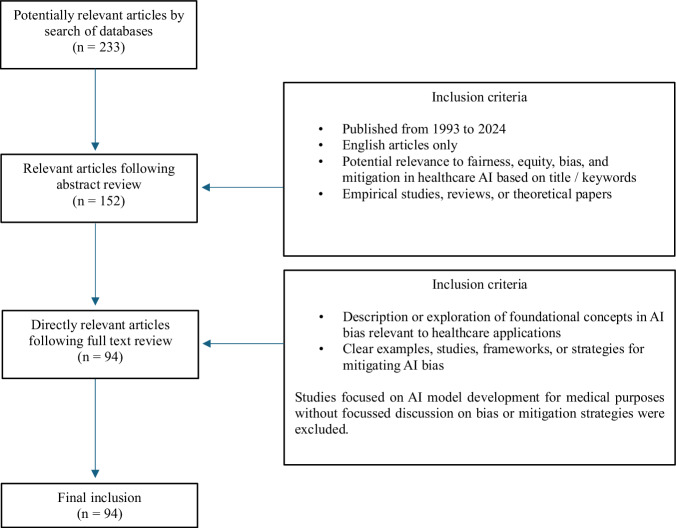
- As of May 13, 2024, the FDA listed 191 new AI-enabled medical devices, reaching 882 total, predominantly in radiology (76%), cardiology (10%), and neurology (4%). The review’s literature search yielded 233 potentially relevant articles, narrowed to 152 after title/abstract screening and 94 after full-text review.
- Cited evidence shows substantial bias burden: Kumar et al. found 50% of 48 sampled healthcare AI studies had high risk of bias and only 20% low risk; Chen et al. found only 86 of 555 neuroimaging-based psychiatric AI models (15.5%) included external validation, 97.5% included only high-income-region subjects, and 83% were rated high risk of bias.
- Case examples include Obermeyer et al.’s algorithm using healthcare costs as a proxy: among 43,539 White and 6,079 Black patients, Black patients had 26.3% more chronic illnesses at the same risk score (4.8 vs. 3.8 conditions); recalibration using direct health indicators nearly tripled high-risk Black patient enrollment from 17.7% to 46.5%. In cardiac MRI segmentation (nnU-Net, 5,903 UK Biobank subjects, 80% White), Dice similarity was 93.5% for White subjects but as low as 84.5% for Black and Mixed-race subjects; protected group models reached 92.15% for Black and 93.17% for Mixed-race subjects.
- Deployment biases are documented: incorrect AI BI-RADS suggestions dropped mammography reporting accuracy from 79.7% to 19.8% for inexperienced radiologists, 81.3% to 24.8% for moderately experienced, and 82.3% to 45.5% for very experienced radiologists; in a COVID-19 decision-support study, only 35% given risk score alone and 52% given risk score plus explanation critically evaluated incorrect recommendations; an ICU alarm study found 1,154,201 unique alarms, 88.8% for arrhythmias, with most false positives.
Methods
- The authors followed a critical review methodology, searching English articles published from 1993 to 2024 in PubMed, Google Scholar, and publisher platforms such as Elsevier, using Boolean operators and keywords including “Medical AI,” “AI bias,” “AI ethics,” “Fairness in medical AI,” and “Bias mitigation strategies in AI.”
- The search yielded 233 potentially relevant articles; after title/abstract screening, 152 were considered directly relevant, and 94 were selected for final review. A thematic-based approach was used to identify and categorize recurring themes, patterns, and insights related to bias types and mitigation strategies.
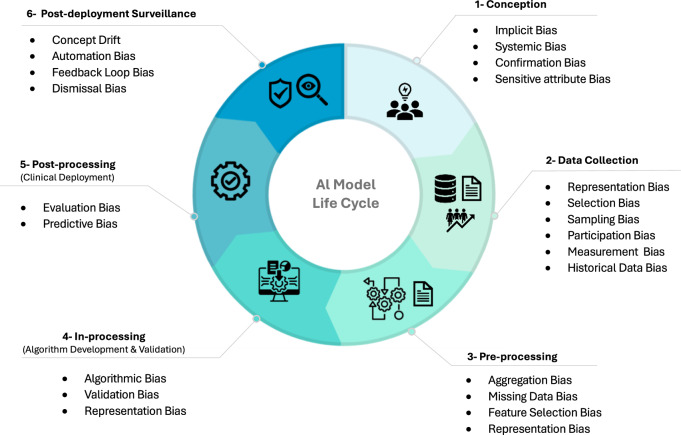
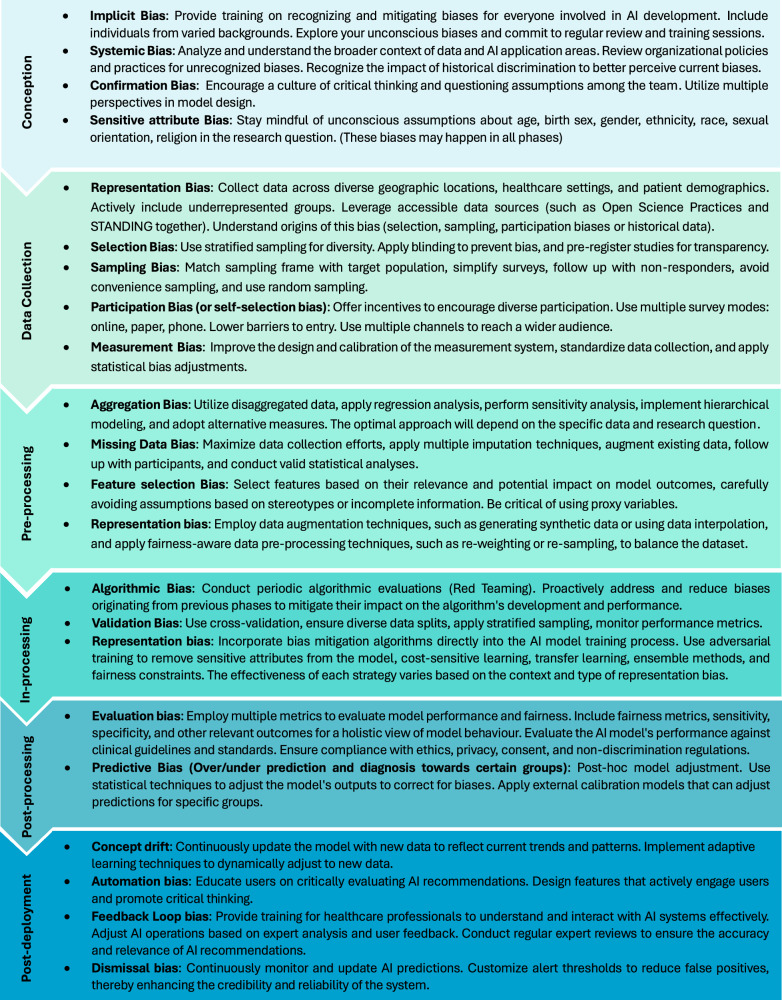
- The review is structured around bias origins and types—human, data, algorithmic, and model deployment—and mitigation recommendations across six AI lifecycle phases: conception, data collection, pre-processing, in-processing, post-processing, and post-deployment surveillance.
Limitations
- The paper states that achieving unbiased, broadly representative healthcare datasets remains formidable: data sparsity for underrepresented populations may not be feasible, prospective data quality improvement is time-consuming, sampling and participation biases are difficult to eliminate, standardizing data collection to reduce measurement bias is resource-intensive, vulnerable groups may remain underrepresented due to abundant WEIRD-population resources, and some socio-demographic features such as gender orientation remain poorly captured.
- The paper states that specific mitigation techniques have limitations: disaggregation can create noisy overly granular datasets; multiple imputation may introduce inaccuracies; data augmentation can generate synthetic data that fails to reflect true diversity; SMOTE can produce unrealistic data points; random under-sampling risks information loss; cost-sensitive learning can overfit; fairness metrics can create a fairness-accuracy trade-off; federated learning limits data pre-processing/quality assurance access; adversarial training can be computationally intensive and reduce accuracy; transfer learning may transfer unrecognized biases; explainability tools can be inconsistent or misleading; external validation data access is often challenging; and shadow deployment can delay implementation.
- The paper does not state limitations of the review itself; evident from the text, it is a critical/narrative review using thematic synthesis and does not report a formal risk-of-bias assessment or meta-analysis of the 94 included articles.
Model-written summary. Check it against the paper before relying on it.
Integrity signals
Registry
Cites
Statistics
Figures
Verification
Claims the paper makes
46 Valid · 4 Not valid · 55 Not checked · 23 Own results and interpretations
Every source the paper cites for this claim was checked and supports it.
In the paper
“Overall, 83% of studies were rated at high ROB18.”
§ Bias recognition and mitigation strategies in artificial intelligence healthcare applications > Methods > Bias
What the sources say
- Supportedcites [18] Chen, Z. et al. Evaluation of Risk of Bias in Neuroimaging-Based Artificial Intelligence Models for Psychiatric Diagnosis: A Systematic Review. JAMA Netw. Open 6, e231671 (2023). 36877519 PMC9989906 source
The Abstract and the 'Overall ROB for AI Models' section of our copy state that 461 of 555 units (83.1%; 95% CI, 80.0%-86.2%) were rated as having a high overall risk of bias by PROBAST, and the Discussion repeats '83.1% of existing AI models exhibited a high ROB for psychiatric diagnosis'. The citing sentence's 83% figure therefore matches the source's headline estimate exactly; the source's unit of appraisal is the neuroimaging-based AI models derived from the included studies (searched for a separate study-level count and found none reported), so the paraphrase carries the same magnitude, population and rating instrument. (LLM, conf=0.85)
plain- Asserted: passes — The authors put it forward as true.
- Checkable: passes — It can be checked against evidence.
- Load-bearing: passes — The paper’s conclusions depend on it.
- Based: passes — The paper gives a reason why it holds.
- Supported
The sources with a verdict support this claim; the rest weren’t checked yet, have no full text we could read, or their verdicts aren’t rated yet.
In the paper
“During model development, developers may consciously or subconsciously select, interpret, or give more weight to data that confirms their beliefs, overemphasizing certain patterns while ignoring other patterns that don’t fit expectations. This form of human-mediated bias is called confirmation bias30,31.”
§ Bias recognition and mitigation strategies in artificial intelligence healthcare applications > Methods > Human Biases
What the sources say
- Not checked yetcites [30] Elston, D. M. Confirmation bias in medical decision-making. J. Am. Acad. Dermatol. 82, 572 (2020). 31279036 source
- Supportedcites [31] Althubaiti, A. Information bias in health research: definition, pitfalls, and adjustment methods. J. Multidiscip. Healthc. 9, 211–217 (2016). 27217764 PMC4862344 source
The 'Confirmation bias' section of Althubaiti (2016) states that placing emphasis on one hypothesis because it does not contradict investigator beliefs is confirmation bias, that it is a psychological bias in which decisions are made according to the subject's preconceptions, beliefs or preferences, and that it emerges from overconfidence resulting in contradictory evidence being ignored or overlooked — matching the claim's 'give more weight to data that confirms their beliefs … ignoring other patterns'. The Introduction's statement that bias is often introduced unintentionally but can also be introduced intentionally covers the 'consciously or subconsciously' element, and the section notes confirmation bias affects any aspect of investigation requiring human judgment, including inclusion/exclusion criteria (selection). The source frames this around medical researchers/investigators rather than machine-learning model developers; the developers/model-development setting is the citing authors' own application, while the definitional content the citation is offered for ('this form of human-mediated bias is called confirmation bias') is stated directly in our copy. (LLM, conf=0.82)
hedgedstates a possible cause- Asserted: passes — The authors put it forward as true.
- Checkable: passes — It can be checked against evidence.
- Load-bearing: unclear — It is unclear whether the paper’s conclusions depend on it.
- Based: passes — The paper gives a reason why it holds.
Every source the paper cites for this claim was checked and supports it.
In the paper
“examined 555 published neuroimaging-based AI models for psychiatric diagnosis”
§ Bias recognition and mitigation strategies in artificial intelligence healthcare applications > Methods > Bias
What the sources say
- Supportedcites [18] Chen, Z. et al. Evaluation of Risk of Bias in Neuroimaging-Based Artificial Intelligence Models for Psychiatric Diagnosis: A Systematic Review. JAMA Netw. Open 6, e231671 (2023). 36877519 PMC9989906 source
The Abstract (FINDINGS, p. 3 of our copy) states that 517 studies presenting 555 AI models were included and evaluated, matching the claimed number exactly. The Data Extraction and Analysis section repeats the figure ('Of the 555 artificial intelligence (AI) models, 469 were tested at the internal sample and 86 at the independent external sample'), and the Retrieval Strategy/Introduction confirm the models are neuroimaging-based and aimed at psychiatric diagnosis. (LLM, conf=0.94)
plain- Asserted: passes — The authors put it forward as true.
- Checkable: passes — It can be checked against evidence.
- Load-bearing: passes — The paper’s conclusions depend on it.
- Based: passes — The paper gives a reason why it holds.
- Supported
Every source the paper cites for this claim was checked and supports it.
In the paper
“A similar temporally sensitive bias, known as “Concept shift,” can occur due to changes in the perceived meanings of data. How clinicians perceive and code diseases or outcomes can change dynamically over time, introducing a unique, human-level bias surrounding what data means and is being used for.”
§ Bias recognition and mitigation strategies in artificial intelligence healthcare applications > Methods > Human Biases
What the sources say
- Supportedcites [33] Chen, R. J. et al. Algorithmic fairness in artificial intelligence for medicine and healthcare. Nat. Biomed. Eng. 7, 719–742 (2023). 37380750 PMC10632090 source
The 'Evolving dataset shifts over time' subsection (p. under 'Healthcare disparities arising from dataset shift') defines concept shift/concept drift as arising from 'changes in diagnostic criteria and in labelling paradigms across populations', i.e. a changed relationship between X and Y when 'the criteria for diagnosing disease Y are revised over time', illustrated by the ICD-8→ICD-9→ICD-10→ICD-11 coding migrations and by repeated revisions of classification systems (Banff, WHO/ISUP, glioma taxonomy). This matches the claim that concept shift stems from changes in the perceived/coded meaning of disease or outcome data over time, and the passage's placement under temporal/evolving dataset shifts supports the citing sentence's characterisation of it as a temporally sensitive bias. (LLM, conf=0.88)
plainstates a cause- Asserted: passes — The authors put it forward as true.
- Checkable: passes — It can be checked against evidence.
- Load-bearing: unclear — It is unclear whether the paper’s conclusions depend on it.
- Based: passes — The paper gives a reason why it holds.
- Supported
The cited sources support only part of this claim — read each source’s verdict below.
In the paper
“This complexity is compounded by the inadequacy of methods for routinely detecting or mitigating biases across various stages of an algorithm’s life cycle, emphasizing a need for comprehensive and holistic bias detection frameworks14,15.”
§ Bias recognition and mitigation strategies in artificial intelligence healthcare applications > Methods > Bias
What the sources say
- Supportedcites [14] Kumar, A. et al. Artificial intelligence bias in medical system designs: a systematic review. Multimed. Tools Appl 83, 18005–18057 (2024). source
Our copy treats the shortfall directly: §4.3.4 (Analytical strategy to evaluate AI-bias) reports that most reviewed studies fall in the high-bias zone because 'the studies have not considered the imperative evaluation parameters for bias analysis', 'the bias qualitative analysis is also not performed... to identify the RoB', and 'the bias mitigation steps such as feature selection and feature augmentation are rarely performed in AI-studies' — i.e. routine detection and mitigation are inadequate. The Introduction reinforces this with 'To the best of our knowledge, no work has qualitatively and quantitatively analyzed the bias in AI-based prediction models in the healthcare domain.' The life-cycle framing the claim invokes is the paper's own structure (§3 Bias life cycle, stages I–III; §5 mitigation at pre-, in- and post-processing), and §7 Conclusion recommends robust analysis plus clinical validation before deployment. The only softening is that the paper locates the inadequacy in the practice of the surveyed studies rather than in the methods as such. (LLM, conf=0.82)
- Partly supportedcites [15] Chin, M. H. et al. Guiding Principles to Address the Impact of Algorithm Bias on Racial and Ethnic Disparities in Health and Health Care. JAMA Netw. Open 6, e2345050 (2023). 38100101 PMC11181958 sourceExperimental — accuracy not yet measured
Our copy conveys the surrounding idea but not the claim as stated: it never asserts that methods for routinely detecting or mitigating bias across the algorithm life cycle are 'inadequate.' What it does say is (a) in Guiding Principle 4 that 'technical definitions and metrics of fairness often do not translate clearly or intuitively to ethical, legal, social, and economic conceptions of fairness' and that 'there is no simple cookie-cutter technical solution,' and (b) under Guiding Principle 2 that existing reporting guidelines 'do not include concrete ways to report on fairness, and they rarely make explicit mention of equity.' Its life-cycle statements are normative rather than a finding of inadequacy — e.g., 'Equity and fairness checks should be built into each phase of the algorithm life cycle' (Guiding Principle 5) and that outcomes 'should be assessed routinely' (Algorithm Life Cycle) — so the part of the claim that routine detection/mitigation methods ARE inadequate is not stated by this source, only implied by its recommendations. (LLM, conf=0.72)
plain- Asserted: passes — The authors put it forward as true.
- Checkable: passes — It can be checked against evidence.
- Load-bearing: passes — The paper’s conclusions depend on it.
- Based: passes — The paper gives a reason why it holds.
- Supported
65 more claims · 35 with their cited sources checked
Create a free account to see all 128 claims and to verify the 61 references still open.
- Probably not a substantial claim. 18
- It may state two separate claims as one. 46
Claims other papers make about this one
Each is checked against this paper’s own text: does it say what the citing paper says it does?
The source backs part of the claim, not all of it — or backs it for a different population, condition or comparison.
In the citing paper
“Moreover, frameworks developed in studies4,11,35 enhance methodological theory by incorporating AI ethics, transparency, and bias mitigation into evidence appraisal models like PRISMA-AI and CLASMOD-AI.”
From Generative Artificial Intelligence in Healthcare: Automation Bias, Deskilling, and Cognitive Implications – A Systematic Review (2026) · cites this paper as [4]
Experimental — accuracy not yet measuredThe source backs part of the claim, not all of it — or backs it for a different population, condition or comparison.
In the citing paper
“In the same way, ethical and psychological aspects4,33 show that clinician trust and identity need to be actively built through open governance and clear AI design.”
From Generative Artificial Intelligence in Healthcare: Automation Bias, Deskilling, and Cognitive Implications – A Systematic Review (2026) · cites this paper as [4]
Experimental — accuracy not yet measuredThe source backs part of the claim, not all of it — or backs it for a different population, condition or comparison.
In the citing paper
“Ethical governance frameworks, like the ones suggested in,4,49 stress the importance of clear rules, accountability systems, and algorithmic transparency in order to protect clinician independence and patient trust.”
From Generative Artificial Intelligence in Healthcare: Automation Bias, Deskilling, and Cognitive Implications – A Systematic Review (2026) · cites this paper as [4]
Experimental — accuracy not yet measuredIn the citing paper
“Nevertheless, we draw a tentative conclusion that a minimal level of ML and data literacy should be included, consistent with the predominant expert view and patient-safety imperatives [31-34].”
From Role-Differentiated AI Competencies and Curriculum Implications for Health Professions Education: Qualitative Study (2026) · cites this paper as [33]
Citations
Cites
The PRISMA 2020 statement: An updated guideline for reporting systematic reviews
Page, M. J., McKenzie, J. E., Bossuyt, P. M., Boutron, I., Hoffmann, T. C., Mulrow, C. D., Shamseer, L., Tetzlaff, J. M., Akl, E. A., Brennan, S. E., et al. (2021) · BMJ · doi:10.1136/bmj.n71 · Cited by 108,283
SMOTE synthetic minority over-sampling technique
Chawla, N. V., Bowyer, K. W., Hall, L. O., & Kegelmeyer, W. P. (2002) · Journal of Artificial Intelligence Research · doi:10.1613/jair.953 · Cited by 32,865 · cited 2×
“To address class imbalance, strategies such as resampling to balance class distributions 60 , synthetic data generation (such as Synthetic Minority Over-sampling Technique (SMOTE)) 61 , and the application of cost-sensitive learning to emphasize minority class errors should be considered 62 .”
A typology of reviews: an analysis of 14 review types and associated methodologies
Grant, M. J., & Booth, A. (2009) · Health Information & Libraries Journal · doi:10.1111/j.1471-1842.2009.00848.x · Cited by 10,817
The PRISMA 2020 statement: an updated guideline for reporting systematic reviews
Page, M. J., McKenzie, J., Bossuyt, P., Boutron, I., Hoffmann, T., mulrow, C., Shamseer, L., Tetzlaff, J., Akl, E., Brennan, S. E., et al. (2020) · doi:10.31222/osf.io/v7gm2_v1 · Cited by 8,090
Dissecting racial bias in an algorithm used to manage the health of populations
Obermeyer, Z., Powers, B., Vogeli, C., & Mullainathan, S. (2019) · Science · doi:10.1126/science.aax2342 · Cited by 7,137 · cited 2×
“However, ongoing surveillance is necessary, as reliance on historical data and evolving healthcare dynamics could allow biases to re-emerge 46 .”
A Survey on Bias and Fairness in Machine Learning
Mehrabi, N., Morstatter, F., Saxena, N., Lerman, K., & Galstyan, A. (2022) · ACM Computing Surveys · doi:10.1145/3457607 · Cited by 5,812 · cited 1×
“An example of this is the “ healthy volunteer ” selection bias observed in the UK Biobank, where participants are generally healthy and therefore do not represent patients typically encountered by healthcare systems 39 .”
A Survey on Bias and Fairness in Machine Learning
Mehrabi, N., Morstatter, F., Saxena, N., Lerman, K., & Galstyan, A. (2019) · arXiv · doi:10.48550/arxiv.1908.09635 · Cited by 5,812
The PRISMA 2020 statement: an updated guideline for reporting systematic reviews
Page, M. J., McKenzie, J., Bossuyt, P., Boutron, I., Hoffmann, T., mulrow, C., Shamseer, L., Tetzlaff, J., Akl, E., Brennan, S. E., et al. (2020) · doi:10.31222/osf.io/v7gm2 · Cited by 5,177
Information bias in health research: definition, pitfalls, and adjustment methods
Althubaiti, A. (2016) · Journal of Multidisciplinary Healthcare · doi:10.2147/jmdh.s104807 · Cited by 3,018 · cited 1×
“For example, systemic bias may manifest as inadequate medical resource funding for un-insured individuals, underserved 30,31 .”
PROBAST: A Tool to Assess the Risk of Bias and Applicability of Prediction Model Studies
Wolff, R. F., Moons, K. G. M., Riley, R. D., Whiting, P. F., Westwood, M., Collins, G. S., Reitsma, J. B., Kleijnen, J., Mallett, S., & for the PROBAST Group† (2019) · Annals of Internal Medicine · doi:10.7326/m18-1376 · Cited by 2,984 · cited 1×
“A similar study, performed by Chen, et al., using the PROBAST (Prediction model Risk Of Bias ASsessment Tool) framework 17 (For further details, refer to Supplementary Table 1), examined 555 published neuroimaging-based AI models for psychiatric diagnosis, identifying only 86 studies (15.5”
Influential
Research works printed but not linked: 2
- Jackson, M. C. Artificial Intelligence & Algorithmic Bias: The Issues with Technology Reflecting History & Humans Notes & Comments. J. Bus. Tech. L. 16, 299–316 (2021).
- Wachter, S., Mittelstadt, B. & Russell, C. Counterfactual explanations without opening the black box: Automated decisions and the GDPR. Harv. JL & Tech. 31, 841 (2017).
Cited by
Multimodal Large Language Models in Medical Imaging: Current State and Future Directions
Nam, Y., Kim, D., Kyung, S., Seo, J., Song, J. M., Kwon, J., Kim, J., Jo, W., Park, H. J., Sung, J., et al. (2025) · Korean Journal of Radiology · doi:10.3348/kjr.2025.0599 · Cited by 154
“Effective risk mitigation hinges on balanced, expertly curated datasets, continuous post-deployment auditing, and cross-institutional benchmarking [125,126].”
Nourazarain, A., & Vaziri, Y. (2025) · Genes & Nutrition · doi:10.1186/s12263-025-00790-9 · Cited by 92
“…Data Protection Regulation (GDPR) and Health Insurance Por-tability and Accountability Act (HIPAA), alongside the adoption of privacy-preserving techniques like federated learning, which enables model training across decentralized datasets without centralizing raw patient information [126, 151].”
Peykani, P., Ramezanlou, F., Tănăsescu, C. R., & Ghanidel, S. (2025) · Applied Sciences · doi:10.3390/app15148103 · Cited by 85
Khan, S. N., Danishuddin, Khan, M. W. A., Guarnera, L., & Akhtar, S. M. F. (2026) · Frontiers in Artificial Intelligence · doi:10.3389/frai.2025.1743921 · Cited by 80
Racacho, K. J., Shiau, Y., Villa, R., Mahri, S., Tang, M., Lin, T., & Li, Y. (2025) · Frontiers in Immunology · doi:10.3389/fimmu.2025.1621812 · Cited by 72
Cognitive bias in clinical large language models
Mahajan, A., Obermeyer, Z., Daneshjou, R., Lester, J., & Powell, D. (2025) · npj Digital Medicine · doi:10.1038/s41746-025-01790-0 · Cited by 79
Sah, A. K., Elshaikh, R. H., Shalabi, M. G., Abbas, A. M., Prabhakar, P. K., Babker, A. M. A., Choudhary, R. K., Gaur, V., Choudhary, A. S., & Agarwal, S. (2025) · Life · doi:10.3390/life15050745 · Cited by 66
“Fairness can also be quantitatively evaluated using specialized metrics, including demographic parity, equalized odds, and disparate impact ratios, which help determine whether the model’s predictions are equitably distributed [71,72].”
AI in Orthopedic Research: A Comprehensive Review
Mısır, A., & Yuce, A. (2025) · Journal of Orthopaedic Research® · doi:10.1002/jor.26109 · Cited by 53
“Furthermore, standardization of imaging protocols is necessary to ensure consistent model performance across different clinical settings [35].”
Small data, big challenges: Machine- and deep-learning strategies for data-limited drug discovery
Pallikkavaliyaveetil, N., & Chandrasekaran, S. (2025) · Advanced Drug Delivery Reviews · doi:10.1016/j.addr.2025.115762 · Cited by 71
Zhang, S., Li, Y., Liu, W., Qi, C., Wang, S., Li, J., & Chen, Y. (2025) · Frontiers in Medicine · doi:10.3389/fmed.2025.1630408 · Cited by 65
“Hasanzadeh et al. believe that this is caused by non-representative data, bias in the reflection of basic data, etc. (89).”
Biases in AI: acknowledging and addressing the inevitable ethical issues
Hofmann, B. (2025) · Frontiers in Digital Health · doi:10.3389/fdgth.2025.1614105 · Cited by 63
“Yet another example is how group-based training of algorithms for cardiac segmentation in MRI images substantially reduced bias to a standard deviation of 0.89, while making the algorithm impractical (79, 86).”
InfluentialAlmarie, B., González-González, L. F., Barbosa, L. A. D. S., Lutz, A. M., Grosse, U., & Fregni, F. (2025) · Biomedicines · doi:10.3390/biomedicines13123005 · Cited by 48
“Persistent gaps in demographic transparency reflect entrenched representation bias—a well-documented barrier to the generalizability of model performance and clinical outcomes across diverse populations [16,17].”
Lin, Y., Luo, Z., Ye, Z., Zhong, N., Zhao, L., Zhang, L., Li, X., Chen, Z., & Chen, Y. (2025) · JMIR Medical Education · doi:10.2196/71125 · Cited by 58
“Concurrently, it is necessary to construct dynamically evolving medical education datasets that incorporate cross-regional case spectra and multilingual clinical literature to systematically mitigate cultural biases and time-lag effects in training data [182].”
Singh, M. P., & Keche, Y. N. (2025) · Cureus · doi:10.7759/cureus.84804 · Cited by 67
“Collaboration with policymakers and legal experts is needed to ensure comprehensive and adaptive regulations that can keep pace with technological advancements [60-62].”
Ouhmouk, M., Baichoo, S., & Abık, M. (2025) · Informatics in Medicine Unlocked · doi:10.1016/j.imu.2025.101679 · Cited by 35
Boussi Rahmouni, H., Hassine, N. B. E. H., Chouchen, M., Ceylan, H. İ., Muntean, R. I., Bragazzi, N. L., & Dergaa, I. (2025) · Healthcare · doi:10.3390/healthcare13202553 · Cited by 25
“These techniques help foster fair outcomes across all patient groups [194].”
Enhancing Intuitive Decision-Making and Reliance Through Human–AI Collaboration: A Review
Xu, G., Murthy, S. V., & Jia, B. (2025) · Informatics · doi:10.3390/informatics12040135 · Cited by 49
“For instance, research highlights cognitive risks such as automation bias, where over-reliance on AI recommendations can lead to diminished decision-making skills and mental inertia, particularly in healthcare settings where clinicians increasingly depend on AI-driven diagnostic tools [7,8].”
Fu, R., Chen, Z., Tian, H., Hu, J., Bu, F., Peng, Z., Chi, L., Xue, L., Jiang, Q. Y., Li, L., et al. (2025) · Smart Materials in Medicine · doi:10.1016/j.smaim.2025.06.003 · Cited by 53
Automation complacency: risks of abdicating medical decision making
Saadeh, M., Janhonen, J., Beer, E., Castelyn, C., & Hoffman, D. N. (2025) · AI and Ethics · doi:10.1007/s43681-025-00825-2 · Cited by 33
Bailo, P., Nittari, G., Pesel, G., Basello, E., Spasari, T., & Ricci, G. (2026) · Sci · doi:10.3390/sci8020036 · Cited by 22
“First, rigorous error analysis by subgroup—ideally pre-specified and powered—should be routine, and adverse events linked to automation bias or brittle generalization must be reportable like any other safety signal [42–45].”
Marano, G., Rossi, S., Marzo, E. M., Ronsisvalle, A., Artuso, L., Traversi, G., Pallotti, A., Bove, F., Piano, C., Bentivoglio, A. R., et al. (2025) · Biomedicines · doi:10.3390/biomedicines13071764 · Cited by 36
“[151].”
Al-Ewaidat, O. A., & Naffaa, M. M. (2025) · Rheumato · doi:10.3390/rheumato5040017 · Cited by 28
“In parallel, explainability tools such as saliency maps and uncertainty quantification are increasingly incorporated into imaging AI pipelines to address clinician trust and mitigate automation bias [218,219].”
From data-driven cities to data-driven tumors: dynamic digital twins for adaptive oncology
Karaman, İ., & Sebin, B. (2025) · Frontiers in Artificial Intelligence · doi:10.3389/frai.2025.1624877 · Cited by 20
Flight rules for clinical AI: lessons from aviation for human-AI collaboration in medicine
Ong, A. Y., Merle, D. A., Pollreisz, A., Wagner, S. K., Sevgi, M., Keane, P. A., Huemer, R., Oehling, J., Jäger, M., & Huemer, J. C. (2026) · npj Digital Medicine · doi:10.1038/s41746-026-02410-1 · Cited by 23
Garg, P. K., Krishna, M., Kulkarni, P., Horne, D. A., Salgia, R., & Singhal, S. S. (2025) · Cancers · doi:10.3390/cancers17172799 · Cited by 29
“Algorithm bias remains a major issue, as models trained on non-representative data may worsen disparities [103].”
Advancing smart public administration: Challenges and benefits of artificial intelligence
Barsekh-Onji, A., Hernandez, Z. T., & Espinosa, E. O. C. (2025) · Urban Governance · doi:10.1016/j.ugj.2025.06.003 · Cited by 46
Molecular diagnostics in clinical microbiology: Advances, applications, and future directions
Asokan, S., Choudekar, A., Jagadeesan, A., Rudresh, S., Ali, A., Napte, S. U., Selvam, S. A., Verma, G., Das, P., Beniwal, N., et al. (2025) · Diagnostic Microbiology and Infectious Disease · doi:10.1016/j.diagmicrobio.2025.117223 · Cited by 26
Multimodal Wearable Biosensing Meets Multidomain AI: A Pathway to Decentralized Healthcare
Liu, C., Fan, H., Kim, M., Zhou, T., Yang, P., Zhao, L., Wang, Y., Che, Z., Liu, C., Li, B., et al. (2026) · Advanced Science · doi:10.1002/advs.202522900 · Cited by 32
Artificial Intelligence for Cardiovascular Care in Action
Biswas, D., Thangaraj, P., Pedroso, A. F., Ogunniyi, M. O., Maddox, T. M., Ahmad, F. S., & Khera, R. (2025) · JACC Advances · doi:10.1016/j.jacadv.2025.102307 · Cited by 21
Bias and Oversight in Clinical AI: A Review of Decision Support Tools and Equity Frameworks
Adegunle, F., Chhatwal, K., Arab, S., Alabdaljabar, M. S., Raslan, M. A., Sayed, O., & Goldsweig, A. M. (2026) · Journal of General Internal Medicine · doi:10.1007/s11606-026-10229-5 · Cited by 16
“Training data can reflect societal and systemic biases, and model development is shaped by human expertise, which can unintentionally encode unconscious biases 50 into the design process.”
Silberlust, J., Solanki, P., Stevens, E. R., Genes, N. G., Lim, E., Sun, K., Lewis, M., Testa, P. A., & Szerencsy, A. C. (2025) · JAMIA Open · doi:10.1093/jamiaopen/ooaf096 · Cited by 17
Barrett, R. B., Lawler, B., Liu, S., Park, W. Y., Davoodi, M., Martin, B. P., Kalyanam, S. M., Makker, K., Kuiper, J. R., & Aziz, K. B. (2025) · Seminars in Perinatology · doi:10.1016/j.semperi.2025.152144 · Cited by 16
Konstantinou, G. Ν., Anderson, W. C., Bagkis, E., Brown, Z., Karatzas, K. D., Kassandros, T., Sardeli, C., Singla, R., & Nyenhuis, S. M. (2025) · The Journal of Allergy and Clinical Immunology In Practice · doi:10.1016/j.jaip.2025.09.013 · Cited by 15
Lin, Y., Li, C., & Li, H. (2025) · Medical Teacher · doi:10.1080/0142159x.2025.2533401 · Cited by 10
“Moreover, ethical issues related to the black box nature of algorithms [45], data privacy [46], and potential biases highlight the critical need for human oversight and the cultivation of educators ’ AI literacy [47].”
Frascarelli, C., Venetis, K., Marra, A., Concardi, A., D’Ercole, M., Mangione, E., Negrelli, M., Porta, F. M., Keswani, S., Curigliano, G., et al. (2025) · npj Breast Cancer · doi:10.1038/s41523-025-00857-1 · Cited by 13
“This can amplify biases present in the training data, potentially leading to systematic over-or under-treatment of speci fi c patient subgroups 83,84 .”
A Survey on Bias in Machine Learning Research
Mikołajczyk, A., & Grochowski, M. (2025) · IEEE Access · doi:10.1109/access.2025.3649998 · Cited by 12
Harwardt, M., & Köhler, M. (2023) · Springer eBooks · doi:10.1007/978-3-658-39109-6_3 · Cited by 9
Robitschek, E. J., Bastani, A., Horwath, K., Sordean, S., Pletcher, M. J., Lai, J. C., Galletta, S., Ash, E., Ge, J., & Chen, I. Y. (2025) · npj Digital Medicine · doi:10.1038/s41746-025-02025-y · Cited by 18
“…from patient average; blue indicates lower rates, red indicates higher rates. c) Blinder-Oaxaca decomposition analysis quantifying explained and unexplained components of listing probability disparities, showing independent contributions of liver health metrics, SDOH features, and temporal effects.”
AI-based neoadjuvant immunotherapy response prediction across pan-cancer: a comprehensive review
Deng, Y., Li, T., Wang, Y., Chen, S., Tang, F., Zhu, T., Ran, J., Yang, B., Zhang, X., Xu, R., et al. (2025) · Cancer Cell International · doi:10.1186/s12935-025-04063-8 · Cited by 12
“Meth-ods like adversarial debiasing, reweighting strategies, and subgroup-aware training can help reduce bias during model development [273].”
Deuster, E., & Khalil, A. A. (2025) · Clinical Obstetrics & Gynecology · doi:10.1097/grf.0000000000000980 · Cited by 12
Jayasrilakshmi, S., & Mahapatra, A. (2026) · Computers in Biology and Medicine · doi:10.1016/j.compbiomed.2026.111469 · Cited by 13
Chen, M., Wu, Y., Ma, J., Jia, X., Gao, C., Zhao, F., & Qiao, Y. (2026) · npj Digital Medicine · doi:10.1038/s41746-026-02409-8 · Cited by 22
Khairil, L., Benny, K. H. S., Jerry, J., Khatib, F. M., Ramli, M. D. C., & Kumar, S. (2026) · Pharmaceuticals · doi:10.3390/ph19060916 · Cited by 11
Zhang, X., Yang, L., Liu, C., Yuan, X., & Zhang, Y. (2025) · International Journal of General Medicine · doi:10.2147/ijgm.s529322 · Cited by 10
Fahmy, A. M. (2025) · Premier journal of public health. · doi:10.70389/pjph.100021 · Cited by 9
Rethinking anticholinergic burden in older adults: innovative approaches to detection and management
Phutietsile, G. O., & Nishtala, P. S. (2025) · Expert Review of Clinical Pharmacology · doi:10.1080/17512433.2025.2546142 · Cited by 11
“As shown in broader healthcare AI research, including Hasanzadeh et al. [44], models built with inclusive, well-stratified datasets consistently outperform traditional tools in terms of equity and generalizability.”
Artificial intelligence in cardiovascular prognosis and diagnosis: a review
Bayona, A. V., Wang, J., & Xiang, Y. (2025) · Exploration of Medicine · doi:10.37349/emed.2025.1001347 · Cited by 7
Smart Catheters for Diagnosis, Monitoring, and Therapy
Tarman, A. Y., Ahmed, S., Althumayri, M. O., Guy, M., Lugo, D. C., Ligler, F. S., Ligler, G. T., Öklü, R., Kawahira, H., McShane, M. J., et al. (2025) · Advanced Healthcare Materials · doi:10.1002/adhm.202503913 · Cited by 9
The balance between artificial and human intelligence in clinical practice
Marrella, D., Anttila, T., Ryhänen, J., Miller, R., Liu, B., & Liverneaux, P. A. (2026) · Journal of Hand Surgery (European Volume) · doi:10.1177/17531934251401382 · Cited by 8
“Lacking critical expertise, users may develop trust bias: underuse (omission errors) or overreliance (commission errors) (Hasanzadeh et al., 2025).”
Magouliotis, D. E., Sicouri, N., Ramlawi, L., Baudo, M., Androutsopoulou, V. A., & Sicouri, S. (2026) · Journal of Personalized Medicine · doi:10.3390/jpm16020069 · Cited by 13
“Ensuring fairness requires implementing bias-detection frameworks, stratified performance reporting, and deliberate oversampling or reweighting techniques to achieve demographic balance [105].”
Borra, S., Dey, N., Fong, S., Sherratt, R. S., & Shi, F. (2026) · Cancers · doi:10.3390/cancers18091361 · Cited by 9
Harnessing machine learning for improved diagnosis, drug discovery, and patient care
Paul, J. K., Azmal, M., Talukder, O. F., Haque, A. S. N. B., Meem, M., & Ghosh, A. (2025) · Computational and Structural Biotechnology Reports · doi:10.1016/j.csbr.2025.100051 · Cited by 10
AI-Powered Insights into Drug Resistance in Gastric Cancer: A Path Toward Precision Therapy
Mottaghi-Dastjerdi, N., & Soltany‐Rezaee‐Rad, M. (2025) · Iranian journal of pharmaceutical research · doi:10.5812/ijpr-159954 · Cited by 8
“Ensuring fairness requires diverse, high-quality datasets and the use of bias-detection methods during model development (116).”
Integrating statistical design and inference: A roadmap for robust and trustworthy medical AI
Wei, Q., Cui, M., Liu, Z., Liu, Z., Feng, G., Li, Y., Christiani, D. C., Li, L., Wang, J., Hao, Y., et al. (2025) · The Innovation Medicine · doi:10.59717/j.xinn-med.2025.100145 · Cited by 8
The value alignment problem in advisory AI: a systematic literature review
Triantafyllopoulos, L., Paxinou, E., Tzanoulinou, D., Verykios, V. S., & Kalles, D. (2026) · AI and Ethics · doi:10.1007/s43681-026-01015-4 · Cited by 10
“This gap hampers the assessment of progress, the identification of risks, and the setting of pri - orities for future research and implementation [33].”
A Brief History of Digital Twin Technology
Zhang, Y., Shi, K., & Li, B. (2025) · PET Clinics · doi:10.1016/j.cpet.2025.09.006 · Cited by 8
Mind the (widening) gap: why public health must engage with AI now
Rey-Puech, P. D., Payne, R., Saund, J., & McKee, M. (2025) · Public Health · doi:10.1016/j.puhe.2025.106047 · Cited by 9
Precision oncology in the age of AI: lessons from AI-driven drug discovery and clinical translation
Yoo, W. (2026) · BJC Reports · doi:10.1038/s44276-026-00221-1 · Cited by 13
“Moreover, the integration of bias detection frameworks and population-speci fi c genomic and environmental variables into model development is required to mitigate structural inequities in drug ef fi cacy and tolerability [32 – 34].”
Evolving surgical teams in the age of artificial intelligence and robotics
Granados, A., Khanna, R., Fischer, N., Raison, N., Ciabattini, M., Robertshaw, H. H., Boels, M., Malik, M., Granados, V., Vercauteren, T. K., et al. (2026) · Frontiers in Science · doi:10.3389/fsci.2026.1783803 · Cited by 8
Jia, Q., Wen, Y., Liu, Y., Zhao, H., Yu, Q., Long, Y., Sun, D., & Yu, Y. (2026) · PLoS ONE · doi:10.1371/journal.pone.0348819 · Cited by 9
“As these systems assume roles that require high-stakes judgment, ensuring the fairness and equity of their outputs through rigorous evaluation and mitigation of cognitive biases becomes paramount [14,15].”
Sanghvi, G. V., Bishoyi, A. K., Joshi, K., Kaneriya, J. P., & Pattani, V. B. (2026) · Clinical Nutrition ESPEN · doi:10.1016/j.clnesp.2026.103422 · Cited by 7
Unbiased Artificial Intelligence: Addressing Bias in Computational Pathology
Montezuma, D., Porz, R. C., Ameisen, D., L’Imperio, V., Şerbănescu, M.-S., Temprana‐Salvador, J., Zerbe, N., Khalili, N., & Zlobec, I. (2025) · Mayo Clinic Proceedings Digital Health · doi:10.1016/j.mcpdig.2025.100302 · Cited by 5
Vrettos, K., Giouroukou, K., Isaac, A., Raissaki, M., & Klontzas, M. E. (2025) · Pediatric Radiology · doi:10.1007/s00247-025-06497-8 · Cited by 7
Apolinário-Hagen, J., Schobel, J., Helten, A.-K., Sahan, F., Pryss, R. C., & John, D. T. (2026) · Frontiers in Psychology · doi:10.3389/fpsyg.2025.1629265 · Cited by 4
Artificial intelligence in Traditional Chinese Medicine herbs: a survey
Wu, J., He, Q., Yang, D., Cai, Y., Zhang, J., Lü, X., & Zhu, H. (2026) · Artificial Intelligence Review · doi:10.1007/s10462-026-11513-w · Cited by 9
Zhong, J., Al‐Zaiti, S. S., Bennett, D., Do, S., Gaudino, M. F. L., Gichoya, J. W., Musaad, S. M. A., Narayan, S. M., Sajobi, T. T., Yu, S., et al. (2026) · Circulation Genomic and Precision Medicine · doi:10.1161/hcg.0000000000000101 · Cited by 5
Lee, H., Xiong, C., Baughman, D. J., Dun, C., Tong, J., Martin, B. P., Lehmann, H. P., & Nagy, P. G. (2026) · Journal of Biomedical Informatics · doi:10.1016/j.jbi.2026.104989 · Cited by 4
Al-Anezi, F. M. (2026) · Journal of Healthcare Leadership · doi:10.2147/jhl.s590498 · Cited by 6
“Moreover, frameworks developed in studies 4,11,35 enhance methodological theory by incorporating AI ethics, transparency, and bias mitigation into evidence appraisal models like PRISMA-AI and CLASMOD-AI.”
InfluentialArtificial intelligence agent in clinical trial operations: a fictional (for now) case study
Ménard, T., & Bramstedt, K. A. (2025) · AI and Ethics · doi:10.1007/s43681-025-00798-2 · Cited by 3
Shahzaib, F., Shakil, S., & Arifa, A. (2025) · Journal of Medical Engineering & Technology · doi:10.1080/03091902.2025.2548478 · Cited by 3
“For instance, an algorithm that is mostly trained on data from one ethnic group might not work well for other groups. this could lead to wrong diagnoses and unfair treatment. this bias in technology can make our diagnostic processes unfair, which is another way that health-care is unfair [1].”
Tahara, S., & Ozaki, H. (2025) · Briefings in Functional Genomics · doi:10.1093/bfgp/elaf016 · Cited by 5
“…biases have been widely recognized in other biological datasets, including drug–target interactions [45] and protein–protein interactions [46], where they are known to impact the validity and accuracy of computational analyses, machine learning predictions, and downstream interpretations [47, 48].”
Griffin, A. C., Javier, S. J., Golding, M., Runnels, T. W., Matthias, M. S., Shimada, S. L., Higgins, D. M., Zulman, D. M., & Midboe, A. M. (2025) · Journal of Medical Internet Research · doi:10.2196/78173 · Cited by 4
“Diverse patient perspectives are especially valuable for AI-based messaging approaches, given the well-known algorithmic biases that lead to different outputs across patient populations [50].”
AI models, bias and data sharing efforts to tackle Alzheimer's disease and related dementias
Kolachalama, V. B., Sureshkumar, V., & Au, R. (2025) · The Journal of Prevention of Alzheimer s Disease · doi:10.1016/j.tjpad.2025.100400 · Cited by 7
“AI , with its advanced data analysis capabilities, can serve as a powerful tool in identifying and dissecting the biases embedded within our systems and decision-making processes [7,8].”
Wang, X., Wang, Q., Ding, G., Wang, J., Tang, Y., & Feng, Y. (2026) · iScience · doi:10.1016/j.isci.2026.114627 · Cited by 12
Advancing global dementia research through equity and inclusion
Vilor‐Tejedor, N., Danso, S., Albanus, R. D., Billingsley, K. J., Evans, T. E., Lee, L. Y., Wang, S., Jiang, J., Liu, H., Ross, J., et al. (2026) · Alzheimer s & Dementia · doi:10.1002/alz.71069 · Cited by 3
“27 Advances in data collection, analysis, and sharing have opened new opportunities to engage diverse populations, overcome geographical barriers, and captured the complexity of dementia across different demographic and cultural contexts.”
Raghupathi, W., & Raghupathi, V. (2026) · Health Information Science and Systems · doi:10.1007/s13755-026-00433-2 · Cited by 6
Ibrahim, Z. A., & Al-Sambawee, M. A. J. (2026) · Discover Artificial Intelligence · doi:10.1007/s44163-026-00956-3 · Cited by 3
Ali, A. M., Kausar, M. A., Anwar, S., Khan, F. H., Elagib, H. M., Shahien, M. M., & Alshabrmi, F. M. (2026) · Frontiers in Medicine · doi:10.3389/fmed.2026.1795879 · Cited by 6
“Multidisciplinary collaboration among clinicians, data scientists, and policymakers is essential for the responsible harnessing of AI’s potential, ensuring that advances in precision medicine are achieved equitably and ethically (25–27) (Tables 1–3).”
Wang, H. J., Shi, G., Liu, X., Zhang, J., Chen, S., Shi, J., Li, Y., Yue, G., & Wu, Y. (2026) · Expert Systems · doi:10.1111/exsy.70259 · Cited by 8
Dataset effects outweigh algorithmic effects in determining fairness of healthcare machine learning
Elgendi, M., Elkhalifa, A., Khandoker, A. H., Maruotti, A., Zhou, H., Menon, C., & Ward, R. (2026) · npj Digital Medicine · doi:10.1038/s41746-026-02723-1 · Cited by 6
Lee, H., Handler, R., Mungle, T., & Hernandez‐Boussard, T. (2026) · Journal of the American Medical Informatics Association · doi:10.1093/jamia/ocag078 · Cited by 9
Artificial Intelligence in Image Assisted Radiation Oncology
Wang, H., Zhao, Y., Chen, X., McDonald, B. A., Li, Y., Xie, J., Rhee, D. J., Lim, T. Y., Netherton, T., Phan, J., et al. (2026) · Cancers · doi:10.3390/cancers18111715 · Cited by 4
“Critical concerns include algorithmic bias [259], which occurs when AI models exhibit systematic disparities in performance due to unrepresentative training data or flawed model design, and automation bias, where clinicians may over-rely on machine-generated decision-making [259,260].”
Educational Frameworks for Diagnostic Decision-Making in AI-Enhanced Head and Neck Pathology
Tavares, T., Sangalli, L., Menon, R. S., Miller, C. S., & Hochman, G. (2026) · Head and Neck Pathology · doi:10.1007/s12105-026-01909-z · Cited by 5
“[ 42 , 48] Decision Audits and Reflection revised after consulting AI suggestions, learners can identify tendencies toward automation bias, algorithm aversion (loss of confidence, distrust, or negative bias towards AI outputs), or opacity of models [ 61 , 67 , 68 ].”
Zheng, W., Tong, Y., Huang, J., Zhu, L., & Chai, J. (2026) · Chinese Medicine · doi:10.1186/s13020-026-01455-4 · Cited by 6
“Broader healthcare research consistently highlights how bias in data, labeling, and deployment can lead to inequitable outcomes, noting that explainability alone does not rectify these biases [68].”
Granat, M. M., Paź, A., & Mirowska-Guzel, D. M. (2025) · PeerJ Computer Science · doi:10.7717/peerj-cs.2954 · Cited by 4
Georgiou, G. P. (2025) · Annals of Biomedical Engineering · doi:10.1007/s10439-025-03820-0 · Cited by 3
“However, ML is accompanied by several challenges (e.g., see [23]): • It may function as a “black box”, making its decision-making difficult to interpret and potentially undermining clinician trust.”
FairBias: Mitigating bias in medical image diagnosis with mixed noise and class imbalance
Iqbal, S., Zhong, X., Khan, M. A., Wu, Z., Almujally, N. A., Liu, W., & Hussain, A. (2025) · Neurocomputing · doi:10.1016/j.neucom.2025.130910 · Cited by 4
Khakpoor, F. L., van der Vliet, W., Deng, J. D., & Pornpattananangkul, N. (2025) · bioRxiv (Cold Spring Harbor Laboratory) · doi:10.1101/2025.11.12.688133 · Cited by 4
Aboian, E., Kiang, S. C., & Dardik, A. (2025) · JVS-Vascular Insights · doi:10.1016/j.jvsvi.2025.100275 · Cited by 2
Using Artificial Intelligence and Machine Learning to Promote Child Health Equity
Cheung, R., Butler, M., Cooper, C., & Dhanoa, H. (2025) · PEDIATRICS · doi:10.1542/peds.2025-070739l · Cited by 5
Evaluating the Quality of Health Information: Comparison of Human and Artificial Intelligence
Arcot, D., Pondicherry, N., & Chakraborty, S. (2025) · Neurogastroenterology & Motility · doi:10.1111/nmo.70164 · Cited by 3
“To mitigate this problem, several strategies have been suggested, such as automated reasoning to improve logical consistency, retrieval-augmented generation to ground responses in reliable sources, and bias auditing to improve transparency and fairness [44, 45].”
Lee, S., & Han, S. (2025) · Electronics · doi:10.3390/electronics14214246 · Cited by 2
Generative AI and Scientific Authorship: A New Paradigm for Biomedical Imaging Research
Hsieh, S.-C., Lee, K.-H., Karmakar, R., Kandalkar, A., Mukundan, A., & Wang, H. (2025) · International Journal of Software Science and Computational Intelligence · doi:10.4018/ijssci.394323 · Cited by 2
ChatGPT-4.0 as a Tool for Automated Review of Ethics and Transparency in Biomedical Literature
Doskaliuk, B., Seiil, B., & Qumar, A. B. (2026) · Journal of Korean Medical Science · doi:10.3346/jkms.2026.41.e24 · Cited by 3
Artificial Intelligence in Cardiology: The Current Applications and Future Directions
Mikeladze, B., Nikolaishvili, G., & Kobaladze, N. (2025) · Cureus · doi:10.7759/cureus.99270 · Cited by 4
“Robust regulatory frameworks and clear ethical guidelines are necessary to develop and deploy AI technologies responsibly in healthcare [15,16].”
Scoping review of precision child and youth mental health research: dwelling in possibility
Lyeo, J. S., Blais, A. Z., Cloutier, P., Boafo, A., Dargél, A., Helleman, A., Tanya, T., Kashala-Abotnes, E., Honeywell, C. R., & PAJER, K. A. (2026) · Frontiers in Psychiatry · doi:10.3389/fpsyt.2025.1691548 · Cited by 2
Machine Learning-Empowered Depression Detection With Wearable Skin Electronics: A Review
Xu, Y., Zhao, Z., Zhu, H., Lai, S., Jia, Y., & Liu, G. (2026) · IEEE Sensors Journal · doi:10.1109/jsen.2026.3660322 · Cited by 3
“2) Algorithm Generalizability: maintaining model performance across diverse populations and device platforms, while adapting to individual baselines and longitudinal physiological drift [15], [16].”
AI and Personalized Medicine in Wound Care
Gurler, N., Yaakov, R. A., Bulbul, H. S., Cheng, P., Wu, K., & Güler, Ö. (2026) · Stem cell biology and regenerative medicine · doi:10.1007/978-3-032-12442-5_32 · Cited by 3
Webster, C. S. (2026) · Anesthesia & Analgesia · doi:10.1213/ane.0000000000008016 · Cited by 2
NimbleLabs: Accelerating Healthcare AI Development Through Agentic AI
Shimgekar, S. R., Goyal, A., Vassef, S., Saha, K., Poellabauer, C., Vautier, X., Zonooz, P., & Kumar, N. (2025) · IEEE International Conference on Big Data (BigData) · doi:10.1109/bigdata66926.2025.11401464 · Cited by 5
“Ethical deployment requires privacy safeguards, bias mitigation, and explainable AI to ensure clinical transparency [31].”
Metadata
- Authors
- Hasanzadeh, F., Josephson, C. B., Waters, G., Adedinsewo, D., Azizi, Z., & White, J. A.
- Affiliations
- University of Calgary (CA)
- Morgan State University (US)
- Mayo Clinic (US)
- Stanford Medicine (US)
- Corresponding author
- White, James A.
- ORCID
- Venue
- npj Digital Medicine
- Published
- 2025-03-11
- Volume
- 8
- Issue
- 1
- Pages
- 154-154
- ISSN
- 2398-6352 (ISSN-L)
- PMC
- PMC11897215
- OpenAlex
- W4408314709
- Semantic Scholar
- d25dafe6aee6f79c641ef84b9d0982f2870a8731
- Cited by
- 320
- References
- 93
- Citations by year
- 2026: 221 · 2025: 97
- FWCI
- 49.28
- Type
- journal article
- Language
- en
- Open access
- gold
- doi.org
- Licence
- cc-by-nc-nd
- creativecommons.org/licenses/by-nc-nd/4.0 (tdm)
- creativecommons.org/licenses/by-nc-nd/4.0 (vor)
- Locations
- npj Digital Medicine (publishedVersion, cc-by-nc-nd)
- Europe PMC (PubMed Central) (publishedVersion, cc-by-nc-nd)
- PubMed Central (publishedVersion, cc-by-nc-nd)
- PubMed (publishedVersion)
- DOAJ (DOAJ: Directory of Open Access Journals) (submittedVersion, cc-by-sa)
- Topics
- Physical Sciences › Computer Science › Artificial Intelligence › Ethics and Social Impacts of AI
- Health Sciences › Medicine › Health Informatics › Artificial Intelligence in Healthcare and Education
- Physical Sciences › Computer Science › Artificial Intelligence › Explainable Artificial Intelligence (XAI)
- Keywords
- algorithmic bias, artificial intelligence in healthcare, bias mitigation, health care disparities, algorithmic fairness, model life cycle, bias detection, stakeholder responsibility, long-term monitoring
About these checks
Registry, retraction, Cites and statistics results are computed, not judged, with one exception: a printed reference that no index lists is read once by a model before it counts as a citation error. Claims are extracted by a model and kept only when their quote appears verbatim in the text; each cited source is then checked, with a model’s help, for whether it says what the claim relies on. Those verdicts can be wrong — read the claim’s quote and the cited source before relying on one.
The claim verdicts this report counts are experimental: their accuracy is not yet measured.
A language model drew the claims from the paper on 2026-10-05, under version 3 of the claim definition (model deepseek-v4.1-flash, prompt extract-v3).
A second model labelled each claim on 2026-10-05 (model jev-1.13-20260917, definition revision gold-guideline-v0.2).
Cited sources are checked with a language model’s help (qwen3.8-omni-flash).
Statistics and arithmetic are recomputed, not judged.
Confidence bands are shown only for fields calibrated on our annotated test set. None is calibrated yet, so no band is shown.
What counts as a claim ›How we measure confidence ›How we check this ›
Are you an author, or do you see a problem with this page? Request a review
Data sources
Bibliographic data: Semantic Scholar, OpenAlex, Crossref.
Contains information from the Semantic Scholar Academic Graph Datasets, made available under the ODC Attribution License (ODC-BY 1.0).
Semantic Scholar’s data is described in: Kinney, R., et al. (2023). The Semantic Scholar Open Data Platform. arXiv:2301.10140.
