

Bias recognition and mitigation strategies in artificial intelligence healthcare applications
Open accessThe DOI matches its Crossref record; 95 of the 95 references it cites were found in a registry or an index; 53 of the 114 sources its claims cite were checked for support.
Abstract
Artificial intelligence (AI) is delivering value across all aspects of clinical practice. However, bias may exacerbate healthcare disparities. This review examines the origins of bias in healthcare AI, strategies for mitigation, and responsibilities of relevant stakeholders towards achieving fair and equitable use. We highlight the importance of systematically identifying bias and engaging relevant mitigation activities throughout the AI model lifecycle, from model conception through to deployment and longitudinal surveillance.
Overview
CoChat Summary
TL;DR
This critical/narrative review examines the origins of bias in healthcare AI and mitigation strategies across the AI model lifecycle, from conception through deployment and surveillance. It argues that systematically identifying and mitigating bias is necessary to uphold fairness, equity, and equality in clinical AI.
Key findings
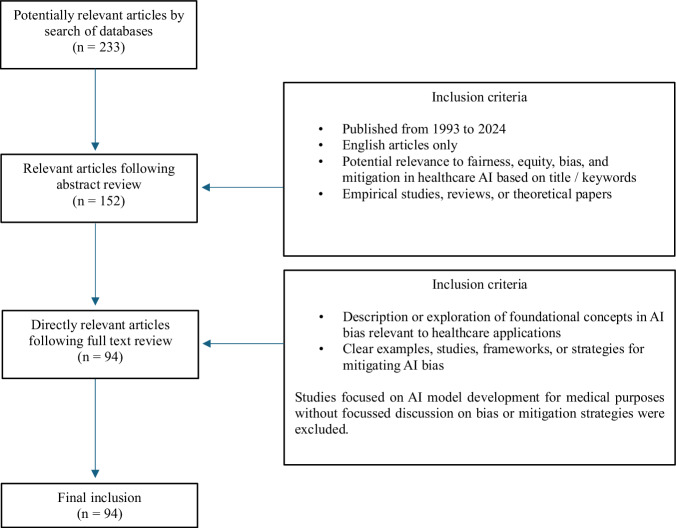
- As of May 13, 2024, the FDA listed 191 new AI-enabled medical devices, reaching 882 total, predominantly in radiology (76%), cardiology (10%), and neurology (4%). The review’s literature search yielded 233 potentially relevant articles, narrowed to 152 after title/abstract screening and 94 after full-text review.
- Cited evidence shows substantial bias burden: Kumar et al. found 50% of 48 sampled healthcare AI studies had high risk of bias and only 20% low risk; Chen et al. found only 86 of 555 neuroimaging-based psychiatric AI models (15.5%) included external validation, 97.5% included only high-income-region subjects, and 83% were rated high risk of bias.
- Case examples include Obermeyer et al.’s algorithm using healthcare costs as a proxy: among 43,539 White and 6,079 Black patients, Black patients had 26.3% more chronic illnesses at the same risk score (4.8 vs. 3.8 conditions); recalibration using direct health indicators nearly tripled high-risk Black patient enrollment from 17.7% to 46.5%. In cardiac MRI segmentation (nnU-Net, 5,903 UK Biobank subjects, 80% White), Dice similarity was 93.5% for White subjects but as low as 84.5% for Black and Mixed-race subjects; protected group models reached 92.15% for Black and 93.17% for Mixed-race subjects.
- Deployment biases are documented: incorrect AI BI-RADS suggestions dropped mammography reporting accuracy from 79.7% to 19.8% for inexperienced radiologists, 81.3% to 24.8% for moderately experienced, and 82.3% to 45.5% for very experienced radiologists; in a COVID-19 decision-support study, only 35% given risk score alone and 52% given risk score plus explanation critically evaluated incorrect recommendations; an ICU alarm study found 1,154,201 unique alarms, 88.8% for arrhythmias, with most false positives.
Methods
- The authors followed a critical review methodology, searching English articles published from 1993 to 2024 in PubMed, Google Scholar, and publisher platforms such as Elsevier, using Boolean operators and keywords including “Medical AI,” “AI bias,” “AI ethics,” “Fairness in medical AI,” and “Bias mitigation strategies in AI.”
- The search yielded 233 potentially relevant articles; after title/abstract screening, 152 were considered directly relevant, and 94 were selected for final review. A thematic-based approach was used to identify and categorize recurring themes, patterns, and insights related to bias types and mitigation strategies.
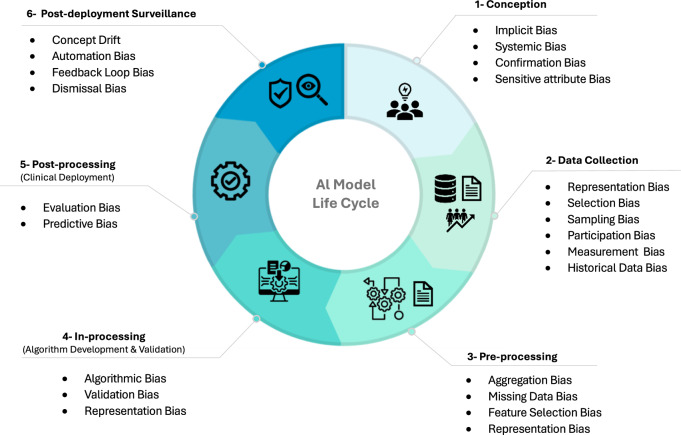
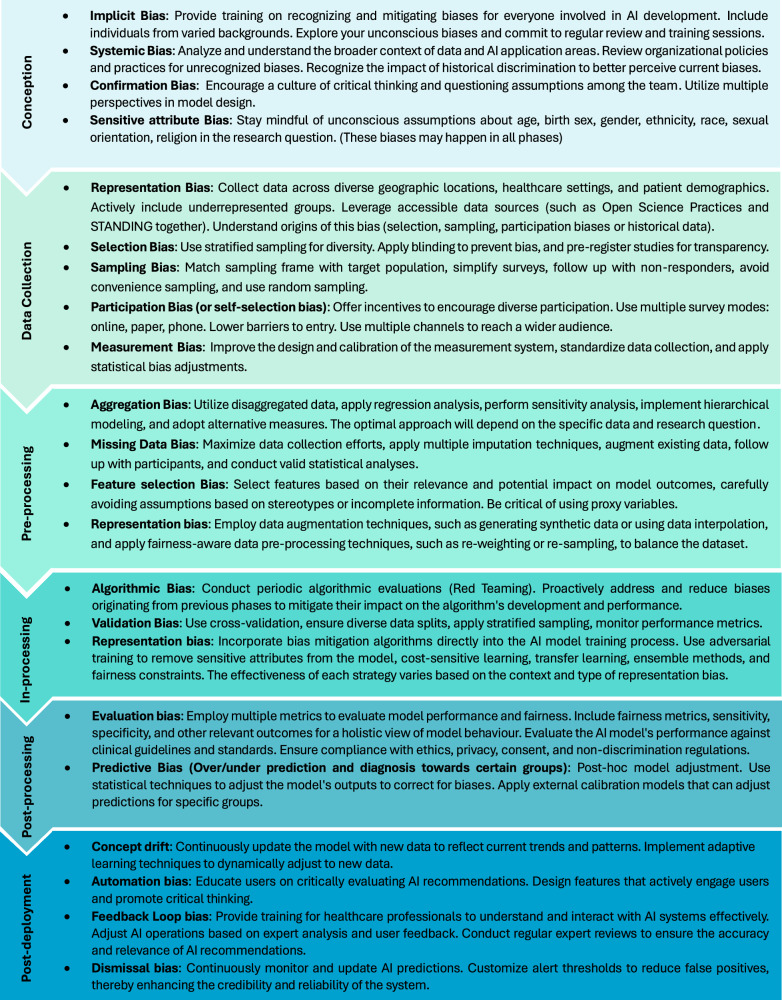
- The review is structured around bias origins and types—human, data, algorithmic, and model deployment—and mitigation recommendations across six AI lifecycle phases: conception, data collection, pre-processing, in-processing, post-processing, and post-deployment surveillance.
Limitations
- The paper states that achieving unbiased, broadly representative healthcare datasets remains formidable: data sparsity for underrepresented populations may not be feasible, prospective data quality improvement is time-consuming, sampling and participation biases are difficult to eliminate, standardizing data collection to reduce measurement bias is resource-intensive, vulnerable groups may remain underrepresented due to abundant WEIRD-population resources, and some socio-demographic features such as gender orientation remain poorly captured.
- The paper states that specific mitigation techniques have limitations: disaggregation can create noisy overly granular datasets; multiple imputation may introduce inaccuracies; data augmentation can generate synthetic data that fails to reflect true diversity; SMOTE can produce unrealistic data points; random under-sampling risks information loss; cost-sensitive learning can overfit; fairness metrics can create a fairness-accuracy trade-off; federated learning limits data pre-processing/quality assurance access; adversarial training can be computationally intensive and reduce accuracy; transfer learning may transfer unrecognized biases; explainability tools can be inconsistent or misleading; external validation data access is often challenging; and shadow deployment can delay implementation.
- The paper does not state limitations of the review itself; evident from the text, it is a critical/narrative review using thematic synthesis and does not report a formal risk-of-bias assessment or meta-analysis of the 94 included articles.
Model-written summary. Check it against the paper before relying on it.
Integrity signals
Registry
Cites
Statistics
Figures
Verification
Claims the paper makes
46 Valid · 4 Not valid · 55 Not checked · 23 Own results and interpretations
Every source the paper cites for this claim was checked and supports it.
In the paper
“Overall, 83% of studies were rated at high ROB18.”
§ Bias recognition and mitigation strategies in artificial intelligence healthcare applications > Methods > Bias
What the sources say
- Supportedcites [18] Chen, Z. et al. Evaluation of Risk of Bias in Neuroimaging-Based Artificial Intelligence Models for Psychiatric Diagnosis: A Systematic Review. JAMA Netw. Open 6, e231671 (2023). 36877519 PMC9989906 source
The Abstract and the 'Overall ROB for AI Models' section of our copy state that 461 of 555 units (83.1%; 95% CI, 80.0%-86.2%) were rated as having a high overall risk of bias by PROBAST, and the Discussion repeats '83.1% of existing AI models exhibited a high ROB for psychiatric diagnosis'. The citing sentence's 83% figure therefore matches the source's headline estimate exactly; the source's unit of appraisal is the neuroimaging-based AI models derived from the included studies (searched for a separate study-level count and found none reported), so the paraphrase carries the same magnitude, population and rating instrument. (LLM, conf=0.85)
plain- Asserted: passes — The authors put it forward as true.
- Checkable: passes — It can be checked against evidence.
- Load-bearing: passes — The paper’s conclusions depend on it.
- Based: passes — The paper gives a reason why it holds.
- Supported
The sources with a verdict support this claim; the rest weren’t checked yet, have no full text we could read, or their verdicts aren’t rated yet.
In the paper
“During model development, developers may consciously or subconsciously select, interpret, or give more weight to data that confirms their beliefs, overemphasizing certain patterns while ignoring other patterns that don’t fit expectations. This form of human-mediated bias is called confirmation bias30,31.”
§ Bias recognition and mitigation strategies in artificial intelligence healthcare applications > Methods > Human Biases
What the sources say
- Not checked yetcites [30] Elston, D. M. Confirmation bias in medical decision-making. J. Am. Acad. Dermatol. 82, 572 (2020). 31279036 source
- Supportedcites [31] Althubaiti, A. Information bias in health research: definition, pitfalls, and adjustment methods. J. Multidiscip. Healthc. 9, 211–217 (2016). 27217764 PMC4862344 source
The 'Confirmation bias' section of Althubaiti (2016) states that placing emphasis on one hypothesis because it does not contradict investigator beliefs is confirmation bias, that it is a psychological bias in which decisions are made according to the subject's preconceptions, beliefs or preferences, and that it emerges from overconfidence resulting in contradictory evidence being ignored or overlooked — matching the claim's 'give more weight to data that confirms their beliefs … ignoring other patterns'. The Introduction's statement that bias is often introduced unintentionally but can also be introduced intentionally covers the 'consciously or subconsciously' element, and the section notes confirmation bias affects any aspect of investigation requiring human judgment, including inclusion/exclusion criteria (selection). The source frames this around medical researchers/investigators rather than machine-learning model developers; the developers/model-development setting is the citing authors' own application, while the definitional content the citation is offered for ('this form of human-mediated bias is called confirmation bias') is stated directly in our copy. (LLM, conf=0.82)
hedgedstates a possible cause- Asserted: passes — The authors put it forward as true.
- Checkable: passes — It can be checked against evidence.
- Load-bearing: unclear — It is unclear whether the paper’s conclusions depend on it.
- Based: passes — The paper gives a reason why it holds.
Every source the paper cites for this claim was checked and supports it.
In the paper
“examined 555 published neuroimaging-based AI models for psychiatric diagnosis”
§ Bias recognition and mitigation strategies in artificial intelligence healthcare applications > Methods > Bias
What the sources say
- Supportedcites [18] Chen, Z. et al. Evaluation of Risk of Bias in Neuroimaging-Based Artificial Intelligence Models for Psychiatric Diagnosis: A Systematic Review. JAMA Netw. Open 6, e231671 (2023). 36877519 PMC9989906 source
The Abstract (FINDINGS, p. 3 of our copy) states that 517 studies presenting 555 AI models were included and evaluated, matching the claimed number exactly. The Data Extraction and Analysis section repeats the figure ('Of the 555 artificial intelligence (AI) models, 469 were tested at the internal sample and 86 at the independent external sample'), and the Retrieval Strategy/Introduction confirm the models are neuroimaging-based and aimed at psychiatric diagnosis. (LLM, conf=0.94)
plain- Asserted: passes — The authors put it forward as true.
- Checkable: passes — It can be checked against evidence.
- Load-bearing: passes — The paper’s conclusions depend on it.
- Based: passes — The paper gives a reason why it holds.
- Supported
Every source the paper cites for this claim was checked and supports it.
In the paper
“A similar temporally sensitive bias, known as “Concept shift,” can occur due to changes in the perceived meanings of data. How clinicians perceive and code diseases or outcomes can change dynamically over time, introducing a unique, human-level bias surrounding what data means and is being used for.”
§ Bias recognition and mitigation strategies in artificial intelligence healthcare applications > Methods > Human Biases
What the sources say
- Supportedcites [33] Chen, R. J. et al. Algorithmic fairness in artificial intelligence for medicine and healthcare. Nat. Biomed. Eng. 7, 719–742 (2023). 37380750 PMC10632090 source
The 'Evolving dataset shifts over time' subsection (p. under 'Healthcare disparities arising from dataset shift') defines concept shift/concept drift as arising from 'changes in diagnostic criteria and in labelling paradigms across populations', i.e. a changed relationship between X and Y when 'the criteria for diagnosing disease Y are revised over time', illustrated by the ICD-8→ICD-9→ICD-10→ICD-11 coding migrations and by repeated revisions of classification systems (Banff, WHO/ISUP, glioma taxonomy). This matches the claim that concept shift stems from changes in the perceived/coded meaning of disease or outcome data over time, and the passage's placement under temporal/evolving dataset shifts supports the citing sentence's characterisation of it as a temporally sensitive bias. (LLM, conf=0.88)
plainstates a cause- Asserted: passes — The authors put it forward as true.
- Checkable: passes — It can be checked against evidence.
- Load-bearing: unclear — It is unclear whether the paper’s conclusions depend on it.
- Based: passes — The paper gives a reason why it holds.
- Supported
The cited sources support only part of this claim — read each source’s verdict below.
In the paper
“This complexity is compounded by the inadequacy of methods for routinely detecting or mitigating biases across various stages of an algorithm’s life cycle, emphasizing a need for comprehensive and holistic bias detection frameworks14,15.”
§ Bias recognition and mitigation strategies in artificial intelligence healthcare applications > Methods > Bias
What the sources say
- Supportedcites [14] Kumar, A. et al. Artificial intelligence bias in medical system designs: a systematic review. Multimed. Tools Appl 83, 18005–18057 (2024). source
Our copy treats the shortfall directly: §4.3.4 (Analytical strategy to evaluate AI-bias) reports that most reviewed studies fall in the high-bias zone because 'the studies have not considered the imperative evaluation parameters for bias analysis', 'the bias qualitative analysis is also not performed... to identify the RoB', and 'the bias mitigation steps such as feature selection and feature augmentation are rarely performed in AI-studies' — i.e. routine detection and mitigation are inadequate. The Introduction reinforces this with 'To the best of our knowledge, no work has qualitatively and quantitatively analyzed the bias in AI-based prediction models in the healthcare domain.' The life-cycle framing the claim invokes is the paper's own structure (§3 Bias life cycle, stages I–III; §5 mitigation at pre-, in- and post-processing), and §7 Conclusion recommends robust analysis plus clinical validation before deployment. The only softening is that the paper locates the inadequacy in the practice of the surveyed studies rather than in the methods as such. (LLM, conf=0.82)
- Partly supportedcites [15] Chin, M. H. et al. Guiding Principles to Address the Impact of Algorithm Bias on Racial and Ethnic Disparities in Health and Health Care. JAMA Netw. Open 6, e2345050 (2023). 38100101 PMC11181958 sourceExperimental — accuracy not yet measured
Our copy conveys the surrounding idea but not the claim as stated: it never asserts that methods for routinely detecting or mitigating bias across the algorithm life cycle are 'inadequate.' What it does say is (a) in Guiding Principle 4 that 'technical definitions and metrics of fairness often do not translate clearly or intuitively to ethical, legal, social, and economic conceptions of fairness' and that 'there is no simple cookie-cutter technical solution,' and (b) under Guiding Principle 2 that existing reporting guidelines 'do not include concrete ways to report on fairness, and they rarely make explicit mention of equity.' Its life-cycle statements are normative rather than a finding of inadequacy — e.g., 'Equity and fairness checks should be built into each phase of the algorithm life cycle' (Guiding Principle 5) and that outcomes 'should be assessed routinely' (Algorithm Life Cycle) — so the part of the claim that routine detection/mitigation methods ARE inadequate is not stated by this source, only implied by its recommendations. (LLM, conf=0.72)
plain- Asserted: passes — The authors put it forward as true.
- Checkable: passes — It can be checked against evidence.
- Load-bearing: passes — The paper’s conclusions depend on it.
- Based: passes — The paper gives a reason why it holds.
- Supported
65 more claims · 35 with their cited sources checked
Create a free account to see all 128 claims and to verify the 61 references still open.
- Probably not a substantial claim. 18
- It may state two separate claims as one. 46
Claims other papers make about this one
Each is checked against this paper’s own text: does it say what the citing paper says it does?
The source backs part of the claim, not all of it — or backs it for a different population, condition or comparison.
In the citing paper
“Moreover, frameworks developed in studies4,11,35 enhance methodological theory by incorporating AI ethics, transparency, and bias mitigation into evidence appraisal models like PRISMA-AI and CLASMOD-AI.”
From Generative Artificial Intelligence in Healthcare: Automation Bias, Deskilling, and Cognitive Implications – A Systematic Review (2026) · cites this paper as [4]
Experimental — accuracy not yet measuredThe source backs part of the claim, not all of it — or backs it for a different population, condition or comparison.
In the citing paper
“In the same way, ethical and psychological aspects4,33 show that clinician trust and identity need to be actively built through open governance and clear AI design.”
From Generative Artificial Intelligence in Healthcare: Automation Bias, Deskilling, and Cognitive Implications – A Systematic Review (2026) · cites this paper as [4]
Experimental — accuracy not yet measuredThe source backs part of the claim, not all of it — or backs it for a different population, condition or comparison.
In the citing paper
“Ethical governance frameworks, like the ones suggested in,4,49 stress the importance of clear rules, accountability systems, and algorithmic transparency in order to protect clinician independence and patient trust.”
From Generative Artificial Intelligence in Healthcare: Automation Bias, Deskilling, and Cognitive Implications – A Systematic Review (2026) · cites this paper as [4]
Experimental — accuracy not yet measuredIn the citing paper
“Nevertheless, we draw a tentative conclusion that a minimal level of ML and data literacy should be included, consistent with the predominant expert view and patient-safety imperatives [31-34].”
From Role-Differentiated AI Competencies and Curriculum Implications for Health Professions Education: Qualitative Study (2026) · cites this paper as [33]
Citations
Cites
The PRISMA 2020 statement: An updated guideline for reporting systematic reviews
Page, M. J., McKenzie, J. E., Bossuyt, P. M., Boutron, I., Hoffmann, T. C., Mulrow, C. D., Shamseer, L., Tetzlaff, J. M., Akl, E. A., Brennan, S. E., et al. (2021) · BMJ · doi:10.1136/bmj.n71 · Cited by 108,283
SMOTE synthetic minority over-sampling technique
Chawla, N. V., Bowyer, K. W., Hall, L. O., & Kegelmeyer, W. P. (2002) · Journal of Artificial Intelligence Research · doi:10.1613/jair.953 · Cited by 32,865 · cited 2×
“To address class imbalance, strategies such as resampling to balance class distributions 60 , synthetic data generation (such as Synthetic Minority Over-sampling Technique (SMOTE)) 61 , and the application of cost-sensitive learning to emphasize minority class errors should be considered 62 .”
A typology of reviews: an analysis of 14 review types and associated methodologies
Grant, M. J., & Booth, A. (2009) · Health Information & Libraries Journal · doi:10.1111/j.1471-1842.2009.00848.x · Cited by 10,817
The PRISMA 2020 statement: an updated guideline for reporting systematic reviews
Page, M. J., McKenzie, J., Bossuyt, P., Boutron, I., Hoffmann, T., mulrow, C., Shamseer, L., Tetzlaff, J., Akl, E., Brennan, S. E., et al. (2020) · doi:10.31222/osf.io/v7gm2_v1 · Cited by 8,090
Dissecting racial bias in an algorithm used to manage the health of populations
Obermeyer, Z., Powers, B., Vogeli, C., & Mullainathan, S. (2019) · Science · doi:10.1126/science.aax2342 · Cited by 7,137 · cited 2×
“However, ongoing surveillance is necessary, as reliance on historical data and evolving healthcare dynamics could allow biases to re-emerge 46 .”
A Survey on Bias and Fairness in Machine Learning
Mehrabi, N., Morstatter, F., Saxena, N., Lerman, K., & Galstyan, A. (2022) · ACM Computing Surveys · doi:10.1145/3457607 · Cited by 5,812 · cited 1×
“An example of this is the “ healthy volunteer ” selection bias observed in the UK Biobank, where participants are generally healthy and therefore do not represent patients typically encountered by healthcare systems 39 .”
A Survey on Bias and Fairness in Machine Learning
Mehrabi, N., Morstatter, F., Saxena, N., Lerman, K., & Galstyan, A. (2019) · arXiv · doi:10.48550/arxiv.1908.09635 · Cited by 5,812
The PRISMA 2020 statement: an updated guideline for reporting systematic reviews
Page, M. J., McKenzie, J., Bossuyt, P., Boutron, I., Hoffmann, T., mulrow, C., Shamseer, L., Tetzlaff, J., Akl, E., Brennan, S. E., et al. (2020) · doi:10.31222/osf.io/v7gm2 · Cited by 5,177
Information bias in health research: definition, pitfalls, and adjustment methods
Althubaiti, A. (2016) · Journal of Multidisciplinary Healthcare · doi:10.2147/jmdh.s104807 · Cited by 3,018 · cited 1×
“For example, systemic bias may manifest as inadequate medical resource funding for un-insured individuals, underserved 30,31 .”
PROBAST: A Tool to Assess the Risk of Bias and Applicability of Prediction Model Studies
Wolff, R. F., Moons, K. G. M., Riley, R. D., Whiting, P. F., Westwood, M., Collins, G. S., Reitsma, J. B., Kleijnen, J., Mallett, S., & for the PROBAST Group† (2019) · Annals of Internal Medicine · doi:10.7326/m18-1376 · Cited by 2,984 · cited 1×
“A similar study, performed by Chen, et al., using the PROBAST (Prediction model Risk Of Bias ASsessment Tool) framework 17 (For further details, refer to Supplementary Table 1), examined 555 published neuroimaging-based AI models for psychiatric diagnosis, identifying only 86 studies (15.5”
Influential
Research works printed but not linked: 2
- Jackson, M. C. Artificial Intelligence & Algorithmic Bias: The Issues with Technology Reflecting History & Humans Notes & Comments. J. Bus. Tech. L. 16, 299–316 (2021).
- Wachter, S., Mittelstadt, B. & Russell, C. Counterfactual explanations without opening the black box: Automated decisions and the GDPR. Harv. JL & Tech. 31, 841 (2017).
Cited by
Items 201–300 of 322
Ethical, Privacy, and Regulatory Considerations
Shaikh, K., Thanki, R., & Shah, S. (2026) · Synthesis lectures on engineering, science, and technology · doi:10.1007/978-3-032-25486-3_6
AI Methods in Genomic Analysis
Shaikh, K., Thanki, R., & Shah, S. (2026) · Synthesis lectures on engineering, science, and technology · doi:10.1007/978-3-032-25486-3_3
Wilkins, E. (2026) · Journal of Clinical Practice in Speech-Language Pathology · doi:10.1080/22000259.2026.2665861
Future of AI in Cognitive Disease Diagnosis and Healthcare
Jain, K., Singh, A., Pandey, A., Garg, K., Rathore, S., Bhatele, K. R., Tiwari, D., & Bhargava, A. (2026) · Cognitive systems monographs · doi:10.1007/978-3-032-18782-6_10 · Cited by 1
Fundamentals of Cognitive Diseases and Diagnostic Challenges
Kumar, S. M. (2026) · Cognitive systems monographs · doi:10.1007/978-3-032-18782-6_2
Artificial Intelligence (Pattern Recognition) in Musculoskeletal Imaging: The Future or Hype?
Tordjman, M., Regnard, N.-E., Bouvier, F. M., Rizk, B., & Guermazi, A. (2026) · Seminars in Musculoskeletal Radiology · doi:10.1055/a-2818-3827
Yamamura, Y., Fujii, K., Nakashima, C., & Otsuka, A. (2026) · Acta Dermato Venereologica · doi:10.2340/actadv.v106.adv-2025-0180 · Cited by 1
“In addition, the number of AI-generated differential diagnoses was limited to 3, as presenting a single candidate may promote anchoring (9), whereas excessive options can increase cognitive burden (10, 11).”
Chen, Y. Y., Xu, Z. S., Pan, H., Lin, J., Zhu, K., & Shull, P. B. (2026) · Biomedical Signal Processing and Control · doi:10.1016/j.bspc.2026.110629
Sun, Y., & Wu, L.-Y. (2026) · Frontiers in Public Health · doi:10.3389/fpubh.2026.1841351 · Cited by 3
“However, the integration of AI into health literacy education also introduces a set of structural and epistemic risks that warrant critical consideration (29, 30).”
Xu, Z., Zhou, S., Song, J., Russell, D., Zolnoori, M., Shang, J., & Topaz, M. (2026) · International Journal of Medical Informatics · doi:10.1016/j.ijmedinf.2026.106485
Hegazi, M. A. A. A., Monari, M., Pasqualini, F., Beltrame, S., Martella, C., Bax, C., Tidu, L., Capelli, L., Taverna, G., & Grizzi, F. (2026) · Life · doi:10.3390/life16050848
“These issues are particularly relevant for VOC-based ML models, where differences in pre-analytical conditions, cohort composition, and data preprocessing may strongly affect the final diagnostic output [145,154–159].”
Clinical XAI: A Tutorial on Concepts, Methods, and Modalities from Linear Models to LLMs
Mesinovic, M., & Zhu, T. (2026) · ACM Computing Surveys · doi:10.1145/3816420 · Cited by 2
Dakal, T. C., Beura, A., & Kumar, A. (2026) · Genetics. · doi:10.5772/intechopen.1015851
Khakpoor, F. L., van der Vliet, W., Deng, J. D., Wang, Y., & Pat, N. (2026) · bioRxiv (Cold Spring Harbor Laboratory) · doi:10.64898/2026.05.25.727742
Bag, S. B., Kumari, P., Vashishtha, A., & Madhav, M. (2026) · Advances in computational intelligence and robotics book series · doi:10.4018/979-8-2600-2173-6.ch004
Bag, S. B., Goel, A., Rahangdale, P., & Yadav, E. (2026) · Advances in computational intelligence and robotics book series · doi:10.4018/979-8-2600-2173-6.ch002
Responsible AI in the Age of Algorithms: Emerging Trends in Ethics and Bias Mitigation
Nagpal, T., Bhasutkar, P., Kumar, J. D., Mishra, R. P., & Prashant (2026) · International Conference on Intelligent Computing and Automation for Sustainable Solutions (ICASS) · doi:10.1109/icass69550.2026.11547741
Machine learning-integrated private blockchain framework for bias detection in clinical trials data
Shetty, S. S., Pushpalatha, K., & Lokesh, K. S. (2026) · Array · doi:10.1016/j.array.2026.101002
Gumede, S. B., Venter, W. D. F., Mndebele, N., & Lalla‐Edward, S. T. (2026) · Mayo Clinic Proceedings Digital Health · doi:10.1016/j.mcpdig.2026.100380
“22,25 These limitations are particularly pronounced in this context, where data constraints and structural inequities directly shape model performance and downstream health outcomes.”
Ghane, M., Elmore, M., Dankwa‐Mullan, I., Stapleton, S., Owens, K., Khalid, S., Delonay, A., Youssef, A., Chisunka, M., Rariy, C., et al. (2026) · The American Journal of Bioethics · doi:10.1080/15265161.2026.2677391
“…unrepresentative datasets or missing data that functionally exclude key populations or input variables (Bankhead et al. 2019); Measurement Bias, from inconsistencies or incompleteness in datasets, data labeling, or data pre-processing (Hasanzadeh et al. 2025 (Bond et al. 2018; Wang et al. 2022).”
Seghier, M. L. (2026) · International Journal of Imaging Systems and Technology · doi:10.1002/ima.70393
“This calls for more rigorous mitigation frameworks of bias in medical AI to ensure that AI is delivering value for all populations and across all aspects of clinical practice [34, 37, 38].”
Ethics of AI in Patient Recruitment and Diversity
Kholiya, N. S., Ojha, A., Singh, A. K., & Bhatt, V. (2026) · Journal of Drug Delivery and Therapeutics · doi:10.22270/jddt.v16i6.7815
Angermayr, K., Neuendorf, N. L., & Scherr, S. (2026) · Health Communication · doi:10.1080/10410236.2026.2666885
Hirapara, J., Ranpara, R. D., & Doshi, M. V. (2026) · Advances in computational intelligence and robotics book series · doi:10.4018/979-8-2600-2463-8.ch004
Visconti-Lopez, F. J., Florián-Pérez, M. C., Vega, M. E. M., & Jiménez, A. L. (2026) · Iberoamerican Journal of Science Measurement and Communication · doi:10.47909/ijsmc.375
“(Hasanzadeh et al., 2025; Hunik et al., 2025; Lozada-Martinez et al., 2025a; Lozada-Martinez et al., 2025b; Lozada-Martinez et al., 2025c; Smiley et al., 2025).”
InfluentialFrom agentic artificial intelligence to accountable military healthcare: A readiness imperative
Vijayasimha, M., Srikanth, M., & Jha, R. K. (2026) · Medical Journal Armed Forces India · doi:10.1016/j.mjafi.2026.05.005
The Grammar of Science: B&I Before AI—Bias and Inference Still Matter
Kaewkungwal, J. (2026) · Outbreak Surveillance Investigation & Response (OSIR) Journal · doi:10.59096/osir.v19i2.282987
Using routine school data to support adolescent well-being in resource-limited settings
Nguyen, N. P., Nguyen, T. H. A., Ha, A., & Nguyen, P. L. (2026) · Discover Public Health · doi:10.1186/s12982-026-02482-0
“Algorithms built on biased or incomplete data can reinforce inequality [33, 34].”
Healthcare and Medical Education in the Age of Artificial Intelligence
Lee, S., & Hyun, M. (2026) · Korean Medical Education Review · doi:10.17496/kmer.26.018
Exploring perceptions of data risks in AI-enabled nursing research: A qualitative study
Yin, X., Song, H., Moreira, P., Song, C., & Sun, Y. (2026) · Digital Health · doi:10.1177/20552076261456561
“70,71 In terms of academic integrity, it is particularly important to establish an effective mechanism for identifying and verifying AI-generated content.”
Ferdinand, K. C., Selvaraj, S., Alexander, K. M., & Malhotra, S. (2026) · Heart Failure Reviews · doi:10.1007/s10741-026-10651-1 · Cited by 1
Oliveira, M. (2026) · ACM Interactive Health Conference · doi:10.1145/3786579.3801800
“Between 2024 and 2025, the U.S Food and Drug Administration (FDA) has reported 493 new AIeMD entries [9], with this rapid rise of AIeMD being driven by AI’s unique capability for complex analysis and large-scale healthcare, outperforming traditional statistical methods [11].”
Shin, H. D., Ronquillo, C., Lee, J., Lokmic‐Tomkins, Z., Reid, L., You, S. B., Davies, S., Block, L. J., Özbay, İ., Lukitasari, M., et al. (2026) · International Journal of Medical Informatics · doi:10.1016/j.ijmedinf.2026.106582
Ye, J. Y., Shen, Z.-J., Li, B., & Yan, W. (2026) · Frontiers in Psychiatry · doi:10.3389/fpsyt.2026.1866163
A data-centric trust pipeline:an empirical framework for trustworthy AI in sensitive domains
Pereira, C. D. C. (2026) · AI and Ethics · doi:10.1007/s43681-026-01247-4 · Cited by 1
“…of demographic disparities in AI outputs has been documented at least since the gender-shades audits of commercial face classifiers [ 12] and replicates in domains with higher stakes, particularly clinical AI where bias-recognition and mitigation strategies remain an active research frontier [13].”
Personalisation and Predictive Insights: Applied AI Strategies in Modern Learning Technologies
Wastira, J., & Dedi (2026) · Digital Education Review · doi:10.1344/der.2026.49.95-114 · Cited by 2
Rodrigues, R., Dias, P. C., & da Silva, C. V. (2026) · Springer eBooks · doi:10.1007/978-3-032-27336-9_10
Non-neutrality in Machine Learning Models for Detection of Parkinson’s Disease
Pandey, K., Mazumdar, B. D., Tiwari, S., Choubey, A., Abid, N., & Khan, S. (2026) · International Conference on Frontiers of Engineering and Emerging Technologies (FET) · doi:10.1109/fet68771.2026.11601890
“In clinical AI, biased predictions can be very dangerous and can aggravate systemic healthcare disparities which may lead to delayed diagnosis or unequal treatment outcomes [15].”
Pérez, A., Piñeiro, C., & Parapar, J. (2026) · Social Network Analysis and Mining · doi:10.1007/s13278-026-01620-5
“Other con - cerns include bias amplification, limited interpretability for 4 Code and materials: https:/ /github .com/An xo06/ Scaling-Mental-Support-NLP clinicians, and the lack of oversight comparable to regulated care (Ray 2023; Hasanzadeh et al. 2025 ).”
Arcuri, M. A. (2025) · Springer eBooks · doi:10.1007/978-3-031-93247-2_8
Fitriasari, E., & Umasugi, M. T. (2026) · Health Policy and Technology · doi:10.1016/j.hlpt.2026.101289
Artificial intelligence in assisted reproduction: Navigating the next frontier in fertility care
Chakraborty, P., Nandi, P., & Rahman, S. M. (2026) · Elsevier eBooks · doi:10.1016/b978-0-443-43934-6.00002-x
Malhotra, S. (2026) · IntechOpen eBooks · doi:10.5772/intechopen.1015983
Data Stewardship Barriers to Building Digital Twin Technology for Precision Medicine
Silva, P. J., Tao, J., Rogers, S. L., He, Q., Robert, J. D., Black, L., Bruce, S. A., Shireman, P. K., & Ramos, K. S. (2026) · AI in Medicine · doi:10.3390/aimed1030020 · Cited by 1
“Transfer learning and domain adaptation techniques allow models trained on larger, albeit biased, datasets to be fine-tuned on smaller, more representative cohorts, improving performance for under-served groups while leveraging existing investments [96,97].”
Kinzhebay, A., Zhanymbetova, A., & Salybekov, A. A. (2026) · IntechOpen eBooks · doi:10.5772/intechopen.1016046
Upadhyay, L., Kale, A., Mishra, A., & Shukla, A. K. (2026) · Complex & Intelligent Systems · doi:10.1007/s40747-026-02390-5
“…degradation and concept drift: AI models deployed in Metaverse healthcare environments may experience concept drift, where the relationships between input features and target outcomes change over time due to evolving disease patterns, demographic shifts, or changes in clinical practice [77].”
Basta, K., Zahid, U., Hardalupas, M., & Vilić, D. (2026) · BMJ Digital Health & AI · doi:10.1136/bmjdh-2026-000087
The Role of AI in Shaping Organizational Culture and Values
Makinde, O. F. (2026) · Advances in computational intelligence and robotics book series · doi:10.4018/979-8-3373-5213-8.ch016
MacLeod, G., Çevik, H. S., Varahra, A., & Thompson, K. (2026) · Family Practice · doi:10.1093/fampra/cmag063
Healthcare Digital Twins Across Scales: A Narrative Review and Five-Level Conceptual Framework
Azamfirei, L., Bica, D., Dragomir, A. C., & Almásy, E. (2026) · Healthcare · doi:10.3390/healthcare14162445
“Post-deployment surveillance protocols would help detect model drift and determine when revalidation is required [17,19].”
InfluentialArtificial Intelligence in Anesthesiology Education
Rosenkrans, D. J., Blacker, S. N., Lele, A. V., & Buhl, L. K. (2026) · Anesthesiology Clinics · doi:10.1016/j.anclin.2026.06.005
Data Quality, Noise, and Bias in Medical Data: The Critical Role of Data Collection Design
Lhotská, L. (2026) · World Congress on Medical Physics and Biomedical Engineering, September 7 - 12, 2009, Munich, Germany · doi:10.1007/978-3-032-20291-8_44
Sharanesha, R. B., Virupakshappa, D., Abushanan, A., & Alghamdi, S. (2026) · Informatics · doi:10.3390/informatics13080129
Managing Security Risks in AI Deployment
Mudassir, N., Waris, A., & Shehzad, A. (2026) · Springer eBooks · doi:10.1007/978-981-92-0875-3_13
Strategic Solutions for Overcoming Challenges in AI Adoption
Baig, T., Khan, M. J., & Shehzad, A. (2026) · Springer eBooks · doi:10.1007/978-981-92-0875-3_14
From metrics to morals: evaluating ethical and clinical dimensions of AI in ICU decision-making
Levin, C., Orkaby, B., Suliman, M., & Saban, M. (2026) · Ethics and Information Technology · doi:10.1007/s10676-026-09914-0 · Cited by 1
“This aligns with the growing recognition that reducing AI bias is essential not only for accuracy but also for ethical, equi-table healthcare(Hasanzadeh et al., 2025).”
The Gender Data Gap in Medical AI: Causes, Consequences, and Building Inclusive Solutions
Taleghani, S., & Dolatabadi, E. (2026) · Springer eBooks · doi:10.1007/978-3-032-22368-5_4
Rehman, K., & Akash, M. S. H. (2026) · Elsevier eBooks · doi:10.1016/b978-0-443-45911-5.00005-2
From Algorithm to Augmentation: Redefining Human–AI Dynamics in Modern Healthcare
Gresbek, M., & Schirmer, H. (2026) · IntechOpen eBooks · doi:10.5772/intechopen.1017039
Tulpule, S. S., & Jadhav, S. J. (2026) · Journal of Cardiovascular Imaging · doi:10.1186/s44348-026-00064-x
“Various different types of bias in AI are already identified [47] and research is being carried to device new methods and techniques to minimize the bias [29].”
Artificial intelligence agents and agentic artificial intelligence applied to precision medicine
Costa, F. F. (2026) · Drug Discovery Today · doi:10.1016/j.drudis.2026.104781
Wang, Q., Song, Y.-X., Yang, X., Zhang, J., Sun, R., Wu, X., Li, A., Lou, J., Li, H., Liu, Y., et al. (2026) · MedComm · doi:10.1002/mco2.70944
Xie, J., 时春艳, Dou, L., Peng, D., Li, L., Xu, R., & Wu, Y. (2026) · Pregnancy Hypertension · doi:10.1016/j.preghy.2026.101506 · Cited by 1
Artificial Intelligence and the Risk of Self-fulfilling Prophecies
Maslove, D. M. (2026) · Annals of Internal Medicine · doi:10.7326/annals-26-02011
The Migration of Bias in Law: From Human Cognition to Predictive AI System and Large Language Models
Zhong, H. (2026) · Springer eBooks · doi:10.1007/978-3-031-87993-7_185-1 · Cited by 1
Oyetunji, I. O., Stansberry, T. T., & Bull, S. S. (2026) · doi:10.2196/preprints.110087
Impacts of AI decision support on conversational strategies of emergency call-takersPreprint
Shrestha, A., Shao, R., Byrne, K. A., & Fan, C. (2026) · SSRN Electronic Journal · doi:10.2139/ssrn.7358581
Xu, J., Wang, Y., Zhang, X., Zhou, Z., Li, Z.-M., Chen, H., Cai, Q., Tang, W., Hua, H.-Z., Liu, T., et al. (2026) · Journal of the Formosan Medical Association · doi:10.1016/j.jfma.2026.08.049
Lynch, N. S. J., Loughran, R., Hugh, M. M., & McCaffery, F. (2026) · Design and Artificial Intelligence · doi:10.1016/j.daai.2026.100101
Data-Driven Impedimetric Sensor for Senescent Fruits: A Case Study on Papaya Ripeness Classification
Saxena, Y., Roy, D., Ghosh, C., & Adhikary, A. (2026) · IEEE Sensors Letters · doi:10.1109/lsens.2026.3729560
“Using a typical data augmentation algorithm, i.e., synthetic minority oversampling technique[19],theoriginalclassdataarefurtherbalancedtoachieveamore reliable,accurate,andclass-unbiasedclassification.”
REX-ASD: A Robust and Explainable Evaluation Protocol for Autism Spectrum Disorder Screening
Ali, H., Sama, N. U., & Ibrahim, M. (2026) · Lecture notes in networks and systems · doi:10.1007/978-3-032-31755-1_28
Temporal Myopia in AI-Accelerated Materials Research
Pereira, L., Martins, B., & Azevedo, R. (2023) · Journal of Artificial Intelligence for Materials Science · doi:10.68159/y079843774
Biomarkers in axial spondyloarthritis diagnosis: from clinical signs to multi-omics integration
Xin, P., Xu, Z., Pan, Y., Zhang, M., & Wang, R. (2026) · Frontiers in Immunology · doi:10.3389/fimmu.2026.1929862
A Causal Inference–Driven Treatment Effect Governance Model for Observational Clinical Systems
Larsson, S., Johansson, E., & Nilsson, A. (2026) · Journal of Artificial Intelligence for Healthcare Systems · doi:10.68159/a120078888
Social Determinants in Healthcare AI: Integration Strategies, Bias Mechanisms, and Equity Evaluation
Martinez, J., & Lopez, C. (2026) · Journal of Health Informatics and Digital Systems · doi:10.68159/m924320832
Cresswell, K. M., Mozaffar, H., Anderson, S., Yang, X., Bea, S., Seuren, L. M., & Williams, R. (2026) · Journal of the American Medical Informatics Association · doi:10.1093/jamia/ocag148
Beyond the Algorithm: Guiding Principles for AI-Enhanced Dentistry
Lee, A. L., Kim, C. S., & Chan, H. K. (2026) · Journal of the California Dental Association · doi:10.1080/19424396.2026.2719376
Protecting Patient Information in Healthcare
Szabat, M. (2026) · Bioethics · doi:10.1111/bioe.70188
Khakpoor, F. L., van der Vliet, W., Deng, J. D., Wang, Y., & Pornpattananangkul, N. (2026) · eLife · doi:10.7554/elife.112354.1
Khakpoor, F. L., van der Vliet, W., Deng, J. D., Wang, Y., & Pornpattananangkul, N. (2026) · eLife · doi:10.7554/elife.112354
A Survey on Perspectives Toward Artificial Intelligence Among Italian Interventional Cardiologists
Biondi‐Zoccai, G., Biondi-Zoccai, G. V., Cerri, A., Burzotta, F., Trani, C., Romagnoli, E., Giordano, A., Corcione, N., Giordano, S. A., Pepe, M., et al. (2026) · Journal of Clinical Medicine · doi:10.3390/jcm15187050
“These associations suggest that education may be a modifiable determinant of adoption, although causality cannot be inferred and self-selection remains possible [23].”
Santoyo, J., Figueroa, C. V., Nabizada, H., Argüello-Lacayo, L., Arias, G., & Abdelgawad, M. M. (2026) · Journal of Dental Health and Oral Research · doi:10.46889/jdhor.2026.7302
“Integrating clinical data, radiological information and real-time monitoring may improve risk stratification and support precision-based follow-up after procedures such as implant placement, reconstructive surgery and trauma management [59].”
Artificial Intelligence (AI) in Home-Care and Community Nursing: A Scoping Review
Wang, H., Wang, G., Wang, T., Delaney, L., Bayuo, J., Li, M., & Tan, J.-Y. B. (2026) · Healthcare · doi:10.3390/healthcare14183034 · Cited by 2
“Recent healthcare AI literature emphasizes that responsible AI adoption requires diverse and representative datasets, equity-oriented model development, bias mitigation strategies, and post-deployment surveillance to prevent the amplification of existing inequities [67,68].”
InfluentialAn AI-Based Whole-Person Care Summarization Tool for Care Management Providers
Mulligan, J., Zhu, K., Batlivala, N., Kumar, S., Juusola, J. L., & Favini, N. (2026) · NEJM Catalyst · doi:10.1056/cat.26.0025
Ong, M., Schanberg, L. E., Kohlheim, M., Leal, J., Luo, A., Natter, M. D., & Kimura, Y. (2026) · ACR Open Rheumatology · doi:10.1002/acr2.90105
Basilio, D. D., Casson, A. J., & Jones, A. K. P. (2026) · Philosophical Transactions of the Royal Society B Biological Sciences · doi:10.1098/rstb.2024.0468 · Cited by 2
“However, these benefits depend on the quality of the data used; biased or incomplete datasets can produce inaccurate predictions and undermine trust [130 ].”
Dark proteome and emerging technologies for functional characterization and drug discovery
Haque, M. A., Kim, J.-J., & Danishuddin (2026) · Drug Discovery Today · doi:10.1016/j.drudis.2026.104806
Amponsah, C., Kyiewu, B., Yiadom, C. B., & Oppong-Asante, A. (2026) · SAP Social AI · doi:10.62486/sai2026101
Operationalizing ethical AI for safe clinical integration: A qualitative interview study
ÇAYIRTEPE, Z., Demir, B., & Ertuğrul, Ö. F. (2026) · International Journal of Medical Informatics · doi:10.1016/j.ijmedinf.2026.106721
Charting a human-Centered future: AI's promise and challenges for occupational therapy
Pellerin, M., Malfitano, A. P. S., Francis, J., Teng, M. Y., & Jacobs, K. (2026) · Work · doi:10.1177/10519815261490547
AI Based Cough Analysis for Pulmonary Tuberculosis Triage and Diagnosis: A Technical Review
Chowdary, G. J., Ali, S. N., Sakpuntoon, V., Shapiro, A. E., Restrepo, B. I., Pont, S. J., Armitige, L. Y., Kingwara, L., Villa, U., & Panpradist, N. (2026) · npj Biomedical Innovations. · doi:10.1038/s44385-026-00110-9 · Cited by 1
“Model fairness must be systematically evaluated: biases by age, sex, geography, or comorbidities cannot be tolerated in deployment 77 – 80 .”
Lavecchia, A. (2026) · Springer eBooks · doi:10.1007/978-981-96-7448-0_68-1
Development and performance of a specialized large language model for restorative treatment planning
Shirani, M. (2026) · Journal of Prosthetic Dentistry · doi:10.1016/j.prosdent.2026.08.012
ÇAYIRTEPE, Z., & Demir, B. (2026) · Hacettepe sağlık idaresi dergisi · doi:10.61859/hacettepesid.1922869
Frey, N., Agha-Mir-Salim, L., Renner, L., Haufe, S., Voge, L., & Balzer, F. (2026) · Research Square · doi:10.21203/rs.3.rs-10892043/v1 · Cited by 2
Healthcare bias estimation with XAI model for clinical workflow
Sonawane, V. R., Mishra, V. P., Shinde, B. N., Dwaramwar, P. A., & William, P. (2026) · Intelligence-Based Medicine · doi:10.1016/j.ibmed.2026.100486
Bias in AI applications for audiology: cultural, linguistic and ethical considerations in Africa
Khoza‐Shangase, K. (2026) · International Journal of Health Care Quality Assurance · doi:10.1108/ijhcqa-05-2026-0128
Mulyadi, S., Supangkat, S. H., & Anggara, D. W. (2026) · International Conference on ICT for Smart Society (ICISS) · doi:10.1109/iciss71466.2026.11715528
“…systematically skewed toward atypical, ambiguous erosions rather than the full case-mix encountered in practice—a pattern consistent with feedback-loop bias, whereby clinician-adjusted labels can selectively reinforce and propagate the model's existing blind spots rather than correcting them [9].”
YAPAY ZEKA ÇAĞINDA DİJİTAL SAĞLIK OKURYAZARLIĞI VE HASTA HAKLARI
Deniz, E. (2026) · Sağlıkta Performans ve Kalite Dergisi · doi:10.70915/spkd.1854900
Metadata
- Authors
- Hasanzadeh, F., Josephson, C. B., Waters, G., Adedinsewo, D., Azizi, Z., & White, J. A.
- Affiliations
- University of Calgary (CA)
- Morgan State University (US)
- Mayo Clinic (US)
- Stanford Medicine (US)
- Corresponding author
- White, James A.
- ORCID
- Venue
- npj Digital Medicine
- Published
- 2025-03-11
- Volume
- 8
- Issue
- 1
- Pages
- 154-154
- ISSN
- 2398-6352 (ISSN-L)
- PMC
- PMC11897215
- OpenAlex
- W4408314709
- Semantic Scholar
- d25dafe6aee6f79c641ef84b9d0982f2870a8731
- Cited by
- 320
- References
- 93
- Citations by year
- 2026: 221 · 2025: 97
- FWCI
- 49.28
- Type
- journal article
- Language
- en
- Open access
- gold
- doi.org
- Licence
- cc-by-nc-nd
- creativecommons.org/licenses/by-nc-nd/4.0 (tdm)
- creativecommons.org/licenses/by-nc-nd/4.0 (vor)
- Locations
- npj Digital Medicine (publishedVersion, cc-by-nc-nd)
- Europe PMC (PubMed Central) (publishedVersion, cc-by-nc-nd)
- PubMed Central (publishedVersion, cc-by-nc-nd)
- PubMed (publishedVersion)
- DOAJ (DOAJ: Directory of Open Access Journals) (submittedVersion, cc-by-sa)
- Topics
- Physical Sciences › Computer Science › Artificial Intelligence › Ethics and Social Impacts of AI
- Health Sciences › Medicine › Health Informatics › Artificial Intelligence in Healthcare and Education
- Physical Sciences › Computer Science › Artificial Intelligence › Explainable Artificial Intelligence (XAI)
- Keywords
- algorithmic bias, artificial intelligence in healthcare, bias mitigation, health care disparities, algorithmic fairness, model life cycle, bias detection, stakeholder responsibility, long-term monitoring
About these checks
Registry, retraction, Cites and statistics results are computed, not judged, with one exception: a printed reference that no index lists is read once by a model before it counts as a citation error. Claims are extracted by a model and kept only when their quote appears verbatim in the text; each cited source is then checked, with a model’s help, for whether it says what the claim relies on. Those verdicts can be wrong — read the claim’s quote and the cited source before relying on one.
The claim verdicts this report counts are experimental: their accuracy is not yet measured.
A language model drew the claims from the paper on 2026-10-05, under version 3 of the claim definition (model deepseek-v4.1-flash, prompt extract-v3).
A second model labelled each claim on 2026-10-05 (model jev-1.13-20260917, definition revision gold-guideline-v0.2).
Cited sources are checked with a language model’s help (qwen3.8-omni-flash).
Statistics and arithmetic are recomputed, not judged.
Confidence bands are shown only for fields calibrated on our annotated test set. None is calibrated yet, so no band is shown.
What counts as a claim ›How we measure confidence ›How we check this ›
Are you an author, or do you see a problem with this page? Request a review
Data sources
Bibliographic data: Semantic Scholar, OpenAlex, Crossref.
Contains information from the Semantic Scholar Academic Graph Datasets, made available under the ODC Attribution License (ODC-BY 1.0).
Semantic Scholar’s data is described in: Kinney, R., et al. (2023). The Semantic Scholar Open Data Platform. arXiv:2301.10140.
