

The DOI matches its Crossref record; 58 of the 59 references it cites were found in a registry or an index.
Activations of deep convolutional neural networks are aligned with gamma band activity of human visual cortex
Open accessPublished version of a preprint
Abstract
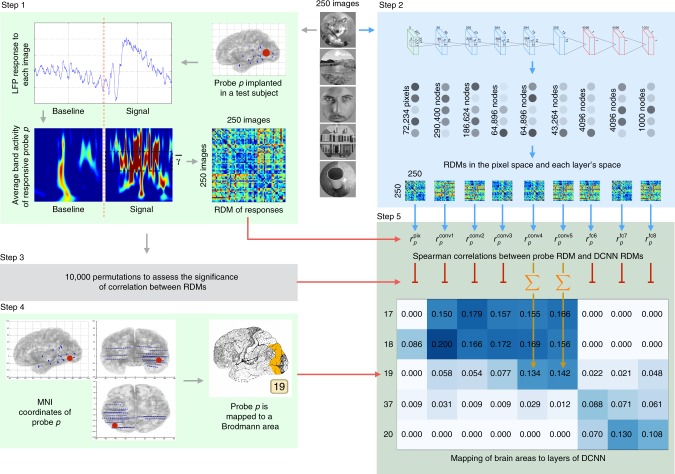
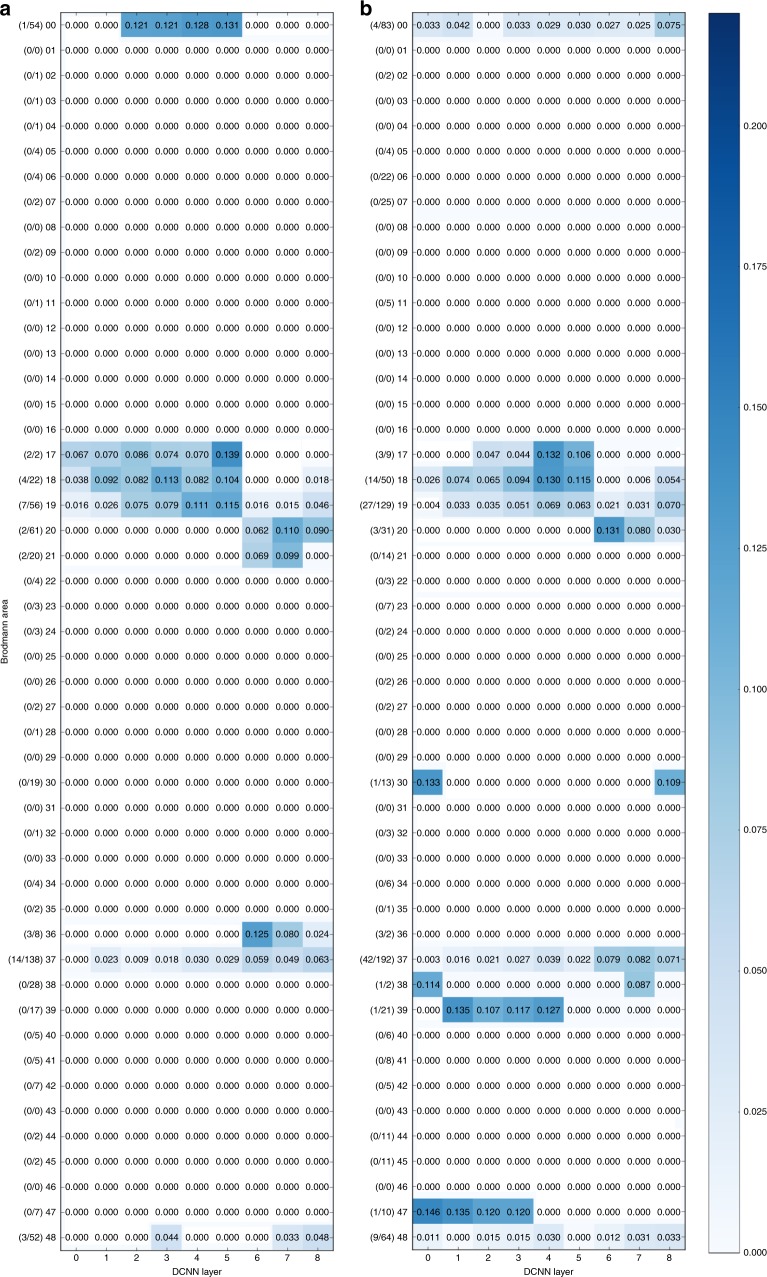
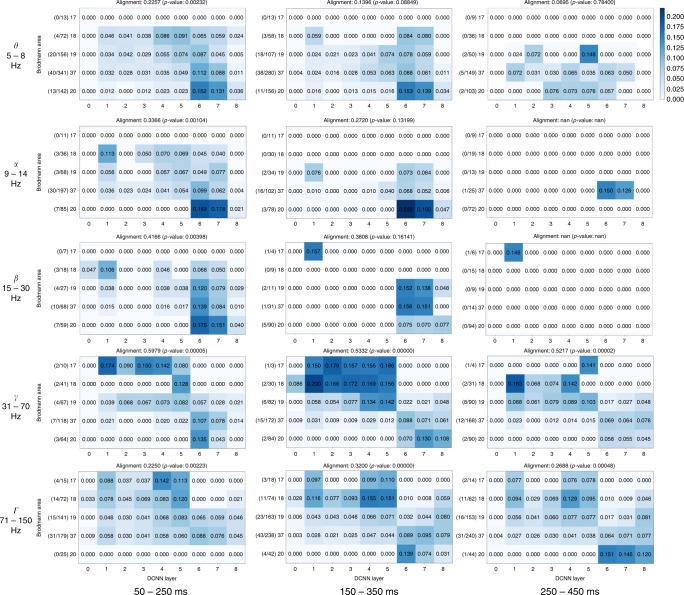
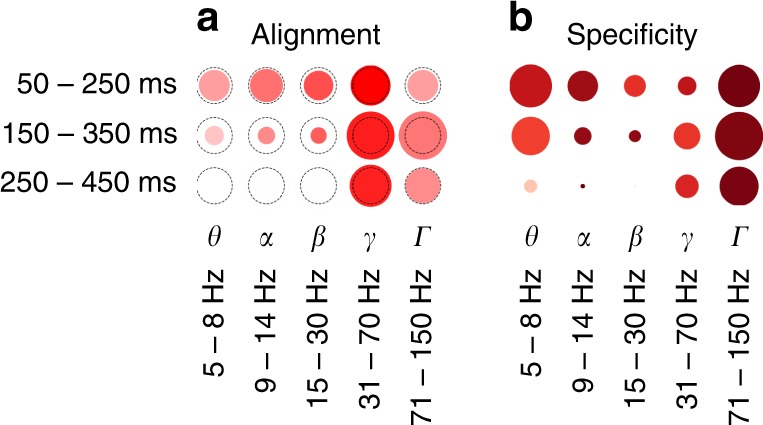
Recent advances in the field of artificial intelligence have revealed principles about neural processing, in particular about vision. Previous work demonstrated a direct correspondence between the hierarchy of the human visual areas and layers of deep convolutional neural networks (DCNN) trained on visual object recognition. We use DCNN to investigate which frequency bands correlate with feature transformations of increasing complexity along the ventral visual pathway. By capitalizing on intracranial depth recordings from 100 patients we assess the alignment between the DCNN and signals at different frequency bands. We find that gamma activity (30–70 Hz) matches the increasing complexity of visual feature representations in DCNN. These findings show that the activity of the DCNN captures the essential characteristics of biological object recognition not only in space and time, but also in the frequency domain. These results demonstrate the potential that artificial intelligence algorithms have in advancing our understanding of the brain.
Overview
The claims and statistics of this paper haven’t been checked yet.
Run the check — free, no account needed. It reads the open-access text and checks the sources it cites.
Integrity signals
Registry
Cites
Statistics
Figures
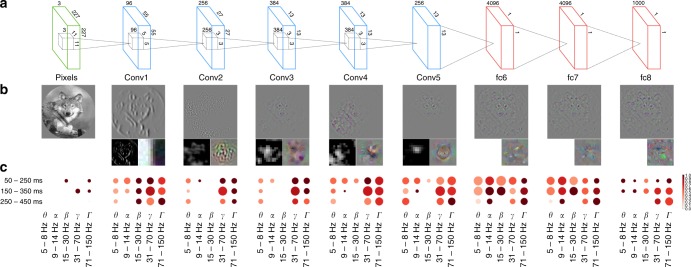
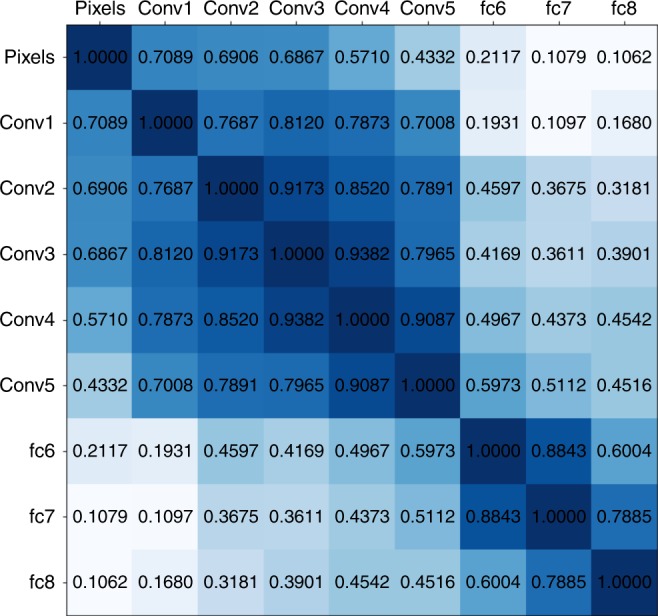
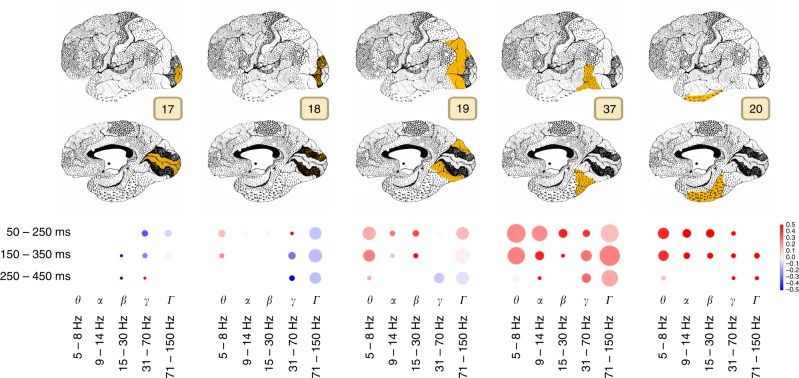
Verification
Claims the paper makes
The claims and statistics of this paper haven’t been checked yet.
Run the check — free, no account needed. It reads the open-access text and checks the sources it cites.
Claims other papers make about this one
Each is checked against this paper’s own text: does it say what the citing paper says it does?
The cited source says what the claim attributes to it.
In the citing paper
“Similarly, the visual cortex in the human brain, which has been shown to work similarly to a feed-forward neural network [53], does not possess its own consciousness.”
From Deanthropomorphising NLP: Can a language model be conscious? (2024) · cites this paper as [53]
Self-check
Percentages, sums and reported differences re-computed from the paper’s own numbers.
The self-check needs the paper’s full text.
Citations
Cites
ImageNet classification with deep convolutional neural networks
Krizhevsky, A., Sutskever, I., & Hinton, G. E. (2017) · Communications of the ACM · doi:10.1145/3065386 · Cited by 112,155
ImageNet Large Scale Visual Recognition Challenge
Russakovsky, O., Deng, J., Su, H., Krause, J., Satheesh, S., Ma, S., Huang, Z., Karpathy, A., Khosla, A., Bernstein, M., et al. (2015) · International Journal of Computer Vision · doi:10.1007/s11263-015-0816-y · Cited by 39,380
Delorme, A., & Makeig, S. (2004) · Journal of Neuroscience Methods · doi:10.1016/j.jneumeth.2003.10.009 · Cited by 24,371
Visualizing and understanding convolutional networks
Zeiler, M. D., & Fergus, R. (2014) · Lecture Notes in Computer Science · doi:10.1007/978-3-319-10590-1_53 · Cited by 15,839
On a Test of Whether one of Two Random Variables is Stochastically Larger than the Other
Mann, H. B., & Whitney, D. R. (1947) · The Annals of Mathematical Statistics · doi:10.1214/aoms/1177730491 · Cited by 14,320
Caffe: Convolutional Architecture for Fast Feature Embedding
Jia, Y., Shelhamer, E., Donahue, J., Karayev, S., Long, J., Girshick, R., Guadarrama, S., & Darrell, T. (2014) · Proceedings of the 22nd ACM international conference on Multimedia · doi:10.1145/2647868.2654889 · Cited by 11,077
The wavelet transform, time-frequency localization and signal analysis
Daubechies, I. (1990) · IEEE Transactions on Information Theory · doi:10.1109/18.57199 · Cited by 6,483
Caffe: Convolutional Architecture for Fast Feature EmbeddingPreprint
Jia, Y., Shelhamer, E., Donahue, J., Karayev, S., Long, J., Girshick, R., Guadarrama, S., & Darrell, T. (2014) · arXiv (Cornell University) · doi:10.48550/arxiv.1408.5093 · Cited by 5,299
Multiple comparisons among means
Dunn, O. J. (1961) · Journal of the American Statistical Association · doi:10.1080/01621459.1961.10482090 · Cited by 5,006
Thresholding of statistical maps in functional neuroimaging using the false discovery rate
Genovese, C. R., Lazar, N. A., & Nichols, T. (2002) · NeuroImage · doi:10.1006/nimg.2001.1037 · Cited by 4,923
Research works printed but not linked: 1
- Seeliger, K. et al. CNN-based encoding and decoding of visual object recognition in space and time. bioRxiv https://doi.org/10.1101/118091 (2017). · DOI
Cited by
Sorted by citations
Jagannath, A., Jagannath, J., & Kumar, P. S. P. V. (2022) · Computer Networks · doi:10.1016/j.comnet.2022.109455 · Cited by 326
Deep learning-based cardiovascular image diagnosis: A promising challenge
Wong, K. K. L., Fortino, G., & Abbott, D. (2019) · Future Generation Computer Systems · doi:10.1016/j.future.2019.09.047 · Cited by 221
Performance vs. competence in human–machine comparisons
Firestone, C. (2020) · Proceedings of the National Academy of Sciences · doi:10.1073/pnas.1905334117 · Cited by 150
Grossman, S., Gaziv, G., Yeagle, E. M., Harel, M., Mégevand, P., Groppe, D. M., Khuvis, S., Herrero, J. L., Irani, M., Mehta, A. D., et al. (2019) · Nature Communications · doi:10.1038/s41467-019-12623-6 · Cited by 120
Remote Sensing Image Superresolution Using Deep Residual Channel Attention
Haut, J. M., Fernández-Beltrán, R., Paoletti, M. E., Plaza, J., & Plaza, A. (2019) · IEEE Transactions on Geoscience and Remote Sensing · doi:10.1109/tgrs.2019.2924818 · Cited by 107
Stable maintenance of multiple representational formats in human visual short-term memory
Liu, J., Zhang, H., Yu, T., Ni, D., Ren, L., Yang, Q., Lu, B., Wang, D., Heinen, R. M., Axmacher, N., et al. (2020) · Proceedings of the National Academy of Sciences · doi:10.1073/pnas.2006752117 · Cited by 75
NeuroRA: A Python Toolbox of Representational Analysis From Multi-Modal Neural Data
Lu, Z., & Ku, Y. (2020) · Frontiers in Neuroinformatics · doi:10.3389/fninf.2020.563669 · Cited by 68
A new pairwise deep learning feature for environmental microorganism image analysis
Kulwa, F., Li, C., Zhang, J.-H., Shirahama, K., Kosov, S., Zhao, X., Sun, H.-Z., Jiang, T., & Grzegorzek, M. (2021) · Environmental science and pollution research international · doi:10.1007/s11356-022-18849-0 · Cited by 51
Generative models for active vision
Parr, T., Sajid, N., Da Costa, L., Mirza, M. B., & Friston, K. J. (2021) · Frontiers in Neurorobotics · doi:10.3389/fnbot.2021.651432 · Cited by 46
Brain-inspired models for visual object recognition: an overview
Yang, X. N., Yan, J., Wang, W., Li, S., Hu, B., & Lin, J. L. (2022) · Artificial Intelligence Review · doi:10.1007/s10462-021-10130-z · Cited by 46
Modeling naturalistic face processing in humans with deep convolutional neural networks
Jiahui, G., Feilong, M., Castello, M. V. D. O., Nastase, S. A., Haxby, J. V., & Gobbini, M. I. (2023) · Proceedings of the National Academy of Sciences · doi:10.1073/pnas.2304085120 · Cited by 46
A Model of Semantic Completion in Generative Episodic Memory
Fayyaz, Z., Altamimi, A., Zoellner, C., Klein, N., Wolf, O. T., Cheng, S., & Wiskott, L. (2022) · Neural Computation · doi:10.1162/neco_a_01520 · Cited by 43
Jagannath, J., Jagannath, A., Furman, S., & Gwin, T. (2021) · Studies in computational intelligence · doi:10.1007/978-3-030-77939-9_2 · Cited by 42
Representational formats of human memory traces
Heinen, R. M., Bierbrauer, A., Wolf, O. T., & Axmacher, N. (2023) · Brain Structure and Function · doi:10.1007/s00429-023-02636-9 · Cited by 45
Mind the gap: challenges of deep learning approaches to Theory of Mind
Aru, J., Labash, A., Corcoll, O., & Vicente, R. (2023) · Artificial Intelligence Review · doi:10.1007/s10462-023-10401-x · Cited by 45
Self-citationCeleghin, A., Borriero, A., Orsenigo, D., Diano, M., Guerrero, C. A. M., Perotti, A., Petri, G., & Tamietto, M. (2023) · Frontiers in Computational Neuroscience · doi:10.3389/fncom.2023.1153572 · Cited by 50
A neuronal population model based on cellular automata to simulate the electrical waves of the brain
Khaleghi, A., Mohammadi, M. R., Shahi, K., & Nasrabadi, A. M. (2021) · Waves in Random and Complex Media · doi:10.1080/17455030.2021.1938746 · Cited by 31
Cyberattacks on Miniature Brain Implants to Disrupt Spontaneous Neural Signaling
Bernal, S. L., Celdrán, A. H., Maimó, L. F., Barros, M. T., Balasubramaniam, S., & Pérez, G. M. (2020) · IEEE Access · doi:10.1109/access.2020.3017394 · Cited by 28
Heinke, D. G., Wachman, P., van Zoest, W., & Leek, E. C. (2021) · Vision Research · doi:10.1016/j.visres.2021.09.004 · Cited by 28
Freitas, P. G., da Eira, L. P., dos Santos, S. F., & Farias, M. C. Q. (2018) · Journal of Imaging · doi:10.3390/jimaging4100114 · Cited by 26
Deep neural networks and image classification in biological vision
Leek, E. C., Leonardis, A., & Heinke, D. G. (2022) · Vision Research · doi:10.1016/j.visres.2022.108058 · Cited by 29
Maintenance and transformation of representational formats during working memory prioritization
Pacheco, D., Fellner, M.-C., Kunz, L., Zhang, H., Reinacher, P. C., Roy, C., Brandt, A., Schulze‐Bonhage, A., Yang, L., Wang, S., et al. (2024) · Nature Communications · doi:10.1038/s41467-024-52541-w · Cited by 29
Connecting Deep Neural Networks to Physical, Perceptual, and Electrophysiological Auditory Signals
Huang, N. J., Slaney, M., & Elhilali, M. (2018) · Frontiers in Neuroscience · doi:10.3389/fnins.2018.00532 · Cited by 22
Novel Cognitive Functions Arise at the Convergence of Macroscale Gradients
Jung, H., Wager, T. D., & Carter, R. M. (2021) · Journal of Cognitive Neuroscience · doi:10.1162/jocn_a_01803 · Cited by 20
Bridging the gap between EEG and DCNNs reveals a fatigue mechanism of facial repetition suppression
Lu, Z., & Ku, Y. (2023) · iScience · doi:10.1016/j.isci.2023.108501 · Cited by 16
Eight Reasons to Prioritize Brain-Computer Interface Cybersecurity
Bernal, S. L., Celdrán, A. H., & Pérez, G. M. (2023) · Communications of the ACM · doi:10.1145/3535509 · Cited by 15
Chaotic recurrent neural networks for brain modelling: A review
Mattera, A., Alfieri, V., Granato, G., & Baldassarre, G. (2024) · Neural Networks · doi:10.1016/j.neunet.2024.107079 · Cited by 19
Kulwa, F., Li, C., Grzegorzek, M., Rahaman, M. M., Shirahama, K., & Kosov, S. (2022) · Biomedical Signal Processing and Control · doi:10.1016/j.bspc.2022.104168 · Cited by 15
Petton, M., Perrone‐Bertolotti, M., Mac-Auliffe, D., Bertrand, O., Aguera, P., Sipp, F., Bhattacharjee, M., Isnard, J., Minotti, L., Rheims, S., et al. (2018) · Neuropsychologia · doi:10.1016/j.neuropsychologia.2019.107151 · Cited by 22
Self-citationModeling Tweet Dependencies with Graph Convolutional Networks for Sentiment Analysis
Keramatfar, A., Amirkhani, H., & Bidgoly, A. J. (2022) · Cognitive Computation · doi:10.1007/s12559-021-09986-8 · Cited by 14
Decoding the rhythmic representation and communication of visual contents
Stecher, R., Cichy, R. M., & KAISER, D. H. (2025) · Trends in Neurosciences · doi:10.1016/j.tins.2024.12.005 · Cited by 18
Synthetic-Neuroscore: Using a neuro-AI interface for evaluating generative adversarial networks
Wang, Z., She, Q., Smeaton, A. F., Ward, T. E., & Healy, G. F. (2020) · Neurocomputing · doi:10.1016/j.neucom.2020.04.069 · Cited by 15
Reddy, L., Cichy, R. M., & VanRullen, R. (2021) · eNeuro · doi:10.1523/eneuro.0362-20.2021 · Cited by 11
Shu, K., Mao, S., Zhang, Z., Coyle, J. L., & Sejdić, E. (2024) · Computer Methods and Programs in Biomedicine · doi:10.1016/j.cmpb.2024.108505 · Cited by 16
Reinstatement and transformation of memory traces for recognition
Rau, E. M. B., Fellner, M.-C., Heinen, R. M., Zhang, H., Yin, Q., Vahidi, P., Kobelt, M., Asano, E., McManus, O. K., Sattar, S., et al. (2025) · Science Advances · doi:10.1126/sciadv.adp9336 · Cited by 12
Bernal, S. L., Celdrán, A. H., & Pérez, G. M. (2021) · Computers & Security · doi:10.1016/j.cose.2021.102534 · Cited by 13
Hulse, S. V., Renoult, J. P., & Mendelson, T. C. (2021) · Ecological Informatics · doi:10.1016/j.ecoinf.2021.101486 · Cited by 12
Spatio-temporal transformers for decoding neural movement control
Candelori, B., Bardella, G., Spinelli, I., Ramawat, S., Pani, P., Ferraina, S., & Scardapane, S. (2025) · Journal of Neural Engineering · doi:10.1088/1741-2552/adaef0 · Cited by 15
Deanthropomorphising NLP: Can a language model be conscious?
Shardlow, M., & Przybyła, P. (2024) · PLoS ONE · doi:10.1371/journal.pone.0307521 · Cited by 16
“Similarly, the visual cortex in the human brain, which has been shown to work similarly to a feed-forward neural network (Kuzovkin et al, 2018), does not possess its own consciousness.”
Using Artificial Intelligence to Analyze Non-Human Drawings: A First Step with Orangutan Productions
Beltzung, B., Pelé, M., Renoult, J. P., Shimada, M., & Sueur, C. (2022) · Animals · doi:10.3390/ani12202761 · Cited by 11
Biomimetic Deep Learning Networks With Applications to Epileptic Spasms and Seizure Prediction
Lucasius, C., Grigorovsky, V., Nariai, H., Galanopoulou, A. S., Gursky, J. M., Moshé, S. L., & Bardakjian, B. L. (2023) · IEEE Transactions on Biomedical Engineering · doi:10.1109/tbme.2023.3325762 · Cited by 11
Berezutskaya, J., Freudenburg, Z. V., Ambrogioni, L., Güçlü, U., van Gerven, M. A. J., & Ramsey, N. F. (2020) · Scientific Reports · doi:10.1038/s41598-020-68853-y · Cited by 13
Semantic Segmentation for Aerial Mapping
Martínez-Soltero, G., Alanís, A. Y., Arana‐Daniel, N., & López-Franco, C. (2020) · Mathematics · doi:10.3390/math8091456 · Cited by 9
Wang, L., Fatemi, M., & Alizad, A. (2025) · Computers in Biology and Medicine · doi:10.1016/j.compbiomed.2025.110312 · Cited by 12
Real‐time tomographic reconstructor based on convolutional neural networks for solar observation
Lasheras, F. S., Ordóñez, C., Roca‐Pardiñas, J., & Juez, F. J. D. C. (2019) · Mathematical Methods in the Applied Sciences · doi:10.1002/mma.5948 · Cited by 8
Autoencoding sensory substitution
Tóth, V., & Parkkonen, L. (2019) · Unpublished · doi:10.13140/rg.2.2.10576.87048 · Cited by 7
Pal, N. R. (2020) · Frontiers in Robotics and AI · doi:10.3389/frobt.2020.00076 · Cited by 9
Freitas, P. G., Akamine, W. Y. L., & Farias, M. C. Q. (2018) · Journal of the Brazilian Computer Society · doi:10.1186/s13173-018-0073-3 · Cited by 7
Grossman, S., Gaziv, G., Yeagle, E. M., Harel, M., Mégevand, P., Groppe, D. M., Khuvis, S., Herrero, J. L., Irani, M., Mehta, A. D., et al. (2018) · bioRxiv (Cold Spring Harbor Laboratory) · doi:10.1101/444323 · Cited by 7
Barlow, M. C., Zhu, X., & Glennie, C. (2022) · Remote Sensing · doi:10.3390/rs14010234 · Cited by 6
Generalized Gradient Flow Based Saliency for Pruning Deep Convolutional Neural Networks
Liu, X., Li, B., Chen, Z., & Yuan, Y. (2023) · International Journal of Computer Vision · doi:10.1007/s11263-023-01854-2 · Cited by 6
Liu, S., & Wang, K. (2024) · International Conference on Computer Science and Application Engineering (CSAE) · doi:10.1145/3704814.3704822 · Cited by 7
Deep Recurrent Encoder: an end-to-end network to model magnetoencephalography at scale
Chehab, O., Defossez, A., Loiseau, J.-C., Gramfort, A., & King, J.-R. (2022) · Neurons Behavior Data analysis and Theory · doi:10.51628/001c.38668 · Cited by 8
Nambudiri, M. K. K., Rajanbabu, A., Nair, I. R., Anandita, Nair, S. V., Koyakutty, M., & Girish, C. M. (2022) · Translational Biophotonics · doi:10.1002/tbio.202200014 · Cited by 5
Identifying task-relevant spectral signatures of perceptual categorization in the human cortex
Kuzovkin, I., Vidal, J. R., Perrone‐Bertolotti, M., Kahane, P., Rheims, S., Aru, J., Lachaux, J.-P., & Vicente, R. (2020) · Scientific Reports · doi:10.1038/s41598-020-64243-6 · Cited by 5
Self-citationWhat deep learning can tell us about higher cognitive functions like mindreading?Preprint
Aru, J., & Vicente, R. (2018) · PsyArXiv (OSF Preprints) · doi:10.31234/osf.io/9skeq · Cited by 5
Self-citationImproving Explainability of Integrated Gradients with Guided Non-Linearity
Kwon, H. J., Koo, H. I., & Cho, N. I. (2021) · Proceedings - International Conference on Pattern Recognition/Proceedings/International Conference on Pattern Recognition · doi:10.1109/icpr48806.2021.9412936 · Cited by 4
Fayyaz, Z., Righetti, F., Wiskott, L., & Werning, M. (2025) · Philosophical Psychology · doi:10.1080/09515089.2025.2522966 · Cited by 4
Task-relevant representational spaces in human memory traces
Heinen, R. M., Rau, E. M. B., Herweg, N. A., & Axmacher, N. (2025) · PLoS Computational Biology · doi:10.1371/journal.pcbi.1013476 · Cited by 6
Lu, Z., & Golomb, J. D. (2025) · eLife · doi:10.1101/2023.08.19.553999 · Cited by 4
Understanding images in biological and computer vision
Schofield, A. J., Gilchrist, I. D., Bloj, M., Leonardis, A., & Bellotto, N. (2018) · Interface Focus · doi:10.1098/rsfs.2018.0027 · Cited by 4
Sanongdej, W. (2021) · Archives in Neurology & Neuroscience · doi:10.33552/ann.2021.09.000721 · Cited by 4
Development of a SHM system by elastic guided waves applied to aeronautic structures
Kulakovskyi, A. (2019) · theses.fr (ABES) · doi:10.70675/cbf81c2azc5f6z4998zbe53z6df8f5d11bc9 · Cited by 4
Carboni, L., Nwaigwe, D., Mainsant, M., Bayle, R., Reyboz, M., Mermillod, M., Michel Dojat, D., & Achard, S. (2025) · Neural Networks · doi:10.1016/j.neunet.2025.107125 · Cited by 3
Machine Intelligence-Based Epileptic Seizure Forecasting
Grigorovsky, V., Tufa, U., Jacobs, D., & Bardakjian, B. L. (2020) · Springer eBooks · doi:10.1007/978-3-030-43395-6_19 · Cited by 3
How Does Artificial Intelligence Contribute to iEEG Research?
Berezutskaya, J., Saive, A.-L., Jerbi, K., & van Gerven, M. A. J. (2023) · Studies in neuroscience, psychology and behavioral economics · doi:10.1007/978-3-031-20910-9_47 · Cited by 3
Deep Recurrent Encoder: A scalable end-to-end network to model brain signalsPreprint
Chehab, O., Defossez, A., Loiseau, J.-C., Gramfort, A., & King, J.-R. (2021) · arXiv (Cornell University) · doi:10.48550/arxiv.2103.02339 · Cited by 9
Sensing the beauty of interface: Neural oscillatory correlates of visual aesthetic judgment
Liu, Y., Zhang, S., Jiang, Z., & Du, F. (2025) · Behavioural Brain Research · doi:10.1016/j.bbr.2025.115623 · Cited by 2
A Deep Model of Visual Attention for Saliency Detection on 3D Objects
Rouhafzay, G., Creţu, A.-M., & Payeur, P. (2023) · Neural Processing Letters · doi:10.1007/s11063-023-11180-w · Cited by 2
Zhang, Q., & Liu, B. (2023) · Applied Intelligence · doi:10.1007/s10489-023-04802-2 · Cited by 2
The Intersection between Linguistic Theories and Computational Linguistics over time
Moreira, A., Oliveira, A. D. P., & Possi, M. D. A. (2022) · DELTA Documentação de Estudos em Lingüística Teórica e Aplicada · doi:10.1590/1678-460x202238248453 · Cited by 2
A Neuro-AI Interface for Evaluating Generative Adversarial NetworksPreprint
Wang, Z., She, Q., Smeaton, A. F., Ward, T. E., & Healy, G. F. (2020) · arXiv (Cornell University) · doi:10.48550/arxiv.2003.03193 · Cited by 2
Lopopolo, A., & van den Bosch, A. P. J. (2020) · doi:10.31234/osf.io/6gqj8 · Cited by 2
Bernal, S. L., Celdrán, A. H., & Pérez, G. M. (2021) · arXiv (Cornell University) · doi:10.48550/arxiv.2106.04968 · Cited by 2
Lu, Z., & Golomb, J. D. (2024) · eLife · doi:10.7554/elife.98117 · Cited by 3
Rong, B., Gifford, A. T., Düzel, E., & Cichy, R. M. (2025) · eLife · doi:10.7554/elife.108915 · Cited by 3
Aldhahi, W., Albusair, T., & Sull, S. (2022) · Electronics · doi:10.3390/electronics12010048 · Cited by 1
How Can We Track Cognitive Representations with Deep Neural Networks and Intracranial EEG?
Pacheco, D. (2023) · Studies in neuroscience, psychology and behavioral economics · doi:10.1007/978-3-031-20910-9_50 · Cited by 1
Sanongdej, W. (2021) · Archives in Neurology & Neuroscience · doi:10.33552/ann.2020.09.000721 · Cited by 1
Task-specific representational spaces for memory formation in the medial temporal lobePreprint
Rau, E. M. B., Heinen, R. M., Herweg, N. A., Patai, E. Z., Kobelt, M., Ahmadi, K., & Axmacher, N. (2025) · bioRxiv (Cold Spring Harbor Laboratory) · doi:10.1101/2025.05.23.655754 · Cited by 1
Machine learning based prediction of dynamical clustering in granular gasesPreprint
Sata, S. P., Stannarius, R., Noack, B., & Puzyrev, D. (2025) · Research Square · doi:10.21203/rs.3.rs-7474100/v1 · Cited by 1
Date, H., Kawasaki, K., Hasegawa, I., & Okatani, T. (2020) · bioRxiv (Cold Spring Harbor Laboratory) · doi:10.1101/2020.01.13.902775
Auditory Salience in Natural Scenes
Huang, N. J. (2019)
Understanding Information Processing in Human Brain by Interpreting Machine Learning ModelsPreprint
Kuzovkin, I. (2020) · arXiv (Cornell University) · doi:10.48550/arxiv.2010.08715
Self-citationHuang, J. A., & Gerhardstein, P. C. (2021) · doi:10.31234/osf.io/9dvgq
Bridging the Gap: Exploring Neural Mechanisms of Facial Repetition Suppression through EEG and DCNNsPreprint
Lu, Z., & Ku, Y. (2023) · bioRxiv (Cold Spring Harbor Laboratory) · doi:10.1101/2023.01.02.522298
How can we track cognitive representations with Deep Neural Networks and intracranial EEG?Preprint
Pacheco, D. (2023) · doi:10.31234/osf.io/qmb2e
Dong, Z. H., Lin, B., & Xie, F. (2023) · IEEE Access · doi:10.1109/access.2023.3264502 · Cited by 1
Ren, Q., & Sun, A. (2024) · Highlights in Science Engineering and Technology · doi:10.54097/c5kbeg66
Martinez-Ramon, M., Ajith, M., & Kurup, A. R. (2024) · Wiley eBooks · doi:10.1002/9781119861898.biblio
Lu, Z., & Golomb, J. D. (2024) · eLife · doi:10.7554/elife.98117.1
Carboni, L., Nwaigwe, D., Mainsant, M., Bayle, R., Reyboz, M., Mermillod, M., Michel Dojat, D., & Achard, S. (2024) · SSRN Electronic Journal · doi:10.2139/ssrn.4904745 · Cited by 2
CNN-extracted features generate synthetic fMRI responses to unseen images
Delavari, P., Sigal, L., & Oruç, İ. (2025) · Vision Research · doi:10.1016/j.visres.2025.108641
Neural cyberattacks applied to the vision under realistic visual stimuli
Madejska, V. M. L., Bernal, S. L., Pérez, G. M., & Celdrán, A. H. (2025) · Neurocomputing · doi:10.1016/j.neucom.2025.131344
Lu, Z., & Golomb, J. D. (2025) · eLife · doi:10.7554/elife.98117.2
Rong, B., Gifford, A. T., Düzel, E., & Cichy, R. M. (2025) · eLife · doi:10.7554/elife.108915.1 · Cited by 1
Metadata
- Authors
- Kuzovkin, I., Vicente, R., Petton, M., Lachaux, J.-P., Baciu, M., Kahane, P., Rheims, S., Vidal, J. R., & Aru, J.
- Affiliations
- University of Tartu (EE)
- Lyon 1 Université (FR)
- Centre National de la Recherche Scientifique (FR)
- Inserm (FR)
- Université catholique de lyon (FR)
- Corresponding author
- Kuzovkin, Ilya
- Aru, Jaan
- ORCID
- Venue
- Communications Biology
- Published
- 2018-08-08
- Volume
- 1
- Issue
- 1
- Pages
- 107-107
- ISSN
- 2399-3642 (ISSN-L)
- PMC
- PMC6123818
- OpenAlex
- W2949411980
- Cited by
- 104
- References
- 59
- Citations by year
- 2026: 2 · 2025: 17 · 2024: 14 · 2023: 16 · 2022: 13 · 2021: 14 · 2020: 14 · 2019: 7 · 2018: 7
- FWCI
- 6.25
- Type
- journal article
- Language
- en
- Open access
- gold
- doi.org
- Locations
- Communications Biology (publishedVersion, cc-by)
- bioRxiv (Cold Spring Harbor Laboratory) (acceptedVersion, cc-by)
- Europe PMC (PubMed Central) (publishedVersion, cc-by)
- PubMed Central (publishedVersion, cc-by)
- PubMed (publishedVersion)
- HAL (submittedVersion, other-oa)
- DOAJ (DOAJ: Directory of Open Access Journals) (submittedVersion)
- Funders
- Eesti Teadusagentuur (PUT438, PUT1476)
- Topics
- Life Sciences › Neuroscience › Cognitive Neuroscience › Visual perception and processing mechanisms
- Life Sciences › Neuroscience › Cognitive Neuroscience › Neural dynamics and brain function
- Life Sciences › Neuroscience › Cognitive Neuroscience › Face Recognition and Perception
- Keywords
- deep convolutional neural networks, gamma oscillations, visual cortex, ventral stream, visual feature representation, object recognition
About these checks
Registry, retraction, Cites and statistics results are computed, not judged, with one exception: a printed reference that no index lists is read once by a model before it counts as a citation error. Claims are extracted by a model and kept only when their quote appears verbatim in the text; each cited source is then checked, with a model’s help, for whether it says what the claim relies on. Those verdicts can be wrong — read the claim’s quote and the cited source before relying on one.
Statistics and arithmetic are recomputed, not judged.
Confidence bands are shown only for fields calibrated on our annotated test set. None is calibrated yet, so no band is shown.
What counts as a claim ›How we measure confidence ›How we check this ›
Are you an author, or do you see a problem with this page? Request a review
