

The DOI matches its Crossref record; 80 of the 81 references it cites were found in a registry or an index.
Identification of 12 genetic loci associated with human healthspan
Open accessPublished version of a preprint
Abstract
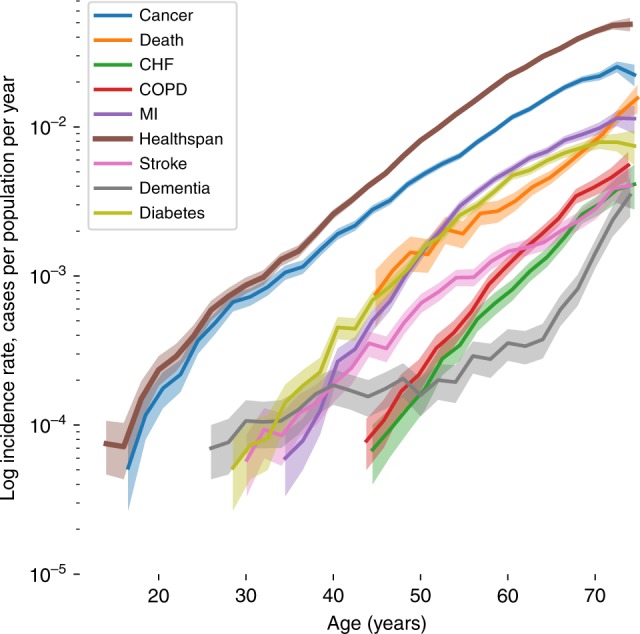
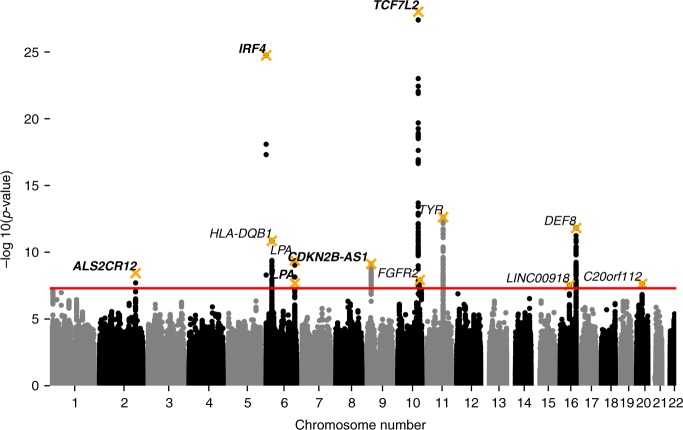
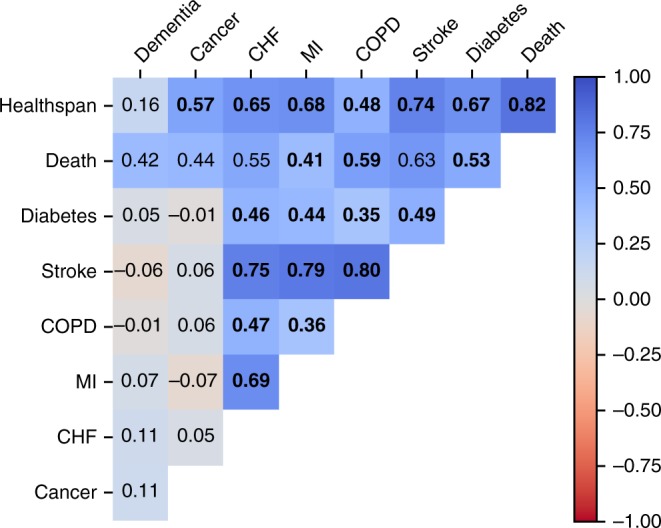
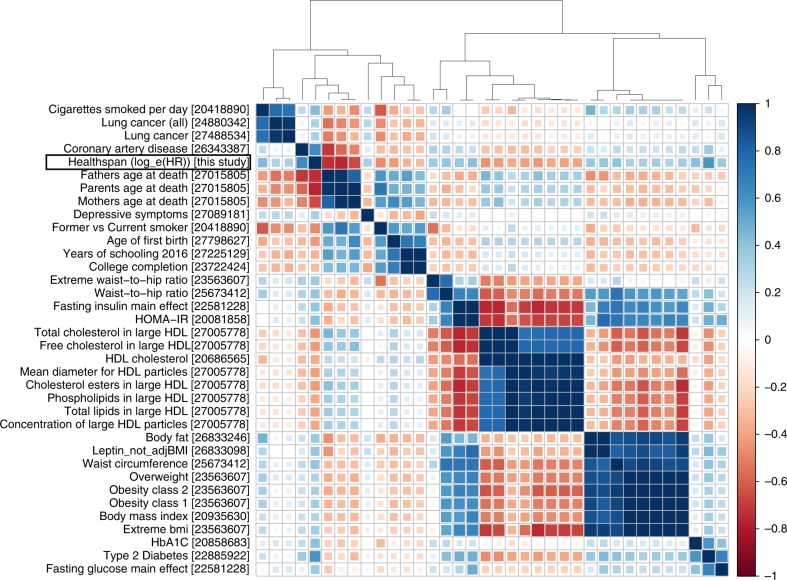
Aging populations face diminishing quality of life due to increased disease and morbidity. These challenges call for longevity research to focus on understanding the pathways controlling healthspan. We use the data from the UK Biobank (UKB) cohort and observe that the risks of major chronic diseases increased exponentially and double every eight years, i.e., at a rate compatible with the Gompertz mortality law. Assuming that aging drives the acceleration in morbidity rates, we build a risk model to predict the age at the end of healthspan depending on age, gender, and genetic background. Using the sub-population of 300,447 British individuals as a discovery cohort, we identify 12 loci associated with healthspan at the whole-genome significance level. We find strong genetic correlations between healthspan and all-cause mortality, life-history, and lifestyle traits. We thereby conclude that the healthspan offers a promising new way to interrogate the genetics of human longevity.
Overview
The claims and statistics of this paper haven’t been checked yet.
Run the check — free, no account needed. It reads the open-access text and checks the sources it cites.
Integrity signals
Registry
Cites
Statistics
Figures
Verification
Claims the paper makes
The claims and statistics of this paper haven’t been checked yet.
Run the check — free, no account needed. It reads the open-access text and checks the sources it cites.
Claims other papers make about this one
Each is checked against this paper’s own text: does it say what the citing paper says it does?
In the citing paper
“Genes that regulate lifespan in animal models6–9 and human studies10–14 as well as multiple experimental paradigms, such as caloric restriction, heterochronic parabiosis and partial epigenetic reprogramming, have demonstrated that it is possible to manipulate ageing biology to ‘rejuvenate’ physiological functioning in complex model organisms15–28.”
From Measuring biological age using omics data (2022) · cites this paper as [11]
Self-check
Percentages, sums and reported differences re-computed from the paper’s own numbers.
The self-check needs the paper’s full text.
Citations
Cites
A global reference for human genetic variation
The 1000 Genomes Project Consortium, authors, C., Auton, A., Abecasis, G. R., Steering committee, Altshuler, D. M., Durbin, R. M., Abecasis, G. R., Bentley, D. R., Chakravarti, A., et al. (2015) · Nature · doi:10.1038/nature15393 · Cited by 18,247
Sudlow, C., Gallacher, J., Allen, N., Beral, V., Burton, P., Danesh, J., Downey, P., Elliott, P., Green, J., Landray, M., et al. (2015) · PLOS Medicine · doi:10.1371/journal.pmed.1001779 · Cited by 12,728
Second-generation PLINK: rising to the challenge of larger and richer datasets
Chang, C. C., Chow, C. C., Tellier, L. C., Vattikuti, S., Purcell, S. M., & Lee, J. J. (2015) · Gigascience · doi:10.1186/s13742-015-0047-8 · Cited by 12,709
The UK Biobank resource with deep phenotyping and genomic data
Bycroft, C., Freeman, C., Petkova, D., Band, G., Elliott, L. T., Sharp, K., Motyer, A., Vukcevic, D., Delaneau, O., O’Connell, J., et al. (2018) · Nature · doi:10.1038/s41586-018-0579-z · Cited by 8,876
The Ensembl Variant Effect Predictor
McLaren, W., Gil, L., Hunt, S. E., Riat, H. S., Ritchie, G. R. S., Thormann, A., Flicek, P., & Cunningham, F. (2016) · Genome Biology · doi:10.1186/s13059-016-0974-4 · Cited by 8,099
A map of human genome variation from population-scale sequencing.
The 1000 Genomes Project Consortium (2010) · Nature · doi:10.1038/nature09534 · Cited by 7,877
LD Score regression distinguishes confounding from polygenicity in genome-wide association studies
Schizophrenia Working Group of the Psychiatric Genomics Consortium, Bulik-Sullivan, B. K., Loh, P.-R., Finucane, H. K., Ripke, S., Yang, J., Patterson, N., Daly, M. J., Price, A. L., & Neale, B. M. (2015) · Nature Genetics · doi:10.1038/ng.3211 · Cited by 5,559
Meta-Analysis of 74,046 Individuals Identifies 11 New Susceptibility Loci for Alzheimer’s Disease
(EADI), E. A. D. I., Lambert, J.-C., (GERAD), G. A. E. R. I. A. D., Alzheimer's Disease Genetic Consortium (ADGC), (CHARGE), C. F. H. A. A. R. I. G. E., Ibrahim-Verbaas, C. A., Harold, D., Naj, A. C., Sims, R., Bellenguez, C., et al. (2013) · Nature Genetics · doi:10.1038/ng.2802 · Cited by 4,336
An atlas of genetic correlations across human diseases and traits
ReproGen Consortium, Bulik-Sullivan, B., Psychiatric Genomics Consortium, Genetic Consortium for Anorexia Nervosa of the Wellcome Trust Case Control Consortium 3, Finucane, H. K., Anttila, V., Gusev, A., Day, F. R., Loh, P.-R., Duncan, L., et al. (2015) · Nature Genetics · doi:10.1038/ng.3406 · Cited by 4,255
Gompertz, B. (1825) · Philosophical Transactions of the Royal Society of London · doi:10.1098/rstl.1825.0026 · Cited by 3,816
Cited by
Sorted by citations
Mitochondrial and metabolic dysfunction in ageing and age-related diseases
Amorim, J. A., Coppotelli, G., Rolo, A. P., Palmeira, C. M., Ross, J. M., & Sinclair, D. A. (2022) · Nature Reviews Endocrinology · doi:10.1038/s41574-021-00626-7 · Cited by 990
“6-Amino[1,2,5]oxadiazolo[3,4-b] pyrazin-5-ol derivatives as efficacious mitochondrial uncouplers in STAM mouse model of nonalcoholic steatohepatitis.”
BackgroundMeasuring biological age using omics data
Rutledge, J., Oh, H., & Wyss-Coray, T. (2022) · Nature Reviews Genetics · doi:10.1038/s41576-022-00511-7 · Cited by 570
Applications of multi‐omics analysis in human diseases
Chen, C., Wang, J., Pan, D., Wang, X., Xu, Y., Yan, J., Wang, L., Yang, X., Yang, M., & Liu, G. (2023) · MedComm · doi:10.1002/mco2.315 · Cited by 545
Sex differences in biological aging with a focus on human studies
Hägg, S., & Jylhävä, J. (2021) · eLife · doi:10.7554/elife.63425 · Cited by 442
Aging Hallmarks and the Role of Oxidative Stress
Maldonado, E., Morales, S., Urbina, F., & Solari, A. (2023) · Antioxidants · doi:10.3390/antiox12030651 · Cited by 491
Metadata
- Authors
- Zenin, A., Tsepilov, Y., Sharapov, S., Getmantsev, E., Menshikov, L. I., Fedichev, P. O., & Aulchenko, Y.
- Affiliations
- Novosibirsk State University (RU)
- Moscow Institute of Physics and Technology (RU)
- Corresponding author
- Fedichev, Peter O.
- Venue
- Communications Biology
- Published
- 2019-01-30
- Volume
- 2
- Issue
- 1
- Pages
- 41-41
- ISSN
- 2399-3642 (ISSN-L)
- PMC
- PMC6353874
- OpenAlex
- W2952981231
- Cited by
- 170
- References
- 81
- Citations by year
- 2026: 22 · 2025: 26 · 2024: 31 · 2023: 23 · 2022: 15 · 2021: 25 · 2020: 13 · 2019: 12
- FWCI
- 9.76
- Type
- journal article
- Language
- en
- Open access
- gold
- doi.org
- Locations
- Communications Biology (publishedVersion, cc-by)
- bioRxiv (Cold Spring Harbor Laboratory) (acceptedVersion)
- Europe PMC (PubMed Central) (publishedVersion, other-oa)
- PubMed Central (publishedVersion, cc-by)
- PubMed (publishedVersion)
- Edinburgh Research Explorer (University of Edinburgh) (submittedVersion, cc-by)
- DOAJ (DOAJ: Directory of Open Access Journals) (submittedVersion)
- Funders
- Medical Research Council (MC_PC_17228)
- Topics
- Life Sciences › Biochemistry, Genetics and Molecular Biology › Genetics › Genetic Associations and Epidemiology
- Life Sciences › Biochemistry, Genetics and Molecular Biology › Aging › Genetics, Aging, and Longevity in Model Organisms
- Life Sciences › Biochemistry, Genetics and Molecular Biology › Genetics › Genetic and phenotypic traits in livestock
- Keywords
- healthspan, human longevity, genetic loci, aging, chronic disease risk, Gompertz mortality law, all-cause mortality, genetic correlation, life-history traits, genetic risk models
- MeSH terms
- Aged, Alleles, Female, United Kingdom, Health Status, Humans, Longevity, Male, Cluster Analysis, Computational Biology, Quantitative Trait, Heritable, Polymorphism, Single Nucleotide, Quantitative Trait Loci, Genome-Wide Association Study, Genetic Association Studies, Molecular Sequence Annotation
About these checks
Registry, retraction, Cites and statistics results are computed, not judged, with one exception: a printed reference that no index lists is read once by a model before it counts as a citation error. Claims are extracted by a model and kept only when their quote appears verbatim in the text; each cited source is then checked, with a model’s help, for whether it says what the claim relies on. Those verdicts can be wrong — read the claim’s quote and the cited source before relying on one.
Statistics and arithmetic are recomputed, not judged.
Confidence bands are shown only for fields calibrated on our annotated test set. None is calibrated yet, so no band is shown.
What counts as a claim ›How we measure confidence ›How we check this ›
Are you an author, or do you see a problem with this page? Request a review
