

Fungal acetylome comparative analysis identifies an essential role of acetylation in human fungal pathogen virulence
Open accessThe DOI matches its Crossref record; 47 of the 47 references it cites were found in a registry or an index.
Abstract
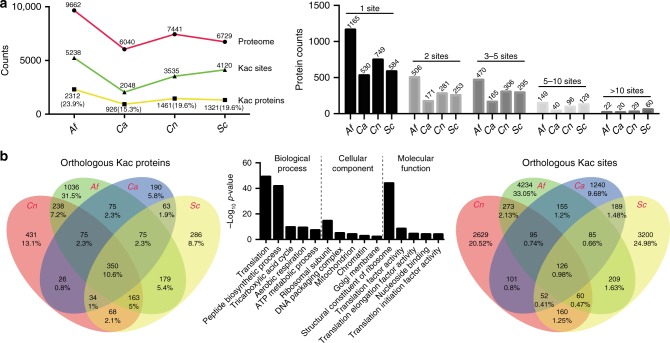
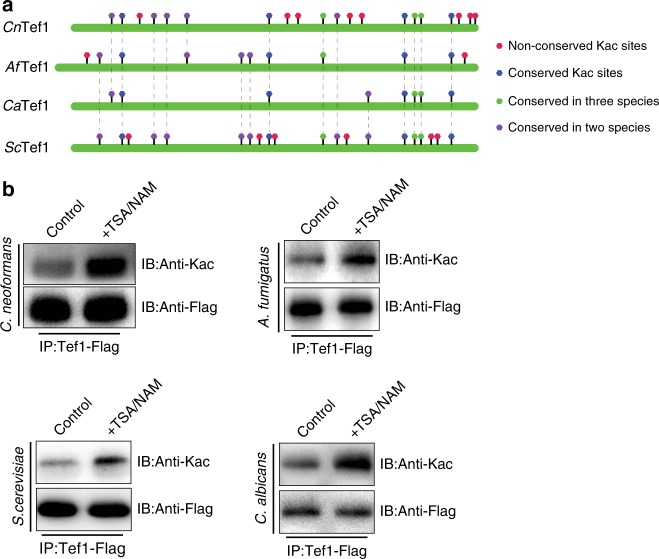
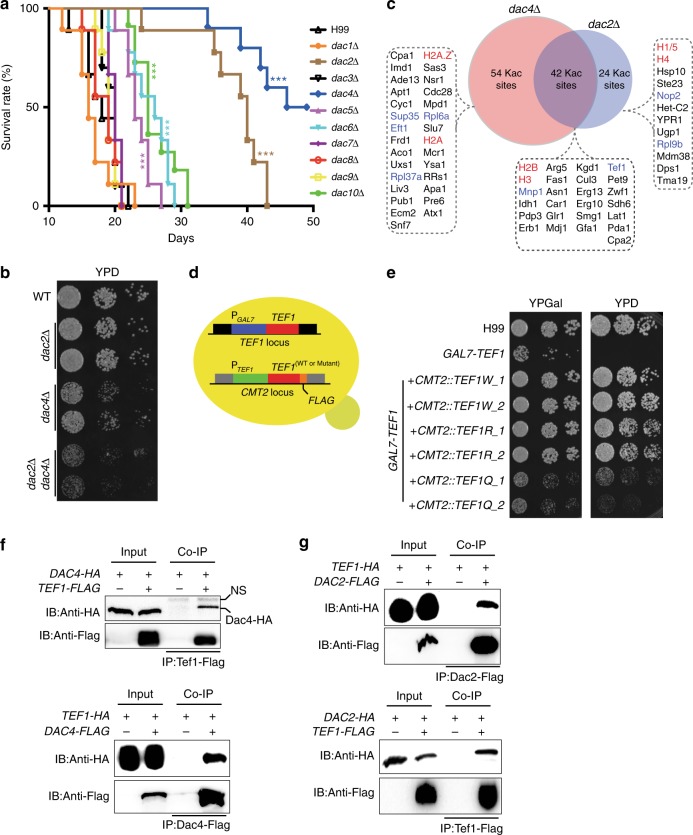
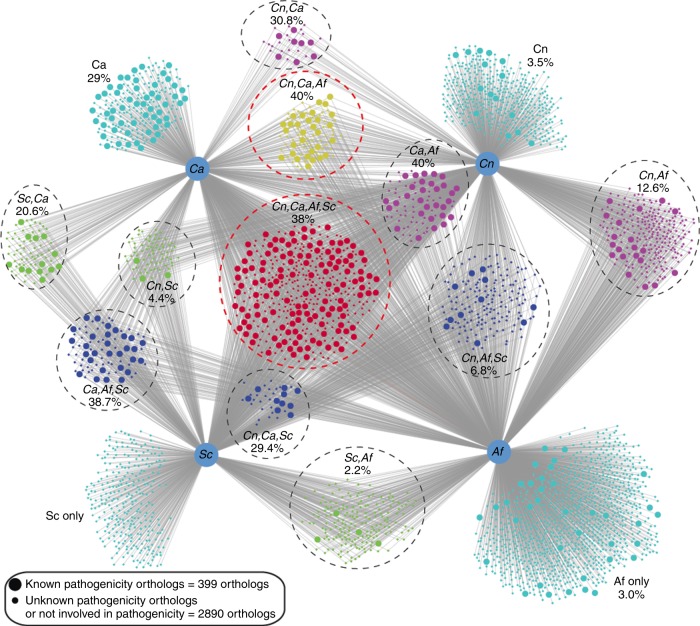
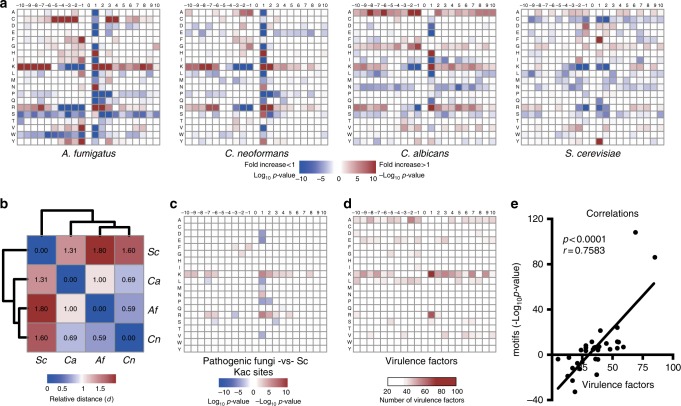
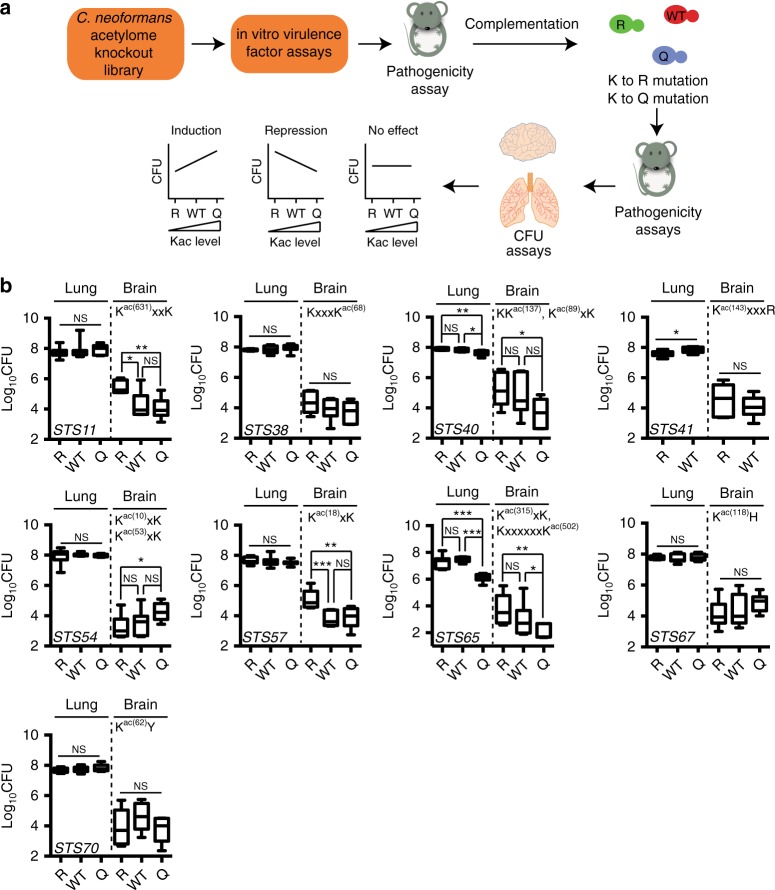
Lysine acetylation is critical in regulating important biological processes in many organisms, yet little is known about acetylome evolution and its contribution to phenotypic diversity. Here, we compare the acetylomes of baker’s yeast and the three deadliest human fungal pathogens, Cryptococcus neoformans, Candida albicans, and Aspergillus fumigatus. Using mass spectrometry enriched for acetylated peptides together with public data from Saccharomyces cerevisiae, we show that fungal acetylomes are characterized by dramatic evolutionary dynamics and limited conservation in core biological processes. Notably, the levels of protein acetylation in pathogenic fungi correlate with their pathogenicity. Using gene knockouts and pathogenicity assays in mice, we identify deacetylases with critical roles in virulence and protein translation elongation. Finally, through mutational analysis of deactylation motifs we find evidence of positive selection at specific acetylation motifs in fungal pathogens. These results shed new light on the pathogenicity regulation mechanisms underlying the evolution of fungal acetylomes.
Overview
The claims and statistics of this paper haven’t been checked yet.
Free: it reads the open-access text and checks the first 5 claims that cite a source we can check. Create a free account to check every claim.
Integrity signals
Registry
Cites
Statistics
Figures
Verification
Claims the paper makes
The claims and statistics of this paper haven’t been checked yet.
Free: it reads the open-access text and checks the first 5 claims that cite a source we can check. Create a free account to check every claim.
Claims other papers make about this one
Each is checked against this paper’s own text: does it say what the citing paper says it does?
The source backs part of the claim, not all of it — or backs it for a different population, condition or comparison.
In the citing paper
“Chromatin modification factors, including KATs such as GCN5, HAT1, and RTT109, as well as KDACs like SET3, HAD1, RPD31, and HST3, are implicated in the virulence processes of Candida species, including filamentous growth and biofilm formation, as well as in their resistance and sensitivity to antifungal drugs (14–16).”
From Potential role of lysine acetylation in the stepwise adaptation of Candida albicans to fluconazole (2025) · cites this paper as [15]
Experimental — accuracy not yet measured
Self-check
Percentages, sums and reported differences re-computed from the paper’s own numbers.
The self-check needs the paper’s full text.
Citations
Cites
The Sequence Alignment/Map format and SAMtools
Li, H., Handsaker, B., Wysoker, A., Fennell, T., Ruan, J., Homer, N., Marth, G., Abecasis, G., Durbin, R., & 1000 Genome Project Data Processing Subgroup (2009) · Bioinformatics · doi:10.1093/bioinformatics/btp352 · Cited by 62,041
Self-citationFast gapped-read alignment with Bowtie 2
Langmead, B., & Salzberg, S. L. (2012) · Nature Methods · doi:10.1038/nmeth.1923 · Cited by 56,400
Cytoscape: A software Environment for integrated models of biomolecular interaction networks
Shannon, P., Markiel, A., Ozier, O., Baliga, N. S., Wang, J. T., Ramage, D., Amin, N., Schwikowski, B., & Ideker, T. (2003) · Genome Research · doi:10.1101/gr.1239303 · Cited by 51,888
Self-citationModel-based Analysis of ChIP-Seq (MACS)
Zhang, Y., Liu, T., Meyer, C. A., Eeckhoute, J., Johnson, D. S., Bernstein, B. E., Nusbaum, C., Myers, R. M., Brown, M., Li, W., et al. (2008) · Genome Biology · doi:10.1186/gb-2008-9-9-r137 · Cited by 18,386
Differential expression analysis for sequence count data
Anders, S., & Huber, W. (2010) · Genome Biology · doi:10.1186/gb-2010-11-10-r106 · Cited by 15,581
Robinson, J. T., Thorvaldsdóttir, H., Winckler, W., Guttman, M., Lander, E. S., Getz, G., & Mesirov, J. P. (2011) · Nature Biotechnology · doi:10.1038/nbt.1754 · Cited by 15,390
Trapnell, C., Roberts, A., Goff, L., Pertea, G., Kim, D., Kelley, D. R., Pimentel, H., Salzberg, S. L., Rinn, J. L., & Pachter, L. (2012) · Nature Protocols · doi:10.1038/nprot.2012.016 · Cited by 12,116
OrthoMCL: Identification of Ortholog Groups for Eukaryotic Genomes
Li, L., Stoeckert, C. J., & Roos, D. S. (2003) · Genome Research · doi:10.1101/gr.1224503 · Cited by 5,707
Regulation of cellular metabolism by protein lysine acetylation
Zhao, S., Xu, W., Jiang, W., Yu, W., Lin, Y., Zhang, T., Yao, J., Zhou, L., Zeng, Y., Li, H., et al. (2010) · Science · doi:10.1126/science.1179689 · Cited by 1,910
Self-citationMolecular evidence for an ancient duplication of the entire yeast genome
Wolfe, K. H., & Shields, D. C. (1997) · Nature · doi:10.1038/42711 · Cited by 1,785
Cited by
Post‐translational modifications drive secondary metabolite biosynthesis in Aspergillus : a review
Yang, K., Tian, J., & Keller, N. P. (2022) · Environmental Microbiology · doi:10.1111/1462-2920.16034 · Cited by 67
“Recently, a global comparative acetylome was studied in three human fungal pathogens, A. fumigatus, Cryptococcus neoformans and C. albicans, of which 2312 lysine acetylated (Kac) proteins were identified in A. fumigatus (Li et al., 2019).”
BackgroundPost-Translational Modifications Drive Success and Failure of Fungal–Host Interactions
Retanal, C., Ball, B., & Geddes‐McAlister, J. (2021) · Journal of Fungi · doi:10.3390/jof7020124 · Cited by 56
“Essential roles for acetylation in these fungal pathogens were identified and determined that protein acetylation levels correlate to fungal pathogenicity [76].”
BackgroundYang, G., Yue, Y., Ren, S., Yang, M., Zhang, Y., Cao, X., Wang, Y., Zhang, J., Ge, F., & Wang, S. (2019) · Environmental Microbiology · doi:10.1111/1462-2920.14825 · Cited by 48
Substrate and Functional Diversity of Protein Lysine Post-translational Modifications
Hao, B., Chen, K., Zhai, L., Liu, M., Liu, B., & Tan, M. (2024) · Genomics Proteomics & Bioinformatics · doi:10.1093/gpbjnl/qzae019 · Cited by 47
“…three deadliest human fungal pathogens, Cryptococcus neoformans , Candida albicans , and Aspergillus fumigatus , Li et al. characterized dramatic evolutionary dynamics and limited conservation of Kac in core biological processes, such as protein translation, histone modifications, TCA cycle [279].”
Protein Acetylation/Deacetylation: A Potential Strategy for Fungal Infection Control
Chen, J.-Z., Liu, Q., Zeng, L., & Huang, X. (2020) · Frontiers in Microbiology · doi:10.3389/fmicb.2020.574736 · Cited by 38
Metadata
- Authors
- Li, Y., Li, H., Sui, M., Li, M., Wang, J., Meng, Y., Sun, T., Liang, Q., Suo, C., Gao, X., Li, C., Li, Z., Du, W., Zhang, B., Sai, S., Zhang, Z., Ye, J., Wang, H., Yue, S., Li, J., Zhong, M., Chen, C., Qi, S., Lu, L., Li, D., & Ding, C.
- Affiliations
- Northeastern University (CN)
- Chinese Academy of Medical Sciences & Peking Union Medical College (CN)
- Binzhou Medical University (CN)
- Nanjing Normal University (CN)
- Lund University (SE)
- Chinese Academy of Sciences (CN)
- Corresponding author
- Ding, Chen
- ORCID
- Venue
- Communications Biology
- Published
- 2019-05-01
- Volume
- 2
- Issue
- 1
- Pages
- 154-154
- ISSN
- 2399-3642 (ISSN-L)
- PMC
- PMC6494858
- OpenAlex
- W2943411914
- Cited by
- 42
- References
- 47
- Citations by year
- 2026: 3 · 2025: 6 · 2024: 9 · 2023: 4 · 2022: 6 · 2021: 8 · 2020: 5 · 2019: 1
- FWCI
- 1.66
- Type
- journal article
- Language
- en
- Open access
- gold
- doi.org
- Licence
- cc-by
- creativecommons.org/licenses/by/4.0 (tdm)
- creativecommons.org/licenses/by/4.0 (vor)
- Locations
- Communications Biology (publishedVersion, cc-by)
- Europe PMC (PubMed Central) (publishedVersion, cc-by)
- PubMed Central (publishedVersion, cc-by)
- PubMed (publishedVersion)
- Funders
- the Fundamental Research Funds for Central Universities of China
- Topics
- Life Sciences › Biochemistry, Genetics and Molecular Biology › Molecular Biology › Fungal and yeast genetics research
- Health Sciences › Medicine › Infectious Diseases › Fungal Infections and Studies
- Physical Sciences › Chemistry › Spectroscopy › Advanced Proteomics Techniques and Applications
- Keywords
- lysine acetylation, protein acetylation, fungal virulence, Cryptococcus neoformans, Candida albicans, Aspergillus fumigatus, deacetylase, translation elongation, positive selection, comparative evolution, Saccharomyces cerevisiae
- MeSH terms
- Acetylation, Amidohydrolases, Animals, Aspergillus fumigatus, Candida albicans, Cryptococcosis, Cryptococcus neoformans, Disease Models, Animal, Female, Fungal Proteins, Humans, Lysine, Mice, Inbred C57BL, Peptide Chain Elongation, Translational, Peptides, Protein Processing, Post-Translational, Saccharomyces cerevisiae, Virulence, Survival Analysis, Proteomics, Mice, Host-Pathogen Interactions
About these checks
Registry, retraction, Cites and statistics results are computed, not judged, with one exception: a printed reference that no index lists is read once by a model before it counts as a citation error. Claims are extracted by a model and kept only when their quote appears verbatim in the text; each cited source is then checked, with a model’s help, for whether it says what the claim relies on. Those verdicts can be wrong — read the claim’s quote and the cited source before relying on one.
Statistics and arithmetic are recomputed, not judged.
Confidence bands are shown only for fields calibrated on our annotated test set. None is calibrated yet, so no band is shown.
What counts as a claim ›How we measure confidence ›How we check this ›
Are you an author, or do you see a problem with this page? Request a review
How to cite
Cite CoChat for the checks on this page, and the paper for its own findings.
- This page
- CoChat. (2026). Citation check: Fungal acetylome comparative analysis identifies an essential role of acetylation in human fungal pathogen virulence. https://app.cochat.ai/papers/10.1038/s42003-019-0419-1
- The paper
- Li, Y., Li, H., Sui, M., Li, M., Wang, J., Meng, Y., Sun, T., Liang, Q., Suo, C., Gao, X., Li, C., Li, Z., Du, W., Zhang, B., Sai, S., Zhang, Z., Ye, J., Wang, H., Yue, S., . . . Ding, C. (2019). Fungal acetylome comparative analysis identifies an essential role of acetylation in human fungal pathogen virulence. Communications Biology. https://doi.org/10.1038/s42003-019-0419-1
Data sources
Bibliographic data: Semantic Scholar, OpenAlex, Crossref.
Contains information from the Semantic Scholar Academic Graph Datasets, made available under the ODC Attribution License (ODC-BY 1.0).
Semantic Scholar’s data is described in: Kinney, R., et al. (2023). The Semantic Scholar Open Data Platform. arXiv:2301.10140.
