

Somatostatin expressing GABAergic interneurons in the medial entorhinal cortex preferentially inhibit layerIII-V pyramidal cells
Open accessThe DOI matches its Crossref record; 53 of the 53 references it cites were found in a registry or an index.
Abstract
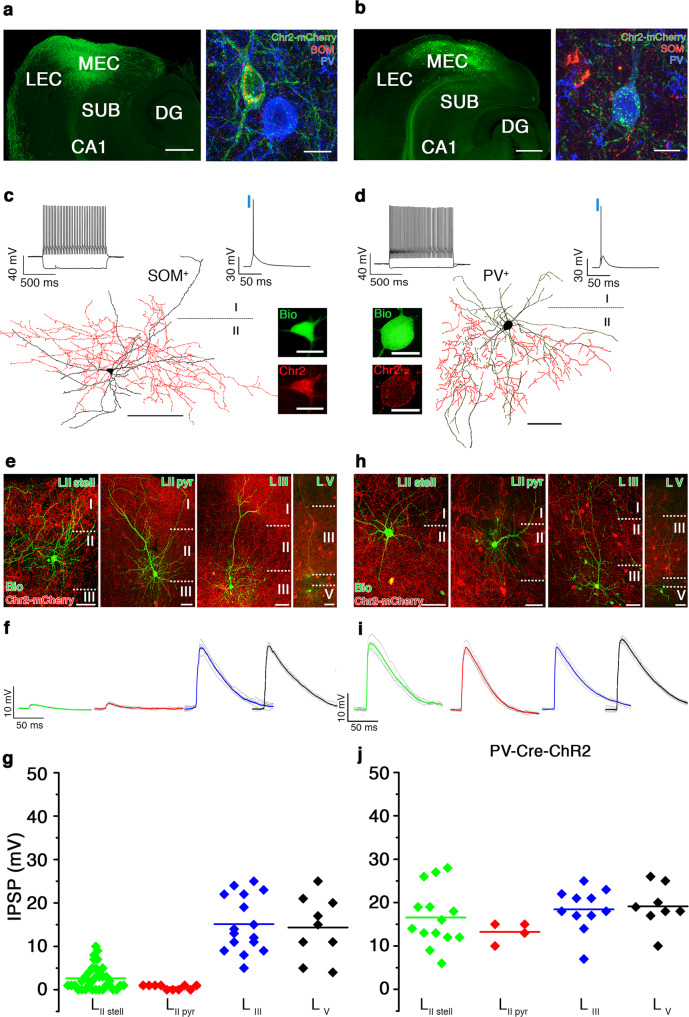
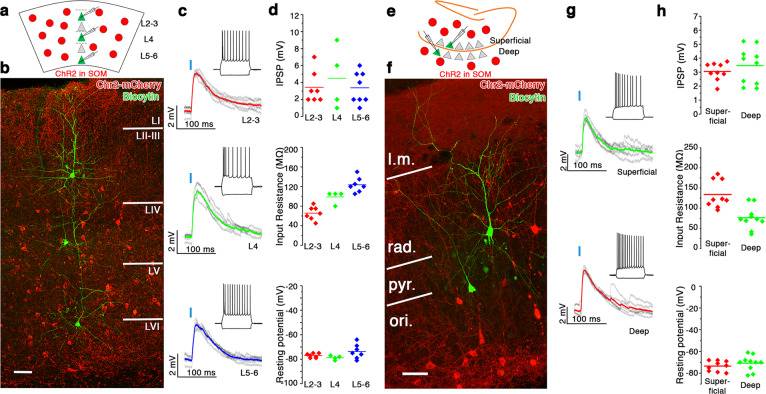
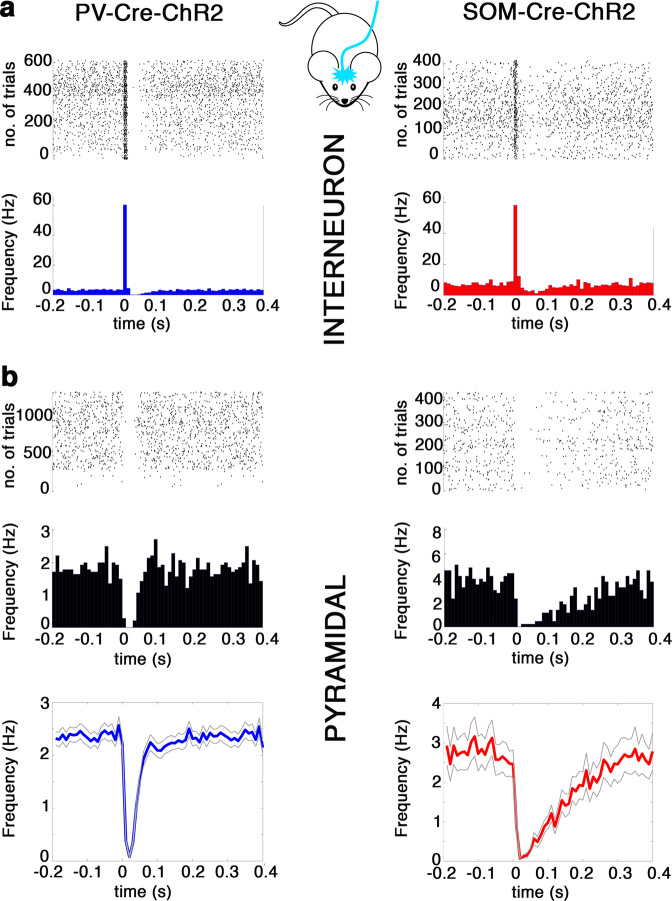
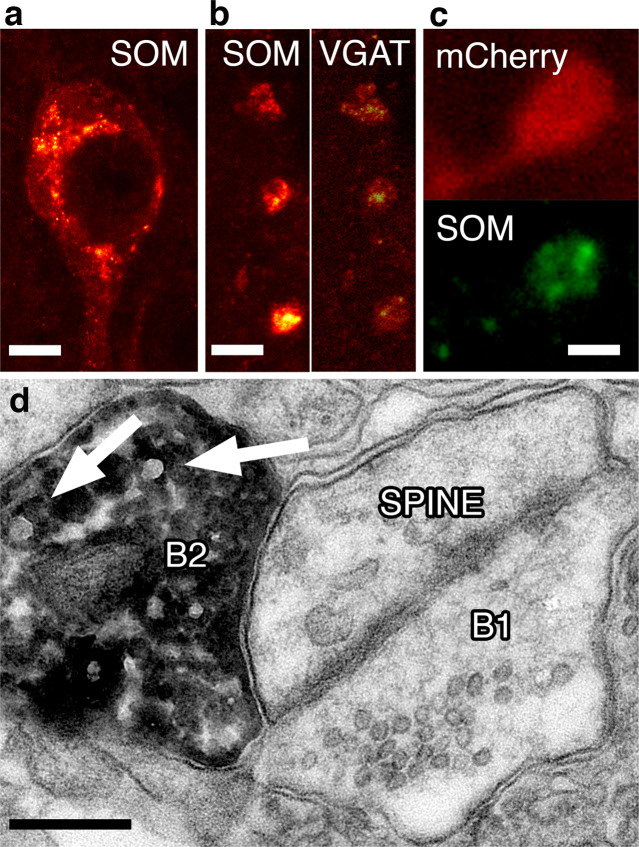
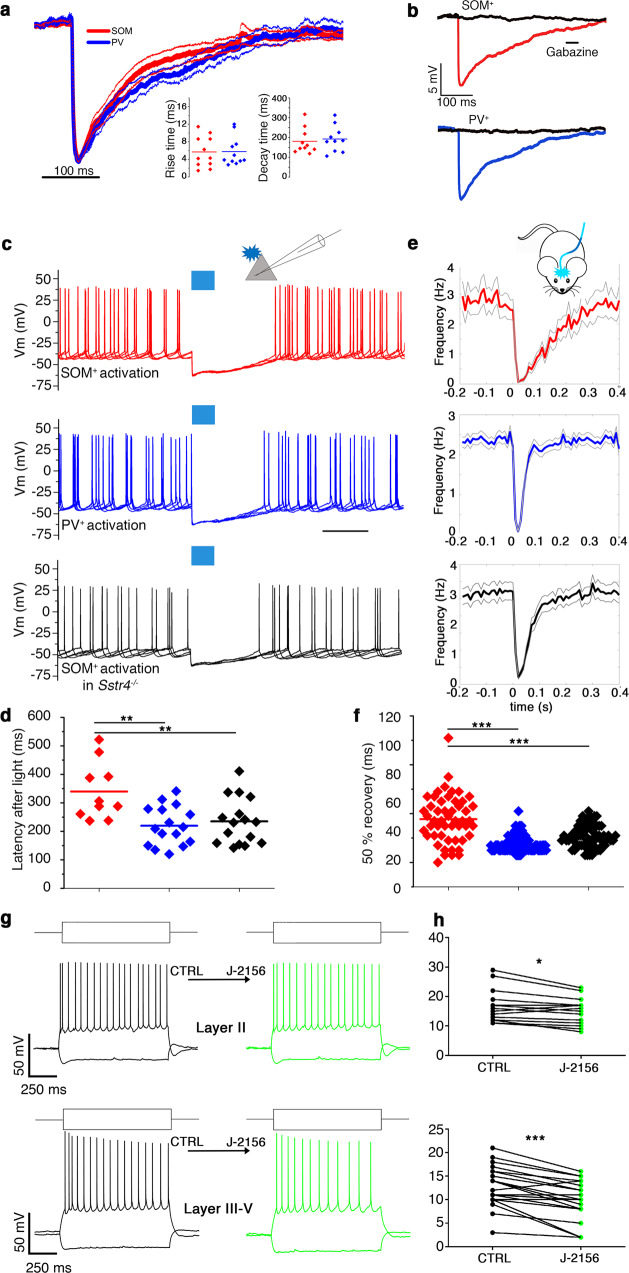
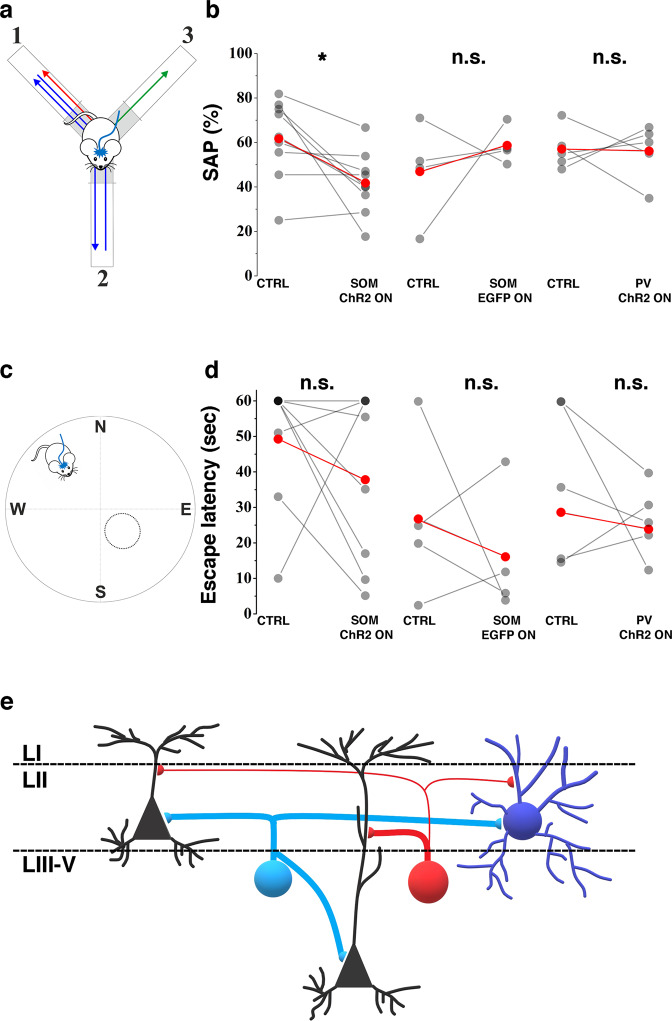
GABA released from heterogeneous types of interneurons acts in a complex spatio-temporal manner on postsynaptic targets in the networks. In addition to GABA, a large fraction of GABAergic cells also express neuromodulator peptides. Somatostatin (SOM) containing interneurons, in particular, have been recognized as key players in several brain circuits, however, the action of SOM and its downstream network effects remain largely unknown. Here, we used optogenetics, electrophysiologic, anatomical and behavioral experiments to reveal that the dendrite-targeting, SOM+ GABAergic interneurons demonstrate a unique layer-specific action in the medial entorhinal cortex (MEC) both in terms of GABAergic and SOM-related properties. We show that GABAergic and somatostatinergic neurotransmission originating from SOM+ local interneurons preferentially inhibit layer III-V pyramidal cells, known to be involved in memory formation. We propose that this dendritic GABA–SOM dual inhibitory network motif within the MEC serves to selectively modulate working-memory formation without affecting the retrieval of already learned spatial navigation tasks.
Overview
The claims and statistics of this paper haven’t been checked yet.
Free: it reads the open-access text and checks the first 5 claims that cite a source we can check. Create a free account to check every claim.
Integrity signals
Registry
Cites
Statistics
Figures
Verification
Claims the paper makes
The claims and statistics of this paper haven’t been checked yet.
Free: it reads the open-access text and checks the first 5 claims that cite a source we can check. Create a free account to check every claim.
Claims other papers make about this one
Each is checked against this paper’s own text: does it say what the citing paper says it does?
The check wasn’t confident either way, so it gives no verdict — never disputed.
In the citing paper
“Confirmatory post-mortem studies in depressed patients have found reduced somatostatin gene expression in the subgenual anterior cingulate cortex (146).”
From Chronic stress, neuroinflammation, and depression: an overview of pathophysiological mechanisms and emerging anti-inflammatories (2023) · cites this paper as [146]
Experimental — accuracy not yet measured
Self-check
Percentages, sums and reported differences re-computed from the paper’s own numbers.
The self-check needs the paper’s full text.
Citations
Cites
Synaptic mechanisms of synchronized gamma oscillations in inhibitory interneuron networks
Bartos, M., Vida, I., & Jonas, P. (2007) · Nature Reviews Neuroscience · doi:10.1038/nrn2044 · Cited by 2,070
Three groups of interneurons account for nearly 100% of neocortical GABAergic neurons
Rudy, B., Fishell, G., Lee, S., & Hjerling‐Leffler, J. (2011) · Developmental Neurobiology · doi:10.1002/dneu.20853 · Cited by 1,420
K+ channel regulation of signal propagation in dendrites of hippocampal pyramidal neurons
Hoffman, D. A., Magee, J. C., Colbert, C. M., & Johnston, D. (1997) · Nature · doi:10.1038/43119 · Cited by 1,389
Pfeffer, C. K., Xue, M., He, M., Huang, Z. J., & Scanziani, M. (2013) · Nature Neuroscience · doi:10.1038/nn.3446 · Cited by 1,353
Brain-state- and cell-type-specific firing of hippocampal interneurons in vivo
Klausberger, T., Magill, P. J., Márton, L. F., Roberts, J. D. B., Cobden, P. M., Buzsáki, G., & Somogyi, P. (2003) · Nature · doi:10.1038/nature01374 · Cited by 1,345
Oscillatory coupling of hippocampal pyramidal cells and interneurons in the behaving rat
Csicsvari, J., Hirase, H., Czurkó, A., Mamiya, A., & Buzsáki, G. (1999) · The Journal of Neuroscience · doi:10.1523/jneurosci.19-01-00274.1999 · Cited by 966
Davies, P., Katzman, R., & Terry, R. D. (1980) · Nature · doi:10.1038/288279a0 · Cited by 882
Graded persistent activity in entorhinal cortex neurons
Egorov, A. V., Hamam, B. N., Fransén, E., Hasselmo, M. E., & Alonso, A. A. (2002) · Nature · doi:10.1038/nature01171 · Cited by 769
Control of timing, rate and bursts of hippocampal place cells by dendritic and somatic inhibition
Royer, S., Zemelman, B. V., Losonczy, A., Kim, J., Chance, F., Magee, J. C., & Buzsáki, G. (2012) · Nature Neuroscience · doi:10.1038/nn.3077 · Cited by 728
Rhythms of the hippocampal network
Colgin, L. L. (2016) · Nature reviews. Neuroscience · doi:10.1038/nrn.2016.21 · Cited by 654
Cited by
Hassamal, S. (2023) · Frontiers in Psychiatry · doi:10.3389/fpsyt.2023.1130989 · Cited by 578
“Confirmatory post-mortem studies in depressed patients have found reduced somatostatin gene expression in the subgenual anterior cingulate cortex (146).”
BackgroundFernandez, F. R., Via, G., Canavier, C. C., & White, J. A. (2022) · eNeuro · doi:10.1523/eneuro.0441-21.2022 · Cited by 59
Casello, S. M., Flores, R. J., Yarur, H. E., Wang, H., Awanyai, M., Arenivar, M. A., Jaime-Lara, R. B., Bravo-Rivera, H., & Tejeda, H. A. (2022) · Frontiers in Neural Circuits · doi:10.3389/fncir.2022.796443 · Cited by 55
A neuronal coping mechanism linking stress-induced anxiety to motivation for reward
Klenowski, P. M., Zhao-Shea, R., Freels, T. G., Molas, S., Zinter, M., M'angale, P. G., Xiao, C., Martínez‐Núñez, L., Thomson, T., & Tapper, A. R. (2023) · Science Advances · doi:10.1126/sciadv.adh9620 · Cited by 39
“Previous studies indicate that SST can mediate inhibitory responses primarily at dendritic sites within excitatory neuronal networks ( 67 – 69 ) and also at axonal sites within the MHb-IPN pathway ( 62 ).”
BackgroundThe hippocampus associated GABAergic neural network impairment in early-stage of Alzheimer's disease
Tang, Y., Yan, Y., Mao, J., Ni, J., & Qing, H. (2023) · Ageing Research Reviews · doi:10.1016/j.arr.2023.101865 · Cited by 38
Scalmani, P., Paterra, R., Mantegazza, M., Avoli, M., & de Curtis, M. (2023) · Journal of Neuroscience · doi:10.1523/jneurosci.1190-22.2023 · Cited by 29
“INSOM features have been described in the EC (Neske et al., 2015; Ferrante et al., 2017; Kecskés et al., 2020; Fernandez et al., 2022).”
InfluentialEffective target genes for RNA interference‐based management of the cabbage stem flea beetle
Cedden, D., Güney, G., Debaisieux, X., Scholten, S., Rostás, M., & Bucher, G. (2024) · Insect Molecular Biology · doi:10.1111/imb.12942 · Cited by 31
A non-canonical visual cortical-entorhinal pathway contributes to spatial navigation
Shao, Q., Chen, L., Li, X., Li, M., Cui, H. F., Li, X., Zhao, X., Shi, Y., Sun, Q., Yan, K., et al. (2024) · Nature Communications · doi:10.1038/s41467-024-48483-y · Cited by 22
“SOM INs of the MEC as a whole have been shown to maintain selectivity of aper-iodic spatial cells 56 and modulate working-memory formation 57 , but theexactfunctionofSOMINsinL5bisunknown.”
Sutton, N. M., Gutiérrez-Guzmán, B. E., Dannenberg, H., & Ascoli, G. A. (2024) · International Journal of Molecular Sciences · doi:10.3390/ijms25116059 · Cited by 13
“Grid cells in MEC LII can be either glutamatergic stellate cells or pyramidal cells [61].”
BackgroundPlaza‐Alonso, S., Cano‐Astorga, N., DeFelipe, J., & Alonso‐Nanclares, L. (2025) · eLife · doi:10.7554/elife.96144 · Cited by 12
“These ‘unexpected’ 3D distributions may arise from particular elements of the tissue studied, such as the presence of large trunks of apical dendrites or myelin fibers that could reduce the effective neuropil space where synapses may be established.”
Key role of neuronal diversity in structured reservoir computing
Thivierge, J., Giraud, É., Lynn, M. B., & Charbonneau, A. T. (2022) · Chaos An Interdisciplinary Journal of Nonlinear Science · doi:10.1063/5.0111131 · Cited by 8
Vetere, L. M., Galas, A., Vaughan, N., Kohler, C., Feng, Y., Wick, Z. C., Philipsberg, P. A., Liobimova, O., Gordon, K. E., Fernández‐Ruiz, A., et al. (2026) · Cell Reports · doi:10.1016/j.celrep.2026.117646 · Cited by 5
Nilssen, E. S., Jacobsen, B., Doan, T. P., Girão, P. J., & Witter, M. P. (2022) · bioRxiv (Cold Spring Harbor Laboratory) · doi:10.1101/2022.11.29.518323 · Cited by 5
Neurogliaform cells mediate feedback inhibition in the medial entorhinal cortex
Szőcs, S., Henn-Mike, N., Agócs-Laboda, Á., Szabó‐Meleg, E., & Varga, C. (2022) · Frontiers in Neuroanatomy · doi:10.3389/fnana.2022.779390 · Cited by 3
“3 ms, not shown) instead of having apical dendrites running straight up to layer I perpendicular to the layer, as layer II–III pyramidal cells in the neocortex (Feldman, 1984) and layer III pyramidal cells in entorhinal cortex have (Canto and Witter, 2012; Craig and McBain, 2015; Kecskés et al., 2020), MEC layer II ca…”
BackgroundMethodSelf-citationMerighi, A., Sbriz, M., & Lossi, L. (2026) · Frontiers in Molecular Neuroscience · doi:10.3389/fnmol.2026.1839947 · Cited by 2
“…CORT (cortistatin) (Patel, 1999) SSTR1–SSTR5 (Patel, 1999) SST co-localizes with GABA in cortical and hippocampal interneurons (Martinotti cells) (Kecskés et al., 2020); with NPY in hypothalamic neurons (Anderson and Reiner, 1990) Cortical Martinotti cells co-release SST + GABA (Wang et al.,…”
Beyond gradients: Factorized, geometric control of interference and generalizationPreprint
Scott, D. N., & Frank, M. J. (2024) · eLife · doi:10.7554/elife.103701.1 · Cited by 1
Beyond gradients: Factorized, geometric control of interference and generalizationPreprint
Scott, D. N., & Frank, M. J. (2024) · eLife · doi:10.7554/elife.103701 · Cited by 1
Optogenetic and chemogenetic studies of spatial navigation
Jarzębowski, P., Hay, Y. A., & Paulsen, O. (2024) · Elsevier eBooks · doi:10.1016/b978-0-12-820480-1.00111-x
Associations between epilepsy-related polygenic risk and brain morphology in childhoodPreprint
Ngo, A., Liu, L., Larivière, S., Kebets, V., Fett, S., Weber, C. F., Royer, J., Yu, E., Rodríguez‐Cruces, R., Zhang, Z., et al. (2025) · bioRxiv (Cold Spring Harbor Laboratory) · doi:10.1101/2025.01.17.633277 · Cited by 1
Space, time and item coding in the lateral entorhinal cortex and the hippocampus
Barriuso-Ortega, I. (2023) · heiDOK (Heidelberg University) · doi:10.11588/heidok.00033200
Badrinarayanan, S. (2024) · eScholarship@McGill (McGill) · doi:10.82308/29794
Metadata
- Authors
- Kecskés, M., Henn-Mike, N., Agócs-Laboda, Á., Szőcs, S., Petykó, Z., & Varga, C.
- Affiliations
- University of Pecs (HU)
- Corresponding author
- Varga, Csaba
- Venue
- Communications Biology
- Published
- 2020-12-10
- Volume
- 3
- Issue
- 1
- Pages
- 754-754
- ISSN
- 2399-3642 (ISSN-L)
- PMC
- PMC7728756
- OpenAlex
- W3112127784
- Cited by
- 18
- References
- 53
- Citations by year
- 2026: 1 · 2025: 2 · 2024: 6 · 2023: 4 · 2022: 5
- FWCI
- 1.21
- Type
- journal article
- Language
- en
- Open access
- gold
- doi.org
- Licence
- cc-by
- creativecommons.org/licenses/by/4.0 (tdm)
- creativecommons.org/licenses/by/4.0 (vor)
- Locations
- Communications Biology (publishedVersion, cc-by)
- PubMed Central (publishedVersion, cc-by)
- PubMed (publishedVersion)
- DOAJ (DOAJ: Directory of Open Access Journals) (submittedVersion, cc-by-sa)
- Funders
- Directorate-General for Employment, Social Affairs and Inclusion
- Topics
- Life Sciences › Neuroscience › Cognitive Neuroscience › Memory and Neural Mechanisms
- Life Sciences › Neuroscience › Cellular and Molecular Neuroscience › Neuroscience and Neuropharmacology Research
- Life Sciences › Neuroscience › Cognitive Neuroscience › Neural dynamics and brain function
- Keywords
- somatostatin, GABAergic interneurons, medial entorhinal cortex, pyramidal neurons, dendritic inhibition, working memory, spatial navigation
- MeSH terms
- Animals, Cell Communication, Female, Interneurons, Male, Memory, Short-Term, Neural Pathways, Synaptic Transmission, Peptides, Somatostatin, Biomarkers, Gene Expression, Pyramidal Cells, Mice, Knockout, Neurotransmitter Agents, Entorhinal Cortex, Mice, Electrophysiological Phenomena, GABAergic Neurons
About these checks
Registry, retraction, Cites and statistics results are computed, not judged, with one exception: a printed reference that no index lists is read once by a model before it counts as a citation error. Claims are extracted by a model and kept only when their quote appears verbatim in the text; each cited source is then checked, with a model’s help, for whether it says what the claim relies on. Those verdicts can be wrong — read the claim’s quote and the cited source before relying on one.
Statistics and arithmetic are recomputed, not judged.
Confidence bands are shown only for fields calibrated on our annotated test set. None is calibrated yet, so no band is shown.
What counts as a claim ›How we measure confidence ›How we check this ›
Are you an author, or do you see a problem with this page? Request a review
Data sources
Bibliographic data: Semantic Scholar, OpenAlex, Crossref.
Contains information from the Semantic Scholar Academic Graph Datasets, made available under the ODC Attribution License (ODC-BY 1.0).
Semantic Scholar’s data is described in: Kinney, R., et al. (2023). The Semantic Scholar Open Data Platform. arXiv:2301.10140.
