

Interaction of SHP‐2 SH2 domains with PD‐1 ITSM induces PD‐1 dimerization and SHP‐2 activation
Open accessThe DOI matches its Crossref record; 67 of the 67 references it cites were found in a registry or an index.
Abstract
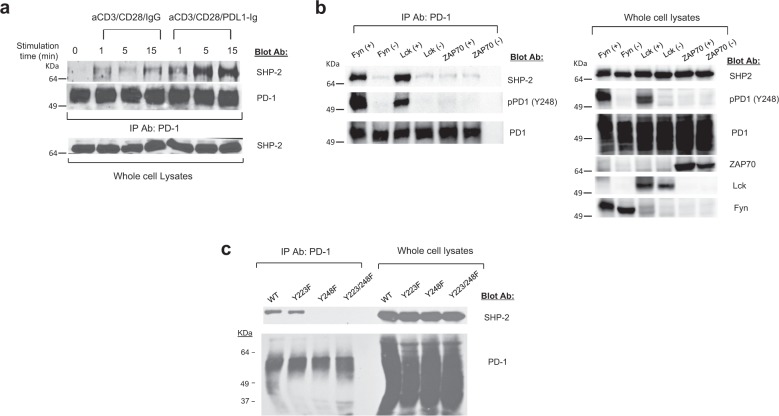
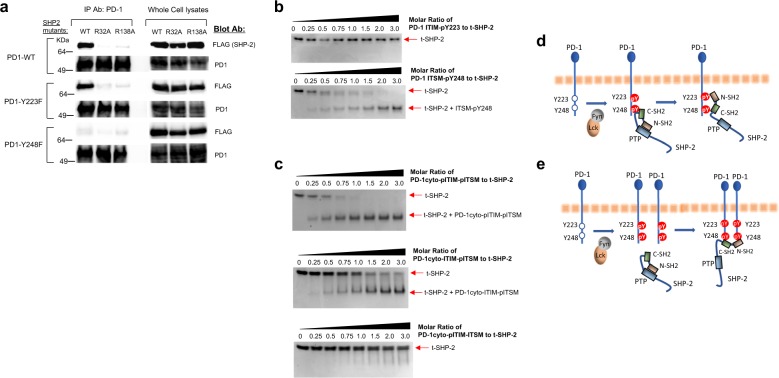
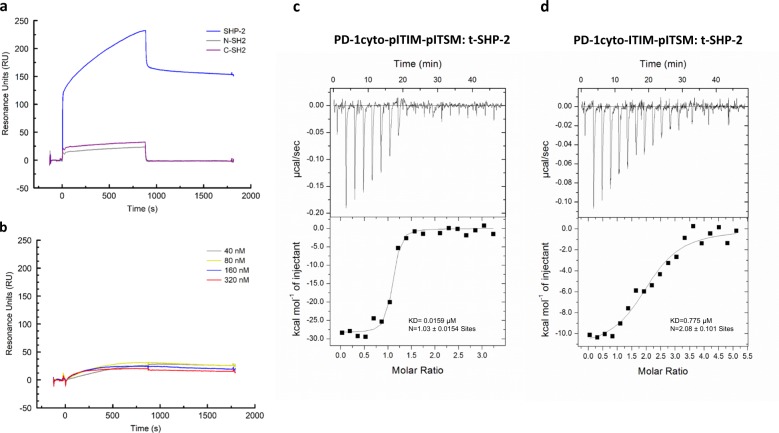
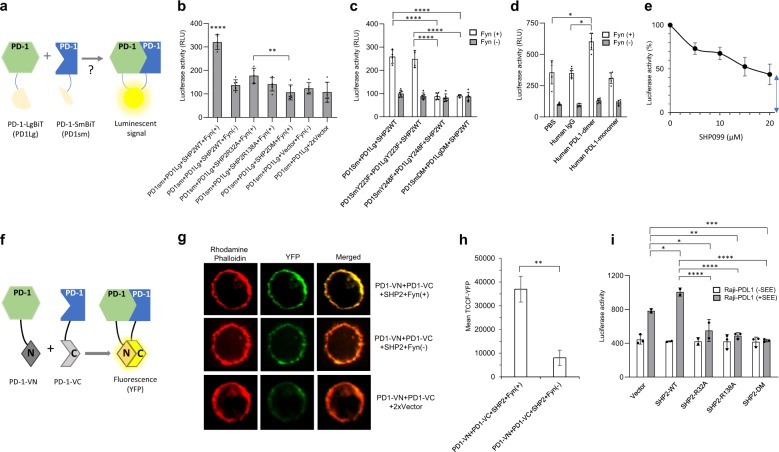
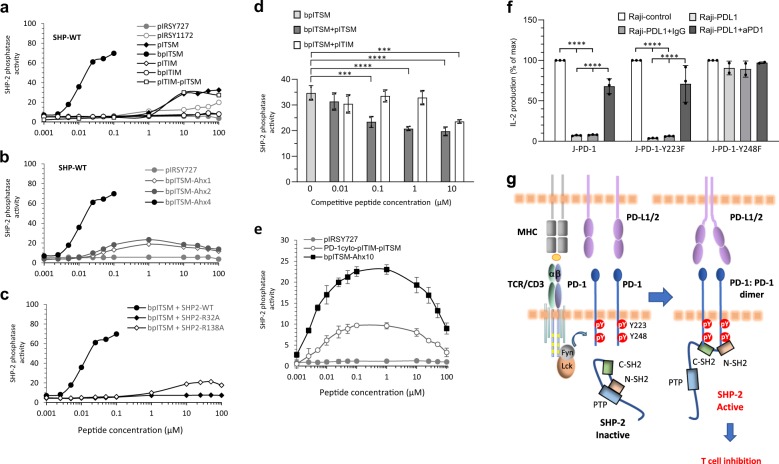
Programmed cell death-1 (PD-1) inhibits T cell responses. This function relies on interaction with SHP-2. PD-1 has one immunoreceptor tyrosine-based inhibitory motif (ITIM) at Y223 and one immunoreceptor tyrosine-based switch motif (ITSM) at Y248. Only ITSM-Y248 is indispensable for PD-1-mediated inhibitory function but how SHP-2 enzymatic activation is mechanistically regulated by one PD-1 phosphotyrosine remains a puzzle. We found that after PD-1 phosphorylation, SHP-2 can bridge phosphorylated ITSM-Y248 residues on two PD-1 molecules via its amino terminal (N)-SH2 and carboxyterminal (C)-SH2 domains forming a PD-1: PD-1 dimer in live cells. The biophysical ability of SHP-2 to interact with two ITSM-pY248 residues was documented by isothermal titration calorimetry. SHP-2 interaction with two ITSM-pY248 phosphopeptides induced robust enzymatic activation. Our results unravel a mechanism of PD-1: SHP-2 interaction that depends only on ITSM-Y248 and explain how a single docking site within the PD-1 cytoplasmic tail can activate SHP-2 and PD-1-mediated inhibitory function.
Overview
The claims and statistics of this paper haven’t been checked yet.
Free: it reads the open-access text and checks the first 5 claims that cite a source we can check. Create a free account to check every claim.
Integrity signals
Registry
Cites
Statistics
Figures
Verification
Claims the paper makes
The claims and statistics of this paper haven’t been checked yet.
Free: it reads the open-access text and checks the first 5 claims that cite a source we can check. Create a free account to check every claim.
Claims other papers make about this one
Each is checked against this paper’s own text: does it say what the citing paper says it does?
The source backs part of the claim, not all of it — or backs it for a different population, condition or comparison.
In the citing paper
“Reports also showed that phosphorylated PD‐1 ITSM could recruit SHP‐1 to play a role in the T‐cell inhibitory mechanism [286].”
From Tumor microenvironment signaling and therapeutics in cancer progression (2023) · cites this paper as [286]
Experimental — accuracy not yet measured
Self-check
Percentages, sums and reported differences re-computed from the paper’s own numbers.
The self-check needs the paper’s full text.
Citations
Cites
Safety, activity, and immune correlates of anti–PD-1 antibody in cancer
Topalian, S. L., Hodi, F. S., Brahmer, J. R., Gettinger, S. N., Smith, D. C., McDermott, D. F., Powderly, J. D., Carvajal, R. D., Sosman, J. A., Atkins, M. B., et al. (2012) · New England Journal of Medicine · doi:10.1056/nejmoa1200690 · Cited by 12,628
Restoring function in exhausted CD8 T cells during chronic viral infection
Barber, D. L., Wherry, E. J., Masopust, D., Zhu, B., Allison, J. P., Sharpe, A. H., Freeman, G. J., & Ahmed, R. (2006) · Nature · doi:10.1038/nature04444 · Cited by 3,986
Self-citationIwai, Y., Ishida, M., Tanaka, Y., Okazaki, T., Honjo, T., & Minato, N. (2002) · Proceedings of the National Academy of Sciences · doi:10.1073/pnas.192461099 · Cited by 3,203
PD-L1 regulates the development, maintenance, and function of induced regulatory T cells
Francisco, L. M., Salinas, V. H., Brown, K. E., Vanguri, V. K., Freeman, G. J., Kuchroo, V. K., & Sharpe, A. H. (2009) · Journal of Experimental Medicine · doi:10.1084/jem.20090847 · Cited by 2,079
Self-citationT cell costimulatory receptor CD28 is a primary target for PD-1–mediated inhibition
Hui, E., Cheung, J., Zhu, J., Su, X., Taylor, M. J., Wallweber, H. A., Sasmal, D. K., Huang, J., Kim, J. M., Mellman, I., et al. (2017) · Science · doi:10.1126/science.aaf1292 · Cited by 1,689
NanoLuc Complementation Reporter Optimized for Accurate Measurement of Protein Interactions in Cells
Dixon, A. S., Schwinn, M. K., Hall, M. P., Zimmerman, K., Otto, P., Lubben, T. H., Butler, B. L., Binkowski, B. F., Machleidt, T., Kirkland, T. A., et al. (2016) · ACS Chemical Biology · doi:10.1021/acschembio.5b00753 · Cited by 1,405
Molecular and Biochemical Aspects of the PD-1 Checkpoint Pathway
Boussiotis, V. A. (2016) · New England Journal of Medicine · doi:10.1056/nejmra1514296 · Cited by 1,339
Self-citationThe ‘Shp'ing news: SH2 domain-containing tyrosine phosphatases in cell signaling
Neel, B. G., Gu, H., & Pao, L. (2003) · Trends in Biochemical Sciences · doi:10.1016/s0968-0004(03)00091-4 · Cited by 1,249
Chemnitz, J. M., Parry, R. V., Nichols, K. E., June, C. H., & Riley, J. L. (2004) · The Journal of Immunology · doi:10.4049/jimmunol.173.2.945 · Cited by 1,246
Patsoukis, N., Bardhan, K., Chatterjee, P., Sari, D., Liu, B., Bell, L. N., Karoly, E. D., Freeman, G. J., Petkova, V., Seth, P., et al. (2015) · Nature Communications · doi:10.1038/ncomms7692 · Cited by 1,202
Self-citationYokosuka, T., Takamatsu, M., Kobayashi-Imanishi, W., Hashimoto-Tane, A., Azuma, M., & Saito, T. (2012) · Journal of Experimental Medicine · doi:10.1084/jem.20112741 · Cited by 1,161
Rescue of exhausted CD8 T cells by PD-1–targeted therapies is CD28-dependent
Kamphorst, A. O., Wieland, A., Nasti, T., Yang, S., Zhang, R., Barber, D. L., Konieczny, B. T., Daugherty, C. Z., Koenig, L., Yu, K., et al. (2017) · Science · doi:10.1126/science.aaf0683 · Cited by 1,015
Self-citationCrystal Structure of the Tyrosine Phosphatase SHP-2
Hof, P., Pluskey, S., Dhe-Paganon, S., Eck, M. J., & Shoelson, S. E. (1998) · Cell · doi:10.1016/s0092-8674(00)80938-1 · Cited by 985
Allosteric inhibition of SHP2 phosphatase inhibits cancers driven by receptor tyrosine kinases
Chen, Y.-N. P., LaMarche, M. J., Chan, H. M., Fekkes, P., Garcia-Fortanet, J., Acker, M. G., Antonakos, B., Chen, C. H.-T., Chen, Z., Cooke, V. G., et al. (2016) · Nature · doi:10.1038/nature18621 · Cited by 925
PD-1 is a regulator of virus-specific CD8+ T cell survival in HIV infection
Petrovas, C., Casazza, J. P., Brenchley, J. M., Price, D. A., Gostick, E., Adams, W. C., Precopio, M. L., Schacker, T., Roederer, M., Douek, D. C., et al. (2006) · The Journal of Experimental Medicine · doi:10.1084/jem.20061496 · Cited by 889
Partial inhibition of Cdk1 in G2phase overrides the SAC and decouples mitotic events
McCloy, R. A., Rogers, S., Caldon, C. E., Lorca, T., Castro, A., & Burgess, A. (2014) · Cell Cycle · doi:10.4161/cc.28401 · Cited by 853
Okazaki, T., Maeda, A., Nishimura, H., Kurosaki, T., & Honjo, T. (2001) · Proceedings of the National Academy of Sciences · doi:10.1073/pnas.231486598 · Cited by 848
Sheppard, K.-A., Fitz, L. J., Lee, J. M., Benander, C., George, J. A., Wooters, J., Qiu, Y., Jussif, J. M., Carter, L. L., Wood, C. R., et al. (2004) · FEBS Letters · doi:10.1016/j.febslet.2004.07.083 · Cited by 791
Sequential Interactions of the TCR with Two Distinct Cytoplasmic Tyrosine Kinases
Iwashima, M., Irving, B. A., van Oers, N. S. C., Chan, A. C., & Weiss, A. (1994) · Science · doi:10.1126/science.7509083 · Cited by 714
A Grb2-associated docking protein in EGF- and insulin-receptor signalling
Holgado-Madruga, M., Emlet, D. R., Moscatello, D. K., Godwin, A. K., & Wong, A. J. (1996) · Nature · doi:10.1038/379560a0 · Cited by 677
T cell receptor ligation induces the formation of dynamically regulated signaling assemblies
Bunnell, S. C., Hong, D. I., Kardon, J. R., Yamazaki, T., McGlade, C. J., Barr, V. A., & Samelson, L. E. (2002) · The Journal of Cell Biology · doi:10.1083/jcb.200203043 · Cited by 632
pp59fyn mutant mice display differential signaling in thymocytes and peripheral T cells
Stein, P. L., Lee, H.-M., Rich, S., & Soriano, P. (1992) · Cell · doi:10.1016/0092-8674(92)90308-y · Cited by 568
Coinhibitory Pathways in the B7-CD28 Ligand-Receptor Family
Schildberg, F. A., Klein, S. R., Freeman, G. J., & Sharpe, A. H. (2016) · Immunity · doi:10.1016/j.immuni.2016.05.002 · Cited by 542
Self-citationStructure of the Complex of Human Programmed Death 1, PD-1, and Its Ligand PD-L1
Zak, K. M., Kitel, R., Przetocka, S., Golik, P., Guzik, K., Musielak, B., Dömling, A., Dubin, G., & Holak, T. A. (2015) · Structure · doi:10.1016/j.str.2015.09.010 · Cited by 531
Patsoukis, N., Brown, J., Petkova, V., Liu, F., Li, L., & Boussiotis, V. A. (2012) · Science Signaling · doi:10.1126/scisignal.2002796 · Cited by 529
Self-citationCrystal structure of the B7-1/CTLA-4 complex that inhibits human immune responses
Stamper, C. C., Zhang, Y., Tobin, J. F., Erbe, D. V., Ikemizu, S., Davis, S. J., Stahl, M. L., Seehra, J., Somers, W. S., & Mosyak, L. (2001) · Nature · doi:10.1038/35069118 · Cited by 489
Fujioka, Y., Matozaki, T., Noguchi, T., Iwamatsu, A., Yamao, T., Takahashi, N., Tsuda, M., Takada, T., & Kasuga, M. (1996) · Molecular and Cellular Biology · doi:10.1128/mcb.16.12.6887 · Cited by 448
Regulation of T cell receptor signaling by a src family protein-tyrosine kinase (p59fyn)
Cooke, M. P., Abraham, K. M., Forbush, K. A., & Perimutter, R. M. (1991) · Cell · doi:10.1016/0092-8674(91)90162-r · Cited by 381
The insulin receptor substrate 1 associates with the SH2-containing phosphotyrosine phosphatase Syp
Kuhné, M. R., Pawson, T., Lienhard, G. E., & Feng, G. S. (1993) · Journal of Biological Chemistry · doi:10.1016/s0021-9258(19)50220-4 · Cited by 380
Dorfman, D. M., Brown, J. A., Shahsafaei, A., & Freeman, G. J. (2006) · American Journal of Surgical Pathology · doi:10.1097/01.pas.0000209855.28282.ce · Cited by 358
Self-citationStructural basis for co-stimulation by the human CTLA-4/B7-2 complex
Schwartz, J.-C. D., Zhang, X., Fedorov, A. A., Nathenson, S. G., & Almo, S. C. (2001) · Nature · doi:10.1038/35069112 · Cited by 349
Hadari, Y. R., Kouhara, H., Lax, I., & Schlessinger, J. (1998) · Molecular and Cellular Biology · doi:10.1128/mcb.18.7.3966 · Cited by 324
Lechleider, R. J., Sugimoto, S., Bennett, A. M., Kashishian, A. S., Cooper, J. A., Shoelson, S. E., Walsh, C. T., & Neel, B. G. (1993) · Journal of Biological Chemistry · doi:10.1016/s0021-9258(20)80562-6 · Cited by 319
Characterization of CTLA-4 structure and expression on human T cells.
Lindsten, T., Lee, K. P., Harris, E. S., Petryniak, B., Craighead, N., Reynolds, P. J., Lombard, D. B., Freeman, G. J., Nadler, L. M., Gray, G. S., et al. (1993) · The Journal of Immunology · doi:10.4049/jimmunol.151.7.3489 · Cited by 316
Self-citationGu, H., Pratt, J. C., Burakoff, S. J., & Neel, B. G. (1998) · Molecular Cell · doi:10.1016/s1097-2765(00)80288-9 · Cited by 304
A dominant-negative transgene defines a role for p56lck in thymopoiesis.
Levin, S. D., Anderson, S. J., Forbush, K. A., & Perlmutter, R. M. (1993) · The EMBO Journal · doi:10.1002/j.1460-2075.1993.tb05812.x · Cited by 296
Potent Stimulation of SH-PTP2 Phosphatase Activity by Simultaneous Occupancy of Both SH2 Domains
Pluskey, S., Wandless, T. J., Walsh, C. T., & Shoelson, S. E. (1995) · Journal of Biological Chemistry · doi:10.1074/jbc.270.7.2897 · Cited by 282
Insulin Receptor-Mediated Stimulation Boosts T Cell Immunity during Inflammation and Infection
Tsai, S., Clemente-Casares, X., Zhou, A. C., Lei, H., Ahn, J. J., Chan, Y. T., Choi, O., Luck, H., Woo, M., Dunn, S. E., et al. (2018) · Cell Metabolism · doi:10.1016/j.cmet.2018.08.003 · Cited by 272
Lu, W., Gong, D., Bar-Sagi, D., & Cole, P. A. (2001) · Molecular Cell · doi:10.1016/s1097-2765(01)00369-0 · Cited by 268
Structure and Chromosomal Localization of the Human PD-1 Gene (PDCD1)
Shinohara, T., Taniwaki, M., Ishida, Y., Kawaichi, M., & Honjo, T. (1994) · Genomics · doi:10.1006/geno.1994.1562 · Cited by 253
Measurement of the binding of tyrosyl phosphopeptides to SH2 domains: a reappraisal.
Ladbury, J. E., Lemmon, M. A., Zhou, M., Green, J., Botfield, M. C., & Schlessinger, J. (1995) · Proceedings of the National Academy of Sciences · doi:10.1073/pnas.92.8.3199 · Cited by 249
Anti-programmed cell death protein-1/ligand-1 therapy in different cancers
Homet Moreno, B., & Ribas, A. (2015) · British Journal of Cancer · doi:10.1038/bjc.2015.124 · Cited by 245
Tandem SH2 Domains Confer High Specificity in Tyrosine Kinase Signaling
Ottinger, E. A., Botfield, M. C., & Shoelson, S. E. (1998) · Journal of Biological Chemistry · doi:10.1074/jbc.273.2.729 · Cited by 228
Sugimoto, S., Wandless, T. J., Shoelson, S. E., Neel, B. G., & Walsh, C. T. (1994) · Journal of Biological Chemistry · doi:10.1016/s0021-9258(17)36874-6 · Cited by 213
Kazlauskas, A., Feng, G. S., Pawson, T., & Valius, M. (1993) · Proceedings of the National Academy of Sciences · doi:10.1073/pnas.90.15.6939 · Cited by 207
Nonreceptor Protein-Tyrosine Phosphatases in Immune Cell Signaling
Pao, L. I., Badour, K., Siminovitch, K. A., & Neel, B. G. (2007) · Annual Review of Immunology · doi:10.1146/annurev.immunol.23.021704.115647 · Cited by 201
Eck, M. J., Pluskey, S., Trüb, T., Harrison, S. C., & Shoelson, S. E. (1996) · Nature · doi:10.1038/379277a0 · Cited by 199
An Improved Bimolecular Fluorescence Complementation Assay with a High Signal-To-Noise Ratio
Kodama, Y., & Hu, C.-D. (2010) · BioTechniques · doi:10.2144/000113519 · Cited by 195
Lechleider, R. J., Freeman, R. M., & Neel, B. G. (1993) · Journal of Biological Chemistry · doi:10.1016/s0021-9258(19)38668-5 · Cited by 191
PD-1 Primarily Targets TCR Signal in the Inhibition of Functional T Cell Activation
Mizuno, R., Sugiura, D., Shimizu, K., Maruhashi, T., Watada, M., Okazaki, I.-M., & Okazaki, T. (2019) · Frontiers in Immunology · doi:10.3389/fimmu.2019.00630 · Cited by 171
Regulation of the Mitogen-activated Protein Kinase Signaling Pathway by SHP2
Cunnick, J. M., Meng, S., Ren, Y., Desponts, C., Wang, H.-G., Djeu, J. Y., & Wu, J. (2002) · Journal of Biological Chemistry · doi:10.1074/jbc.m110547200 · Cited by 162
Shp-2 Is Dispensable for Establishing T Cell Exhaustion and for PD-1 Signaling In Vivo
Rota, G., Niogret, C., Dang, A. T., Barros, C. R., Fonta, N. P., Alfei, F., Morgado, L., Zehn, D., Birchmeier, W., Vivier, E., et al. (2018) · Cell Reports · doi:10.1016/j.celrep.2018.03.026 · Cited by 155
Celis-Gutierrez, J., Blattmann, P., Zhai, Y., Jarmuzynski, N., Ruminski, K., Grégoire, C., Ounoughene, Y., Fiore, F., Aebersold, R., Roncagalli, R., et al. (2019) · Cell Reports · doi:10.1016/j.celrep.2019.05.041 · Cited by 154
Bhatia, S., Edidin, M. A., Almo, S. C., & Nathenson, S. G. (2005) · Immunology Letters · doi:10.1016/j.imlet.2005.11.019 · Cited by 151
The Immunological Synapse, TCR Microclusters, and T Cell Activation
Yokosuka, T., & Saito, T. (2009) · Current topics in microbiology and immunology · doi:10.1007/978-3-642-03858-7_5 · Cited by 149
Davidson, D., Chow, L. M., Fournel, M., & Veillette, A. (1992) · The Journal of experimental medicine · doi:10.1084/jem.175.6.1483 · Cited by 149
Model and Simulation of Multivalent Binding to Fixed Ligands
Müller, K. M., Arndt, K. M., & Plückthun, A. (1998) · Analytical Biochemistry · doi:10.1006/abio.1998.2725 · Cited by 143
Gajewski, T. F., Qian, D., Fields, P., & Fitch, F. W. (1994) · Proceedings of the National Academy of Sciences · doi:10.1073/pnas.91.1.38 · Cited by 130
Binding Stoichiometry of the Cytotoxic T Lymphocyte-associated Molecule-4 (CTLA-4)
Linsley, P. S., Nadler, S. G., Bajorath, J., Peach, R., Leung, H. T., Rogers, J., Bradshaw, J., Stebbins, M., Leytze, G., Brady, W., et al. (1995) · Journal of Biological Chemistry · doi:10.1074/jbc.270.25.15417 · Cited by 111
The Insulin Receptor Plays a Critical Role in T Cell Function and Adaptive Immunity
Fischer, H. J., Sie, C., Schumann, E., Witte, A.-K., Dressel, R., van den Brandt, J., & Reichardt, H. M. (2017) · The Journal of Immunology · doi:10.4049/jimmunol.1601011 · Cited by 109
Nguyen, T. V., Ke, Y., Zhang, E. E., & Feng, G.-S. (2006) · The Journal of Immunology · doi:10.4049/jimmunol.177.9.5990 · Cited by 87
Affinity purification mass spectrometry analysis of PD-1 uncovers SAP as a new checkpoint inhibitor
Peled, M., Tocheva, A. S., Sandigursky, S., Nayak, S., Philips, E. A., Nichols, K. E., Strazza, M., Azoulay-Alfaguter, I., Askenazi, M., Neel, B. G., et al. (2018) · Proceedings of the National Academy of Sciences · doi:10.1073/pnas.1710437115 · Cited by 87
Boussiotis, V. A., Barber, D. L., Lee, B. J., Gribben, J. G., Freeman, G. J., & Nadler, L. M. (1996) · The Journal of experimental medicine · doi:10.1084/jem.184.2.365 · Cited by 83
Self-citationThe Grb2-mSos1 Complex Binds Phosphopeptides with Higher Affinity than Grb2
Chook, Y. M., Gish, G. D., Kay, C. M., Pai, E. F., & Pawson, T. (1996) · Journal of Biological Chemistry · doi:10.1074/jbc.271.48.30472 · Cited by 75
Sun, J., Lu, S., Ouyang, M., Lin, L.-J., Zhuo, Y., Liu, B., Chien, S., Neel, B. G., & Wang, Y. (2013) · Nature Communications · doi:10.1038/ncomms3037 · Cited by 46
RIAM Regulates the Cytoskeletal Distribution and Activation of PLC-γ1 in T Cells
Patsoukis, N., Lafuente, E. M., Meraner, P., Kim, J. S., Dombkowski, D., Li, L., & Boussiotis, V. A. (2009) · Science Signaling · doi:10.1126/scisignal.2000409 · Cited by 37
Self-citationRasooly, R., Do, P. M., & Hernlem, B. J. (2016) · Toxins · doi:10.3390/toxins8050150 · Cited by 9
Research works printed but not linked: 1
- Bardhan K Weaver DJ Strauss L Patsoukis N Boussiotis AV Phosphorylation of Y248 in the ITSM of PD-1 is indicative of PD-1-mediated inhibitory function J. Immunol. 2017 194 154.159
Cited by
Regulatory mechanisms of PD-1/PD-L1 in cancers
Lin, X., Kang, K., Chen, P., Zeng, Z., Li, G., Xiong, W., Yi, M., & Xiang, B. (2024) · Molecular Cancer · doi:10.1186/s12943-024-02023-w · Cited by 784
“The phosphorylated ITMM binds to N-SH2 and activates SHP2 [20, 21].”
BackgroundPatsoukis, N., Wang, Q., Strauss, L., & Boussiotis, V. A. (2020) · Science Advances · doi:10.1126/sciadv.abd2712 · Cited by 535
Self-citationTumor immunotherapies by immune checkpoint inhibitors (ICIs); the pros and cons
Naimi, A., Mohammed, R. N., Raji, A., Chupradit, S., Yumashev, A. V., Suksatan, W., Shalaby, M. N., Thangavelu, L., Kamrava, S., Shomali, N., et al. (2022) · Cell Communication and Signaling · doi:10.1186/s12964-022-00854-y · Cited by 507
“There is clear evidence showing that PD-1 inhibitory function relies on the ITSM phosphotyrosine, which in turn recruits SHP2 and consequently suppresses downstream signaling axes [21, 22].”
BackgroundRational combinations of targeted cancer therapies: background, advances and challenges
Jin, H., Wang, L., & Bernards, R. (2023) · Nature Reviews Drug Discovery · doi:10.1038/s41573-022-00615-z · Cited by 503
Tumor microenvironment signaling and therapeutics in cancer progression
Goenka, A., Khan, F., Verma, B., Sinha, P., Dmello, C. C., Jogalekar, M. P., Gangadaran, P., & Ahn, B. (2023) · Cancer Communications · doi:10.1002/cac2.12416 · Cited by 323
Metadata
- Authors
- Patsoukis, N., Duke-Cohan, J. S., Chaudhri, A., Aksoylar, H.-I., Wang, Q., Council, A., Berg, A., Freeman, G. J., & Boussiotis, V. A.
- Affiliations
- Beth Israel Deaconess Medical Center (US)
- The University of Texas MD Anderson Cancer Center (US)
- Cedars-Sinai Medical Center (US)
- Harvard University (US)
- Corresponding author
- Boussiotis, Vassiliki A.
- ORCID
- Venue
- Communications Biology
- Published
- 2020-03-17
- Volume
- 3
- Issue
- 1
- Pages
- 128-128
- ISSN
- 2399-3642 (ISSN-L)
- PMC
- PMC7078208
- OpenAlex
- W3011824547
- Cited by
- 169
- References
- 67
- Citations by year
- 2026: 27 · 2025: 30 · 2024: 26 · 2023: 31 · 2022: 22 · 2021: 25 · 2020: 8
- FWCI
- 6.98
- Type
- journal article
- Language
- en
- Open access
- gold
- doi.org
- Licence
- cc-by
- creativecommons.org/licenses/by/4.0 (tdm)
- creativecommons.org/licenses/by/4.0 (vor)
- Locations
- Communications Biology (publishedVersion, cc-by)
- Europe PMC (PubMed Central) (publishedVersion, cc-by)
- PubMed Central (publishedVersion, cc-by)
- PubMed (publishedVersion)
- Funders
- National Institutes of Health (P50CA101942 and P01AI056299)
- National Cancer Institute (R01CA183605, P50CA101942, R01CA238263, R01CA212605)
- National Institute of Allergy and Infectious Diseases (P01AI056299)
- National Institute of Arthritis and Musculoskeletal and Skin Diseases (R21AR073494)
- Topics
- Life Sciences › Biochemistry, Genetics and Molecular Biology › Molecular Biology › Protein Tyrosine Phosphatases
- Life Sciences › Immunology and Microbiology › Immunology › T-cell and B-cell Immunology
- Health Sciences › Medicine › Oncology › Cancer Immunotherapy and Biomarkers
- Keywords
- PD-1, SHP2, SH2 domain, IT service management, ITIM, T cell suppression, receptor tyrosine phosphatase, protein-protein interaction
- MeSH terms
- Animals, Chlorocebus aethiops, Enzyme Activation, Humans, Phosphorylation, Protein Binding, T-Lymphocytes, Mice, Knockout, src Homology Domains, Jurkat Cells, COS Cells, Proto-Oncogene Proteins c-fyn, Protein Tyrosine Phosphatase, Non-Receptor Type 11, Protein Multimerization, HEK293 Cells, Programmed Cell Death 1 Receptor, Immunoreceptor Tyrosine-Based Activation Motif
About these checks
Registry, retraction, Cites and statistics results are computed, not judged, with one exception: a printed reference that no index lists is read once by a model before it counts as a citation error. Claims are extracted by a model and kept only when their quote appears verbatim in the text; each cited source is then checked, with a model’s help, for whether it says what the claim relies on. Those verdicts can be wrong — read the claim’s quote and the cited source before relying on one.
Statistics and arithmetic are recomputed, not judged.
Confidence bands are shown only for fields calibrated on our annotated test set. None is calibrated yet, so no band is shown.
What counts as a claim ›How we measure confidence ›How we check this ›
Are you an author, or do you see a problem with this page? Request a review
Data sources
Bibliographic data: Semantic Scholar, OpenAlex, Crossref.
Contains information from the Semantic Scholar Academic Graph Datasets, made available under the ODC Attribution License (ODC-BY 1.0).
Semantic Scholar’s data is described in: Kinney, R., et al. (2023). The Semantic Scholar Open Data Platform. arXiv:2301.10140.
