

Parallel ZNF598 and GIGYF2 pathways mediate conserved collision dependent mRNA decay with divergent endonucleolytic features
Open accessThe DOI matches its Crossref record; 71 of the 71 references it cites were found in a registry or an index; none of the 28 sources its claims cite is checked for support yet.
Abstract
SUMMARY Quality control of aberrant mRNAs is essential for maintaining cellular homeostasis. Ribosome collisions caused by translational stalling trigger mRNA surveillance pathways that promote degradation of faulty transcripts. In yeast, two major collision-responsive pathways have been proposed: the Hel2–Cue2 pathway and the Syh1–Xrn1 pathway, yet their functional relationship and conservation in mammals have remained unclear. Here, we demonstrate that these two pathways act redundantly to degrade collision-inducing mRNAs in both yeast and mammalian cells. In yeast, we dissect the contribution of Cue2-mediated endonucleolytic cleavage and show that eS7 polyubiquitination–dependent cleavage plays a dominant role in Hel2–Cue2 pathway. In mammals, although the proposed Cue2 homolog N4BP2 is dispensable, we provide the first direct evidence of collision-induced endonucleolytic mRNA cleavage. Together, our findings reveal both conserved and divergent features of ribosome collision–coupled mRNA quality control and expand our understanding of mRNA surveillance and potential therapeutic mRNA implications.
Overview
CoChat Summary
TL;DR
In yeast and mammalian cells, Hel2/ZNF598 and Syh1-Smy2/GIGYF2 act redundantly to degrade collision-inducing mRNAs. Yeast Cue2-mediated NGD-RQC⁻ cleavage dominates mRNA decay, whereas mammalian N4BP2 is dispensable and collision-induced cleavage instead occurs via SMG6-dependent NMD on frameshifted K20 reporters.
Key findings
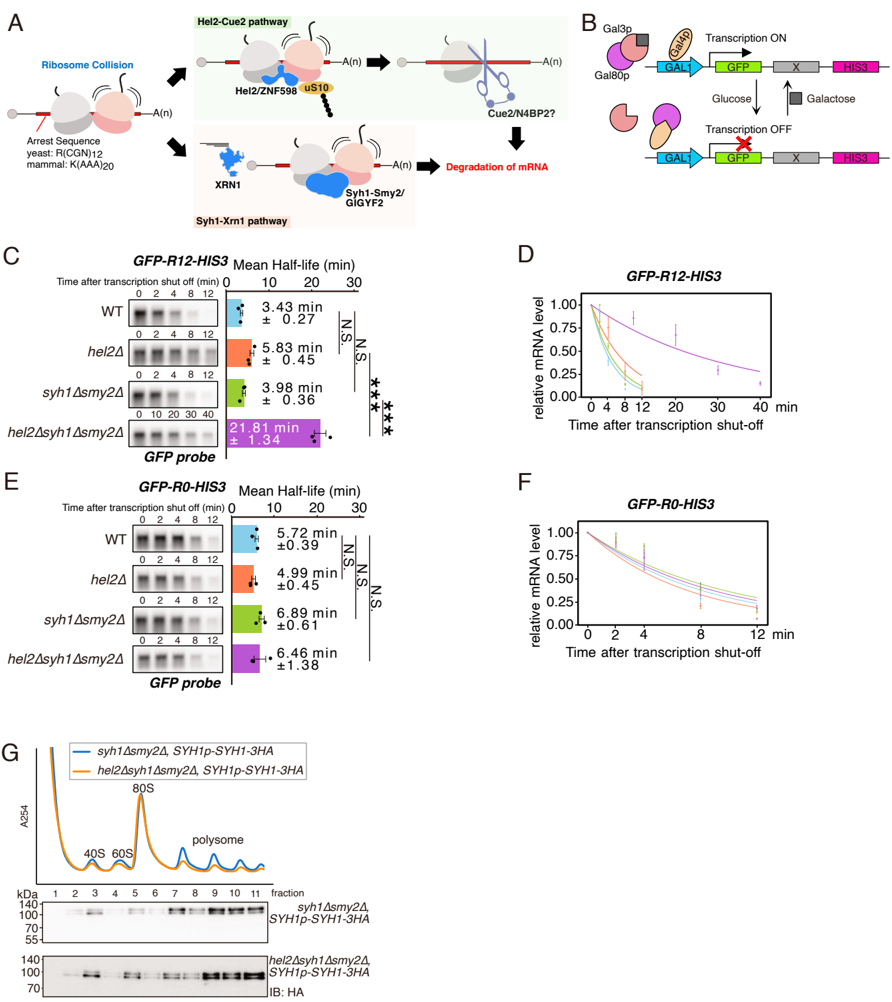
- Yeast Hel2 and Syh1-Smy2 act redundantly: double deletion stabilized the GFP-R12-HIS3 reporter to 23.84 ± 0.93 min versus WT 3.98 ± 0.36 min, while single deletions had little or no significant effect; the non-stalling GFP-R0-HIS3 reporter was not stabilized.
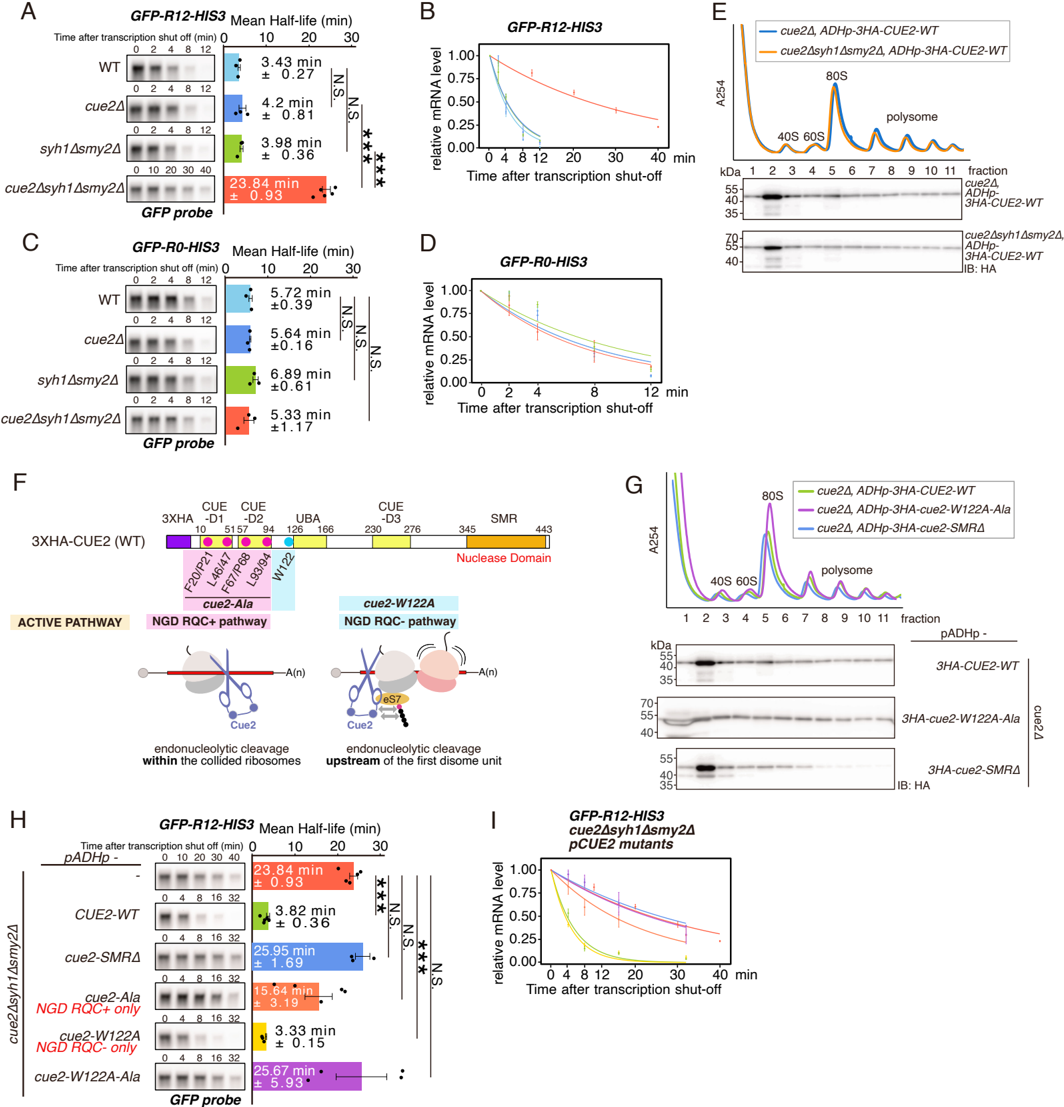
- Cue2 and Syh1-Smy2 act redundantly, and Cue2’s SMR nuclease domain is essential. The NGD-RQC⁻-only mutant cue2-W122A fully rescued decay to WT-like levels (3.82 ± 0.36 min), whereas the NGD-RQC⁺-only mutant cue2-Ala only partially restored decay (15.64 ± 3.19 min) and double-inactive/SMR-deleted mutants failed to complement (25.67 ± 5.93 min and 25.95 ± 1.69 min).
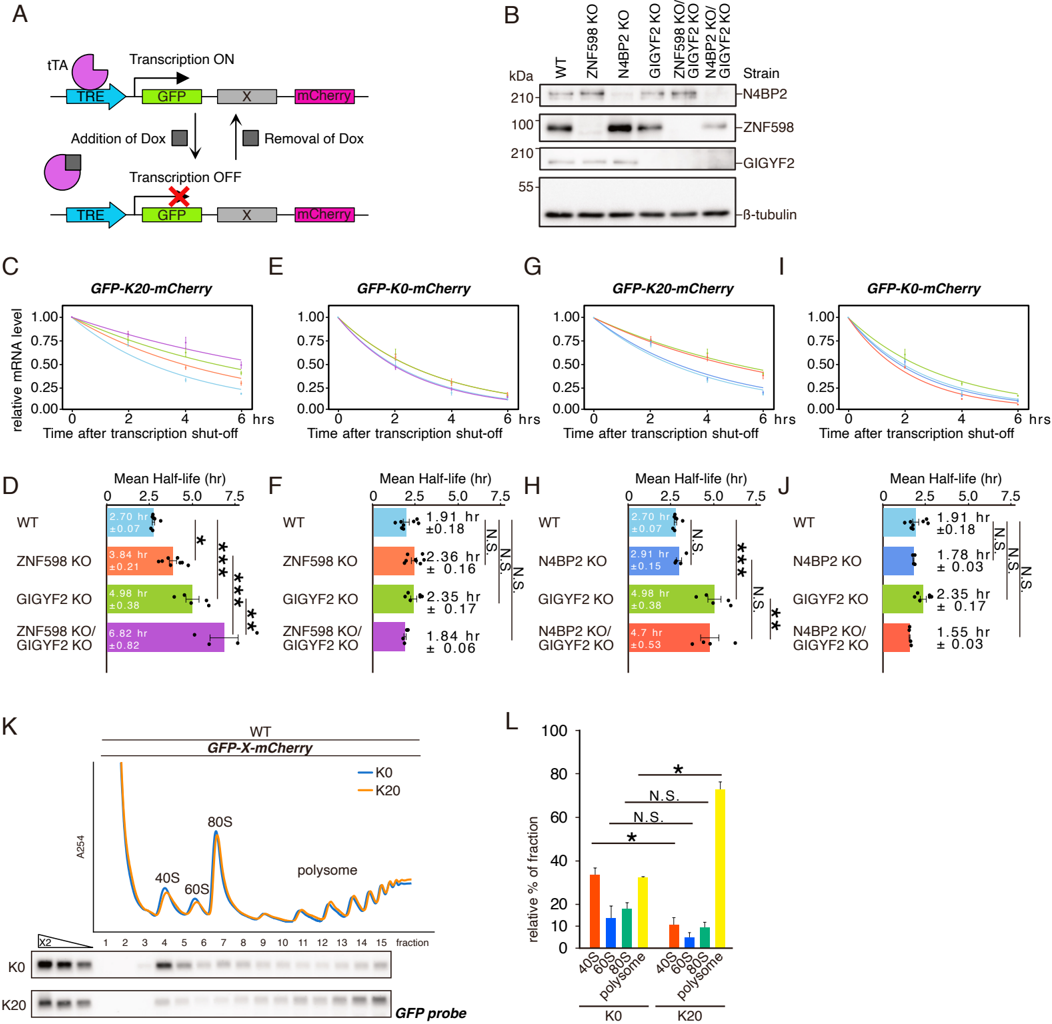
- Mammalian ZNF598 and GIGYF2 act redundantly: double knockout stabilized GFP-K20-mCherry to 6.82 ± 0.82 hr versus WT 2.70 ± 0.07 hr, with single knockouts showing modest effects; the non-stalling GFP-K0-mCherry reporter was unchanged. N4BP2 knockout alone had no effect, and N4BP2/GIGYF2 double knockout did not further stabilize the reporter compared with GIGYF2 single knockout (4.98 ± 0.38 hr vs 4.7 ± 0.53 hr).
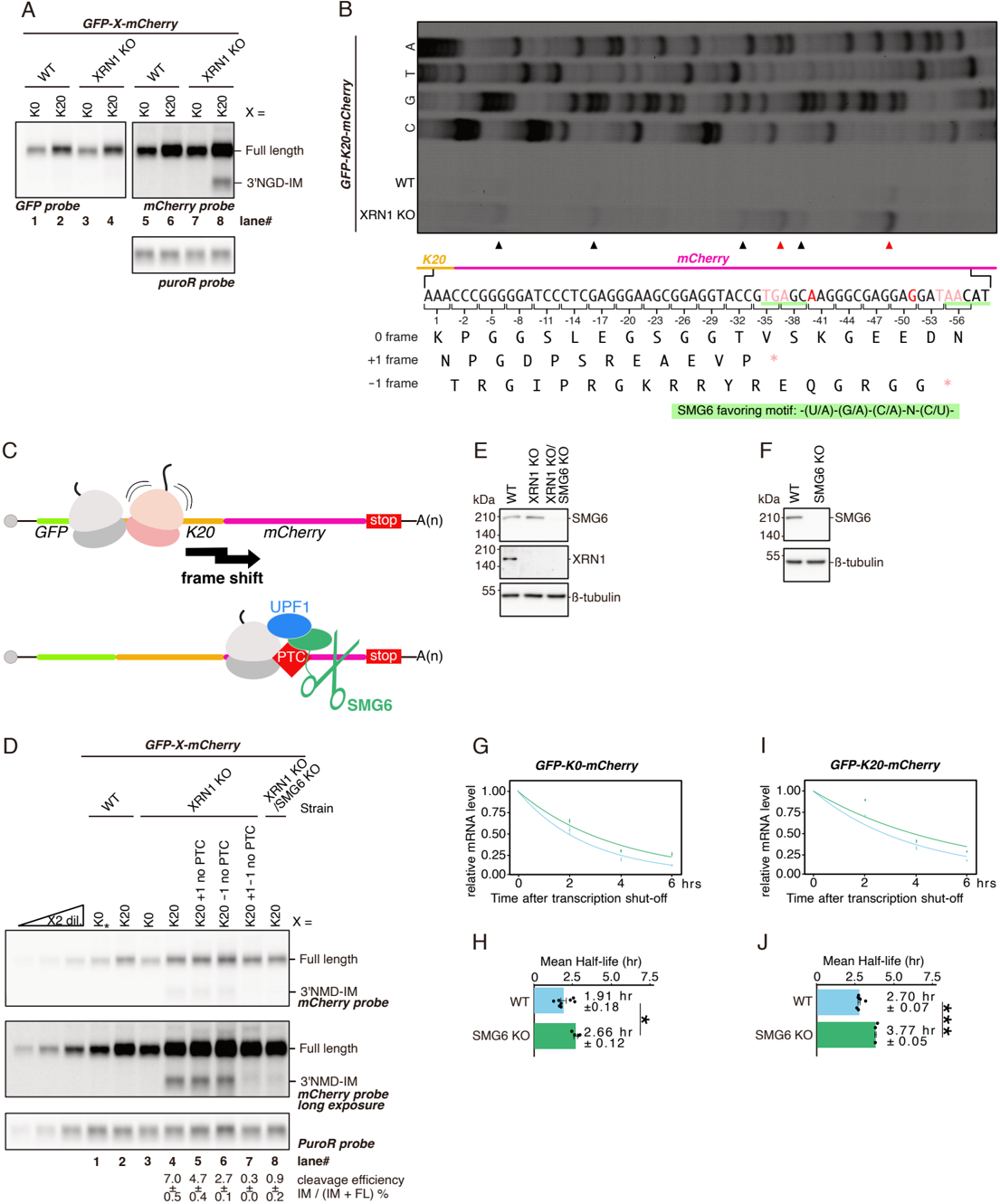
- In XRN1 knockout cells, the K20 reporter produced a 3′ cleavage intermediate not seen with K0; cleavage sites mapped downstream of K20 near PTCs in the +1/−1 frames, and SMG6 deletion abolished the intermediate. SMG6 loss modestly stabilized the K20 reporter, and the K20 reporter was more polysome-enriched than K0.
Methods
- Yeast: W303-1a and derivatives; GAL1 promoter glucose shutoff to measure reporter mRNA half-lives by northern blot; sucrose density gradient–western blotting for polysome association; n = 3–5.
- Mammalian: HEK293T cells; Tet-off doxycycline transcriptional shutoff; CRISPR knockout lines for ZNF598, N4BP2, GIGYF2, XRN1, and SMG6; RT-qPCR half-life measurements, sucrose density gradient–northern blotting, and primer extension; n = 3–8.
- Analysis: single-exponential decay fitting by nonlinear least squares, t₁/₂ = ln(2)/k; Benjamini-Hochberg or Student’s t-test; outliers removed by IQR.
Limitations
- Stated: N4BP2 is dispensable for NGD only under the conditions tested; the authors note possible context dependence, a distinct nuclease, or that cleavage may not be strictly required for mammalian NGD, and that collision geometry may influence endonuclease engagement.
- Stated: SMG6-mediated cleavage efficiency was relatively low, and SMG6 loss only modestly stabilized the K20 reporter; GIGYF2 is multifunctional and may crosstalk with NMD.
- Evident from the text: conclusions rely on artificial stall reporters (R12, K20) and specific yeast/mammalian cell lines; HEK293T cells were not authenticated, and knockout clones may carry clonal effects.
Model-written summary. Check it against the paper before relying on it.
Integrity signals
Registry
Cites
Statistics
Figures
Verification
Claims the paper makes
0 Valid · 0 Not valid · 14 Not checked · 63 Own results and interpretations
A result the paper reports from its own data — it cites no other source for it, so there is none to check. The quote shows it is in the paper.
In the paper
“Cue2 association with ribosomes was unaffected by deletion of SYH1-SMY2 (Fig. 2E)”
§ Parallel ZNF598 and GIGYF2 pathways mediate conserved collision-dependent mRNA decay with distinct endonucleolytic features > INTRODUCTION
plain- Asserted: passes — The authors put it forward as true.
- Checkable: passes — It can be checked against evidence.
- Load-bearing: passes — The paper’s conclusions depend on it.
- Based: passes — The paper gives a reason why it holds.
A result the paper reports from its own data — it cites no other source for it, so there is none to check. The quote shows it is in the paper.
In the paper
“Deletion of SMG6 completely abolished the 3′ NGD intermediate in XRN1/SMG6 double knockout cells (Fig. 4D, lane 8)”
§ Parallel ZNF598 and GIGYF2 pathways mediate conserved collision-dependent mRNA decay with distinct endonucleolytic features > Ribosome slippage on the K20 sequence induces SMG6-dependent endonucleolytic cleavage
plainstates a cause- Asserted: passes — The authors put it forward as true.
- Checkable: passes — It can be checked against evidence.
- Load-bearing: passes — The paper’s conclusions depend on it.
- Based: passes — The paper gives a reason why it holds.
- Rests on an assumption not shown here.
A result the paper reports from its own data — it cites no other source for it, so there is none to check. The quote shows it is in the paper.
In the paper
“In contrast, simultaneous deletion of CUE2 together with SYH1-SMY2 resulted in a pronounced increase in the half-life of the aberrant mRNA compared with either single deletion (Fig. 2A, B).”
§ Parallel ZNF598 and GIGYF2 pathways mediate conserved collision-dependent mRNA decay with distinct endonucleolytic features > Abstract
plainstates a cause- Asserted: passes — The authors put it forward as true.
- Checkable: passes — It can be checked against evidence.
- Load-bearing: passes — The paper’s conclusions depend on it.
- Based: passes — The paper gives a reason why it holds.
A result the paper reports from its own data — it cites no other source for it, so there is none to check. The quote shows it is in the paper.
In the paper
“Importantly, no significant changes in mRNA stability were observed for the non-stalling control reporter (GFP-K0-mCherry) in any genetic background (Fig. 3E, F).”
§ Parallel ZNF598 and GIGYF2 pathways mediate conserved collision-dependent mRNA decay with distinct endonucleolytic features > ZNF598 and GIGYF2 act redundantly in mammalian collision-dependent mRNA decay
plain- Asserted: passes — The authors put it forward as true.
- Checkable: passes — It can be checked against evidence.
- Load-bearing: passes — The paper’s conclusions depend on it.
- Based: passes — The paper gives a reason why it holds.
- Rests on an assumption not shown here.
A result the paper reports from its own data — it cites no other source for it, so there is none to check. The quote shows it is in the paper.
In the paper
“Loss of SMG6 led to a modest stabilization of the K20 reporter (Fig. 4H-K)”
§ Parallel ZNF598 and GIGYF2 pathways mediate conserved collision-dependent mRNA decay with distinct endonucleolytic features > Ribosome slippage on the K20 sequence induces SMG6-dependent endonucleolytic cleavage
plainstates a cause- Asserted: passes — The authors put it forward as true.
- Checkable: passes — It can be checked against evidence.
- Load-bearing: passes — The paper’s conclusions depend on it.
- Based: passes — The paper gives a reason why it holds.
46 more claims
Create a free account to see all 77 claims and to verify the 27 references still open.
- It may state two separate claims as one. 15
- The quote only partly states this claim. 1
- Probably not a substantial claim. 11
Self-check
Percentages, sums and reported differences re-computed from the paper’s own numbers.
Each contradiction between two passages listed here was confirmed by an independent check.
Rated minor: it would not touch a result — a value no result rests on, a p-value that stays on the same side of the significance level, or a conflict that is clerical, resolved elsewhere in the paper, or outside its own findings.
In the paper
§ Parallel ZNF598 and GIGYF2 pathways mediate conserved collision-dependent mRNA decay with distinct endonucleolytic features > DISCUSSION
“We observed that the K20 reporter exhibited a slightly longer half-life than the non-stalling reporter in mammalian cells (Fig. 2D and F).”
§ Parallel ZNF598 and GIGYF2 pathways mediate conserved collision-dependent mRNA decay with distinct endonucleolytic features > ZNF598 and GIGYF2 act redundantly in mammalian collision-dependent mRNA decay
“Interestingly, we observed that the collision-inducing GFP-K20-mCherry reporter exhibited a slightly longer half-life than the non-stalling GFP-K0-mCherry reporter (Fig3.D and F).”
Citations
Cites
Genome engineering using the CRISPR-Cas9 system
Ran, F. A., Hsu, P. D., Wright, J., Agarwala, V., Scott, D. A., & Zhang, F. (2013) · Nature Protocols · doi:10.1038/nprot.2013.143 · Cited by 11,133
Longtine, M. S., Mckenzie III, A., Demarini, D. J., Shah, N. G., Wach, A., Brachat, A., Philippsen, P., & Pringle, J. R. (1998) · Yeast · doi:10.1002/(sici)1097-0061(199807)14:10<953::aid-yea293>3.0.co;2-u · Cited by 5,345
Tight control of gene expression in mammalian cells by tetracycline-responsive promoters.
Gossen, M., & Bujard, H. (1992) · Proceedings of the National Academy of Sciences · doi:10.1073/pnas.89.12.5547 · Cited by 4,943 · cited 1×
“To investigate whether collision-dependent mRNA decay is conserved in mammalian cells, we employed a Tet-off transcriptional shutoff system to measure reporter mRNA stability (Gossen & Bujard, 1992).”
Janke, C., Magiera, M. M., Rathfelder, N., Taxis, C., Reber, S., Maekawa, H., Moreno‐Borchart, A., Doenges, G., Schwob, E., Schiebel, E., et al. (2004) · Yeast · doi:10.1002/yea.1142 · Cited by 2,119
CHOPCHOP v3: expanding the CRISPR web toolbox beyond genome editing
Labun, K., Montague, T. G., Krause, M., Torres Cleuren, Y. N., Tjeldnes, H., & Valen, E. (2019) · Nucleic Acids Research · doi:10.1093/nar/gkz365 · Cited by 2,054
Decapping and Decay of Messenger RNA Occur in Cytoplasmic Processing Bodies
Sheth, U., & Parker, R. (2003) · Science · doi:10.1126/science.1082320 · Cited by 1,365
Efficient transposition of the piggyBac (PB) transposon in mammalian cells and mice
Ding, S., Wu, X., Li, G., Han, M., Zhuang, Y., & Xu, T. (2005) · Cell · doi:10.1016/j.cell.2005.07.013 · Cited by 1,009 · cited 1×
“Half-life measurement by Tet-off system For half-life measurements, HEK293 cells stably expressing reporter were generated using the PiggyBac Transposon Vector System (Ding et al., 2005; A. Kim & Pyykko, 2011)(System Biosciences).”
Endonucleolytic cleavage of eukaryotic mRNAs with stalls in translation elongation
Doma, M. K., & Parker, R. (2006) · Nature · doi:10.1038/nature04530 · Cited by 760
Brandman, O., Stewart-Ornstein, J., Wong, D., Larson, A., Williams, C. C., Li, G.-W., Zhou, S., King, D., Shen, P. S., Weibezahn, J., et al. (2012) · Cell · doi:10.1016/j.cell.2012.10.044 · Cited by 646
Self-citationPredictable and precise template-free CRISPR editing of pathogenic variants
Shen, M. W., Arbab, M., Hsu, J. Y., Worstell, D., Culbertson, S. J., Krabbe, O., Cassa, C. A., Liu, D. R., Gifford, D. K., & Sherwood, R. I. (2018) · Nature · doi:10.1038/s41586-018-0686-x · Cited by 569 · cited 1×
“The gRNA sequence was designed using CHOPCHOP v3 (Labun et al., 2019) and inDelphi (Shen et al., 2018), genome sequence was analysed by CRISP-ID (Dehairs et al., 2016). pSpCas9(BB)-2A- Puro (PX459), a gift from Feng Zhang ( Addgene plasmid #62988 (Ran et al., 2013)) or SpCas9-HF1-plus, a gift from…”
ZNF598 Is a Quality Control Sensor of Collided Ribosomes
Juszkiewicz, S., Chandrasekaran, V., Lin, Z., Kraatz, S., Ramakrishnan, V., & Hegde, R. S. (2018) · Molecular Cell · doi:10.1016/j.molcel.2018.08.037 · Cited by 424
Transcriptional regulation in the yeast GAL gene family: a complex genetic network
Lohr, D., Venkov, P., & Zlatanova, J. (1995) · The FASEB Journal · doi:10.1096/fasebj.9.9.7601342 · Cited by 417
Sundaramoorthy, E., Leonard, M., Mak, R., Liao, J., Fulzele, A., & Bennett, E. J. (2017) · Molecular Cell · doi:10.1016/j.molcel.2016.12.026 · Cited by 372
SMG6 is the catalytic endonuclease that cleaves mRNAs containing nonsense codons in metazoan
Huntzinger, E., Kashima, I., Fauser, M., Saulière, J., & Izaurralde, E. (2008) · RNA · doi:10.1261/rna.1386208 · Cited by 343
Juszkiewicz, S., & Hegde, R. S. (2017) · Molecular Cell · doi:10.1016/j.molcel.2016.11.039 · Cited by 337
Ubiquitination of stalled ribosome triggers ribosome-associated quality control
Matsuo, Y., Ikeuchi, K., Saeki, Y., Iwasaki, S., Schmidt, C., Udagawa, T., Sato, F., Tsuchiya, H., Becker, T., Tanaka, K., et al. (2017) · Nature Communications · doi:10.1038/s41467-017-00188-1 · Cited by 317
Self-citationCollided ribosomes form a unique structural interface to induce Hel2-driven quality control pathways
Ikeuchi, K., Tesina, P., Matsuo, Y., Sugiyama, T., Cheng, J., Saeki, Y., Tanaka, K., Becker, T., Beckmann, R., & Inada, T. (2019) · The EMBO Journal · doi:10.15252/embj.2018100276 · Cited by 315
Self-citationHe, F., & Jacobson, A. (1995) · Genes & Development · doi:10.1101/gad.9.4.437 · Cited by 283
Chapter 17 Messenger RNA Half‐Life Measurements in Mammalian Cells
Chen, C. A., Ezzeddine, N., & Shyu, A. (2008) · Methods in Enzymology · doi:10.1016/s0076-6879(08)02617-7 · Cited by 256
Dimitrova, L. N., Kuroha, K., Tatematsu, T., & Inada, T. (2009) · Journal of Biological Chemistry · doi:10.1074/jbc.m808840200 · Cited by 252
Self-citationCRISP-ID: decoding CRISPR mediated indels by Sanger sequencing
Dehairs, J., Talebi, A., Cherifi, Y., & Swinnen, J. V. (2016) · Scientific Reports · doi:10.1038/srep28973 · Cited by 234
N1-methylpseudouridylation of mRNA causes +1 ribosomal frameshifting
Mulroney, T. E., Pöyry, T., Yam-Puc, J. C., Rust, M., Harvey, R. F., Kalmar, L., Horner, E., Booth, L., Ferreira, A. P., Stoneley, M., et al. (2024) · Nature · doi:10.1038/s41586-023-06800-3 · Cited by 219
The endonuclease Cue2 cleaves mRNAs at stalled ribosomes during No Go Decay
D'Orazio, K. N., Wu, C. C.-C., Sinha, N., Loll-Krippleber, R., Brown, G. W., & Green, R. (2019) · eLife · doi:10.7554/elife.49117 · Cited by 207
A Novel 4EHP-GIGYF2 Translational Repressor Complex Is Essential for Mammalian Development
Morita, M., Ler, L. W., Fabian, M. R., Siddiqui, N., Mullin, M., Henderson, V. C., Alain, T., Fonseca, B. D., Karashchuk, G., Bennett, C. F., et al. (2012) · Molecular and Cellular Biology · doi:10.1128/mcb.00455-12 · Cited by 198
Inada, T., & Aiba, H. (2005) · The EMBO Journal · doi:10.1038/sj.emboj.7600636 · Cited by 177
Self-citationReceptor for activated C kinase 1 stimulates nascent polypeptide‐dependent translation arrest
Kuroha, K., Akamatsu, M., Dimitrova, L., Ito, T., Kato, Y., Shirahige, K., & Inada, T. (2010) · EMBO reports · doi:10.1038/embor.2010.169 · Cited by 177
Self-citationMechanism of ribosome stalling during translation of a poly(A) tail
Chandrasekaran, V., Juszkiewicz, S., Choi, J., Puglisi, J. D., Brown, A., Shao, S., Ramakrishnan, V., & Hegde, R. S. (2019) · Nature Structural & Molecular Biology · doi:10.1038/s41594-019-0331-x · Cited by 173
Formation, function, and pathology of RNP granules
Ripin, N., & Parker, R. (2023) · Cell · doi:10.1016/j.cell.2023.09.006 · Cited by 172
Ribosome collisions trigger cis-acting feedback inhibition of translation initiation
Juszkiewicz, S., Slodkowicz, G., Lin, Z., Freire-Pritchett, P., Peak-Chew, S.-Y., & Hegde, R. S. (2020) · eLife · doi:10.7554/elife.60038 · Cited by 171
Molecular mechanism of translational stalling by inhibitory codon combinations and poly(A) tracts
Tesina, P., Lessen, L. N., Buschauer, R., Cheng, J., Wu, C. C., Berninghausen, O., Buskirk, A. R., Becker, T., Beckmann, R., & Green, R. (2020) · The EMBO Journal · doi:10.15252/embj.2019103365 · Cited by 166
Nichol, S. T., Arikawa, J., & Kawaoka, Y. (2000) · Proceedings of the National Academy of Sciences · doi:10.1073/pnas.210382297 · Cited by 160
Hickey, K. L., Dickson, K., Cogan, J. Z., Replogle, J. M., Schoof, M., D’Orazio, K. N., Sinha, N. K., Hussmann, J. A., Jost, M., Frost, A., et al. (2020) · Molecular Cell · doi:10.1016/j.molcel.2020.07.007 · Cited by 159
RQT complex dissociates ribosomes collided on endogenous RQC substrate SDD1
Matsuo, Y., Tesina, P., Nakajima, S., Mizuno, M., Endo, A., Buschauer, R., Cheng, J., Shounai, O., Ikeuchi, K., Saeki, Y., et al. (2020) · Nature Structural & Molecular Biology · doi:10.1038/s41594-020-0393-9 · Cited by 150 · cited 6×
“As previously reported, ribosome slippage on the K(AAA) 20 sequence induces frequent frameshifting (Arthur et al., 2015; Chandrasekaran et al., 2019; Hashimoto et al., 2020; Juszkiewicz & Hegde, 2017; Koutmou et al., 2015; Tesina et al., 2020), generating PTCs in alternative reading frames.”
InfluentialSelf-citationRibosomes slide on lysine-encoding homopolymeric A stretches
Koutmou, K. S., Schuller, A. P., Brunelle, J. L., Radhakrishnan, A., Djuranović, S., & Green, R. (2015) · eLife · doi:10.7554/elife.05534 · Cited by 148
Ribosome collisions induce mRNA cleavage and ribosome rescue in bacteria
Saito, K., Kratzat, H., Campbell, A., Buschauer, R., Burroughs, A. M., Berninghausen, O., Aravind, L., Green, R., Beckmann, R., & Buskirk, A. R. (2022) · Nature · doi:10.1038/s41586-022-04416-7 · Cited by 140
Translational control by lysine-encoding A-rich sequences
Arthur, L. L., Pavlovic-Djuranovic, S., Koutmou, K. S., Green, R., Szczesny, P., & Djuranovic, S. (2015) · Science Advances · doi:10.1126/sciadv.1500154 · Cited by 118
Schmidt, S. A., Foley, P. L., Jeong, D.-H., Rymarquis, L. A., Doyle, F., Tenenbaum, S. A., Belasco, J. G., & Green, P. J. (2015) · Nucleic Acids Research · doi:10.1093/nar/gku1258 · Cited by 113
El Fatimy, R., Davidovic, L., Tremblay, S., Jaglin, X., Dury, A., Robert, C., De Koninck, P., & Khandjian, E. W. (2016) · PLOS Genetics · doi:10.1371/journal.pgen.1006192 · Cited by 107
Yano, K.-I., & Fukasawa, T. (1997) · Proceedings of the National Academy of Sciences · doi:10.1073/pnas.94.5.1721 · Cited by 102
Hashimoto, S., Sugiyama, T., Yamazaki, R., Nobuta, R., & Inada, T. (2020) · Scientific Reports · doi:10.1038/s41598-020-60241-w · Cited by 102
Self-citationNarita, M., Denk, T., Matsuo, Y., Sugiyama, T., Kikuguchi, C., Ito, S., Sato, N., Suzuki, T., Hashimoto, S., Machová, I., et al. (2022) · Nature Communications · doi:10.1038/s41467-022-34097-9 · Cited by 97
Self-citationNONU-1 Encodes a Conserved Endonuclease Required for mRNA Translation Surveillance
Glover, M. L., Burroughs, A. M., Monem, P. C., Egelhofer, T. A., Pule, M. N., Aravind, L., & Arribere, J. A. (2020) · Cell Reports · doi:10.1016/j.celrep.2020.03.023 · Cited by 85
Size matters: versatile use of PiggyBac transposons as a genetic manipulation tool
Kim, A., & Pyykkö, I. V. (2011) · Molecular and Cellular Biochemistry · doi:10.1007/s11010-011-0832-3 · Cited by 80
Structural basis for clearing of ribosome collisions by the RQT complex
Best, K., Ikeuchi, K., Kater, L., Best, D., Musial, J., Matsuo, Y., Berninghausen, O., Becker, T., Inada, T., & Beckmann, R. (2023) · Nature Communications · doi:10.1038/s41467-023-36230-8 · Cited by 74
Self-citationSaito, K., Horikawa, W., & Ito, K. (2015) · PLOS Genetics · doi:10.1371/journal.pgen.1005197 · Cited by 74
Live-cell imaging reveals kinetic determinants of quality control triggered by ribosome stalling
Goldman, D. H., Livingston, N. M., Movsik, J., Wu, B., & Green, R. (2021) · Molecular Cell · doi:10.1016/j.molcel.2021.01.029 · Cited by 72
4EHP and GIGYF1/2 mediate translation-coupled messenger RNA decay
Weber, R., Chung, M.-Y., Keskeny, C., Zinnall, U., Landthaler, M., Valkov, E., Izaurralde, E., & Igreja, C. (2020) · Cell Reports · doi:10.1016/j.celrep.2020.108262 · Cited by 70
Bicknell, A. A., Reid, D. W., Licata, M. C., Jones, A. K., Cheng, Y. M., Li, M., Hsiao, C. J., Pepin, C. S., Metkar, M., Levdansky, Y., et al. (2024) · Cell Reports · doi:10.1016/j.celrep.2024.114098 · Cited by 68 · cited 2×
“…density of stalled ribosomes on a mRNA has been proposed to protect transcripts from decay by increasing ribosome occupancy and thereby shielding the mRNA from decay factors (Bicknell et al., 2024; Dilrangi et al., 2025; El Fatimy et al., 2016; Ripin & Parker, 2022, 2023; Sheth & Parker, 2003).”
Distinct elongation stalls during translation are linked with distinct pathways for mRNA degradation
Veltri, A. J., D'Orazio, K. N., Lessen, L. N., Loll-Krippleber, R., Brown, G. W., & Green, R. (2022) · eLife · doi:10.7554/elife.76038 · Cited by 59
Are stress granules the RNA analogs of misfolded protein aggregates?
Ripin, N., & Parker, R. (2021) · RNA · doi:10.1261/rna.079000.121 · Cited by 58
ZNF598 Plays Distinct Roles in Interferon-Stimulated Gene Expression and Poxvirus Protein Synthesis
DiGiuseppe, S., Rollins, M. G., Bartom, E. T., & Walsh, D. (2018) · Cell Reports · doi:10.1016/j.celrep.2018.03.132 · Cited by 51
Kulcsár, P. I., Tálas, A., Tóth, E., Nyeste, A., Ligeti, Z., Welker, Z., & Welker, E. (2020) · Nature Communications · doi:10.1038/s41467-020-15021-5 · Cited by 45 · cited 1×
“…al., 2018), genome sequence was analysed by CRISP-ID (Dehairs et al., 2016). pSpCas9(BB)-2A- Puro (PX459), a gift from Feng Zhang ( Addgene plasmid #62988 (Ran et al., 2013)) or SpCas9-HF1-plus, a gift from Feng Welker E (Addgene plasmid #126768 (Kulcsár et al., 2020)) were used for genome editing.”
ZAK activation at the collided ribosome
Huso, V. L., Niu, S., Catipovic, M. A., Saba, J. A., Denk, T., Park, E., Cheng, J., Berninghausen, O., Becker, T. A., Green, R., et al. (2025) · Nature · doi:10.1038/s41586-025-09772-8 · Cited by 44
Wang, G., Kouwaki, T., Okamoto, M., & Oshiumi, H. (2019) · Cell Reports · doi:10.1016/j.celrep.2019.07.081 · Cited by 44
Translational repression of NMD targets by GIGYF2 and EIF4E2
Zinshteyn, B., Sinha, N. K., Enam, S. U., Koleske, B. N., & Green, R. (2021) · PLoS Genetics · doi:10.1371/journal.pgen.1009813 · Cited by 42
Decoding of the ubiquitin code for clearance of colliding ribosomes by the RQT complex
Matsuo, Y., Uchihashi, T., & Inada, T. (2023) · Nature Communications · doi:10.1038/s41467-022-35608-4 · Cited by 41
Self-citationmRNA Vaccines: Current Applications and Future Directions
Li, J., Liu, Y., Dai, J., Li, Y., Xiong, F., Xia, J., Jin, J., Wu, Y., & Peng, X. (2025) · MedComm · doi:10.1002/mco2.70434 · Cited by 40
Ash, M.-R., Faelber, K., Kosslick, D., Albert, G. I., Roske, Y., Kofler, M., Schuemann, M., Krause, E., & Freund, C. (2010) · Structure · doi:10.1016/j.str.2010.04.020 · Cited by 40
The ribosome as a platform to coordinate mRNA decay
Müller, M. B. D., Becker, T., Denk, T., Hashimoto, S., Inada, T., & Beckmann, R. (2025) · Nucleic Acids Research · doi:10.1093/nar/gkaf049 · Cited by 38
Self-citationChapter 14 Methods to Determine mRNA Half‐Life in Saccharomyces cerevisiae
Coller, J. (2008) · Methods in enzymology on CD-ROM/Methods in enzymology · doi:10.1016/s0076-6879(08)02614-1 · Cited by 38
Fukao, A., Tomohiro, T., & Fujiwara, T. (2021) · Cells · doi:10.3390/cells10071711 · Cited by 36
Two modes of Cue2-mediated mRNA cleavage with distinct substrate recognition initiate no-go decay
Tomomatsu, S., Watanabe, A., Tesina, P., Hashimoto, S., Ikeuchi, K., Li, S., Matsuo, Y., Beckmann, R., & Inada, T. (2023) · Nucleic Acids Research · doi:10.1093/nar/gkac1172 · Cited by 35
Self-citationB. subtilis MutS2 splits stalled ribosomes into subunits without mRNA cleavage
Park, E. N., Mackens-Kiani, T., Berhane, R., Esser, H., Erdenebat, C., Burroughs, A. M., Berninghausen, O., Aravind, L., Beckmann, R., Green, R., et al. (2023) · The EMBO Journal · doi:10.1038/s44318-023-00010-3 · Cited by 29
Raustad, N., Dai, Y., Iinishi, A., Mohapatra, A., Soo, M. W., Hay, E., Hernandez, G. M., & Geisinger, E. (2025) · Nucleic Acids Research · doi:10.1093/nar/gkaf063 · Cited by 19
Ishibashi, K., Shichino, Y., Han, P., Wakabayashi, K., Mito, M., Inada, T., Kimura, S., Iwasaki, S., & Mishima, Y. (2024) · PLoS Biology · doi:10.1371/journal.pbio.3002887 · Cited by 14
Self-citationLi, S., Shounai, O., Kato, M., Ikeuchi, K., & Inada, T. (2025) · Nature Communications · doi:10.1038/s41467-025-66026-x · Cited by 11
Self-citationSARS-CoV-2 Nsp2 recruits GIGYF2 near viral replication sites and supports viral protein production
Kim, J., Park, Y., Yoon, D., Lee, S., Kim, H., Ban, K.-Y., Yang, J., Choi, D.-E., Kim, J., Kim, J.-S., et al. (2025) · Nucleic Acids Research · doi:10.1093/nar/gkaf674 · Cited by 8
Human CCR4 deadenylase homolog Angel1 is a non-stop mRNA decay factor
Shaw, T., Dowdle, M. E., Ajaj, Y., Perelis, M., Fulzele, A., Yeo, G. W.-M., Bennett, E. J., & Lykke‐Andersen, J. (2025) · RNA · doi:10.1261/rna.080399.125 · Cited by 5
Dilrangi, K. H., Aretakis, J. R., Vaidya, K., Al-Husini, N., Muthunayake, N. S., Kim, S., & Schrader, J. M. (2025) · Cell Reports · doi:10.1016/j.celrep.2025.116691 · Cited by 4
Zhao, C.-S., Liu, S., Li, Z., Chen, J.-Y., & Xiong, X. (2025) · Cells · doi:10.3390/cells14131032 · Cited by 3
Crosstalk between the ribosome quality control‐associated E3 ubiquitin ligases LTN1 and RNF10
Huang, Y., Hashimoto, S., Ito, S., Kikuguchi, C., Hoshi, M., Yamaguchi, K., Furukawa, Y., Suzuki, T., & Inada, T. (2026) · FEBS Letters · doi:10.1002/1873-3468.70230 · Cited by 2
Self-citation
Cited by
Wanted and unwanted modifications of mRNA and their effect on gene expression and signaling
Urs, A. N. N., Dali, A., & Zaher, H. S. (2026) · Journal of Biological Chemistry · doi:10.1016/j.jbc.2026.113314
Metadata
- Authors
- Hashimoto, S., Sauerland, J., Zeng, J., Kikuguchi, C., & Inada, T.
- Affiliations
- Institute of Medical Science, The University of Tokyo (JP)
- Venue
- Communications Biology
- Published
- 2026-11-20
- ISSN
- 2399-3642 (ISSN-L)
- OpenAlex
- W7117984279
- Cited by
- 1
- References
- 69
- Citations by year
- 2026: 1
- FWCI
- 1.10
- Type
- journal article
- Language
- en
- Open access
- gold
- doi.org
- Licence
- cc-by-nc-nd
- creativecommons.org/licenses/by-nc-nd/4.0 (tdm)
- creativecommons.org/licenses/by-nc-nd/4.0 (am)
- Locations
- Communications Biology (publishedVersion, cc-by-nc-nd)
- bioRxiv (Cold Spring Harbor Laboratory) (submittedVersion, cc-by-nc)
- Funders
- MEXT | Japan Society for the Promotion of Science (22H0040, 25H000071, 25K18399)
- Japan Agency for Medical Research and Development (JP23gm1110010, JP223fa627001)
- Takeda Science Foundation
- Mitsubishi Foundation
- Topics
- Life Sciences › Biochemistry, Genetics and Molecular Biology › Molecular Biology › RNA Research and Splicing
- Life Sciences › Biochemistry, Genetics and Molecular Biology › Molecular Biology › RNA and protein synthesis mechanisms
- Life Sciences › Biochemistry, Genetics and Molecular Biology › Molecular Biology › RNA regulation and disease
- Keywords
- ribosome collisions, mRNA degradation, mRNA surveillance, ZNF598, GIGYF2, endonucleolytic cleavage, mRNA quality control, translational quality control, yeast, mammalian cells
About these checks
Registry, retraction, Cites and statistics results are computed, not judged, with one exception: a printed reference that no index lists is read once by a model before it counts as a citation error. Claims are extracted by a model and kept only when their quote appears verbatim in the text; each cited source is then checked, with a model’s help, for whether it says what the claim relies on. Those verdicts can be wrong — read the claim’s quote and the cited source before relying on one.
A language model drew the claims from the paper on 2026-11-22, under version 3 of the claim definition (model deepseek-v4.1-flash, prompt extract-v3).
A second model labelled each claim on 2026-11-22 (model jev-1.13-20260917, definition revision gold-guideline-v0.2).
Statistics and arithmetic are recomputed, not judged.
Confidence bands are shown only for fields calibrated on our annotated test set. None is calibrated yet, so no band is shown.
What counts as a claim ›How we measure confidence ›How we check this ›
Are you an author, or do you see a problem with this page? Request a review
Data sources
Bibliographic data: Semantic Scholar, OpenAlex, Crossref.
Contains information from the Semantic Scholar Academic Graph Datasets, made available under the ODC Attribution License (ODC-BY 1.0).
Semantic Scholar’s data is described in: Kinney, R., et al. (2023). The Semantic Scholar Open Data Platform. arXiv:2301.10140.
