

Variational quantum algorithms
Open accessThe DOI matches its Crossref record; 333 of the 334 references it cites were found in a registry or an index, and 1 are not checked yet; 179 of the 264 sources its claims cite were checked for support.
Abstract
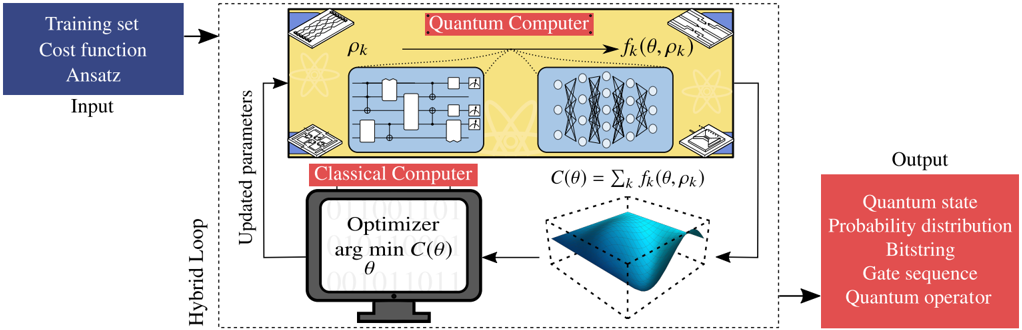
Applications such as simulating complicated quantum systems or solving large-scale linear algebra problems are very challenging for classical computers, owing to the extremely high computational cost. Quantum computers promise a solution, although fault-tolerant quantum computers will probably not be available in the near future. Current quantum devices have serious constraints, including limited numbers of qubits and noise processes that limit circuit depth. Variational quantum algorithms (VQAs), which use a classical optimizer to train a parameterized quantum circuit, have emerged as a leading strategy to address these constraints. VQAs have now been proposed for essentially all applications that researchers have envisaged for quantum computers, and they appear to be the best hope for obtaining quantum advantage. Nevertheless, challenges remain, including the trainability, accuracy and efficiency of VQAs. Here we overview the field of VQAs, discuss strategies to overcome their challenges and highlight the exciting prospects for using them to obtain quantum advantage. The advent of commercial quantum devices has ushered in the era of near-term quantum computing. Variational quantum algorithms are promising candidates to make use of these devices for achieving a practical quantum advantage over classical computers. Variational quantum algorithms (VQAs) are the leading proposal for achieving quantum advantage using near-term quantum computers. VQAs have been developed for a wide range of applications, including finding ground states of molecules, simulating dynamics of quantum systems and solving linear systems of equations. VQAs share a common structure, where a task is encoded into a parameterized cost function that is evaluated using a quantum computer, and a classical optimizer trains the parameters in the VQA. The adaptive nature of VQAs is well suited to handle the constraints of near-term quantum computers. Trainability, accuracy and efficiency are three challenges that arise when applying VQAs to large-scale applications, and strategies are currently being developed to address these challenges. Variational quantum algorithms (VQAs) are the leading proposal for achieving quantum advantage using near-term quantum computers. VQAs have been developed for a wide range of applications, including finding ground states of molecules, simulating dynamics of quantum systems and solving linear systems of equations. VQAs share a common structure, where a task is encoded into a parameterized cost function that is evaluated using a quantum computer, and a classical optimizer trains the parameters in the VQA. The adaptive nature of VQAs is well suited to handle the constraints of near-term quantum computers. Trainability, accuracy and efficiency are three challenges that arise when applying VQAs to large-scale applications, and strategies are currently being developed to address these challenges.
Verified 2026-11-25 · 1 reference not checked yet
Overview
CoChat Summary
TL;DR
Variational quantum algorithms (VQAs) train parametrized quantum circuits with a classical optimizer and are presented as the leading strategy for obtaining quantum advantage on noisy intermediate-scale quantum (NISQ) devices. The review surveys VQA components, applications, challenges, and prospects, emphasizing that trainability, accuracy, and efficiency remain central obstacles.
Key findings
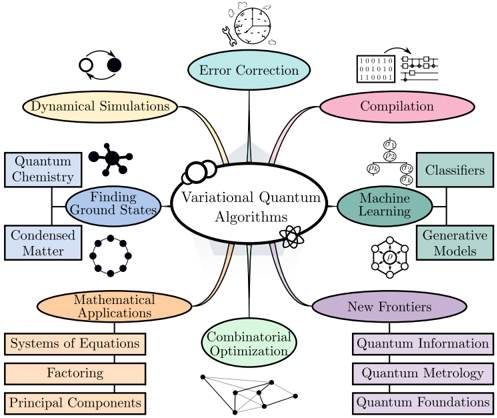
- VQAs have been proposed for essentially all applications envisioned for quantum computers, including finding ground and excited states, dynamical quantum simulation, combinatorial optimization, linear systems, compiling, error correction, machine learning, and metrology.
- Current state-of-the-art device size ranges from 50 to 100 qubits, and VQAs are argued to be the best hope for near-term quantum advantage because they keep circuit depth shallow and outsource parameter optimization to classical optimizers.
- Trainability is threatened by barren plateaus, where cost-function partial derivatives vanish exponentially with system size on average; noise can also induce barren plateaus regardless of the ansatz.
- Resource and scaling examples reported include: VQE requires \(O(1/\epsilon^2)\) measurements for precision \(\epsilon\), whereas quantum phase estimation requires \(O(\log(1/\epsilon))\); chemical Hamiltonians have Pauli-string counts scaling as \(n^4\), with commuting groupings reducing measurement scaling to \(n^3\); classical shadows scale logarithmically with \(n\); and a variational quantum linear solver study used \(n=10,\ldots,30\) qubits for Ising-inspired systems and \(n=2,\ldots,7\) qubits for random sparse linear systems.
Methods
- Design: narrative review/overview of the VQA field, not a primary experimental or theoretical study.
- Data or sample: no primary data or sample; the paper synthesizes prior literature and cites numerical and experimental results from other works.
- Main analysis: conceptual description of VQA architecture (cost function, ansatz, gradients, optimizers), applications, challenges, and opportunities for near-term quantum advantage.
Limitations
- The paper states that challenges remain including the trainability, accuracy, and efficiency of VQAs, and that barren plateaus could erase a potential quantum advantage.
- The paper states that the degree to which error mitigation can correct noise effects is still an open question, and that measurement efficiency is not guaranteed even without barren plateaus.
- Evident from the text: as a review, it presents no new experimental results, and many performance claims rely on cited heuristic or numerical studies rather than a systematic meta-analysis.
Model-written summary. Check it against the paper before relying on it.
Integrity signals
Registry
Cites
Statistics
Figures
Verification
Claims the paper makes
53 Valid · 74 Not valid · 51 Not checked · 84 Own results and interpretations
At least one cited source doesn’t support this claim or points to a different paper, and none confirmed it — see the verdicts below.
In the paper
“Hence, a VQA for factoring as a potential near-term alternative was introduced in Ref. [145].”
What the sources say
- Disputedcites [145] [145] Eric Anschuetz, Jonathan Olson, Alán Aspuru-Guzik, and Yudong Cao, 'Variational quantum factoring,' in International Workshop on Quantum Technology and Optimization Problems (Springer, 2019) pp. 74-85. - sourceExperimental — accuracy not yet measured
The Introduction says factoring is typically a longer-term application because of its high resource requirements, while identifying other applications as nearer term. The paper introduces variational quantum state diagonalization, not a variational algorithm for factoring. (LLM, conf=0.88)
Checked by a reasoning model — may be wrong.
plain- Asserted: passes — The authors put it forward as true.
- Checkable: passes — It can be checked against evidence.
- Load-bearing: unclear — It is unclear whether the paper’s conclusions depend on it.
- Based: passes — The paper gives a reason why it holds.
- Disputed
At least one cited source doesn’t support this claim or points to a different paper, and none confirmed it — see the verdicts below.
In the paper
“This qubit requirement can be reduced with the VQA of Ref. [113], which requires only n qubits.”
What the sources say
- Disputedcites [113] [113] M. Cerezo, Kunal Sharma, Andrew Arrasmith, and Patrick J Coles, 'Variational quantum state eigensolver,' arXiv preprint arXiv:2004.01372 (2020). - sourceExperimental — accuracy not yet measured
Section II B (p. 3) describes an (n+1)-qubit controlled sign flip in the proposed algorithm and says its cited implementation requires additional ancillas. That contradicts the claim that this VQA requires only n qubits; the paper discusses reductions in measurements and circuit depth, not a reduction to n qubits. (LLM, conf=0.84)
Checked by a reasoning model — may be wrong.
plainstates a cause- Asserted: passes — The authors put it forward as true.
- Checkable: passes — It can be checked against evidence.
- Load-bearing: unclear — It is unclear whether the paper’s conclusions depend on it.
- Based: passes — The paper gives a reason why it holds.
- Disputed
The cited sources that could be checked couldn’t confirm or dispute this claim.
In the paper
“The classical optimization problems associated with VQAs are expected to be NP-hard in general as they involve cost functions that can have many local minima [94].”
What the sources say
- Could not verifycites [94] [94] Lennart Bittel and Martin Kliesch, 'Training variational quantum algorithms is np-hard-even for logarithmically many qubits and free fermionic systems,' arXiv preprint arXiv:2101.07267 (2021). - sourceExperimental — accuracy not yet measured
The Introduction (p. 1) describes hybrid quantum-classical cost functions and the need for gradients, but does not address the complexity of optimizing them. Searches for “NP-hard,” “local minima,” and related terms found no passage saying that VQA optimization is generally NP-hard or attributing that difficulty to many local minima. (LLM, conf=0.74)
hedgedstates a cause- Asserted: passes — The authors put it forward as true.
- Checkable: passes — It can be checked against evidence.
- Load-bearing: unclear — It is unclear whether the paper’s conclusions depend on it.
- Based: passes — The paper gives a reason why it holds.
- Could not verify
The cited sources that could be checked couldn’t confirm or dispute this claim.
In the paper
“Numerical simulations showed that QVECTOR can find quantum codes that outperform existing ones [152].”
What the sources say
- Could not verifycites [152] [152] Peter D Johnson, Jonathan Romero, Jonathan Olson, Yudong Cao, and Alán Aspuru-Guzik, 'Qvector: an algorithm for device-tailored quantum error correction,' arXiv preprint arXiv:1711.02249 (2017). - sourceExperimental — accuracy not yet measured
The closest discussion in our copy, “Designing and controlling quantum systems” (p. 12), concerns machine-learning methods for improving quantum gates, not finding quantum codes. Searches for QVECTOR and for simulations of codes outperforming existing ones found no passage addressing the claim. (LLM, conf=0.76)
plainstates a cause- Asserted: passes — The authors put it forward as true.
- Checkable: passes — It can be checked against evidence.
- Load-bearing: passes — The paper’s conclusions depend on it.
- Based: passes — The paper gives a reason why it holds.
- Could not verify
The cited sources that could be checked couldn’t confirm or dispute this claim.
In the paper
“The importance of parameter initialization was made clear in Ref. [204] where it was noted that the optimal parameters in QAOA exhibit persistent patterns.”
What the sources say
- Could not verifycites [204] [204] Leo Zhou, Sheng-Tao Wang, Soonwon Choi, Hannes Pichler, and Mikhail D Lukin, 'Quantum approximate optimization algorithm: Performance, mechanism, and implementation on near-term devices,' Physical Review X 10 , 021067 (2020). - sourceExperimental — accuracy not yet measured
Appendix C (page unavailable) studies QAOA with parameters constrained to be equal across layers and describes that approach as suboptimal for the ring-of-disagrees problem. The Introduction and Conclusions discuss parameter correlation and trainability, but the passages found do not say that optimal QAOA parameters exhibit persistent patterns (searched: optimal parameters, QAOA patterns, initialization). (LLM, conf=0.76)
boosted- Asserted: passes — The authors put it forward as true.
- Checkable: passes — It can be checked against evidence.
- Load-bearing: passes — The paper’s conclusions depend on it.
- Based: passes — The paper gives a reason why it holds.
- Could not verify
125 more claims · 57 with their cited sources checked
Create a free account to see all 262 claims and to verify the 42 references still open.
- Probably not a substantial claim. 94
- It may state two separate claims as one. 57
Claims other papers make about this one
Each is checked against this paper’s own text: does it say what the citing paper says it does?
The source backs part of the claim, not all of it — or backs it for a different population, condition or comparison.
In the citing paper
“Google's recent proof of quantum supremacy is a major step forward for quantum computing [15].”
From Quantum Computing: Vision and Challenges (2025) · cites this paper as [15]
Experimental — accuracy not yet measuredThe cited source says what the claim attributes to it.
In the citing paper
“An important class of algorithms for NISQ hardware are socalled hybrid quantum-classical algorithms that partition the computational workload between a classical and a quantum computer.[124,125]”
From Quantum Computing for Molecular Biology** (2023) · cites this paper as [125]
The cited source says what the claim attributes to it.
In the citing paper
“In this regard, References [164] and [171] focus on gate-based algorithms that can be implemented on NISQ devices and therefore may be applied to various application areas with CO just as one example of those.”
From Quantum Combinatorial Optimization in the NISQ Era: A Systematic Mapping Study (2024) · cites this paper as [171]
Self-check
Percentages, sums and reported differences re-computed from the paper’s own numbers.
Each contradiction between two passages listed here was confirmed by an independent check.
Rated minor: it would not touch a result — a value no result rests on, a p-value that stays on the same side of the significance level, or a conflict that is clerical, resolved elsewhere in the paper, or outside its own findings.
In the paper
§ E. Error correction · p. 12
“two parametrized circuits V ( θ 1 ) (on n ≥ k qubits) and W ( θ 2 ) (on n + r qubits)”
§ E. Error correction · p. 12
“ρ out = W ( θ 1 ) V ( θ 1 )( ψ ⊗ | 0 〉〈 0 | ⊗ n -k + r ) V ( θ 1 ) † W ( θ 1 ) †”
Rated minor: it would not touch a result — a value no result rests on, a p-value that stays on the same side of the significance level, or a conflict that is clerical, resolved elsewhere in the paper, or outside its own findings.
In the paper
§ 1. Linear systems · p. 11
“the task is to prepare a normalized state | x 〉 such that A | x 〉 ∝ | b 〉”
§ 1. Linear systems · p. 11
“one can then construct a Hamiltonian whose ground state is the solution to the QLSP and apply a variational approach to minimize the cost C ( θ ) = 〈 ψ ( θ ) | H G | ψ ( ψ ) 〉 . Refs. [139-141] considered the Hamiltonian H G = A ( ✶ -| b 〉 〈 b | ) A †”
Citations
Cites
Adam: A Method for Stochastic Optimization
Kingma, D. P., & Ba, J. (2014) · arXiv · doi:10.48550/arxiv.1412.6980 · Cited by 98,946
Self-Consistent Equations Including Exchange and Correlation Effects
Kohn, W., & Sham, L. J. (1965) · Physical Review · doi:10.1103/physrev.140.a1133 · Cited by 64,135 · cited 1×
“Classical methods for materials simulations usually employ density-functional theory coupled with approximation methods, such as the local density approximation [234] to tackle weakly correlated materials.”
MethodQuantum Computing in the NISQ era and beyond
Preskill, J. (2018) · Quantum · doi:10.22331/q-2018-08-06-79 · Cited by 8,830 · cited 1×
“But excitement grew as to what could be done with these new devices, which have been called Noisy Intermediate-Scale Quantum (NISQ) computers [7].”
BackgroundAlgorithms for quantum computation: discrete logarithms and factoring
Shor, P. W. (2002) · Proceedings 35th Annual Symposium on Foundations of Computer Science · doi:10.1109/sfcs.1994.365700 · Cited by 8,713 · cited 1×
“Shor’s quantum algorithm was proposed to factor numbers with exponential speedup over classical methods [2], dynamical quantum simulation algorithms were developed [3], and quantum algorithms for solving linear systems of equations were identified [4].”
MethodQuantum Computation and Quantum Information: 10th Anniversary Edition
Nielsen, M. A., & Chuang, I. L. (2012) · doi:10.1017/cbo9780511976667 · Cited by 8,436
Quantum supremacy using a programmable superconducting processor
Arute, F., Arya, K., Babbush, R., Bacon, D., Bardin, J. C., Barends, R., Biswas, R., Boixo, S., Brandao, F. G. S. L., Buell, D. A., et al. (2019) · Nature · doi:10.1038/s41586-019-1666-5 · Cited by 7,720 · cited 1×
“This size actually allows one to achieve quantum supremacy, outperforming the best classical supercomputer, for certain contrived mathematical tasks [8, 9].”
BackgroundSelf-citationDensity matrix formulation for quantum renormalization groups
White, S. R. (1992) · Physical Review Letters · doi:10.1103/physrevlett.69.2863 · Cited by 7,702 · cited 1×
“These include approximate methods such as Hartree-Fock or density functional theory, or methods closely connected to quantum information, like the density matrix renormalization group approach that utilizes matrix product states as an ansatz [224, 225].”
MethodBiamonte, J., Wittek, P., Pancotti, N., Rebentrost, P., Wiebe, N., & Lloyd, S. (2017) · Nature · doi:10.1038/nature23474 · Cited by 4,779 · cited 1×
“to use quantum algorithms for machine learning applications [134, 148, 256, 257].”
MethodA variational eigenvalue solver on a photonic quantum processor
Peruzzo, A., McClean, J., Shadbolt, P., Yung, M.-H., Zhou, X.-Q., Love, P. J., Aspuru-Guzik, A., & O’Brien, J. L. (2014) · Nature Communications · doi:10.1038/ncomms5213 · Cited by 4,552 · cited 3×
“3, VQE is aimed at finding the ground state energy EG of a Hamiltonian H [16].”
BackgroundMethodSelf-citationQuantum Algorithm for Linear Systems of Equations
Harrow, A. W., Hassidim, A., & Lloyd, S. (2009) · Physical Review Letters · doi:10.1103/physrevlett.103.150502 · Cited by 3,325 · cited 2×
“The classical algorithmic complexity for this task scales polynomially in the dimension N , whereas the now-famous HHL quantum algorithm [4] has a complexity that scales logarithmically in N , with some scaling improvements having been proposed [113– 116].”
BackgroundMethod
Research works printed but not linked: 12
- [4] 'IBM Makes Quantum Computing Available on IBM Cloud to Accelerate Innovation,' (2016), press release at https://www-03.ibm.com/press/us/ en/pressrelease/49661.wss . -
- Bilkis, M., Cerezo, M., Verdon, G., Coles, P. J. & Cincio, L. A semi-agnostic ansatz with variable structure for quantum machine learning. Preprint at https://arxiv.org/abs/2103.06712 (2021). · arXiv
- [35] Arthur G Rattew, Shaohan Hu, Marco Pistoia, Richard Chen, and Steve Wood, 'A domain-agnostic, noiseresistant, hardware-efficient evolutionary variational quantum eigensolver,' arXiv preprint arXiv:1910.09694 (2019). - · arXiv
- [115] Guoming Wang, Dax Enshan Koh, Peter D Johnson, and Yudong Cao, 'Minimizing estimation runtime on noisy quantum computers,' Phys. Rev. X Quantum 2 , 010346 (2021). -
- [134] A Ambainis, 'Variable time amplitude amplification and a faster quantum algorithm for solving systems of linear equations 29th int,' in Symp. Theoretical Aspects of Computer Science (STACS 2012) , Vol. 14 (2012) pp. 636-47. -
- [159] Edwin Stoudenmire and David J Schwab, 'Supervised learning with tensor networks,' in Advances in Neural Information Processing Systems (2016) pp. 4799-4807. -
- [178] Lukas Franken and Bogdan Georgiev, 'Explorations in quantum neural networks with intermediate measurements,' in Proceedings of ESANN (2020). -
- [264] Bela Bauer, Dave Wecker, Andrew J Millis, Matthew B Hastings, and Matthias Troyer, 'Hybrid quantumclassical approach to correlated materials,' Physical Review X 6 , 031045 (2016). -
- [269] Hsuan-Hao Lu, Natalie Klco, Joseph M Lukens, Titus D Morris, Aaina Bansal, Andreas Ekström, Gaute Hagen, Thomas Papenbrock, Andrew M Weiner, Martin J Savage, et al. , 'Simulations of subatomic manybody physics on a quantum frequency processor,' Physical Review A 100 , 012320 (2019). -
- [271] Julian Bender, Erez Zohar, Alessandro Farace, and J Ignacio Cirac, 'Digital quantum simulation of lattice gauge theories in three spatial dimensions,' New Journal of Physics 20 , 093001 (2018). -
- [277] A Avkhadiev, PE Shanahan, and RD Young, 'Accelerating lattice quantum field theory calculations via interpolator optimization using noisy intermediate-scale quantum computing,' Physical Review Letters 124 , 080501 (2020). -
- [293] Yuval R Sanders, Dominic W Berry, Pedro CS Costa, Louis W Tessler, Nathan Wiebe, Craig Gidney, Hartmut Neven, and Ryan Babbush, 'Compilation of faulttolerant quantum heuristics for combinatorial optimization,' Physical Review X Quantum 1 , 020312 (2020).
Cited by
Items 1,201–1,300 of 3,232
Hybrid Quantum Neural Network Image Anti-Noise Classification Model Combined with Error Mitigation
Ji, N., Bao, R., Zhao, C., Yu, Y., & Ma, H. (2024) · Applied Sciences · doi:10.3390/app14041392 · Cited by 11
“Various implementations of quantum neural network models exist, with variational quantum circuits (VQCs) gaining significant attention [25–27].”
BackgroundBae, J., Yoo, G., Nakamura, S., Ohnishi, S., & Kim, D. S. (2024) · Quantum Information Processing · doi:10.1007/s11128-024-04458-y · Cited by 7
“Aligned with this trend, a new class of hybrid quantum–classical algorithms, known as the variational quantum algorithm (VQA), is widely regarded as a potential method for achieving quantum advantage over classical algorithms on NISQ devices [18–20].”
Noisy-intermediate-scale quantum power system state estimation
Feng, F., Zhang, P., Zhou, Y., & Shamash, Y. (2024) · iEnergy · doi:10.23919/ien.2024.0019 · Cited by 10
Kolotouros, I., & Wallden, P. (2024) · Quantum · doi:10.22331/q-2024-10-22-1503 · Cited by 16
“To address these issues, people employed powerful classical computers to work in conjunction with these imperfect devices and developed variational quantum algorithms (VQAs) [1, 2].”
MethodHybrid Quantum Neural Network for Rice Leaf Disease Classification
Muntazhar, A. Z. A., Sulistyaningrum, D. R., Setiyono, B., & Wijaya, R. N. R. (2024) · International Conference on Electrical, Communication, and Computer Engineering (ICECCE) · doi:10.1109/icecce63537.2024.10823437 · Cited by 10
Ďuriška, M., Miháliková, I., & Friák, M. (2025) · Physica Scripta · doi:10.1088/1402-4896/adbb29 · Cited by 9
Learning the Expressibility of Quantum Circuit Ansatz Using Transformer
Zhang, F., Li, J., He, Z., & Situ, H. (2025) · Advanced Quantum Technologies · doi:10.1002/qute.202400366 · Cited by 11
“[3] 8] Selecting an appropriate ansatz for a given task is crucial for simplifying the optimization process and achieving optimal values.”
Kocabay, S., Acar, E., Memiş, S., Taşkın, I. İ., Sever, M. R., & Şener, R. (2025) · Computational Biology and Chemistry · doi:10.1016/j.compbiolchem.2025.108476 · Cited by 9
Zhang, S., Zhou, Y., Qin, Z., Li, R., Du, C., Xiao, Z., & Zhang, Y. (2025) · Physical Review A · doi:10.1103/physreva.111.052403 · Cited by 11
“In the current noisy intermediate-scale quantum era [1, 2], variational quantum algorithms (VQAs) garner wide interest due to their low consumption of quantum resources and noisy friendliness [3, 4].”
Enhanced Hybrid Quantum Neural Network for Breast Cancer Detection
Rifat, R. C., Tonmoy, M. T. U. I., Aziz, R. T., & Qayum, M. A. (2024) · International Conference on Computer and Information Technology (ICCIT) · doi:10.1109/iccit64611.2024.11021989 · Cited by 10
Quantum Annealing Based Power Grid Partitioning for Parallel Simulation
Hartmann, C., Zhang, J., Calaza, C. D. G., Pesch, T., Michielsen, K. F. L., & Benigni, A. (2025) · IEEE Transactions on Power Systems · doi:10.1109/tpwrs.2025.3578243 · Cited by 17
“However, quantum advantage has yet not been experimentally demonstrated for any variational approach [15].”
Gaz, E., Popov, P. P., Pardo, G., Lewenstein, M., Hauke, P., & Zohar, E. (2025) · Physical Review Research · doi:10.1103/l8b6-h5s5 · Cited by 21
“Variational algorithms have emerged as a promising candidate to implement subroutines for resource-e ffi cient quantum simulation [49].”
Slack-variable approach for variational quantum semidefinite programming
Chen, J., Westerheim, H., Holmes, Z., Luo, I., Nuradha, T., Patel, D., Rethinasamy, S., Wang, K., & Wilde, M. M. (2025) · Physical Review A · doi:10.1103/lwxq-4myj · Cited by 12
Quantum Circuit Construction and Optimization through Hybrid Evolutionary Algorithms
Sünkel, L., Altmann, P. J., Kölle, M., Stenzel, G., Gabor, T., & Linnhoff–Popien, C. (2025) · Genetic and Evolutionary Computation Conference (GECCO) · doi:10.1145/3712256.3726392 · Cited by 8
Patra, C., & Maitra, R. (2025) · The Journal of Chemical Physics · doi:10.1063/5.0276415 · Cited by 10
Zeng, K.-Y., Niu, X., Khan, A., Li, D., & Yamaguchi, H. (2025) · Physics of Fluids · doi:10.1063/5.0278054 · Cited by 13
Mukhanbet, A., & Daribayev, B. (2025) · Computation · doi:10.3390/computation13080185 · Cited by 15
“Cerezo et al. [29] reviewed variational quantum algorithms, noting their promise but also their limitations in practical applications.”
Quantum Machine Learning in Cloud-Based Security Services and Applications
Ch, R., Raghavendar, K., Batra, I., Alwakid, G. N., & Alshudukhi, K. S. (2025) · IGI Global eBooks · doi:10.4018/979-8-3693-6925-8.ch010 · Cited by 6
Distributed machine learning based on quantum cloud with quantum homomorphic encryption
Lin, Z., Chang, Y., Zhang, X., Xue, W., Zhang, S., Yan, L., & Gou, Z. (2025) · Future Generation Computer Systems · doi:10.1016/j.future.2025.108053 · Cited by 10
On the Baltimore Light RailLink into the quantum future
Domino, K., Doucet, E., Robertson, R., Gardas, B., & Deffner, S. (2025) · Scientific Reports · doi:10.1038/s41598-025-15545-0 · Cited by 12
“There are various such algorithms [39, 40], which employ various variational ansatzes and are tuned for different purposes.”
Scalability challenges in variational quantum optimization under stochastic noise
Bärligea, A., Poggel, B., & Lorenz, J. M. (2025) · Physical Review A · doi:10.1103/rgyh-8xw8 · Cited by 19
“Among these, variational quantum algorithms [6] have gained particular attention due to their adaptability to near-term quantum devices.”
Danilov, D., Moreno, J. R., Sung, K. J., Motta, M., & Shee, J. (2025) · Journal of Chemical Theory and Computation · doi:10.1021/acs.jctc.5c01407 · Cited by 47
Differentiable Quantum Architecture Search in Quantum-Enhanced Neural Network Parameter Generation
Chen, S. Y.-C., Liu, C.-Y., Chen, K., Huang, W., Chang, Y.-J., & Huang, W. (2025) · IEEE International Conference on Quantum Computing and Engineering (QCE) · doi:10.1109/qce65121.2025.00170 · Cited by 15
“Among various QML strategies, variational quantum algorithms (VQAs) [3], [4] have emerged as a prominent framework designed to operate on noisy intermediate-scale quantum (NISQ) hardware.”
Quantum dynamics simulation of the advection-diffusion equation
Alipanah, H., Zhang, F., Yao, Y.-X., Thompson, R., Nguyen, N., Liu, J., Givi, P., McDermott, B. J., & Mendoza-Arenas, J. J. (2025) · Physical Review Research · doi:10.1103/ndc3-bdwt · Cited by 20
Ilari, L., Tiribelli, S., & Caruso, F. (2026) · AI and Ethics · doi:10.1007/s43681-025-00935-x · Cited by 10
Quantum Long Short-Term Memory with Differentiable Architecture Search
Chen, S. Y.-C., & Tiwari, P. (2025) · IEEE International Conference on Quantum Artificial Intelligence (QAI) · doi:10.1109/qai63978.2025.00010 · Cited by 7
“At the heart of many QML models lie variational quantum algorithms (VQAs) [2], [3], which constitute the foundation of hybrid quantum-classical learning systems.”
Recent progress towards large-scale integrated photonic quantum computation
zhu, H., Chen, T., Ma, H., Zhao, Z., Jia, G. U. O., Liang, Q., Tu, Y., He, T., Luo, W., Wang, B., et al. (2026) · npj Nanophotonics · doi:10.1038/s44310-026-00114-8 · Cited by 24
Variational Quantum Process Tomography of Non-Unitaries
Xue, S., Wang, Y., Liu, Y., Shi, W., & Wu, J. (2023) · Entropy · doi:10.3390/e25010090 · Cited by 6
“Abbreviations The following abbreviations are used in this manuscript: VQPT Variational quantum process tomography SQPT Standard quantum process tomography PQC Parametric quantum circuit VQA Variational quantum algorithm RQC Randomly-generated quantum circuit”
BackgroundAn efficient combination strategy for hybrid quantum ensemble classifier
Zhang, X.-Y., & Wang, M. (2023) · International Journal of Quantum Information · doi:10.1142/s0219749923500272 · Cited by 10
Continuous Variational Quantum Algorithms for Time Series
Guo, M., Weng, Y., Lili, Y., & Lai, Y. C. (2023) · International Joint Conference on Neural Networks (IJCNN) · doi:10.1109/ijcnn54540.2023.10191609 · Cited by 9
“Currently, the simplest and most efficient approach to benefit from near-term quantum computers is to use variational quantum circuits (VQCs) [8]–[10].”
BackgroundA Comparison of Evolutionary Algorithms for Training Variational Quantum Classifiers
Acampora, G., Chiatto, A., & Vitiello, A. (2023) · IEEE Congress on Evolutionary Computation (CEC) · doi:10.1109/cec53210.2023.10254076 · Cited by 12
Efficient and quantum-adaptive machine learning with fermion neural networks
Zheng, P.-L., Wang, J., & Zhang, Y. (2023) · Physical Review Applied · doi:10.1103/physrevapplied.20.044002 · Cited by 8
Reconstructing thermal quantum quench dynamics from pure states
Saroni, J., Lamm, H., Orth, P. P., & Iadecola, T. (2023) · Physical review. B./Physical review. B · doi:10.1103/physrevb.108.134301 · Cited by 11
A progressive predictor-based quantum architecture search with active learning
Deng, M., He, Z., Zheng, S., Zhou, Y., Zhang, F., & Situ, H. (2023) · The European Physical Journal Plus · doi:10.1140/epjp/s13360-023-04537-6 · Cited by 8
Benchmarking hybrid digitized-counterdiabatic quantum optimization
Xu, R., Tang, J., Chandarana, P., Paul, K., Xu, X., Yung, M., & Chen, X. (2024) · Physical Review Research · doi:10.1103/physrevresearch.6.013147 · Cited by 10
“Among several promising quantum algorithms, Variational Quantum Algorithms (VQAs) have emerged as a particularly intriguing and versatile approach [1].”
BackgroundA Review of Quantum Machine Learning for Image Classification
Li, Q., Huang, Z., Yang, H., & Song, M. (2023) · International Conference on Intelligent Management and Software Engineering (IMSE) · doi:10.1109/imse61332.2023.00021 · Cited by 7
Estimating entanglement entropy via variational quantum circuits with classical neural networks
Lee, S., Kwon, H., & Lee, J. S. (2024) · Physical review. E · doi:10.1103/physreve.109.044117 · Cited by 8
“Recently, variational quantum algorithms (VQA) [25], such as the variational quantum state diagonalization (VQSD) [26] and the variational quantum state eigensolver (VQSE) [27] have emerged as potential approaches for estimating quantum state eigenvalues.”
BackgroundInformation flow in parameterized quantum circuits
Anand, A., Kristensen, L. B., Frohnert, F., Sim, S., & Aspuru‐Guzik, A. (2024) · Quantum Science and Technology · doi:10.1088/2058-9565/ad3eab · Cited by 14
Classically Computing Performance Bounds on Depolarized Quantum Circuits
Mishra, S. D., Frías-Pérez, M., & Trivedi, R. (2024) · PRX Quantum · doi:10.1103/prxquantum.5.020317 · Cited by 12
“Furthermore, due to the constraints on available quantum hardware, there has been intense activity in exploring hardware-efficient heuristics for solving this problem such as quantum adiabatic algorithms or variational quantum algorithms [11–14].”
Red-QAOA: Efficient Variational Optimization through Circuit Reduction
Wang, M., Fang, B., Li, A., & Nair, P. J. (2024) · International Conference on Architectural Support for Programming Languages and Operating Systems (ASPLOS) · doi:10.1145/3620665.3640363 · Cited by 11
Maximizing quantum-computing expressive power through randomized circuits
Yang, Y., Zhang, Z., Wang, A., Xu, X., Wang, X., & Li, Y. (2024) · Physical Review Research · doi:10.1103/physrevresearch.6.023098 · Cited by 11
“Among such applications, variational quantum algorithms (VQAs) [2] have attracted the most interest.”
BackgroundShuffle-QUDIO: accelerate distributed VQE with trainability enhancement and measurement reduction
Qian, Y., Du, Y., & Tao, D. (2024) · Quantum Machine Intelligence · doi:10.1007/s42484-024-00167-y · Cited by 10
“Second, due to the existence of barren plateau (McClean et al. 2018; Marrero et al. 2021; Wang et al. 2021; Cerezo et al. 2021; Arrasmith et al. 2021) in the optimization of ansatz, the training of local quantum models may get stuck.”
Parametrization and optimizability of pulse-level variational quantum eigensolvers
Sherbert, K., Amer, H., Economou, S. E., Barnes, E., & Mayhall, N. J. (2025) · Physical Review Applied · doi:10.1103/physrevapplied.23.024036 · Cited by 16
“Variational quantum eigensolvers (VQEs) are among the most promising candidates for achieving useful computations in chemistry on near-term quantum computers [1–6].”
Dong, Y., Li, F., Zhu, T., & Yan, R. (2024) · Frontiers in Physics · doi:10.3389/fphy.2024.1412664 · Cited by 9
Near-term quantum algorithm for solving the MaxCut problem with fewer quantum resources
Xiumei, Z., Li, Y., Li, J., Wang, S., Wang, S., Qin, S., & Gao, F. (2024) · Physica A Statistical Mechanics and its Applications · doi:10.1016/j.physa.2024.129951 · Cited by 9
Quantum Mini-Apps: A Framework for Developing and Benchmarking Quantum-HPC Applications
Saurabh, N., Mantha, P. K., Kiwit, F. J., Jha, S., & Luckow, A. (2024) · doi:10.1145/3659996.3660036 · Cited by 13
“Examples of Quantum-in-HPC [43] pattern involves accelerating ground state energy estimation in a molecular system or linear equation solving [5, 7].”
Correr, G. I., Medina, I., Azado, P. C., Drinko, A., & Soares-Pinto, D. O. (2024) · Quantum Science and Technology · doi:10.1088/2058-9565/ad80be · Cited by 17
Quantum machine learning enhanced laser speckle analysis for precise speed prediction
Chen, Y., Han, W., Bin, G., Wu, S., Morgan, S. P., & Sun, S. (2024) · Scientific Reports · doi:10.1038/s41598-024-78884-4 · Cited by 8
A quantum annealing protocol to solve the nuclear shell model
Costa, E., Pérez-Obiol, A., Menéndez, J., Rios, A., García-Sáez, A., & Juliá-Díaz, B. (2025) · SciPost Physics · doi:10.21468/scipostphys.19.2.062 · Cited by 14
LatentQGAN: A Hybrid QGAN with Classical Convolutional Autoencoder
Vieloszynski, A., Cherkaoui, S., Ahmad, O. S., Laprade, J., Nahman-Lévesque, O., Aaraba, A., & Wang, S. (2024) · IEEE World Forum on Internet of Things (WF-IoT) · doi:10.1109/wf-iot62078.2024.10811384 · Cited by 13
“Variational quantum algorithms [17] (VQAs) proceed by optimizing a cost function C ( θ ) which encodes the problem of interest.”
de Jesus, G. F., Teixeira, E. S., Galvão, L. Q., da Silva, M. H. F., Neto, M. Q. N., Fernandez, B. O., de Lima, A. M., Silva, E. D., & Cruz, C. (2024) · Molecules · doi:10.3390/molecules30010119 · Cited by 10
Sparse Probabilistic Synthesis of Quantum Operations
Koczor, B. (2024) · PRX Quantum · doi:10.1103/prxquantum.5.040352 · Cited by 19
“It is, however, equally important to find new theoretical tools and protocols that reduce the required quantum resources, such as reducing stringent coherence-time requirements [8–13].”
BackgroundFragPT2: Multifragment Wave Function Embedding with Perturbative Interactions
Koridon, E., Sen, S., Visscher, L., & Polla, S. (2025) · Journal of Chemical Theory and Computation · doi:10.1021/acs.jctc.4c01221 · Cited by 8
“…on a classical computer, enabling the implementation of ans¨atze such as unitary coupled cluster [75, 76] and other heuristic constructions [77–79]; however, sampling the energy and other properties from the quantum state incurs in a large sampling cost, which is worsened by the required…”
MLQAOA: Graph Learning Accelerated Hybrid Quantum-Classical Multilevel QAOA
Bach, B., Falla, J., & Safro, I. (2024) · IEEE International Conference on Quantum Computing and Engineering (QCE) · doi:10.1109/qce60285.2024.00072 · Cited by 26
“Taking into consideration the constraints and limitations of current quantum hardware, the hybrid architecture of QAOA emerges as one of the most promising approaches to mitigate the impact of hardware constraints by incorporating classical counterparts [2].”
Design and Architecture of the IBM Quantum Engine Compiler
Healy, M. B., Jokar, R., Thomas, S., Pascuzzi, V. R., Barton, K., Alexander, T. A., Elkabetz, R., Donovan, B. C., Horii, H., & Hillenbrand, M. (2024) · IEEE International Conference on Quantum Computing and Engineering (QCE) · doi:10.1109/qce60285.2024.00106 · Cited by 17
“Additional interfaces are provided for supporting the parametric [1] compilation of circuits.”
Walters, P., Sherazi, M. U., & Wang, F. (2025) · The Journal of Physical Chemistry Letters · doi:10.1021/acs.jpclett.4c03431 · Cited by 7
Exploiting symmetries in nuclear Hamiltonians for ground state preparation
Gibbs, J., Holmes, Z., & Stevenson, P. D. (2025) · Quantum Machine Intelligence · doi:10.1007/s42484-025-00242-y · Cited by 17
“The VQE algorithm uses a hybrid quantum classical optimisation loop (Cerezo et al. 2021; Bharti et al. 2022), where the energy of a trial quantum state with respect to a given target Hamiltonian is evaluated on a quantum computer, while a classical optimiser trains a parameterised quantum circuit…”
Quantum delegated and federated learning via quantum homomorphic encryption
Li, W., & Deng, D. (2025) · Research Directions Quantum Technologies · doi:10.1017/qut.2025.2 · Cited by 15
“We first consider variational quantum classifiers, which is applicable to near-term quantum devices, in our delegated learning setting [31].”
BackgroundLow-Rank Variational Quantum Algorithm for the Dynamics of Open Quantum Systems
dos Santos, S. D. L., Song, X., & Savona, V. (2025) · Quantum · doi:10.22331/q-2025-02-04-1620 · Cited by 13
“To address the limitations of NISQ devices, variational quantum algorithms (VQAs), have emerged [13–15].”
Ponce, M., Herrman, R., Lotshaw, P. C., Powers, S., Siopsis, G., Humble, T. S., & Ostrowski, J. (2025) · Quantum Information Processing · doi:10.1007/s11128-025-04675-z · Cited by 39
“An outer loop optimizes the parameters via classical optimization techniques [4, 5].”
Error-mitigated photonic quantum circuit Born machine
Salavrakos, A., Sedrakyan, T., Mills, J., Mansfield, S., & Mezher, R. (2025) · Physical Review A · doi:10.1103/physreva.111.l030401 · Cited by 16
Bounding the Systematic Error in Quantum Error Mitigation due to Model Violation
Govia, L. C. G., Majumder, S., Barron, S. V., Mitchell, B., Seif, A., Kim, Y., Wood, C. J., Pritchett, E., Merkel, S., & McKay, D. C. (2025) · PRX Quantum · doi:10.1103/prxquantum.6.010354 · Cited by 28
Adaptive variational quantum dynamics simulations with compressed circuits and fewer measurements
Zhang, F., Wang, C., Iadecola, T., Orth, P. P., & Yao, Y. (2025) · Physical review. B./Physical review. B · doi:10.1103/physrevb.111.094310 · Cited by 10
“Alternative algorithms for compressing quantum circuits in dynamics simulations include projected variational quantum dynamics (pVQD) [37] and its adaptive variant [38], as well as variational fast forwarding (VFF) and the subspace approach [30, 39–41].”
Coskuner‐Weber, O., Alpsoy, S., Yolcu, O., Teber, E., de Marco, A., & Shumka, S. (2025) · Computational Biology and Chemistry · doi:10.1016/j.compbiolchem.2025.108444 · Cited by 7
Choi, M., & Ryu, H. (2025) · New Journal of Physics · doi:10.1088/1367-2630/add8b4 · Cited by 10
Trade-off between gradient measurement efficiency and expressivity in deep quantum neural networks
Chinzei, K., Yamano, S., Tran, Q. H., Endo, Y., & Oshima, H. (2025) · npj Quantum Information · doi:10.1038/s41534-025-01036-7 · Cited by 26
“In VQAs, a parameterized quantum circuit, called a quantum neural network (QNN) in the context of quantum machine learning (QML) 15 – 18 , is optimized by minimizing an objective function with quantum and classical computers 19 .”
Post-variational classical quantum transfer learning for binary classification
Yogaraj, K., Quanz, B., Vikas, T., Mondal, A., & Mondal, S. (2025) · Scientific Reports · doi:10.1038/s41598-025-08887-2 · Cited by 12
Hammami, W., Cherkaoui, S., & Wang, S. (2025) · International Wireless Communications and Mobile Computing Conference (IWCMC) · doi:10.1109/iwcmc65282.2025.11059562 · Cited by 8
“Since SuDaI trades off the number of qubits used with the circuit depth, selecting an encoding technique that uses a minimal number of gates is crucial for limiting the amount of noise. b) Variational Layer: This is the core of the variational circuit [19].”
The Dilemma of Random Parameter Initialization and Barren Plateaus in Variational Quantum Algorithms
Kashif, M., & Shafique, M. (2024) · IEEE International Conference on Rebooting Computing (ICRC) · doi:10.1109/icrc64395.2024.10937003 · Cited by 10
“Variational Quantum Algorithms (VQAs) are becoming a crucial framework for assessing quantum advantage in practical applications during the NISQ era, primarily due to their relatively low requirements for gate noise and circuit connectivity [4], [5].”
Quantum algorithms for Schrieffer-Wolff transformation
Zhang, Z., Yang, Y., Xu, X., & Li, Y. (2022) · Physical Review Research · doi:10.1103/physrevresearch.4.043023 · Cited by 11
Faster Born probability estimation via gate merging and frame optimisation
Koukoulekidis, N., Kwon, H., Jee, H. H., Jennings, D., & Kim, M. S. (2022) · Quantum · doi:10.22331/q-2022-10-13-838 · Cited by 9
Mimicking quantum correlation of a long-range Hamiltonian by finite-range interactions
Lakkaraju, L. G. C., Ghosh, S., Sadhukhan, D., & Sen, A. (2022) · Physical Review A · doi:10.1103/physreva.106.052425 · Cited by 8
Periodic plane-wave electronic structure calculations on quantum computers
Song, D., Bauman, N. P., Prawiroatmodjo, G., Peng, B., Granade, C., Rosso, K. M., Low, G. H., Roetteler, M., Kowalski, K., & Bylaska, E. J. (2023) · Materials Theory · doi:10.1186/s41313-022-00049-5 · Cited by 6
“This has materialized into the development of Variational Quantum Algorithms (VQA) [70, 71].”
Parametrized quantum circuit for weight-adjustable quantum loop gas
Sun, R.-Y., Shirakawa, T., & Yunoki, S. (2023) · Physical review. B./Physical review. B · doi:10.1103/physrevb.107.l041109 · Cited by 12
Assisted quantum simulation of open quantum systems
Liang, J., Lv, Q.-Q., Wang, Z., & Fei, S.-M. (2023) · iScience · doi:10.1016/j.isci.2023.106306 · Cited by 8
“To achieve a certain precision ε, the standard sample complexity of VQAs scales O(ε−2) [16, 17].”
BackgroundInfluentialVariational quantum simulation of long-range interacting systems
Lyu, C., Tang, X., Li, J., Xu, X., Yung, M., & Bayat, A. (2023) · New Journal of Physics · doi:10.1088/1367-2630/acd571 · Cited by 15
Parameter-parallel distributed variational quantum algorithm
Niu, Y.-F., Zhang, S., Ding, C., Bao, W., & Huang, H.-L. (2023) · SciPost Physics · doi:10.21468/scipostphys.14.5.132 · Cited by 11
“Variational quantum algorithms (VQAs) leverage a quantum device to minimize a specific cost function [ 17, 18 ] , by employing a classical optimizer (e.g., Adam optimizer [ 19 ] ) to train parameter quantum circuits (PQCs).”
BackgroundMethodPractical quantum simulation of small-scale non-Hermitian dynamics
Liu, H., Yang, X., Tang, K., Che, L., Nie, X., Xin, T., Li, J., & Lu, D. (2023) · Physical Review A · doi:10.1103/physreva.107.062608 · Cited by 13
QUBO.jl : a Julia ecosystem for quadratic unconstrained binary optimization
Xavier, P. M., Ripper, P., Andrade, T., Garcia, J. D., Maculan, N., & Bernal, D. E. (2026) · Optimization methods & software · doi:10.1080/10556788.2026.2702926 · Cited by 20
“In order for a QUBO model, generated by ToQUBO.jl , to be sent to a QUBO solver, we have developed QUBODrivers.jl , where users can define an interface to access different QUBO-amenable solvers, such as gate-based algorithms [26], Quantum Annealing [27], and other quantum-inspired methods [28].”
MPS-VQE: A variational quantum computational chemistry simulator with matrix product states
Xu, Z., Fan, Y., Guo, C., & Shang, H. (2023) · Computer Physics Communications · doi:10.1016/j.cpc.2023.108897 · Cited by 8
Quantum algorithm for smoothed particle hydrodynamics
Au-Yeung, R., Williams, A. J., Kendon, V. M., & Lind, S. (2023) · Computer Physics Communications · doi:10.1016/j.cpc.2023.108909 · Cited by 14
“)δ( r − r ) d r with the kernel W providing a smoothed approximation to the Dirac delta function, δ( r Qualitatively, kernels tend to resemble Gaussian profiles but are often constructed to have a compact support (e.g., Fig.”
Quantum kernel evaluation via Hong–Ou–Mandel interference
Bowie, C., Shrapnel, S., & Kewming, M. J. (2023) · Quantum Science and Technology · doi:10.1088/2058-9565/acfba9 · Cited by 12
Zhao, T., Sun, C., Cohen, A., STOKES, J. M., & Veerapaneni, S. (2023) · Quantitative Finance · doi:10.1080/14697688.2023.2259954 · Cited by 13
“The former development has motivated a new research direction called variational quantum algorithms (VQAs) (Cerezo et al. 2021), in which the stochastic variational character of the algorithms render them suitable for noisy intermediate-scale quantum computers (Preskill 2018).”
MethodDispatching Shots Among Multiple Quantum Computers: An Architectural Proposal
Bisicchia, G., García-Alonso, J. M., Murillo, J. M., & Brogi, A. (2023) · IEEE International Conference on Quantum Computing and Engineering (QCE) · doi:10.1109/qce57702.2023.10210 · Cited by 14
“Furthermore, we plan to extend our architecture to natively support, through a dedicated component, Variational Quantum Algorithms (VQAs) [10], that strongly rely on classical pre and post-processing, embedding the whole execution process inside the Quantum Broker .”
BackgroundMethodModel-Driven Optimization for Quantum Program Synthesis with MOMoT
Gemeinhardt, F., Eisenberg, M., Klikovits, S., & Wimmer, M. (2023) · ACM/IEEE International Conference on Model Driven Engineering Languages and Systems Companion (MODELS-C) · doi:10.1109/models-c59198.2023.00100 · Cited by 9
Chemically Accurate Potential Curves for H2 Molecules Using Explicitly Correlated Qubit-ADAPT
Volkmann, H., Sathyanarayanan, R., Sáenz, A., Jansen, K., & Kühn, S. (2024) · Journal of Chemical Theory and Computation · doi:10.1021/acs.jctc.3c01281 · Cited by 8
Important Quantum Gates for Quantum Algorithms of Travelling Salesman Problem
Sinaga, T. J. H., Anwar, K., Amalia, N., Sunnardianto, G. K., & Budiman, G. (2023) · International Conference on Artificial Intelligence, Blockchain, Cloud Computing, and Data Analytics (ICoABCD) · doi:10.1109/icoabcd59879.2023.10390921 · Cited by 6
“In the noisy intermediate-scale quantum (NISQ) era, several candidates of hybrid quantum algorithms, such as variational quantum eigensolver (VQE) and quantum approximate optimization algorithm (QAOA) [7], [8] have been developed to solve TSP and other complex NP-hard optimization problems.”
PQCLP: Parameterized quantum circuit based link prediction in dynamic networks
Singh, N., Kumar, M., & Biswas, B. (2024) · Computer Networks · doi:10.1016/j.comnet.2024.110210 · Cited by 11
Utilizing modern computer architectures to solve mathematical optimization problems: A survey
Bernal, D. E., Laird, C. D., Lueg, L. R., Harwood, S. M., Trenev, D., & Venturelli, D. (2024) · Computers & Chemical Engineering · doi:10.1016/j.compchemeng.2024.108627 · Cited by 12
Adaptive variational ground state preparation for spin-1 models on qubit-based architectures
Getelina, J. C., Wang, C., Iadecola, T., Yao, Y., & Orth, P. P. (2024) · Physical review. B./Physical review. B · doi:10.1103/physrevb.109.085128 · Cited by 6
QNN Learning Algorithm to Diversify the Framework in Deep Learning
Sharma, A., Sharma, H. K., & Sharma, K. (2023) · IEEE Uttar Pradesh Section International Conference on Electrical, Electronics and Computer Engineering (UPCON) · doi:10.1109/upcon59197.2023.10434320 · Cited by 6
“[14] Variation quantum algorithms – it is describe the stated way to algorithmic approach to deal and constitutes the way of the data learning method of the quantum learning approach.”
MethodMiyamoto, K., Yamazaki, S., Uchida, F., Fujisawa, K., & Yoshida, N. (2024) · Physical Review Research · doi:10.1103/physrevresearch.6.013200 · Cited by 18
“[72] summarizes the prospect of quantum algorithms to solve plasma dynamics in both linearized and non-linear settings, and also mentions the variational quantum algorithms (VQAs) [73].”
BackgroundSilva, A. C. D. N., Galvão, L. Q., & Cruz, C. (2024) · Physica Scripta · doi:10.1088/1402-4896/ad6ec3 · Cited by 7
Single entanglement connection architecture between multi-layer bipartite hardware efficient ansatz
Zhang, S., Qin, Z., Yang, Z., Li, R., Du, C., & Xiao, Z. (2024) · New Journal of Physics · doi:10.1088/1367-2630/ad64fb · Cited by 11
Quantum Circuit Ansatz: Patterns of Abstraction and Reuse of Quantum Algorithm Design
Guo, X., Muta, T., & Zhao, J. (2024) · IEEE International Conference on Quantum Software (QSW) · doi:10.1109/qsw62656.2024.00021 · Cited by 17
“Some research has summarized quantum circuit ansatzes for various purposes, such as the work by Tilly et al. [60] discussing ansatz selection for the VQE algorithm pipeline and the overview of VQAs by Cerezo et al. [16].”
BackgroundMethodQAOA-Assisted Benders' Decomposition for Mixed-integer Linear Programming
Zhao, Z., Fan, L., Guo, Y., Wang, Y., Han, Z., & Hanzo, L. (2024) · International Conference on Communications · doi:10.1109/icc51166.2024.10622474 · Cited by 9
“QAOA, as a special case of the variational quantum algorithm (VQA) [11], can reduce noise in the system and make efficient use of the available quantum resources by combining classical optimizers and parameterized quantum circuits [12].”
BackgroundCombining Parameterized Pulses and Contextual Subspace for More Practical VQE
Liang, Z., Song, Z., Cheng, J., Ren, H., Hao, T., Yang, R., Shi, Y., & Li, T. (2024) · ACM/IEEE Design Automation Conference (DAC) · doi:10.1145/3649329.3656245 · Cited by 11
“To address these challenges, variational quantum algorithms [1] have gained prominence, with the extensively studied Variational Quantum Eigensolver (VQE) [5] being a notable example.”
Variational measurement-based quantum computation for generative modeling
Majumder, A., Krumm, M., Radkohl, T., Fiderer, L. J., Nautrup, H. P., Jerbi, S., & Briegel, H. J. (2024) · Physical Review A · doi:10.1103/physreva.110.062616 · Cited by 20
Quantum error mitigation for rotation-symmetric bosonic codes with symmetry expansion
Endo, S., Suzuki, Y., Tsubouchi, K., Asaoka, R., Yamamoto, K., Matsuzaki, Y., & Tokunaga, Y. (2025) · Physical Review A · doi:10.1103/physreva.111.062402 · Cited by 22
“This problem may not be so significant because most NISQ algorithms, e.g., the variational quantum eigen-solver (VQE) [56–59], employs only expectation values.”
Self-citationPower of the Sine Hamiltonian Operator for Estimating the Eigenstate Energies on Quantum Computers
Xie, Q., Song, Y., & Zhao, Y. (2022) · Journal of Chemical Theory and Computation · doi:10.1021/acs.jctc.2c00759 · Cited by 8
Metadata
- Authors
- Cerezo, M., Arrasmith, A., Babbush, R., Benjamin, S. C., Endo, S., Fujii, K., McClean, J. R., Mitarai, K., Yuan, X., Cincio, L., & Coles, P. J.
- Affiliations
- Los Alamos National Laboratory (US)
- Google (United States) (US)
- University of Oxford (GB)
- NTT (Japan) (JP)
- RIKEN (JP)
- Japan Science and Technology Agency (JP)
- Peking University (CN)
- Corresponding author
- Cerezo, M.
- Coles, Patrick J.
- Venue
- Nature Reviews Physics
- Published
- 2021-08-12
- Volume
- 3
- Issue
- 9
- Pages
- 625-644
- ISSN
- 2522-5820 (ISSN-L)
- OpenAlex
- W3111162498
- Semantic Scholar
- c1cf657d1e13149ee575b5ca779e898938ada60a
- Cited by
- 3,385
- References
- 200
- Citations by year
- 2026: 874 · 2025: 896 · 2024: 699 · 2023: 521 · 2022: 317 · 2021: 78
- FWCI
- 29.21
- Type
- journal article
- Language
- en
- Open access
- green
- arxiv.org
- Licence
- www.springernature.com/gp/researchers/text-and-data-mining (tdm)
- www.springernature.com/gp/researchers/text-and-data-mining (vor)
- Locations
- Nature Reviews Physics (publishedVersion)
- arXiv (Cornell University) (publishedVersion)
- OSTI OAI (U.S. Department of Energy Office of Scientific and Technical Information) (submittedVersion, cc-by)
- arXiv (Cornell University)
- Funders
- U.S. Department of Energy (#89233218CNA000001, KA2401032, DE-AC52-06NA2-5396, AC52-06NA25396, 20190065DR)
- Ministry of Education, Culture, Sports, Science and Technology (JPMXS0118068682, JPMXS0118067394, JP-MXS0120319794, CREST)
- Office of Science (89233218CNA000001, KA2401032, DE-AC52-06NA25396)
- National Nuclear Security Administration (DEAC52- 06NA25396, 89233218C-NA000001)
- Horizon 2020 Framework Programme (820495)
- Engineering and Physical Sciences Research Council (820495, M013243/1, EP/T001062/1, EP/M013243/1, T001062, H2020)
- Japan Society for the Promotion of Science (JPMXS0118067394, 20K22330, JPMJER1601, JPMXS0120319794, CREST, 16H02211)
- Advanced Scientific Computing Research (DE-AC52-06NA25396, 89233218CNA000001)
- Laboratory Directed Research and Development (20200056DR, DE-AC52-06NA2-5396, 89233218CNA000001, 20190065DR, 20180628ECR)
- Core Research for Evolutional Science and Technology (JPMJCR1673)
- Precursory Research for Embryonic Science and Technology (JPMJPR2019)
- Exploratory Research for Advanced Technology (JPMJER1601)
- Los Alamos National Laboratory (20200056DR, 89233218CNA 000001, KA2401032, AC52-06NA25396, 20180628ECR, 20190065DR, DE-AC52-06NA25396)
- Topics
- Physical Sciences › Computer Science › Artificial Intelligence › Quantum Computing Algorithms and Architecture
- Physical Sciences › Physics and Astronomy › Atomic and Molecular Physics, and Optics › Quantum many-body systems
- Physical Sciences › Physics and Astronomy › Atomic and Molecular Physics, and Optics › Quantum Information and Cryptography
- Keywords
- variational quantum algorithms, variational quantum circuits, quantum advantage, near-term quantum computing, quantum chemistry simulation, quantum linear algebra, trainability, noisy quantum hardware, classical optimization
About these checks
Registry, retraction, Cites and statistics results are computed, not judged, with one exception: a printed reference that no index lists is read once by a model before it counts as a citation error. Claims are extracted by a model and kept only when their quote appears verbatim in the text; each cited source is then checked, with a model’s help, for whether it says what the claim relies on. Those verdicts can be wrong — read the claim’s quote and the cited source before relying on one.
The claim verdicts this report counts are experimental: their accuracy is not yet measured.
A language model drew the claims from the paper on 2026-10-10, under version 3 of the claim definition (model deepseek-v4.1-flash, prompt extract-v3).
A second model labelled each claim on 2026-10-10 (model jev-1.13-20260917, definition revision gold-guideline-v0.2).
Cited sources are checked with a language model’s help (gpt-6-sol).
Statistics and arithmetic are recomputed, not judged.
Confidence bands are shown only for fields calibrated on our annotated test set. None is calibrated yet, so no band is shown.
What counts as a claim ›How we measure confidence ›How we check this ›
Are you an author, or do you see a problem with this page? Request a review
Data sources
Bibliographic data: Semantic Scholar, OpenAlex, Crossref.
Contains information from the Semantic Scholar Academic Graph Datasets, made available under the ODC Attribution License (ODC-BY 1.0).
Semantic Scholar’s data is described in: Kinney, R., et al. (2023). The Semantic Scholar Open Data Platform. arXiv:2301.10140.
