

From attribution maps to human-understandable explanations through Concept Relevance Propagation
Open accessThe DOI matches its Crossref record; 62 of the 63 references it cites were found in a registry or an index, and 1 are not checked yet.
Abstract
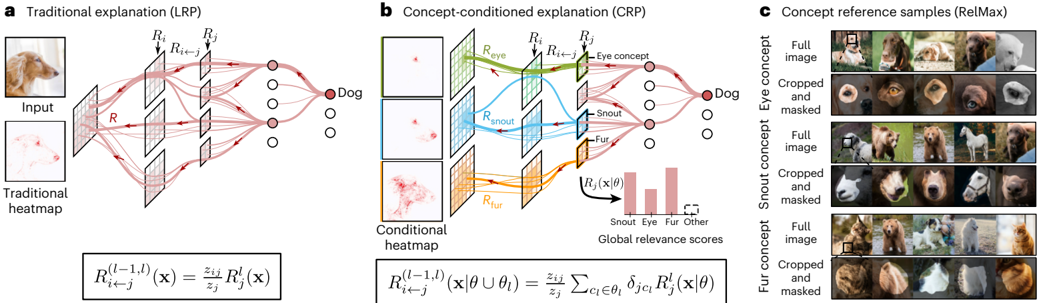
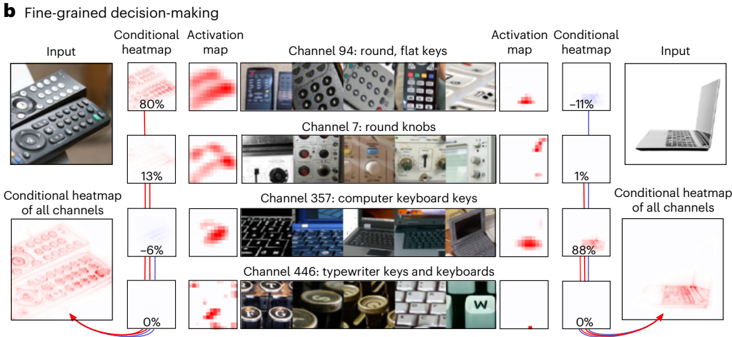
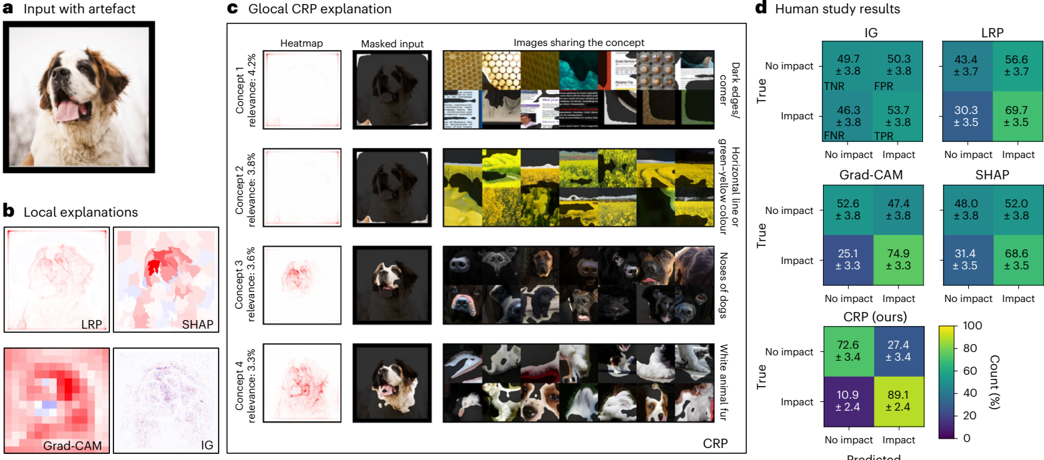
The field of explainable artificial intelligence (XAI) aims to bring transparency to today’s powerful but opaque deep learning models. While local XAI methods explain individual predictions in the form of attribution maps, thereby identifying ‘where’ important features occur (but not providing information about ‘what’ they represent), global explanation techniques visualize what concepts a model has generally learned to encode. Both types of method thus provide only partial insights and leave the burden of interpreting the model’s reasoning to the user. Here we introduce the Concept Relevance Propagation (CRP) approach, which combines the local and global perspectives and thus allows answering both the ‘where’ and ‘what’ questions for individual predictions. We demonstrate the capability of our method in various settings, showcasing that CRP leads to more human interpretable explanations and provides deep insights into the model’s representation and reasoning through concept atlases, concept-composition analyses, and quantitative investigations of concept subspaces and their role in fine-grained decision-making.
Overview
The claims and statistics of this paper haven’t been checked yet.
Free: it reads the open-access text and checks the first 5 claims that cite a source we can check. Create a free account to check every claim.
Integrity signals
Registry
Cites
Statistics
Figures



Verification
Claims the paper makes
The claims and statistics of this paper haven’t been checked yet.
Free: it reads the open-access text and checks the first 5 claims that cite a source we can check. Create a free account to check every claim.
Claims other papers make about this one
Each is checked against this paper’s own text: does it say what the citing paper says it does?
The source backs part of the claim, not all of it — or backs it for a different population, condition or comparison.
In the citing paper
“The only approach combining human involvement with quantitative methods was by Achtibat et al. [1], where users were asked to assess if the model relied on artifacts in the prediction process.”
From Study on the Helpfulness of Explainable Artificial Intelligence (2024) · cites this paper as [1]
Experimental — accuracy not yet measuredThe cited source says what the claim attributes to it.
In the citing paper
“This approach is a very interesting step in the right direction for quantitative XAI user-studies, but also focused on a sub-task, namely detection of model bias.”
From Study on the Helpfulness of Explainable Artificial Intelligence (2024) · cites this paper as [1]
Self-check
Percentages, sums and reported differences re-computed from the paper’s own numbers.
The self-check needs the paper’s full text.
Citations
Cites
LeCun, Y., Bengio, Y., & Hinton, G. (2015) · Nature · doi:10.1038/nature14539 · Cited by 84,126
Gradient-based learning applied to document recognition
Lecun, Y., Bottou, L., Bengio, Y., & Haffner, P. (1998) · Proceedings of the IEEE · doi:10.1109/5.726791 · Cited by 58,805
ImageNet Large Scale Visual Recognition Challenge
Russakovsky, O., Deng, J., Su, H., Krause, J., Satheesh, S., Ma, S., Huang, Z., Karpathy, A., Khosla, A., Bernstein, M., et al. (2015) · International Journal of Computer Vision · doi:10.1007/s11263-015-0816-y · Cited by 39,380
PyTorch: An Imperative Style, High-Performance Deep Learning Library
Paszke, A., Gross, S., Massa, F., Lerer, A., Bradbury, J., Chanan, G., Killeen, T., Lin, Z., Gimelshein, N., Antiga, L., et al. (2019) · arXiv · doi:10.48550/arxiv.1912.01703 · Cited by 31,473
Grad-CAM: Visual Explanations from Deep Networks via Gradient-Based Localization
Selvaraju, R. R., Cogswell, M., Das, A., Vedantam, R., Parikh, D., & Batra, D. (2017) · 2017 IEEE International Conference on Computer Vision (ICCV) · doi:10.1109/iccv.2017.74 · Cited by 24,513
A Unified Approach to Interpreting Model Predictions
Lundberg, S., & Lee, S.-I. (2017) · arXiv · doi:10.48550/arxiv.1705.07874 · Cited by 23,707
"Why Should I Trust You?": Explaining the Predictions of Any Classifier
Ribeiro, M. T., Singh, S., & Guestrin, C. (2016) · Proceedings of the 22nd ACM SIGKDD International Conference on Knowledge Discovery and Data Mining · doi:10.1145/2939672.2939778 · Cited by 17,555
Neural Machine Translation by Jointly Learning to Align and Translate
Bahdanau, D., Cho, K., & Bengio, Y. (2014) · arXiv · doi:10.48550/arxiv.1409.0473 · Cited by 16,213
Visualizing and understanding convolutional networks
Zeiler, M. D., & Fergus, R. (2014) · Lecture Notes in Computer Science · doi:10.1007/978-3-319-10590-1_53 · Cited by 15,839
Rudin, C. (2019) · Nature Machine Intelligence · doi:10.1038/s42256-019-0048-x · Cited by 10,561 · cited 4×
“This in turn hampers the transferability of ML models to many application domains of interest, for example, due to the risks involved in high-stakes decision-making 5 , or the requirements set in governmental regulatory frameworks 11 and guidelines brought forward 12 .”
BackgroundInfluential
Research works printed but not linked: 6
- Goodman, B. & Flaxman, S. European Union regulations on algorithmic decision-making and a ‘right to explanation’. AI Mag. 38, 50–57 (2017).
- Sundararajan, M., Taly, A. & Yan, Q. Axiomatic attribution for deep networks.In Proc. 34th International Conference on Machine Learning (eds Precup, D. & Teh, Y. W.) 3319–3328 (PMLR, 2017).
- Murdoch, W. J., Liu, P. J. & Yu, B. Beyond word importance: contextual decomposition to extract interactions from LSTMs. In 6th International Conference on Learning Representations (ICLR, 2018).
- Erhan, D., Bengio, Y., Courville, A. & Vincent, P. Visualizing higher-layer features of a deep network. Univ. Montreal 1341, 1 (2009).
- Nguyen, A., Dosovitskiy, A., Yosinski, J., Brox, T. & Clune, J. Synthesizing the preferred inputs for neurons in neural networks via deep generator networks. Adv. Neural Inf. Process. Syst. 29, 3387–3395 (2016).
- Simonyan, K. & Zisserman, A. Very deep convolutional networks for large-scale image recognition. In International Conference on Learning Representations (eds Bengio, Y. & LeCun, Y.) (ICLR, 2015).
Cited by
Longo, L., Brcic, M., Cabitza, F., Choi, J., Confalonieri, R., Ser, J. D., Guidotti, R., Hayashi, Y., Herrera, F., Holzinger, A., et al. (2024) · Information Fusion · doi:10.1016/j.inffus.2024.102301 · Cited by 626
Self-citationAudioMNIST: Exploring Explainable Artificial Intelligence for audio analysis on a simple benchmark
Becker, S., Vielhaben, J., Ackermann, M., Müller, K.-R., Lapuschkin, S., & Samek, W. (2024) · Journal of the Franklin Institute · doi:10.1016/j.jfranklin.2023.11.038 · Cited by 73
Self-citationHow Interpretable Machine Learning Can Benefit Process Understanding in the Geosciences
Jiang, S., Sweet, L., Blougouras, G., Brenning, A., Li, W., Reichstein, M., Denzler, J., Shangguan, W., Yu, G., Huang, F., et al. (2024) · Earth's Future · doi:10.1029/2024ef004540 · Cited by 182
A survey on explainable artificial intelligence for cybersecurity
Rjoub, G., Bentahar, J., Abdel Wahab, O., Mizouni, R., Song, A., Cohen, R., Otrok, H., & Mourad, A. (2023) · IEEE Transactions on Network and Service Management · doi:10.1109/tnsm.2023.3282740 · Cited by 158
Concept-based Explainable Artificial Intelligence: A Survey
Poeta, E., Ciravegna, G., Pastor, E., Cerquitelli, T., & Baralis, E. (2025) · ACM Computing Surveys · doi:10.1145/3774643 · Cited by 181
Metadata
- Authors
- Achtibat, R., Dreyer, M., Eisenbraun, I., Bosse, S., Wiegand, T., Samek, W., & Lapuschkin, S.
- Affiliations
- Fraunhofer Institute for Telecommunications, Heinrich Hertz Institute (DE)
- Corresponding author
- Samek, Wojciech
- Lapuschkin, Sebastian
- ORCID
- Venue
- Nature Machine Intelligence
- Published
- 2023-09-20
- Volume
- 5
- Issue
- 9
- Pages
- 1006-1019
- ISSN
- 2522-5839 (ISSN-L)
- OpenAlex
- W4386897466
- Semantic Scholar
- c2fbc8ad4e2403c795529c2606e4686f5a571215
- Cited by
- 181
- References
- 45
- Citations by year
- 2026: 43 · 2025: 71 · 2024: 57 · 2023: 10
- FWCI
- 16.02
- Type
- journal article
- Language
- en
- Open access
- hybrid
- doi.org
- Licence
- cc-by
- creativecommons.org/licenses/by/4.0 (tdm)
- creativecommons.org/licenses/by/4.0 (vor)
- Locations
- Nature Machine Intelligence (publishedVersion, cc-by)
- arXiv (Cornell University) (submittedVersion)
- Fraunhofer-Publica (Fraunhofer-Gesellschaft) (submittedVersion)
- arXiv (Cornell University)
- Funders
- Fraunhofer-Gesellschaft
- Karl-Franzens-Universität Graz
- Medizinische Universität Graz
- Topics
- Physical Sciences › Computer Science › Artificial Intelligence › Explainable Artificial Intelligence (XAI)
- Physical Sciences › Computer Science › Software › Software Testing and Debugging Techniques
- Physical Sciences › Computer Science › Computer Vision and Pattern Recognition › Advanced Neural Network Applications
- Keywords
- explainable AI, attribution maps, local and global explanations, concept composition, deep learning model interpretability
About these checks
Registry, retraction, Cites and statistics results are computed, not judged, with one exception: a printed reference that no index lists is read once by a model before it counts as a citation error. Claims are extracted by a model and kept only when their quote appears verbatim in the text; each cited source is then checked, with a model’s help, for whether it says what the claim relies on. Those verdicts can be wrong — read the claim’s quote and the cited source before relying on one.
Statistics and arithmetic are recomputed, not judged.
Confidence bands are shown only for fields calibrated on our annotated test set. None is calibrated yet, so no band is shown.
What counts as a claim ›How we measure confidence ›How we check this ›
Are you an author, or do you see a problem with this page? Request a review
How to cite
Cite CoChat for the checks on this page, and the paper for its own findings.
- This page
- CoChat. (2026). Citation check: From attribution maps to human-understandable explanations through Concept Relevance Propagation. https://app.cochat.ai/papers/10.1038/s42256-023-00711-8
- The paper
- Achtibat, R., Dreyer, M., Eisenbraun, I., Bosse, S., Wiegand, T., Samek, W., & Lapuschkin, S. (2023). From attribution maps to human-understandable explanations through Concept Relevance Propagation. Nature Machine Intelligence. https://doi.org/10.1038/s42256-023-00711-8
Data sources
Bibliographic data: Semantic Scholar, OpenAlex, Crossref.
Contains information from the Semantic Scholar Academic Graph Datasets, made available under the ODC Attribution License (ODC-BY 1.0).
Semantic Scholar’s data is described in: Kinney, R., et al. (2023). The Semantic Scholar Open Data Platform. arXiv:2301.10140.
