

From attribution maps to human-understandable explanations through Concept Relevance Propagation
Open accessThe DOI matches its Crossref record; 72 of the 72 references it cites were found in a registry or an index.
Abstract
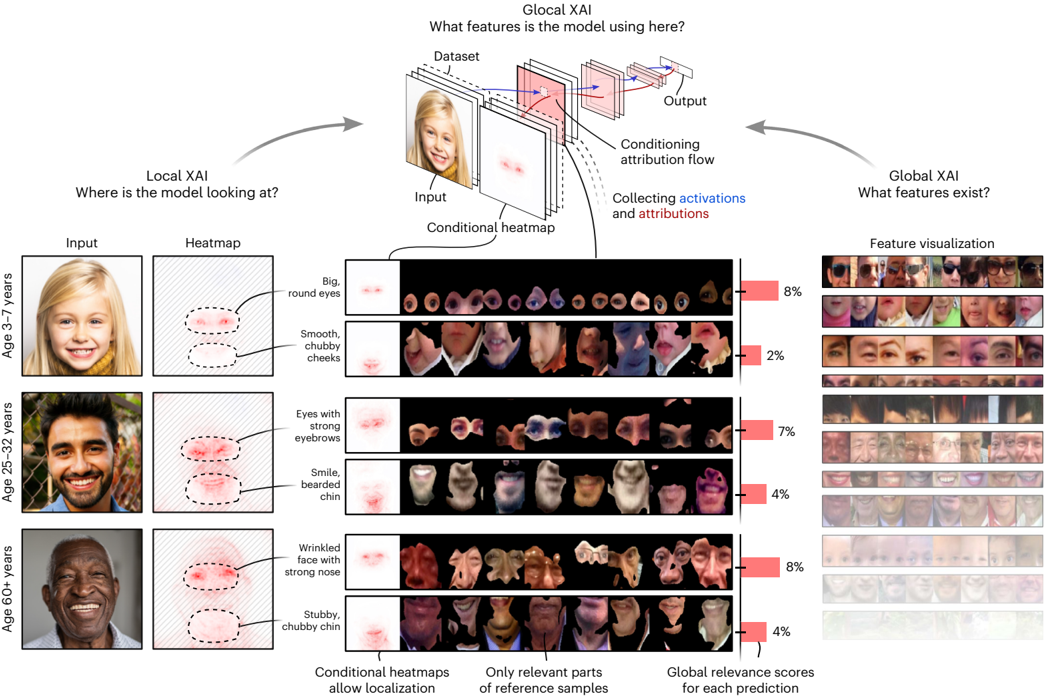
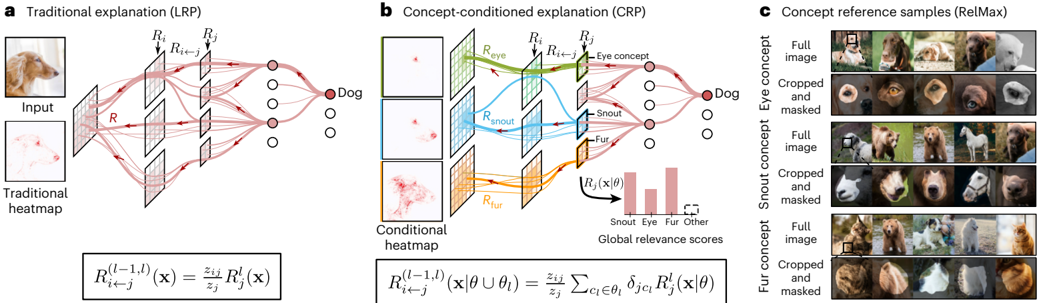
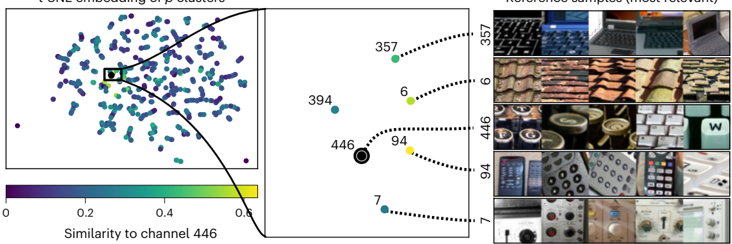
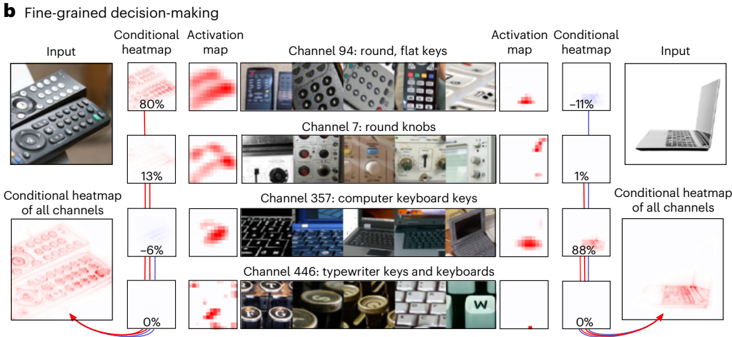
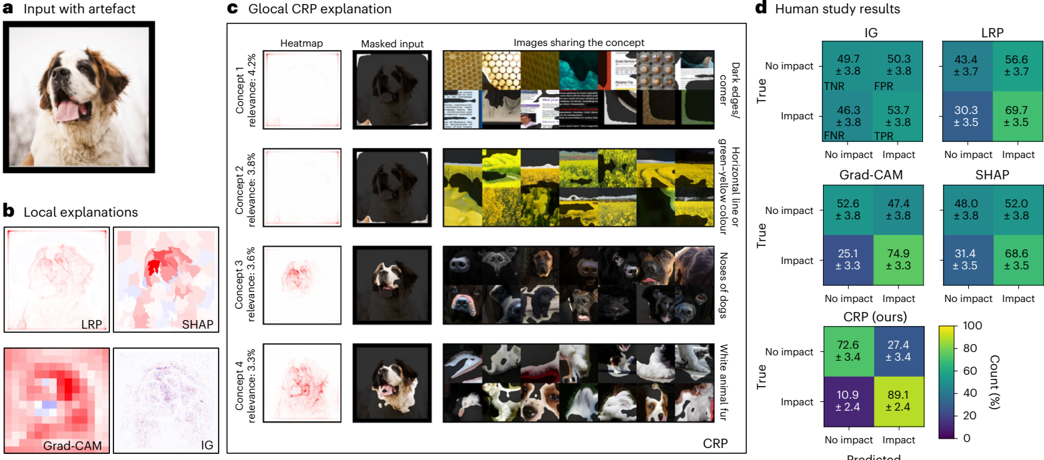
The field of explainable artificial intelligence (XAI) aims to bring transparency to today’s powerful but opaque deep learning models. While local XAI methods explain individual predictions in the form of attribution maps, thereby identifying ‘where’ important features occur (but not providing information about ‘what’ they represent), global explanation techniques visualize what concepts a model has generally learned to encode. Both types of method thus provide only partial insights and leave the burden of interpreting the model’s reasoning to the user. Here we introduce the Concept Relevance Propagation (CRP) approach, which combines the local and global perspectives and thus allows answering both the ‘where’ and ‘what’ questions for individual predictions. We demonstrate the capability of our method in various settings, showcasing that CRP leads to more human interpretable explanations and provides deep insights into the model’s representation and reasoning through concept atlases, concept-composition analyses, and quantitative investigations of concept subspaces and their role in fine-grained decision-making.
Overview
The claims and statistics of this paper haven’t been checked yet.
Free: it reads the open-access text and checks the first 5 claims that cite a source we can check. Create a free account to check every claim.
Integrity signals
Registry
Cites
Statistics
Figures
Verification
Claims the paper makes
The claims and statistics of this paper haven’t been checked yet.
Free: it reads the open-access text and checks the first 5 claims that cite a source we can check. Create a free account to check every claim.
Claims other papers make about this one
Each is checked against this paper’s own text: does it say what the citing paper says it does?
The source backs part of the claim, not all of it — or backs it for a different population, condition or comparison.
In the citing paper
“The only approach combining human involvement with quantitative methods was by Achtibat et al. [1], where users were asked to assess if the model relied on artifacts in the prediction process.”
From Study on the Helpfulness of Explainable Artificial Intelligence (2024) · cites this paper as [1]
Experimental — accuracy not yet measuredThe cited source says what the claim attributes to it.
In the citing paper
“This approach is a very interesting step in the right direction for quantitative XAI user-studies, but also focused on a sub-task, namely detection of model bias.”
From Study on the Helpfulness of Explainable Artificial Intelligence (2024) · cites this paper as [1]
Self-check
Percentages, sums and reported differences re-computed from the paper’s own numbers.
The self-check needs the paper’s full text.
Citations
Cites
Deep Residual Learning for Image Recognition
He, K., Zhang, X., Ren, S., & Sun, J. (2016) · 2016 IEEE Conference on Computer Vision and Pattern Recognition (CVPR) · doi:10.1109/cvpr.2016.90 · Cited by 235,474
LeCun, Y., Bengio, Y., & Hinton, G. (2015) · Nature · doi:10.1038/nature14539 · Cited by 84,126
Gradient-based learning applied to document recognition
Lecun, Y., Bottou, L., Bengio, Y., & Haffner, P. (1998) · Proceedings of the IEEE · doi:10.1109/5.726791 · Cited by 58,805
ImageNet Large Scale Visual Recognition Challenge
Russakovsky, O., Deng, J., Su, H., Krause, J., Satheesh, S., Ma, S., Huang, Z., Karpathy, A., Khosla, A., Bernstein, M., et al. (2015) · International Journal of Computer Vision · doi:10.1007/s11263-015-0816-y · Cited by 39,380
PyTorch: An Imperative Style, High-Performance Deep Learning Library
Paszke, A., Gross, S., Massa, F., Lerer, A., Bradbury, J., Chanan, G., Killeen, T., Lin, Z., Gimelshein, N., Antiga, L., et al. (2019) · arXiv · doi:10.48550/arxiv.1912.01703 · Cited by 31,473
Grad-CAM: Visual Explanations from Deep Networks via Gradient-Based Localization
Selvaraju, R. R., Cogswell, M., Das, A., Vedantam, R., Parikh, D., & Batra, D. (2017) · 2017 IEEE International Conference on Computer Vision (ICCV) · doi:10.1109/iccv.2017.74 · Cited by 24,513
A Unified Approach to Interpreting Model Predictions
Lundberg, S., & Lee, S.-I. (2017) · arXiv · doi:10.48550/arxiv.1705.07874 · Cited by 23,707
"Why Should I Trust You?": Explaining the Predictions of Any Classifier
Ribeiro, M. T., Singh, S., & Guestrin, C. (2016) · Proceedings of the 22nd ACM SIGKDD International Conference on Knowledge Discovery and Data Mining · doi:10.1145/2939672.2939778 · Cited by 17,555
Neural Machine Translation by Jointly Learning to Align and Translate
Bahdanau, D., Cho, K., & Bengio, Y. (2014) · arXiv · doi:10.48550/arxiv.1409.0473 · Cited by 16,213
Visualizing and understanding convolutional networks
Zeiler, M. D., & Fergus, R. (2014) · Lecture Notes in Computer Science · doi:10.1007/978-3-319-10590-1_53 · Cited by 15,839 · cited 1×
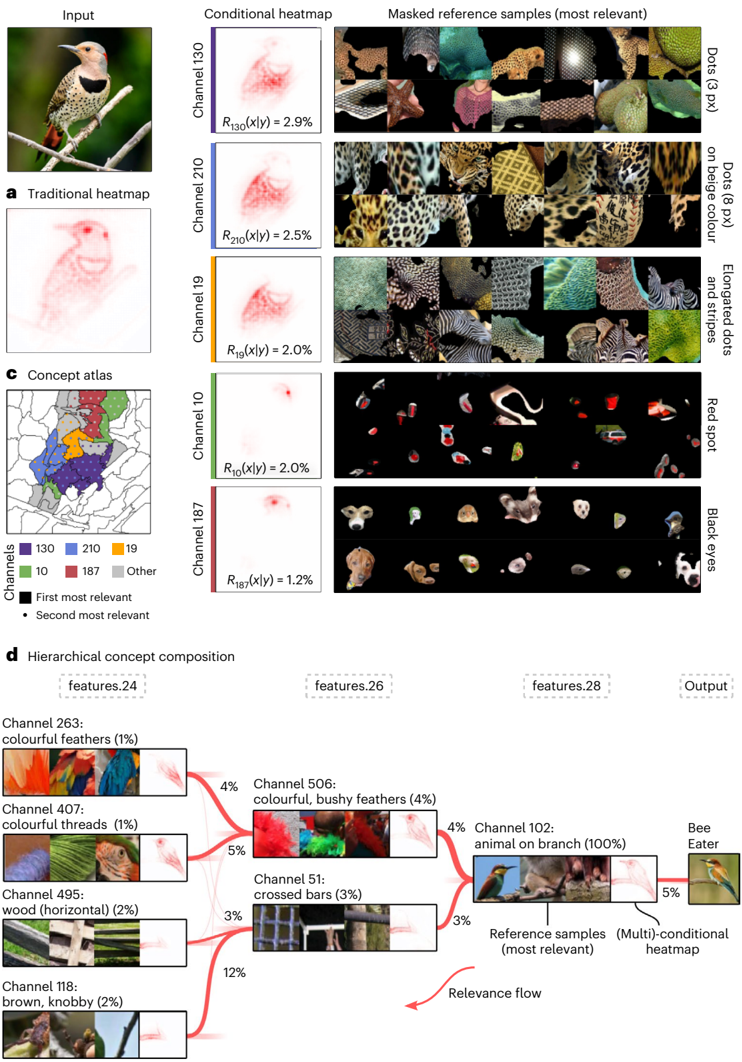
“210 and 130), ‘red spot’ (10), ‘black eyes’ (187) and ‘stripes-like’ (19).”
Learning Deep Features for Discriminative Localization
Zhou, B., Khosla, A., Lapedriza, A., Oliva, A., & Torralba, A. (2016) · 2016 IEEE Conference on Computer Vision and Pattern Recognition (CVPR) · doi:10.1109/cvpr.2016.319 · Cited by 11,428
Rudin, C. (2019) · Nature Machine Intelligence · doi:10.1038/s42256-019-0048-x · Cited by 10,561 · cited 4×
“This in turn hampers the transferability of ML models to many application domains of interest, for example, due to the risks involved in high-stakes decision-making 5 , or the requirements set in governmental regulatory frameworks 11 and guidelines brought forward 12 .”
BackgroundInfluentialA tutorial on spectral clustering
von Luxburg, U. (2007) · Statistics and Computing · doi:10.1007/s11222-007-9033-z · Cited by 10,349
Intriguing properties of neural networks
Szegedy, C., Zaremba, W., Sutskever, I., Bruna, J., Erhan, D., Goodfellow, I., & Fergus, R. (2013) · arXiv · doi:10.48550/arxiv.1312.6199 · Cited by 8,143 · cited 1×
“Some approaches from this category synthesize example data to reveal the concept a particular neuron activates for 22,23,25–27 , but do not inform which concept is in use in a specific classification or how Analogously to Activation Maximization (ActMax) 36 , our proposed RelMax approach searches…”
MethodUMAP: Uniform Manifold Approximation and Projection for Dimension Reduction
McInnes, L., Healy, J., & Melville, J. (2018) · arXiv · doi:10.48550/arxiv.1802.03426 · Cited by 7,101
Fashion-MNIST: a Novel Image Dataset for Benchmarking Machine Learning Algorithms
Xiao, H., Rasul, K., & Vollgraf, R. (2017) · arXiv · doi:10.48550/arxiv.1708.07747 · Cited by 6,108
The impact of the MIT-BIH Arrhythmia Database
Moody, G. B., & Mark, R. G. (2001) · IEEE Engineering in Medicine and Biology Magazine · doi:10.1109/51.932724 · Cited by 4,812
On Pixel-Wise Explanations for Non-Linear Classifier Decisions by Layer-Wise Relevance Propagation
Bach, S., Binder, A., Montavon, G., Klauschen, F., Müller, K.-R., & Samek, W. (2015) · PLOS ONE · doi:10.1371/journal.pone.0130140 · Cited by 4,524 · cited 16×
“CRP is an extension of LRP, which disentangles the relevance flows associated with concepts learned by the model via conditional backpropagation.”
BackgroundMethodInfluentialSelf-citationAxiomatic attribution for deep networks
Sundararajan, M., Taly, A., & Yan, Q. (2017) · arXiv · doi:10.48550/arxiv.1703.01365 · Cited by 4,087
5th International Conference on Learning Representations (ICLR 17)
Havrylov, S., & Titov, I. (2017) · Cited by 3,503
Striving for Simplicity: The All Convolutional Net
Springenberg, J. T., Dosovitskiy, A., Brox, T., & Riedmiller, M. (2014) · arXiv · doi:10.48550/arxiv.1412.6806 · Cited by 3,447
Improved protein structure prediction using potentials from deep learning
Senior, A. W., Evans, R., Jumper, J., Kirkpatrick, J., Sifre, L., Green, T., Qin, C., Žídek, A., Nelson, A. W. R., Bridgland, A., et al. (2020) · Nature · doi:10.1038/s41586-019-1923-7 · Cited by 3,378 · cited 1×
“For a more elaborate introduction and discussion, please refer to Supplementary Notes 2 and 3.”
BackgroundLearning Important Features Through Propagating Activation Differences
Shrikumar, A., Greenside, P., & Kundaje, A. (2017) · arXiv · doi:10.48550/arxiv.1704.02685 · Cited by 2,761 · cited 1×
“17,41–43), where the contributions of all concepts are superimposed into a single attribution map.”
BackgroundMethods for interpreting and understanding deep neural networks
Montavon, G., Samek, W., & Müller, K.-R. (2018) · Digital Signal Processing · doi:10.1016/j.dsp.2017.10.011 · Cited by 2,665 · cited 1×
“48.”
Self-citationCodella, N. C. F., Gutman, D., Celebi, M. E., Helba, B., Marchetti, M. A., Dusza, S. W., Kalloo, A., Liopyris, K., Mishra, N., Kittler, H., et al. (2018) · 2018 IEEE 15th International Symposium on Biomedical Imaging (ISBI 2018) · doi:10.1109/isbi.2018.8363547 · Cited by 2,620
Understanding deep image representations by inverting them
Mahendran, A., & Vedaldi, A. (2015) · 2015 IEEE Conference on Computer Vision and Pattern Recognition (CVPR) · doi:10.1109/cvpr.2015.7299155 · Cited by 1,827
Explaining Deep Neural Networks and Beyond: A Review of Methods and Applications
Samek, W., Montavon, G., Lapuschkin, S., Anders, C. J., & Muller, K.-R. (2021) · Proceedings of the IEEE · doi:10.1109/jproc.2021.3060483 · Cited by 1,477 · cited 18×
“In addition, Supplementary Note 9 provides an example on how CRP can be leveraged to identify systematically learned biases in male versus female face classification and Supplementary Note 10 demonstrates the applicability of CRP to time-series data.”
BackgroundMethodInfluentialSelf-citationSmoothGrad: removing noise by adding noise
Smilkov, D., Thorat, N., Kim, B., Viégas, F., & Wattenberg, M. (2017) · arXiv · doi:10.48550/arxiv.1706.03825 · Cited by 1,467
Network Dissection: Quantifying Interpretability of Deep Visual Representations
Bau, D., Zhou, B., Khosla, A., Oliva, A., & Torralba, A. (2017) · 2017 IEEE Conference on Computer Vision and Pattern Recognition (CVPR) · doi:10.1109/cvpr.2017.354 · Cited by 1,389
Explaining nonlinear classification decisions with deep taylor decomposition
Montavon, G., Lapuschkin, S., Binder, A., Samek, W., & Müller, K.-R. (2017) · Pattern Recognition · doi:10.1016/j.patcog.2016.11.008 · Cited by 1,357 · cited 1×
“LRP is mathematically founded in deep Taylor decomposition 47 .”
BackgroundSelf-citationKim, B., Wattenberg, M., Gilmer, J., Cai, C., Wexler, J., Viegas, F., & Sayres, R. (2017) · arXiv · doi:10.48550/arxiv.1711.11279 · Cited by 1,240
Amazon Scraps Secret AI Recruiting Tool that Showed Bias against Women *
Dastin, J. (2022) · Ethics of Data and Analytics · doi:10.1201/9781003278290-44 · Cited by 1,165
Unmasking Clever Hans predictors and assessing what machines really learn
Lapuschkin, S., Wäldchen, S., Binder, A., Montavon, G., Samek, W., & Müller, K.-R. (2019) · Nature Communications · doi:10.1038/s41467-019-08987-4 · Cited by 1,047 · cited 2×
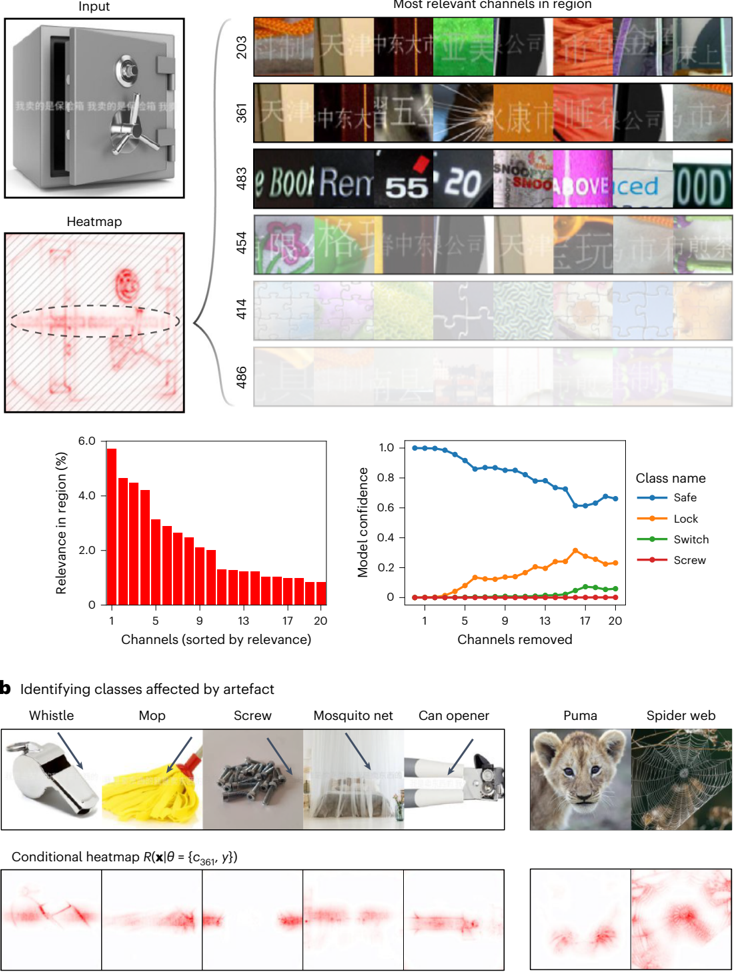
“In the first step, we uncover a Clever Hans artefact 8 , and suppress it by selectively eliminating the most relevant concepts to assess its decisiveness for the recognition of the correct class of a particular data sample.”
BackgroundMethodSelf-citationObject Detectors Emerge in Deep Scene CNNs
Zhou, B., Khosla, A., Lapedriza, A., Oliva, A., & Torralba, A. (2014) · arXiv · doi:10.48550/arxiv.1412.6856 · Cited by 971 · cited 2×
“…latent structures of neural networks are encoding abstract human-understandable concepts with distinct semantics, especially in higher layers 23,31,37–40 , the channel-wise relevance values can be interpreted as scores quantifying the importance of the corresponding concepts in the inference…”
BackgroundAdversarial Examples Are Not Bugs, They Are Features
Ilyas, A., Santurkar, S., Tsipras, D., Engstrom, L., Tran, B., & Madry, A. (2019) · arXiv · doi:10.48550/arxiv.1905.02175 · Cited by 971
CoAtNet: Marrying Convolution and Attention for All Data Sizes
Dai, Z., Liu, H., Le, Q. V., & Tan, M. (2021) · arXiv · doi:10.48550/arxiv.2106.04803 · Cited by 925 · cited 2×
“We demonstrate on multiple datasets, model architectures and application domains that CRP-based analyses allow one to (1) gain insights into the representation and composition of concepts in the model as well as quantitatively investigate their role in prediction, (2) identify and counteract Clever Hans filters(8) foc…”
BackgroundOlah, C., Mordvintsev, A., & Schubert, L. (2017) · Distill · doi:10.23915/distill.00007 · Cited by 880
Layer-Wise Relevance Propagation: An Overview
Montavon, G., Binder, A., Lapuschkin, S., Samek, W., & Müller, K.-R. (2019) · Lecture Notes in Computer Science · doi:10.1007/978-3-030-28954-6_10 · Cited by 750
Self-citationThis Looks Like That: Deep Learning for Interpretable Image Recognition
Chen, C., Li, O., Tao, C., Barnett, A. J., Su, J., & Rudin, C. (2018) · arXiv · doi:10.48550/arxiv.1806.10574 · Cited by 702 · cited 1×
“These methods, however, require either specialized architectures, data and labels, or training regimes (or a combination thereof) 34,35 and do not support the still widely used off-the-mill end-to-end-trained DNN models with their extended explanation capabilities.”
MethodHuman-level performance in 3D multiplayer games with population-based reinforcement learning
Jaderberg, M., Czarnecki, W. M., Dunning, I., Marris, L., Lever, G., Castañeda, A. G., Beattie, C., Rabinowitz, N. C., Morcos, A. S., Ruderman, A., et al. (2019) · Science · doi:10.1126/science.aau6249 · Cited by 662 · cited 4×
“For further details and evaluations, we refer the interested reader to Supplementary Notes 3 and 4.”
BackgroundInfluentialCaptum: A unified and generic model interpretability library for PyTorch
Kokhlikyan, N., Miglani, V., Martin, M., Wang, E., Alsallakh, B., Reynolds, J., Melnikov, A., Kliushkina, N., Araya, C., Yan, S., et al. (2020) · arXiv · doi:10.48550/arxiv.2009.07896 · Cited by 658
The Building Blocks of Interpretability
Olah, C., Satyanarayan, A., Johnson, I., Carter, S., Schubert, L., Ye, K., & Mordvintsev, A. (2018) · Distill · doi:10.23915/distill.00010 · Cited by 591
Dreaming to Distill: Data-Free Knowledge Transfer via DeepInversion
Yin, H., Molchanov, P., Alvarez, J. M., Li, Z., Mallya, A., Hoiem, D., Jha, N. K., & Kautz, J. (2020) · 2020 IEEE/CVF Conference on Computer Vision and Pattern Recognition (CVPR) · doi:10.1109/cvpr42600.2020.00874 · Cited by 540
Opportunities and Challenges in Explainable Artificial Intelligence (XAI): A Survey
Das, A., & Rad, P. (2020) · arXiv · doi:10.48550/arxiv.2006.11371 · Cited by 504
Towards Better Analysis of Deep Convolutional Neural Networks
Liu, M., Shi, J., Li, Z., Li, C., Zhu, J., & Liu, S. (2017) · IEEE Transactions on Visualization and Computer Graphics · doi:10.1109/tvcg.2016.2598831 · Cited by 498
Advancing mathematics by guiding human intuition with AI
Davies, A., Veličković, P., Buesing, L., Blackwell, S., Zheng, D., Tomašev, N., Tanburn, R., Battaglia, P., Blundell, C., Juhász, A., et al. (2021) · Nature · doi:10.1038/s41586-021-04086-x · Cited by 451
Towards Automatic Concept-based Explanations
Ghorbani, A., Wexler, J., Zou, J., & Kim, B. (2019) · arXiv · doi:10.48550/arxiv.1902.03129 · Cited by 378
Understanding the role of individual units in a deep neural network
Bau, D., Zhu, J.-Y., Strobelt, H., Lapedriza, A., Zhou, B., & Torralba, A. (2020) · Proceedings of the National Academy of Sciences · doi:10.1073/pnas.1907375117 · Cited by 375 · cited 2×
“Other branches of global XAI propose methods, for example, to test a model’s sensitivity to a priori known, expected or pre-categorized stimuli 28–31 .”
BackgroundMethodExplaining Recurrent Neural Network Predictions in Sentiment Analysis
Arras, L., Montavon, G., Müller, K.-R., & Samek, W. (2017) · Proceedings of the 8th Workshop on Computational Approaches to Subjectivity, Sentiment and Social Media Analysis · doi:10.18653/v1/w17-5221 · Cited by 361
Self-citationRajalingham, R., Issa, E. B., Bashivan, P., Kar, K., Schmidt, K., & DiCarlo, J. J. (2018) · The Journal of Neuroscience · doi:10.1523/jneurosci.0388-18.2018 · Cited by 358
Koh, P. W., Nguyen, T., Tang, Y. S., Mussmann, S., Pierson, E., Kim, B., & Liang, P. (2020) · arXiv · doi:10.48550/arxiv.2007.04612 · Cited by 338
Learning to Generate Reviews and Discovering Sentiment
Radford, A., Jozefowicz, R., & Sutskever, I. (2017) · arXiv · doi:10.48550/arxiv.1704.01444 · Cited by 330
Multimodal Neurons in Artificial Neural Networks
Goh, G., Cammarata, N., Voss, C., Carter, S., Petrov, M., Schubert, L., Radford, A., & Olah, C. (2021) · Distill · doi:10.23915/distill.00030 · Cited by 330 · cited 1×
“…structures of neural networks are encoding abstract human-understandable concepts with distinct semantics, especially in higher layers 23,31,37–40 , the channel-wise relevance values can be interpreted as scores quantifying the importance of the corresponding concepts in the inference process.”
BackgroundConcept whitening for interpretable image recognition
Chen, Z., Bei, Y., & Rudin, C. (2020) · Nature Machine Intelligence · doi:10.1038/s42256-020-00265-z · Cited by 279 · cited 2×
“These methods, however, require either specialized architectures, data and labels, or training regimes (or a combination thereof) 34,35 and do not support the still widely used off-the-mill end-to-end-trained DNN models with their extended explanation capabilities.”
BackgroundMethodLearning how to explain neural networks: PatternNet and PatternAttribution
Kindermans, P.-J., Schütt, K. T., Alber, M., Müller, K. R., Erhan, D., Kim, B., & Dähne, S. (2017) · arXiv (Cornell University) · doi:10.48550/arxiv.1705.05598 · Cited by 264 · cited 2×
“24–26.”
BackgroundHigher-Order Explanations of Graph Neural Networks via Relevant Walks
Schnake, T., Eberle, O., Lederer, J., Nakajima, S., Schutt, K. T., Muller, K.-R., & Montavon, G. (2022) · IEEE Transactions on Pattern Analysis and Machine Intelligence · doi:10.1109/tpami.2021.3115452 · Cited by 259
Hohman, F., Park, H., Robinson, C., & Polo Chau, D. H. (2020) · IEEE Transactions on Visualization and Computer Graphics · doi:10.1109/tvcg.2019.2934659 · Cited by 213
Schramowski, P., Stammer, W., Teso, S., Brugger, A., Herbert, F., Shao, X., Luigs, H.-G., Mahlein, A.-K., & Kersting, K. (2020) · Nature Machine Intelligence · doi:10.1038/s42256-020-0212-3 · Cited by 207 · cited 17×
“In addition, Supplementary Note 9 provides an example on how CRP can be leveraged to identify systematically learned biases in male versus female face classification and Supplementary Note 10 demonstrates the applicability of CRP to time-series data.”
BackgroundInfluentialCammarata, N., Carter, S., Goh, G., Olah, C., Petrov, M., & Schubert, L. (2020) · Distill · doi:10.23915/distill.00024 · Cited by 174 · cited 1×
“A canonical approach for gaining insight into the meaning and function of latent model structures is ActMax 23,37–39 for generating or selecting samples as representations for concepts encoded in hidden space.”
BackgroundConvNets and ImageNet Beyond Accuracy: Understanding Mistakes and Uncovering Biases
Stock, P., & Cisse, M. (2018) · Lecture Notes in Computer Science · doi:10.1007/978-3-030-01231-1_31 · Cited by 158 · cited 2×
“However, the reasoning of these highly complex and nonlinear DNNs is generally not obvious 5,6 , and, as such, their decisions may be (and often are) biased towards unintended or undesired features 7–10 .”
BackgroundTowards Best Practice in Explaining Neural Network Decisions with LRP
Kohlbrenner, M., Bauer, A., Nakajima, S., Binder, A., Samek, W., & Lapuschkin, S. (2020) · 2020 International Joint Conference on Neural Networks (IJCNN) · doi:10.1109/ijcnn48605.2020.9206975 · Cited by 145 · cited 1×
“In practice, CRP can be implemented efficiently as a single backpropagation step by binary masking of relevance tensors, and is compatible to the recommended rule composites for relevance backpropagation 49,50 .”
MethodSelf-citationFinding and removing Clever Hans: Using explanation methods to debug and improve deep models
Anders, C. J., Weber, L., Neumann, D., Samek, W., Müller, K.-R., & Lapuschkin, S. (2022) · Information Fusion · doi:10.1016/j.inffus.2021.07.015 · Cited by 119 · cited 3×
“In addition, Supplementary Note 9 provides an example on how CRP can be leveraged to identify systematically learned biases in male versus female face classification and Supplementary Note 10 demonstrates the applicability of CRP to time-series data.”
BackgroundSelf-citationHedström, A., Weber, L., Bareeva, D., Krakowczyk, D., Motzkus, F., Samek, W., Lapuschkin, S., & Höhne, M. M. C. (2022) · arXiv · doi:10.48550/arxiv.2202.06861 · Cited by 116
Self-citationAnders, C. J., Neumann, D., Samek, W., Müller, K., & Lapuschkin, S. (2026) · PLoS ONE · doi:10.1371/journal.pone.0336683 · Cited by 79
Self-citationVarieties of AI Explanations Under the Law. From the GDPR to the AIA, and Beyond
Hacker, P., & Passoth, J.-H. (2022) · Lecture Notes in Computer Science · doi:10.1007/978-3-031-04083-2_17 · Cited by 76
Visualization of neural networks using saliency maps
Morch, N. J. S., Kjems, U., Hansen, L. K., Svarer, C., Law, I., Lautrup, B., Strother, S., & Rehm, K. (2002) · Proceedings of ICNN'95 - International Conference on Neural Networks · doi:10.1109/icnn.1995.488997 · Cited by 58 · cited 1×
“…that are able to provide explanations of a model’s decision while approaching the subject from different angles, for example, based on gradients 13,14 , as modified backpropagation processes 15–18 , by probing the model’s reaction to changes in the input 19–21 or visualizing stimuli that…”
BackgroundHow to Explain Individual Classification Decisions
(2010) · Journal of Machine Learning Research · doi:10.5555/1756006.1859912 · Cited by 54
On Completeness-aware Concept-Based Explanations in Deep Neural Networks
Yeh, C., Kim, B., Arık, S. Ö., Li, C., Pfister, T., & Ravikumar, P. (2019) · arXiv (Cornell University) · doi:10.48550/arxiv.1910.07969 · Cited by 46
Achtibat, R., Dreyer, M., Eisenbraun, I., Bosse, S., Wiegand, T., Samek, W., & Lapuschkin, S. (2022) · arXiv.org · doi:10.48550/arxiv.2206.03208 · Cited by 31
Self-citationECQ$$^{\text {x}}$$: Explainability-Driven Quantization for Low-Bit and Sparse DNNs
Becking, D., Dreyer, M., Samek, W., Müller, K., & Lapuschkin, S. (2022) · Lecture notes in computer science · doi:10.1007/978-3-031-04083-2_14 · Cited by 27
Self-citationPredDiff: Explanations and interactions from conditional expectations
Blücher, S., Vielhaben, J., & Strodthoff, N. (2022) · Artificial Intelligence · doi:10.1016/j.artint.2022.103774 · Cited by 26 · cited 1×
“…of a model’s decision while approaching the subject from different angles, for example, based on gradients 13,14 , as modified backpropagation processes 15–18 , by probing the model’s reaction to changes in the input 19–21 or visualizing stimuli that specific neurons react strongly to 22,23 .”
BackgroundAchtibat, R., Dreyer, M., & Lapuschkin, S. (2023) · Zenodo (CERN European Organization for Nuclear Research) · doi:10.5281/zenodo.7962573 · Cited by 2
Self-citation
Research works printed but not linked: 4
- 11. Goodman, B. & Flaxman, S. European Union regulations on algorithmic decision-making and a 'right to explanation'. AI Mag. 38, 50-57 (2017).
- 18. Murdoch, W. J., Liu, P. J. & Yu, B. Beyond word importance: contextual decomposition to extract interactions from LSTMs. In 6th International Conference on Learning Representations (ICLR, 2018).
- 22. Erhan, D., Bengio, Y., Courville, A. & Vincent, P. Visualizing higher- layer features of a deep network. Univ. Montreal 1341, 1 (2009).
- 36. Nguyen, A., Dosovitskiy, A., Yosinski, J., Brox, T. & Clune, J. Synthesizing the preferred inputs for neurons in neural networks via deep generator networks. Adv. Neural Inf. Process. Syst. 29, 3387-3395 (2016).
Cited by
Longo, L., Brcic, M., Cabitza, F., Choi, J., Confalonieri, R., Ser, J. D., Guidotti, R., Hayashi, Y., Herrera, F., Holzinger, A., et al. (2024) · Information Fusion · doi:10.1016/j.inffus.2024.102301 · Cited by 626
“…learn features that describe ‘prototypical concepts’ or ‘prototypes’ present in individual inputs to the model, including ProtoPNet [147], ProtoTree [148], ProtoPShare [149], Concept Bottleneck Models [150], Concept Activation Vectors [146], Concept Embedding Models [151] or Concept Atlases [152].”
Self-citationAudioMNIST: Exploring Explainable Artificial Intelligence for audio analysis on a simple benchmark
Becker, S., Vielhaben, J., Ackermann, M., Müller, K.-R., Lapuschkin, S., & Samek, W. (2024) · Journal of the Franklin Institute · doi:10.1016/j.jfranklin.2023.11.038 · Cited by 73
“This can be achieved by employing innovative concept-based methods that have demonstrated improved interpretability in computer vision applications [41].”
BackgroundMethodResultInfluentialSelf-citationHow Interpretable Machine Learning Can Benefit Process Understanding in the Geosciences
Jiang, S., Sweet, L., Blougouras, G., Brenning, A., Li, W., Reichstein, M., Denzler, J., Shangguan, W., Yu, G., Huang, F., et al. (2024) · Earth's Future · doi:10.1029/2024ef004540 · Cited by 182
“This oversight may be due to the fact that ML models, even when trained on multicollinear data, are likely to retain predictive power, especially when the test data used have a similar dependence structure (Farrell et al., 2019).”
InfluentialA survey on explainable artificial intelligence for cybersecurity
Rjoub, G., Bentahar, J., Abdel Wahab, O., Mizouni, R., Song, A., Cohen, R., Otrok, H., & Mourad, A. (2023) · IEEE Transactions on Network and Service Management · doi:10.1109/tnsm.2023.3282740 · Cited by 158
“LRP has been applied to many applications, including computer vision [44], [45], natural language processing (NLP) [46], recommendation [47], object recognition [48], and anomaly detection [49].”
MethodConcept-based Explainable Artificial Intelligence: A Survey
Poeta, E., Ciravegna, G., Pastor, E., Cerquitelli, T., & Baralis, E. (2026) · ACM Computing Surveys · doi:10.1145/3774643 · Cited by 182
Metadata
- Authors
- Achtibat, R., Dreyer, M., Eisenbraun, I., Bosse, S., Wiegand, T., Samek, W., & Lapuschkin, S.
- Affiliations
- Fraunhofer Institute for Telecommunications, Heinrich Hertz Institute (DE)
- Corresponding author
- Samek, Wojciech
- Lapuschkin, Sebastian
- ORCID
- Venue
- Nature Machine Intelligence
- Published
- 2023-09-20
- Volume
- 5
- Issue
- 9
- Pages
- 1006-1019
- ISSN
- 2522-5839 (ISSN-L)
- OpenAlex
- W4386897466
- Semantic Scholar
- c2fbc8ad4e2403c795529c2606e4686f5a571215
- Cited by
- 181
- References
- 45
- Citations by year
- 2026: 43 · 2025: 71 · 2024: 57 · 2023: 10
- FWCI
- 16.02
- Type
- journal article
- Language
- en
- Open access
- hybrid
- doi.org
- Licence
- cc-by
- creativecommons.org/licenses/by/4.0 (tdm)
- creativecommons.org/licenses/by/4.0 (vor)
- Locations
- Nature Machine Intelligence (publishedVersion, cc-by)
- arXiv (Cornell University) (submittedVersion)
- Fraunhofer-Publica (Fraunhofer-Gesellschaft) (submittedVersion)
- arXiv (Cornell University)
- Funders
- Fraunhofer-Gesellschaft
- Karl-Franzens-Universität Graz
- Medizinische Universität Graz
- Topics
- Physical Sciences › Computer Science › Artificial Intelligence › Explainable Artificial Intelligence (XAI)
- Physical Sciences › Computer Science › Software › Software Testing and Debugging Techniques
- Physical Sciences › Computer Science › Computer Vision and Pattern Recognition › Advanced Neural Network Applications
- Keywords
- explainable AI, attribution maps, local and global explanations, concept composition, deep learning model interpretability
About these checks
Registry, retraction, Cites and statistics results are computed, not judged, with one exception: a printed reference that no index lists is read once by a model before it counts as a citation error. Claims are extracted by a model and kept only when their quote appears verbatim in the text; each cited source is then checked, with a model’s help, for whether it says what the claim relies on. Those verdicts can be wrong — read the claim’s quote and the cited source before relying on one.
Statistics and arithmetic are recomputed, not judged.
Confidence bands are shown only for fields calibrated on our annotated test set. None is calibrated yet, so no band is shown.
What counts as a claim ›How we measure confidence ›How we check this ›
Are you an author, or do you see a problem with this page? Request a review
Data sources
Bibliographic data: Semantic Scholar, OpenAlex, Crossref.
Contains information from the Semantic Scholar Academic Graph Datasets, made available under the ODC Attribution License (ODC-BY 1.0).
Semantic Scholar’s data is described in: Kinney, R., et al. (2023). The Semantic Scholar Open Data Platform. arXiv:2301.10140.
