

Global food insecurity and famine from reduced crop, marine fishery and livestock production due to climate disruption from nuclear war soot injection
Open accessPublished version of a preprint
The DOI matches its Crossref record; 43 of the 43 references it cites were found in a registry or an index; 14 of the 31 sources its claims cite were checked for support.
Abstract
Atmospheric soot loadings from nuclear weapon detonation would cause disruptions to the Earth’s climate, limiting terrestrial and aquatic food production. Here, we use climate, crop and fishery models to estimate the impacts arising from six scenarios of stratospheric soot injection, predicting the total food calories available in each nation post-war after stored food is consumed. In quantifying impacts away from target areas, we demonstrate that soot injections larger than 5 Tg would lead to mass food shortages, and livestock and aquatic food production would be unable to compensate for reduced crop output, in almost all countries. Adaptation measures such as food waste reduction would have limited impact on increasing available calories. We estimate more than 2 billion people could die from nuclear war between India and Pakistan, and more than 5 billion could die from a war between the United States and Russia—underlining the importance of global cooperation in preventing nuclear war.
Overview
CoChat Summary
## TL;DR
This modeling study estimates how soot from nuclear war would disrupt climate, crops, fisheries, livestock, and national food calories across six soot-injection scenarios. The authors conclude that soot injections above 5 Tg would cause mass food shortages, and that more than 2 billion people could die in an India-Pakistan war and more than 5 billion in a U.S.-Russia war.
## Key findings
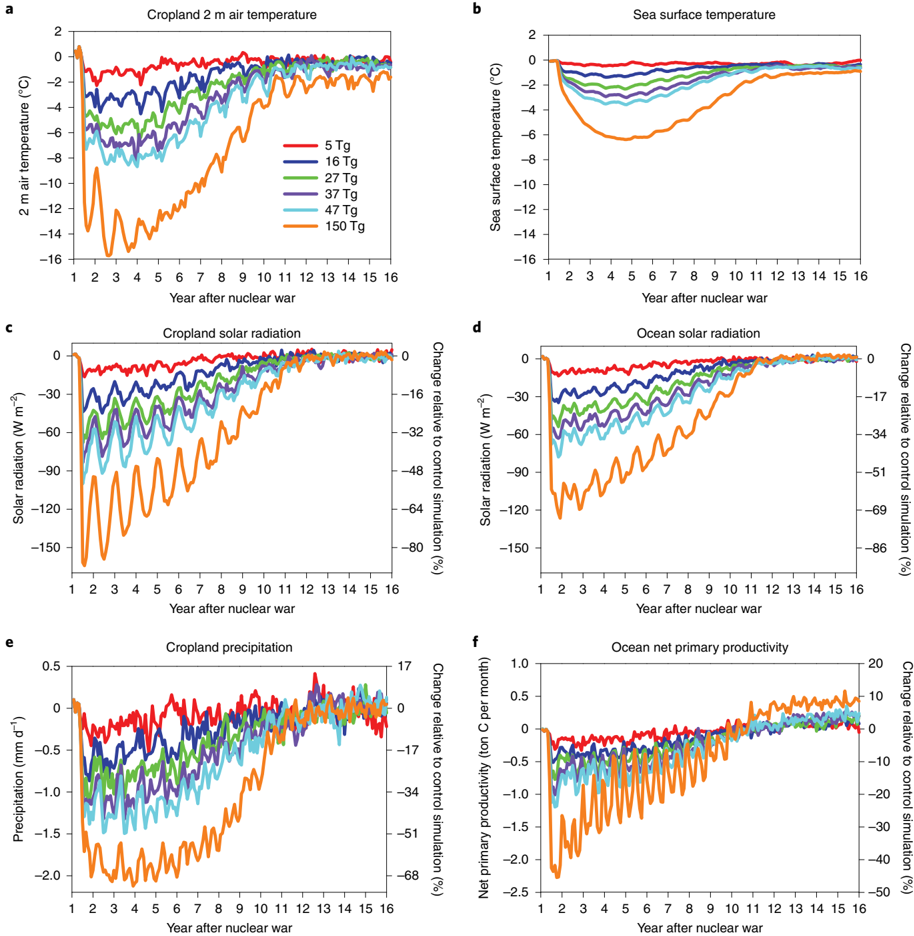
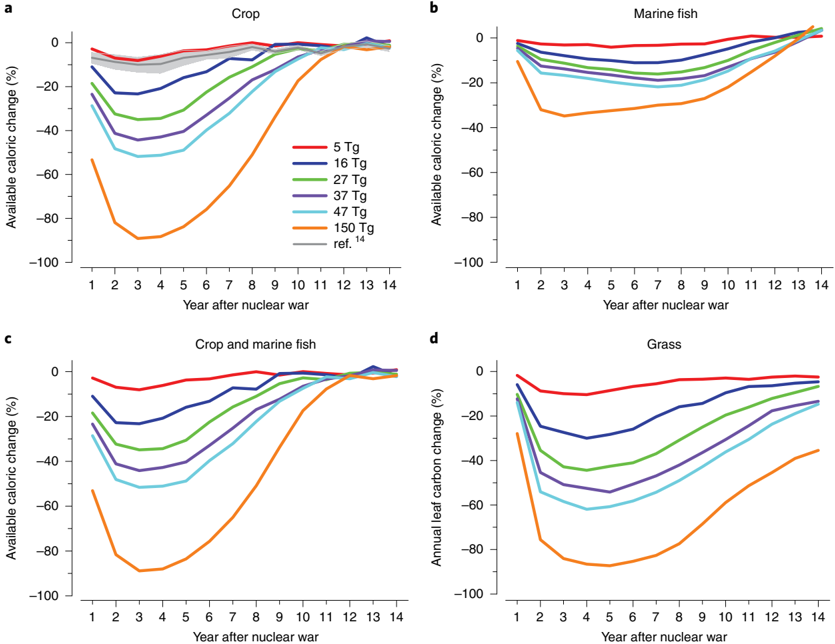
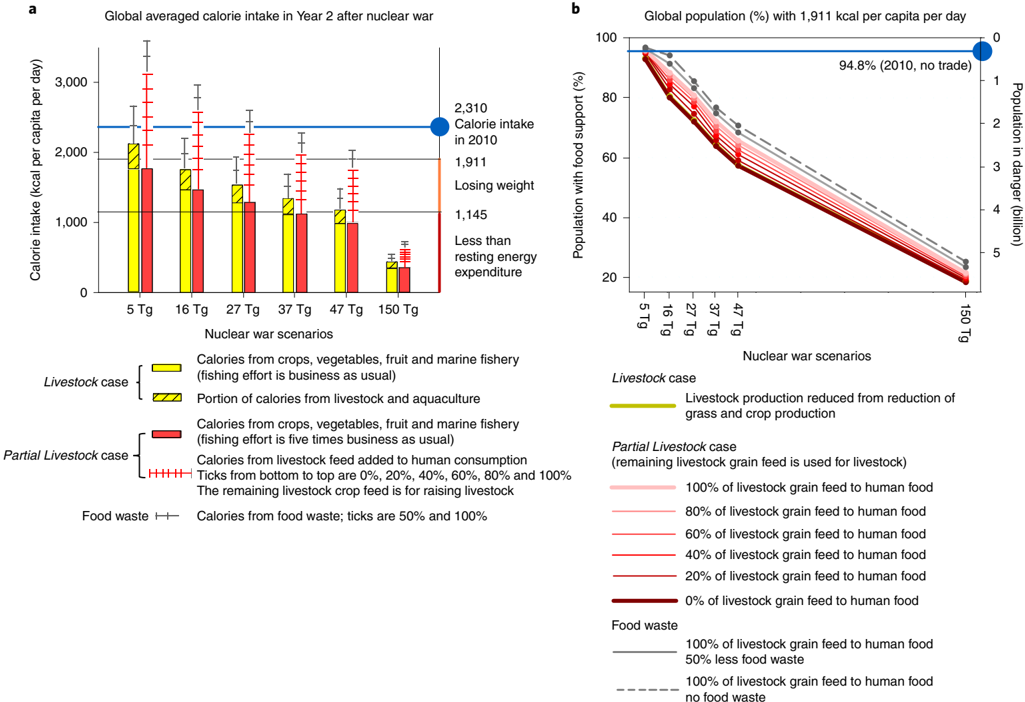
- Global average calorie production from the simulated crops fell by 7% in years 1–5 after the war even in the smallest 5 Tg soot scenario, by up to 50% in the 47 Tg scenario, and by around 90% in the 150 Tg scenario 3–4 years after the war.
- Marine wild-capture fisheries were affected less than land agriculture, but still declined: oceanic net primary productivity fell from 3% in the 5 Tg case to 37% in the 150 Tg case; marine wild capture fisheries contributed 0.5% of total calories and 3.5% of global average protein supply.
- Table 1 reports the number of people without food at the end of Year 2 as 255 million (5 Tg), 926 million (16 Tg), 1.426 billion (27 Tg), 2.081 billion (37 Tg), 2.512 billion (47 Tg), and 5.341 billion (150 Tg).
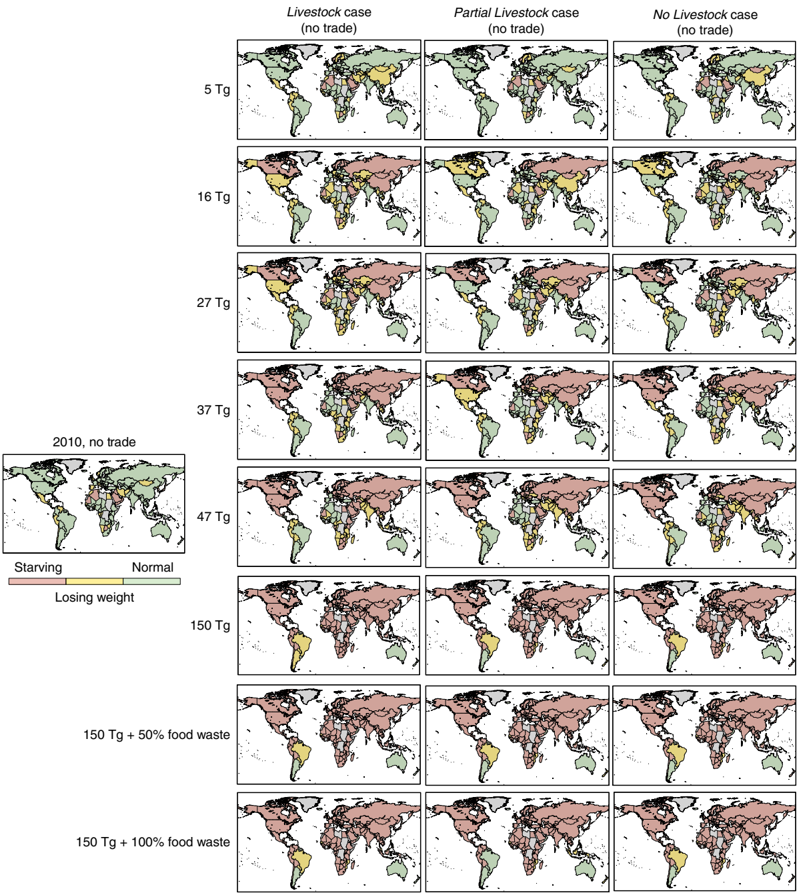
- Under the most optimistic assumptions discussed, global food could still be enough for everyone in the 47 Tg case if food were evenly distributed and 100% of livestock feed were converted to human food with no household waste; under the 150 Tg case, most countries would have less than 25% of the population survive by the end of Year 2.
## Methods
- The study used a state-of-the-art global climate model (CESM) to simulate climate and biogeochemical changes from six stratospheric soot injection scenarios, then forced a crop model (CLM5crop) for major crops and a marine fisheries model (BOATS) for ocean fish production.
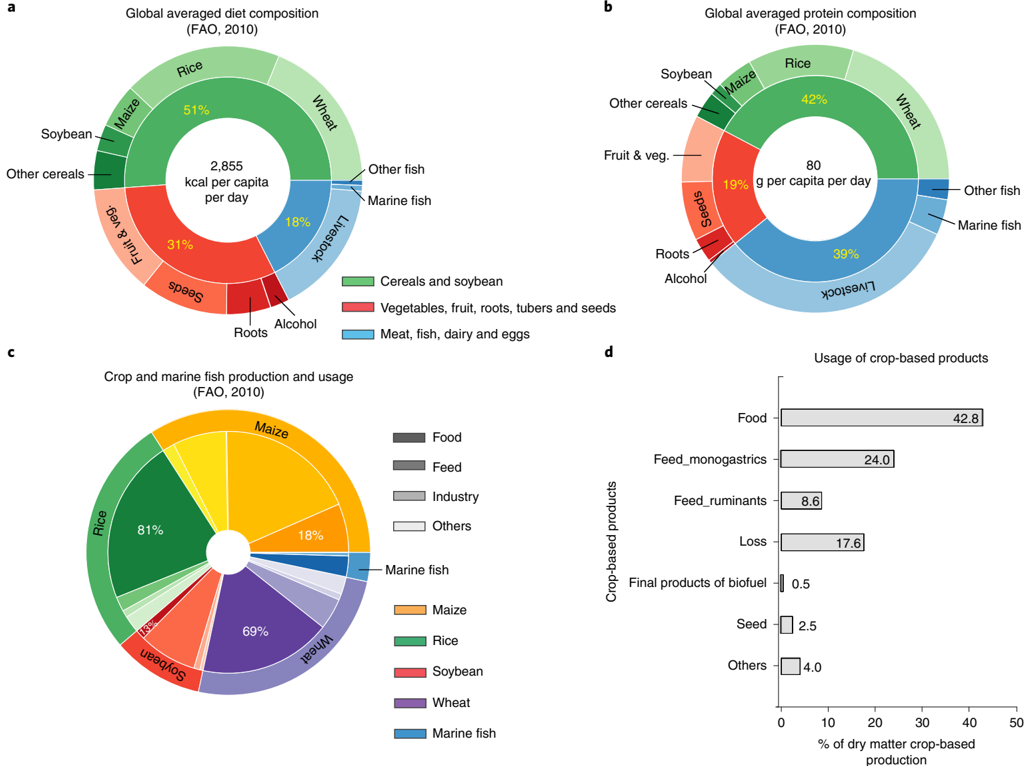
- The food system analysis combined simulated changes in maize, rice, soybean, spring wheat, marine fish, livestock, aquaculture, food trade, and household waste to estimate country-level calorie availability after nuclear war.
- The paper considered three food-system response cases: Livestock, Partial Livestock, and No Livestock, and assumed no international trade in the main no-trade analyses.
## Limitations
- The authors explicitly state they did not model reduced human populations from direct or indirect mortality, reduced birth rates, farm-management adaptations, alternative food sources, or adaptation in fisheries.
- They also did not consider several important impacts the text names, including surface ozone, ultraviolet radiation, radioactive contamination, pollinator effects, killing frost, and freshwater availability; this is stated in the Methods/Discussion as outside the scope.
- Evident from the text: the analysis relies on one Earth system model, one crop model, and one fishery model, with only one ensemble member for soot cases above 5 Tg, so model-structure uncertainty is substantial.
Model-written summary. Check it against the paper before relying on it.
Integrity signals
Registry
Cites
Statistics
Figures

Verification
Claims the paper makes
8 Valid · 4 Not valid · 9 Not checked · 70 Own results and interpretations
The cited sources support only part of this claim — read each source’s verdict below.
In the paper
“Nuclear war would reduce the wild fish catch 15”
What the sources say
- Partly supportedcites [15] 15. Scherrer, K. J. N. et al. Marine wild-capture fisheries after nuclear war. Proc. Natl Acad. Sci. USA 117 , 29748-29758 (2020). sourceExperimental — accuracy not yet measured
The Results (‘Initial Impacts on Catch and Biomass’; page not provided) report that global catches fall under business-as-usual fishing after the modeled nuclear conflicts. But they also report initial catch increases when postwar fishing intensifies, so the unqualified claim that nuclear war would reduce wild fish catch overstates the findings. (LLM, conf=0.88)
hedgedstates a cause- Asserted: passes — The authors put it forward as true.
- Checkable: passes — It can be checked against evidence.
- Load-bearing: passes — The paper’s conclusions depend on it.
- Based: passes — The paper gives a reason why it holds.
- Partly supported
The cited sources support only part of this claim — read each source’s verdict below.
In the paper
“So far, an integrated estimate of the impacts of the entire range of war scenarios on both land- and ocean-based food production is missing.”
What the sources say
- Not checked — no full text of the sourcecites [12] 12. Xia, L. & Robock, A. Impacts of a nuclear war in South Asia on rice production in mainland China. Climatic Change 116 , 357-372 (2013). source
- Not checked — no full text of the sourcecites [13] 13. Özdoğan, M., Robock, A. & Kucharik, C. Impacts of a nuclear war in South Asia on soybean and maize production in the Midwest United States. Climatic Change 116 , 373-387 (2013). source
- Partly supportedcites [14] 14. Jägermeyr, J. et al. A regional nuclear conflict would compromise global food security. Proc. Natl Acad. Sci. USA 117 , 7071-7081 (2020). sourceExperimental — accuracy not yet measured
The Significance section (p. 1) identifies a gap in assessing how nuclear-war-related crop losses affect global food trade. But this paper examines a regional conflict and major land crops; it does not establish that an integrated estimate is missing across the entire range of war scenarios and both land- and ocean-based food production. (LLM, conf=0.85)
- Supportedcites [15] 15. Scherrer, K. J. N. et al. Marine wild-capture fisheries after nuclear war. Proc. Natl Acad. Sci. USA 117 , 29748-29758 (2020). source
The Abstract describes crop-production estimates separately from this paper’s modeling of fish catches across six war scenarios. The Discussion (Food System Linkages; page not provided) says further investigation of the interdependencies between fishing, aquaculture, and the rest of food production is needed, supporting the claim that an integrated estimate is missing. (LLM, conf=0.88)
plain- Asserted: passes — The authors put it forward as true.
- Checkable: passes — It can be checked against evidence.
- Load-bearing: passes — The paper’s conclusions depend on it.
- Based: passes — The paper gives a reason why it holds.
The cited sources support only part of this claim — read each source’s verdict below.
In the paper
“Although CLM5crop does not simulate winter wheat, we assume winter wheat production is changed by the same amount as spring wheat, which has been found in other studies 14 ; however, this may underestimate the winter wheat response, because winter wheat would experience colder temperatures during its growing period that would be more likely to cross critical thresholds 14 .”
What the sources say
- Partly supportedcites [14] 14. Jägermeyr, J. et al. A regional nuclear conflict would compromise global food security. Proc. Natl Acad. Sci. USA 117 , 7071-7081 (2020). sourceExperimental — accuracy not yet measured
Split into 2 atoms — 1 confirmed, 1 partially supported, 0 disputed, 0 misattributed, 0 unverifiable. Expand the claim to see per-atom verdicts.
hedgedstates a possible cause- Asserted: passes — The authors put it forward as true.
- Checkable: passes — It can be checked against evidence.
- Load-bearing: unclear — It is unclear whether the paper’s conclusions depend on it.
- Based: passes — The paper gives a reason why it holds.
- Rests on an assumption not shown here.
- Partly supported
The cited sources that could be checked couldn’t confirm or dispute this claim.
In the paper
“CLM5crop compares well with other crop models in response to nuclear war forcing 14 (Supplementary Fig. 2).”
What the sources say
- Could not verifycites [14] 14. Jägermeyr, J. et al. A regional nuclear conflict would compromise global food security. Proc. Natl Acad. Sci. USA 117 , 7071-7081 (2020). sourceExperimental — accuracy not yet measured
The Crop Yield Simulations section (p. 9) names the six crop models studied; CLM5crop is not among them. A search for CLM5crop found no passage comparing its response to nuclear-war forcing with that of other models. (LLM, conf=0.75)
plain- Asserted: passes — The authors put it forward as true.
- Checkable: passes — It can be checked against evidence.
- Load-bearing: unclear — It is unclear whether the paper’s conclusions depend on it.
- Based: passes — The paper gives a reason why it holds.
- Could not verify
A result the paper states — it cites no source for it, so there is none to check. The quote shows it is in the paper.
In the paper
“but the reduction would be less than for land agriculture (Fig. 2b)”
hedgedstates a cause- Asserted: passes — The authors put it forward as true.
- Checkable: passes — It can be checked against evidence.
- Load-bearing: unclear — It is unclear whether the paper’s conclusions depend on it.
- Based: passes — The paper gives a reason why it holds.
49 more claims
Create a free account to see all 91 claims and to verify the 2 references still open.
- It may state two separate claims as one. 21
- Probably not a substantial claim. 21
Claims other papers make about this one
Each is checked against this paper’s own text: does it say what the citing paper says it does?
The source backs part of the claim, not all of it — or backs it for a different population, condition or comparison.
In the citing paper
“Even a ' limited ' nuclear war involving only 250 of the 13,000 nuclear weapons in the world could kill 120 million people outright and cause global climate disruption leading to a nuclear famine, putting two billion people at risk [7, 8].”
From Reducing the Risks of Nuclear War. (2023) · cites this paper as [8]
Experimental — accuracy not yet measuredThe cited source says what the claim attributes to it.
In the citing paper
“Even a ' limited ' nuclear war involving only 250 of the 13,000 nuclear weapons in the world could kill 120 million people outright and cause global climate disruption leading to a nuclear famine, putting two billion people at risk [7, 8].”
From Reducing the Risks of Nuclear War. (2023) · cites this paper as [8]
The cited source says what the claim attributes to it.
In the citing paper
“A large scale nuclear war between the US and Russia could kill 200 million people or more in the near term and potentially cause a global ' nuclear winter ' that could kill 5 -6 billion people, threatening the survival of humanity [7, 8].”
From Reducing the Risks of Nuclear War. (2023) · cites this paper as [8]
Citations
Cites
The State of World Fisheries and Aquaculture 2020
(2020) · doi:10.4060/ca9229en · Cited by 3,167
The Community Earth System Model: A Framework for Collaborative Research
Hurrell, J. W., Holland, M. M., Gent, P. R., Ghan, S., Kay, J. E., Kushner, P. J., Lamarque, J.-F., Large, W. G., Lawrence, D., Lindsay, K., et al. (2013) · Bulletin of the American Meteorological Society · doi:10.1175/bams-d-12-00121.1 · Cited by 2,686
Lawrence, D. M., Fisher, R. A., Koven, C. D., Oleson, K. W., Swenson, S. C., Bonan, G., Collier, N., Ghimire, B., van Kampenhout, L., Kennedy, D., et al. (2019) · Journal of Advances in Modeling Earth Systems · doi:10.1029/2018ms001583 · Cited by 2,060
Climate Change from 1850 to 2005 Simulated in CESM1(WACCM)
Marsh, D. R., Mills, M. J., Kinnison, D. E., Lamarque, J.-F., Calvo, N., & Polvani, L. M. (2013) · Journal of Climate · doi:10.1175/jcli-d-12-00558.1 · Cited by 1,081 · cited 1×
“40 ).”
Livestock: On our plates or eating at our table? A new analysis of the feed/food debate
Mottet, A., de Haan, C., Falcucci, A., Tempio, G., Opio, C., & Gerber, P. (2017) · Global Food Security · doi:10.1016/j.gfs.2017.01.001 · Cited by 1,034 · cited 1×
“For global calculations for livestock, we assume that 46% are fed by pasture and 54% are fed by crops and processed products 48 and use national-level data 26 to calculate reduction of livestock feed from pasture and crop-based products.”
MethodNuclear Winter: Global Consequences of Multiple Nuclear Explosions
Turco, R. P., Toon, O. B., Ackerman, T. P., Pollack, J. B., & Sagan, C. (1983) · Science · doi:10.1126/science.222.4630.1283 · Cited by 825
Self-citationBlack carbon lofts wildfire smoke high into the stratosphere to form a persistent plume
Yu, P., Toon, O. B., Bardeen, C. G., Zhu, Y., Rosenlof, K. H., Portmann, R. W., Thornberry, T. D., Gao, R.-S., Davis, S. M., Wolf, E. T., et al. (2019) · Science · doi:10.1126/science.aax1748 · Cited by 363
Self-citationPeterson, D. A., Fromm, M. D., McRae, R. H. D., Campbell, J. R., Hyer, E. J., Taha, G., Camacho, C. P., Kablick, G. P., Schmidt, C. C., & DeLand, M. T. (2021) · npj Climate and Atmospheric Science · doi:10.1038/s41612-021-00192-9 · Cited by 236
Bodirsky, B. L., Dietrich, J. P., Martinelli, E., Stenstad, A., Pradhan, P., Gabrysch, S., Mishra, A., Weindl, I., Le Mouël, C., Rolinski, S., et al. (2020) · Scientific Reports · doi:10.1038/s41598-020-75213-3 · Cited by 231 · cited 4×
“All food commodity trade calculations are based on the 2010 FAO Commodity Balance Sheet (FAO-CBS), FAO-FBS and processed data from previous studies 24,27,28,47 .”
BackgroundMethodInfluentialSelf-citationHigh‐latitude eruptions cast shadow over the African monsoon and the flow of the Nile
Oman, L., Robock, A., Stenchikov, G. L., & Thordarson, T. (2006) · Geophysical Research Letters · doi:10.1029/2006gl027665 · Cited by 211
Self-citation
Research works printed but not linked: 7
- 3. Stommel, H. & Stommel, E. Volcano Weather; The Story of 1816, The Year Without a Summer (Seven Seas Press, 1983).
- 5. Aleksandrov, V. V . & Stenchikov, G. L. On the modeling of the climatic consequences of the nuclear war. Proc. Applied Math (Computing Centre of the USSR Academy of Sciences, 1983).
- 11. Cropper Jr., W . P . & Harwell, M. A. in Environmental Consequences of Nuclear War, SCOPE 28, Volume II Ecological and Agricultural Effects , 2nd Edn (eds Harwell, M. A. & Hutchinson, T. C.) Ch. 5 (Wiley, 1989).
- 10. Harwell, M. A. & Cropper Jr., W . P . in Environmental Consequences of Nuclear War, SCOPE 28, Volume II Ecological and Agricultural Effects , 2nd Edn (eds Harwell, M. A. & Hutchinson, T. C.) Ch. 4 (Wiley, 1989).
- 22. Ambio Advisory Group, Reference scenarios: How a nuclear war might be fought, in Nuclear War: The Aftermath (ed Peterson, J.) Ch. 3 (Pergamon Press, 1983).
- 29. National Research Council, Energy, in Recommended Dietary Allowances, 10th Edn Ch. 3 (US National Academies Press, 1989).
- 32. Denkenberger, D., Pearce, J. M. Feeding Everyone No Matter What: Managing Food Security After Global Catastrophe (Academic Press, 2014).
Cited by
Ahmed, Z., Gui, D., Murtaza, G., Yunfei, L., & Ali, S. (2023) · Agronomy · doi:10.3390/agronomy13082113 · Cited by 187
Opinion: How fear of nuclear winter has helped save the world, so far
Robock, A. D., Xia, L., Harrison, C. S., Coupe, J., Toon, O. B., & Bardeen, C. (2023) · Atmospheric chemistry and physics · doi:10.5194/acp-23-6691-2023 · Cited by 129
Self-citationReducing the risks of nuclear war
Abbasi, K. A., Ali, P. A., Barbour, V., Bibbins-Domingo, K. B., Rikkert, M. G. M. O., Haines, A., Helfand, I., Horton, R. C., Mash, R. J., Mitra, A., et al. (2023) · BMJ · doi:10.1136/bmj.p1682 · Cited by 132
How the War in Ukraine Affects Food Security
Filho, W. L., Fedoruk, M., Eustachio, J. H. P. P., Barbir, J., Lisovska, T., Lingos, A., & Baars, C. (2023) · Foods · doi:10.3390/foods12213996 · Cited by 185
International risk of food insecurity and mass mortality in a runaway global warming scenario
Richards, C. E., Gauch, H. L., & Allwood, J. M. (2023) · Futures · doi:10.1016/j.futures.2023.103173 · Cited by 57
Rahut, D. B., Mishra, R., & Bera, S. (2023) · Nutrition · doi:10.1016/j.nut.2023.112346 · Cited by 105
Redox Regulation by Priming Agents Toward a Sustainable Agriculture
Tripathi, D. K., Bhat, J. A., Antoniou, C., Kandhol, N., Singh, V. P., Fernie, A. R., & Fotopoulos, V. (2024) · Plant and Cell Physiology · doi:10.1093/pcp/pcae031 · Cited by 55
“Human activities such as industrialization and urbanization (Nagajyoti et al. 2010) and climate change have led to further environmental deterioration, thereby decreasing crop yields and leading to food shortages (Calleja-Cabrera et al. 2020, Xia et al. 2022, Alsafadi et al. 2023).”
BackgroundMoersdorf, J., Rivers, M., Denkenberger, D., Breuer, L., & Jehn, F. U. (2023) · Global Challenges · doi:10.1002/gch2.202300206 · Cited by 55
Agriculture, food security, and sustainability: a review
Islam, S. (2025) · Exploration of Foods and Foodomics · doi:10.37349/eff.2025.101082 · Cited by 94
Xu, Z., Qayum, M., Afzal, J., & Aslam, M. (2023) · Heliyon · doi:10.1016/j.heliyon.2023.e22549 · Cited by 67
Pham, A., Martínez, J. B. G., Brynych, V., Stormbjorne, R., Pearce, J. M., & Denkenberger, D. (2022) · Nutrients · doi:10.3390/nu14030492 · Cited by 37
Stäger, F., Zok, D., Schiller, A.-K., et al. (2023) · Environmental Science & Technology · doi:10.1021/acs.est.3c03565 · Cited by 31
Island refuges for surviving nuclear winter and other abrupt sunlight‐reducing catastrophes
Boyd, M., & Wilson, N. (2022) · Risk Analysis · doi:10.1111/risa.14072 · Cited by 49
AIoT based soil nutrient analysis and recommendation system for crops using machine learning
Cheema, S. M., & Pires, I. M. (2025) · Smart Agricultural Technology · doi:10.1016/j.atech.2025.100924 · Cited by 49
Zhan, C., Liang, C., Zhao, L., Jiang, S., & Zhang, Y. (2023) · The Science of The Total Environment · doi:10.1016/j.scitotenv.2023.167559 · Cited by 28
Wilson, N., Valler, V., Cassidy, M., Boyd, M., Mani, L., & Brönnimann, S. (2023) · Scientific Reports · doi:10.1038/s41598-023-30729-2 · Cited by 29
Biodiversity, peace and conflict: understanding the connections
Rist, L., Norström, A. V., & Queiroz, C. (2024) · Current Opinion in Environmental Sustainability · doi:10.1016/j.cosust.2024.101431 · Cited by 38
Xiong, J., Zhang, B., Liang, Z., Zhao, X., Yang, Y., Chen, X., Wu, J. F., Yang, J., Fang, Y., Pan, C., et al. (2024) · Environmental Science & Technology · doi:10.1021/acs.est.4c01001 · Cited by 24
Seaweed as a Resilient Food Solution After a Nuclear War
Jehn, F. U., Dingal, F. J., Mill, A., Harrison, C. S., Ilin, E., Roleda, M. Y., James, S. C., & Denkenberger, D. (2024) · Earth s Future · doi:10.1029/2023ef003710 · Cited by 25
“In a less severe nuclear war with 47 Tg of soot, production is reduced by around 50% (Xia et al., 2022).”
BackgroundInfluentialSelf-citationNegative social tipping dynamics resulting from and reinforcing Earth system destabilization
Spaiser, V., Juhola, S. K., Constantino, S. M., Guo, W., Watson, T., Sillmann, J., Craparo, A., Basel, A. M., Bruun, J. T., Krishnamurthy, P. K., et al. (2024) · Earth System Dynamics · doi:10.5194/esd-15-1179-2024 · Cited by 33
Global food expenditure patterns diverge between low-income and high-income countries
Liang, W., Sivashankar, P., Hua, Y., & Li, W. (2024) · Nature Food · doi:10.1038/s43016-024-01012-y · Cited by 25
“The implications of these findings extend to policy considerations, as they offer indicators of expenditure patterns and the pace of convergence, both of which can serve as valuable predictors of future food demand 12,40 .”
Malm, A. (2022) · Historical Materialism · doi:10.1163/1569206x-20222369 · Cited by 34
Boyd, M., Ragnarsson, S., Terry, S., Payne, B., & Wilson, N. (2024) · Risk Analysis · doi:10.1111/risa.14297 · Cited by 20
“Such processes could cool the planet and increase the number of frost days (Coupe et al., 2019; Jagermeyr et al., 2020; Xia et al., 2022).”
(Re)integrating radioactive materials and waste into a global sustainable development context
Wimmers, A., Böse, F., Beppler, J., Morawe, P., Weber, M., & von Hirschhausen, C. (2024) · Radiation and Environmental Biophysics · doi:10.1007/s00411-024-01088-x · Cited by 16
“The Russian attack on Ukraine has resurfaced the long subdued possibility and risks of nuclear fallout which would have social but also global environmental implications (Sch-neider et al. 2022; Xia et al. 2022).”
MCD-Yolov5: Accurate, Real-Time Crop Disease and Pest Identification Approach Using UAVs
Li, L., Zhao, H., & Liu, N. (2023) · Electronics · doi:10.3390/electronics12204365 · Cited by 20
Maladaptation in cereal crop landraces following a soot-producing climate catastrophe
McLaughlin, C. M., Shi, Y., Viswanathan, V., Sawers, R. J. H., Kemanian, A. R., & Lasky, J. R. (2025) · Nature Communications · doi:10.1038/s41467-025-59488-6 · Cited by 17
Li, C., Gráda, C. Ó., & Lumey, L. H. (2024) · BMJ Global Health · doi:10.1136/bmjgh-2024-015355 · Cited by 20
Wilson, N., Payne, B., & Boyd, M. (2023) · Scientific Reports · doi:10.1038/s41598-023-35354-7 · Cited by 14
Multi-disciplinary strategy to optimize irrigation efficiency in irrigated agriculture
Batisha, A. F. (2024) · Scientific Reports · doi:10.1038/s41598-024-61372-0 · Cited by 21
Rivers, M., Hinge, M., Rassool, K., Blouin, S., Jehn, F. U., Martínez, J. B. G., Grilo, V. A., Jaeck, V., Tieman, R. J., Mulhall, J., et al. (2024) · Global Food Security · doi:10.1016/j.gfs.2024.100807 · Cited by 22
Deployment of Resilient Foods Can Greatly Reduce Famine in an Abrupt Sunlight Reduction ScenarioPreprint
Rivers, M., Hinge, M., Martínez, J. B. G., Tieman, R. J., Jaeck, V., Butt, T. E., & Denkenberger, D. (2022) · Research Square · doi:10.21203/rs.3.rs-1446444/v1 · Cited by 17
Public health and nuclear winter: addressing a catastrophic threat
Vilhelmsson, A., & Baum, S. D. (2023) · Journal of Public Health Policy · doi:10.1057/s41271-023-00416-7 · Cited by 11
“The intensity of the effects also depends on the war itself: larger nuclear wars cause more intense envi‐ ronmental change [5].”
BackgroundHao, L., Yu, J., Wang, P., Han, C., Gojenko, B., Qu, B., Jiang, E., & Muminov, S. (2024) · Journal of Hydrology · doi:10.1016/j.jhydrol.2024.130997 · Cited by 14
Hope in a Warming World: Rereading Adorno on Progress
Frelek, A. (2025) · New German Critique · doi:10.1215/0094033x-11503213 · Cited by 11
The Impact of Abrupt Sunlight Reduction Scenarios on Renewable Energy Production
Varne, A. R., Blouin, S., Williams, B., & Denkenberger, D. (2024) · Energies · doi:10.3390/en17205147 · Cited by 18
“However, conventional crop production could be reduced by up to 89% in an ASRS (Xia et al., 2022).”
BackgroundEnhancing sustainability in meat production through insect biorefinery
Kim, J. Y., Park, J., Lee, D.-J., Choi, Y., Choi, Y., Park, W.-K., Koo, B., Park, K., Lee, D., & Kwon, E. E. (2025) · npj Science of Food · doi:10.1038/s41538-025-00434-7 · Cited by 15
Looking beyond calories—when food quality and sourcing matters
Novotny, I. P., Lefeuvre, N. B., Stoudmann, N., Dray, A. G., García, C., & Waeber, P. O. (2022) · Journal of Cleaner Production · doi:10.1016/j.jclepro.2022.135482 · Cited by 13
“Caloric intake is commonly used as a proxy for food security in the literature (Abarca-G ´ omez et al., 2017; Cassidy et al., 2013; FAO, 2016; Fones et al., 2020; Nechifor et al., 2021; Xia et al., 2022), with FAO promoting its use through its reports since the 1970s (Ickowitz et al., 2019).”
The false promise of nuclear risk reduction
Pélopidas, B., & Egeland, K. (2023) · International Affairs · doi:10.1093/ia/iiad290 · Cited by 10
(2023) · doi:10.29333/ejosdr/12936 · Cited by 10
“The planet earth is probably seeing its worst days after civilization has started as climate (Carrington, 2022) and economic crisis (Georgieva, 2022), along with global conflicts (Xia et al., 2022) are reaching their top.”
BackgroundNutritional Composition of Post‐Catastrophic Foods
Mather, T., Siva, N., Jauregui, M., Poudel, P., Brossi, M. J. D. L., Lambert, J. D., Gioia, F. D., Connolly, E. L., & Anderson, C. T. (2024) · Current Protocols · doi:10.1002/cpz1.1110 · Cited by 8
Martínez, J. B. G., Behr, J., Pearce, J. M., & Denkenberger, D. (2025) · Critical Reviews in Food Science and Nutrition · doi:10.1080/10408398.2024.2431207 · Cited by 25
“Without proper planning and preparation, billions could die of starvation (Xia et al. 2022).”
InfluentialDisentangling the Nexus of Nuclear Weapons and Climate Change—A Research Agenda
Egeland, K. (2025) · International Studies Review · doi:10.1093/isr/viaf003 · Cited by 10
Ending nuclear weapons, before they end us
Abbasi, K. A., Ali, P. A., Barbour, V., Birch, M., Blum, I., Doherty, P. C., Haines, A., Helfand, I., Horton, R. C., Juva, K., et al. (2025) · BMJ · doi:10.1136/bmj.r881 · Cited by 19
Seaweed cultivation: a cost-effective strategy for food production in a global catastrophe
Hinge, M., Grilo, V. A., Jehn, F. U., Martínez, J. B. G., Dingal, F. J., Roleda, M. Y., & Denkenberger, D. (2025) · Aquaculture International · doi:10.1007/s10499-025-01978-x · Cited by 18
“These events vary in their magnitudes and duration; however, any ASRS would have a catastrophic impact on the global food system (Xia et al. 2022), with the shock potentially lasting for over a decade.”
The state of global catastrophic risk research: a bibliometric review
Jehn, F. U., Engler, J., Arnscheidt, C. W., Wache, M., Ilin, E., Cook, L., Sundaram, L. S., Hanusch, F., & Kemp, L. (2025) · Earth System Dynamics · doi:10.5194/esd-16-1053-2025 · Cited by 17
Sudden Reduction of Antarctic Sea Ice Despite Cooling After Nuclear War
Coupe, J., Harrison, C. S., Robock, A. D., DuVivier, A. K., Maroon, E. A., Lovenduski, N. S., Bachman, S., Landrum, L., & Bardeen, C. (2023) · Journal of Geophysical Research Oceans · doi:10.1029/2022jc018774 · Cited by 7
Self-citationZhou, K., Chen, L., Wu, J., et al. (2024) · Clean Technologies and Environmental Policy · doi:10.1007/s10098-024-02765-7 · Cited by 9
“Some studies analyze carbon emissions from planting (Xu and Lin 2017), fishing (Xia et al. 2022), forestry (Cheng et al. 2023), animal husbandry (Bai et al., 2018; Wang et al. 2022a, b, c), and agricultural land resources (He et al. 2021; Koondhar et al. 2021).”
Lime Chemical Stabilization of Expansive Deposits Exposed at El-Kawther Quarter, Sohag Region, Egypt
Ismaiel, H. A. H., & Badry, M. M. (2013) · Geosciences · Cited by 9
Quan, Q., Wang, M., Jiao, J., et al. (2024) · Journal of Applied Mathematics and Computing · doi:10.1007/s12190-024-02081-9 · Cited by 8
Extinction of the human species: What could cause it and how likely is it to occur?
hÉigeartaigh, S. Ó. (2025) · Cambridge Prisms Extinction · doi:10.1017/ext.2025.4 · Cited by 14
“Xia et al. (2022) estimate that over 2 billion people could die from nuclear war between Pakistan and India and over 5 billion between Russia and the USA.”
Crafting a resilient and sustainable future amid major crises
Elsamadony, M., Pileggi, S. F., Liu, J., & Fujii, M. (2025) · Journal of Cleaner Production · doi:10.1016/j.jclepro.2025.145583 · Cited by 11
Five levels of famine prevention: towards a framework for the twenty‐first century and beyond
Howe, P. W., Fitzpatrick, M., & Maxwell, D. (2024) · Disasters · doi:10.1111/disa.12668 · Cited by 10
Prediction and Analysis of Nuclear Explosion Radioactive Pollutant Diffusion Model
Zheng, Y., Liu, W., Li, X., Yang, M., Li, P., Wu, Y., & Chen, X. (2023) · Pollutants · doi:10.3390/pollutants3010004 · Cited by 8
“If a nuclear war were to break out, it would cause global climate change [6] and unrecoverable disturbances to the marine environment [7], thus affecting agriculture, fisheries, and animal husbandry, and ultimately causing a globalized food problem [8,9] with devastating consequences for the world.”
BackgroundWilson, N., Prickett, M., & Boyd, M. (2022) · medRxiv · doi:10.1101/2022.05.13.22275065 · Cited by 7
Adapting agriculture to climate catastrophes: the nuclear winter case
Shi, Y., Montes, F., Gioia, F. D., Xia, L., Bardeen, C., Anderson, C. T., Gil, Y., Khider, D., Ratnakar, V., & Kemanian, A. R. (2025) · Environmental Research Letters · doi:10.1088/1748-9326/adcfb5 · Cited by 23
Self-citationIt's time to consider global catastrophic food failures
Wescombe, N. J., Martínez, J. B. G., Jehn, F. U., Wunderling, N., Tzachor, A., Sandström, V., Cassidy, M., Ainsworth, R., & Denkenberger, D. (2025) · Global Food Security · doi:10.1016/j.gfs.2025.100880 · Cited by 12
Global patterns of commodity-driven deforestation and associated carbon emissions
Singh, C., & Persson, U. M. (2026) · Nature Food · doi:10.1038/s43016-026-01305-4 · Cited by 34
“Moreover, given that nearly half of the global average human diet consists of staple commodities 51 , and their cultivation is expected to increase to feed the growing population 52 , incorporating staple crops into deforestation monitoring and regulatory frameworks will be vital for curbing global…”
Forecasting Costs of U.S. Ballistic Missile Defense Against a Major Nuclear Strike
Morić, I., & Kadyshev, T. (2024) · Defence and Peace Economics · doi:10.1080/10242694.2024.2396415 · Cited by 6
“However, while the cost of any war is great, the cost of nuclear war is greater still, with little known about its long-term effects such as significant climate changes it would inevitably produce (Xia et al. 2022).”
Reducing the Risks of Nuclear War—The Role of Health Professionals
Abbasi, K. A., Ali, P. A., Barbour, V., Bibbins-Domingo, K. B., Rikkert, M. G. M. O., Horton, R. C., Mash, R., Monteiro, C. A., Naumova, E. N., Rubin, E. J., et al. (2023) · International Journal of Health Policy and Management · doi:10.1111/aogs.14650 · Cited by 6
Reducing the Risks of Nuclear War — The Role of Health Professionals
Abbasi, K. A., Ali, P. A., Barbour, V., Bibbins-Domingo, K. B., Rikkert, M. G. M. O., Haines, A., Helfand, I., Horton, R. C., Mash, R. J., Mitra, A., et al. (2023) · New England Journal of Medicine · doi:10.1056/nejmp2308547 · Cited by 6
Phthalic acid derivatives: Sources and effects on the human body
Sobolevskaya, M. P., Виткина, Т. И., & Cherenkov, D. N. (2024) · Russian Open Medical Journal · doi:10.15275/rusomj.2024.0407 · Cited by 4
Nuclear war between two nations could spark global famine
Witze, A. (2022) · Nature · doi:10.1038/d41586-022-02219-4 · Cited by 5
Mohiuddin, A. K. (2023) · American Journal of Biopharmacy and Pharmaceutical Sciences · doi:10.25259/ajbps_21_2022 · Cited by 11
Siva, N., & Anderson, C. T. (2024) · Food Science & Nutrition · doi:10.1002/fsn3.4358 · Cited by 4
“All these environmental changes could create an unfavorable environment for crop production, ultimately leading to mass starvation for survivors of the initial event (Xia et al., 2022).”
Backgroundvan Buuren, S., Fraise, T., & Pélopidas, B. (2025) · Futures · doi:10.1016/j.futures.2025.103671 · Cited by 7
Systemic contributions to global catastrophic risk
Arnscheidt, C. W., Beard, S., Hobson, T., Ingram, P., Kemp, L., Mani, L., Marcoci, A., Mbeva, K., hÉigeartaigh, S. Ó., Sandberg, A., et al. (2025) · Global Sustainability · doi:10.1017/sus.2025.20 · Cited by 9
“The effects of nuclear war could be amplified by subsequent global cooling, leading to large-scale global starvation (Xia et al., 2022).”
Yield and Toxin Analysis of Leaf Protein Concentrate from Common North American Coniferous Trees
Mottaghi, M., Meyer, T. K., Tieman, R. J., Denkenberger, D., & Pearce, J. M. (2023) · Biomass · doi:10.3390/biomass3020011 · Cited by 6
“Introduction In the event of a naturally occurring abrupt sunlight reduction scenario (ASRS), such as super volcanic eruption and asteroid or comet impact [1], or an anthropogenic cause, such as large-scale nuclear winter [2], numerical simulations indicate an anticipated reduction in crop-produced food calories of 90…”
BackgroundJohn Launer: Nuclear war—it’s time to face up to the risks
Launer, J. (2023) · BMJ · doi:10.1136/bmj.p1540 · Cited by 4
Time to stop playing: No game studies on a dead planet
Hammar, E. L., Jong, C., & Despland-Lichtert, J. (2023) · Eludamos Journal for Computer Game Culture · doi:10.7557/23.7109 · Cited by 25
Open-Source Flexible Material Tensile Testing Apparatus
Woods, M., Nauta, N., & Pearce, J. M. (2024) · Hardware · doi:10.3390/hardware2010002 · Cited by 4
Even a small nuclear war threatens food security
Ray, D. K. (2022) · Nature Food · doi:10.1038/s43016-022-00575-y · Cited by 4
Graham, J., Boyd, M., Sadler, G., & Noetel, M. (2025) · SSRN Electronic Journal · doi:10.2139/ssrn.5253625 · Cited by 6
Food trade disruption after global catastrophes
Jehn, F. U., Gajewski, Ł. G., Hedlund, J., Arnscheidt, C. W., Xia, L., Wunderling, N., & Denkenberger, D. (2025) · Earth System Dynamics · doi:10.5194/esd-16-1585-2025 · Cited by 23
“Beyond this, even sophisticated modelling efforts like Xia et al. (2022) have limitations – they did not account for several factors that could further impact agriculture after nuclear war, such as changes in irrigation water availability, increased surface ozone levels, ultraviolet light damage,…”
InfluentialSelf-citationCuellar, J. E. L., Palm, R., Denkenberger, D. C., & Jehn, F. U. (2025) · Water Security · doi:10.1016/j.wasec.2025.100193 · Cited by 5
Bridging a gap: Analyzing radioactive materials within the planetary boundary framework
Böse, F., Neugebauer, J., Lösel, T., Nickel, M.-S., Wimmers, A., & von Hirschhausen, C. (2026) · Ecological Economics · doi:10.1016/j.ecolecon.2026.108971 · Cited by 5
Xu, Y., Ribar, N. P., Schade, G. W., Lockley, A., Zhang, Y., Sachnik, J., Yu, P., Hu, J., & Velders, G. J. M. (2024) · Atmosphere · doi:10.3390/atmos15111322 · Cited by 4
Reducing the Risks of Nuclear War—the Role of Health Professionals
Abbasi, K. A., Ali, P. A., Barbour, V., Bibbins-Domingo, K. B., Rikkert, M. G. M. O., Haines, A., Helfand, I., Horton, R. C., Mash, R. J., Mitra, A., et al. (2023) · ESC Heart Failure · doi:10.1002/ehf2.14502 · Cited by 2
Reducing the Risks of Nuclear War.
Abbasi, K., Ali, P., Barbour, V., Bibbins-Domingo, K., Olde Rikkert, M. G. M., Haines, A., Helfand, I., Horton, R., Mash, B., Mitra, A., et al. (2023) · Public Health Reviews · doi:10.3389/phrs.2023.1606533 · Cited by 2
Alzahrani, A. A. (2024) · Biosciences Biotechnology Research Asia · doi:10.13005/bbra/3249 · Cited by 3
Femeena, P. V., & Brennan, R. A. (2025) · Agriculture & Food Security · doi:10.1186/s40066-025-00527-2 · Cited by 4
“These include events such as super volcanic eruptions or a nuclear war which are expected to result in abrupt climatic changes following the disaster [74].”
InfluentialNuclear Threats and the (F)Utility of Law
Benedict, K., & Kaplan, K. (2025) · Annual Review of Law and Social Science · doi:10.1146/annurev-lawsocsci-041822-034418 · Cited by 3
Vegetable supply to Tokyo disrupted by 2023 and 2024 summer heatwaves
CHAOGEJILATU, Iizumi, T., & Takimoto, T. (2025) · Journal of Agricultural Meteorology · doi:10.2480/agrmet.d-25-00020 · Cited by 2
Cropping patterns for phenology stability and resource conservation under extreme climates
Ahmad, A., Shahzadi, I., Ali, Q., Umer, M., Yasin, N. A., Akram, W., Wu, T., Khan, W. U., & Shah, A. A. (2025) · Frontiers in Agronomy · doi:10.3389/fagro.2025.1672935 · Cited by 3
Martínez, J. B. G., Behr, J., Andrade, T. A., Blouin, S., Costa, J., & Denkenberger, D. (2026) · Sustainable Production and Consumption · doi:10.1016/j.spc.2026.02.009 · Cited by 5
Reducing the risks of nuclear war—the role of health professionals
Abbasi, K. A., Ali, P. A., Barbour, V., Bibbins-Domingo, K. B., Rikkert, M. G. M. O., Haines, A., Helfand, I., Horton, R. C., Mash, R. J., Mitra, A., et al. (2023) · Maternal and Child Nutrition · doi:10.1111/mcn.13554 · Cited by 2
Beyond the cinematic feat: Consequences Oppenheimer ignored
Santiago, B. C., & Rand, L. (2024) · Physics Today · doi:10.1063/pt.xasn.zlyg · Cited by 2
Nuclear Weapons, Climate Disruption and Planetary Health
Ruff, T. A. (2024) · CABI eBooks · doi:10.1079/9781800620025.0003 · Cited by 2
Simulating the Response of Tropical Cyclones to Potential Nuclear War
Zhao, K., Zhao, H., Coupe, J., Klotzbach, P. J., & Wu, L. (2024) · Journal of Geophysical Research Atmospheres · doi:10.1029/2024jd041658 · Cited by 2
“Xia et al. (2022) found that up to 5.3 billion people could be without food 2 years after an all‐out nuclear war between the United States and Russia, leaving behind between 2 and 3 billion people to battle against a severely altered climate state.”
InfluentialChallenges in Sustainable Pharmaceutical Development
Nguyen, T. T., & Nguyen, T. P. T. (2025) · Springer eBooks · doi:10.1007/978-981-97-9707-3_16 · Cited by 2
Naeem, M., El-Khoreby, M. A., Elattar, H. M., et al. (2025) · Cureus Journal of Engineering. · doi:10.7759/s44388-025-03470-x · Cited by 2
Is Nuclear Anarchy Sustainable? A Temporal Approach
Uchaev, Y. I., & Kvartalnov, A. A. (2022) · MGIMO Review of International Relations · doi:10.24833/2071-8160-2022-olf3 · Cited by 4
Reducing the risks of nuclear war—the role of health professionals
Abbasi, K. A., Ali, P. A., Barbour, V., Bibbins-Domingo, K. B., Rikkert, M. G. M. O., Horton, R. C., Mash, R. J., Monteiro, C. A., Naumova, E. N., Rubin, E. J., et al. (2023) · Pediatric Research · doi:10.1038/s41390-023-02850-5 · Cited by 2
Reducing the Risks of Nuclear War— the Role of Health Professionals
Abbasi, K. A., Ali, P. A., Barbour, V., Bibbins-Domingo, K. B., Rikkert, M. G. M. O., Haines, A., Helfand, I., Horton, R. C., Mash, R. J., Mitra, A., et al. (2023) · Philippine Journal of Otolaryngology Head and Neck Surgery · doi:10.32412/pjohns.v38i2.2207 · Cited by 2
Island refuges for surviving nuclear winter and other abrupt sun-reducing catastrophesPreprint
Boyd, M., & Wilson, N. (2022) · Research Square · doi:10.21203/rs.3.rs-1927222/v1 · Cited by 2
Wilson, N., Cassidy, M., Boyd, M., Mani, L., Valler, V., & Brönnimann, S. (2022) · Research Square · doi:10.21203/rs.3.rs-2124163/v1 · Cited by 2
The impact of abrupt sunlight reduction scenarios on renewable energy productionPreprint
Varne, A. R., Blouin, S., Williams, B., et al. (2024) · doi:10.31223/x5jm6v · Cited by 2
Seaweed Cultivation: A Cost-Effective Strategy for Food Production in a Global CatastrophePreprint
Hinge, M., Grilo, V. A., Jehn, F. U., et al. (2024) · doi:10.31223/x5bx2k · Cited by 2
GLOBAL HEALTH ISSUES WITH CONFLICT ESCALATION AMONG PANDEMIC, CLIMATE, AND ECONOMIC CRISES
Mohiuddin, A. K. (2023) · Innovare Journal of Health Sciences · doi:10.22159/ijhs.2023.v11i1.47147 · Cited by 1
Toon, O. B., & Robock, A. D. (2025) · doi:10.1093/9780197799734.001.0001 · Cited by 2
Self-citationEnding nuclear weapons, before they end us
Abbasi, K. A., Ali, P. A., Barbour, V., Birch, M., Blum, I., Doherty, P. C., Haines, A., Helfand, I., Horton, R. C., Juva, K., et al. (2025) · Journal of Public Health Policy · doi:10.1057/s41271-025-00569-7 · Cited by 1
“The global climate disruption caused by the smoke pouring from cities ignited by just 2% of the current arsenal could result in over two billion people starving [11].”
Metadata
- Authors
- Xia, L., Robock, A., Scherrer, K., Harrison, C. S., Bodirsky, B. L., Weindl, I., Jägermeyr, J., Bardeen, C. G., Toon, O. B., & Heneghan, R.
- Affiliations
- Rutgers, The State University of New Jersey (US)
- Universitat Autònoma de Barcelona (ES)
- Louisiana State University (US)
- World Vegetable Center (TW)
- Potsdam Institute for Climate Impact Research (DE)
- Goddard Institute for Space Studies (US)
- NSF National Center for Atmospheric Research (US)
- University of Colorado Boulder (US)
- Queensland University of Technology (AU)
- Corresponding author
- Xia, Lili
- ORCID
- Venue
- Nature Food
- Published
- 2022-08-15
- Volume
- 3
- Issue
- 8
- Pages
- 586-596
- ISSN
- 2662-1355 (ISSN-L)
- OpenAlex
- W4291904039
- Cited by
- 398
- References
- 40
- Citations by year
- 2026: 29 · 2025: 167 · 2024: 42 · 2023: 144 · 2022: 14
- FWCI
- 299.53
- Type
- journal article
- Language
- en
- Open access
- hybrid
- doi.org
- Licence
- cc-by
- creativecommons.org/licenses/by/4.0 (tdm)
- creativecommons.org/licenses/by/4.0 (vor)
- Locations
- Nature Food (publishedVersion, cc-by)
- Research Square (acceptedVersion, cc-by)
- PubMed (publishedVersion)
- QUT ePrints (Queensland University of Technology) (submittedVersion, cc-by)
- Civil War Book Review (submittedVersion)
- ScholarWorks @ UTRGV (The University of Texas Rio Grande Valley) (submittedVersion, cc-by)
- NORA - Norwegian Open Research Archives (submittedVersion, cc-by)
- Dipòsit Digital de Documents de la UAB (Universitat Autònoma de Barcelona) (submittedVersion, cc-by)
- Publication Database PIK (Potsdam Institute for Climate Impact Research (PIK)) (submittedVersion, other-oa)
- Publication Database PIK (Potsdam Institute for Climate Impact Research (PIK)) (submittedVersion, cc-by)
- Griffith Research Online (submittedVersion, cc-by)
- Funders
- National Science Foundation (2017113, 2028541)
- National Aeronautics and Space Administration
- Open Philanthropy Project
- European Commission (821010, HORIZON2020, 776479, 682602)
- Bundesministerium für Bildung und Forschung (031B0787B)
- Norges Forskningsråd (326896)
- Goddard Institute for Space Studies
- Topics
- Social Sciences › Political Science and International Relations › Nuclear Issues and Defense
- Physical Sciences › Environmental Science › Management, Monitoring, Policy and Law › Environmental and Biological Research in Conflict Zones
- Life Sciences › Agricultural and Biological Sciences › Agronomy and Crop Science › Climate change impacts on agriculture
- Keywords
- nuclear war, climate disruption, food insecurity, famine, crop production, animal husbandry, food waste reduction, India-Pakistan conflict, global food security
About these checks
Registry, retraction, Cites and statistics results are computed, not judged, with one exception: a printed reference that no index lists is read once by a model before it counts as a citation error. Claims are extracted by a model and kept only when their quote appears verbatim in the text; each cited source is then checked, with a model’s help, for whether it says what the claim relies on. Those verdicts can be wrong — read the claim’s quote and the cited source before relying on one.
The claim verdicts this report counts are experimental: their accuracy is not yet measured.
A language model drew the claims from the paper on 2026-10-01, under version 3 of the claim definition (model deepseek-v4.1-flash, prompt extract-v3).
A second model labelled each claim on 2026-10-01 (model jev-1.13-20260917, definition revision gold-guideline-v0.2).
Cited sources are checked with a language model’s help (gpt-6-sol).
Statistics and arithmetic are recomputed, not judged.
Confidence bands are shown only for fields calibrated on our annotated test set. None is calibrated yet, so no band is shown.
What counts as a claim ›How we measure confidence ›How we check this ›
Are you an author, or do you see a problem with this page? Request a review
Data sources
Bibliographic data: Semantic Scholar, OpenAlex, Crossref.
Contains information from the Semantic Scholar Academic Graph Datasets, made available under the ODC Attribution License (ODC-BY 1.0).
Semantic Scholar’s data is described in: Kinney, R., et al. (2023). The Semantic Scholar Open Data Platform. arXiv:2301.10140.
