

Global food insecurity and famine from reduced crop, marine fishery and livestock production due to climate disruption from nuclear war soot injection
Open accessPublished version of a preprint
The DOI matches its Crossref record; 43 of the 43 references it cites were found in a registry or an index; 14 of the 31 sources its claims cite were checked for support.
Abstract
Atmospheric soot loadings from nuclear weapon detonation would cause disruptions to the Earth’s climate, limiting terrestrial and aquatic food production. Here, we use climate, crop and fishery models to estimate the impacts arising from six scenarios of stratospheric soot injection, predicting the total food calories available in each nation post-war after stored food is consumed. In quantifying impacts away from target areas, we demonstrate that soot injections larger than 5 Tg would lead to mass food shortages, and livestock and aquatic food production would be unable to compensate for reduced crop output, in almost all countries. Adaptation measures such as food waste reduction would have limited impact on increasing available calories. We estimate more than 2 billion people could die from nuclear war between India and Pakistan, and more than 5 billion could die from a war between the United States and Russia—underlining the importance of global cooperation in preventing nuclear war.
Overview
CoChat Summary
## TL;DR
This modeling study estimates how soot from nuclear war would disrupt climate, crops, fisheries, livestock, and national food calories across six soot-injection scenarios. The authors conclude that soot injections above 5 Tg would cause mass food shortages, and that more than 2 billion people could die in an India-Pakistan war and more than 5 billion in a U.S.-Russia war.
## Key findings
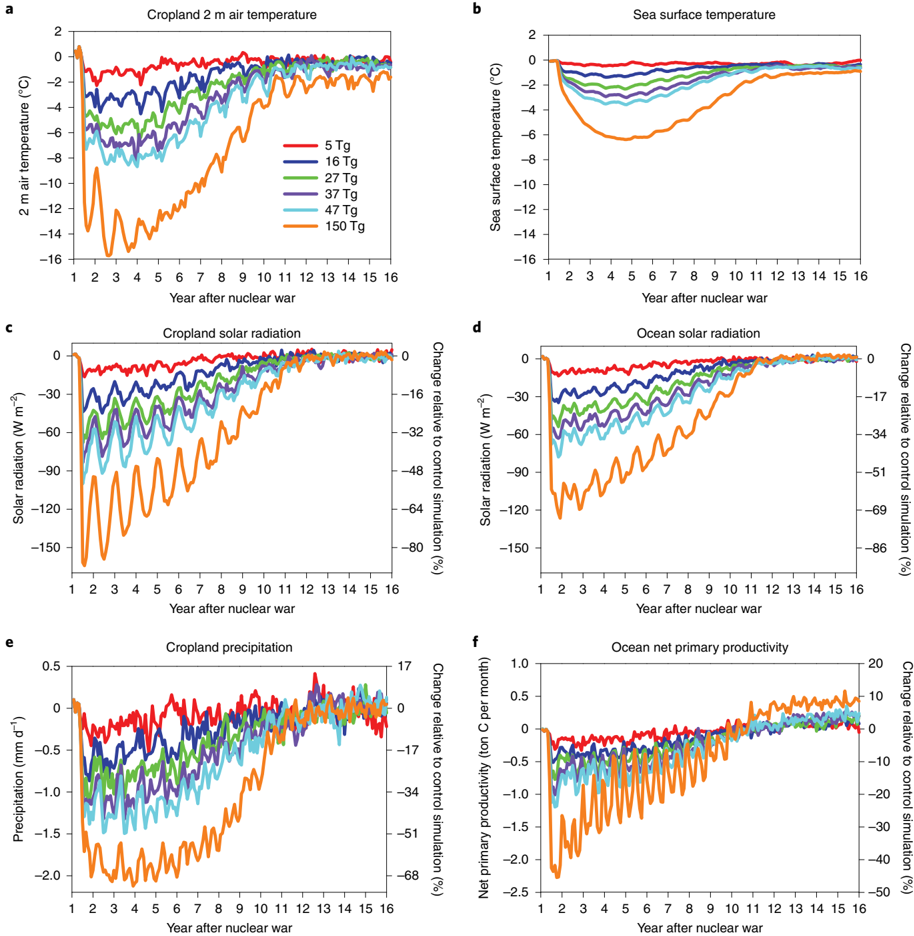
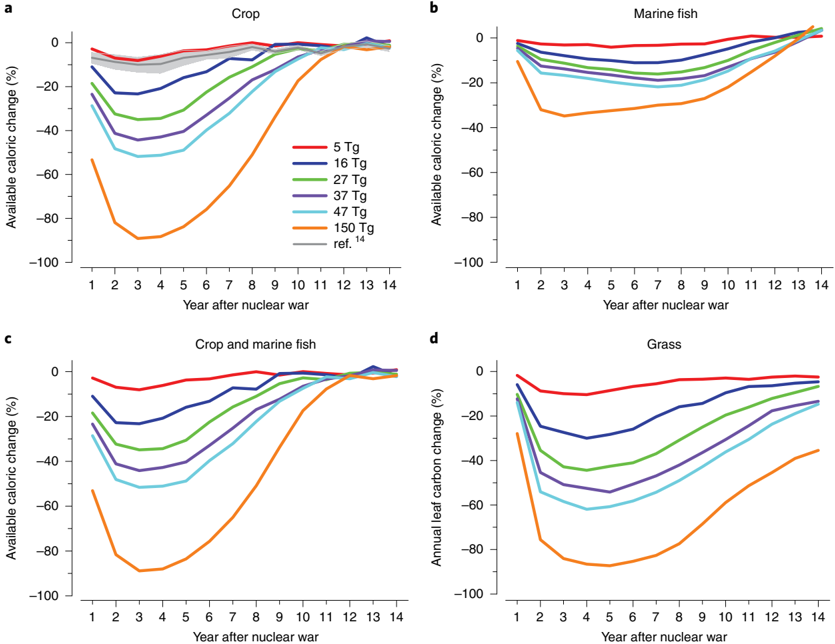
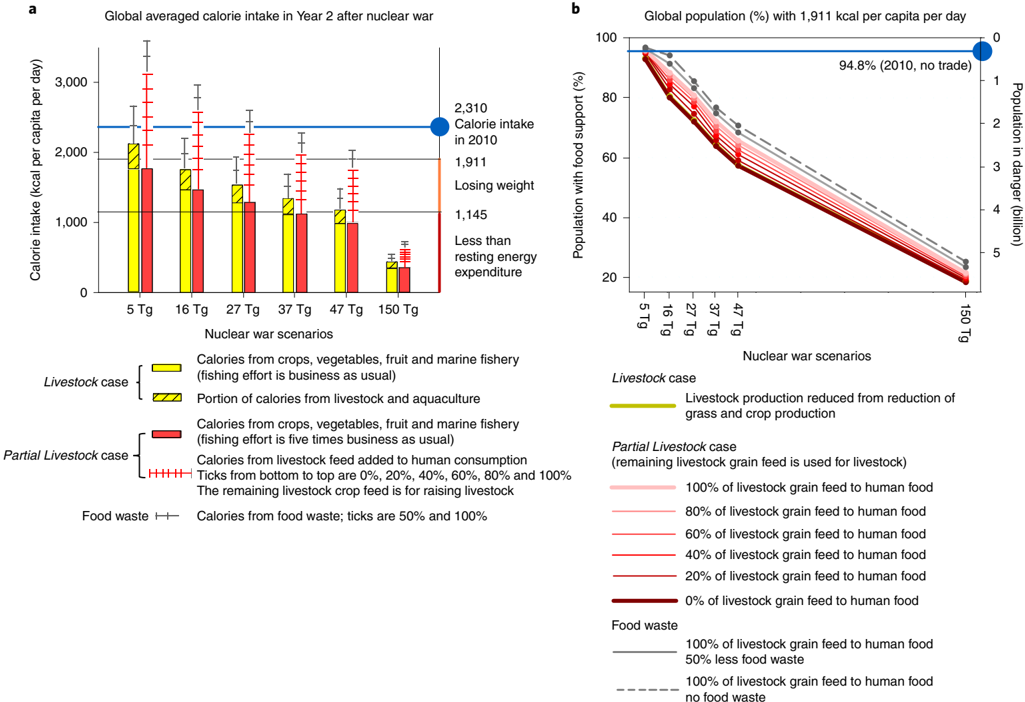
- Global average calorie production from the simulated crops fell by 7% in years 1–5 after the war even in the smallest 5 Tg soot scenario, by up to 50% in the 47 Tg scenario, and by around 90% in the 150 Tg scenario 3–4 years after the war.
- Marine wild-capture fisheries were affected less than land agriculture, but still declined: oceanic net primary productivity fell from 3% in the 5 Tg case to 37% in the 150 Tg case; marine wild capture fisheries contributed 0.5% of total calories and 3.5% of global average protein supply.
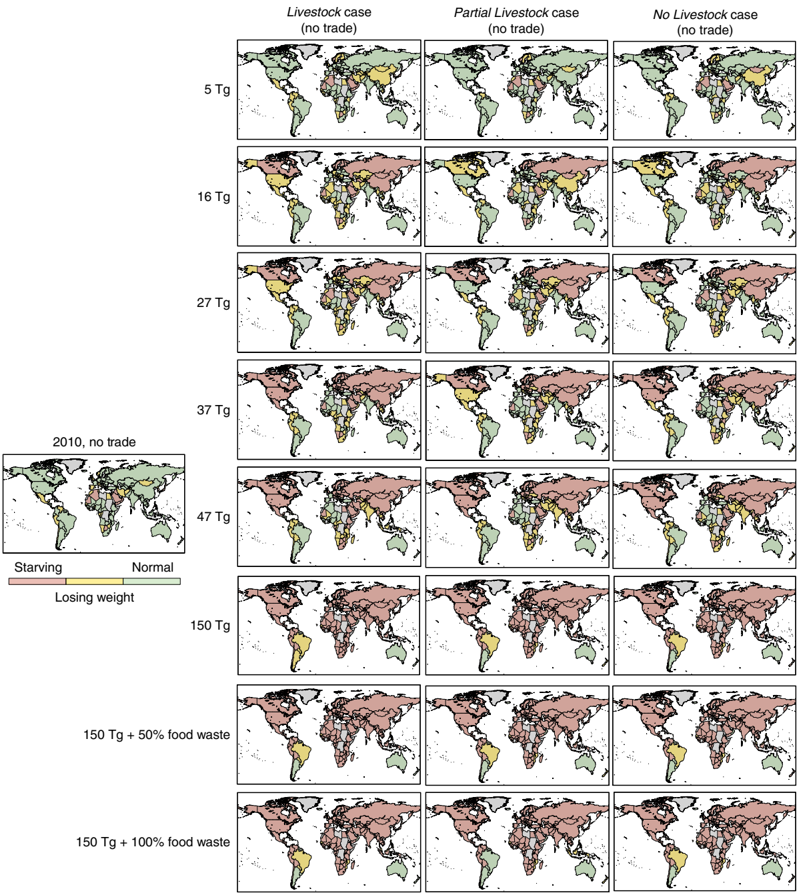
- Table 1 reports the number of people without food at the end of Year 2 as 255 million (5 Tg), 926 million (16 Tg), 1.426 billion (27 Tg), 2.081 billion (37 Tg), 2.512 billion (47 Tg), and 5.341 billion (150 Tg).
- Under the most optimistic assumptions discussed, global food could still be enough for everyone in the 47 Tg case if food were evenly distributed and 100% of livestock feed were converted to human food with no household waste; under the 150 Tg case, most countries would have less than 25% of the population survive by the end of Year 2.
## Methods
- The study used a state-of-the-art global climate model (CESM) to simulate climate and biogeochemical changes from six stratospheric soot injection scenarios, then forced a crop model (CLM5crop) for major crops and a marine fisheries model (BOATS) for ocean fish production.
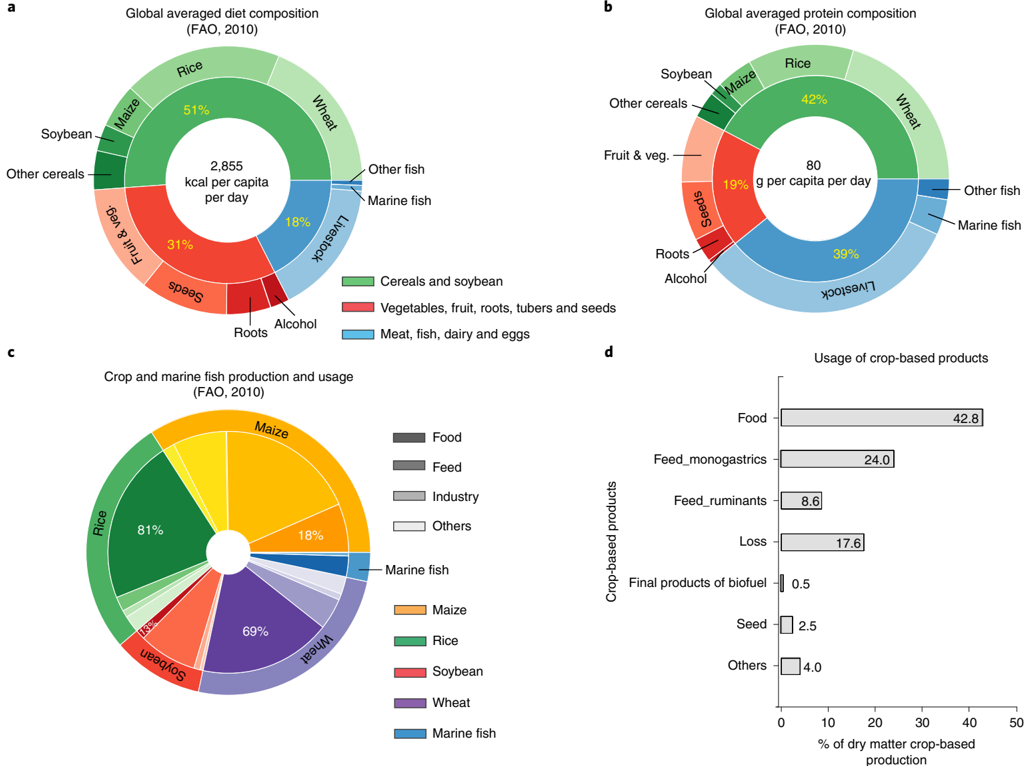
- The food system analysis combined simulated changes in maize, rice, soybean, spring wheat, marine fish, livestock, aquaculture, food trade, and household waste to estimate country-level calorie availability after nuclear war.
- The paper considered three food-system response cases: Livestock, Partial Livestock, and No Livestock, and assumed no international trade in the main no-trade analyses.
## Limitations
- The authors explicitly state they did not model reduced human populations from direct or indirect mortality, reduced birth rates, farm-management adaptations, alternative food sources, or adaptation in fisheries.
- They also did not consider several important impacts the text names, including surface ozone, ultraviolet radiation, radioactive contamination, pollinator effects, killing frost, and freshwater availability; this is stated in the Methods/Discussion as outside the scope.
- Evident from the text: the analysis relies on one Earth system model, one crop model, and one fishery model, with only one ensemble member for soot cases above 5 Tg, so model-structure uncertainty is substantial.
Model-written summary. Check it against the paper before relying on it.
Integrity signals
Registry
Cites
Statistics
Figures

Verification
Claims the paper makes
8 Valid · 4 Not valid · 9 Not checked · 70 Own results and interpretations
The cited sources support only part of this claim — read each source’s verdict below.
In the paper
“Nuclear war would reduce the wild fish catch 15”
What the sources say
- Partly supportedcites [15] 15. Scherrer, K. J. N. et al. Marine wild-capture fisheries after nuclear war. Proc. Natl Acad. Sci. USA 117 , 29748-29758 (2020). sourceExperimental — accuracy not yet measured
The Results (‘Initial Impacts on Catch and Biomass’; page not provided) report that global catches fall under business-as-usual fishing after the modeled nuclear conflicts. But they also report initial catch increases when postwar fishing intensifies, so the unqualified claim that nuclear war would reduce wild fish catch overstates the findings. (LLM, conf=0.88)
hedgedstates a cause- Asserted: passes — The authors put it forward as true.
- Checkable: passes — It can be checked against evidence.
- Load-bearing: passes — The paper’s conclusions depend on it.
- Based: passes — The paper gives a reason why it holds.
- Partly supported
The cited sources support only part of this claim — read each source’s verdict below.
In the paper
“So far, an integrated estimate of the impacts of the entire range of war scenarios on both land- and ocean-based food production is missing.”
What the sources say
- Not checked — no full text of the sourcecites [12] 12. Xia, L. & Robock, A. Impacts of a nuclear war in South Asia on rice production in mainland China. Climatic Change 116 , 357-372 (2013). source
- Not checked — no full text of the sourcecites [13] 13. Özdoğan, M., Robock, A. & Kucharik, C. Impacts of a nuclear war in South Asia on soybean and maize production in the Midwest United States. Climatic Change 116 , 373-387 (2013). source
- Partly supportedcites [14] 14. Jägermeyr, J. et al. A regional nuclear conflict would compromise global food security. Proc. Natl Acad. Sci. USA 117 , 7071-7081 (2020). sourceExperimental — accuracy not yet measured
The Significance section (p. 1) identifies a gap in assessing how nuclear-war-related crop losses affect global food trade. But this paper examines a regional conflict and major land crops; it does not establish that an integrated estimate is missing across the entire range of war scenarios and both land- and ocean-based food production. (LLM, conf=0.85)
- Supportedcites [15] 15. Scherrer, K. J. N. et al. Marine wild-capture fisheries after nuclear war. Proc. Natl Acad. Sci. USA 117 , 29748-29758 (2020). source
The Abstract describes crop-production estimates separately from this paper’s modeling of fish catches across six war scenarios. The Discussion (Food System Linkages; page not provided) says further investigation of the interdependencies between fishing, aquaculture, and the rest of food production is needed, supporting the claim that an integrated estimate is missing. (LLM, conf=0.88)
plain- Asserted: passes — The authors put it forward as true.
- Checkable: passes — It can be checked against evidence.
- Load-bearing: passes — The paper’s conclusions depend on it.
- Based: passes — The paper gives a reason why it holds.
The cited sources support only part of this claim — read each source’s verdict below.
In the paper
“Although CLM5crop does not simulate winter wheat, we assume winter wheat production is changed by the same amount as spring wheat, which has been found in other studies 14 ; however, this may underestimate the winter wheat response, because winter wheat would experience colder temperatures during its growing period that would be more likely to cross critical thresholds 14 .”
What the sources say
- Partly supportedcites [14] 14. Jägermeyr, J. et al. A regional nuclear conflict would compromise global food security. Proc. Natl Acad. Sci. USA 117 , 7071-7081 (2020). sourceExperimental — accuracy not yet measured
Split into 2 atoms — 1 confirmed, 1 partially supported, 0 disputed, 0 misattributed, 0 unverifiable. Expand the claim to see per-atom verdicts.
hedgedstates a possible cause- Asserted: passes — The authors put it forward as true.
- Checkable: passes — It can be checked against evidence.
- Load-bearing: unclear — It is unclear whether the paper’s conclusions depend on it.
- Based: passes — The paper gives a reason why it holds.
- Rests on an assumption not shown here.
- Partly supported
The cited sources that could be checked couldn’t confirm or dispute this claim.
In the paper
“CLM5crop compares well with other crop models in response to nuclear war forcing 14 (Supplementary Fig. 2).”
What the sources say
- Could not verifycites [14] 14. Jägermeyr, J. et al. A regional nuclear conflict would compromise global food security. Proc. Natl Acad. Sci. USA 117 , 7071-7081 (2020). sourceExperimental — accuracy not yet measured
The Crop Yield Simulations section (p. 9) names the six crop models studied; CLM5crop is not among them. A search for CLM5crop found no passage comparing its response to nuclear-war forcing with that of other models. (LLM, conf=0.75)
plain- Asserted: passes — The authors put it forward as true.
- Checkable: passes — It can be checked against evidence.
- Load-bearing: unclear — It is unclear whether the paper’s conclusions depend on it.
- Based: passes — The paper gives a reason why it holds.
- Could not verify
A result the paper states — it cites no source for it, so there is none to check. The quote shows it is in the paper.
In the paper
“but the reduction would be less than for land agriculture (Fig. 2b)”
hedgedstates a cause- Asserted: passes — The authors put it forward as true.
- Checkable: passes — It can be checked against evidence.
- Load-bearing: unclear — It is unclear whether the paper’s conclusions depend on it.
- Based: passes — The paper gives a reason why it holds.
49 more claims
Create a free account to see all 91 claims and to verify the 2 references still open.
- It may state two separate claims as one. 21
- Probably not a substantial claim. 21
Claims other papers make about this one
Each is checked against this paper’s own text: does it say what the citing paper says it does?
The source backs part of the claim, not all of it — or backs it for a different population, condition or comparison.
In the citing paper
“Even a ' limited ' nuclear war involving only 250 of the 13,000 nuclear weapons in the world could kill 120 million people outright and cause global climate disruption leading to a nuclear famine, putting two billion people at risk [7, 8].”
From Reducing the Risks of Nuclear War. (2023) · cites this paper as [8]
Experimental — accuracy not yet measuredThe cited source says what the claim attributes to it.
In the citing paper
“Even a ' limited ' nuclear war involving only 250 of the 13,000 nuclear weapons in the world could kill 120 million people outright and cause global climate disruption leading to a nuclear famine, putting two billion people at risk [7, 8].”
From Reducing the Risks of Nuclear War. (2023) · cites this paper as [8]
The cited source says what the claim attributes to it.
In the citing paper
“A large scale nuclear war between the US and Russia could kill 200 million people or more in the near term and potentially cause a global ' nuclear winter ' that could kill 5 -6 billion people, threatening the survival of humanity [7, 8].”
From Reducing the Risks of Nuclear War. (2023) · cites this paper as [8]
Citations
Cites
The State of World Fisheries and Aquaculture 2020
(2020) · doi:10.4060/ca9229en · Cited by 3,167
The Community Earth System Model: A Framework for Collaborative Research
Hurrell, J. W., Holland, M. M., Gent, P. R., Ghan, S., Kay, J. E., Kushner, P. J., Lamarque, J.-F., Large, W. G., Lawrence, D., Lindsay, K., et al. (2013) · Bulletin of the American Meteorological Society · doi:10.1175/bams-d-12-00121.1 · Cited by 2,686
Lawrence, D. M., Fisher, R. A., Koven, C. D., Oleson, K. W., Swenson, S. C., Bonan, G., Collier, N., Ghimire, B., van Kampenhout, L., Kennedy, D., et al. (2019) · Journal of Advances in Modeling Earth Systems · doi:10.1029/2018ms001583 · Cited by 2,060
Climate Change from 1850 to 2005 Simulated in CESM1(WACCM)
Marsh, D. R., Mills, M. J., Kinnison, D. E., Lamarque, J.-F., Calvo, N., & Polvani, L. M. (2013) · Journal of Climate · doi:10.1175/jcli-d-12-00558.1 · Cited by 1,081 · cited 1×
“40 ).”
Livestock: On our plates or eating at our table? A new analysis of the feed/food debate
Mottet, A., de Haan, C., Falcucci, A., Tempio, G., Opio, C., & Gerber, P. (2017) · Global Food Security · doi:10.1016/j.gfs.2017.01.001 · Cited by 1,034 · cited 1×
“For global calculations for livestock, we assume that 46% are fed by pasture and 54% are fed by crops and processed products 48 and use national-level data 26 to calculate reduction of livestock feed from pasture and crop-based products.”
MethodNuclear Winter: Global Consequences of Multiple Nuclear Explosions
Turco, R. P., Toon, O. B., Ackerman, T. P., Pollack, J. B., & Sagan, C. (1983) · Science · doi:10.1126/science.222.4630.1283 · Cited by 825
Self-citationBlack carbon lofts wildfire smoke high into the stratosphere to form a persistent plume
Yu, P., Toon, O. B., Bardeen, C. G., Zhu, Y., Rosenlof, K. H., Portmann, R. W., Thornberry, T. D., Gao, R.-S., Davis, S. M., Wolf, E. T., et al. (2019) · Science · doi:10.1126/science.aax1748 · Cited by 363
Self-citationPeterson, D. A., Fromm, M. D., McRae, R. H. D., Campbell, J. R., Hyer, E. J., Taha, G., Camacho, C. P., Kablick, G. P., Schmidt, C. C., & DeLand, M. T. (2021) · npj Climate and Atmospheric Science · doi:10.1038/s41612-021-00192-9 · Cited by 236
Bodirsky, B. L., Dietrich, J. P., Martinelli, E., Stenstad, A., Pradhan, P., Gabrysch, S., Mishra, A., Weindl, I., Le Mouël, C., Rolinski, S., et al. (2020) · Scientific Reports · doi:10.1038/s41598-020-75213-3 · Cited by 231 · cited 4×
“All food commodity trade calculations are based on the 2010 FAO Commodity Balance Sheet (FAO-CBS), FAO-FBS and processed data from previous studies 24,27,28,47 .”
BackgroundMethodInfluentialSelf-citationHigh‐latitude eruptions cast shadow over the African monsoon and the flow of the Nile
Oman, L., Robock, A., Stenchikov, G. L., & Thordarson, T. (2006) · Geophysical Research Letters · doi:10.1029/2006gl027665 · Cited by 211
Self-citation
Research works printed but not linked: 7
- 3. Stommel, H. & Stommel, E. Volcano Weather; The Story of 1816, The Year Without a Summer (Seven Seas Press, 1983).
- 5. Aleksandrov, V. V . & Stenchikov, G. L. On the modeling of the climatic consequences of the nuclear war. Proc. Applied Math (Computing Centre of the USSR Academy of Sciences, 1983).
- 11. Cropper Jr., W . P . & Harwell, M. A. in Environmental Consequences of Nuclear War, SCOPE 28, Volume II Ecological and Agricultural Effects , 2nd Edn (eds Harwell, M. A. & Hutchinson, T. C.) Ch. 5 (Wiley, 1989).
- 10. Harwell, M. A. & Cropper Jr., W . P . in Environmental Consequences of Nuclear War, SCOPE 28, Volume II Ecological and Agricultural Effects , 2nd Edn (eds Harwell, M. A. & Hutchinson, T. C.) Ch. 4 (Wiley, 1989).
- 22. Ambio Advisory Group, Reference scenarios: How a nuclear war might be fought, in Nuclear War: The Aftermath (ed Peterson, J.) Ch. 3 (Pergamon Press, 1983).
- 29. National Research Council, Energy, in Recommended Dietary Allowances, 10th Edn Ch. 3 (US National Academies Press, 1989).
- 32. Denkenberger, D., Pearce, J. M. Feeding Everyone No Matter What: Managing Food Security After Global Catastrophe (Academic Press, 2014).
Cited by
Items 301–398 of 398
Ending nuclear weapons, before they end us
Zielinski, C. (2025) · Drug and Therapeutics Bulletin · doi:10.1136/dtb.2025.000017
Ending nuclear weapons, before they end us
Zielinski, C. (2025) · BMJ Innovations · doi:10.1136/bmjinnov-2025-001424
Ending nuclear weapons, before they end us
Zielinski, C., & authorship group listed below (2025) · General Psychiatry · doi:10.1136/gpsych-2025-102207
Ending nuclear weapons, before they end us
Zielinski, C. (2025) · BMJ Evidence-Based Medicine · doi:10.1136/bmjebm-2025-113922
Ending nuclear weapons, before they end us
Zielinski, C. (2025) · Injury Prevention · doi:10.1136/ip-2025-045820
Ending nuclear weapons, before they end us
Zielinski, C. (2025) · BMJ Oncology · doi:10.1136/bmjonc-2025-000853
Ending nuclear weapons, before they end us
Zielinski, C. (2025) · BMJ Medicine · doi:10.1136/bmjmed-2025-001654
Ending nuclear weapons, before they end us
Zielinski, C. (2025) · Archives of Disease in Childhood · doi:10.1136/archdischild-2025-329027
Ending nuclear weapons, before they end us
Zielinski, C. (2025) · Archives of Disease in Childhood Education & Practice · doi:10.1136/archdischild-2025-329056
Ending nuclear weapons, before they end us
Abbasi, K. A., Ali, P. A., Barbour, V., Birch, M., Blum, I., Doherty, P. C., Haines, A., Helfand, I., Horton, R. C., Juva, K., et al. (2025) · Oxford Open Digital Health · doi:10.1093/oodh/oqaf009
Ending nuclear weapons, before they end us
Abbasi, K. A., Ali, P. A., Barbour, V., Birch, M., Blum, I., Doherty, P. C., Haines, A., Helfand, I., Horton, R. C., Juva, K., et al. (2025) · Health Education Research · doi:10.1093/her/cyaf020
Ending nuclear weapons, before they end us
Abbasi, K. A., Ali, P. A., Barbour, V., Birch, M., Blum, I., Doherty, P. C., Haines, A., Helfand, I., Horton, R. C., Juva, K., et al. (2025) · JNCI Cancer Spectrum · doi:10.1093/jncics/pkaf044
Ending nuclear weapons, before they end us
Abbasi, K. A., Ali, P. A., Barbour, V., Birch, M., Blum, I., Doherty, P. C., Haines, A., Helfand, I., Horton, R. C., Juva, K., et al. (2025) · Transactions of the Royal Society of Tropical Medicine and Hygiene · doi:10.1093/trstmh/traf047
Ending nuclear weapons, before they end us
Abbasi, K. A., Ali, P. A., Barbour, V., Birch, M., Blum, I., Doherty, P. C., Haines, A., Helfand, I., Horton, R. C., Juva, K., et al. (2025) · International Health · doi:10.1093/inthealth/ihaf052
Ending nuclear weapons, before they end us
Abbasi, K. A., Ali, P. A., Barbour, V., Birch, M., Blum, I., Doherty, P. C., Haines, A., Helfand, I., Horton, R. C., Juva, K., et al. (2025) · Journal of Pharmaceutical Health Services Research · doi:10.1093/jphsr/rmaf008
Ending nuclear weapons, before they end us
Abbasi, K. A., Ali, P. A., Barbour, V., Birch, M., Blum, I., Doherty, P. C., Haines, A., Helfand, I., Horton, R. C., Juva, K., et al. (2025) · European Journal of Endocrinology · doi:10.1093/ejendo/lvaf082
Ending nuclear weapons, before they end us
Abbasi, K. A., Ali, P. A., Barbour, V., Birch, M., Blum, I., Doherty, P., Haines, A., Helfand, I., Mitra, A., Horton, R. C., et al. (2025) · Occupational Medicine · doi:10.1093/occmed/kqaf039
Ending nuclear weapons, before they end us
Abbasi, K. A., Ali, P. A., Barbour, V., Birch, M., Blum, I., Doherty, P. C., Haines, A., Helfand, I., Horton, R. C., Juva, K., et al. (2025) · Journal of Pharmacy and Pharmacology · doi:10.1093/jpp/rgaf026
Ending nuclear weapons, before they end us
Abbasi, K. A., Ali, P. A., Barbour, V., Birch, M., Blum, I., Doherty, P. C., Haines, A., Helfand, I., Horton, R. C., Juva, K., et al. (2025) · Brain Communications · doi:10.1093/braincomms/fcaf154
Ending nuclear weapons, before they end us
Abbasi, K. A., Ali, P. A., Barbour, V., Birch, M., Blum, I., Doherty, P. C., Haines, A., Helfand, I., Horton, R. C., Juva, K., et al. (2025) · International Journal of Pharmacy Practice · doi:10.1093/ijpp/riaf032
Ending nuclear weapons, before they end us
Abbasi, K. A., Ali, P. A., Barbour, V., Birch, M., Blum, I., Doherty, P. C., Haines, A., Helfand, I., Horton, R. C., Juva, K., et al. (2025) · The Oncologist · doi:10.1093/oncolo/oyaf109
Ending nuclear weapons, before they end us
Abbasi, K. A., Ali, P. A., Barbour, V., Birch, M., Blum, I., Doherty, P. C., Haines, A., Helfand, I., Horton, R. C., Juva, K., et al. (2025) · Indian Journal of Medical Ethics · doi:10.20529/ijme.2025.040
Ending Nuclear Weapons, Before They End Us
Abbasi, K. A., Ali, P. A., Barbour, V., Birch, M., Blum, I., Doherty, P. C., Haines, A., Helfand, I., Horton, R. C., Juva, K., et al. (2025) · Western Journal of Emergency Medicine · doi:10.5811/westjem.47301
Ending nuclear weapons, before they end us
Abbasi, K. A., Ali, P. A., Barbour, V., Birch, M., Blum, I., Doherty, P., Haines, A., Helfand, I., Horton, R. C., Juva, K., et al. (2025) · JNCI Journal of the National Cancer Institute · doi:10.1093/jnci/djaf102
Ending nuclear weapons, before they end us
Abbasi, K. A., Ali, P. A., Barbour, V., Birch, M., Blum, I., Doherty, P. C., Haines, A., Helfand, I., Horton, R. C., Juva, K., et al. (2025) · Health Open Research · doi:10.12688/healthopenres.13863.1
Ending nuclear weapons, before they end us
Abbasi, K. A., Ali, P. A., Barbour, V., Birch, M., Blum, I., Doherty, P. C., Haines, A., Helfand, I., Horton, R. C., Juva, K., et al. (2025) · F1000Research · doi:10.12688/f1000research.163970.1
Ending nuclear weapons, before they end us
Abbasi, K. A., Ali, P. A., Barbour, V., Birch, M., Blum, I., Doherty, P. C., Haines, A., Helfand, I., Horton, R. C., Juva, K., et al. (2025) · Health Promotion International · doi:10.1093/heapro/daaf064
Ending nuclear weapons, before they end us
Abbasi, K. A., Ali, P. A., Barbour, V., Birch, M., Blum, I., Doherty, P. C., Haines, A., Helfand, I., Horton, R. C., Juva, K., et al. (2025) · Global Health Action · doi:10.1080/16549716.2025.2492465 · Cited by 1
Ending Nuclear Weapons, Before they end Us
Abbasi, K. A., Ali, P. A., Barbour, V., Birch, M., Blum, I., Doherty, P. C., Haines, A., Helfand, I., Horton, R. C., Juva, K., et al. (2025) · ESC Heart Failure · doi:10.1002/ehf2.15334
Ending nuclear weapons, before they end us
Abbasi, K. A., Ali, P. A., Barbour, V., Birch, M., Blum, I., Doherty, P. C., Haines, A., Helfand, I., Horton, R. C., Juva, K., et al. (2025) · Sonography · doi:10.1002/sono.12527
Ending nuclear weapons, before they end us
Abbasi, K. A., Ali, P. A., Barbour, V., Birch, M., Inga Blum, Doherty, P., Haines, A., Helfand, I., Horton, R. C., Kati Juva, et al. (2025) · International Journal of Gynecology & Obstetrics · doi:10.1002/ijgo.70229
Ending Nuclear Weapons, Before They End Us
Abbasi, K. A., Ali, P. A., Barbour, V., Birch, M., Blum, I., Doherty, P. C., Haines, A., Helfand, I., Horton, R. C., Juva, K., et al. (2025) · International Journal of Health Policy and Management · doi:10.34172/ijhpm.9200
Acabar com as Armas Nucleares, Antes que Acabem Connosco
Abbasi, K. A., Ali, P. A., Barbour, V., Birch, M., Blum, I., Doherty, P. C., Haines, A., Helfand, I., Horton, R. C., Juva, K., et al. (2025) · Acta Médica Portuguesa · doi:10.20344/amp.23271
Ending nuclear weapons, before they end us
Abbasi, K. A., Ali, P. A., Barbour, V., Birch, M., Blum, I., Doherty, P. C., Haines, A., Helfand, I., Horton, R. C., Juva, K., et al. (2025) · Journal of Child Health Care · doi:10.1177/13674935251340159
Ending nuclear weapons, before they end us
Abbasi, K. A., Ali, P. A., Barbour, V., Birch, M., Blum, I., Doherty, P. C., Haines, A., Helfand, I., Horton, R. C., Juva, K., et al. (2025) · Acta Paediatrica · doi:10.1111/apa.70138
“The global climate disruption caused by the smoke pouring from cities ig-nited by just 2% of the current arsenal could result in over two billion people starving [11].”
Ending nuclear weapons, before they end us
Abbasi, K. A., Ali, P. A., Barbour, V., Birch, M., Blum, I., Doherty, P. C., Haines, A., Helfand, I., Horton, R. C., Juva, K., et al. (2025) · British Journal of Cancer · doi:10.1038/s41416-025-03067-5
“The global climate disruption caused by the smoke pouring from cities ignited by just 2% of the current arsenal could result in over two billion people starving [11].”
Ending Nuclear Weapons, Before They End Us
Abbasi, K. A., Ali, P. A., Barbour, V., Birch, M., Blum, I., Doherty, P. C., Haines, A., Helfand, I., Horton, R. C., Juva, K., et al. (2025) · Reproductive Female and Child Health · doi:10.1002/rfc2.70026
Ending nuclear weapons, before they end us
Abbasi, K. A., Ali, P. A., Barbour, V., Birch, M., Blum, I., Doherty, P. C., Haines, A., Helfand, I., Horton, R. C., Juva, K., et al. (2025) · Cancer Gene Therapy · doi:10.1038/s41417-025-00920-w
Bacchus, J. (2025) · Cambridge University Press eBooks · doi:10.1017/9781009583237.018
Ending nuclear weapons, before they end us
Abbasi, K. A., Ali, P. A., Barbour, V., Birch, M., Blum, I., Doherty, P. C., Haines, A., Helfand, I., Horton, R. C., Juva, K., et al. (2025) · Prostate Cancer and Prostatic Diseases · doi:10.1038/s41391-025-00988-3
“The global climate disruption caused by the smoke pouring from cities ignited by just 2% of the current arsenal could result in over two billion people starving [11].”
Ending nuclear weapons, before they end us
Abbasi, K. A., Ali, P. A., Barbour, V., Birch, M., Blum, I., Doherty, P. C., Haines, A., Helfand, I., Horton, R. C., Juva, K., et al. (2025) · Geriatrics Gerontology and Aging · doi:10.53886/gga.eedt0252_en
Empirical study and model of warfare dynamics: Willingness to risk
Podobnik, B., Medvidović, L., Wild, D., & Boccaletti, S. (2025) · Chaos An Interdisciplinary Journal of Nonlinear Science · doi:10.1063/5.0277615
Ending Nuclear Weapons, Before They end us
Abbasi, K. A., Ali, P. A., Barbour, V., Birch, M., Blum, I., Doherty, P. C., Haines, A., Helfand, I., Horton, R. C., Juva, K., et al. (2025) · International Nursing Review · doi:10.1111/inr.70038
Ending nuclear weapons, before they end us
Abbasi, K. A., Ali, P. A., Barbour, V., Birch, M., Blum, I., Doherty, P. C., Haines, A., Helfand, I., Horton, R. C., Juva, K., et al. (2025) · Danish Medical Journal · doi:10.61409/a300014
Ending nuclear weapons, before they end us
Abbasi, K. A., Ali, P. A., Barbour, V., Birch, M., Blum, I., Doherty, P. C., Haines, A., Helfand, I., Horton, R. C., Juva, K., et al. (2025) · European Journal of Nuclear Medicine and Molecular Imaging · doi:10.1007/s00259-025-07365-1
إنهاء الأسلحة النووية قبل أن تنهي حياتنا
عباسي, ك., علي, ب., الربان, م., بربور, ف., بيرتش, م., بلوم, ا., دورتي, ب., هينس, آ., هلفاند, إ., هورتون, ر., et al. (2025) · Arabian Journal of Scientific Research-المجلة العربية للبحث العلمي · doi:10.5339/ajsr.2025.6
Addressing Humanity’s failure to establish Existential Security
Lewis-Jones, R. (2025) · Journal of International Political Theory · doi:10.1177/17550882251342390 · Cited by 1
“Even a contained regi-nal nuclear war could still incur fatalities comparable to all of those worldwide in World War II, with significant climate changes (Robock et al., 2007; cf. Xia et al., 2022).”
Who’s afraid of the evidence? Updating the health impact assessment of nuclear weapons
Birch, M. (2025) · Medicine Conflict & Survival · doi:10.1080/13623699.2025.2515784
Ending nuclear weapons, before they end us
Abbasi, K., Ali, P., Barbour, V., Birch, M., Blum, I., Doherty, P. C., Haines, A., Helfand, I., Horton, R., Juva, K., et al. (2025) · Khyber Medical University Journal · doi:10.35845/kmuj.2025.24071
Ending nuclear weapons, before they end us
Zielinski, C., & Ippnw (2025) · Global South Health Horizons · doi:10.63950/gshh.2025.1.1.7
Jehn, F. U. (2023) · doi:10.59350/632mm-dak33
Ending nuclear weapons, before they end us
Abbasi, K. A., Ali, P. A., Barbour, V., Birch, M., Blum, I., Doherty, P. C., Haines, A., Helfand, I., Horton, R. C., Juva, K., et al. (2025) · Pediatric Research · doi:10.1038/s41390-025-04178-8
The best places to weather global catastrophes
Jehn, F. U. (2024) · doi:10.59350/bgsnc-b5430
Ending nuclear weapons, before they end us
Abbasi, K. A., Ali, P. A., Barbour, V., Birch, M., Blum, I., Doherty, P. C., Haines, A., Helfand, I., Horton, R. C., Juva, K., et al. (2025) · Supportive Care in Cancer · doi:10.1007/s00520-025-09569-5
Ending Nuclear Weapons, Before They End Us
Abbasi, K. A., Ali, P. A., Barbour, V., Birch, M., Blum, I., Doherty, P. C., Haines, A., Helfand, I., Horton, R. C., Juva, K., et al. (2025) · Journal of General Internal Medicine · doi:10.1007/s11606-025-09694-1
Ending nuclear weapons, before they end us
Abbasi, K. A., Ali, P. A., Barbour, V., Birch, M., Blum, I., Doherty, P. C., Haines, A., Helfand, I., Horton, R. C., Juva, K., et al. (2025) · European Journal of Pediatrics · doi:10.1007/s00431-025-06194-6
“While the numbers of nuclear weapons are down to 12,331 now, from their 1986 peak of 70,300 [8] [11].”
Ending nuclear weapons, before they end us
Zielinski, C. (2025) · Journal of Phytomedicine and Therapeutics · doi:10.4314/jopat.v24i1.1
Bari, A., & Kamal, M. K. B. (2025) · SSRN Electronic Journal · doi:10.2139/ssrn.5362933
Ending nuclear weapons, before they end us
Abbasi, K. A., Ali, P. A., Barbour, V., Birch, M., Blum, I., Doherty, P. C., Haines, A., Helfand, I., Horton, R. C., Juva, K., et al. (2025) · Annales Africaines de Medecine · doi:10.4314/aamed.v18i3.1
Skagen, K. M. (2025) · Tidsskrift for Den norske legeforening · doi:10.4045/tidsskr.25.0362
Ending Nuclear Weapons, Before They End Us
Abbasi, K. A., Ali, P. A., Barbour, V., Birch, M., Blum, I., Doherty, P. C., Haines, A., Helfand, I., Horton, R. C., JUVA, K., et al. (2025) · The National Medical Journal of India · doi:10.25259/nmji_634_2025
Las repercusiones climáticas de una guerra nuclear
de Dios, V. R. (2022) · doi:10.64628/aao.5h93y55gp
Integrating climate biodiversity and food security risks from soot injection scenariosPreprint
Kaiho, K. (2025) · SSRN Electronic Journal · doi:10.2139/ssrn.5418361
Manipulating the global thermostat
Jehn, F. U. (2025) · doi:10.59350/existentialcrunch.167348184
The climate effects of nuclear war
Ruff, T. (2025) · Medicine Conflict & Survival · doi:10.1080/13623699.2025.2560274 · Cited by 1
“…trade or livestock production, an India-Pakistan war producing 37 million tons of smoke would result, after 2 years, in the starvation of 1.029 billion people in China, 126 million in Russia, 186 million in the United States, and 37 million in the United Kingdom (Xia et al. 2022, Table S4).”
InfluentialLoretz, J., & McGinty, M. (2025) · Medicine Conflict & Survival · doi:10.1080/13623699.2025.2559336
“(Xia et al. 2022) Over several decades, scientific research published in peer-reviewed journals has informed activists working for nuclear disarmament by describing and providing the evidence for the health and environmental damage these weapons have inflicted even without being used in war.”
Nukleare Abschreckung in Europa: Zwischen strategischer Notwendigkeit und politischer Ungewissheit
Bumeder, L. (2025) · Gerechter Frieden · doi:10.1007/978-3-658-49438-4_4
Vieluf, M., Kretzschmar, S., & Saar, E. (2025) · Studies in energy, resource and environmental economics · doi:10.1007/978-3-031-99894-2_6 · Cited by 2
Herrera, R. J., & Garcia‐Bertrand, R. (2025) · Elsevier eBooks · doi:10.1016/b978-0-443-28919-4.00014-3
Nuclear Conflict in Eastern Europe: Climate Disruption & Radiological FalloutPreprint
Ranjithkumar, A., Mayne, N. J., Jones, A. C., et al. (2025) · Research Square · doi:10.21203/rs.3.rs-8344698/v1
Jahan, N., Liu, L., Orlowski, S., Greene, E. S., & Dridi, S. (2026) · Poultry Science · doi:10.1016/j.psj.2026.106482
Sequential cultivation of oyster and shiitake mushrooms on willow enhances biomass degradability
Siva, N., Klatte, H., Mather, T., Kothattil, S., Pecchia, J. A., & Anderson, C. T. (2026) · Biomass Conversion and Biorefinery · doi:10.1007/s13399-025-06955-1
The largest crop production shocks: magnitude, causes and frequency
Jehn, F. U., Mulhall, J., Blouin, S., Gajewski, Ł., & Wunderling, N. (2026) · Earth System Dynamics · doi:10.5194/esd-17-151-2026 · Cited by 6
Global capacity of dietary sustainability to deal with climate change
Zhao, R., Li, X., Xu, Z., Li, F., Wang, Y., Wang, H., Zhu, P., Jiang, Z., Ren, Q., Li, Z. B., et al. (2026) · Geography and sustainability · doi:10.1016/j.geosus.2026.100451
Nuclear war, nuclear winter, and the food system
Jehn, F. U. (2026) · doi:10.59350/hkngk-5fq39
Threshold dynamics of mass extinctions and human famine risk
Kaiho, K. (2026) · Evolving Earth · doi:10.1016/j.eve.2026.100114 · Cited by 2
Nuclear war, nuclear winter, and the food system
Jehn, F. U. (2026) · doi:10.59350/0by4q-nng34
Naturwissenschaftlich-technische Friedens- und Konfliktforschung
Reuter, C., Scheffran, & Kreutle, M. (2026) · Springer eBooks · doi:10.1007/978-3-658-49644-9_3
Manipulating the global thermostat
Jehn, F. U. (2025) · doi:10.59350/05mkh-6d698
Jehn, F. U. (2023) · doi:10.59350/99g5e-60q98
The best places to weather global catastrophes
Jehn, F. U. (2024) · doi:10.59350/ef1vx-zgv21
Is Nuclear Anarchy Sustainable? A Temporal Approach
Uchaev, Y. I., & Kvartalnov, A. A. (2024) · Russian Journal of World Politics and Law of Nations · doi:10.24833/rjwpln-2023-2-14-32
Expansion of Cropland Area as a Food-Providing System in Case of an Abrupt-Sunlight-Reduction Event
Monteiro, L., Hinge, M., Rivers, M., et al. (2026) · Lecture notes on multidisciplinary industrial engineering · doi:10.1007/978-3-032-19652-1_14
Nuclear Conflict in Eastern Europe: Climate disruption and Radiological fallout
Ranjithkumar, A., Mayne, N. J., Jones, A. C., & Haywood, J. (2026) · npj Clean Air · doi:10.1038/s44407-026-00064-7
“…primarily examined an all-out superpower nuclear con fl ict (United States of America and Russia) resulting in ~150 million-tons (or 150 Teragram (Tg)) of BC being emitted into the stratosphere, or South Asian (India and Pakistan) regional wars resulting in 5 – 50 Tg stratospheric BC 6 – 8 , 14 –”
1439 Nuclear Weapons and their Health Consequences
Ruff, T. A. (2025) · De Gruyter eBooks · doi:10.1515/9783111250144-010
Crop yields under simulated nuclear winter: a growth chamber experimentPreprint
Blouin, S., Abrams, D. R., Ben-Zeev, R., Anderson, C. T., Lasky, J. R., & Denkenberger, D. (2026) · bioRxiv (Cold Spring Harbor Laboratory) · doi:10.64898/2026.05.05.723012
Why public health needs to engage with existential risk studies: a call for collaboration
Armitage, R. C. (2026) · Considerations in Medicine · doi:10.1136/conmed-2026-000060
Rowan, N. J., Jansen, M. A. K., & Klimek, P. (2026) · Resources Environment and Sustainability · doi:10.1016/j.resenv.2026.100354
The near miss modal ontological argument for atheism
Witmer, D. G., & Edvenson, M. (2026) · International Journal for Philosophy of Religion · doi:10.1007/s11153-026-10020-w
Revisiting the implications of nuclear war on global health
Okeke, I. F., Sokunbi, T. O., Omojuyigbe, J. O., & Owolade, A. J.-J. (2026) · Discover Public Health · doi:10.1186/s12982-026-02278-2
“Some studies have also demonstrated that nuclear warfare between India and Paki-stan could inject substantial quantities of soot into the atmosphere, causing a decline in global temperature and affecting food production within the ecosystem [12].”
Kmentt, A. (2026) · Frontiers in Political Science · doi:10.3389/fpos.2026.1835970
Mukai, T., Adachi, T., Inoue, J., et al. (2026) · Progress in Earth and Planetary Science · doi:10.1186/s40645-025-00784-6
“…in the “nuclear winter” debate; Although scenarios currently being reviewed are focusing on the effects on humanity and crops, including living organisms, as the earth’s surface cools due to the umbrella effect by soot (BC) and dust generated by nuclear war (Coupe et al. 2019; Xia et al. 2022).”
Siva, N., Mather, T., & Anderson, C. T. (2026) · Current Research in Food Science · doi:10.1016/j.crfs.2026.101505
İklim Krizi Çağında Nukleer Caydırıcılık: Stratejik İstikrar ve Kriz Dinamikleri
Özbay, S., Durmuş, İ., & Özek, N. (2026) · Güvenlik Stratejileri Dergisi · doi:10.17752/guvenlikstrtj.1916685
Turchin, A., & Denkenberger, D. (2026) · Sustainability · doi:10.3390/su18168219
Climate Change Following Nuclear War: A Brief Introduction
Ellwood, D. A. (2026) · Springer proceedings in physics · doi:10.1007/978-3-032-29873-7_16
Levene, M. (2026) · The International Journal of Human Rights · doi:10.1080/13642987.2026.2725679
A Primer on Global Catastrophic Risk (GCR)
Kemp, L. (2026) · Oxford University Press eBooks · doi:10.1093/9780198945239.003.0058
Metadata
- Authors
- Xia, L., Robock, A., Scherrer, K., Harrison, C. S., Bodirsky, B. L., Weindl, I., Jägermeyr, J., Bardeen, C. G., Toon, O. B., & Heneghan, R.
- Affiliations
- Rutgers, The State University of New Jersey (US)
- Universitat Autònoma de Barcelona (ES)
- Louisiana State University (US)
- World Vegetable Center (TW)
- Potsdam Institute for Climate Impact Research (DE)
- Goddard Institute for Space Studies (US)
- NSF National Center for Atmospheric Research (US)
- University of Colorado Boulder (US)
- Queensland University of Technology (AU)
- Corresponding author
- Xia, Lili
- ORCID
- Venue
- Nature Food
- Published
- 2022-08-15
- Volume
- 3
- Issue
- 8
- Pages
- 586-596
- ISSN
- 2662-1355 (ISSN-L)
- OpenAlex
- W4291904039
- Cited by
- 398
- References
- 40
- Citations by year
- 2026: 29 · 2025: 167 · 2024: 42 · 2023: 144 · 2022: 14
- FWCI
- 299.53
- Type
- journal article
- Language
- en
- Open access
- hybrid
- doi.org
- Licence
- cc-by
- creativecommons.org/licenses/by/4.0 (tdm)
- creativecommons.org/licenses/by/4.0 (vor)
- Locations
- Nature Food (publishedVersion, cc-by)
- Research Square (acceptedVersion, cc-by)
- PubMed (publishedVersion)
- QUT ePrints (Queensland University of Technology) (submittedVersion, cc-by)
- Civil War Book Review (submittedVersion)
- ScholarWorks @ UTRGV (The University of Texas Rio Grande Valley) (submittedVersion, cc-by)
- NORA - Norwegian Open Research Archives (submittedVersion, cc-by)
- Dipòsit Digital de Documents de la UAB (Universitat Autònoma de Barcelona) (submittedVersion, cc-by)
- Publication Database PIK (Potsdam Institute for Climate Impact Research (PIK)) (submittedVersion, other-oa)
- Publication Database PIK (Potsdam Institute for Climate Impact Research (PIK)) (submittedVersion, cc-by)
- Griffith Research Online (submittedVersion, cc-by)
- Funders
- National Science Foundation (2017113, 2028541)
- National Aeronautics and Space Administration
- Open Philanthropy Project
- European Commission (821010, HORIZON2020, 776479, 682602)
- Bundesministerium für Bildung und Forschung (031B0787B)
- Norges Forskningsråd (326896)
- Goddard Institute for Space Studies
- Topics
- Social Sciences › Political Science and International Relations › Nuclear Issues and Defense
- Physical Sciences › Environmental Science › Management, Monitoring, Policy and Law › Environmental and Biological Research in Conflict Zones
- Life Sciences › Agricultural and Biological Sciences › Agronomy and Crop Science › Climate change impacts on agriculture
- Keywords
- nuclear war, climate disruption, food insecurity, famine, crop production, animal husbandry, food waste reduction, India-Pakistan conflict, global food security
About these checks
Registry, retraction, Cites and statistics results are computed, not judged, with one exception: a printed reference that no index lists is read once by a model before it counts as a citation error. Claims are extracted by a model and kept only when their quote appears verbatim in the text; each cited source is then checked, with a model’s help, for whether it says what the claim relies on. Those verdicts can be wrong — read the claim’s quote and the cited source before relying on one.
The claim verdicts this report counts are experimental: their accuracy is not yet measured.
A language model drew the claims from the paper on 2026-10-01, under version 3 of the claim definition (model deepseek-v4.1-flash, prompt extract-v3).
A second model labelled each claim on 2026-10-01 (model jev-1.13-20260917, definition revision gold-guideline-v0.2).
Cited sources are checked with a language model’s help (gpt-6-sol).
Statistics and arithmetic are recomputed, not judged.
Confidence bands are shown only for fields calibrated on our annotated test set. None is calibrated yet, so no band is shown.
What counts as a claim ›How we measure confidence ›How we check this ›
Are you an author, or do you see a problem with this page? Request a review
Data sources
Bibliographic data: Semantic Scholar, OpenAlex, Crossref.
Contains information from the Semantic Scholar Academic Graph Datasets, made available under the ODC Attribution License (ODC-BY 1.0).
Semantic Scholar’s data is described in: Kinney, R., et al. (2023). The Semantic Scholar Open Data Platform. arXiv:2301.10140.
