

Global food insecurity and famine from reduced crop, marine fishery and livestock production due to climate disruption from nuclear war soot injection
Open accessPublished version of a preprint
The DOI matches its Crossref record; 43 of the 43 references it cites were found in a registry or an index; 14 of the 31 sources its claims cite were checked for support.
Abstract
Atmospheric soot loadings from nuclear weapon detonation would cause disruptions to the Earth’s climate, limiting terrestrial and aquatic food production. Here, we use climate, crop and fishery models to estimate the impacts arising from six scenarios of stratospheric soot injection, predicting the total food calories available in each nation post-war after stored food is consumed. In quantifying impacts away from target areas, we demonstrate that soot injections larger than 5 Tg would lead to mass food shortages, and livestock and aquatic food production would be unable to compensate for reduced crop output, in almost all countries. Adaptation measures such as food waste reduction would have limited impact on increasing available calories. We estimate more than 2 billion people could die from nuclear war between India and Pakistan, and more than 5 billion could die from a war between the United States and Russia—underlining the importance of global cooperation in preventing nuclear war.
Overview
CoChat Summary
## TL;DR
This modeling study estimates how soot from nuclear war would disrupt climate, crops, fisheries, livestock, and national food calories across six soot-injection scenarios. The authors conclude that soot injections above 5 Tg would cause mass food shortages, and that more than 2 billion people could die in an India-Pakistan war and more than 5 billion in a U.S.-Russia war.
## Key findings
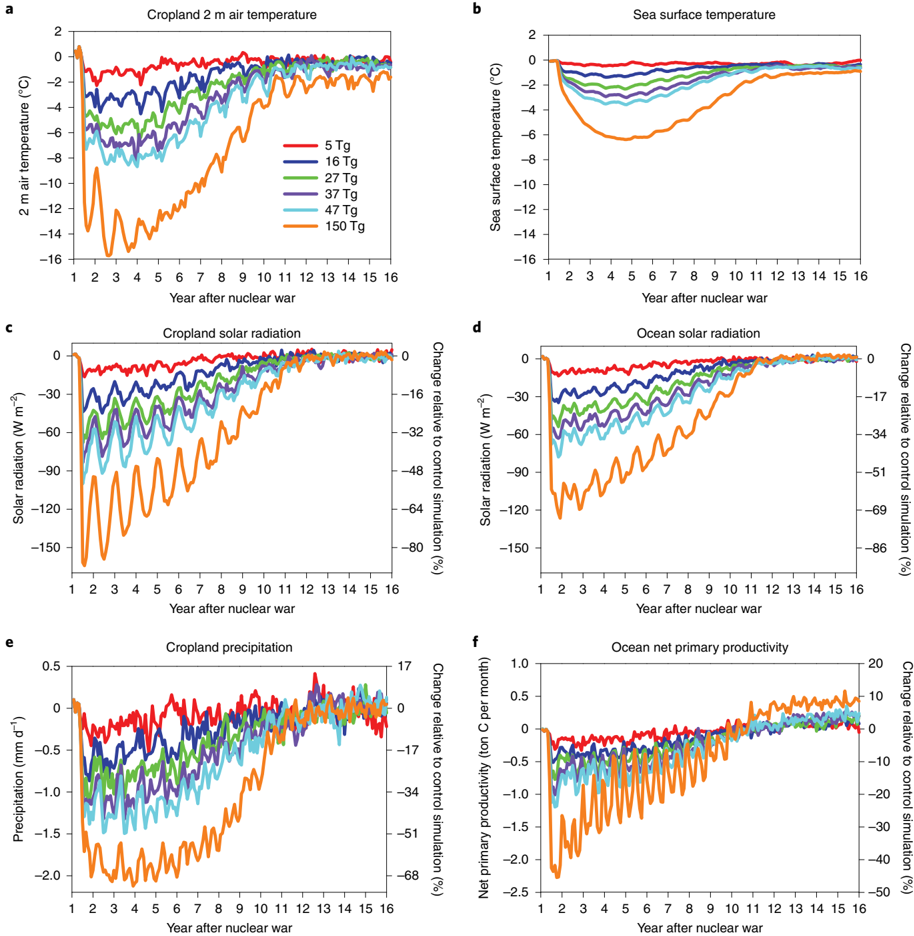
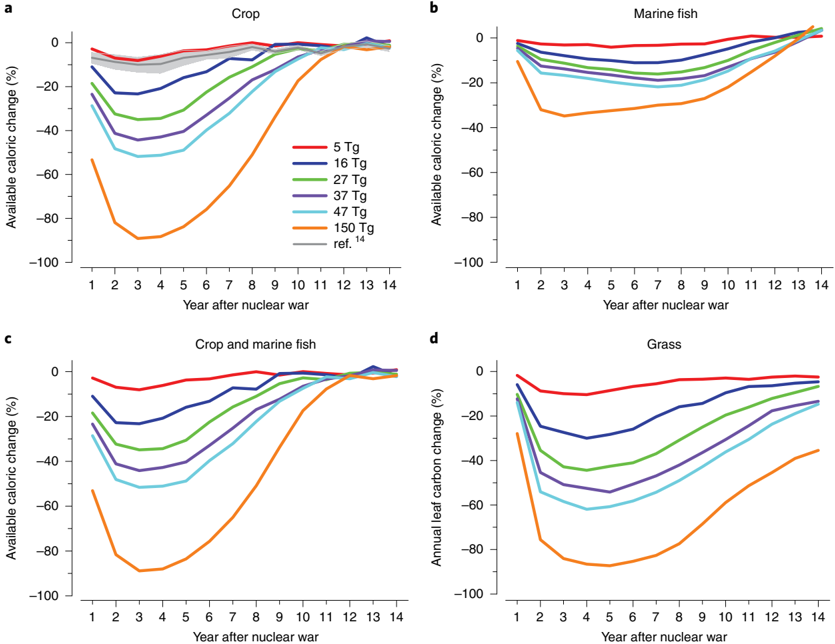
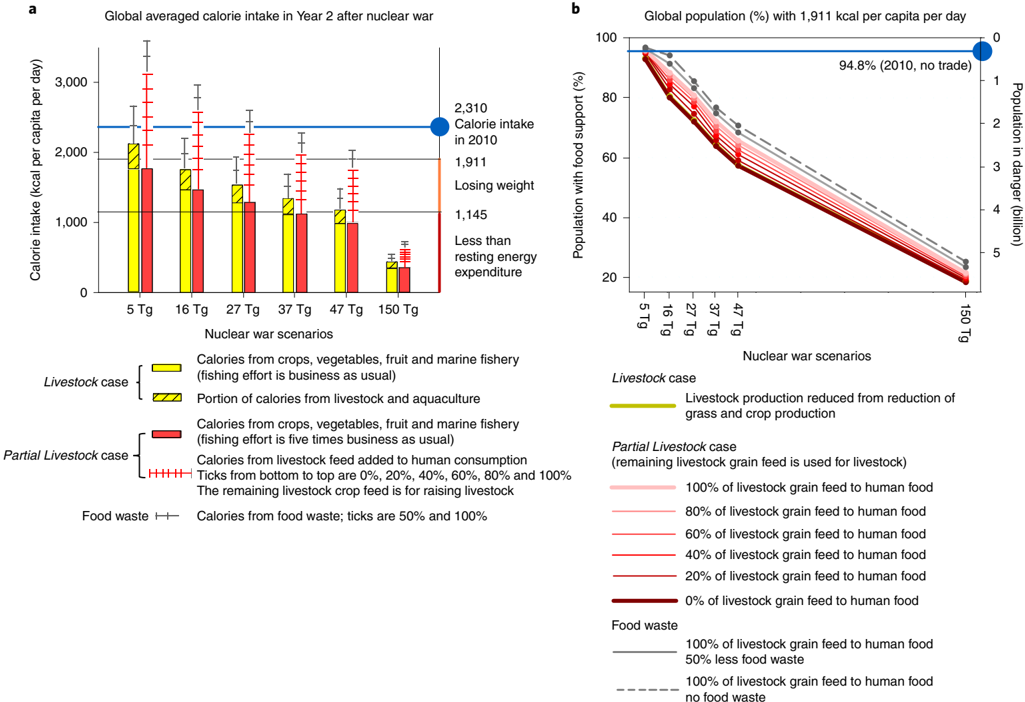
- Global average calorie production from the simulated crops fell by 7% in years 1–5 after the war even in the smallest 5 Tg soot scenario, by up to 50% in the 47 Tg scenario, and by around 90% in the 150 Tg scenario 3–4 years after the war.
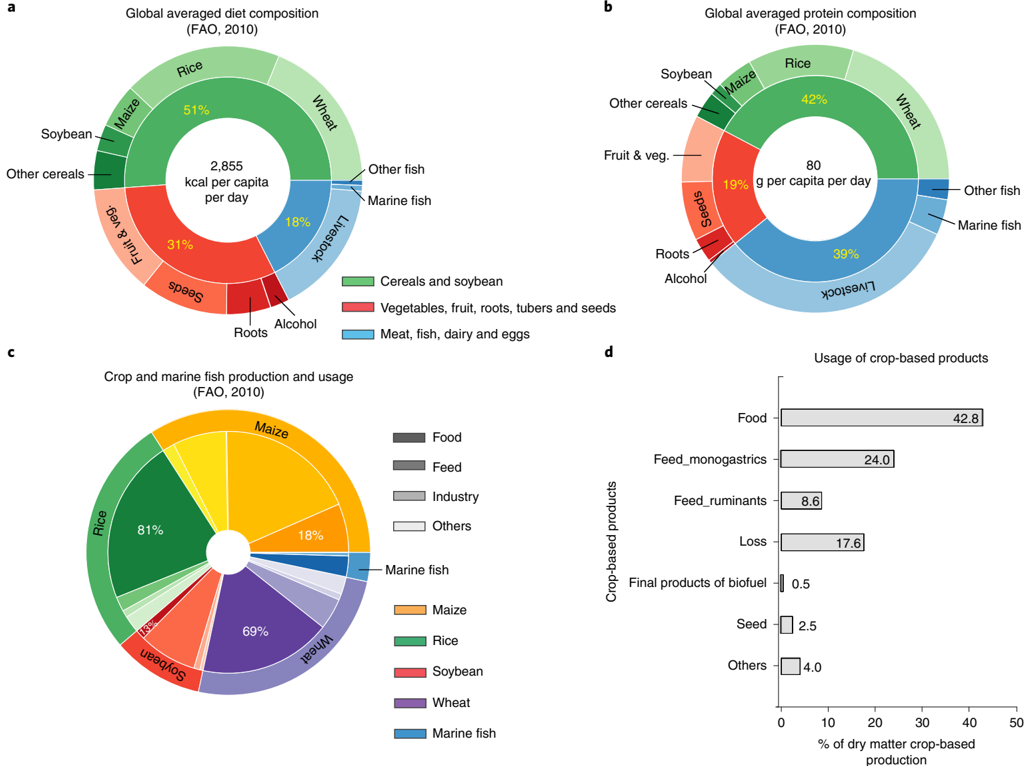
- Marine wild-capture fisheries were affected less than land agriculture, but still declined: oceanic net primary productivity fell from 3% in the 5 Tg case to 37% in the 150 Tg case; marine wild capture fisheries contributed 0.5% of total calories and 3.5% of global average protein supply.
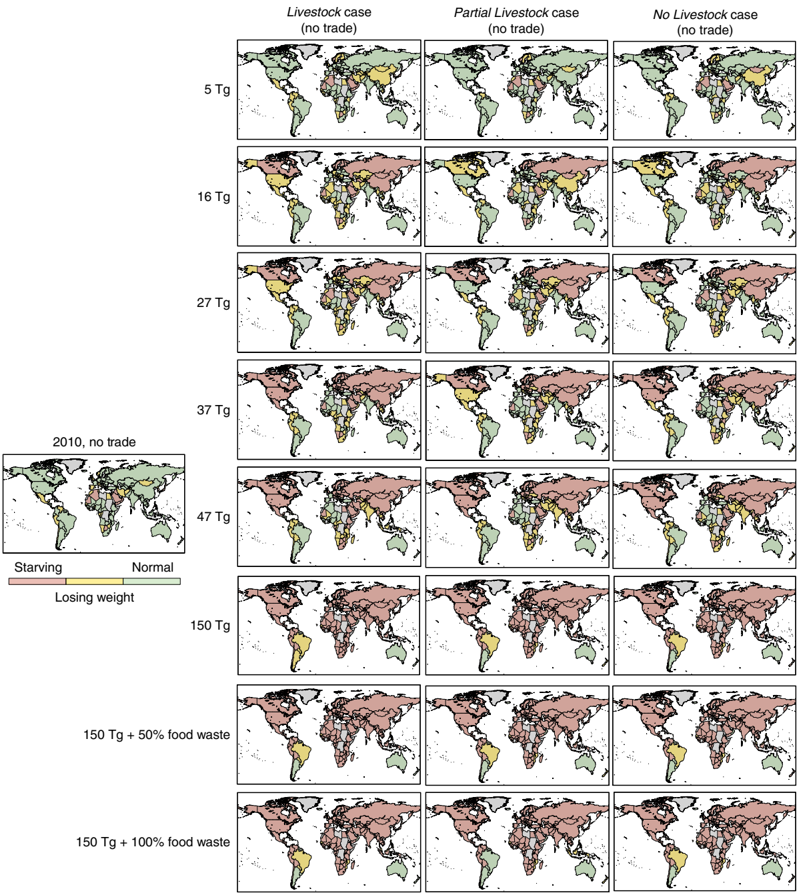
- Table 1 reports the number of people without food at the end of Year 2 as 255 million (5 Tg), 926 million (16 Tg), 1.426 billion (27 Tg), 2.081 billion (37 Tg), 2.512 billion (47 Tg), and 5.341 billion (150 Tg).
- Under the most optimistic assumptions discussed, global food could still be enough for everyone in the 47 Tg case if food were evenly distributed and 100% of livestock feed were converted to human food with no household waste; under the 150 Tg case, most countries would have less than 25% of the population survive by the end of Year 2.
## Methods
- The study used a state-of-the-art global climate model (CESM) to simulate climate and biogeochemical changes from six stratospheric soot injection scenarios, then forced a crop model (CLM5crop) for major crops and a marine fisheries model (BOATS) for ocean fish production.
- The food system analysis combined simulated changes in maize, rice, soybean, spring wheat, marine fish, livestock, aquaculture, food trade, and household waste to estimate country-level calorie availability after nuclear war.
- The paper considered three food-system response cases: Livestock, Partial Livestock, and No Livestock, and assumed no international trade in the main no-trade analyses.
## Limitations
- The authors explicitly state they did not model reduced human populations from direct or indirect mortality, reduced birth rates, farm-management adaptations, alternative food sources, or adaptation in fisheries.
- They also did not consider several important impacts the text names, including surface ozone, ultraviolet radiation, radioactive contamination, pollinator effects, killing frost, and freshwater availability; this is stated in the Methods/Discussion as outside the scope.
- Evident from the text: the analysis relies on one Earth system model, one crop model, and one fishery model, with only one ensemble member for soot cases above 5 Tg, so model-structure uncertainty is substantial.
Model-written summary. Check it against the paper before relying on it.
Integrity signals
Registry
Cites
Statistics
Figures

Verification
Claims the paper makes
8 Valid · 4 Not valid · 9 Not checked · 70 Own results and interpretations
The cited sources support only part of this claim — read each source’s verdict below.
In the paper
“Nuclear war would reduce the wild fish catch 15”
What the sources say
- Partly supportedcites [15] 15. Scherrer, K. J. N. et al. Marine wild-capture fisheries after nuclear war. Proc. Natl Acad. Sci. USA 117 , 29748-29758 (2020). sourceExperimental — accuracy not yet measured
The Results (‘Initial Impacts on Catch and Biomass’; page not provided) report that global catches fall under business-as-usual fishing after the modeled nuclear conflicts. But they also report initial catch increases when postwar fishing intensifies, so the unqualified claim that nuclear war would reduce wild fish catch overstates the findings. (LLM, conf=0.88)
hedgedstates a cause- Asserted: passes — The authors put it forward as true.
- Checkable: passes — It can be checked against evidence.
- Load-bearing: passes — The paper’s conclusions depend on it.
- Based: passes — The paper gives a reason why it holds.
- Partly supported
The cited sources support only part of this claim — read each source’s verdict below.
In the paper
“So far, an integrated estimate of the impacts of the entire range of war scenarios on both land- and ocean-based food production is missing.”
What the sources say
- Not checked — no full text of the sourcecites [12] 12. Xia, L. & Robock, A. Impacts of a nuclear war in South Asia on rice production in mainland China. Climatic Change 116 , 357-372 (2013). source
- Not checked — no full text of the sourcecites [13] 13. Özdoğan, M., Robock, A. & Kucharik, C. Impacts of a nuclear war in South Asia on soybean and maize production in the Midwest United States. Climatic Change 116 , 373-387 (2013). source
- Partly supportedcites [14] 14. Jägermeyr, J. et al. A regional nuclear conflict would compromise global food security. Proc. Natl Acad. Sci. USA 117 , 7071-7081 (2020). sourceExperimental — accuracy not yet measured
The Significance section (p. 1) identifies a gap in assessing how nuclear-war-related crop losses affect global food trade. But this paper examines a regional conflict and major land crops; it does not establish that an integrated estimate is missing across the entire range of war scenarios and both land- and ocean-based food production. (LLM, conf=0.85)
- Supportedcites [15] 15. Scherrer, K. J. N. et al. Marine wild-capture fisheries after nuclear war. Proc. Natl Acad. Sci. USA 117 , 29748-29758 (2020). source
The Abstract describes crop-production estimates separately from this paper’s modeling of fish catches across six war scenarios. The Discussion (Food System Linkages; page not provided) says further investigation of the interdependencies between fishing, aquaculture, and the rest of food production is needed, supporting the claim that an integrated estimate is missing. (LLM, conf=0.88)
plain- Asserted: passes — The authors put it forward as true.
- Checkable: passes — It can be checked against evidence.
- Load-bearing: passes — The paper’s conclusions depend on it.
- Based: passes — The paper gives a reason why it holds.
The cited sources support only part of this claim — read each source’s verdict below.
In the paper
“Although CLM5crop does not simulate winter wheat, we assume winter wheat production is changed by the same amount as spring wheat, which has been found in other studies 14 ; however, this may underestimate the winter wheat response, because winter wheat would experience colder temperatures during its growing period that would be more likely to cross critical thresholds 14 .”
What the sources say
- Partly supportedcites [14] 14. Jägermeyr, J. et al. A regional nuclear conflict would compromise global food security. Proc. Natl Acad. Sci. USA 117 , 7071-7081 (2020). sourceExperimental — accuracy not yet measured
Split into 2 atoms — 1 confirmed, 1 partially supported, 0 disputed, 0 misattributed, 0 unverifiable. Expand the claim to see per-atom verdicts.
hedgedstates a possible cause- Asserted: passes — The authors put it forward as true.
- Checkable: passes — It can be checked against evidence.
- Load-bearing: unclear — It is unclear whether the paper’s conclusions depend on it.
- Based: passes — The paper gives a reason why it holds.
- Rests on an assumption not shown here.
- Partly supported
The cited sources that could be checked couldn’t confirm or dispute this claim.
In the paper
“CLM5crop compares well with other crop models in response to nuclear war forcing 14 (Supplementary Fig. 2).”
What the sources say
- Could not verifycites [14] 14. Jägermeyr, J. et al. A regional nuclear conflict would compromise global food security. Proc. Natl Acad. Sci. USA 117 , 7071-7081 (2020). sourceExperimental — accuracy not yet measured
The Crop Yield Simulations section (p. 9) names the six crop models studied; CLM5crop is not among them. A search for CLM5crop found no passage comparing its response to nuclear-war forcing with that of other models. (LLM, conf=0.75)
plain- Asserted: passes — The authors put it forward as true.
- Checkable: passes — It can be checked against evidence.
- Load-bearing: unclear — It is unclear whether the paper’s conclusions depend on it.
- Based: passes — The paper gives a reason why it holds.
- Could not verify
A result the paper states — it cites no source for it, so there is none to check. The quote shows it is in the paper.
In the paper
“but the reduction would be less than for land agriculture (Fig. 2b)”
hedgedstates a cause- Asserted: passes — The authors put it forward as true.
- Checkable: passes — It can be checked against evidence.
- Load-bearing: unclear — It is unclear whether the paper’s conclusions depend on it.
- Based: passes — The paper gives a reason why it holds.
49 more claims
Create a free account to see all 91 claims and to verify the 2 references still open.
- It may state two separate claims as one. 21
- Probably not a substantial claim. 21
Claims other papers make about this one
Each is checked against this paper’s own text: does it say what the citing paper says it does?
The source backs part of the claim, not all of it — or backs it for a different population, condition or comparison.
In the citing paper
“Even a ' limited ' nuclear war involving only 250 of the 13,000 nuclear weapons in the world could kill 120 million people outright and cause global climate disruption leading to a nuclear famine, putting two billion people at risk [7, 8].”
From Reducing the Risks of Nuclear War. (2023) · cites this paper as [8]
Experimental — accuracy not yet measuredThe cited source says what the claim attributes to it.
In the citing paper
“Even a ' limited ' nuclear war involving only 250 of the 13,000 nuclear weapons in the world could kill 120 million people outright and cause global climate disruption leading to a nuclear famine, putting two billion people at risk [7, 8].”
From Reducing the Risks of Nuclear War. (2023) · cites this paper as [8]
The cited source says what the claim attributes to it.
In the citing paper
“A large scale nuclear war between the US and Russia could kill 200 million people or more in the near term and potentially cause a global ' nuclear winter ' that could kill 5 -6 billion people, threatening the survival of humanity [7, 8].”
From Reducing the Risks of Nuclear War. (2023) · cites this paper as [8]
Citations
Cites
The State of World Fisheries and Aquaculture 2020
(2020) · doi:10.4060/ca9229en · Cited by 3,167
The Community Earth System Model: A Framework for Collaborative Research
Hurrell, J. W., Holland, M. M., Gent, P. R., Ghan, S., Kay, J. E., Kushner, P. J., Lamarque, J.-F., Large, W. G., Lawrence, D., Lindsay, K., et al. (2013) · Bulletin of the American Meteorological Society · doi:10.1175/bams-d-12-00121.1 · Cited by 2,686
Lawrence, D. M., Fisher, R. A., Koven, C. D., Oleson, K. W., Swenson, S. C., Bonan, G., Collier, N., Ghimire, B., van Kampenhout, L., Kennedy, D., et al. (2019) · Journal of Advances in Modeling Earth Systems · doi:10.1029/2018ms001583 · Cited by 2,060
Climate Change from 1850 to 2005 Simulated in CESM1(WACCM)
Marsh, D. R., Mills, M. J., Kinnison, D. E., Lamarque, J.-F., Calvo, N., & Polvani, L. M. (2013) · Journal of Climate · doi:10.1175/jcli-d-12-00558.1 · Cited by 1,081 · cited 1×
“40 ).”
Livestock: On our plates or eating at our table? A new analysis of the feed/food debate
Mottet, A., de Haan, C., Falcucci, A., Tempio, G., Opio, C., & Gerber, P. (2017) · Global Food Security · doi:10.1016/j.gfs.2017.01.001 · Cited by 1,034 · cited 1×
“For global calculations for livestock, we assume that 46% are fed by pasture and 54% are fed by crops and processed products 48 and use national-level data 26 to calculate reduction of livestock feed from pasture and crop-based products.”
MethodNuclear Winter: Global Consequences of Multiple Nuclear Explosions
Turco, R. P., Toon, O. B., Ackerman, T. P., Pollack, J. B., & Sagan, C. (1983) · Science · doi:10.1126/science.222.4630.1283 · Cited by 825
Self-citationBlack carbon lofts wildfire smoke high into the stratosphere to form a persistent plume
Yu, P., Toon, O. B., Bardeen, C. G., Zhu, Y., Rosenlof, K. H., Portmann, R. W., Thornberry, T. D., Gao, R.-S., Davis, S. M., Wolf, E. T., et al. (2019) · Science · doi:10.1126/science.aax1748 · Cited by 363
Self-citationPeterson, D. A., Fromm, M. D., McRae, R. H. D., Campbell, J. R., Hyer, E. J., Taha, G., Camacho, C. P., Kablick, G. P., Schmidt, C. C., & DeLand, M. T. (2021) · npj Climate and Atmospheric Science · doi:10.1038/s41612-021-00192-9 · Cited by 236
Bodirsky, B. L., Dietrich, J. P., Martinelli, E., Stenstad, A., Pradhan, P., Gabrysch, S., Mishra, A., Weindl, I., Le Mouël, C., Rolinski, S., et al. (2020) · Scientific Reports · doi:10.1038/s41598-020-75213-3 · Cited by 231 · cited 4×
“All food commodity trade calculations are based on the 2010 FAO Commodity Balance Sheet (FAO-CBS), FAO-FBS and processed data from previous studies 24,27,28,47 .”
BackgroundMethodInfluentialSelf-citationHigh‐latitude eruptions cast shadow over the African monsoon and the flow of the Nile
Oman, L., Robock, A., Stenchikov, G. L., & Thordarson, T. (2006) · Geophysical Research Letters · doi:10.1029/2006gl027665 · Cited by 211
Self-citation
Research works printed but not linked: 7
- 3. Stommel, H. & Stommel, E. Volcano Weather; The Story of 1816, The Year Without a Summer (Seven Seas Press, 1983).
- 5. Aleksandrov, V. V . & Stenchikov, G. L. On the modeling of the climatic consequences of the nuclear war. Proc. Applied Math (Computing Centre of the USSR Academy of Sciences, 1983).
- 11. Cropper Jr., W . P . & Harwell, M. A. in Environmental Consequences of Nuclear War, SCOPE 28, Volume II Ecological and Agricultural Effects , 2nd Edn (eds Harwell, M. A. & Hutchinson, T. C.) Ch. 5 (Wiley, 1989).
- 10. Harwell, M. A. & Cropper Jr., W . P . in Environmental Consequences of Nuclear War, SCOPE 28, Volume II Ecological and Agricultural Effects , 2nd Edn (eds Harwell, M. A. & Hutchinson, T. C.) Ch. 4 (Wiley, 1989).
- 22. Ambio Advisory Group, Reference scenarios: How a nuclear war might be fought, in Nuclear War: The Aftermath (ed Peterson, J.) Ch. 3 (Pergamon Press, 1983).
- 29. National Research Council, Energy, in Recommended Dietary Allowances, 10th Edn Ch. 3 (US National Academies Press, 1989).
- 32. Denkenberger, D., Pearce, J. M. Feeding Everyone No Matter What: Managing Food Security After Global Catastrophe (Academic Press, 2014).
Cited by
Items 201–300 of 398
Reducing the risks of nuclear war – the role of health professionals
Abbasi, K. A., Ali, P. A., Barbour, V., Bibbins-Domingo, K. B., Rikkert, M. G. M. O., Haines, A., Helfand, I., Horton, R. C., Mash, R. J., Mitra, A., et al. (2023) · The Journal of Pathology · doi:10.1002/path.6203
Reducing the risks of nuclear war—the role of health professionals
Abbasi, K. A., Ali, P. A., Barbour, V., Bibbins-Domingo, K. B., Rikkert, M. G. M. O., Gong, P., Haines, A., Medicine, T., Helfand, I., Physicians, I., et al. (2023) · Croatian Medical Journal · doi:10.3325/cmj.2023.64.211 · Cited by 1
Reducing the risks of nuclear war – The role of health professionals
Kamran, A., Ali, P. A., Barbour, V., Bibbins-Domingo, K. B., Rikkert, M. G. M. O., Horton, R. C., Mash, R. J., Monteiro, C. A., Naumova, E. N., Rubin, E. J., et al. (2023) · African Journal of Primary Health Care & Family Medicine · doi:10.4102/phcfm.v15i1.4249
“Even a “limited” nuclear war involving only 250 of the 13,000 nuclear weapons could kill 120 million people outright and cause global climate disruption, leading to an atomic famine, putting 2 billion people at risk [7,8].”
BackgroundAbbasi, K. A., Ali, P. A., Barbour, V., Bibbins-Domingo, K. B., Rikkert, M. G. M. O., Haines, A., Helfand, I., Horton, R. C., Mash, B., Mitra, A., et al. (2023) · Ethiopian Journal of Health Sciences · doi:10.4314/ejhs.v33i5.1
Reducing the risks of nuclear war—the role of health professionals
Abbasi, K. A., Ali, P. A., Barbour, V., Bibbins-Domingo, K. B., Rikkert, M. G. M. O., Horton, R. C., Mash, R. J., Monteiro, C. A., Naumova, E. N., Rubin, E. J., et al. (2023) · Supportive Care in Cancer · doi:10.1007/s00520-023-08072-z
Reducir los riesgos de una guerra nuclear, el papel de los profesionales de la salud
Abbasi, K. A., Ali, P. A., Barbour, V., Bibbins-Domingo, K. B., Rikkert, M. G. M. O., Haines, A., Helfand, I., Horton, R. C., Mash, B., Mitra, A., et al. (2023) · Cirujano General · doi:10.35366/112921
Reducing the risks of nuclear war—the role of health professionals
Abbasi, K. A., Ali, P. A., Barbour, V., Bibbins-Domingo, K. B., Rikkert, M. G. M. O., Horton, R. C., Mash, R. J., Monteiro, C. A., Naumova, E. N., Rubin, E. J., et al. (2023) · Cancer Gene Therapy · doi:10.1038/s41417-023-00671-6
Reducing the risk of nuclear war- the role of healthcare professionals
Abbasi, K. A., Ali, P. A., Barbour, V., Bibbins-Domingo, K. B., Rikkert, M. G. M. O., Haines, A., Helfland, I., Horton, R., Mash, R. J., Mitra, A., et al. (2023) · Anatomy Journal of Africa · doi:10.4314/aja.v12i3.1
Reducing the risks of nuclear war—the role of health professionals
Abbasi, K. A., Ali, P. A., Barbour, V., Bibbins-Domingo, K. B., Rikkert, M. G. M. O., Horton, R. C., Mash, R. J., Monteiro, C. A., Naumova, E. N., Rubin, E. J., et al. (2023) · European Journal of Nuclear Medicine and Molecular Imaging · doi:10.1007/s00259-023-06453-4
Reducing the risks of nuclear war—the role of health professionals
Abbasi, K. A., Ali, P. A., Barbour, V., Bibbins-Domingo, K. B., Rikkert, M. G. M. O., Horton, R. C., Mash, R. J., Monteiro, C. A., Naumova, E. N., Rubin, E. J., et al. (2023) · Blood Cancer Journal · doi:10.1038/s41408-023-00925-4
Reducing the risks of nuclear war—the role of health professionals
Abbasi, K. A., Ali, P. A., Barbour, V., Bibbins-Domingo, K. B., Rikkert, M. G. M. O., Horton, R. C., Mash, R. J., Monteiro, C. A., Naumova, E. N., Rubin, E. J., et al. (2023) · British Journal of Cancer · doi:10.1038/s41416-023-02447-z
“A large-scale nuclear war between the USA and Russia could kill 200 million people or more in the near term, and potentially cause a global ‘ nuclear winter ’ that could kill 5 – 6 billion people, threatening the survival of humanity [7, 8].”
Republication of: Reducing the risks of nuclear war—the role of health professionals
(2023) · Anaesthesia Critical Care & Pain Medicine · doi:10.1016/j.accpm.2023.101313
Reducing the risks of nuclear war—the role of health professionals
Abbasi, K. A., Ali, P. A., Barbour, V., Bibbins-Domingo, K. B., Rikkert, M. G. M. O., Haines, A., Helfand, I., Horton, R. C., Mash, R. J., Mitra, A., et al. (2023) · Prostate Cancer and Prostatic Diseases · doi:10.1038/s41391-023-00739-2
“A large-scale nuclear war between the USA and Russia could kill 200 million people or more in the near term, and potentially cause a global “nuclear winter” that could kill 5–6 billion people, threatening the survival of humanity [7, 8].”
Reducing the risks of nuclear war—the role of health professionals
Abbasi, K. A., Ali, P. A., Barbour, V., Bibbins-Domingo, K. B., Rikkert, M. G. M. O., Horton, R. C., Mash, R. J., Monteiro, C. A., Naumova, E. N., Rubin, E. J., et al. (2023) · Bone Marrow Transplantation · doi:10.1038/s41409-023-02126-w
Reducing the Risks of Nuclear War: the Role of Health Professionals
Abbasi, K. A., Ali, P. A., Barbour, V., Bibbins-Domingo, K. B., Rikkert, M. G. M. O., Haines, A., Helfand, I., Horton, R. C., Mash, R. J., Mitra, A., et al. (2023) · The Cerebellum · doi:10.1007/s12311-023-01599-1
“Even a “limited” nuclear war involving only 250 of the 13 000 nuclear weapons in the world could kill 120 million people outright and cause global climate disruption leading to a nuclear famine, putting 2 billion people at risk [7, 8].”
الحدّ من مخاطر الحرب النووية – دور المهنيين الصحيين
عباسي, ك., علي, ب., الربان, م., بربور, ف., دومينغو, ك. ب., ريكيرت, م. أ., هينس, آ., هلفاند, إ., هورتون, ر., ماش, ب., et al. (2023) · Arabian Journal of Scientific Research-المجلة العربية للبحث العلمي · doi:10.5339/ajsr.2023.9
Reducing the risks of nuclear war—the role of health professionals
Kamran, A., Parveen, A., Virginia, B., Bibbins-Domingo, K. B., Rikkert, M. G. O., Haines, A., Helfand, I., Horton, R., Mash, B., Mitra, A., et al. (2023) · Khyber Medical University Journal · doi:10.35845/kmuj.2023.23435
Reducing the risks of nuclear war: the role of health professionals
Abbasi, K. A., Ali, P. A., Barbour, V., Bibbins-Domingo, K. B., Rikkert, M. G. M. O., Haines, A., Helfand, I., Horton, R. C., Mash, B., Mitra, A., et al. (2023) · Aging Clinical and Experimental Research · doi:10.1007/s40520-023-02588-4
“Even a “limited” nuclear war involving only 250 of the 13,000 nuclear weapons in the world could kill 120 million people outright and cause global climate disruption leading to a nuclear famine, putting 2 billion people at risk [7, 8].”
BackgroundCrilley, R. (2023) · Manchester University Press eBooks · doi:10.7765/9781526170453.00016
Reducing the Risks of Nuclear War—the Role of Health Professionals
Abbasi, K. A., Ali, P. A., Barbour, V., Bibbins-Domingo, K. B., Rikkert, M. G. M. O., Gong, P., Haines, A., Helfand, I., Horton, R. C., Mash, R. J., et al. (2023) · International Journal of Medical Students · doi:10.5195/ijms.2023.2179 · Cited by 2
Boyd, M., Ragnarsson, S., Terry, S., Payne, B., & Wilson, N. (2023) · Research Square · doi:10.21203/rs.3.rs-3273609/v2
Reducing the risks of nuclear war—the role of health professionals
Kamran Abbasi Machoko, Y., Farouk, P. A. G., Editor-in-Chief, I. N. R., Virginia, B., & Ladu, S. J. B. I. (2023) · Kanem Journal of Medical Sciences · doi:10.36020/kjms.2023.1701.001
Reducing the Risks of Nuclear War—the Role of Health Professionals
Abbasi, K. A., Ali, P. A., Barbour, V., Bibbins-Domingo, K. B., Rikkert, M. G. M. O., Haines, A., Helfand, I., Horton, R. C., Mash, R. J., Mitra, A., et al. (2023) · Journal of General Internal Medicine · doi:10.1007/s11606-023-08529-1
Reducing the risks of nuclear war—the role of health professionals
Olobayo, K. (2023) · Journal of Phytomedicine and Therapeutics · doi:10.4314/jopat.v22i2.1
Khadka, B. (2023) · Medicine Conflict & Survival · doi:10.1080/13623699.2023.2289075
Reducing the risks of nuclear war—the role of health professionals
Abbasi, K. A., Ali, P. A., Barbour, V., Bibbins-Domingo, K. B., Rikkert, M. G. M. O., Horton, R. C., Mash, R. J., Monteiro, C. A., Naumova, E. N., Rubin, E. J., et al. (2023) · European Journal of Pediatrics · doi:10.1007/s00431-023-05261-0
“Even a “limited” nuclear war involving only 250 of the 13 000 nuclear weapons in the world could kill 120 million people outright and cause global climate disruption leading to a nuclear famine, putting 2 billion people at risk [7, 8].”
Reducing the risks of nuclear war; the role of health professionals
Zielinski, C. (2023) · Babcock University Medical Journal · doi:10.38029/babcockuniv.med.j..v6i2.221
“Even a “limited” nuclear war involving only 250 of the 13000 nuclear weapons in the world could kill 120 million people outright and cause global climate disruption leading to a nuclear famine, putting 2 billion people at risk [7,8].”
Reducing the risks of nuclear war—the role of health professionals
Abbasi, K. A., Ali, P. A., Barbour, V., Bibbins-Domingo, K. B., Rikkert, M. G. M. O., Haines, A., Helfand, I., Horton, R. C., Mash, R. J., Mitra, A., et al. (2024) · Langenbeck s Archives of Surgery · doi:10.1007/s00423-023-03167-x
Reducing the risks of nuclear war—the role of health professionals
Abbasi, K. A., Ali, P. A., Barbour, V., Bibbins-Domingo, K. B., Rikkert, M. G. M. O., Horton, R. C., Mash, R. J., Monteiro, C. A., Naumova, E. N., Rubin, E. J., et al. (2024) · Internal and Emergency Medicine · doi:10.1007/s11739-023-03462-x
“Even a “limited” nuclear war involving only 250 of the 13,000 nuclear weapons in the world could kill 120 million people outright and cause global climate disruption leading to a nuclear famine, putting 2 billion people at risk [7, 8].”
Reducing the risks of nuclear war—the role of health professionals
Abbasi, K. A., Ali, P. A., Barbour, V., Bibbins-Domingo, K. B., Rikkert, M. G. M. O., Gong, P., Haines, A., Helfand, I., Horton, R. C., Mash, R. J., et al. (2023) · Ghana Medical Journal · doi:10.4314/gmj.v57i3.1
Nuclear war and the public health community: the responsibility to act
Helfand, I. (2024) · Journal of Public Health Policy · doi:10.1057/s41271-023-00456-z
“A war between the United States and Russia would kill 5–6 billion, three quarters of humanity [14].”
Lessons from Existing WMD Multilateral Programmes and Platforms
Lennane, R. (2024) · Routledge eBooks · doi:10.4324/9781032699028-5
Reducing the Risks of Nuclear War: The role of health professionals
Abbasi, K. A., Ali, P. A., Barbour, V., Bibbins-Domingo, K. B., Rikkert, M. G. M. O., Haines, A., Helfand, I., Mitra, A., Ruff, T., Horton, R. C., et al. (2024) · The National Medical Journal of India · doi:10.25259/nmji_687_2023
Reducing the Risks of Nuclear War: The Role of Health Professionals
Abbasi, K. A., Al, P., Barbour, V., Bibbins-Domingo, K. B., Rikkert, M. G. M. O., Gong, P., Haines, A., Helfand, I., Horton, R. C., Mash, R. J., et al. (2024) · Annals of African Surgery · doi:10.4314/aas.v20i4.1
Wibowo, D. P., Vayed, D. A., & Bernadin Dwi, M. (2024) · Climate change management · doi:10.1007/978-3-031-58261-5_28 · Cited by 3
Addressing the health threats of nuclear war as United States medical students
Hale, A. E., Kellis, D. M., Lee, G. R., & Hodgkin, J. G. (2024) · Medicine Conflict & Survival · doi:10.1080/13623699.2024.2409535 · Cited by 1
“This could result in a ‘nuclear winter’ event that drops global temperatures and precipitation, reduces crop yields, and puts between two to five billion individuals at risk of malnutrition and starvation, depending on the scale of the conflict (Xia et al. 2022).”
Klimapolitik und nuklearer Winter
Dethloff, K. (2024) · Springer eBooks · doi:10.1007/978-3-662-69662-0_17
The extraterrestrial hypothesis: an epistemological case for removing the taboo
Lane, W. C. (2025) · European Journal for Philosophy of Science · doi:10.1007/s13194-025-00634-8 · Cited by 17
“But though the first three (and others not listed) may cause wide-spread death and economic collapse, the extinction of all intelligent life seems beyond them absent a singular series of catastrophes (Xia et al., 2022; Tonn & McGregor, 2018).”
The Arsenal and the Ballot Box: Scoping the Incompatibility of Nuclear Weapons and Democracy
van Buuren, S. (2025) · Perspectives on Politics · doi:10.1017/s1537592724002664 · Cited by 3
Ending nuclear weapons, before they end us
Abbasi, K. A., Ali, P. A., Barbour, V., Birch, M., Blum, I., Doherty, P. C., Haines, A., Helfand, I., Horton, R. C., Juva, K., et al. (2025) · Complementary Therapies in Medicine · doi:10.1016/j.ctim.2025.103175
How Many Bombs Are Out There, and How Could They Be Delivered?
Toon, O. B., & Robock, A. D. (2025) · Oxford University Press eBooks · doi:10.1093/9780197799734.003.0009
Self-citationToon, O. B., & Robock, A. D. (2025) · Oxford University Press eBooks · doi:10.1093/9780197799734.003.0001
Self-citationImpacts on Humans of Nuclear War
Toon, O. B., & Robock, A. D. (2025) · Oxford University Press eBooks · doi:10.1093/9780197799734.003.0015
Self-citationPreface: How We Met and a Brief History
Toon, O. B., & Robock, A. D. (2025) · Oxford University Press eBooks · doi:10.1093/9780197799734.002.0005
Self-citationCan We Stop an Asteroid or Comet Collision in the Future?
Toon, O. B., & Robock, A. D. (2025) · Oxford University Press eBooks · doi:10.1093/9780197799734.003.0006
Self-citationToon, O. B., & Robock, A. D. (2025) · Oxford University Press eBooks · doi:10.1093/9780197799734.002.0004
Self-citationClimate Disaster, Climate Models, and Natural Analogs
Toon, O. B., & Robock, A. D. (2025) · Oxford University Press eBooks · doi:10.1093/9780197799734.003.0014
Self-citationWorldwide Fires Killed the Dinosaurs
Toon, O. B., & Robock, A. D. (2025) · Oxford University Press eBooks · doi:10.1093/9780197799734.003.0005
Self-citationToon, O. B., & Robock, A. D. (2025) · Oxford University Press eBooks · doi:10.1093/9780197799734.003.0019
Self-citationClues from Craters, Assured Destruction, and Ejecta Layers
Toon, O. B., & Robock, A. D. (2025) · Oxford University Press eBooks · doi:10.1093/9780197799734.003.0004
Self-citationToon, O. B., & Robock, A. D. (2025) · Oxford University Press eBooks · doi:10.1093/9780197799734.003.0013
Self-citationWill Humans Become Extinct from an Asteroid Collision or a Nuclear War?
Toon, O. B., & Robock, A. D. (2025) · Oxford University Press eBooks · doi:10.1093/9780197799734.003.0017
Self-citationAssured Destruction by Nuclear Explosions
Toon, O. B., & Robock, A. D. (2025) · Oxford University Press eBooks · doi:10.1093/9780197799734.003.0012 · Cited by 1
Self-citationScenarios for War and Near Misses
Toon, O. B., & Robock, A. D. (2025) · Oxford University Press eBooks · doi:10.1093/9780197799734.003.0010
Self-citationToon, O. B., & Robock, A. D. (2025) · Oxford University Press eBooks · doi:10.1093/9780197799734.003.0008
Self-citationAre You Being Targeted with a Nuclear Weapon?
Toon, O. B., & Robock, A. D. (2025) · Oxford University Press eBooks · doi:10.1093/9780197799734.003.0011
Self-citationToon, O. B., & Robock, A. D. (2025) · Oxford University Press eBooks · doi:10.1093/9780197799734.003.0018
Self-citationThe Power of Asteroids and Comets: When Will the Next Big One Hit?
Toon, O. B., & Robock, A. D. (2025) · Oxford University Press eBooks · doi:10.1093/9780197799734.003.0003
Self-citationBoyd, M., & Wilson, N. (2025) · Research Square · doi:10.21203/rs.3.rs-4590974/v3
Ending nuclear weapons, before they end us
Abbasi, K. A., Ali, P. A., Barbour, V., Birch, M., Blum, I., Doherty, P. C., Haines, A., Helfand, I., Horton, R. C., Juva, K., et al. (2025) · American Journal of Epidemiology · doi:10.1093/aje/kwaf081 · Cited by 1
Boyd, M., & Wilson, N. (2025) · PLoS ONE · doi:10.1371/journal.pone.0321203
“Assuming both 150 Tg (equivalent to 150 megatonnes) or 5 Tg of soot has reached the stratosphere [37], with this previous study by Xia et al. specifically considering impacts on crop yields in New Zealand (with yield coefficients of 0.921 and 0.391 respectively, as in Table 2).”
InfluentialEnding nuclear weapons, before they end us
Abbasi, K. A., Ali, P. A., Barbour, V., Birch, M., Blum, I., Doherty, P. C., Haines, A., Helfand, I., Horton, R. C., Juva, K., et al. (2025) · African Journal of Laboratory Medicine · doi:10.4102/ajlm.v14i1.2847
Ending nuclear weapons, before they end us
Abbasi, K. A., Ali, P. A., Barbour, V., Birch, M., Blum, I., Doherty, P. C., Haines, A., Helfand, I., Horton, R. C., Juva, K., et al. (2025) · African Journal of Primary Health Care & Family Medicine · doi:10.4102/phcfm.v17i1.5016
Ending Nuclear Weapons, Before They End Us
Zielinski, C. (2025) · AlQalam Journal of Medical and Applied Sciences · doi:10.54361/ajmas.258247
Ending nuclear weapons, before they end us
Zielinski, C. (2025) · BMJ Open Sport & Exercise Medicine · doi:10.1136/bmjsem-2025-002692
Ending nuclear weapons, before they end us
Zielinski, C. (2025) · Journal of Epidemiology & Community Health · doi:10.1136/jech-2025-224300
Ending nuclear weapons, before they end us
Zielinski, C. (2025) · Tobacco Control · doi:10.1136/tc-2025-059518
Ending nuclear weapons, before they end us
Zielinski, C. (2025) · Medical Humanities · doi:10.1136/medhum-2025-013368
Ending nuclear weapons, before they end us
Zielinski, C. (2025) · Sexually Transmitted Infections · doi:10.1136/sextrans-2025-056602
Ending nuclear weapons, before they end us
Zielinski, C. (2025) · BMJ Open Gastroenterology · doi:10.1136/bmjgast-2025-001891
Ending nuclear weapons, before they end us
Zielinski, C. (2025) · BMJ Open · doi:10.1136/bmjopen-2025-104473
Ending nuclear weapons, before they end us
Zielinski, C. (2025) · BMJ Military Health · doi:10.1136/military-2025-003046
Ending nuclear weapons, before they end us
Zielinski, C. (2025) · Journal of NeuroInterventional Surgery · doi:10.1136/jnis-2025-023673
Ending nuclear weapons, before they end us
Zielinski, C. (2025) · Gut · doi:10.1136/gutjnl-2025-335771
Ending nuclear weapons, before they end us
Zielinski, C. (2025) · Journal of Medical Genetics · doi:10.1136/jmg-2025-110897
Ending nuclear weapons, before they end us
Zielinski, C. (2025) · BMJ Surgery Interventions & Health Technologies · doi:10.1136/bmjsit-2025-000412
Ending nuclear weapons, before they end us
Zielinski, C. (2025) · Occupational and Environmental Medicine · doi:10.1136/oemed-2025-110301
Ending nuclear weapons, before they end us
Zielinski, C. (2025) · BMJ Paediatrics Open · doi:10.1136/bmjpo-2025-003626
Ending nuclear weapons, before they end us
Zielinski, C. (2025) · Frontline Gastroenterology · doi:10.1136/flgastro-2025-103225
Ending nuclear weapons, before they end us
Zielinski, C. (2025) · BMJ Mental Health · doi:10.1136/bmjment-2025-301772
Ending nuclear weapons, before they end us
Zielinski, C. (2025) · Journal of Neurology Neurosurgery & Psychiatry · doi:10.1136/jnnp-2025-336653
Ending nuclear weapons, before they end us
Zielinski, C. (2025) · BMJ Open Quality · doi:10.1136/bmjoq-2025-003509
Ending nuclear weapons, before they end us
Zielinski, C. (2025) · BMJ Open Respiratory Research · doi:10.1136/bmjresp-2025-003434
Ending nuclear weapons, before they end us
Zielinski, C. (2025) · BMJ Global Health · doi:10.1136/bmjgh-2025-020389
Ending nuclear weapons, before they end us
Zielinski, C. (2025) · Heart · doi:10.1136/heartjnl-2025-326383
Ending nuclear weapons, before they end us
Zielinski, C. (2025) · BMJ Neurology Open · doi:10.1136/bmjno-2025-001169
Ending nuclear weapons, before they end us
Zielinski, C. (2025) · BMJ Quality & Safety · doi:10.1136/bmjqs-2025-018959
Ending nuclear weapons, before they end us
Zielinski, C. (2025) · BMJ Case Reports · doi:10.1136/bcr-2025-266930
Ending nuclear weapons, before they end us
Zielinski, C. (2025) · BMJ Open Ophthalmology · doi:10.1136/bmjophth-2025-002296
Ending nuclear weapons, before they end us
Zielinski, C. (2025) · BMJ Health & Care Informatics · doi:10.1136/bmjhci-2025-101572
Ending nuclear weapons, before they end us
Zielinski, C. (2025) · Emergency Medicine Journal · doi:10.1136/emermed-2025-215161
Ending nuclear weapons, before they end us
Zielinski, C. (2025) · BMJ Sexual & Reproductive Health · doi:10.1136/bmjsrh-2025-202876
Ending nuclear weapons, before they end us
Zielinski, C. (2025) · Open Heart · doi:10.1136/openhrt-2025-003426
Ending nuclear weapons, before they end us
Zielinski, C. (2025) · Trauma Surgery & Acute Care Open · doi:10.1136/tsaco-2025-001909
Ending nuclear weapons, before they end us
Zielinski, C. (2025) · RMD Open · doi:10.1136/rmdopen-2025-005865
Ending nuclear weapons, before they end us
Zielinski, C. (2025) · Evidence-Based Nursing · doi:10.1136/ebnurs-2025-104340
Ending nuclear weapons, before they end us
Zielinski, C. (2025) · BMJ Supportive & Palliative Care · doi:10.1136/spcare-2025-005605
Ending nuclear weapons, before they end us
Zielinski, C. (2025) · Family Medicine and Community Health · doi:10.1136/fmch-2025-003434
Ending nuclear weapons, before they end us
Zielinski, C. (2025) · BMJ Nutrition Prevention & Health · doi:10.1136/bmjnph-2025-001293
Ending nuclear weapons, before they end us
Zielinski, C. (2025) · BMJ connections. · doi:10.1136/bmjccgg-2025-000018
Metadata
- Authors
- Xia, L., Robock, A., Scherrer, K., Harrison, C. S., Bodirsky, B. L., Weindl, I., Jägermeyr, J., Bardeen, C. G., Toon, O. B., & Heneghan, R.
- Affiliations
- Rutgers, The State University of New Jersey (US)
- Universitat Autònoma de Barcelona (ES)
- Louisiana State University (US)
- World Vegetable Center (TW)
- Potsdam Institute for Climate Impact Research (DE)
- Goddard Institute for Space Studies (US)
- NSF National Center for Atmospheric Research (US)
- University of Colorado Boulder (US)
- Queensland University of Technology (AU)
- Corresponding author
- Xia, Lili
- ORCID
- Venue
- Nature Food
- Published
- 2022-08-15
- Volume
- 3
- Issue
- 8
- Pages
- 586-596
- ISSN
- 2662-1355 (ISSN-L)
- OpenAlex
- W4291904039
- Cited by
- 398
- References
- 40
- Citations by year
- 2026: 29 · 2025: 167 · 2024: 42 · 2023: 144 · 2022: 14
- FWCI
- 299.53
- Type
- journal article
- Language
- en
- Open access
- hybrid
- doi.org
- Licence
- cc-by
- creativecommons.org/licenses/by/4.0 (tdm)
- creativecommons.org/licenses/by/4.0 (vor)
- Locations
- Nature Food (publishedVersion, cc-by)
- Research Square (acceptedVersion, cc-by)
- PubMed (publishedVersion)
- QUT ePrints (Queensland University of Technology) (submittedVersion, cc-by)
- Civil War Book Review (submittedVersion)
- ScholarWorks @ UTRGV (The University of Texas Rio Grande Valley) (submittedVersion, cc-by)
- NORA - Norwegian Open Research Archives (submittedVersion, cc-by)
- Dipòsit Digital de Documents de la UAB (Universitat Autònoma de Barcelona) (submittedVersion, cc-by)
- Publication Database PIK (Potsdam Institute for Climate Impact Research (PIK)) (submittedVersion, other-oa)
- Publication Database PIK (Potsdam Institute for Climate Impact Research (PIK)) (submittedVersion, cc-by)
- Griffith Research Online (submittedVersion, cc-by)
- Funders
- National Science Foundation (2017113, 2028541)
- National Aeronautics and Space Administration
- Open Philanthropy Project
- European Commission (821010, HORIZON2020, 776479, 682602)
- Bundesministerium für Bildung und Forschung (031B0787B)
- Norges Forskningsråd (326896)
- Goddard Institute for Space Studies
- Topics
- Social Sciences › Political Science and International Relations › Nuclear Issues and Defense
- Physical Sciences › Environmental Science › Management, Monitoring, Policy and Law › Environmental and Biological Research in Conflict Zones
- Life Sciences › Agricultural and Biological Sciences › Agronomy and Crop Science › Climate change impacts on agriculture
- Keywords
- nuclear war, climate disruption, food insecurity, famine, crop production, animal husbandry, food waste reduction, India-Pakistan conflict, global food security
About these checks
Registry, retraction, Cites and statistics results are computed, not judged, with one exception: a printed reference that no index lists is read once by a model before it counts as a citation error. Claims are extracted by a model and kept only when their quote appears verbatim in the text; each cited source is then checked, with a model’s help, for whether it says what the claim relies on. Those verdicts can be wrong — read the claim’s quote and the cited source before relying on one.
The claim verdicts this report counts are experimental: their accuracy is not yet measured.
A language model drew the claims from the paper on 2026-10-01, under version 3 of the claim definition (model deepseek-v4.1-flash, prompt extract-v3).
A second model labelled each claim on 2026-10-01 (model jev-1.13-20260917, definition revision gold-guideline-v0.2).
Cited sources are checked with a language model’s help (gpt-6-sol).
Statistics and arithmetic are recomputed, not judged.
Confidence bands are shown only for fields calibrated on our annotated test set. None is calibrated yet, so no band is shown.
What counts as a claim ›How we measure confidence ›How we check this ›
Are you an author, or do you see a problem with this page? Request a review
Data sources
Bibliographic data: Semantic Scholar, OpenAlex, Crossref.
Contains information from the Semantic Scholar Academic Graph Datasets, made available under the ODC Attribution License (ODC-BY 1.0).
Semantic Scholar’s data is described in: Kinney, R., et al. (2023). The Semantic Scholar Open Data Platform. arXiv:2301.10140.
