

Global food insecurity and famine from reduced crop, marine fishery and livestock production due to climate disruption from nuclear war soot injection
Open accessPublished version of a preprint
The DOI matches its Crossref record; 43 of the 43 references it cites were found in a registry or an index; 14 of the 31 sources its claims cite were checked for support.
Abstract
Atmospheric soot loadings from nuclear weapon detonation would cause disruptions to the Earth’s climate, limiting terrestrial and aquatic food production. Here, we use climate, crop and fishery models to estimate the impacts arising from six scenarios of stratospheric soot injection, predicting the total food calories available in each nation post-war after stored food is consumed. In quantifying impacts away from target areas, we demonstrate that soot injections larger than 5 Tg would lead to mass food shortages, and livestock and aquatic food production would be unable to compensate for reduced crop output, in almost all countries. Adaptation measures such as food waste reduction would have limited impact on increasing available calories. We estimate more than 2 billion people could die from nuclear war between India and Pakistan, and more than 5 billion could die from a war between the United States and Russia—underlining the importance of global cooperation in preventing nuclear war.
Overview
CoChat Summary
## TL;DR
This modeling study estimates how soot from nuclear war would disrupt climate, crops, fisheries, livestock, and national food calories across six soot-injection scenarios. The authors conclude that soot injections above 5 Tg would cause mass food shortages, and that more than 2 billion people could die in an India-Pakistan war and more than 5 billion in a U.S.-Russia war.
## Key findings
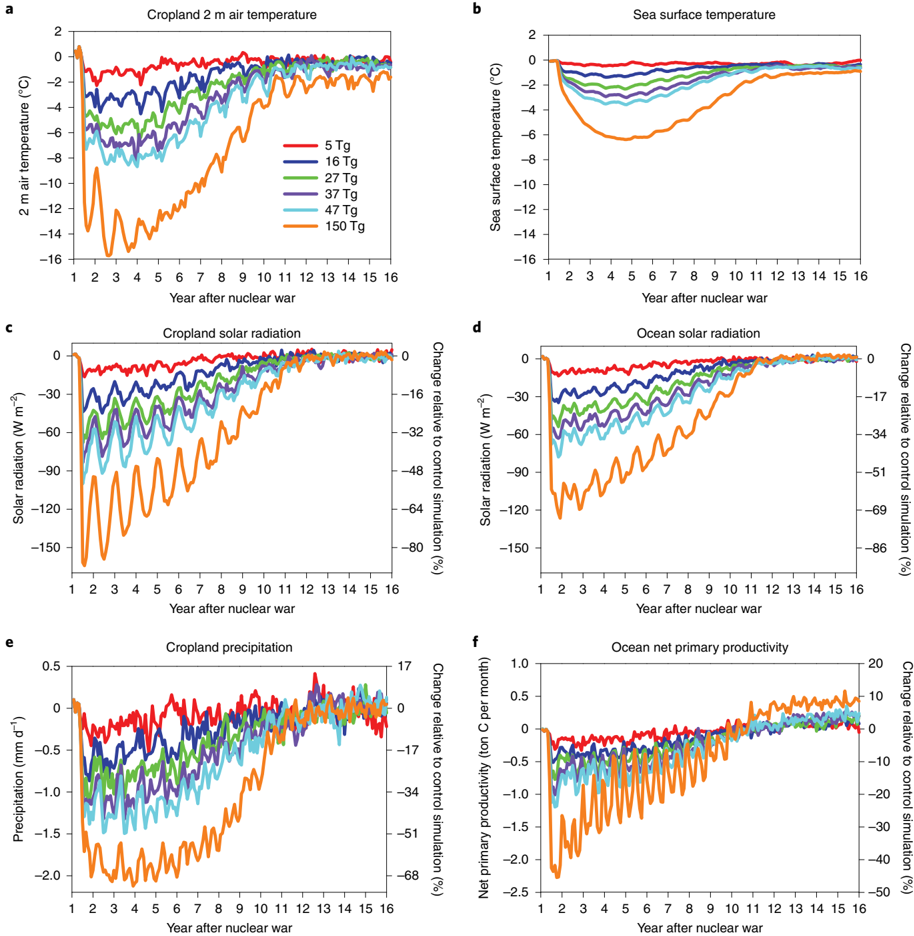
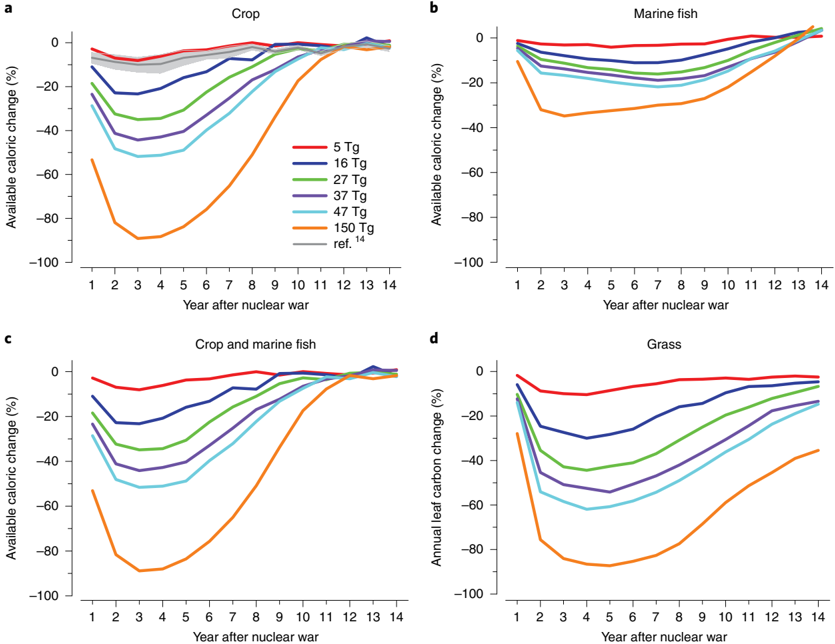
- Global average calorie production from the simulated crops fell by 7% in years 1–5 after the war even in the smallest 5 Tg soot scenario, by up to 50% in the 47 Tg scenario, and by around 90% in the 150 Tg scenario 3–4 years after the war.
- Marine wild-capture fisheries were affected less than land agriculture, but still declined: oceanic net primary productivity fell from 3% in the 5 Tg case to 37% in the 150 Tg case; marine wild capture fisheries contributed 0.5% of total calories and 3.5% of global average protein supply.
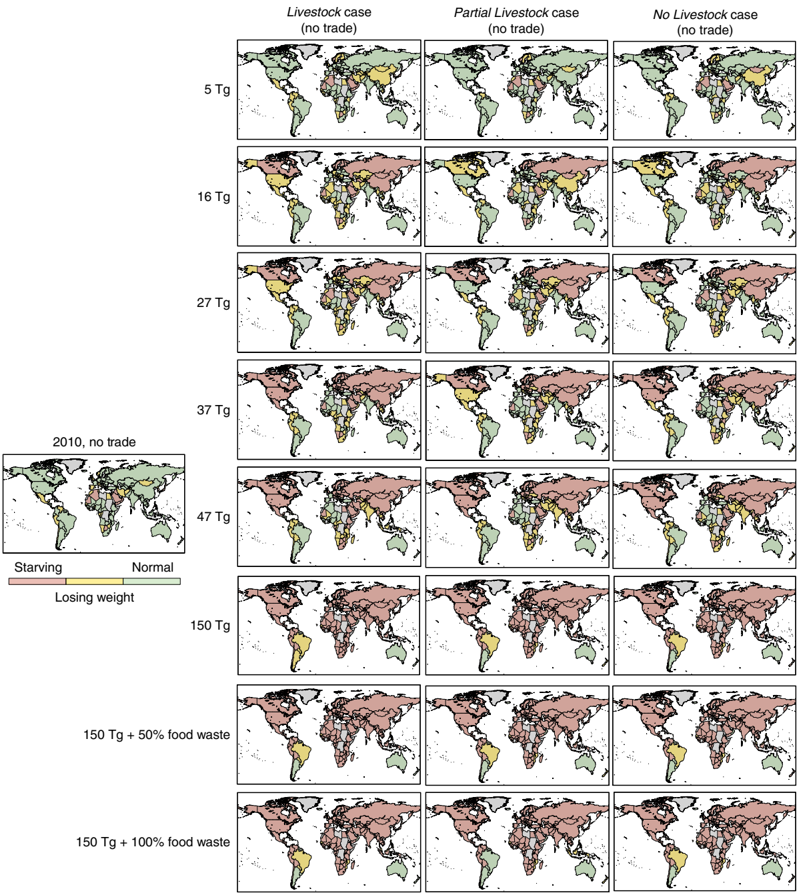
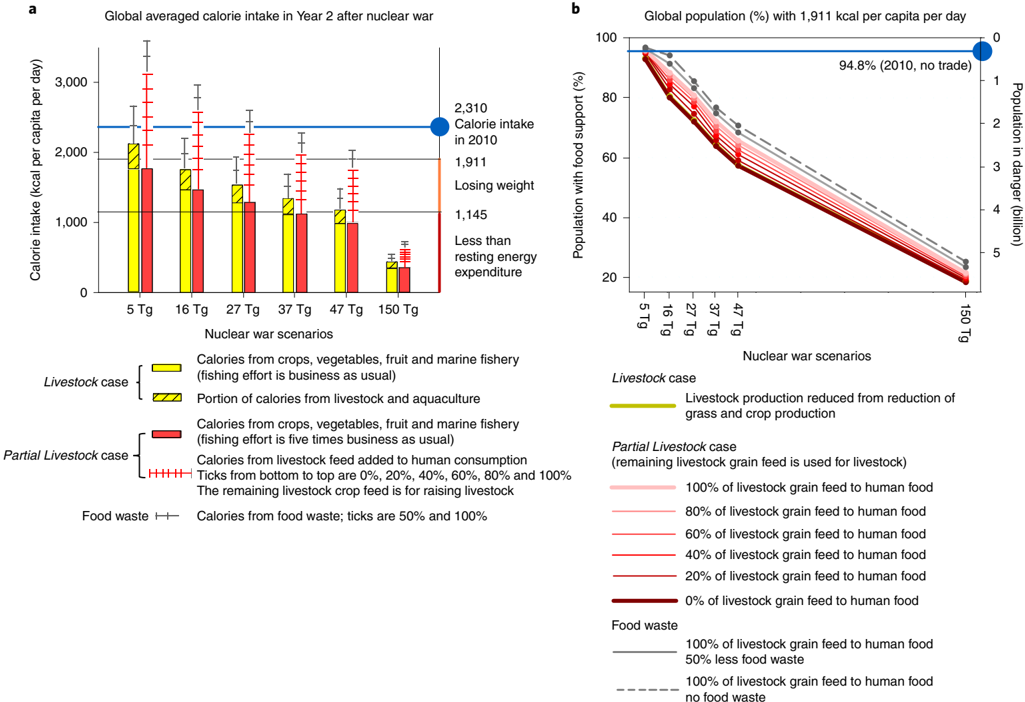
- Table 1 reports the number of people without food at the end of Year 2 as 255 million (5 Tg), 926 million (16 Tg), 1.426 billion (27 Tg), 2.081 billion (37 Tg), 2.512 billion (47 Tg), and 5.341 billion (150 Tg).
- Under the most optimistic assumptions discussed, global food could still be enough for everyone in the 47 Tg case if food were evenly distributed and 100% of livestock feed were converted to human food with no household waste; under the 150 Tg case, most countries would have less than 25% of the population survive by the end of Year 2.
## Methods
- The study used a state-of-the-art global climate model (CESM) to simulate climate and biogeochemical changes from six stratospheric soot injection scenarios, then forced a crop model (CLM5crop) for major crops and a marine fisheries model (BOATS) for ocean fish production.
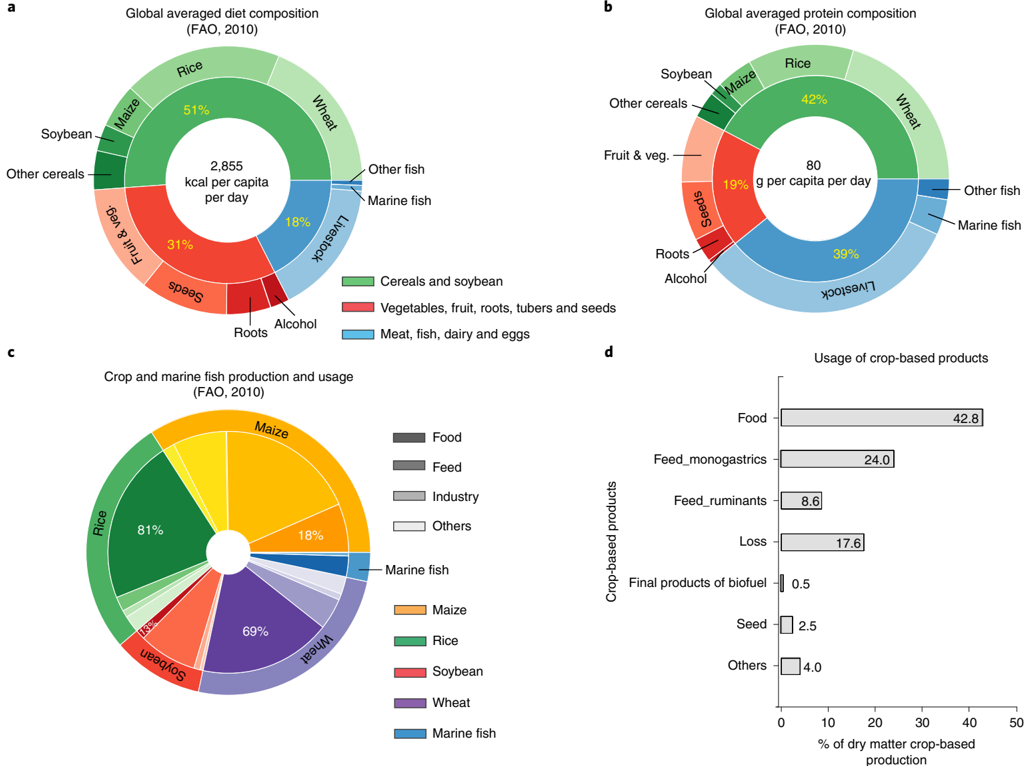
- The food system analysis combined simulated changes in maize, rice, soybean, spring wheat, marine fish, livestock, aquaculture, food trade, and household waste to estimate country-level calorie availability after nuclear war.
- The paper considered three food-system response cases: Livestock, Partial Livestock, and No Livestock, and assumed no international trade in the main no-trade analyses.
## Limitations
- The authors explicitly state they did not model reduced human populations from direct or indirect mortality, reduced birth rates, farm-management adaptations, alternative food sources, or adaptation in fisheries.
- They also did not consider several important impacts the text names, including surface ozone, ultraviolet radiation, radioactive contamination, pollinator effects, killing frost, and freshwater availability; this is stated in the Methods/Discussion as outside the scope.
- Evident from the text: the analysis relies on one Earth system model, one crop model, and one fishery model, with only one ensemble member for soot cases above 5 Tg, so model-structure uncertainty is substantial.
Model-written summary. Check it against the paper before relying on it.
Integrity signals
Registry
Cites
Statistics
Figures

Verification
Claims the paper makes
8 Valid · 4 Not valid · 9 Not checked · 70 Own results and interpretations
The cited sources support only part of this claim — read each source’s verdict below.
In the paper
“Nuclear war would reduce the wild fish catch 15”
What the sources say
- Partly supportedcites [15] 15. Scherrer, K. J. N. et al. Marine wild-capture fisheries after nuclear war. Proc. Natl Acad. Sci. USA 117 , 29748-29758 (2020). sourceExperimental — accuracy not yet measured
The Results (‘Initial Impacts on Catch and Biomass’; page not provided) report that global catches fall under business-as-usual fishing after the modeled nuclear conflicts. But they also report initial catch increases when postwar fishing intensifies, so the unqualified claim that nuclear war would reduce wild fish catch overstates the findings. (LLM, conf=0.88)
hedgedstates a cause- Asserted: passes — The authors put it forward as true.
- Checkable: passes — It can be checked against evidence.
- Load-bearing: passes — The paper’s conclusions depend on it.
- Based: passes — The paper gives a reason why it holds.
- Partly supported
The cited sources support only part of this claim — read each source’s verdict below.
In the paper
“So far, an integrated estimate of the impacts of the entire range of war scenarios on both land- and ocean-based food production is missing.”
What the sources say
- Not checked — no full text of the sourcecites [12] 12. Xia, L. & Robock, A. Impacts of a nuclear war in South Asia on rice production in mainland China. Climatic Change 116 , 357-372 (2013). source
- Not checked — no full text of the sourcecites [13] 13. Özdoğan, M., Robock, A. & Kucharik, C. Impacts of a nuclear war in South Asia on soybean and maize production in the Midwest United States. Climatic Change 116 , 373-387 (2013). source
- Partly supportedcites [14] 14. Jägermeyr, J. et al. A regional nuclear conflict would compromise global food security. Proc. Natl Acad. Sci. USA 117 , 7071-7081 (2020). sourceExperimental — accuracy not yet measured
The Significance section (p. 1) identifies a gap in assessing how nuclear-war-related crop losses affect global food trade. But this paper examines a regional conflict and major land crops; it does not establish that an integrated estimate is missing across the entire range of war scenarios and both land- and ocean-based food production. (LLM, conf=0.85)
- Supportedcites [15] 15. Scherrer, K. J. N. et al. Marine wild-capture fisheries after nuclear war. Proc. Natl Acad. Sci. USA 117 , 29748-29758 (2020). source
The Abstract describes crop-production estimates separately from this paper’s modeling of fish catches across six war scenarios. The Discussion (Food System Linkages; page not provided) says further investigation of the interdependencies between fishing, aquaculture, and the rest of food production is needed, supporting the claim that an integrated estimate is missing. (LLM, conf=0.88)
plain- Asserted: passes — The authors put it forward as true.
- Checkable: passes — It can be checked against evidence.
- Load-bearing: passes — The paper’s conclusions depend on it.
- Based: passes — The paper gives a reason why it holds.
The cited sources support only part of this claim — read each source’s verdict below.
In the paper
“Although CLM5crop does not simulate winter wheat, we assume winter wheat production is changed by the same amount as spring wheat, which has been found in other studies 14 ; however, this may underestimate the winter wheat response, because winter wheat would experience colder temperatures during its growing period that would be more likely to cross critical thresholds 14 .”
What the sources say
- Partly supportedcites [14] 14. Jägermeyr, J. et al. A regional nuclear conflict would compromise global food security. Proc. Natl Acad. Sci. USA 117 , 7071-7081 (2020). sourceExperimental — accuracy not yet measured
Split into 2 atoms — 1 confirmed, 1 partially supported, 0 disputed, 0 misattributed, 0 unverifiable. Expand the claim to see per-atom verdicts.
hedgedstates a possible cause- Asserted: passes — The authors put it forward as true.
- Checkable: passes — It can be checked against evidence.
- Load-bearing: unclear — It is unclear whether the paper’s conclusions depend on it.
- Based: passes — The paper gives a reason why it holds.
- Rests on an assumption not shown here.
- Partly supported
The cited sources that could be checked couldn’t confirm or dispute this claim.
In the paper
“CLM5crop compares well with other crop models in response to nuclear war forcing 14 (Supplementary Fig. 2).”
What the sources say
- Could not verifycites [14] 14. Jägermeyr, J. et al. A regional nuclear conflict would compromise global food security. Proc. Natl Acad. Sci. USA 117 , 7071-7081 (2020). sourceExperimental — accuracy not yet measured
The Crop Yield Simulations section (p. 9) names the six crop models studied; CLM5crop is not among them. A search for CLM5crop found no passage comparing its response to nuclear-war forcing with that of other models. (LLM, conf=0.75)
plain- Asserted: passes — The authors put it forward as true.
- Checkable: passes — It can be checked against evidence.
- Load-bearing: unclear — It is unclear whether the paper’s conclusions depend on it.
- Based: passes — The paper gives a reason why it holds.
- Could not verify
A result the paper states — it cites no source for it, so there is none to check. The quote shows it is in the paper.
In the paper
“but the reduction would be less than for land agriculture (Fig. 2b)”
hedgedstates a cause- Asserted: passes — The authors put it forward as true.
- Checkable: passes — It can be checked against evidence.
- Load-bearing: unclear — It is unclear whether the paper’s conclusions depend on it.
- Based: passes — The paper gives a reason why it holds.
49 more claims
Create a free account to see all 91 claims and to verify the 2 references still open.
- It may state two separate claims as one. 21
- Probably not a substantial claim. 21
Claims other papers make about this one
Each is checked against this paper’s own text: does it say what the citing paper says it does?
The source backs part of the claim, not all of it — or backs it for a different population, condition or comparison.
In the citing paper
“Even a ' limited ' nuclear war involving only 250 of the 13,000 nuclear weapons in the world could kill 120 million people outright and cause global climate disruption leading to a nuclear famine, putting two billion people at risk [7, 8].”
From Reducing the Risks of Nuclear War. (2023) · cites this paper as [8]
Experimental — accuracy not yet measuredThe cited source says what the claim attributes to it.
In the citing paper
“Even a ' limited ' nuclear war involving only 250 of the 13,000 nuclear weapons in the world could kill 120 million people outright and cause global climate disruption leading to a nuclear famine, putting two billion people at risk [7, 8].”
From Reducing the Risks of Nuclear War. (2023) · cites this paper as [8]
The cited source says what the claim attributes to it.
In the citing paper
“A large scale nuclear war between the US and Russia could kill 200 million people or more in the near term and potentially cause a global ' nuclear winter ' that could kill 5 -6 billion people, threatening the survival of humanity [7, 8].”
From Reducing the Risks of Nuclear War. (2023) · cites this paper as [8]
Citations
Cites
The State of World Fisheries and Aquaculture 2020
(2020) · doi:10.4060/ca9229en · Cited by 3,167
The Community Earth System Model: A Framework for Collaborative Research
Hurrell, J. W., Holland, M. M., Gent, P. R., Ghan, S., Kay, J. E., Kushner, P. J., Lamarque, J.-F., Large, W. G., Lawrence, D., Lindsay, K., et al. (2013) · Bulletin of the American Meteorological Society · doi:10.1175/bams-d-12-00121.1 · Cited by 2,686
Lawrence, D. M., Fisher, R. A., Koven, C. D., Oleson, K. W., Swenson, S. C., Bonan, G., Collier, N., Ghimire, B., van Kampenhout, L., Kennedy, D., et al. (2019) · Journal of Advances in Modeling Earth Systems · doi:10.1029/2018ms001583 · Cited by 2,060
Climate Change from 1850 to 2005 Simulated in CESM1(WACCM)
Marsh, D. R., Mills, M. J., Kinnison, D. E., Lamarque, J.-F., Calvo, N., & Polvani, L. M. (2013) · Journal of Climate · doi:10.1175/jcli-d-12-00558.1 · Cited by 1,081 · cited 1×
“40 ).”
Livestock: On our plates or eating at our table? A new analysis of the feed/food debate
Mottet, A., de Haan, C., Falcucci, A., Tempio, G., Opio, C., & Gerber, P. (2017) · Global Food Security · doi:10.1016/j.gfs.2017.01.001 · Cited by 1,034 · cited 1×
“For global calculations for livestock, we assume that 46% are fed by pasture and 54% are fed by crops and processed products 48 and use national-level data 26 to calculate reduction of livestock feed from pasture and crop-based products.”
MethodNuclear Winter: Global Consequences of Multiple Nuclear Explosions
Turco, R. P., Toon, O. B., Ackerman, T. P., Pollack, J. B., & Sagan, C. (1983) · Science · doi:10.1126/science.222.4630.1283 · Cited by 825
Self-citationBlack carbon lofts wildfire smoke high into the stratosphere to form a persistent plume
Yu, P., Toon, O. B., Bardeen, C. G., Zhu, Y., Rosenlof, K. H., Portmann, R. W., Thornberry, T. D., Gao, R.-S., Davis, S. M., Wolf, E. T., et al. (2019) · Science · doi:10.1126/science.aax1748 · Cited by 363
Self-citationPeterson, D. A., Fromm, M. D., McRae, R. H. D., Campbell, J. R., Hyer, E. J., Taha, G., Camacho, C. P., Kablick, G. P., Schmidt, C. C., & DeLand, M. T. (2021) · npj Climate and Atmospheric Science · doi:10.1038/s41612-021-00192-9 · Cited by 236
Bodirsky, B. L., Dietrich, J. P., Martinelli, E., Stenstad, A., Pradhan, P., Gabrysch, S., Mishra, A., Weindl, I., Le Mouël, C., Rolinski, S., et al. (2020) · Scientific Reports · doi:10.1038/s41598-020-75213-3 · Cited by 231 · cited 4×
“All food commodity trade calculations are based on the 2010 FAO Commodity Balance Sheet (FAO-CBS), FAO-FBS and processed data from previous studies 24,27,28,47 .”
BackgroundMethodInfluentialSelf-citationHigh‐latitude eruptions cast shadow over the African monsoon and the flow of the Nile
Oman, L., Robock, A., Stenchikov, G. L., & Thordarson, T. (2006) · Geophysical Research Letters · doi:10.1029/2006gl027665 · Cited by 211
Self-citation
Research works printed but not linked: 7
- 3. Stommel, H. & Stommel, E. Volcano Weather; The Story of 1816, The Year Without a Summer (Seven Seas Press, 1983).
- 5. Aleksandrov, V. V . & Stenchikov, G. L. On the modeling of the climatic consequences of the nuclear war. Proc. Applied Math (Computing Centre of the USSR Academy of Sciences, 1983).
- 11. Cropper Jr., W . P . & Harwell, M. A. in Environmental Consequences of Nuclear War, SCOPE 28, Volume II Ecological and Agricultural Effects , 2nd Edn (eds Harwell, M. A. & Hutchinson, T. C.) Ch. 5 (Wiley, 1989).
- 10. Harwell, M. A. & Cropper Jr., W . P . in Environmental Consequences of Nuclear War, SCOPE 28, Volume II Ecological and Agricultural Effects , 2nd Edn (eds Harwell, M. A. & Hutchinson, T. C.) Ch. 4 (Wiley, 1989).
- 22. Ambio Advisory Group, Reference scenarios: How a nuclear war might be fought, in Nuclear War: The Aftermath (ed Peterson, J.) Ch. 3 (Pergamon Press, 1983).
- 29. National Research Council, Energy, in Recommended Dietary Allowances, 10th Edn Ch. 3 (US National Academies Press, 1989).
- 32. Denkenberger, D., Pearce, J. M. Feeding Everyone No Matter What: Managing Food Security After Global Catastrophe (Academic Press, 2014).
Cited by
Items 101–200 of 398
Chan, C. Y.-C., Prá, G. D., Johnson, I., Boyd, M., & Glomseth, R. E. (2025) · International Journal of Disaster Risk Science · doi:10.1007/s13753-025-00657-y · Cited by 3
Ending nuclear weapons, before they end us
Abbasi, K. A., Ali, P. A., Barbour, V., Birch, M., Blum, I., Doherty, P. C., Haines, A., Helfand, I., Horton, R. C., Juva, K., et al. (2025) · Internal and Emergency Medicine · doi:10.1007/s11739-025-04075-2 · Cited by 1
Impact of Global Demographic Shifts on Agricultural Markets and Food Security
Krishna, M. U. V., Ayyapparajan, R. A., Anute, N., Pathak, G. P., Cherian, A. M., Selvakumar, P., & Manjunath, T. C. (2025) · IGI Global eBooks · doi:10.4018/979-8-3373-2550-7.ch005 · Cited by 2
Yook, S., Solomon, S., Bardeen, C., & Stone, K. A. (2025) · Earth s Future · doi:10.1029/2025ef006866 · Cited by 4
“Additionally, such a conflict could have profound disruptions to food production, including both agriculture and fisheries (Jägermeyr et al., 2020; Scherrer et al., 2020; Xia et al., 2022; Xia & Robock, 2013).”
Self-citationMonteiro, L., Hinge, M., Blouin, S., & Denkenberger, D. (2026) · Sustainability · doi:10.3390/su18136552 · Cited by 2
Jacques Derrida on the Problem of Nuclear Weapons
Uchaev, Y. I. (2023) · Concept philosophy religion culture · doi:10.24833/2541-8831-2023-1-25-7-18 · Cited by 1
Mohiuddin, A. K. (2023) · Middle East Research Journal of Humanities and Social Sciences · doi:10.36348/merjhss.2022.v02i01.001 · Cited by 5
Luo, W., Li, Y., Luo, R., Wei, G., Liu, Y., & Chen, W. (2023) · Agronomy · doi:10.3390/agronomy13061571 · Cited by 1
Reducing the Risks of Nuclear War—The Role of Health Professionals
Abbasi, K. A., Ali, P. A., Barbour, V., Bibbins-Domingo, K. B., Rikkert, M. G. M. O., Haines, A., Helfand, I., Horton, R. C., Mash, B., Mitra, A., et al. (2023) · JAMA Health Forum · doi:10.1001/jamahealthforum.2023.3017 · Cited by 2
Reducing the risks of nuclear war — the role of health professionals
Abbasi, K. A., Ali, P. A., Barbour, V., Bibbins-Domingo, K. B., Rikkert, M. G. M. O., Haines, A., Helfand, I., Horton, R. C., Mash, R. J., Mitra, A., et al. (2023) · The Medical Journal of Australia · doi:10.5694/mja2.52054 · Cited by 1
Reducing the risks of nuclear war: the role of health professionals
Abbasi, K. A., Ali, P. A., Barbour, V., Bibbins-Domingo, K. B., Rikkert, M. G. M. O., Haines, A., Helfand, I., Horton, R. C., Mash, R. J., Mitra, A., et al. (2023) · Journal of Public Health Policy · doi:10.1057/s41271-023-00432-7 · Cited by 1
Reducing the risks of nuclear war: the role of health professionals
Abbasi, K. A., Ali, P. A., Barbour, V., Bibbins-Domingo, K. B., Rikkert, M. G. M. O., Gong, P., Haines, A., Helfand, I., Horton, R. C., Mash, R. J., et al. (2023) · Brain · doi:10.1093/brain/awad269 · Cited by 1
Ultranationalism as a Form of Mass Insanity
Johansen, B. E. (2023) · Springer studies on populism, identity politics and social justice · doi:10.1007/978-3-031-36056-5_4 · Cited by 1
Comments on: Reducing the Risks of Nuclear War—The Role of Health Professionals
Lefrant, J., Benhamou, D., Fischer, M.-O., et al. (2023) · Anaesthesia Critical Care & Pain Medicine · doi:10.1016/j.accpm.2023.101314 · Cited by 1
Ruiz, M. D. C. R., Celis, J. A. T., Martínez, J. B. G., Rivers, M., & Denkenberger, D. (2024) · Revista de Estudios Latinoamericanos sobre Reducción del Riesgo de Desastres REDER · doi:10.55467/reder.v8i2.164 · Cited by 1
“…el sistema alimentario, identificando qué regiones son más vulnerables o resistentes a los impactos (Boyd and Wilson, 2022; Rivers et al., 2022b; Xia et al., 2022), investigando sobre alimentos resilientes (Baum et al., 2015; Jehn et al., 2023; Pham et al., 2022; Rivers et al., 2022b), o…”
BackgroundInfluentialNulkar, G. V. (2024) · Springer eBooks · doi:10.1007/978-981-99-6893-0_3 · Cited by 1
Ending nuclear weapons, before they end us
Abbasi, K. A., Ali, P. A., Barbour, V., Birch, M., Blum, I., Doherty, P. C., Haines, A., Helfand, I., Horton, R. C., Juva, K., et al. (2025) · The Medical Journal of Australia · doi:10.5694/mja2.52676 · Cited by 1
Ending nuclear weapons, before they end us
Abbasi, K. A., Ali, P. A., Barbour, V., Birch, M., Blum, I., Doherty, P. C., Haines, A., Helfand, I., Horton, R. C., Juva, K., et al. (2025) · The Lancet · doi:10.1016/s0140-6736(25)00987-0 · Cited by 2
How Much Should Governments Pay to Prevent Catastrophes? Longtermism’s Limited Role
Shulman, C., & Thornley, E. (2025) · Oxford University Press eBooks · doi:10.1093/9780191979972.003.0019 · Cited by 10
Reducing the Risks of Nuclear War—The Role of Health Professionals
Abbasi, K. A., Ali, P. A., Barbour, V., Bibbins-Domingo, K. B., Rikkert, M. G. M. O., Haines, A., Helfand, I., Horton, R. C., Mash, B., Mitra, A., et al. (2023) · JAMA Psychiatry · doi:10.1001/jamapsychiatry.2023.3275 · Cited by 1
Reducing the Risks of Nuclear War—The Role of Health Professionals
Abbasi, K. A., Ali, P. A., Barbour, V., Bibbins-Domingo, K. B., Rikkert, M. G. M. O., Haines, A., Helfand, I., Horton, R. C., Mash, B., Mitra, A., et al. (2023) · JAMA Cardiology · doi:10.1001/jamacardio.2023.2889 · Cited by 1
Reducing the Risks of Nuclear War—The Role of Health Professionals
Abbasi, K. A., Ali, P. A., Barbour, V., Bibbins-Domingo, K. B., Rikkert, M. G. M. O., Haines, A., Helfand, I., Horton, R. C., Mash, B., Mitra, A., et al. (2023) · JAMA Internal Medicine · doi:10.1001/jamainternmed.2023.4457 · Cited by 1
Reducing the risks of nuclear war—the role of health professionals
Abbasi, K. A., Ali, P. A., Barbour, V., Bibbins-Domingo, K. B., Rikkert, M. G. M. O., Haines, A., Helfand, I., Horton, R. C., Mash, R. J., Mitra, A., et al. (2023) · The Lancet · doi:10.1016/s0140-6736(23)01526-x · Cited by 2
Reducing the risks of nuclear war — the role of health professionals
Abbasi, K. A., Ali, P. A., Barbour, V., Bibbins-Domingo, K. B., Rikkert, M. G. M. O., Haines, A., Helfand, I., Horton, R. C., Mash, R. J., Mitra, A., et al. (2023) · Indian Journal of Medical Ethics · doi:10.20529/ijme.2023.049 · Cited by 1
Reducing the risks of nuclear war—The role of health professionals
Abbasi, K. A., Ali, P. A., Barbour, V., Bibbins-Domingo, K. B., Rikkert, M. G. M. O., Haines, A., Helfand, I., Horton, R. C., Mash, R. J., Mitra, A., et al. (2023) · Acta Paediatrica · doi:10.1111/apa.16922 · Cited by 1
“…to a nuclear famine, putting 2 billion people at risk.7,8 A large-scale nuclear war between the USA and Russia could kill 200 million people or more in the near term, and potentially cause a global “nuclear winter” that could kill 5–6 billion people, threatening the survival of humanity (7-8).”
BackgroundReducing the risks of nuclear war—The role of health professionals
Abbasi, K. A., Ali, P. A., Barbour, V., Bibbins-Domingo, K. B., Rikkert, M. G. M. O., Haines, A., Helfand, I., Horton, R. C., Mash, R. J., Mitra, A., et al. (2023) · International Journal of Gynecology & Obstetrics · doi:10.1002/ijgo.15033 · Cited by 1
Reducing the risks of nuclear war: the role of health professionals
Abbasi, K. A., Ali, P. A., Barbour, V., Bibbins-Domingo, K. B., Rikkert, M. G. M. O., Gong, P., Haines, A., Helfand, I., Horton, R. C., Mash, B., et al. (2023) · IJQHC Communications · doi:10.1093/ijcoms/lyad012 · Cited by 1
Reducing the Risks of Nuclear War: The Role of Health Professionals
Abbasi, K. A., Ali, P. A., Barbour, V., Bibbins-Domingo, K. B., Gong, P., Haines, A., Helfand, I., Horton, R. C., Mash, R. J., Mitra, A., et al. (2023) · American Journal of Psychiatry · doi:10.1176/appi.ajp.20230595 · Cited by 1
Reducing the risks of nuclear war — the role of health professionals
Abbasi, K. A., Ali, P. A., Barbour, V., Bibbins-Domingo, K. B., Rikkert, M. G. M. O., Haines, A., Horton, R. C., Mash, R. J., Mitra, A., Monteiro, C. A., et al. (2023) · Revista Médica Hondureña · doi:10.5377/rmh.v91i2.16501 · Cited by 1
Island refuges for surviving nuclear winter and other abrupt sun-reducing catastrophesPreprint
Boyd, M., & Wilson, N. (2022) · Research Square · doi:10.21203/rs.3.rs-1927222/v2 · Cited by 3
The Sheathed Sword: From Nuclear Brink to No First Use
Loretz, J. (2023) · Medicine Conflict & Survival · doi:10.1080/13623699.2023.2186769 · Cited by 1
“This chapter, originally published just before the successful conclusion of the TPNW negotiations in 2017, does not include the most recent – and even more disturbing – findings about nuclear famine by these same scientists and their colleagues Xia et al. (2022).”
BackgroundReducing the Risks of Nuclear War: The Role of Health Professionals
Abbasi, K. A., Ali, P. A., Barbour, V., Bibbins-Domingo, K. B., Rikkert, M. G. M. O., Gong, P., Haines, A., Helfand, I., Horton, R. C., Mash, B., et al. (2023) · Public Health Ethics · doi:10.1093/phe/phad020 · Cited by 1
Reducing the risks of nuclear war: the role of health professionals
Abbasi, K. A., Ali, P. A., Barbour, V., Bibbins-Domingo, K. B., Rikkert, M. G. M. O., Haines, A., Helfand, I., Horton, R. C., Mash, R. J., Mitra, A., et al. (2023) · Journal of the Royal Society of Medicine · doi:10.1177/01410768231193301 · Cited by 1
Editorial: Reducing the risks of nuclear war: the role of health professionals
Abbasi, K. A., Ali, P. A., Barbour, V., Bibbins-Domingo, K. B., Rikkert, M. G. M. O., Gong, P., Haines, A., Helfand, I., Horton, R. C., Mash, R. J., et al. (2023) · African Health Sciences · doi:10.4314/ahs.v23i3.2 · Cited by 1
Reduzindo os riscos de uma guerra nuclear – o papel dos profissionais de saúde
Abbasi, K. A., Ali, P. A., Barbour, V., Bibbins-Domingo, K. B., Rikkert, M. G. M. O., Haines, A., Helfand, I., Horton, R. C., Mash, R. J., Mitra, A., et al. (2023) · Revista de Saúde Pública · doi:10.11606/s1518-8787.20230570001ed
Reducing the Risks of Nuclear War
Abbasi, K. A., Ali, P. A., Barbour, V., Bibbins-Domingo, K. B., Rikkert, M. G. M. O., Haines, A., Helfand, I., Horton, R. C., Mash, B., Mitra, A., et al. (2023) · International Journal of Public Health · doi:10.3389/ijph.2023.1606534 · Cited by 1
Boyd, M., & Wilson, N. (2024) · Research Square · doi:10.21203/rs.3.rs-4590974/v1 · Cited by 1
Boyd, M., & Wilson, N. (2024) · Research Square · doi:10.21203/rs.3.rs-4590974/v2 · Cited by 1
It's Time to Consider Global Catastrophic Food FailuresPreprint
Wescombe, N. J., Martínez, J. B. G., Jehn, F. U., et al. (2025) · SSRN Electronic Journal · doi:10.2139/ssrn.5116973 · Cited by 1
Radionuclide remediation research is crucial to food security
Rapaport, H. I. E. (2022) · Nature Food · doi:10.1038/s43016-022-00630-8
Robock, A. D., Xia, L., Harrison, C. S., et al. (2023) · doi:10.5194/acp-2022-852-rc1
Self-citationRobock, A. D., Xia, L., Harrison, C. S., et al. (2023) · doi:10.5194/acp-2022-852-rc2
Self-citationRobock, A. D. (2023) · Atmospheric chemistry and physics · doi:10.5194/acp-2022-852-ac1
Self-citationOpposite ethical views converge under the threat of catastrophic climate change
Méjean, A., Pottier, A., Zuber, S., & Fleurbaey, M. (2023) · Ecological Economics · doi:10.1016/j.ecolecon.2023.107887
Cropping Patterns for Phenology Stability and Resource Conservation Under Extreme ClimatesPreprint
Ahmad, A., & Liu, Y. (2023) · SSRN Electronic Journal · doi:10.2139/ssrn.4500528
Reducing the Risks of Nuclear War—The Role of Health Professionals
Abbasi, K. A., Ali, P. A., Barbour, V., Bibbins-Domingo, K. B., Rikkert, M. G. M. O., Haines, A., Helfand, I., Horton, R., Mash, R. J., Mitra, A., et al. (2023) · JAMA Surgery · doi:10.1001/jamasurg.2023.4197
Reducing the Risks of Nuclear War—The Role of Health Professionals
Abbasi, K. A., Ali, P. A., Barbour, V., Bibbins-Domingo, K. B., Rikkert, M. G. M. O., Haines, A., Helfand, I., Horton, R. C., Mash, R. J., Mitra, A., et al. (2023) · JAMA Neurology · doi:10.1001/jamaneurol.2023.3071
Reducing the Risks of Nuclear War—The Role of Health Professionals
Abbasi, K. A., Ali, P. A., Barbour, V., Bibbins-Domingo, K. B., Rikkert, M. G. M. O., Haines, A., Helfand, I., Horton, R. C., Mash, B., Mitra, A., et al. (2023) · JAMA Network Open · doi:10.1001/jamanetworkopen.2023.30357 · Cited by 1
Reducing the Risks of Nuclear War—The Role of Health Professionals
Abbasi, K. A., Ali, P. A., Barbour, V., Bibbins-Domingo, K. B., Rikkert, M. G. M. O., Haines, A., Helfand, I., Horton, R., Mash, B., Mitra, A., et al. (2023) · JAMA Oncology · doi:10.1001/jamaoncol.2023.3622
Reducing the Risks of Nuclear War—The Role of Health Professionals
Abbasi, K. A., Ali, P. A., Barbour, V., Bibbins-Domingo, K. B., Rikkert, M. G. M. O., Haines, A., Helfand, I., Horton, R. C., Mash, B., Mitra, A., et al. (2023) · Archives of Pediatrics and Adolescent Medicine · doi:10.1001/jamapediatrics.2023.3440
Reducing the Risks of Nuclear War—The Role of Health Professionals
Abbasi, K. A., Ali, P. A., Barbour, V., Bibbins-Domingo, K. B., Rikkert, M. G. M. O., Haines, A., Helfand, I., Horton, R. C., Mash, B., Mitra, A., et al. (2023) · JAMA · doi:10.1001/jama.2023.14519 · Cited by 1
Reducing the Risks of Nuclear War—The Role of Health Professionals
Abbasi, K. A., Ali, P. A., Barbour, V., Bibbins-Domingo, K. B., Rikkert, M. G. M. O., Haines, A., Helfand, I., Horton, R., Mash, B., Mitra, A., et al. (2023) · JAMA Ophthalmology · doi:10.1001/jamaophthalmol.2023.4026
Reducing the Risks of Nuclear War—The Role of Health Professionals
Abbasi, K. A., Ali, P. A., Barbour, V., Bibbins-Domingo, K. B., Rikkert, M. G. M. O., Haines, A., Helfand, I., Horton, R. C., Mash, B., Mitra, A., et al. (2023) · JAMA Dermatology · doi:10.1001/jamadermatol.2023.3222
Physicists need to be talking about nuclear weapons
Prager, S. C., & Hippel, F. N. V. (2023) · Physics Today · doi:10.1063/pt.3.5279
Reducing the risks of Nuclear War: The role of Health Professionals
Jawaid, S. A., & Zielinski, C. (2023) · Pakistan Journal of Medical Sciences · doi:10.12669/pjms.39.5.8443
Reducing the risks of nuclear war—The role of health professionals
Abbasi, K. A., Ali, P. A., Barbour, V., Bibbins-Domingo, K. B., Rikkert, M. G. M. O., Horton, R. C., Mash, R. J., Monteiro, C. A., Naumova, E. N., Rubin, E. J., et al. (2023) · Complementary Therapies in Medicine · doi:10.1016/j.ctim.2023.102967
Reducing the risks of nuclear war - the role of health professionals
Abbasi, K. A., Ali, P. A., Barbour, V., Bibbins-Domingo, K. B., Rikkert, M. G. M. O., Haines, A., Helfand, I., Horton, R. C., Mash, R. J., Mitra, A., et al. (2023) · Medwave · doi:10.5867/medwave.2023.07.2722
Reducing the risks of nuclear war—The role of health professionals
Abbasi, K. A., Ali, P. A., Barbour, V., Bibbins-Domingo, K. B., Rikkert, M. G. M. O., Haines, A., Helfand, I., Horton, R. C., Mash, R. J., Mitra, A., et al. (2023) · Biomolecules and Biomedicine · doi:10.17305/bb.2023.9533
Reducing the risks of nuclear war—The role of health professionals
Abbasi, K. A., Ali, P. A., Barbour, V., Bibbins-Domingo, K. B., Rikkert, M. G. M. O., Gong, P., Haines, A., Helfand, I., Horton, R. C., Mash, R. J., et al. (2023) · Paediatric and Perinatal Epidemiology · doi:10.1111/ppe.12999
Reducing the risks of nuclear war: The role of health professionals
Abbasi, K. A., Ali, P. A., Barbour, V., Bibbins-Domingo, K. B., Rikkert, M. G. M. O., Gong, P., Haines, A., Helfand, I., Horton, R. C., Mash, R. J., et al. (2023) · International Nursing Review · doi:10.1111/inr.12875
Reducing the risks of nuclear war: the role of health professionals
Abbasi, K. A., Ali, P. A., Barbour, V., Bibbins-Domingo, K. B., Rikkert, M. G. M. O., Gong, P., Haines, A., Helfand, I., Horton, R. C., Mash, R. J., et al. (2023) · Oxford Open Digital Health · doi:10.1093/oodh/oqad011
Reducing the risks of nuclear war – the role of health professionals
Abbasi, K. A., Ali, P. A., Barbour, V., Bibbins-Domingo, K. B., Rikkert, M. G. M. O., Haines, A., Helfand, I., Horton, R. C., Mash, R. J., Mitra, A., et al. (2023) · Journal of Neurosciences in Rural Practice · doi:10.25259/jnrp_394_2023
Boyd, M., Ragnarsson, S., Terry, S., Payne, B., & Wilson, N. (2023) · Research Square · doi:10.21203/rs.3.rs-3273609/v1
Reducing the risks of nuclear war - The role of health professionals
Abbasi, K. A., Ali, P. A., Barbour, V., Bibbins-Domingo, K. B., Rikkert, M. G. M. O., Haines, A., Helfand, I., Horton, R. C., Mash, R. J., Mitra, A., et al. (2023) · Bleeding Thrombosis and Vascular Biology · doi:10.4081/btvb.2023.94
Reducing the risks of nuclear war—the role of health professionals
Abbasi, K. A., Ali, P. A., Barbour, V., Bibbins-Domingo, K. B., Rikkert, M. G. M. O., Haines, A., Helfand, I., Horton, R., Mash, R. J., Mitra, A., et al. (2023) · Allergy · doi:10.1111/all.15848
Reducing the Risks of Nuclear War—the Role of Health Professionals
Abbasi, K. A., Ali, P. A., Barbour, V., Bibbins-Domingo, K. B., Rikkert, M. G. M. O., Haines, A., Helfand, I., Horton, R. C., Mash, R. J., Mitra, A., et al. (2023) · European Journal of Heart Failure · doi:10.1002/ejhf.2991
Reducing the risks of nuclear war—the role of health professionals
Abbasi, K. A., Ali, P. A., Barbour, V., Bibbins-Domingo, K. B., Rikkert, M. G. M. O., Gong, P., Haines, A., Helfand, I., Horton, R. C., Mash, R. J., et al. (2023) · Reproductive Female and Child Health · doi:10.1002/rfc2.51
Reducing the risks of nuclear war: the role of health professionals
Abbasi, K. A., Ali, P. A., Barbour, V., Bibbins-Domingo, K. B., Rikkert, M. G. M. O., Gong, P., Haines, A., Helfand, I., Horton, R. C., Mash, R. J., et al. (2023) · International Journal of Epidemiology · doi:10.1093/ije/dyad115
Reducing the risks of nuclear war: the role of health professionals
Abbasi, K. A., Ali, P. A., Barbour, V., Bibbins-Domingo, K. B., Rikkert, M. G. M. O., Gong, P., Haines, A., Helfand, I., Horton, R. C., Mash, B., et al. (2023) · European Heart Journal - Cardiovascular Pharmacotherapy · doi:10.1093/ehjcvp/pvad060
Reducing the risks of nuclear war: the role of health professionals
Abbasi, K. A., Ali, P. A., Barbour, V., Bibbins-Domingo, K. B., Rikkert, M. G. M. O., Gong, P., Haines, A., Helfand, I., Horton, R. C., Mash, B., et al. (2023) · European Heart Journal - Quality of Care and Clinical Outcomes · doi:10.1093/ehjqcco/qcad049
Reducing the Risks of Nuclear War—the role of Health Professionals
Abbasi, K. A., Ali, P. A., Barbour, V., Bibbins-Domingo, K. B., Rikkert, M. G. M. O., Gong, P., Haines, A., Helfand, I., Richard, H., Mash, R. J., et al. (2023) · Afro-Egyptian Journal of Infectious and Endemic Diseases · doi:10.21608/aeji.2023.313949
Reducing the risks of nuclear war—the role of health professionals
Abbasi, K. A., Ali, P. A., Barbour, V., Bibbins-Domingo, K. B., Rikkert, M. G. M. O., Haines, A., Helfand, I., Horton, R. C., Mash, R. J., Mitra, A., et al. (2023) · Cytopathology · doi:10.1111/cyt.13291
Reducing the risks of nuclear war—The role of health professionals
Abbasi, K. A., Ali, P. A., Barbour, V., Bibbins-Domingo, K. B., Rikkert, M. G. M. O., Haines, A., Helfand, I., Horton, R. C., Mash, R. J., Mitra, A., et al. (2023) · Journal of medical imaging and radiation sciences · doi:10.1016/j.jmir.2023.08.002
Reducing the risks of nuclear war: the role of health professionals
Abbasi, K. A., Ali, P. A., Barbour, V., Bibbins-Domingo, K. B., Rikkert, M. G. M. O., Gong, P., Haines, A., Helfand, I., Horton, R. C., Mash, R. J., et al. (2023) · EP Europace · doi:10.1093/europace/euad245
Reducing the risks of nuclear war: the role of health professionals
Abbasi, K. A., Ali, P. A., Barbour, V., Bibbins-Domingo, K. B., Rikkert, M. G. M. O., Gong, P., Haines, A., Helfand, I., Horton, R. C., Mash, R. J., et al. (2023) · Cardiovascular Research · doi:10.1093/cvr/cvad125
Reducing the risks of nuclear war: the role of health professionals
Abbasi, K. A., Ali, P. A., Barbour, V., Bibbins-Domingo, K. B., Rikkert, M. G. M. O., Gong, P., Haines, A., Helfand, I., Horton, R. C., Mash, R. J., et al. (2023) · European Heart Journal · doi:10.1093/eurheartj/ehad542
Reducing the risks of nuclear war: the role of health professionals
Abbasi, K. A., Ali, P. A., Barbour, V., Bibbins-Domingo, K. B., Rikkert, M. G. M. O., Gong, P., Haines, A., Helfand, I., Horton, R. C., Mash, B., et al. (2023) · European Heart Journal - Case Reports · doi:10.1093/ehjcr/ytad391
Reducing the risks of nuclear war: the role of health professionals
Abbasi, K. A., Ali, P. A., Barbour, V., Bibbins-Domingo, K. B., Rikkert, M. G. M. O., Gong, P., Haines, A., Helfand, I., Horton, R. C., Mash, B., et al. (2023) · Brain Communications · doi:10.1093/braincomms/fcad217
Reducing the Risks of Nuclear War: The Role of Health Professionals
Abbasi, K. A., Ali, P. A., Barbour, V., Bibbins-Domingo, K. B., Rikkert, M. G. M. O., Horton, R. C., Mash, R. J., Mitra, A., Monteiro, C. A., Naumova, E. N., et al. (2023) · North Carolina Medical Journal · doi:10.18043/001c.87533
Reducing the risks of nuclear war: the role of health professionals
Abbasi, K. A., Ali, P. A., Barbour, V., Bibbins-Domingo, K. B., Rikkert, M. G. M. O., Gong, P., Haines, A., Helfand, I., Horton, R. C., Mash, R. J., et al. (2023) · British journal of surgery · doi:10.1093/bjs/znad265
Reducing the risks of nuclear war – the role of health professionals
Abbasi, K. A., Ali, P. A., Barbour, V., Bibbins-Domingo, K. B., Rikkert, M. G. M. O., Haines, A., Helfand, I., Horton, R. C., Mash, B., Mitra, A., et al. (2023) · Sri Ramachandra Journal of Health Sciences · doi:10.25259/srjhs_46_2023
“Even a ‘ limited ’ nuclear war involving only 250 of the 13,000 nuclear weapons in the world could kill 120 million people outright and cause global climate disruption leading to a nuclear famine, putting two billion people at risk [7,8].”
BackgroundReducing the risks of nuclear war—the role of health professionals
Abbasi, K. A., Ali, P. A., Barbour, V., Bibbins-Domingo, K. B., Rikkert, M. G. M. O., Gong, P., Haines, A., Helfand, I., Horton, R. C., Mash, R. J., et al. (2023) · Tidsskrift for Den norske legeforening · doi:10.4045/tidsskr.23.0563
Reducing the risks of nuclear war – the role of health professionals
Abbasi, K. A., Ali, P. A., Barbour, V., Bibbins-Domingo, K. B., Rikkert, M. G. M. O., Haines, A., Helfand, I., Horton, R. C., Mash, R. J., Mitra, A., et al. (2023) · British Journal of Urology · doi:10.1111/bju.16149
Reducing the risks of nuclear war – The role of health professionals
Abbasi, K. A., Ali, P. A., Barbour, V., Bibbins-Domingo, K. B., Rikkert, M. G. M. O., Haines, A., Helfand, I., Horton, R. C., Mash, B., Mitra, A., et al. (2023) · Journal of Pediatric Endocrinology and Diabetes · doi:10.25259/jped_22_2023
REDUCING THE RISKS OF NUCLEAR WAR – THE ROLE OF HEALTH PROFESSIONALS
Abbasi, K. A., Ali, P. A., Barbour, V., Bibbins-Domingo, K. B., Rikkert, M. G. M. O., Horton, R. C., Mash, R. J., Monteiro, C. A., Naumova, E. N., Rubin, E. J., et al. (2023) · Journal of Postgraduate Medical Institute · doi:10.54079/jpmi.37.3.3291
“The prevention of any use of nuclear weapons is therefore an urgent public health priority, and fundamental steps must also be taken to address the root cause of the problem – by abolishing nuclear weapons.”
BackgroundFreisleben, H. J. (2023) · Medical Journal of Indonesia · doi:10.13181/mji.ed.237162
Reducing the risks of nuclear war: the role of health professionals
Abbasi, K. A., Ali, P. A., Barbour, V., Bibbins-Domingo, K. B., Rikkert, M. G. M. O., Gong, P., Haines, A., Helfand, I., Horton, R. C., Mash, B., et al. (2023) · European Journal of Preventive Cardiology · doi:10.1093/eurjpc/zwad265
Reducing the risks of nuclear war: the role of health professionals
Abbasi, K. A., Ali, P. A., Barbour, V., Bibbins-Domingo, K. B., Rikkert, M. G. M. O., Gong, P., Haines, A., Helfand, I., Horton, R. C., Mash, B., et al. (2023) · European Journal of Cardiovascular Nursing · doi:10.1093/eurjcn/zvad083
Reducing the risks of nuclear war: the role of health professionals
Abbasi, K. A., Ali, P. A., Barbour, V., Bibbins-Domingo, K. B., Rikkert, M. G. M. O., Gong, P., Haines, A., Helfand, I., Horton, R. C., Mash, R. J., et al. (2023) · European Heart Journal - Digital Health · doi:10.1093/ehjdh/ztad048
Reducing the risks of nuclear war: the role of health professionals
Abbasi, K. A., Ali, P. A., Barbour, V., Bibbins-Domingo, K. B., Rikkert, M. G. M. O., Gong, P., Haines, A., Helfand, I., Horton, R. C., Mash, B., et al. (2023) · European Heart Journal - Cardiovascular Imaging · doi:10.1093/ehjci/jead205
Reducing the risks of nuclear war: the role of health professionals
Haines, A., Helfand, I., Mitra, A., Ruff, T., & Zielinski, C. (2023) · British Medical Bulletin · doi:10.1093/bmb/ldad019
Reducing the risks of nuclear war – the role of health professionals
Abbasi, K. A., Ali, P. A., Barbour, V., Bibbins-Domingo, K. B., Rikkert, M. G. M. O., Haines, A., Helfand, I., Horton, R. C., Mash, R. J., Mitra, A., et al. (2023) · The Journal of Pathology Clinical Research · doi:10.1002/cjp2.341
Reducing the risks of nuclear war: the role of health professionals
Haines, A., Helfand, I., Mitra, A., Ruff, T., & Zielinski, C. (2023) · Journal of Public Health · doi:10.1093/pubmed/fdad158
Reducing the risks of nuclear war: the role of health professionals
Haines, A., Helfand, I., Mitra, A., Ruff, T., & Zielinski, C. (2023) · Journal of Travel Medicine · doi:10.1093/jtm/taad105
Reducing the risks of nuclear war: the role of health professionals
Abbasi, K. A., Ali, P. A., Barbour, V., Bibbins-Domingo, K. B., Rikkert, M. G. M. O., Gong, P., Haines, A., Helfand, I., Horton, R. C., Mash, B., et al. (2023) · European Heart Journal - Imaging Methods and Practice · doi:10.1093/ehjimp/qyad018
Reducing the Risks of Nuclear War—The Role of Health Professionals
Abbasi, K. A., Ali, P. A., Barbour, V., Bibbins-Domingo, K. B., Rikkert, M. G. M. O., Gong, P., Haines, A., Helfand, I., Richard, H., Mitra, A., et al. (2023) · african journal of gastroenterology and hepatology · doi:10.21608/ajgh.2023.315570
Reducing the risks of nuclear war – The role of health professionals
Abbasi, K. A., Ali, P. A., Barbour, V., Bibbins-Domingo, K. B., Rikkert, M. G. M. O., Haines, A., Helfand, I., Horton, R. C., Mash, B., Mitra, A., et al. (2023) · Journal of Internal Medicine · doi:10.1111/joim.13716
“Even a ‘limited’ nuclear war involving only 250 of the 13,000 nuclear weapons in the world could kill 120 million people outright and cause global climate disruption leading to a nuclear famine, putting 2 billion people at risk [7, 8].”
BackgroundReducing the risks of nuclear war—The role of health professionals
Abbasi, K. A., Ali, P. A., Barbour, V., Bibbins-Domingo, K. B., Rikkert, M. G. M. O., Horton, R. C., Mash, R. J., Monteiro, C. A., Naumova, E. N., Rubin, E. J., et al. (2023) · Hematological Oncology · doi:10.1002/hon.3218
Reducing the risks of nuclear war: the role of health professionals
Abbasi, K. A., Ali, P. A., Barbour, V., Bibbins-Domingo, K. B., Rikkert, M. G. M. O., Gong, P., Haines, A., Helfand, I., Horton, R. C., Mash, B., et al. (2023) · International Journal for Quality in Health Care · doi:10.1093/intqhc/mzad059
Metadata
- Authors
- Xia, L., Robock, A., Scherrer, K., Harrison, C. S., Bodirsky, B. L., Weindl, I., Jägermeyr, J., Bardeen, C. G., Toon, O. B., & Heneghan, R.
- Affiliations
- Rutgers, The State University of New Jersey (US)
- Universitat Autònoma de Barcelona (ES)
- Louisiana State University (US)
- World Vegetable Center (TW)
- Potsdam Institute for Climate Impact Research (DE)
- Goddard Institute for Space Studies (US)
- NSF National Center for Atmospheric Research (US)
- University of Colorado Boulder (US)
- Queensland University of Technology (AU)
- Corresponding author
- Xia, Lili
- ORCID
- Venue
- Nature Food
- Published
- 2022-08-15
- Volume
- 3
- Issue
- 8
- Pages
- 586-596
- ISSN
- 2662-1355 (ISSN-L)
- OpenAlex
- W4291904039
- Cited by
- 398
- References
- 40
- Citations by year
- 2026: 29 · 2025: 167 · 2024: 42 · 2023: 144 · 2022: 14
- FWCI
- 299.53
- Type
- journal article
- Language
- en
- Open access
- hybrid
- doi.org
- Licence
- cc-by
- creativecommons.org/licenses/by/4.0 (tdm)
- creativecommons.org/licenses/by/4.0 (vor)
- Locations
- Nature Food (publishedVersion, cc-by)
- Research Square (acceptedVersion, cc-by)
- PubMed (publishedVersion)
- QUT ePrints (Queensland University of Technology) (submittedVersion, cc-by)
- Civil War Book Review (submittedVersion)
- ScholarWorks @ UTRGV (The University of Texas Rio Grande Valley) (submittedVersion, cc-by)
- NORA - Norwegian Open Research Archives (submittedVersion, cc-by)
- Dipòsit Digital de Documents de la UAB (Universitat Autònoma de Barcelona) (submittedVersion, cc-by)
- Publication Database PIK (Potsdam Institute for Climate Impact Research (PIK)) (submittedVersion, other-oa)
- Publication Database PIK (Potsdam Institute for Climate Impact Research (PIK)) (submittedVersion, cc-by)
- Griffith Research Online (submittedVersion, cc-by)
- Funders
- National Science Foundation (2017113, 2028541)
- National Aeronautics and Space Administration
- Open Philanthropy Project
- European Commission (821010, HORIZON2020, 776479, 682602)
- Bundesministerium für Bildung und Forschung (031B0787B)
- Norges Forskningsråd (326896)
- Goddard Institute for Space Studies
- Topics
- Social Sciences › Political Science and International Relations › Nuclear Issues and Defense
- Physical Sciences › Environmental Science › Management, Monitoring, Policy and Law › Environmental and Biological Research in Conflict Zones
- Life Sciences › Agricultural and Biological Sciences › Agronomy and Crop Science › Climate change impacts on agriculture
- Keywords
- nuclear war, climate disruption, food insecurity, famine, crop production, animal husbandry, food waste reduction, India-Pakistan conflict, global food security
About these checks
Registry, retraction, Cites and statistics results are computed, not judged, with one exception: a printed reference that no index lists is read once by a model before it counts as a citation error. Claims are extracted by a model and kept only when their quote appears verbatim in the text; each cited source is then checked, with a model’s help, for whether it says what the claim relies on. Those verdicts can be wrong — read the claim’s quote and the cited source before relying on one.
The claim verdicts this report counts are experimental: their accuracy is not yet measured.
A language model drew the claims from the paper on 2026-10-01, under version 3 of the claim definition (model deepseek-v4.1-flash, prompt extract-v3).
A second model labelled each claim on 2026-10-01 (model jev-1.13-20260917, definition revision gold-guideline-v0.2).
Cited sources are checked with a language model’s help (gpt-6-sol).
Statistics and arithmetic are recomputed, not judged.
Confidence bands are shown only for fields calibrated on our annotated test set. None is calibrated yet, so no band is shown.
What counts as a claim ›How we measure confidence ›How we check this ›
Are you an author, or do you see a problem with this page? Request a review
Data sources
Bibliographic data: Semantic Scholar, OpenAlex, Crossref.
Contains information from the Semantic Scholar Academic Graph Datasets, made available under the ODC Attribution License (ODC-BY 1.0).
Semantic Scholar’s data is described in: Kinney, R., et al. (2023). The Semantic Scholar Open Data Platform. arXiv:2301.10140.
