

Diagnosis of Alzheimer's disease using plasma biomarkers adjusted to clinical probability
Open accessThe DOI matches its Crossref record; 61 of the 66 references it cites were found in a registry or an index; 56 of the 83 sources its claims cite were checked for support.
Abstract
Recently approved anti-amyloid immunotherapies for Alzheimer's disease (AD) require evidence of amyloid-β pathology from positron emission tomography (PET) or cerebrospinal fluid (CSF) before initiating treatment. Blood-based biomarkers promise to reduce the need for PET or CSF testing; however, their interpretation at the individual level and the circumstances requiring confirmatory testing are poorly understood. Individual-level interpretation of diagnostic test results requires knowledge of disease prevalence in relation to clinical presentation (clinical pretest probability). Here, in a study of 6,896 individuals evaluated from 11 cohort studies from six countries, we determined the positive and negative predictive value of five plasma biomarkers for amyloid-β pathology in cognitively impaired individuals in relation to clinical pretest probability. We observed that p-tau217 could rule in amyloid-β pathology in individuals with probable AD dementia (positive predictive value above 95%). In mild cognitive impairment, p-tau217 interpretation depended on patient age. Negative p-tau217 results could rule out amyloid-β pathology in individuals with non-AD dementia syndromes (negative predictive value between 90% and 99%). Our findings provide a framework for the individual-level interpretation of plasma biomarkers, suggesting that p-tau217 combined with clinical phenotyping can identify patients where amyloid-β pathology can be ruled in or out without the need for PET or CSF confirmatory testing.
Overview
CoChat Summary
TL;DR
This multicenter diagnostic study evaluated five plasma biomarkers in 6,896 cognitively impaired individuals and estimated how positive and negative predictive values change with age, syndrome, and APOE ε4 status. Plasma p-tau217 performed best: it could rule in amyloid-β pathology in probable AD dementia and older MCI, and rule it out in most non-AD dementia syndromes.
Key findings
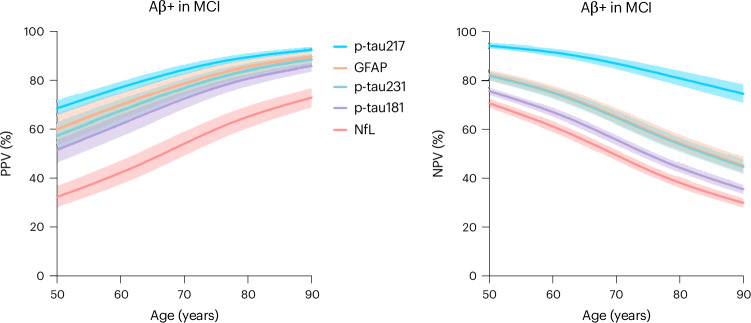
- In MCI, plasma p-tau217 PPV rose with age, reaching 80.9% at age 65 and 92.5% at age 90; its NPV fell with age, from >90% under age 65 to 80.8% at age 80 and 74.6% at age 90.
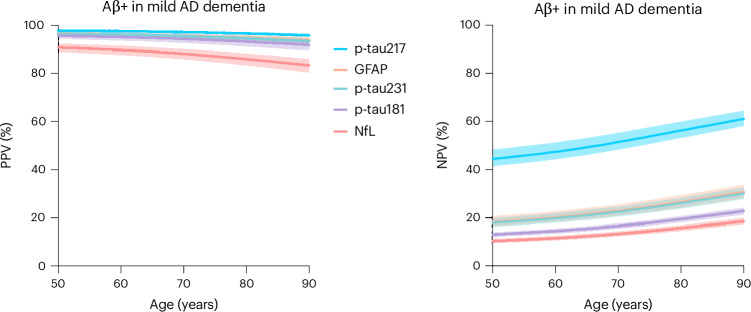
- In probable AD dementia, plasma biomarkers, especially p-tau217, had PPVs above 95% for Aβ+ at all ages; the highest NPV for probable AD dementia was for p-tau217, reaching 60% by age 90.
- In non-AD dementia syndromes, especially frontotemporal dementia, vascular dementia, and corticobasal syndrome, p-tau217 could rule out AD pathology with NPVs above 90% in nearly all circumstances; two exceptions were vascular dementia >90 years (NPV 89.4%) and corticobasal syndrome <65 years (NPV 88.2%).
- Across cohorts and assays, p-tau217 had the highest PPVs and NPVs; GFAP performed next best but with lower specificity, and NfL had relatively lower PPV and NPV.
Methods
- Cross-sectional diagnostic study of individuals from 11 cohort studies in Canada, France, South Korea, Spain, Sweden, and the United States; 6,896 participants total, mean age 69.7 years, 53.6% female.
- Participants had standardized cognitive assessments, plasma biomarkers (p-tau181, p-tau217, p-tau231, GFAP, NfL), and reference standard AD biomarkers from PET, CSF, or neuropathology.
- Biomarker abnormality was defined using z-scores ≥1.5 based on cognitively unimpaired controls without elevated amyloid-β pathology, and prevalence-adjusted PPVs/NPVs were calculated using Bayesian formulas with age-specific amyloid-β prevalence estimates from published meta-analyses; sensitivity analyses adjusted for APOE ε4 and alternative prevalence estimates.
Limitations
- The paper states that its binary disease classification is a limitation, because biomarker accuracy is expected to be higher in later-stage disease.
- It also states that the study is cross-sectional and not designed to predict future AD dementia.
- It states that prevalence estimates came mainly from memory clinic and research settings, so PPV/NPV estimates should not be extrapolated to settings with substantially different prevalence.
- Evident from the text: the main performance estimates depend on published prevalence assumptions rather than a single unified prospective clinical population, so generalizability to routine nonspecialist care may be limited.
Model-written summary. Check it against the paper before relying on it.
Integrity signals
Registry
Cites
Statistics
Figures
Verification
Claims the paper makes
30 Valid · 2 Not valid · 4 Not checked · 41 Own results and interpretations
Every source the paper cites for this claim was checked and supports it.
In the paper
“As the prevalence of amyloid-β pathology is closely linked to age and clinical syndrome18–20, clinical and demographic information can be used to infer the clinical pretest probability of amyloid-β positivity (Aβ+) based on standard clinical assessments17,21,22.”
§ Diagnosis of Alzheimer’s disease using plasma biomarkers adjusted to clinical probability > Main
What the sources say
- Supportedcites [18] Ossenkoppele, R. et al. Prevalence of amyloid PET positivity in dementia syndromes: a meta-analysis. JAMA 313, 1939–1949 (2015). 25988463 PMC4517678 source
The Results section reports that amyloid positivity varies by dementia diagnosis and age: it decreases with age in AD dementia and increases with age in several non-AD dementias. The Discussion identifies clinical diagnosis and age as crucial factors when interpreting amyloid PET scans. (LLM, conf=0.94)
- Supportedcites [19] Jansen, W. J. et al. Prevalence estimates of amyloid abnormality across the Alzheimer disease clinical spectrum. JAMA Neurol. 79, 228–243 (2022). 35099509 PMC12138908 source
The Results section reports that amyloid abnormality prevalence increased with age among people with normal cognition, subjective cognitive decline, or mild cognitive impairment, and was substantially higher in the mild cognitive impairment group. The Results on clinical AD dementia also report age-related differences, though their direction depended on the biomarker cutoff used. Together, these findings support a link to age and clinical syndrome. (LLM, conf=0.92)
- Supportedcites [20] Jack, C. R. et al. Prevalence of biologically versus clinically defined Alzheimer spectrum entities using the National Institute on Aging–Alzheimer’s Association research framework. JAMA Neurol. 76, 1174–1183 (2019). 31305929 PMC6632154 source
The Results (page not available in our copy) report that Alzheimer continuum (A+) prevalence rose from about 30% at age 70 to 62% at age 85. They also report A+ prevalence by clinical group, including an estimate of 77% among people with dementia, supporting the link to age and clinical syndrome. (LLM, conf=0.92)
plainstates an association- Asserted: passes — The authors put it forward as true.
- Checkable: passes — It can be checked against evidence.
- Load-bearing: passes — The paper’s conclusions depend on it.
- Based: passes — The paper gives a reason why it holds.
- Supported
The sources with a verdict support this claim; the rest weren’t checked yet, have no full text we could read, or their verdicts aren’t rated yet.
In the paper
“However, sensitivity and specificity provide limited information when making decisions about individual patients11–13.”
§ Diagnosis of Alzheimer’s disease using plasma biomarkers adjusted to clinical probability > Main
What the sources say
- Not checked — no full text of the sourcecites [11] Grimes, D. A. & Schulz, K. F. Uses and abuses of screening tests. Lancet 359, 881–884 (2002). 11897304 source
- Not checked — no full text of the sourcecites [12] Vecchio, T. J. Predictive value of a single diagnostic test in unselected populations. N. Engl. J. Med. 274, 1171–1173 (1966). 5934954 source
- Supportedcites [13] Pewsner, D. et al. Ruling a diagnosis in or out with ‘SpPIn’ and ‘SnNOut’: a note of caution. Br. Med. J. 329, 209–213 (2004). 15271832 PMC487735 source
The 'Sensitivity and specificity' section states that the power to rule a diagnosis out does not depend on sensitivity alone nor ruling in on specificity alone, and the Conclusions insist appraisal should rest on likelihood ratios and post-test probabilities 'and not simply on the test's sensitivity or specificity'. The 'Transferability and applicability' passage shows why sensitivity and specificity are insufficient for an individual patient: the same test result yields different post-test probabilities (77% vs 95%) depending on that patient's pretest probability. Box 1 likewise defines likelihood ratios as the measure of a result's ability to modify an individual's pretest probability. Our copy thus clearly treats sensitivity and specificity as limited for individual diagnostic decisions. (LLM, conf=0.85)
plain- Asserted: passes — The authors put it forward as true.
- Checkable: passes — It can be checked against evidence.
- Load-bearing: passes — The paper’s conclusions depend on it.
- Based: passes — The paper gives a reason why it holds.
The sources with a verdict support this claim; the rest weren’t checked yet, have no full text we could read, or their verdicts aren’t rated yet.
In the paper
“Sufficiently high positive predictive values (PPVs) or negative predictive values (NPVs) of plasma biomarkers for AD pathology could circumvent the need for the majority of PET or CSF testing, with confirmatory testing used in remaining situations with lower predictive values3,16.”
§ Diagnosis of Alzheimer’s disease using plasma biomarkers adjusted to clinical probability > Main
What the sources say
- Supportedcites [3] Hansson, O., Blennow, K., Zetterberg, H. & Dage, J. Blood biomarkers for Alzheimer’s disease in clinical practice and trials. Nat. Aging 3, 506–519 (2023). 37202517 PMC10979350 source
The “BBMs as diagnostic biomarkers in clinical practice” section (page unavailable) says blood biomarkers will probably suffice to support or reject an AD diagnosis in most patients with MCI or dementia, with PET or CSF confirmation needed mainly for uncertain results. The “Clinical cutoffs” section likewise recommends confirmatory testing for results near the cutoffs. (LLM, conf=0.92)
- Not checked — no full text of the sourcecites [16] Teunissen, C. E. et al. Blood-based biomarkers for Alzheimer’s disease: towards clinical implementation. Lancet Neurol. 21, 66–77 (2022). 34838239 source
hedgedstates a possible cause- Asserted: passes — The authors put it forward as true.
- Checkable: passes — It can be checked against evidence.
- Load-bearing: passes — The paper’s conclusions depend on it.
- Based: passes — The paper gives a reason why it holds.
- Supported
Every source the paper cites for this claim was checked and supports it.
In the paper
“Owing to the substantially higher prevalence of Aβ+ in APOE ε4 carriers18,19,28, plasma biomarkers had higher PPVs for brain amyloid-β, particularly in individuals with MCI.”
§ Diagnosis of Alzheimer’s disease using plasma biomarkers adjusted to clinical probability > Discussion
What the sources say
- Supportedcites [18] Ossenkoppele, R. et al. Prevalence of amyloid PET positivity in dementia syndromes: a meta-analysis. JAMA 313, 1939–1949 (2015). 25988463 PMC4517678 source
The Results section reports higher amyloid-positivity prevalence in APOE ε4 carriers than noncarriers with AD dementia: at age 90, at least 90% versus 68%. The Abstract Results also report higher positivity in carriers across most non-AD dementias. These findings support the prevalence statement attributed to this source; the sentence’s conclusion about plasma-biomarker PPVs is not attributed to it. (LLM, conf=0.92)
- Supportedcites [19] Jansen, W. J. et al. Prevalence estimates of amyloid abnormality across the Alzheimer disease clinical spectrum. JAMA Neurol. 79, 228–243 (2022). 35099509 PMC12138908 source
The Discussion states that APOE ε4 carrier status was associated with higher amyloid abnormality prevalence. The Results report higher prevalence in carriers across clinical diagnoses, including mild cognitive impairment and AD dementia. (LLM, conf=0.93)
- Supportedcites [28] Jansen, W. J. et al. Prevalence of cerebral amyloid pathology in persons without dementia: a meta-analysis. JAMA 313, 1924–1938 (2015). 25988462 PMC4486209 source
The Results (Prevalence of Amyloid Positivity) state that APOE-ε4 carriers had 10% to 40% higher absolute amyloid-positivity prevalence estimates than noncarriers in each diagnostic group, including MCI. This supports the prevalence claim attributed to this source; the sentence’s conclusion about plasma-biomarker PPVs is not attributed to it. (LLM, conf=0.94)
plainstates an association- Asserted: passes — The authors put it forward as true.
- Checkable: passes — It can be checked against evidence.
- Load-bearing: passes — The paper’s conclusions depend on it.
- Based: passes — The paper gives a reason why it holds.
- Supported
The cited sources support only part of this claim — read each source’s verdict below.
In the paper
“The clinical syndrome of probable AD dementia is more closely associated with amyloid-β pathology than MCI at all ages19,20,25”
§ Diagnosis of Alzheimer’s disease using plasma biomarkers adjusted to clinical probability > Discussion
What the sources say
- Supportedcites [19] Jansen, W. J. et al. Prevalence estimates of amyloid abnormality across the Alzheimer disease clinical spectrum. JAMA Neurol. 79, 228–243 (2022). 35099509 PMC12138908 source
The Results sections (page unavailable) report amyloid abnormality in 51% of participants with MCI, compared with 87% by PET and 79% by CSF in those with clinical AD dementia. The paper also reports higher estimates for clinical AD dementia than MCI at the younger and older ages it describes, supporting the comparison across the studied age range. (LLM, conf=0.86)
- Could not verifycites [20] Jack, C. R. et al. Prevalence of biologically versus clinically defined Alzheimer spectrum entities using the National Institute on Aging–Alzheimer’s Association research framework. JAMA Neurol. 76, 1174–1183 (2019). 31305929 PMC6632154 sourceExperimental — accuracy not yet measured
The Results report that amyloid positivity (A+) increases with age among people with MCI and give a 77% estimate for dementia pooled across ages. They do not compare MCI with probable AD dementia at each age, so the claimed ‘at all ages’ relationship cannot be verified from our copy (pages not provided). (LLM, conf=0.72)
- Partly supportedcites [25] Therriault, J. et al. Frequency of biologically-defined AD in relation to age, sex, APOEε4 and cognitive impairment. Neurology 96, e975–e985 (2021). 33443136 PMC8055338 sourceExperimental — accuracy not yet measured
The Results section, under “Concordance of Biologically vs Clinically Defined AD” (page unavailable), reports amyloid- and tau-PET positivity in 52 of 62 people with probable AD dementia, versus 29 of 77 with amnestic MCI. This supports a stronger association in the study sample, but the passage does not establish the comparison at all ages. (LLM, conf=0.84)
plainstates an association- Asserted: passes — The authors put it forward as true.
- Checkable: passes — It can be checked against evidence.
- Load-bearing: passes — The paper’s conclusions depend on it.
- Based: passes — The paper gives a reason why it holds.
- Supported
36 more claims · 10 with their cited sources checked
Create a free account to see all 77 claims and to verify the 3 references still open.
- Probably not a substantial claim. 24
- It may state two separate claims as one. 14
- Borderline: one of the tests for a substantial claim is unclear. 1
Citations
Cites
Lecanemab in early Alzheimer's disease
van Dyck, C. H., Swanson, C. J., Aisen, P., Bateman, R. J., Chen, C., Gee, M., Kanekiyo, M., Li, D., Reyderman, L., Cohen, S., et al. (2023) · New England Journal of Medicine · doi:10.1056/nejmoa2212948 · Cited by 5,678 · cited 1×
“With the recent Food and Drug Administration approval of disease-modifying therapies for Alzheimer’s disease (AD) 1 , determining eligibility for anti-amyloid-β therapy is an important need for cognitively impaired individuals where AD is a suspected etiology.”
Analysis of probability as an aid in the clinical diagnosis of coronary artery disease.
Diamond, G. A., & Forrester, J. S. (1979) · New England Journal of Medicine · doi:10.1056/nejm197906143002402 · Cited by 2,664 · cited 1×
“…with clinically diagnosed probable AD dementia with a negative plasma biomarker test result, even for highly accurate biomarkers such as plasma p-tau217. information can be used to infer the clinical pretest probability of amyloid-β positivity (Aβ+) based on standard clinical assessments 17,21,22 .”
Statistics Notes: Diagnostic tests 2: predictive values
Altman, D. G., & Bland, J. M. (1994) · BMJ · doi:10.1136/bmj.309.6947.102 · Cited by 1,711
Prevalence of Cerebral Amyloid Pathology in Persons Without Dementia: A Meta-analysis
Jansen, W. J., Ossenkoppele, R., Knol, D. L., Tijms, B. M., Scheltens, P., Verhey, F. R. J., Visser, P. J., Aalten, P., Aarsland, D., Alcolea, D., et al. (2015) · JAMA · doi:10.1001/jama.2015.4668 · Cited by 1,610 · cited 2×
“The results of our study used amyloid-β pathology prevalence estimates derived from the Amyloid Biomarker Study Group, an international multicenter study of more than 19,000 individuals 19,28 .”
InfluentialSelf-citationPalmqvist, S., Janelidze, S., Quiroz, Y. T., Zetterberg, H., Lopera, F., Stomrud, E., Su, Y., Chen, Y., Serrano, G. E., Leuzy, A., et al. (2020) · JAMA · doi:10.1001/jama.2020.12134 · Cited by 1,603 · cited 2×
“…a number of recent studies demonstrating excellent performance of multiple p-tau217 assays in the differential diagnosis of cognitive impairment 8–10, 29– 32 , its close association with amyloid-β amyloid-β and Currently, anti-amyloid monoclonal antibodies require the confirmation of amyloid-β…”
Self-citationKarikari, T. K., Pascoal, T. A., Ashton, N. J., Janelidze, S., Benedet, A. L., Rodriguez, J. L., Chamoun, M., Savard, M., Kang, M. S., Therriault, J., et al. (2020) · The Lancet Neurology · doi:10.1016/s1474-4422(20)30071-5 · Cited by 1,316
Self-citationJanelidze, S., Mattsson, N., Palmqvist, S., Smith, R., Beach, T. G., Serrano, G. E., Chai, X., Proctor, N. K., Eichenlaub, U., Zetterberg, H., et al. (2020) · Nature Medicine · doi:10.1038/s41591-020-0755-1 · Cited by 1,247
Self-citationTau PET patterns mirror clinical and neuroanatomical variability in Alzheimer’s disease
Ossenkoppele, R., Schonhaut, D. R., Schöll, M., Lockhart, S. N., Ayakta, N., Baker, S. L., O’Neil, J. P., Janabi, M., Lazaris, A., Cantwell, A., et al. (2016) · Brain · doi:10.1093/brain/aww027 · Cited by 1,185 · cited 1×
“Overall, however, plasma biomarkers are more limited in ruling in AD pathology in non-AD clinical syndromes and follow-up testing with either PET or CSF may be warranted; in these instances, the topographical information provided by tau-PET 47,48 may be useful.”
Blood-based biomarkers for Alzheimer's disease: towards clinical implementation
Teunissen, C. E., Verberk, I. M. W., Thijssen, E. H., Vermunt, L., Hansson, O., Zetterberg, H., van der Flier, W. M., Mielke, M. M., & del Campo, M. (2022) · The Lancet Neurology · doi:10.1016/s1474-4422(21)00361-6 · Cited by 1,045 · cited 1×
“Sufficiently high positive predictive values (PPVs) or negative predictive values (NPVs) of plasma biomarkers for AD pathology could circumvent the need for the majority of PET or CSF testing, with confirmatory testing used in remaining situations with lower predictive values 3,16 .”
Self-citationLecanemab: Appropriate Use Recommendations
Cummings, J., Apostolova, L., Rabinovici, G. D., Atri, A., Aisen, P., Greenberg, S., Hendrix, S., Selkoe, D., Weiner, M., Petersen, R. C., et al. (2023) · The Journal of Prevention of Alzheimer's Disease · doi:10.14283/jpad.2023.30 · Cited by 961 · cited 2×
“Plasma biomarkers may therefore have an important role in reducing the patient burden associated with the initiation of anti-amyloid-β therapies for AD, which at present require biomarker confirmation with PET or CSF, as well as serial magnetic resonance imaging to monitor for adverse events 45,46 .”
Self-citation
Research works printed but not linked: 1
- Campbell, M. J., Machin, D. & Walters, S. J. Medical Statistics: a Textbook for the Health Sciences (Wiley, 2021).
Cited by
New landscape of the diagnosis of Alzheimer’s disease
Frisoni, G. B., Hansson, O., Nichols, E., Garibotto, V., Schindler, S. E., van der Flier, W. M., Jessen, F., Villain, N., Arenaza-Urquijo, E. M., Crivelli, L., et al. (2025) · The Lancet · doi:10.1016/s0140-6736(25)01294-2 · Cited by 143
Self-citationAlzheimer's disease outlook: controversies and future directions
Frisoni, G. B., Aho, E., Brayne, C., Ciccarelli, O., Dubois, B., Fox, N. C., Frederiksen, K. S., Gabay, C., Garibotto, V., Hofmarcher, T., et al. (2025) · The Lancet · doi:10.1016/s0140-6736(25)01389-3 · Cited by 135
Self-citationTherriault, J., Brum, W. S., Trudel, L., Macedo, A. C., Bitencourt, F. V., Martins, C. C., Nakouzi, M., Pola, I., Wong, M. W. K., Kac, P. R., et al. (2025) · The Lancet Neurology · doi:10.1016/s1474-4422(25)00227-3 · Cited by 143
Self-citationPlasma Phosphorylated Tau 217 to Identify Preclinical Alzheimer Disease
Salvadó, G., Janelidze, S., Bali, D., Dolado, A. O., Therriault, J., Brum, W. S., Binette, A. P., Stomrud, E., Mattsson, N., Palmqvist, S., et al. (2025) · JAMA Neurology · doi:10.1001/jamaneurol.2025.3217 · Cited by 100
Self-citationBiomarker-guided decision making in clinical drug development for neurodegenerative disorders
Cummings, J. L., Teunissen, C. E., Fiske, B. K., Ber, I. L., Wildsmith, K. R., Schöll, M., Dunn, B., & Scheltens, P. (2025) · Nature Reviews Drug Discovery · doi:10.1038/s41573-025-01165-w · Cited by 89
“Owing to the need for repeated measurement, plasma markers are generally preferred over CSF or imaging biomarkers for monitoring 206 .”
From Intention To Implementation: Automating Biomedical Research via LLMs
Luo, Y., Shi, L., Li, Y., Zhuang, A., Gong, Y., Liu, L., & Lin, C. (2024) · arXiv · doi:10.48550/arxiv.2412.09429 · Cited by 53
From intention to implementation: automating biomedical research via LLMs
Luo, Y., Shi, L., Li, Y., Zhuang, A., Gong, Y., Liu, L., & Chen, L. (2025) · Science China Information Sciences · doi:10.1007/s11432-024-4485-0 · Cited by 88
“Although the conventional approach has facilitated notable breakthroughs in disease prevention [2–4], diagnosis [5– 7], and treatment [8–10], it struggles to keep pace with the data explosion.”
Prevalence of Alzheimer’s disease pathology in the community
Aarsland, D., Sunde, A. L., Tovar, D., Leuzy, A., Fladby, T., Zetterberg, H., Blennow, K., Tan, K., Santis, G. D., Yakoub, Y., et al. (2025) · Nature · doi:10.1038/s41586-025-09841-y · Cited by 87
“Thus, as has been demonstrated, when the likelihood of ADNCs is high, for example, in older individuals, the PPV is high, whereas the NPV is lower, that is, there is a risk of false-negative results 30 .”
Self-citationSchöll, M., Vrillon, A., Ikeuchi, T., Quevenco, F. C., Iaccarino, L., Vasileva-Metodiev, S. Z., Burnham, S. C., Hendrix, J. A., Epelbaum, S., Zetterberg, H., et al. (2025) · The Journal of Prevention of Alzheimer s Disease · doi:10.1016/j.tjpad.2024.100056 · Cited by 54
Self-citationArias, J. F., Brum, W. S., Salvadó, G., Therriault, J., Servaes, S., Wang, Y., Aumont, É., Rahmouni, N., Macedo, A. C., Quispialaya, K. M., et al. (2025) · Brain · doi:10.1093/brain/awaf033 · Cited by 44
Self-citationCognitive Phenotyping and Interpretation of Alzheimer Blood Biomarkers
Bouteloup, V., Villain, N., Vidal, J., González‐Ortiz, F., Yuksekel, I., dos Santos, C. P., Schraen‐Maschke, S., Pellegrin, I., Lehmann, S., Blennow, K., et al. (2025) · JAMA Neurology · doi:10.1001/jamaneurol.2025.0142 · Cited by 48
Self-citationArnsten, A. F. T., Tredici, K. D., Barthélemy, N. R., Gabitto, M. I., van Dyck, C. H., Lein, E. S., Braak, H., & Datta, D. (2025) · Alzheimer s & Dementia · doi:10.1002/alz.70404 · Cited by 41
“Advantages: CSF and plasma biomarkers are revolutionizing the AD field, 161 providing an early window into disease pathology.”
Diagnostic performance of plasma p‐tau217 and Aβ42/40 biomarkers in the outpatient memory clinic
Piura, Y. D., Figdore, D. J., Lachner, C., Bornhorst, J. A., Algeciras‐Schimnich, A., Graff‐Radford, N. R., & Day, G. S. (2025) · Alzheimer s & Dementia · doi:10.1002/alz.70316 · Cited by 44
Self-citationCousins, K. A. Q., Korecka, M., Wan, Y., Vulaj, A., Brown, C. D., Tropea, T. F., Lee, E. B., Tosun, D., Landau, S. M., Okonkwo, O. C., et al. (2025) · Alzheimer s & Dementia · doi:10.1002/alz.70469 · Cited by 44
“24 Likewise,cognitivestatusandamyloidprevalencecan differ by race.”
Zheng, J., Jiang, X., Bai, S., Lai, M., Yu, J., Chen, M., Zhou, R., Jia, Y., Yan, H., Liang, Z., et al. (2025) · Advanced Materials · doi:10.1002/adma.202505262 · Cited by 34
Kubota, M., Bun, S., Takahata, K., Kurose, S., Momota, Y., Iwabuchi, Y., Tezuka, T., Tabuchi, H., Seki, M., Yamamoto, Y., et al. (2025) · Alzheimer s Research & Therapy · doi:10.1186/s13195-025-01778-8 · Cited by 42
“A significant difference was observed only in the comparison between p-tau217 and NfL (DeLong’s p = 0.018), while comparisons between p-tau181 and GFAP were not significant [33].”
InfluentialTideman, P., Karlsson, L., Strandberg, O. T., Calling, S., Smith, R. A., Midlöv, P., Verghese, P. B., Braunstein, J. B., Mattsson, N., Stomrud, E., et al. (2025) · Nature Medicine · doi:10.1038/s41591-025-03965-4 · Cited by 39
“Blood biomarker tests have shown high performance across many secondary care cohorts 9,30 , as well as in primary care 11 , but their PPV varies by age and cognitive status because of differences in pretest probabilities 31 , so their use should be adapted to the clinical context.”
Self-citationChen, Y., Albert, A. L., Sehrawat, A., Farinas, M., López, O. L., Zeng, X., Cohen, A. D., & Karikari, T. K. (2025) · Journal of Neurochemistry · doi:10.1111/jnc.70114 · Cited by 20
“Blood p-tau217 can identify individuals with biological evidence of AD across the disease continuum and robustly distinguish AD from other neurodegenerative disorders (Palmqvist et al. 2020; Gonzalez-Ortiz et al. 2024; Therriault et al. 2024, 2023; Gildengers et al. 2024; Milà-Alomà et al. 2022).”
Self-citationQuispialaya, K. M., Therriault, J., Aliaga, A., Benedet, A. L., Ashton, N. J., Karikari, T. K., Macedo, A. C., Rahmouni, N., Tissot, C., Arias, J. F., et al. (2024) · Neurology · doi:10.1212/wnl.0000000000210211 · Cited by 19
Self-citationGiacomucci, G., Crucitti, C., Ingannato, A., Moschini, V., Bagnoli, S., Pozzi, F. E., Marcantelli, E., Padiglioni, S., Morinelli, C., Mazzeo, S., et al. (2025) · Alzheimer s & Dementia Diagnosis Assessment & Disease Monitoring · doi:10.1002/dad2.70116 · Cited by 32
“27 Asexpected, the regression analysis revealed that plasma p-tau217 was significantly influenced by Core1 biomarker positivity, further supporting the strong dependence of this plasma biomarker to the underlying AD pathology.”
Iwatsubo, T., Sperling, R. A., Algeciras‐Schimnich, A., Arai, H., Barron, A. M., Benzinger, T. L. S., Carrillo, M. C., Chen, C., Choi, S. H., Fontana, I. C., et al. (2025) · Alzheimer s & Dementia · doi:10.1002/alz.70536 · Cited by 13
Self-citationTrudel, L., Therriault, J., Macedo, A. C., Servaes, S., Hosseini, S. A., Bezgin, G., Aumont, É., Rahmouni, N., Arias, J. F., Zheng, Y., et al. (2025) · Neurology · doi:10.1212/wnl.0000000000214111 · Cited by 14
Self-citationWang, R., Peng, S., Zhu, J., Xu, Y., Wang, M., Zhang, L., Qiu, Y., Hou, D., Wang, Q., & Liu, R. (2025) · Frontiers in Neurology · doi:10.3389/fneur.2025.1651708 · Cited by 16
Blood biomarkers of frailty and cognition: A scoping review
Hodgins, M. L., Maxwell, S. P., Howlett, S. E., & Rockwood, K. J. (2026) · Neurobiology of Aging · doi:10.1016/j.neurobiolaging.2026.01.003 · Cited by 13
Doxycycline: An essential tool for Alzheimer’s disease
Forloni, G. (2025) · Biomedicine & Pharmacotherapy · doi:10.1016/j.biopha.2025.118159 · Cited by 12
Rates of clinical progression according to biological Alzheimer's disease stages
Trudel, L., Therriault, J., Macedo, A. C., Servaes, S., Hosseini, S. A., Bezgin, G., Rahmouni, N., Chan, T., Arias, J. F., Aumont, É., et al. (2025) · Alzheimer s & Dementia · doi:10.1002/alz.70624 · Cited by 13
“62 Takentogether,ourstudyhighlightsthepoten-tial clinical value of AD staging system, while emphasizing the need for more accessible methods with prognostic information comparable to tau-PET-based biological staging.”
Self-citationGharaibeh, S., Alsabbah, A., Alloubani, A., & Gharaibeh, A. (2025) · Neurology International · doi:10.3390/neurolint17060081 · Cited by 11
Thedim, M., Hu, J., Maher, M., Wiener-Kronish, J. P., Saxena, R., & Vacas, S. (2025) · British Journal of Anaesthesia · doi:10.1016/j.bja.2025.05.014 · Cited by 11
Arranz, J., Ferrer, R., Zhu, N., Rubio‐Guerra, S., Rodríguez‐Baz, Í., Arriola‐Infante, J. E., Maure‐Blesa, L., Castro, J. G., Selma‐González, J., Carmona‐Iragui, M., et al. (2025) · Alzheimer s Research & Therapy · doi:10.1186/s13195-025-01779-7 · Cited by 8
Self-citationBenussi, A., Michelutti, M., Lombardo, T. M. I., Toffoletto, B., Palacino, F., Cenacchi, V., Pelusi, L., Capacchione, F., Menichelli, A., Perego, A., et al. (2025) · Neurobiology of Aging · doi:10.1016/j.neurobiolaging.2025.12.005 · Cited by 15
Liu, M., Bai, S., Huang, S., Luo, T., Zhou, Y., Liu, M., Feng, X., & Zeng, W. (2025) · SmartMat · doi:10.1002/smm2.70046 · Cited by 7
“As regards Alzheimer's disease (AD), BChE co ‐ localizes with β ‐ amyloid plaques, with its activity increasing by as much as 90% in advanced stages, suggesting an active involvement in neuro-pathological processes [8].”
Zurrón, M., Pereiro, A. X., Rodriguez-Perez, A. I., Galdo‐Álvarez, S., Ansede‐Bermejo, J. J., Lojo‐Seoane, C., Lindín, M., Facal-Mayo, D., Rivas‐Fernández, M. Á., Campos‐Magdaleno, M., et al. (2025) · The Journal of Prevention of Alzheimer s Disease · doi:10.1016/j.tjpad.2025.100331 · Cited by 6
“Thus, p-tau217, p-tau181, A β 40, and A β 42 are considered sensitive, specific AD plasma biomarkers, with p-tau217 performing best for detecting the presence of brain amyloid and tau pathology in early stages of the AD continuum [19,21 – 23].”
Jannati, A., Thompson, K., Toro‐Serey, C., Gomes‐Osman, J., Banks, R., Higgins, C., Showalter, J., Bates, D. W., Tobyne, S. M., & Pascual‐Leone, Á. (2025) · Alzheimer s Research & Therapy · doi:10.1186/s13195-025-01913-5 · Cited by 6
Microwave technologies for biomedical diagnosis and therapy: advances, challenges, and perspectives
Montoya-Villada, S., Reyes-Vera, E., & Orozco, J. (2026) · Microchimica Acta · doi:10.1007/s00604-025-07826-2 · Cited by 7
The Current Role of Tau PET Imaging in Neurodegeneration
Vanderlinden, G., Vandenberghe, R. R., Vandenbulcke, M., & Laere, K. V. (2025) · Seminars in Nuclear Medicine · doi:10.1053/j.semnuclmed.2025.03.002 · Cited by 8
Galvin, J. E., Kleiman, M. J., Harris, H. M., & Estes, P. W. (2025) · Neurology and Therapy · doi:10.1007/s40120-025-00741-x · Cited by 4
“The biomarker characterization used in Bio-Hermes is consistent with the NIA-AA research framework [35, 36] for biological definitions of AD and non-AD causes of cognitive impairment.”
Cousins, K. A. Q., Boyle, R. T., Morse, C., Verma, A., Brown, C., O'Brien, K. O., Serper, M., Dehghani, N., BioBank, P. M., McMillan, C. T., et al. (2025) · Annals of Neurology · doi:10.1002/ana.78114 · Cited by 5
“15,21 22 – 24 Here, we use electronic health record (EHR) data from the University of Pennsylvania (Penn) Medicine Bio-Bank (PMBB) 25 to identify factors that can in fl uence AD plasma biomarkers.”
Cerebrospinal Fluid Classical Biomarker Levels in Mixed vs. Pure A+T+ (A+T1+) Alzheimer’s Disease
Tsantzali, I., Athanasaki, A., Boufidou, F., Constantinides, V. C., Stefanou, M., Moschovos, C., Zompola, C., Paraskevas, S. G., Bonakis, A., Giannopoulos, S., et al. (2024) · Biomedicines · doi:10.3390/biomedicines12122904 · Cited by 4
“Whether plasma p-tau217 would be an alternative solution remains to be established [72].”
Dulewicz, M., Kac, P. R., Ortiz, F. G., Karikari, T. K., Kulczyńska‐Przybik, A., Mroczko, B., Turton, M., Harrison, P., Maler, M., Oberstein, T. J., et al. (2025) · Journal of Neurochemistry · doi:10.1111/jnc.70313 · Cited by 5
Self-citationRiku, Y., Brion, J., Ando, K., Uchihara, T., & Iwasaki, Y. (2025) · International Journal of Molecular Sciences · doi:10.3390/ijms262412088 · Cited by 6
Plasma p-tau212 identifies cognitively unimpaired individuals with emerging amyloid-β pathology
Kac, P. R., González‐Escalante, A., Milà‐Alomà, M., Ashton, N. J., Shekari, M., Ortiz‐Romero, P., Turton, M., Harrison, P., Zetterberg, H., Gispert, J. D., et al. (2025) · Journal of Neurology · doi:10.1007/s00415-025-13572-5 · Cited by 5
“Recent technological advancements allow us to detect Aβ abnormalities in CU people using blood biomarkers [13–16].”
Self-citationLi, J., Li, A., Ye, C., Zhang, L., Jiang, M., Lan, G., González‐Ortiz, F., Yang, J., Zhu, Y., Cai, Y., et al. (2026) · Molecular Neurodegeneration · doi:10.1186/s13024-026-00926-4 · Cited by 4
Self-citationHosseini, S. A., Servaes, S., Macedo, A. C., Aumont, É., Rahmouni, N., Chan, T., Therriault, J., Trudel, L., Hall, B. J., Wang, Y., et al. (2026) · Journal of Cerebral Blood Flow & Metabolism · doi:10.1177/0271678x261417193 · Cited by 4
“21 To minimize confounding effects from microvascular lesions, susceptibility-weighted imaging (SWI) scans were reviewed during quality control, and participants with microbleeds in regions of interest were systematically excluded.”
Self-citationArndt, P., Pfister, M., Perosa, V., Mattern, H., Taş, M., Holzheimer, L., Engel, J., Dörner, M., Al‐Dubai, M., Garz, C., et al. (2026) · Annals of Neurology · doi:10.1002/ana.78241 · Cited by 4
Fluid biomarkers in the evolving care landscape of Alzheimer's disease and related disorders
Teunissen, C. E., Vermunt, L., Barthélemy, N. R., Benzinger, T. L. S., Graff‐Radford, J., Verberk, I. M. W., Zetterberg, H., Schindler, S. E., & Jack, C. R. (2026) · The Lancet Neurology · doi:10.1016/s1474-4422(26)00246-2 · Cited by 3
Self-citationEvolving Role of Plasma Phosphorylated Tau 217 in Alzheimer Disease—Time for Tau
Binks, S. N. M., & Graff‐Radford, J. (2025) · JAMA Neurology · doi:10.1001/jamaneurol.2025.2972 · Cited by 5
Self-citationScreen, Sample, Stratify: Biomarkers and Machine Learning Compress Dementia Pathways
Battaglia, S., & Tanaka, M. (2026) · Biomedicines · doi:10.3390/biomedicines14010159 · Cited by 2
Arndt, P., Pfister, M., Schreiber, F., Perosa, V., Mattern, H., Bernal, J., Bay, B., Dörner, M., Al‐Dubai, M., Swiatek, V. M., et al. (2025) · Journal of the American Heart Association · doi:10.1161/jaha.124.042614 · Cited by 3
Clinical Validation of Plasma p‐217tau in Neurological Diseases
Kawarabayashi, T., Nakamura, T., Takahashi, R., Ueda, T., Kinoshita, S., Uchida, C., Sugawara, T., Hashimoto, K., Ishizawa, K., Amari, M., et al. (2026) · Annals of Clinical and Translational Neurology · doi:10.1002/acn3.70359 · Cited by 3
Qi, J., Li, L. J., Duan, H., Sun, Y., & Zhang, J. (2026) · Frontiers in Neurology · doi:10.3389/fneur.2026.1801239 · Cited by 2
“%) of the entire cohort comprising individuals with preclinical AD and AD-related MCI exhibited cognitive decline during the follow-up period (9, 10).”
Sleep architecture in Alzheimer’s disease continuum: The deep sleep question
Foukarakis, I., Sampatakakis, S. N., Mamalaki, E., Kyrozis, A., Ntanasi, E., Tsapanou, A., Yannakoulia, M., Rouskas, K., & Scarmeas, N. (2025) · Open Life Sciences · doi:10.1515/biol-2025-1077 · Cited by 4
“Additionally, it is important to highlight here that in contrast to the CSF amyloid biomarker included in our analysis, plasma A β 42 may not be the most reliable plasma biomarker for AD pathology [47].”
Brodman, S. T., Heaton, N., Triana‐Baltzer, G., Zeng, X., Gogola, A., Kamboh, M. I., Villemagne, V. L., López, O. L., Kolb, H. C., Deek, R. A., et al. (2025) · medRxiv · doi:10.1101/2025.07.10.25331312 · Cited by 2
Self-citationCSF Proteomics and Machine Learning Reveal Distinct Stages Across the Alzheimer’s Disease ContinuumPreprint
Rathore, S., Dammer, E. B., Shantaraman, A., et al. (2025) · medRxiv · doi:10.1101/2025.11.05.25339138 · Cited by 2
Ji, M., Jiang, M., Yu, Q. T., Huang, X., Huang, Y., Liu, J., & Liao, W. (2025) · Molecular Neurobiology · doi:10.1007/s12035-025-05049-3 · Cited by 1
Chinnathambi, S., Rangappa, N., Velmurugan, G., & Chandrashekar, M. (2025) · Advances in protein chemistry and structural biology · doi:10.1016/bs.apcsb.2025.10.018 · Cited by 1
Clinical validation of new alzheimer disease diagnosis tools based on plasma p-Tau217
Navia, A. M., Álvarez‐Sánchez, L., Ferré‐González, L., López, A., Peña‐Bautista, C., Balaguer, Á., Pedrosa, N. R., Vico, H., Baquero, M., & Cháfer‐Pericás, C. (2025) · Scientific Reports · doi:10.1038/s41598-025-31613-x · Cited by 1
Xia, X., Wang, Y., Wang, N., Qin, Q., & Tang, Y. (2025) · Alzheimer s & Dementia · doi:10.1002/alz.71026 · Cited by 1
Self-citationTau proteoforms as plasma biomarkers in Alzheimer’s disease: mechanisms, measurement, and medicine
Kim, E., Lee, J. H., & Han, D. (2026) · Expert Review of Proteomics · doi:10.1080/14789450.2025.2611853 · Cited by 1
“Nonetheless, recent advances have accelerated the development of clinical-grade plasma biomarkers, particularly for AD [7].”
Incidence of altered proteins in the aging brain: Implications for biological diagnostic markers
Alafuzoff, I., & Libard, S. (2026) · Journal of Alzheimer s Disease · doi:10.1177/13872877251414978 · Cited by 1
“54,55 This aligns with the study from 2011 by Braak and colleagues, who assessed the brains of 2332 subjects aged 0 to 100 years at death and concluded that HP τ pathology proceeds A β pathology.”
Rogacz, Z., Pacuła, W., Strzałka‐Mrozik, B., & Turek, A. (2026) · Applied Sciences · doi:10.3390/app16052554 · Cited by 2
Hazan, J., Liu, K. Y., Isaacs, J. D., Fox, N. C., & Howard, R. J. (2026) · Neurology · doi:10.1212/wnl.0000000000214953 · Cited by 1
Terao, I., & Kodama, W. (2026) · Ageing Research Reviews · doi:10.1016/j.arr.2026.103173 · Cited by 1
Zotcheva, E., Strand, B. H., Sunde, A. L., Deckers, K., Aarsland, D., Ashton, N. J., Zetterberg, H., Skirbekk, V., Borda, M. G., Livingston, G., et al. (2026) · Neurology · doi:10.1212/wnl.0000000000218093 · Cited by 3
Self-citationTu, Y., Wang, W. Y., Yuan, Z., Li, S., Wang, C., Huang, S., Li, Z., Yang, W., Yang, S., Sun, X., et al. (2026) · Frontiers in Neuroscience · doi:10.3389/fnins.2026.1788324 · Cited by 1
“Although advanced biomarkers from neuroimaging (Leuzy et al., 2025), cerebrospinal fluid analysis (Wang Z. et al., 2025), and blood-based assays (Therriault et al., 2024) show high diagnostic accuracy, their high cost, invasiveness, and limited accessibility constrain their routine use in…”
Jin, B., Li, A., Xu, F., Chen, C., Dong, J., Wang, J., Dantong, T., Gu, Y., & Liu, H. (2026) · Alzheimer s Research & Therapy · doi:10.1186/s13195-026-02119-z · Cited by 1
“Prior studies suggest that age and clinical context can influence p-tau217 diagnostic performance [3, 21] and that the marker retains utility in young-onset cohorts [22].”
Self-citationSalman, Y., Denning, A. E., Schaeverbeke, J. M., Tomé, S. O., Joudiou, N., Khandelwal, P., Yushkevich, P. A., Vandenberghe, R. R., Gallez, B., Wisse, L. E. M., et al. (2026) · NeuroImage · doi:10.1016/j.neuroimage.2026.122098 · Cited by 1
Faster, cheaper, better: the rise of blood tests for Alzheimer’s
Dolgin, E. (2025) · Nature · doi:10.1038/d41586-025-01105-z · Cited by 1
Human whole-epigenome modelling for clinical applications with PleiadesPreprint
Niki, P., Nalmpantis, C., Ganbat, J.-O., Byrne, D., Kathail, P., Fang, C., Wong, A., Karailiev, A., Babikir, H. A., Jhutty, A., et al. (2025) · bioRxiv (Cold Spring Harbor Laboratory) · doi:10.1101/2025.07.16.665231 · Cited by 3
Self-citationCerebrospinal fluid proteomics for predictive assessment of Alzheimer’s Disease riskPreprint
Rathore, S., Dammer, E. B., Shantaraman, A., Wu, F., Duong, D. M., Fox, E. J., Johnson, E. C. B., Lah, J. J., Initiative, A. D. N., Seyfried, N. T., et al. (2025) · medRxiv · doi:10.1101/2025.10.24.25337921 · Cited by 2
“Cerebrospinal fluid (CSF) Aβ42, total tau, and phosphorylated tau (pTau) have become critical tools 6 , with plasma analogs (Aβ42/Aβ40, pTau217/pTau181/pTau231) showing comparable accuracy 7,8 .”
(2025) · The Neuroscientist · doi:10.1177/10738584251327385
Prospecting salivary tau as a diagnostic for Alzheimer’s type dementia
dos Santos, G. A. A., Vale, F. A. C., & Fazan, V. P. S. (2025) · Dementia & Neuropsychologia · doi:10.1590/1980-5764-dn-2024-0253
“Cerebrospinal fluid (CSF) 13,15-19 Presence of A β 42 (amyloid beta protein fraction 42 amino acids), pTau (phosphorylated tau protein), t-tau (total tau protein) 13,16-19 , p-tau181(phosphor tau-181) 15,19 , p-tau-231 19 .”
Shekari, M., Escalante, A. G., Milà‐Alomà, M., Falcón, C., López‐Martos, D., Sánchez‐Benavides, G., Brugulat‐Serrat, A., Niñerola‐Baizán, A., Ashton, N. J., Karikari, T. K., et al. (2025) · medRxiv · doi:10.1101/2025.07.09.25331011
Self-citationAnalytical considerations and clinical utility of plasma phosphorylated Tau217
Frykman, H. (2025) · Critical Reviews in Clinical Laboratory Sciences · doi:10.1080/10408363.2025.2551648 · Cited by 1
“…values as an essential for interpreting personalized test results, Therriault et al. evaluated the PPV and NPV of plasma p-tau217 for amyloid-β pathology in relation to patient age and AD clinical phenotypes by analyzing data from 6,896 individuals across 11 cohorts in six countries [94].”
Navia, A. M., López, A., Álvarez‐Sánchez, L., Ferré‐González, L., Balaguer, Á., Baquero, M., & Cháfer‐Pericás, C. (2025) · Journal of Personalized Medicine · doi:10.3390/jpm15100475
“Consequently, recent research has focused on the identification and quantification of plasma biomarkers [7,8].”
Clinicopathological and prognostic correlations of plasma biomarkers in neurodegenerative diseasesPreprint
Malpetti, M., Chouliaras, L., Murley, A. G., Swann, P., Coyle-Gilchrist, I. T. S., Bevan-Jones, W. R., Savulich, G., Perquin, M. N., Wiggins, J., Bowns, L., et al. (2025) · medRxiv · doi:10.64898/2025.12.07.25341788 · Cited by 2
Self-citationMRI-Radiomics Based Retinal Markers to Detect Amyloid Beta
Giri, D., Parker, E., Hai, S., et al. (2025) · doi:10.1109/sipaim67325.2025.11283331
“While plasma biomarkers such as p-tau217 now achieve very high predictive values for amyloid pathology [6], they provide no structural or anatomical information and still often require confirmatory imaging.”
Is there a link between multiple sclerosis and Alzheimer disease? A critical note
Jellinger, K. (2025) · Journal of Neural Transmission · doi:10.1007/s00702-025-03073-0
“…impairment has been found in various MS phenotypes (Carotenuto et al. 2022 ); given its role in both removing Aβ and related substances in AD, it may be important in the development of AD in MS patients (Cottrill et al. 2025). in individuals with non-AD dementia syndromes (Therriault et al. 2024 ).”
Saliva Speaks: A Critical Analysis of Salivary Biomarkers as an Early Oral Cancer Diagnostic Tool
Kongor, B., & Chatterjee, R. (2026) · Clinica Chimica Acta · doi:10.1016/j.cca.2026.120853 · Cited by 1
Chen, P.-H., & Hsu, J.-L. (2026) · Journal of the Formosan Medical Association · doi:10.1016/j.jfma.2026.01.035 · Cited by 8
Simmonds, P., & Harvala, H. (2026) · BMC Infectious Diseases · doi:10.1186/s12879-026-12678-z · Cited by 2
Blood-based biomarkers and early diagnosis of Alzheimer’s disease
Cui, Z., Li, G., Wei, S., Cheng, Q., Yu, Q., Zong, S., Zhang, P., Chen, H., Yu, S., Wu, S., et al. (2026) · Neural Regeneration Research · doi:10.4103/nrr.nrr-d-25-00759 · Cited by 1
Pham, H. B., Tống, M. T., Tran, N. T. L., Tran, T. T., Phan, T. H., Ching, C. T. S., Huynh, C. K., Ha, T.-T.-H., & Tran, C. T. (2026) · Microchimica Acta · doi:10.1007/s00604-026-07871-5
“Among these, pTau-217 has been shown to have the highest predictive value for AD [16]: its plasma concentrations fluctuate in parallel with CSF pTau-217 levels [17] and become elevated even during the preclinical phase [18, 19].”
Costa, T., Liloia, D., Premi, E., Ashton, N. J., Zettemberg, H., Blennow, K., Padovani, A., & Borroni, B. (2026) · Journal of Alzheimer s Disease · doi:10.1177/13872877261439950
Self-citationKorni, A., & Zandi, E. (2026) · medRxiv · doi:10.64898/2026.04.09.26350514
Emerging Pharmacological Innovation in Alzheimer’s Treatment
Patel, A. K., Singh, M. P., Kumar, S., Kumar, S., Singh, N., Sachan, N., & Chandra, P. (2026) · BENTHAM SCIENCE PUBLISHERS eBooks · doi:10.2174/9798898814953126010013
Laborchemische Diagnostik, Biomarker
Schwarz, M., Wiltfang, J., & Hansen, N. (2026) · Springer Reference Medizin · doi:10.1007/978-3-642-45028-0_26-2
Knopman, D. S. (2026) · Neurology · doi:10.1212/wnl.0000000000218042
Connon, P., McKenna, M. C., Black, S. E., & Masellis, M. (2026) · Expert Review of Molecular Diagnostics · doi:10.1080/14737159.2026.2669646 · Cited by 1
“…these assays–for example, whether they are deployed as rule-in or rule-out tests–and understand that performance characteristics are not uniform across differing indications and how this influences sensitivity and specificity as well as positive and negative predictive values (PPVs and NPVs) [25].”
Zou, H., Kaddurah‐Daouk, R., Luo, S., & Initiative, A. D. N. (2026) · Statistics in Medicine · doi:10.1002/sim.70601
Patterson, C., Chattopadhyay, T., Thomopoulos, S. I., Saykin, A. J., Davatzikos, C. A., Mormino, E. C., Tosun, D., Beecham, G. W., Biber, S., Kukull, W. A., et al. (2026) · bioRxiv (Cold Spring Harbor Laboratory) · doi:10.2139/ssrn.6791127
Self-citationThe clinical utility of blood-based biomarkers of Alzheimer’s disease: Triumphs and pitfalls
Mir, M. M., Mir, G. M., Majid, A., Alharthi, M. H., & Alshahrani, A. M. (2026) · International review of neurobiology · doi:10.1016/bs.irn.2026.05.008
Reid, G. A., DeBay, D. R., Macdonald, I. R., Laouz, A. B., Pottie, I. R., & Darvesh, S. (2026) · Molecular Imaging and Biology · doi:10.1007/s11307-026-02107-7
Clinical Impact and Prognostic Value of Alzheimer Disease Biomarkers in the Very Old
Ceriello, C., Torres, O. H., Rubio‐Guerra, S., Castro, J. G., Selma‐González, J., Sala, I., Sánchez‐Saudinós, M. B., Videla, L., Vera-Campuzano, E., Arranz, J., et al. (2026) · Neurology · doi:10.1212/wnl.0000000000218180
Self-citationKim, Y., Choe, S., Jeong, S., Ding, J., Wang, X., Lee�, H., & Kim, B. (2026) · Journal of Clinical Neurology · doi:10.3988/jcn.2026.0312 · Cited by 1
Li, Z., Ming, Q., Fu, L., Yang, J., Lv, Y., Chen, B., Qiu, X., & Lu, Z. (2026) · Frontiers in Nutrition · doi:10.3389/fnut.2026.1897378
“The same p-tau217 value can yield very different positive or negative predictive value depending on age, apolipoprotein E (APOE) ε 4 status, clinical syndrome, and pretest probability, so interpretation has to be anchored to the patient’s prior likelihood of amyloid pathology (77).”
Tulupova, T. V., Vedunova, M. V., & Mitroshina, Е. V. (2026) · Frontiers in Aging Neuroscience · doi:10.3389/fnagi.2026.1901527
“Under these circumstances, alternative approaches may include evaluating the ratio of proBDNF to mature BDNF (Yi et al., 2021) or assessing BDNF in combination with other biomarkers, such as β -amyloid in Alzheimer’s disease (Therriault et al., 2024) or homocysteine (Janel et al., 2017).”
Le diagnostic sanguin de la maladie d’Alzheimer : utopie ou dystopie ?
Planche, V. (2026) · Bulletin de l Académie Nationale de Médecine · doi:10.1016/j.banm.2026.05.033
Blood-based biomarkers for Alzheimer’s disease: From bench to bedside
Krishna, T. P. H., Mahabaleshwara, J., & Anjanappa, P. (2026) · International Journal of Health & Allied Sciences · doi:10.4103/ijhas.ijhas_46_26
Concordance between plasma biomarkers of phosphorylated tau and tau-PET: A narrative review
van Houwelingen, A., Vernooij, M. W., Vermeiren, M. R., Ossenkoppele, R., van de Giessen, E., Seelaar, H., & Neitzel, J. (2026) · Journal of Alzheimer s Disease · doi:10.1177/13872877261468708
“57”
Metadata
- Authors
- Therriault, J., Janelidze, S., Benedet, A. L., Ashton, N. J., Arranz Martínez, J., Gonzalez-Escalante, A., Bellaver, B., Alcolea, D., Vrillon, A., Karim, H., Mielke, M. M., Hyung Hong, C., Roh, H. W., Contador, J., Puig Pijoan, A., Algeciras-Schimnich, A., Vemuri, P., Graff-Radford, J., Lowe, V. J., Karikari, T. K., Jonaitis, E., Brum, W., Tissot, C., Servaes, S., Rahmouni, N., Macedo, A. C., Stevenson, J., Fernandez-Arias, J., Wang, Y.-T., Woo, M. S., Friese, M. A., Jia, W. L., Dumurgier, J., Hourregue, C., Cognat, E., Ferreira, P. L., Vitali, P., Johnson, S., Pascoal, T. A., Gauthier, S., Lleó, A., Paquet, C., Petersen, R. C., Salmon, D., Mattsson-Carlgren, N., Palmqvist, S., Stomrud, E., Galasko, D., Son, S. J., Zetterberg, H., Fortea, J., Suárez-Calvet, M., Jack, C. R., Blennow, K., Hansson, O., & Rosa-Neto, P.
- Affiliations
- Centre intégré universitaire de santé et de services sociaux de l'Ouest-de-l’Île-de-Montréal (CA)
- Lund University (SE)
- University of Gothenburg (SE)
- King's College London (GB)
- University of Pittsburgh (US)
- Universitat Autònoma de Barcelona (ES)
- Inserm (FR)
- Mayo Clinic (US)
- Ajou University (KR)
- University of Wisconsin–Madison (US)
- Universidade Federal do Rio Grande do Sul (BR)
- Lawrence Berkeley National Laboratory (US)
- University Medical Center Hamburg-Eppendorf (DE)
- McGill University (CA)
- University of California San Diego (US)
- Wallenberg Centre for Molecular and Translational Medicine (SE)
- Corresponding author
- Therriault, Joseph
- ORCID
- Therriault, Joseph
- Janelidze, Shorena
- Benedet, Andréa Lessa
- Ashton, Nicholas J.
- Bellaver, Bruna
- Alcolea, Daniel
- Vrillon, Agathe
- Karim, Helmet
- Mielke, Michelle M.
- Roh, Hyun Woong
- Contador, José
- Puig Pijoan, Albert
- Vemuri, Prashanthi
- Lowe, Val J.
- Karikari, Thomas K.
- Jonaitis, Erin
- Brum, Wagner
- Tissot, Cécile
- Servaes, Stijn
- Rahmouni, Nesrine
- Macedo, Arthur C.
- Stevenson, Jenna
- Wang, Yi-Ting
- Woo, Marcel S.
- Friese, Manuel A.
- Dumurgier, Julien
- Cognat, Emmanuel
- Vitali, Paolo
- Johnson, Sterling
- Pascoal, Tharick A.
- Gauthier, Serge
- Lleó, Alberto
- Paquet, Claire
- Petersen, Ronald C.
- Palmqvist, Sebastian
- Stomrud, Erik
- Galasko, Douglas
- Son, Sang Joon
- Zetterberg, Henrik
- Fortea, Juan
- Suárez-Calvet, Marc
- Jack, Clifford R.
- Blennow, Kaj
- Hansson, Oskar
- Rosa-Neto, Pedro
- Venue
- Nature Aging
- Published
- 2024-11-12
- Volume
- 4
- Issue
- 11
- Pages
- 1529-1537
- ISSN
- 2662-8465 (ISSN-L)
- PMC
- PMC11564087
- OpenAlex
- W4404252863
- Cited by
- 131
- References
- 66
- Citations by year
- 2026: 70 · 2025: 58 · 2024: 3
- FWCI
- 30.98
- Type
- journal article
- Language
- en
- Open access
- hybrid
- doi.org
- Licence
- cc-by
- creativecommons.org/licenses/by/4.0 (tdm)
- creativecommons.org/licenses/by/4.0 (vor)
- Locations
- Nature Aging (publishedVersion, cc-by)
- PubMed Central (publishedVersion, cc-by)
- PubMed (publishedVersion)
- Dipòsit Digital de Documents de la UAB (Universitat Autònoma de Barcelona) (submittedVersion, cc-by)
- eScholarship (California Digital Library) (submittedVersion, cc-by)
- AJOU Open Repository (Ajou University) (submittedVersion)
- Lund University Publications (Lund University) (submittedVersion)
- Funders
- Alzheimer's Association (ADSF-21-831377-C, ADSF‐21‐831376‐C, #ADSF-21-831381-C, NIRP-12-259245, #NIRG‐12‐92090, 34874, 33397, SG-23-1061717, -21- 831377-C)
- Familjen Erling-Perssons Stiftelse (860197)
- Cure Alzheimer's Fund
- McGill University (162303, MOP-11-51-31, RFN 152985, 159815)
- Faculty of Medicine, McGill University
- Fondation Brain Canada (2020-VICO-279314, 34874, 33397)
- Stiftelsen för Gamla Tjänarinnor (FO2022‐0270, 860197)
- Weston Brain Institute
- EU Joint Programme – Neurodegenerative Disease Research (JPND 2021-00694)
- Australian Government
- National Institute for Health and Care Research
- University College London (UKDRI‐1003)
- European Commission (101,053,962, JPND2021‐00694, HORIZON2020, ALFGBG-71320, 860197)
- Lunds Universitet
- Hjärnfonden (FO2021-0293, #FO2022-0270, 1412/22)
- Knut och Alice Wallenbergs Stiftelse (2017‐0383)
- Vetenskapsrådet (#101053962, 2022-01018, 2022-00775, ALFGBG‐71320, FO2021-0293, 2019-02397, AF-980907, 1412/22, 2017-00383)
- Konung Gustaf V:s och Drottning Victorias Frimurarestiftelse (2020-O000028)
- Skånes universitetssjukhus (2022-1259, 2020-O000028, 2022-Projekt0080)
- UK Dementia Research Institute (UKDRI‐ 1003)
- National Institutes of Health
- Parkinsonfonden (1412/22)
- HORIZON EUROPE Framework Programme (101053962, 860197)
- Canadian Institutes of Health Research (#MOP-11-51-31, 201809, 152985, 159815, RFN 152,985, 162303, 92090)
- Instituto de Salud Carlos III (PI19/00155)
- National Institute on Aging (U01AG006786, R01AG054073, R01AG041851, R37AG011378, P30AG062429, R01AG058533, R01AG021155, R01AG027161, P30AG072980, R01AG083874, U19AG078109, P30AG072947)
- National Institute of Biomedical Imaging and Bioengineering (P41EB015922)
- Topics
- Health Sciences › Medicine › Psychiatry and Mental health › Dementia and Cognitive Impairment Research
- Life Sciences › Neuroscience › Cellular and Molecular Neuroscience › Alzheimer's disease research and treatments
- Health Sciences › Medicine › Oncology › Cancer-related cognitive impairment studies
- Keywords
- Alzheimer's disease, plasma biomarkers, amyloid-beta pathology, phosphorylated tau217, predictive value, mild cognitive impairment, dementia, anti-amyloid immunotherapy, confirmatory testing
- MeSH terms
- Aged, Aged, 80 and over, Alzheimer Disease, Female, Humans, Male, Middle Aged, Predictive Value of Tests, Probability, Cohort Studies, Biomarkers, Amyloid beta-Peptides, tau Proteins, Positron-Emission Tomography, Cognitive Dysfunction
About these checks
Registry, retraction, Cites and statistics results are computed, not judged, with one exception: a printed reference that no index lists is read once by a model before it counts as a citation error. Claims are extracted by a model and kept only when their quote appears verbatim in the text; each cited source is then checked, with a model’s help, for whether it says what the claim relies on. Those verdicts can be wrong — read the claim’s quote and the cited source before relying on one.
The claim verdicts this report counts are experimental: their accuracy is not yet measured.
A language model drew the claims from the paper on 2026-10-10, under version 3 of the claim definition (model deepseek-v4.1-flash, prompt extract-v3).
A second model labelled each claim on 2026-10-10 (model jev-1.13-20260917, definition revision gold-guideline-v0.2).
Cited sources are checked with a language model’s help (gpt-6-sol and qwen3.8-omni-flash).
Statistics and arithmetic are recomputed, not judged.
Confidence bands are shown only for fields calibrated on our annotated test set. None is calibrated yet, so no band is shown.
What counts as a claim ›How we measure confidence ›How we check this ›
Are you an author, or do you see a problem with this page? Request a review
Data sources
Bibliographic data: Semantic Scholar, OpenAlex, Crossref.
Contains information from the Semantic Scholar Academic Graph Datasets, made available under the ODC Attribution License (ODC-BY 1.0).
Semantic Scholar’s data is described in: Kinney, R., et al. (2023). The Semantic Scholar Open Data Platform. arXiv:2301.10140.
