

Human-like intuitive behavior and reasoning biases emerged in large language models but disappeared in ChatGPT
Open accessThe DOI matches its Crossref record; 21 of the 21 references it cites were found in a registry or an index.
Abstract
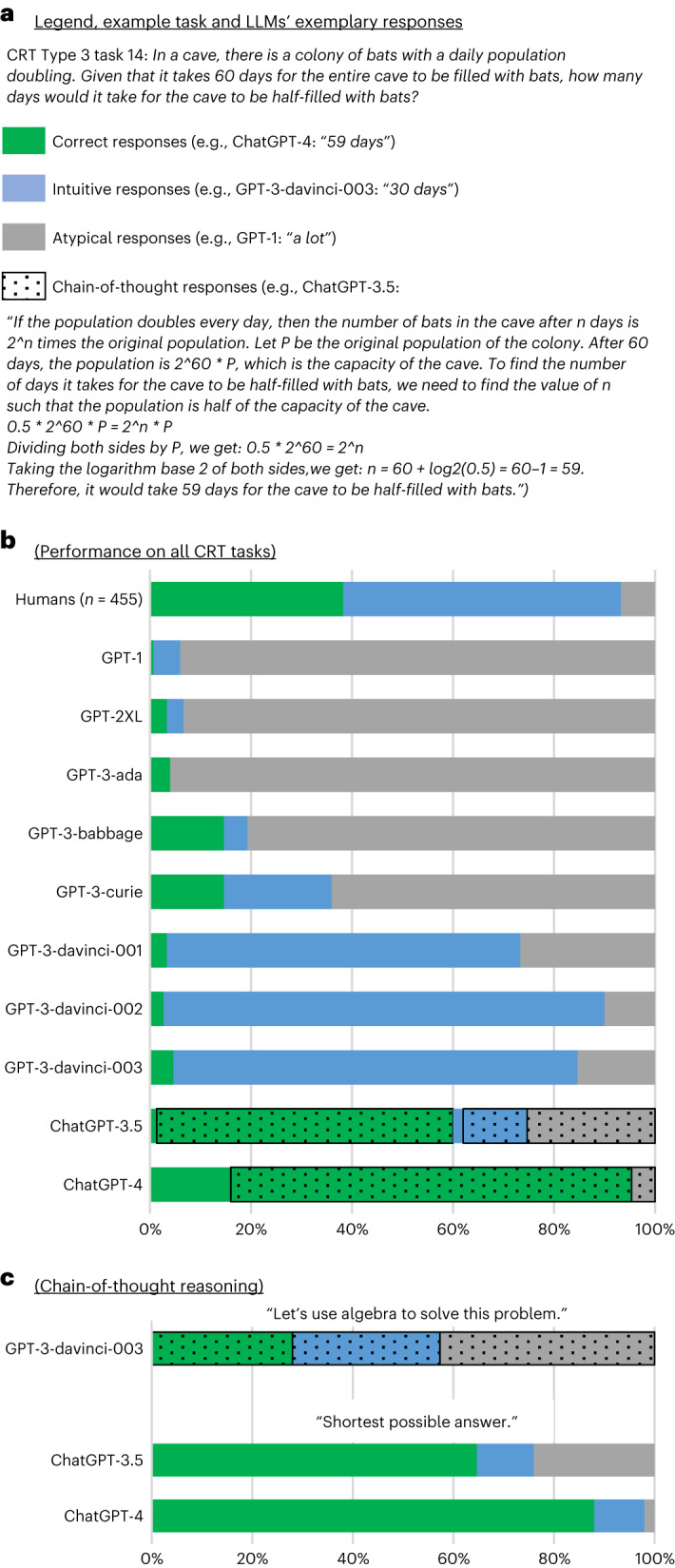
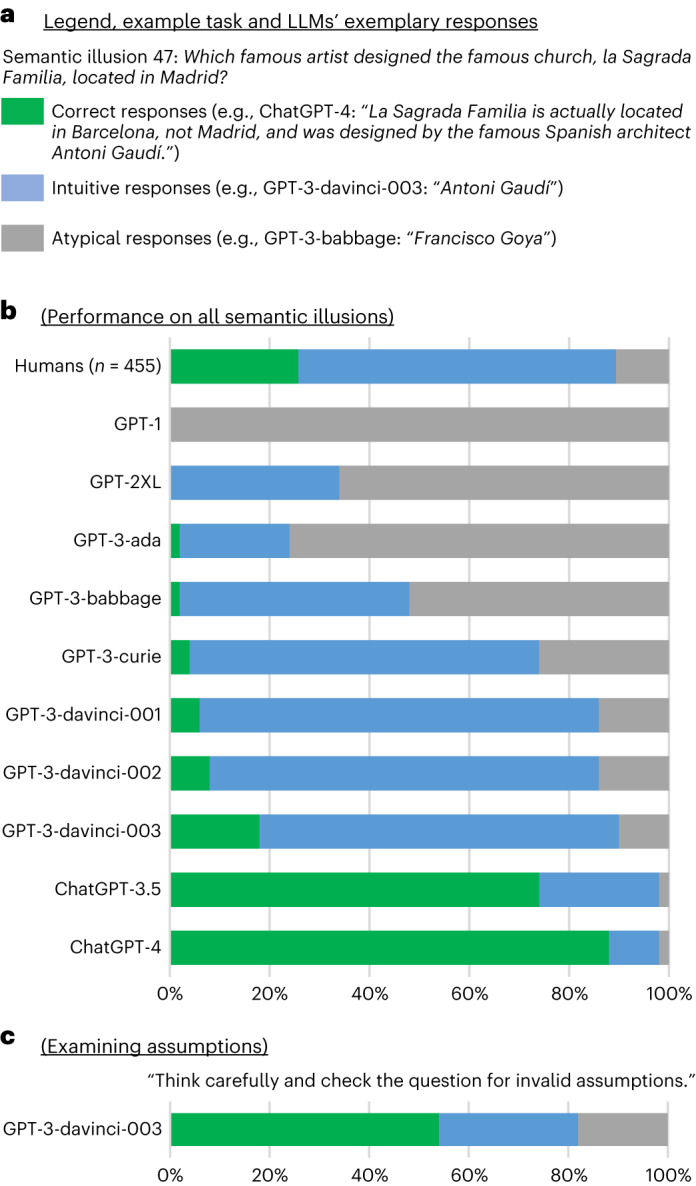
We design a battery of semantic illusions and cognitive reflection tests, aimed to elicit intuitive yet erroneous responses. We administer these tasks, traditionally used to study reasoning and decision-making in humans, to OpenAI’s generative pre-trained transformer model family. The results show that as the models expand in size and linguistic proficiency they increasingly display human-like intuitive system 1 thinking and associated cognitive errors. This pattern shifts notably with the introduction of ChatGPT models, which tend to respond correctly, avoiding the traps embedded in the tasks. Both ChatGPT-3.5 and 4 utilize the input–output context window to engage in chain-of-thought reasoning, reminiscent of how people use notepads to support their system 2 thinking. Yet, they remain accurate even when prevented from engaging in chain-of-thought reasoning, indicating that their system-1-like next-word generation processes are more accurate than those of older models. Our findings highlight the value of applying psychological methodologies to study large language models, as this can uncover previously undetected emergent characteristics.
Overview
The claims and statistics of this paper haven’t been checked yet.
Free: it reads the open-access text and checks the first 5 claims that cite a source we can check. Create a free account to check every claim.
Integrity signals
Registry
Cites
Statistics
Figures
Verification
Claims the paper makes
The claims and statistics of this paper haven’t been checked yet.
Free: it reads the open-access text and checks the first 5 claims that cite a source we can check. Create a free account to check every claim.
Claims other papers make about this one
Each is checked against this paper’s own text: does it say what the citing paper says it does?
The source backs part of the claim, not all of it — or backs it for a different population, condition or comparison.
In the citing paper
“To effectively predict the next word in a sentence generated by a human, LLMs must model not only grammar and vocabulary but also the psychological processes humans use when generating language (35, 36).”
From Evaluating large language models in theory of mind tasks (2024) · cites this paper as [35]
Experimental — accuracy not yet measuredThe source backs part of the claim, not all of it — or backs it for a different population, condition or comparison.
In the citing paper
“Interestingly, there is evidence from several studies showing that, while the previous generation of models frequently exhibited human-like heuristics and biases, they have largely disappeared in the latest generation of LLMs (Chen, Liu, et al., 2023;Hagendorff et al., 2023).”
From Machine Psychology (2023) · cites this paper as Hagendorff et al., 2023
Experimental — accuracy not yet measuredThe cited source says what the claim attributes to it.
In the citing paper
“LLMs trained to predict the next word in a sentence surprised their creators not only by their inclination to be racist and sexist (34) but also by their emergent reasoning and arithmetic skills (35), ability to translate between languages (22), and propensity to semantic priming (36).”
From Evaluating large language models in theory of mind tasks (2024) · cites this paper as [35]
Self-check
Percentages, sums and reported differences re-computed from the paper’s own numbers.
The self-check needs the paper’s full text.
Citations
Cites
Tversky, A., & Kahneman, D. (1974) · Science · doi:10.1126/science.185.4157.1124 · Cited by 28,810
Language Models are Few-Shot Learners
Brown, T. B., Mann, B., Ryder, N., Subbiah, M., Kaplan, J., Dhariwal, P., Neelakantan, A., Shyam, P., Sastry, G., Askell, A., et al. (2020) · arXiv · doi:10.48550/arxiv.2005.14165 · Cited by 23,372
Deep reinforcement learning from human preferences
Christiano, P., Leike, J., Brown, T. B., Martic, M., Legg, S., & Amodei, D. (2017) · arXiv · doi:10.48550/arxiv.1706.03741 · Cited by 7,379 · cited 1×
“Second, it could be that the shift was driven by the employment of reinforcement learning from human feedback 18,19 .”
BackgroundCognitive Reflection and Decision Making
Frederick, S. (2005) · Journal of Economic Perspectives · doi:10.1257/089533005775196732 · Cited by 5,256
Chain-Of-Thought Prompting Elicits Reasoning in Large Language Models
Wei, J., Wang, X., Schuurmans, D., Bosma, M., Ichter, B., Xia, F., Chi, E., Le, Q. V., & Zhou, D. (2022) · Advances in Neural Information Processing Systems 35 · doi:10.52202/068431-1800 · Cited by 4,505
Chain-of-Thought Prompting Elicits Reasoning in Large Language Models
Wei, J., Wang, X., Schuurmans, D., Bosma, M., Ichter, B., Xia, F., Chi, E., Le, Q., & Zhou, D. (2022) · arXiv · doi:10.48550/arxiv.2201.11903 · Cited by 4,263 · cited 2×
“Yet, past research and the results presented here suggest that, like humans, LLMs can also engage in system-2-like cognitive processes 4 .”
ResultTraining language models to follow instructions with human feedback
Ouyang, L., Wu, J., Jiang, X., Almeida, D., Wainwright, C. L., Mishkin, P., Zhang, C., Agarwal, S., Slama, K., Ray, A., et al. (2022) · arXiv · doi:10.48550/arxiv.2203.02155 · Cited by 4,208 · cited 2×
“While reinforcement learning from human feedback has been employed since GPT-3 text-davinci-002 19 , this procedure was enhanced in ChatGPT training: AI trainers played both sides: the user and an AI assistant 20 .”
BackgroundMethodThe empirical case for two systems of reasoning.
Sloman, S. A. (1996) · Psychological Bulletin · doi:10.1037//0033-2909.119.1.3 · Cited by 3,848
Emergent Abilities of Large Language Models
Wei, J., Tay, Y., Bommasani, R., Raffel, C., Zoph, B., Borgeaud, S., Yogatama, D., Bosma, M., Zhou, D., Metzler, D., et al. (2022) · arXiv · doi:10.48550/arxiv.2206.07682 · Cited by 1,264
The Cognitive Reflection Test as a predictor of performance on heuristics-and-biases tasks
Toplak, M. E., West, R. F., & Stanovich, K. E. (2011) · Memory & Cognition · doi:10.3758/s13421-011-0104-1 · Cited by 1,047 · cited 1×
“In humans, CRT and semantic illusions are good predictors of ability to engage in unbiased, reflective, and rational decision-making, as well as overall cognitive ability.(17,32) Thus, LLMs’ ability to solve CRT and semantic illusions should increase as their overall ability increases.”
BackgroundEcological RationalityIntelligence in the World
Todd, P. M., & Gigerenzer, G. (2012) · Oxford University Press eBooks · doi:10.1093/acprof:oso/9780195315448.001.0001 · Cited by 738
Using cognitive psychology to understand GPT-3
Binz, M., & Schulz, E. (2023) · Proceedings of the National Academy of Sciences · doi:10.1073/pnas.2218523120 · Cited by 559 · cited 2×
“It is increasingly difficult to study LLMs through the lenses of their architecture and hyperparameters.(19,43,44) Instead, as we show in this work, LLMs can be studied using methods designed to investigate another capable and opaque structure, namely the human mind.”
BackgroundFrom words to meaning: A semantic illusion
Erickson, T. D., & Mattson, M. E. (1981) · Journal of Verbal Learning and Verbal Behavior · doi:10.1016/s0022-5371(81)90165-1 · Cited by 504
Evaluating Large Language Models in Theory of Mind Tasks
Kosinski, M. (2023) · arXiv · doi:10.48550/arxiv.2302.02083 · Cited by 339
Self-citationAre Emergent Abilities of Large Language Models a Mirage?
Schaeffer, R., Miranda, B., & Koyejo, S. (2023) · arXiv · doi:10.48550/arxiv.2304.15004 · Cited by 200
The cognitive reflection test is robust to multiple exposures
Bialek, M., & Pennycook, G. (2018) · Behavior Research Methods · doi:10.3758/s13428-017-0963-x · Cited by 147
Deception abilities emerged in large language models
Hagendorff, T. (2024) · Proceedings of the National Academy of Sciences · doi:10.1073/pnas.2317967121 · Cited by 100
Self-citationA limitation of the Cognitive Reflection Test: familiarity
Stieger, S., & Reips, U.-D. (2016) · PeerJ · doi:10.7717/peerj.2395 · Cited by 88
Hagendorff, T., Dasgupta, I., Binz, M., Chan, S. C. Y., Lampinen, A., Wang, J. X., Akata, Z., & Schulz, E. (2023) · arXiv · doi:10.48550/arxiv.2303.13988 · Cited by 68 · cited 1×
“Our approach falls within a quickly growing category of studies employing classic psychological tests and experiments to probe LLM ‘psychological’ processes, such as judgment, decision-making and cognitive biases 14,22–24 .”
MethodSelf-citationKosiński, M., & Hagendorff, T. (2023) · OSF Preprints (OSF Preprints) · doi:10.17605/osf.io/w5vhp · Cited by 2
Self-citationOpenAI, Achiam, J., Adler, S., Agarwal, S., Ahmad, L., Akkaya, I., Aleman, F. L., Almeida, D., Altenschmidt, J., Altman, S., et al. (2023) · arXiv · doi:10.48550/arxiv.2303.08774 · cited 1×
“We examine the performance of humans ( n = 455) and ten OpenAI LLMs (ranging from GPT-1 to ChatGPT-4 3,9–11 ) using tasks typically employed to test reasoning and decision-making in humans: cognitive reflection test (CRT) 12 tasks and semantic illusions 13 (see Supplementary Information and…”
Method
Research works printed but not linked: 4
- Radford, A., Narasimhan, K., Salimans, T. & Sutskever, I. Improving language understanding by generative pre-training. Preprint at https://paperswithcode.com/paper/improving-language-understanding-by (2018).
- Radford, A. et al. Language models are unsupervised multitask learners. Preprint at https://paperswithcode.com/paper/language-models-are-unsupervised-multitask (2019).
- Jones, E. & Steinhardt, J. Capturing failures of large language models via human cognitive biases. 36th Conference on Neural Information Processing Systems (2022).
- Nye, M., Tessler, M. H., Tenenbaum, J. B. & Lake, B. M. Improving coherence and consistency in neural sequence models with dual-system, neuro-symbolic reasoning. 35th Conference on Neural Information Processing Systems (2021).
Cited by
A Survey on Evaluation of Large Language Models
Chang, Y., Wang, X., Wang, J., Wu, Y., Yang, L., Zhu, K., Chen, H., Yi, X., Wang, C., Wang, Y., et al. (2024) · ACM Transactions on Intelligent Systems and Technology · doi:10.1145/3641289 · Cited by 4,254
The Crowdless Future? Generative AI and Creative Problem Solving
Boussioux, L., N. Lane, J., Zhang, M., Jacimovic, V., & Lakhani, K. R. (2023) · doi:10.2139/ssrn.4533642 · Cited by 343
Evaluating large language models in theory of mind tasks
Kosinski, M. (2024) · Proceedings of the National Academy of Sciences · doi:10.1073/pnas.2405460121 · Cited by 339
“To effectively predict the next word in a sentence generated by a human, LLMs must model not only grammar and vocabulary but also the psychological processes humans use when generating language ( 35 , 36 ).”
BackgroundThe Crowdless Future? Generative AI and Creative Problem-Solving
Boussioux, L., Lane, J. N., Zhang, M., Jacimovic, V., & Lakhani, K. R. (2024) · Organization Science · doi:10.1287/orsc.2023.18430 · Cited by 329
“…impact of AI on creativity often focuses on well-understood domains (Girotra et al. 2023, Gómez-Rodríguez and Williams 2023, Guzik et al. 2023, Wang et al. 2024) and is typically conducted in controlled laboratory settings (Doshi and Hauser 2023, Hagendorff et al. 2023, Koivisto and Grassini 2023).”
BackgroundIntegrating artificial intelligence in energy transition: A comprehensive review
Wang, Q., Li, Y., & Li, R. (2025) · Energy Strategy Reviews · doi:10.1016/j.esr.2024.101600 · Cited by 248
Metadata
- Authors
- Hagendorff, T., Fabi, S., & Kosinski, M.
- Affiliations
- University of Stuttgart (DE)
- University of California San Diego (US)
- Venue
- Nature Computational Science
- Published
- 2023-10-05
- Volume
- 3
- Issue
- 10
- Pages
- 833-838
- ISSN
- 2662-8457 (ISSN-L)
- PMC
- PMC10766525
- OpenAlex
- W4387378202
- Cited by
- 243
- References
- 16
- Citations by year
- 2026: 87 · 2025: 78 · 2024: 71 · 2023: 7
- FWCI
- 22.91
- Type
- journal article
- Language
- en
- Open access
- hybrid
- doi.org
- Licence
- cc-by
- creativecommons.org/licenses/by/4.0 (tdm)
- creativecommons.org/licenses/by/4.0 (vor)
- Locations
- Nature Computational Science (publishedVersion, cc-by)
- Funders
- Ministerium für Wissenschaft, Forschung und Kunst Baden-Württemberg (Az. 33-7533-9-19/54/5)
- Interchange Forum for Reflecting on Intelligent Systems (IRIS) at the University of Stuttgart
- Topics
- Physical Sciences › Computer Science › Artificial Intelligence › Topic Modeling
- Physical Sciences › Computer Science › Artificial Intelligence › Natural Language Processing Techniques
- Social Sciences › Decision Sciences › General Decision Sciences › Decision-Making and Behavioral Economics
- Keywords
- large language models, ChatGPT, intuitive thinking, cognitive biases, System 2 thinking, chain-of-thought reasoning, semantic illusions, cognitive reflection, model size, context window, emergent behavior, human-like reasoning
About these checks
Registry, retraction, Cites and statistics results are computed, not judged, with one exception: a printed reference that no index lists is read once by a model before it counts as a citation error. Claims are extracted by a model and kept only when their quote appears verbatim in the text; each cited source is then checked, with a model’s help, for whether it says what the claim relies on. Those verdicts can be wrong — read the claim’s quote and the cited source before relying on one.
Statistics and arithmetic are recomputed, not judged.
Confidence bands are shown only for fields calibrated on our annotated test set. None is calibrated yet, so no band is shown.
What counts as a claim ›How we measure confidence ›How we check this ›
Are you an author, or do you see a problem with this page? Request a review
Data sources
Bibliographic data: Semantic Scholar, OpenAlex, Crossref.
Contains information from the Semantic Scholar Academic Graph Datasets, made available under the ODC Attribution License (ODC-BY 1.0).
Semantic Scholar’s data is described in: Kinney, R., et al. (2023). The Semantic Scholar Open Data Platform. arXiv:2301.10140.
