

Human-like intuitive behavior and reasoning biases emerged in large language models but disappeared in ChatGPT
Open accessThe DOI matches its Crossref record; 21 of the 21 references it cites were found in a registry or an index.
Abstract
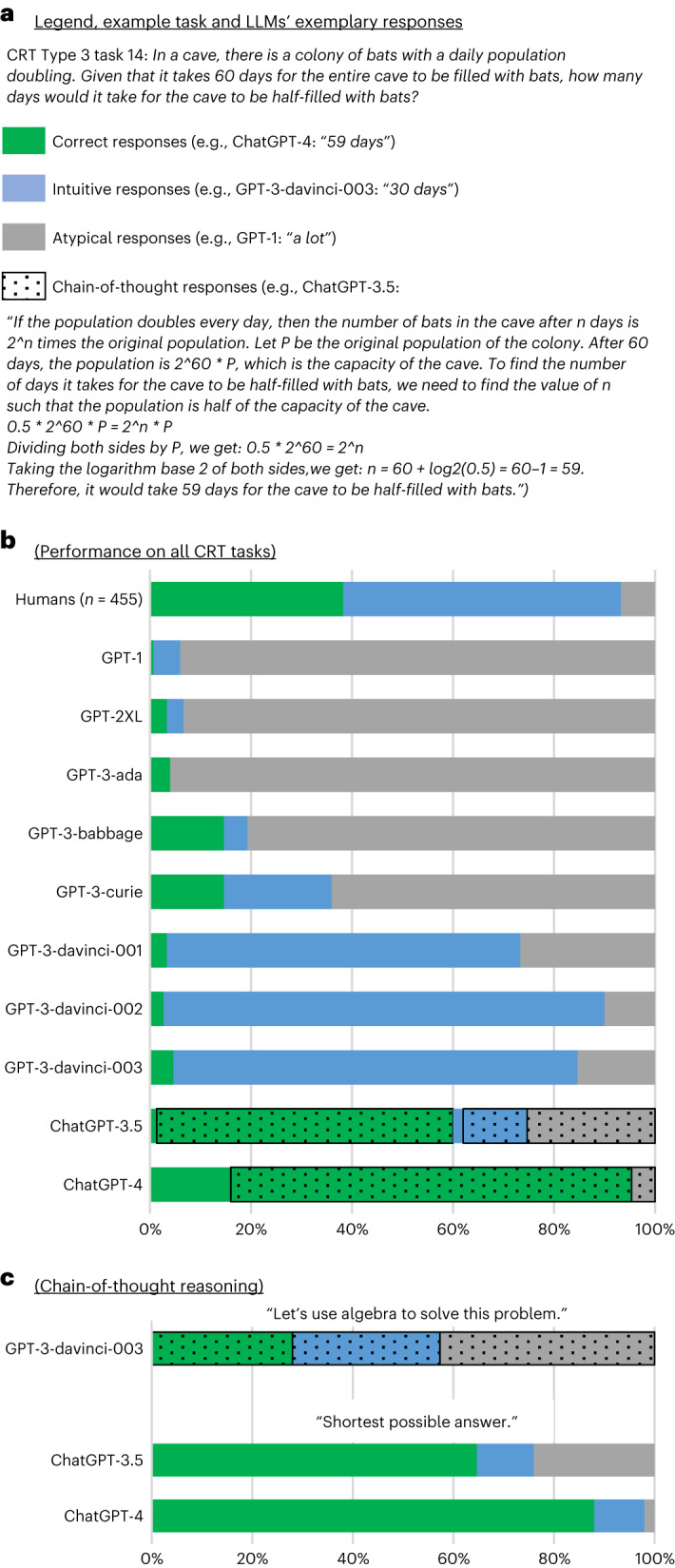
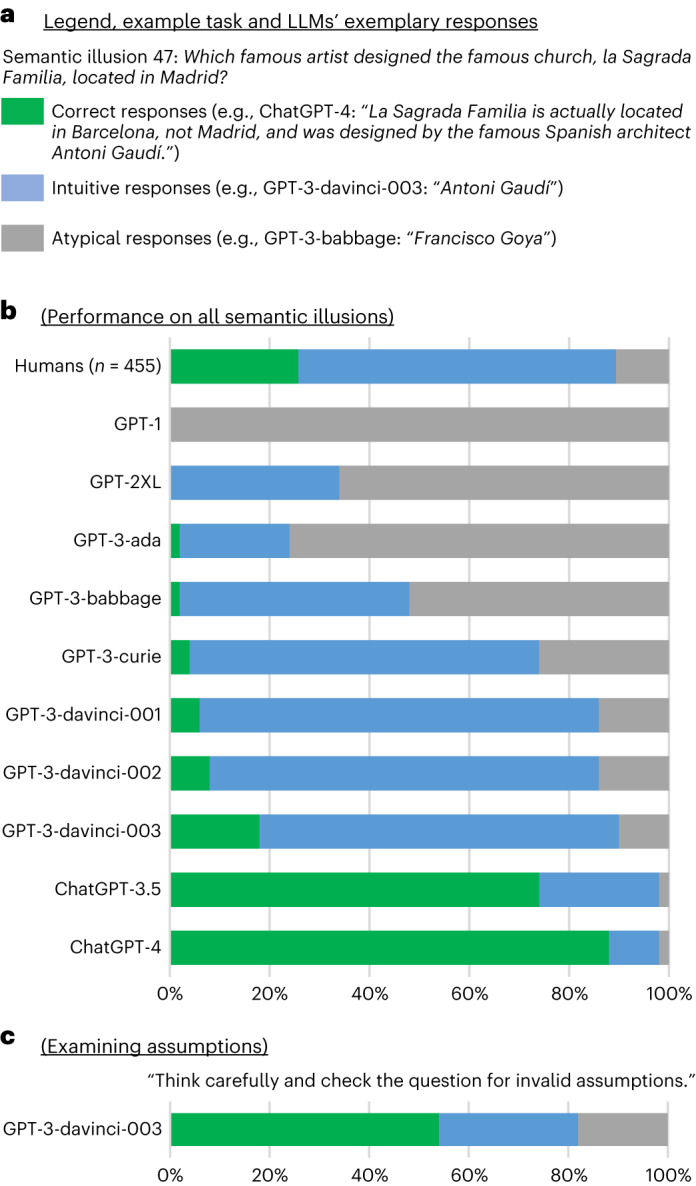
We design a battery of semantic illusions and cognitive reflection tests, aimed to elicit intuitive yet erroneous responses. We administer these tasks, traditionally used to study reasoning and decision-making in humans, to OpenAI’s generative pre-trained transformer model family. The results show that as the models expand in size and linguistic proficiency they increasingly display human-like intuitive system 1 thinking and associated cognitive errors. This pattern shifts notably with the introduction of ChatGPT models, which tend to respond correctly, avoiding the traps embedded in the tasks. Both ChatGPT-3.5 and 4 utilize the input–output context window to engage in chain-of-thought reasoning, reminiscent of how people use notepads to support their system 2 thinking. Yet, they remain accurate even when prevented from engaging in chain-of-thought reasoning, indicating that their system-1-like next-word generation processes are more accurate than those of older models. Our findings highlight the value of applying psychological methodologies to study large language models, as this can uncover previously undetected emergent characteristics.
Overview
The claims and statistics of this paper haven’t been checked yet.
Free: it reads the open-access text and checks the first 5 claims that cite a source we can check. Create a free account to check every claim.
Integrity signals
Registry
Cites
Statistics
Figures
Verification
Claims the paper makes
The claims and statistics of this paper haven’t been checked yet.
Free: it reads the open-access text and checks the first 5 claims that cite a source we can check. Create a free account to check every claim.
Claims other papers make about this one
Each is checked against this paper’s own text: does it say what the citing paper says it does?
The source backs part of the claim, not all of it — or backs it for a different population, condition or comparison.
In the citing paper
“To effectively predict the next word in a sentence generated by a human, LLMs must model not only grammar and vocabulary but also the psychological processes humans use when generating language (35, 36).”
From Evaluating large language models in theory of mind tasks (2024) · cites this paper as [35]
Experimental — accuracy not yet measuredThe source backs part of the claim, not all of it — or backs it for a different population, condition or comparison.
In the citing paper
“Interestingly, there is evidence from several studies showing that, while the previous generation of models frequently exhibited human-like heuristics and biases, they have largely disappeared in the latest generation of LLMs (Chen, Liu, et al., 2023;Hagendorff et al., 2023).”
From Machine Psychology (2023) · cites this paper as Hagendorff et al., 2023
Experimental — accuracy not yet measuredThe cited source says what the claim attributes to it.
In the citing paper
“LLMs trained to predict the next word in a sentence surprised their creators not only by their inclination to be racist and sexist (34) but also by their emergent reasoning and arithmetic skills (35), ability to translate between languages (22), and propensity to semantic priming (36).”
From Evaluating large language models in theory of mind tasks (2024) · cites this paper as [35]
Self-check
Percentages, sums and reported differences re-computed from the paper’s own numbers.
The self-check needs the paper’s full text.
Citations
Cites
Tversky, A., & Kahneman, D. (1974) · Science · doi:10.1126/science.185.4157.1124 · Cited by 28,810
Language Models are Few-Shot Learners
Brown, T. B., Mann, B., Ryder, N., Subbiah, M., Kaplan, J., Dhariwal, P., Neelakantan, A., Shyam, P., Sastry, G., Askell, A., et al. (2020) · arXiv · doi:10.48550/arxiv.2005.14165 · Cited by 23,372
Deep reinforcement learning from human preferences
Christiano, P., Leike, J., Brown, T. B., Martic, M., Legg, S., & Amodei, D. (2017) · arXiv · doi:10.48550/arxiv.1706.03741 · Cited by 7,379 · cited 1×
“Second, it could be that the shift was driven by the employment of reinforcement learning from human feedback 18,19 .”
BackgroundCognitive Reflection and Decision Making
Frederick, S. (2005) · Journal of Economic Perspectives · doi:10.1257/089533005775196732 · Cited by 5,256
Chain-Of-Thought Prompting Elicits Reasoning in Large Language Models
Wei, J., Wang, X., Schuurmans, D., Bosma, M., Ichter, B., Xia, F., Chi, E., Le, Q. V., & Zhou, D. (2022) · Advances in Neural Information Processing Systems 35 · doi:10.52202/068431-1800 · Cited by 4,505
Chain-of-Thought Prompting Elicits Reasoning in Large Language Models
Wei, J., Wang, X., Schuurmans, D., Bosma, M., Ichter, B., Xia, F., Chi, E., Le, Q., & Zhou, D. (2022) · arXiv · doi:10.48550/arxiv.2201.11903 · Cited by 4,263 · cited 2×
“Yet, past research and the results presented here suggest that, like humans, LLMs can also engage in system-2-like cognitive processes 4 .”
ResultTraining language models to follow instructions with human feedback
Ouyang, L., Wu, J., Jiang, X., Almeida, D., Wainwright, C. L., Mishkin, P., Zhang, C., Agarwal, S., Slama, K., Ray, A., et al. (2022) · arXiv · doi:10.48550/arxiv.2203.02155 · Cited by 4,208 · cited 2×
“While reinforcement learning from human feedback has been employed since GPT-3 text-davinci-002 19 , this procedure was enhanced in ChatGPT training: AI trainers played both sides: the user and an AI assistant 20 .”
BackgroundMethodThe empirical case for two systems of reasoning.
Sloman, S. A. (1996) · Psychological Bulletin · doi:10.1037//0033-2909.119.1.3 · Cited by 3,848
Emergent Abilities of Large Language Models
Wei, J., Tay, Y., Bommasani, R., Raffel, C., Zoph, B., Borgeaud, S., Yogatama, D., Bosma, M., Zhou, D., Metzler, D., et al. (2022) · arXiv · doi:10.48550/arxiv.2206.07682 · Cited by 1,264
The Cognitive Reflection Test as a predictor of performance on heuristics-and-biases tasks
Toplak, M. E., West, R. F., & Stanovich, K. E. (2011) · Memory & Cognition · doi:10.3758/s13421-011-0104-1 · Cited by 1,047 · cited 1×
“In humans, CRT and semantic illusions are good predictors of ability to engage in unbiased, reflective, and rational decision-making, as well as overall cognitive ability.(17,32) Thus, LLMs’ ability to solve CRT and semantic illusions should increase as their overall ability increases.”
Background
Research works printed but not linked: 4
- Radford, A., Narasimhan, K., Salimans, T. & Sutskever, I. Improving language understanding by generative pre-training. Preprint at https://paperswithcode.com/paper/improving-language-understanding-by (2018).
- Radford, A. et al. Language models are unsupervised multitask learners. Preprint at https://paperswithcode.com/paper/language-models-are-unsupervised-multitask (2019).
- Jones, E. & Steinhardt, J. Capturing failures of large language models via human cognitive biases. 36th Conference on Neural Information Processing Systems (2022).
- Nye, M., Tessler, M. H., Tenenbaum, J. B. & Lake, B. M. Improving coherence and consistency in neural sequence models with dual-system, neuro-symbolic reasoning. 35th Conference on Neural Information Processing Systems (2021).
Cited by
A Survey on Evaluation of Large Language Models
Chang, Y., Wang, X., Wang, J., Wu, Y., Yang, L., Zhu, K., Chen, H., Yi, X., Wang, C., Wang, Y., et al. (2024) · ACM Transactions on Intelligent Systems and Technology · doi:10.1145/3641289 · Cited by 4,254
The Crowdless Future? Generative AI and Creative Problem Solving
Boussioux, L., N. Lane, J., Zhang, M., Jacimovic, V., & Lakhani, K. R. (2023) · doi:10.2139/ssrn.4533642 · Cited by 343
Evaluating large language models in theory of mind tasks
Kosinski, M. (2024) · Proceedings of the National Academy of Sciences · doi:10.1073/pnas.2405460121 · Cited by 339
“To effectively predict the next word in a sentence generated by a human, LLMs must model not only grammar and vocabulary but also the psychological processes humans use when generating language ( 35 , 36 ).”
BackgroundThe Crowdless Future? Generative AI and Creative Problem-Solving
Boussioux, L., Lane, J. N., Zhang, M., Jacimovic, V., & Lakhani, K. R. (2024) · Organization Science · doi:10.1287/orsc.2023.18430 · Cited by 329
“…impact of AI on creativity often focuses on well-understood domains (Girotra et al. 2023, Gómez-Rodríguez and Williams 2023, Guzik et al. 2023, Wang et al. 2024) and is typically conducted in controlled laboratory settings (Doshi and Hauser 2023, Hagendorff et al. 2023, Koivisto and Grassini 2023).”
BackgroundIntegrating artificial intelligence in energy transition: A comprehensive review
Wang, Q., Li, Y., & Li, R. (2025) · Energy Strategy Reviews · doi:10.1016/j.esr.2024.101600 · Cited by 248
Large language models empowered agent-based modeling and simulation: a survey and perspectives
Gao, C., Lan, X., Li, N., Yuan, Y., Ding, J., Zhou, Z., Xu, F., & Li, Y. (2024) · Humanities and Social Sciences Communications · doi:10.1057/s41599-024-03611-3 · Cited by 294
“To gauge LLM agents ’ susceptibility to social bias and ste-reotype, researchers use semantic illusions and cognitive re fl ection tests (Hagendorff et al., 2023), typically administered to human subjects, to quantify LLM ’ s tendency to produce intuitive yet erroneous responses.”
Resnik, D. B., & Hosseini, M. (2025) · AI and Ethics · doi:10.1007/s43681-024-00493-8 · Cited by 228
“For example, newer versions of ChatGPT are prone to reasoning errors associated with intuitive thinking but older versions did not make these errors [91].”
Hao, X., Demir, E., & Eyers, D. (2024) · Technology in Society · doi:10.1016/j.techsoc.2024.102662 · Cited by 152
Revolutionizing Health Care: The Transformative Impact of Large Language Models in Medicine
Zhang, K., Meng, X., Yan, X., Ji, J., Liu, J., Xu, H., Zhang, H., Liu, D., Wang, J., Wang, X., et al. (2025) · Journal of Medical Internet Research · doi:10.2196/59069 · Cited by 124
“An AI system endowed with the capability to appreciate and respond to these individual differences can offer more personalized and compassionate medical advice [104,105].”
Sarstedt, M., Adler, S. J., Rau, L., & Schmitt, B. (2024) · Psychology & Marketing · doi:10.1002/mar.21982 · Cited by 149
“Most notably, Hagendorff et al. (2023) identified a substantial shift in the response patterns across different GPT versions.”
BackgroundMethodInfluentialA Manager and an AI Walk into a Bar: Does ChatGPT Make Biased Decisions Like We Do?
Chen, Y., Kirshner, S. N., Ovchinnikov, A., Andiappan, M., & Jenkin, T. (2025) · Manufacturing & Service Operations Management · doi:10.1287/msom.2023.0279 · Cited by 143
Large language models can infer psychological dispositions of social media users
Peters, H., & Matz, S. C. (2024) · PNAS Nexus · doi:10.1093/pnasnexus/pgae231 · Cited by 85
Evaluating Large Language Models in Theory of Mind Tasks
Kosinski, M. (2023) · arXiv · doi:10.48550/arxiv.2302.02083 · Cited by 339
“To effectively predict the next word in a sentence generated by a human, LLMs must model not only grammar and vocabulary but also the psychological processes humans use when generating language ( 35 , 36 ).”
BackgroundExploring the frontiers of LLMs in psychological applications: a comprehensive review
Ke, L., Tong, S., Cheng, P., & Peng, K. (2025) · Artificial Intelligence Review · doi:10.1007/s10462-025-11297-5 · Cited by 148
“LLMs, including GPT-4, per - form below human levels (55% on SocialIQa, 60% on ToMi), indicating that scaling alone does not yield ToM, highlighting the need for person-centric NLP approaches.”
InfluentialGenerative AI in Marketing and Principles for Ethical Design and Deployment
Hermann, E., & Puntoni, S. (2025) · Journal of Public Policy & Marketing · doi:10.1177/07439156241309874 · Cited by 136
“…abstraction, con fi rmation, conjunction, reasoning, and truth biases; overcon fi dence and probability weighting; intuitive thinking and prejudices (Hagendorff, Fabi, and Kosinski 2023; Suri et al. 2024; Tian et al. 2024) Nonhuman biases: (cid:129) Hallucinations: Use of data and information…”
Niu, Q., Liu, J., Bi, Z., Feng, P., Peng, B., Chen, K., Li, M., Yan, L. K. Q., Zhang, Y., Yin, C. H., et al. (2026) · BIO Integration · doi:10.15212/bioi-2025-0199 · Cited by 121
The benefits and dangers of anthropomorphic conversational agents
Peter, S., Riemer, K., & West, J. D. (2025) · Proceedings of the National Academy of Sciences · doi:10.1073/pnas.2415898122 · Cited by 110
Beyond Accuracy: Evaluating the Reasoning Behavior of Large Language Models - A SurveyPreprint
Mondorf, P., & Plank, B. (2024) · arXiv.org · doi:10.48550/arxiv.2404.01869 · Cited by 124
“Other studies investigate whether human-like reasoning behavior in mathematical tasks manifests in LLMs. Hagendorff et al. (2023) show that, akin to humans, GPT-3 variants tend to offer intuitive yet incorrect answers to cognitive reflection tests (Frederick, 2005).”
BackgroundInfluentialJalali, M. S., & Akhavan, A. (2024) · System Dynamics Review · doi:10.1002/sdr.1772 · Cited by 131
Language Model Behavior: A Comprehensive Survey
Chang, T. A., & Bergen, B. K. (2024) · Computational Linguistics · doi:10.1162/coli_a_00492 · Cited by 105
Ye, Y., Li, H., & Sawaengdist, A. (2024) · Language Learning in Higher Education · doi:10.1515/cercles-2023-0006 · Cited by 119
Deception abilities emerged in large language models
Hagendorff, T. (2024) · Proceedings of the National Academy of Sciences · doi:10.1073/pnas.2317967121 · Cited by 100
Self-citationVisual cognition in multimodal large language models
Schulze Buschoff, L. M., Akata, E., Bethge, M., & Schulz, E. (2025) · Nature Machine Intelligence · doi:10.1038/s42256-024-00963-y · Cited by 83
“However, most of the previous studies did not investigate multi-modal LLMs but rather remained in the pure language domain.”
Large Language Models for Mobility Analysis in Transportation Systems: A Survey on Forecasting Tasks
Zhang, Z., Sun, Y., Wang, Z., Nie, Y., Ma, X., Li, R., Sun, P., & Ban, X. J. (2025) · Transportation Research Record Journal of the Transportation Research Board · doi:10.1177/03611981251367699 · Cited by 89
“Traditionally, statistical models have been widely used for transportation system forecasting, focusing on factors such as population growth, urban development, and changes in infrastructure.”
Can LLMs Reason Like Humans? Assessing Theory of Mind Reasoning in LLMs for Open-Ended Questions
Amirizaniani, M., Martin, E., Sivachenko, M., Mashhadi, A., & Shah, C. S. (2024) · ACM International Conference on Information and Knowledge Management (CIKM) · doi:10.1145/3627673.3679832 · Cited by 114
(Ir)rationality and cognitive biases in large language models
Macmillan-Scott, O., & Musolesi, M. (2024) · Royal Society Open Science · doi:10.1098/rsos.240255 · Cited by 47
“Building on this debate and looking at LLMs being evaluated using human tests, Hagendorff et al. [16] have proposed the creation of a new field of research called machine psychology , which would treat LLMs as participants in psychological experiments.”
InfluentialBaltà‐Salvador, R., Madafri, I. E., Brasó‐Vives, E., & Peña, M. (2025) · Computer Applications in Engineering Education · doi:10.1002/cae.22817 · Cited by 91
“Moreover, AI can enhance objectivity in the ideation process by mitigating personal biases [55], leading to more unbiased and user ‐ centric solutions.”
Thinking Fast and Slow in Large Language Models
Hagendorff, T., Fabi, S., & Kosiński, M. (2022) · PubMed · doi:10.48550/arxiv.2212.05206 · Cited by 36
Self-citationBC4LLM: A perspective of trusted artificial intelligence when blockchain meets large language models
Luo, H., Luo, J., & Vasilakos, A. V. (2024) · Neurocomputing · doi:10.1016/j.neucom.2024.128089 · Cited by 88
Large language models can outperform humans in social situational judgments
Mittelstädt, J. M., Maier, J., Goerke, P., Zinn, F., & Hermes, M. (2024) · Scientific Reports · doi:10.1038/s41598-024-79048-0 · Cited by 45
“Interestingly, due to the increasing difficulty in evaluating the capabilities of LLMs using their architecture or hyperparameters alone, there is also a growing demand to assess the new possibilities with the use of classical psychological or psychometric tests 31,32 .”
BackgroundHagendorff, T., Dasgupta, I., Binz, M., Chan, S. C. Y., Lampinen, A., Wang, J. X., Akata, Z., & Schulz, E. (2023) · arXiv · doi:10.48550/arxiv.2303.13988 · Cited by 68
“There is evidence from several studies showing that, while early generations of models frequently exhibited behavior resembling human-like heuristics and biases, they have disappeared in later generations of LLMs ( 71 , 76 ).”
Self-citationLarge language models show amplified cognitive biases in moral decision-making
Cheung, V., Maier, M., & Lieder, F. (2025) · Proceedings of the National Academy of Sciences · doi:10.1073/pnas.2412015122 · Cited by 64
GPT and CLT: The impact of ChatGPT's level of abstraction on consumer recommendations
Kirshner, S. N. (2024) · Journal of Retailing and Consumer Services · doi:10.1016/j.jretconser.2023.103580 · Cited by 51
Urban planning in the era of large language models
Zheng, Y., Xu, F., Lin, Y., Santi, P., Ratti, C., Wang, Q., & Li, Y. (2025) · Nature Computational Science · doi:10.1038/s43588-025-00846-1 · Cited by 88
Vision AI-based human-robot collaborative assembly driven by autonomous robots
Liu, S., Zhang, J., Wang, L., & Gao, R. X. (2024) · CIRP Annals · doi:10.1016/j.cirp.2024.03.004 · Cited by 58
A Survey of Test-Time Compute: From Intuitive Inference to Deliberate Reasoning
Ji, Y., Li, J.-T., Xiang, Y., Ye, H., Wu, K., Yao, K., Xu, J., Mo, L., & Zhang, M. (2025) · Computational Linguistics · doi:10.1162/coli.a.629 · Cited by 27
“Currently, advanced LLMs with chain-of-thought (CoT) prompting [326] have enabled language models to perform explicit System-2 thinking [97].”
Large Language Models Show Amplified Cognitive Biases in Moral Decision-Making
Cheung, V., Maier, M., & Lieder, F. (2025) · doi:10.31234/osf.io/aj46b_v3 · Cited by 53
Zhang, T., Koutsoumpis, A., Oostrom, J. K., Holtrop, D., Ghassemi, S., & de Vries, R. E. (2024) · IEEE Transactions on Affective Computing · doi:10.1109/taffc.2024.3374875 · Cited by 66
“Here, we use chain-of-thought prompting strategy (i.e., ask the LLMs to think about and output why it rates the personality traits like this) inspired by previous works [45], [46].”
BackgroundMethodHuman-like object concept representations emerge naturally in multimodal large language models
Du, C., Fu, K., Wen, B., Sun, Y., Peng, J., Wei, W., Gao, Y., Wang, S., Zhang, C., Li, J., et al. (2025) · Nature Machine Intelligence · doi:10.1038/s42256-025-01049-z · Cited by 83
Tuan, N. T., Moore, P. T., Thanh, D. H. V., & Pham, H. V. (2024) · Applied Sciences · doi:10.3390/app14073036 · Cited by 54
“Compared to these studies, LLMs require a large infrastructure or system for reasoning and answering questions [12].”
BackgroundResultCognitive Biases and Artificial Intelligence
Wang, J., & Redelmeier, D. A. (2024) · NEJM AI · doi:10.1056/aics2400639 · Cited by 56
GPT-5 and open-weight large language models: Advances in reasoning, transparency, and control
León, M. (2025) · Information Systems · doi:10.1016/j.is.2025.102620 · Cited by 89
Sufyan, N. S., Fadhel, F. H., Alkhathami, S. S., & Mukhadi, J. Y. A. (2024) · Frontiers in Psychology · doi:10.3389/fpsyg.2024.1353022 · Cited by 53
“…and others introduced large linguistic conversation models that used natural human language relying on a large database; these were trained by interacting with people in specialties and in many fields, including the therapeutic psychological field (Hagendorff and Fabi, 2023; Han et al., 2023).”
BackgroundStrategic behavior of large language models and the role of game structure versus contextual framing
Lorè, N., & Heydari, B. (2024) · Scientific Reports · doi:10.1038/s41598-024-69032-z · Cited by 117
Li, T., Zhan, Z., Ji, Y., & Li, T. (2025) · The Internet and Higher Education · doi:10.1016/j.iheduc.2025.101003 · Cited by 47
Instructed to Bias: Instruction-Tuned Language Models Exhibit Emergent Cognitive Bias
Itzhak, I., Stanovsky, G., Rosenfeld, N., & Belinkov, Y. (2023) · Transactions of the Association for Computational Linguistics · doi:10.1162/tacl_a_00673 · Cited by 85
How developments in natural language processing help us in understanding human behaviour
Mihalcea, R. F., Biester, L., Boyd, R. L., Jin, Z., Pérez‐Rosas, V., Wilson, S. R., & Pennebaker, J. W. (2024) · Nature Human Behaviour · doi:10.1038/s41562-024-01938-0 · Cited by 58
“The development of LLMs is ushering in a new perspective on human-like intuitive behaviours 54 , including the construction of narratives 55–57 that are often indistinguishable from stories written by people.”
Large language models know how the personality of public figures is perceived by the general public
Cao, X., & Kosiński, M. (2024) · Scientific Reports · doi:10.1038/s41598-024-57271-z · Cited by 57
Milička, J., Marklová, A., VanSlambrouck, K., Pospíšilová, E., Šimsová, J., Harvan, S., & Drobil, O. (2024) · PLoS ONE · doi:10.1371/journal.pone.0298522 · Cited by 48
Evaluating chatGPT-4 and chatGPT-4o: performance insights from NAEP mathematics problem solving
Wei, X. (2024) · Frontiers in Education · doi:10.3389/feduc.2024.1452570 · Cited by 43
Wu, S., Oltramari, A., Francis, J., Giles, C. L., & Ritter, F. E. (2025) · Neurosymbolic Artificial Intelligence · doi:10.1177/29498732251377341 · Cited by 41
“Typical LLMs’ use resembles system-1 reasoning process (Hagendorff et al., 2023; Sloman, 1996), offering quick, intuitive responses for everyday tasks.”
Toward a science of human–AI teaming for decision making: a complementarity framework
Gonzalez, C., Donahue, K., Goldstein, D. G., Heidari, H., Jalali, M. S., Schelble, B., Singh, A., & Woolley, A. W. (2026) · PNAS Nexus · doi:10.1093/pnasnexus/pgag030 · Cited by 33
Large language models (LLMs) and the institutionalization of misinformation
Garry, M., Chan, W. M., Foster, J., & Henkel, L. A. (2024) · Trends in Cognitive Sciences · doi:10.1016/j.tics.2024.08.007 · Cited by 33
Human bias in AI models? Anchoring effects and mitigation strategies in large language models
Nguyen, J. K. (2024) · Journal of Behavioral and Experimental Finance · doi:10.1016/j.jbef.2024.100971 · Cited by 33
Six Fallacies in Substituting Large Language Models for Human Participants
Lin, Z. (2025) · Advances in Methods and Practices in Psychological Science · doi:10.1177/25152459251357566 · Cited by 66
“…than in-group description (A. Wang et al., 2025), and misrepresent sampled groups, as demonstrated by an upward bias in mean ratings of the Big Five personality traits (Niszczota et al., 2025) and in other surveys and tests (Hagendorff et al., 2023; Sarstedt et al., 2024; Tjuatja et al., 2024).”
The use of synthetic data in tourism
Viglia, G., Adler, S. J., Miltgen, C. L., & Sarstedt, M. (2024) · Annals of Tourism Research · doi:10.1016/j.annals.2024.103819 · Cited by 35
“These studies typically prompt a large language model with speci fi c tasks or paradigms relevant to the respective fi eld (e.g., vignette-based tasks) and compare the output with human responses (e.g., Binz & Schulz, 2023; Dillion et al., 2023; Hagendorff et al., 2023).”
ResultLarge Language Models and the Wisdom of Small Crowds
Trott, S. (2024) · Open Mind · doi:10.1162/opmi_a_00144 · Cited by 40
“…of using LLMs as in silica “ model organisms ” has thus generated intense interest (Aher et al., 2023; Dillion et al., 2023; Gilardi et al., 2023; Hagendorff et al., 2023; Jain et al., 2024) 1 ; some researchers have even argued that LLMs are actually better “ participants ” than human workers…”
MethodThe effects of generative AI’s human-like competencies on clinical decision-making
Spatscheck, N., Schaschek, M., & Winkelmann, A. (2024) · Journal of Decision Systems · doi:10.1080/12460125.2024.2430731 · Cited by 24
Cognitive Biases in Large Language Models: A Survey and Mitigation Experiments
Sumita, Y., Takeuchi, K., & Kashima, H. (2025) · ACM Symposium on Applied Computing · doi:10.1145/3672608.3707812 · Cited by 47
Toward LLM-agent-based modeling of transportation systems: A conceptual framework
Liu, T., Yang, J., & Yin, Y. (2025) · Artificial Intelligence for Transportation · doi:10.1016/j.ait.2025.100001 · Cited by 53
Dubey, S., Ghosh, R., Chatterjee, S., Dubey, M. J., Das, S., & Benito‐León, J. (2024) · Medical Research Archives · doi:10.18103/mra.v12i6.5383 · Cited by 28
“A study by Hagendorff et al. 14 investigated how large language models like ChatGPT exhibit human-like intuitive thinking and reasoning biases.”
BackgroundResultXu, J., Lu, L., Peng, X., Pang, J., Ding, J., Yang, L., Song, H., Li, K., Sun, X., & Zhang, S. (2024) · JMIR Medical Informatics · doi:10.2196/57674 · Cited by 30
Multi-Agent Collaboration Mechanisms: A Survey of LLMs
Tran, K.-T., Dao, D., Nguyen, M.-D., Pham, Q.-V., O'Sullivan, B., & Nguyen, H. D. (2025) · arXiv · doi:10.48550/arxiv.2501.06322 · Cited by 680
“While these models have shown remarkable capabilities individually, they still suffer from intrinsic limitations such as hallucination [57], auto-regressive nature (e.g., incapable of slow-thinking [49]), and scaling laws [55, 69].”
Chen, L., Zhang, Y., Feng, J., Chai, H., Zhang, H., Fan, B., Ma, Y., Zhang, S., Li, N., Liu, T., et al. (2026) · Humanities and Social Sciences Communications · doi:10.1057/s41599-026-07316-7 · Cited by 37
“For OpenAI’s series of models, ChatGPT marked a turning point with the emergence of human-like biases [64].”
Effective Generative AI: The Human-Algorithm CentaurPreprint
Saghafian, S. (2023) · SSRN Electronic Journal · doi:10.2139/ssrn.4594780 · Cited by 31
Kaiser, C., Kaiser, J., Manewitsch, V., Rau, L., & Schallner, R. (2025) · ACM Conference on User Modeling, Adaptation and Personalization (UMAP) · doi:10.1145/3708319.3733685 · Cited by 44
Data as the new panacea: trends in global education reforms, 1970–2018
Bromley, P., Nachtigal, T., & Kijima, R. (2024) · Comparative Education · doi:10.1080/03050068.2024.2336371 · Cited by 41
van Duijn, M., van Dijk, B., Kouwenhoven, T., de Valk, W., Spruit, M., & vanderPutten, P. (2023) · Proceedings of the 27th Conference on Computational Natural Language Learning (CoNLL) · doi:10.18653/v1/2023.conll-1.25 · Cited by 24
Bickley, S. J., Chan, H. F., Dao, B., Torgler, B., Tran, S., & Zimbatu, A. (2024) · Journal of Services Marketing · doi:10.1108/jsm-11-2023-0441 · Cited by 27
Revealing emergent human-like conceptual representations from language prediction
Xu, N., Zhang, Q., Du, C., Luo, Q., Qiu, X., Huang, X., & Zhang, M. (2025) · Proceedings of the National Academy of Sciences · doi:10.1073/pnas.2512514122 · Cited by 36
Responsible and Ethical Use of AI in Education: Are We Forcing a Square Peg into a Round Hole?
Amigud, A., & Pell, D. J. (2025) · World · doi:10.3390/world6020081 · Cited by 24
“Large language models can summarize, paraphrase, and generate text passages, as well as perform reasoning tasks and answer assignment questions, thereby offering personalized learner support on demand [13,14,16].”
Quantifying uncert-AI-nty: Testing the accuracy of LLMs’ confidence judgments
Cash, T. N., Oppenheimer, D. M., Christie, S., & Devgan, M. (2025) · Memory & Cognition · doi:10.3758/s13421-025-01755-4 · Cited by 32
“For example, Hagendorff et al. (2023) tested various GPT models on cognitive reflection test (CRT) style questions and found that the advanced models (e.g., GPT-3.”
Can AI with High Reasoning Ability Replicate Human-like Decision Making in Economic Experiments?
Kitadai, A., Lugo, S. D. R., Tsurusaki, Y., Fukasawa, Y., & Nishino, N. (2025) · Group Decision and Negotiation · doi:10.1007/s10726-025-09946-9 · Cited by 29
Zhang, K., Wang, J., Ding, N., Qi, B., Hua, E., Lv, X., & Zhou, B. (2024) · arXiv (Cornell University) · doi:10.48550/arxiv.2406.12295 · Cited by 25
“The fast and slow thinking paradigm, where System 1 is fast and intuitive and System 2 is slow and deliberate, has been applied in various LLM applications (Hagendorff et al., 2023; Lin et al., 2024; Qi et al., 2024a,c).”
Zhang, Y., Lin, Y., Li, T., & Yang, X. (2025) · Sustainable Cities and Society · doi:10.1016/j.scs.2025.106761 · Cited by 22
Dual-process theory and decision-making in large language models
Brady, O., Nulty, P., Zhang, L., Ward, T. E., & McGovern, D. P. (2025) · Nature Reviews Psychology · doi:10.1038/s44159-025-00506-1 · Cited by 33
Designing AI-Agents With Personalities: A Psychometric Approach
Huang, M., Zhang, X., Soto, C. J., & Evans, J. A. (2026) · Personality Science · doi:10.48550/arxiv.2410.19238 · Cited by 39
Bouraima, M. B. (2026) · International Journal of Sustainable Development Goals · doi:10.59543/gwh54h42 · Cited by 28
“In recent years, the increase of large language models (LLMs) and generative pre-trained transformers (GPT) has later extended AI’s problem -solving abilities [11].”
Large language model empowered participatory urban planningPreprint
Zhou, Z., Lin, Y., & Li, Y. (2024) · arXiv (Cornell University) · doi:10.48550/arxiv.2402.01698 · Cited by 24
“Based on the role settings, LLM agents can carry out complex reasoning and interactions [14], and even run a virtual town with events like birth party and mayor election [15].”
BackgroundDefining deliberation for dual-process models of reasoning
Neys, W. D. (2025) · Nature Reviews Psychology · doi:10.1038/s44159-025-00466-6 · Cited by 22
“Current work is already applying the dual-process model in AI system design and analysis 95,97–99 .”
The cost of thinking is similar between large reasoning models and humans
de Varda, A. G., D’Elia, F. P., Kean, H., Lampinen, A. K., & Fedorenko, E. G. (2025) · Proceedings of the National Academy of Sciences · doi:10.1073/pnas.2520077122 · Cited by 33
Generative artificial intelligence performs rudimentary structural biology modeling
Ille, A. M., Markosian, C., Burley, S. K., Mathews, M. B., Pasqualini, R., & Arap, W. (2024) · Scientific Reports · doi:10.1038/s41598-024-69021-2 · Cited by 16
AI and the Relationship Between Agency, Autonomy, and Moral Patiency
Formosa, P., Hipólito, I., & Montefiore, T. (2026) · Integrated science · doi:10.1007/978-3-032-14537-6_3 · Cited by 18
Epistemic Agency in the Age of Large Language Models: Design Principles for Knowledge-Building AI
Woodruff, E., & Hewitt, J. (2026) · AI · doi:10.3390/ai7030099 · Cited by 22
Erdmann, A., Yazdani, M., Iglesias, J. M. M., & Palacios, C. M. (2024) · Informatica · doi:10.15388/24-infor559 · Cited by 18
Vidhani, D. V., & Mariappan, M. (2024) · Chemistry · doi:10.3390/chemistry6040043 · Cited by 18
Martela, F. (2025) · AI and Ethics · doi:10.1007/s43681-025-00740-6 · Cited by 19
“In addition to holding a conversation, they can solve verbal insight problems [1], they can engage in chain-of-thought reasoning [2], they can make and execute plans [3], they can modify their models about the world based on incoming sensor data [4], their medical advice is only weakly…”
Niu, Q., Liu, J., Bi, Z., Feng, P., Peng, B., Chen, K., Li, M., Yan, L. K., Zhang, Y., Yin, C. H., et al. (2024) · arXiv · doi:10.48550/arxiv.2409.02387 · Cited by 16
AI delivers creative output but struggles with thinking processes
Zhang, M., Li, Y., Peng, Y., Sun, Y., Guo, W., Hu, H., Chen, S., & Zhao, Q. (2026) · Thinking Skills and Creativity · doi:10.1016/j.tsc.2026.102196 · Cited by 16
Are language models intelligent enough for entrepreneurial work? A language-centered perspective
Ramoglou, S. E., Liang, S., Chandra, Y., & McMullen, J. S. (2026) · Journal of Business Venturing · doi:10.1016/j.jbusvent.2026.106589 · Cited by 15
Psychomatics—A Multidisciplinary Framework for Understanding Artificial Minds
Riva, G., Mantovani, F., Wiederhold, B. K., Marchetti, A., & Gaggioli, A. (2025) · Cyberpsychology Behavior and Social Networking · doi:10.1089/cyber.2024.0409 · Cited by 15
“Finally, Hagendorff, Fabi, and Kosinski 12 found that human-like intuitive behavior and reasoning biases emerged in large language models but disappeared in ChatGPT, This LLM responded correctly to a great majority of tasks, decisively outperforming humans in their ability to avoid traps embedded in the tasks.”
Do LLMs have Consistent Values?Preprint
Rozen, N., Bezalel, L., Elidan, G., Globerson, A., & Daniel, E. (2024) · arXiv (Cornell University) · doi:10.48550/arxiv.2407.12878 · Cited by 14
“Conversely, setting the temperature to zero minimizes variability, enhancing replicability [27], albeit posing challenges for variance-dependent analysis [29].”
Background(Ir)rationality in AI: state of the art, research challenges and open questions
Macmillan-Scott, O., & Musolesi, M. (2025) · Artificial Intelligence Review · doi:10.1007/s10462-025-11341-4 · Cited by 16
“…of these biases (Barron & Leider 2010; Clotfelter & Cook 1993; Donovan & Epstein 1997; Nisbett & Borgida 1975; Tentori et al. 2004) (in recent years, similar experiments have been done with LLMs instead of humans (Binz & Schulz 2023; Hagendorff et al. 2023; Macmillan-Scott & Musolesi 2024)).”
InfluentialGiving AI Personalities Leads to More Human-Like ReasoningPreprint
Nighojkar, A., Moydinboyev, B., Duong, M., & Licato, J. (2025) · arXiv (Cornell University) · doi:10.48550/arxiv.2502.14155 · Cited by 15
“System 1 processes, often seen as intuitive but error-prone, are typically simulated in LLMs through straightforward, concise zero-shot prompts (Hagendorff et al., 2023; Kojima et al., 2022; Yu et al., 2024).”
InfluentialCarammia, M., Iacus, S. M., & Porro, G. (2026) · Social Science Computer Review · doi:10.1177/08944393261485320 · Cited by 19
Pitfalls of large language models in medical ethics reasoning
Soffer, S., Sorin, V., Nadkarni, G. N., & Klang, E. (2025) · npj Digital Medicine · doi:10.1038/s41746-025-01792-y · Cited by 16
Evaluating the ability of large Language models to predict human social decisions
Xiao, F., & Wang, X. T. (2025) · Scientific Reports · doi:10.1038/s41598-025-17188-7 · Cited by 24
“By contrast, although LLMs showcased remarkable potential in mimicking behavior and decision-making capabilities 8–11 , they do not engage in “reasoning” akin to humans 12 .”
Generalization Analogies: A Testbed for Generalizing AI Oversight to Hard-To-Measure DomainsPreprint
Clymer, J., Baker, G., Subramani, R., & Wang, S. C. (2023) · arXiv (Cornell University) · doi:10.48550/arxiv.2311.07723 · Cited by 15
Pham, H. V., & Moore, P. T. (2024) · Information · doi:10.3390/info15070381 · Cited by 11
Prompting the E-Brushes: Users as Authors in Generative AIPreprint
Mei, Y. (2024) · SSRN Electronic Journal · doi:10.2139/ssrn.4751625 · Cited by 13
Metadata
- Authors
- Hagendorff, T., Fabi, S., & Kosinski, M.
- Affiliations
- University of Stuttgart (DE)
- University of California San Diego (US)
- Venue
- Nature Computational Science
- Published
- 2023-10-05
- Volume
- 3
- Issue
- 10
- Pages
- 833-838
- ISSN
- 2662-8457 (ISSN-L)
- PMC
- PMC10766525
- OpenAlex
- W4387378202
- Semantic Scholar
- 0bfc05adcddd4fe5d1335d96cc313c41526d4558
- Cited by
- 243
- References
- 16
- Citations by year
- 2026: 87 · 2025: 78 · 2024: 71 · 2023: 7
- FWCI
- 22.91
- Type
- journal article
- Language
- en
- Open access
- hybrid
- doi.org
- Licence
- cc-by
- creativecommons.org/licenses/by/4.0 (tdm)
- creativecommons.org/licenses/by/4.0 (vor)
- Locations
- Nature Computational Science (publishedVersion, cc-by)
- Funders
- Ministerium für Wissenschaft, Forschung und Kunst Baden-Württemberg (Az. 33-7533-9-19/54/5)
- Interchange Forum for Reflecting on Intelligent Systems (IRIS) at the University of Stuttgart
- Topics
- Physical Sciences › Computer Science › Artificial Intelligence › Topic Modeling
- Physical Sciences › Computer Science › Artificial Intelligence › Natural Language Processing Techniques
- Social Sciences › Decision Sciences › General Decision Sciences › Decision-Making and Behavioral Economics
- Keywords
- large language models, ChatGPT, intuitive thinking, cognitive biases, System 2 thinking, chain-of-thought reasoning, semantic illusions, cognitive reflection, model size, context window, emergent behavior, human-like reasoning
About these checks
Registry, retraction, Cites and statistics results are computed, not judged, with one exception: a printed reference that no index lists is read once by a model before it counts as a citation error. Claims are extracted by a model and kept only when their quote appears verbatim in the text; each cited source is then checked, with a model’s help, for whether it says what the claim relies on. Those verdicts can be wrong — read the claim’s quote and the cited source before relying on one.
Statistics and arithmetic are recomputed, not judged.
Confidence bands are shown only for fields calibrated on our annotated test set. None is calibrated yet, so no band is shown.
What counts as a claim ›How we measure confidence ›How we check this ›
Are you an author, or do you see a problem with this page? Request a review
Data sources
Bibliographic data: Semantic Scholar, OpenAlex, Crossref.
Contains information from the Semantic Scholar Academic Graph Datasets, made available under the ODC Attribution License (ODC-BY 1.0).
Semantic Scholar’s data is described in: Kinney, R., et al. (2023). The Semantic Scholar Open Data Platform. arXiv:2301.10140.
