

An integrative data-driven model simulating C. elegans brain, body and environment interactions
Open accessPublished version of a preprint
The DOI matches its Crossref record; 72 of the 72 references it cites were found in a registry or an index.
Abstract
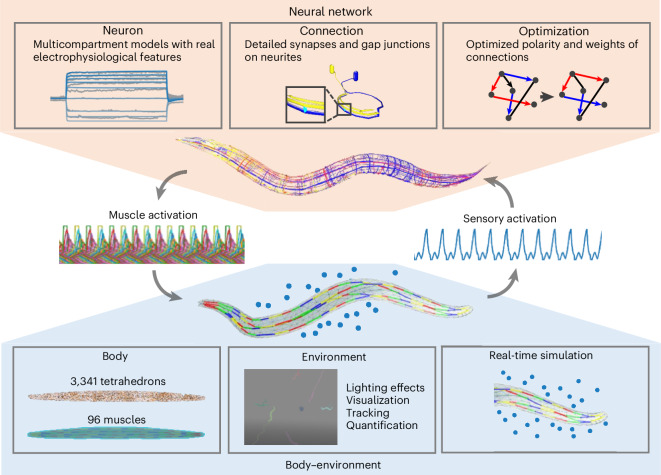
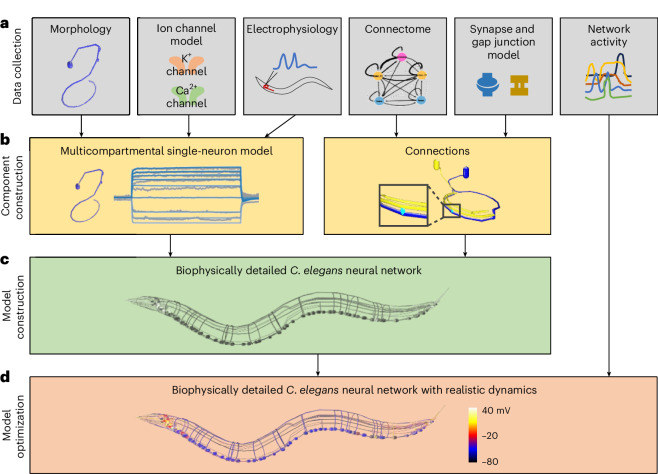
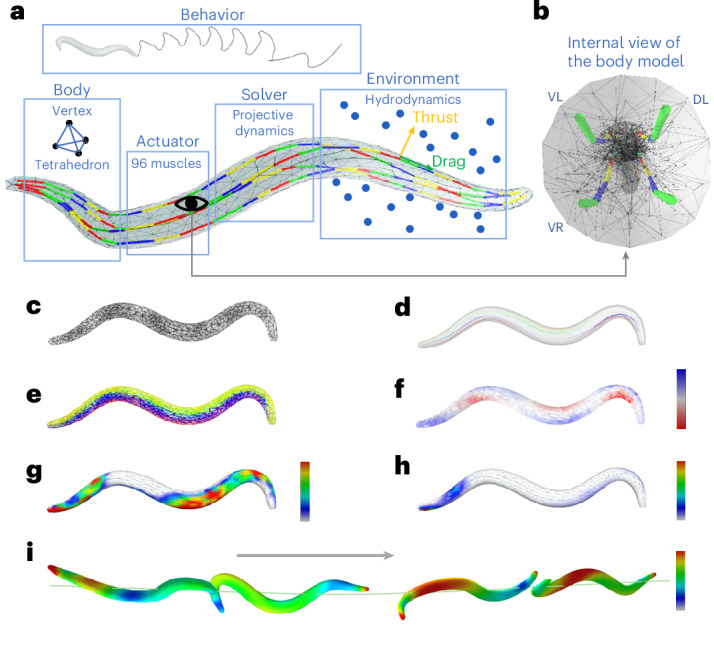
The behavior of an organism is influenced by the complex interplay between its brain, body and environment. Existing data-driven models focus on either the brain or the body–environment. Here we present BAAIWorm, an integrative data-driven model of Caenorhabditis elegans, which consists of two submodels: the brain model and the body–environment model. The brain model was built by multicompartment models with realistic morphology, connectome and neural population dynamics based on experimental data. Simultaneously, the body–environment model used a lifelike body and a three-dimensional physical environment. Through the closed-loop interaction between the two submodels, BAAIWorm reproduced the realistic zigzag movement toward attractors observed in C. elegans. Leveraging this model, we investigated the impact of neural system structure on both neural activities and behaviors. Consequently, BAAIWorm can enhance our understanding of how the brain controls the body to interact with its surrounding environment. BAAIWorm is an integrative data-driven model of C. elegans that simulates interactions between the brain, body and environment. The biophysically detailed neuronal model is capable of replicating the zigzag movement observed in this species.
Overview
The claims and statistics of this paper haven’t been checked yet.
Free: it reads the open-access text and checks the first 5 claims that cite a source we can check. Create a free account to check every claim.
Integrity signals
Registry
Cites
Statistics
Figures
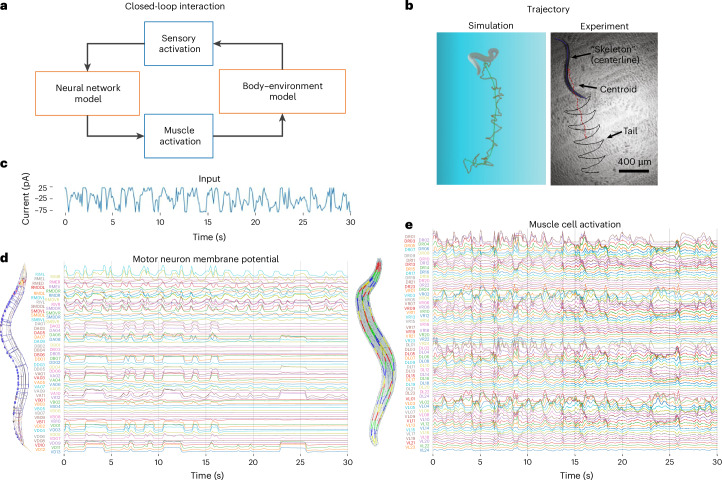
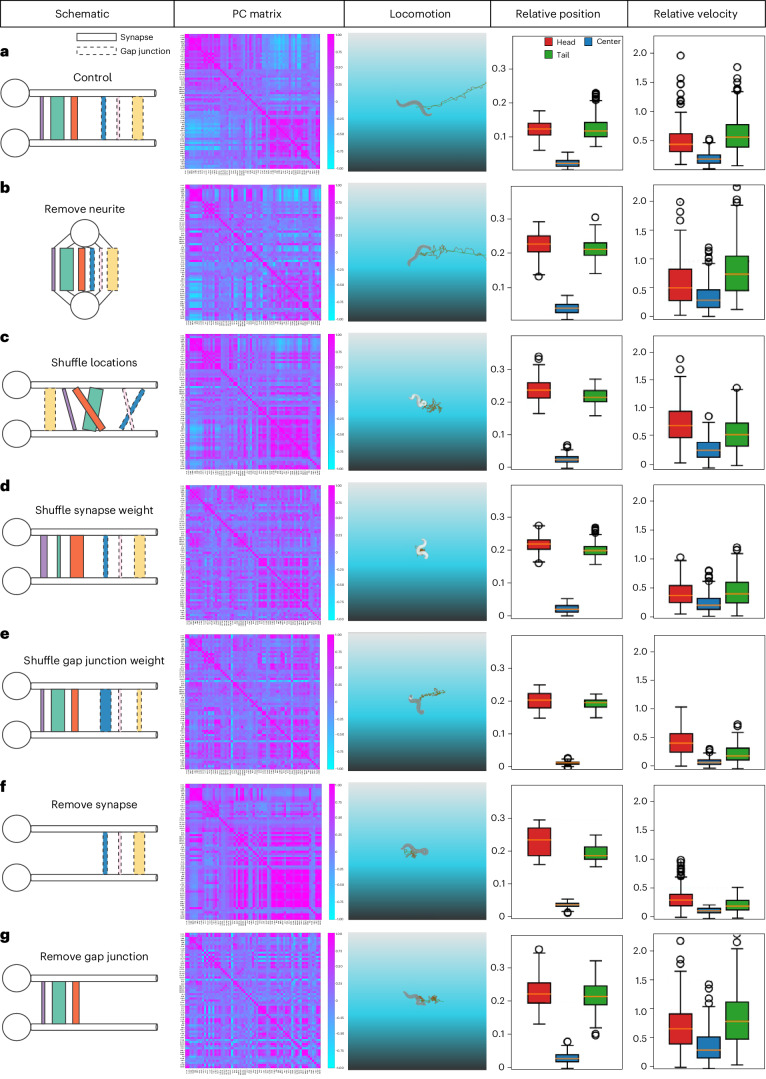
Verification
Claims the paper makes
The claims and statistics of this paper haven’t been checked yet.
Free: it reads the open-access text and checks the first 5 claims that cite a source we can check. Create a free account to check every claim.
Self-check
Percentages, sums and reported differences re-computed from the paper’s own numbers.
The self-check needs the paper’s full text.
Citations
Cites
Hodgkin, A. L., & Huxley, A. F. (1952) · The Journal of Physiology · doi:10.1113/jphysiol.1952.sp004764 · Cited by 23,191 · cited 1×
“Neurons were modeled by morphologically derived multicompartmental models with somatic Hodgkin–Huxley dynamics 58 and passive neurites.”
The Proceedings of the National Academy of Sciences
Richards, J. W. (1915) · Science · doi:10.1126/science.42.1074.161 · Cited by 13,983
The structure of the nervous system of the nematode Caenorhabditis elegans
White, J. G., Southgate, E., Thomson, J. N., & Brenner, S. (1986) · Philosophical Transactions of the Royal Society of London. B, Biological Sciences · doi:10.1098/rstb.1986.0056 · Cited by 5,589
OpenSim: Open-Source Software to Create and Analyze Dynamic Simulations of Movement
Delp, S. L., Anderson, F. C., Arnold, A. S., Loan, P., Habib, A., John, C. T., Guendelman, E., & Thelen, D. G. (2007) · IEEE Transactions on Biomedical Engineering · doi:10.1109/tbme.2007.901024 · Cited by 4,933 · cited 1×
“For example, OpenSim 49 aims to develop models of musculoskeletal structures and create dynamic simulations of movement in closed-loop style in three dimensions, but mainly for humans.”
Philosophical Transactions of the Royal Society B: biological sciences
(2026) · Philosophical Transactions of the Royal Society B Biological Sciences · doi:10.1098/rstb · Cited by 2,876
The NEURON Simulation Environment
Hines, M. L., & Carnevale, N. T. (1997) · Neural Computation · doi:10.1162/neco.1997.9.6.1179 · Cited by 2,658 · cited 1×
“The C. elegans neural network simulation and optimization were conducted with the code written in Python 3.8, and NEURON 8.0.0 was used as the simulation engine 63 .”
InfluentialReconstruction and Simulation of Neocortical Microcircuitry
Markram, H., Muller, E., Ramaswamy, S., Reimann, M. W., Abdellah, M., Sanchez, C. A., Ailamaki, A., Alonso-Nanclares, L., Antille, N., Arsever, S., et al. (2015) · Cell · doi:10.1016/j.cell.2015.09.029 · Cited by 1,557 · cited 1×
“…specific data-driven models that simulate either the brain, such as the mouse primary visual cortex 3 , the mouse striatum 4 and the rat somatosensory cortex 5 , or exclusively the body and environment to reproduce animal behaviors, such as neurome-chanical models for Drosophila 6 and rodents 7 .”
Influence of dendritic structure on firing pattern in model neocortical neurons
Mainen, Z. F., & Sejnowski, T. J. (1996) · Nature · doi:10.1038/382363a0 · Cited by 1,231 · cited 1×
“For connections, we first modeled gap junctions as simple ohmic resistances, and synapses as continuously transmitting synapse, according to published models 9,39–42 .”
Odorant-selective genes and neurons mediate olfaction in C. elegans
Bargmann, C. I., Hartwieg, E., & Horvitz, H. R. (1993) · Cell · doi:10.1016/0092-8674(93)80053-h · Cited by 1,225
Similar network activity from disparate circuit parameters
Prinz, A. A., Bucher, D., & Marder, E. (2004) · Nature Neuroscience · doi:10.1038/nn1352 · Cited by 1,091 · cited 1×
“Graded synapses, including excitatory and inhibitory synapses, were modeled according to published C. elegans models 9,40,41 .”
Research works printed but not linked: 2
- Sheng, K. et al. Domain adaptive neural inference for neurons, microcircuits and networks. Preprint at bioRxiv https://www. biorxiv.org/content/10.1101/2022.10.03.510694v1 (2022). · doi:10.1101/2022.10.03.510694v1
- Sheng, K. et al. Distilling multi-scale neural mechanisms from diverse unlabeled experimental data using deep domain-adaptive inference framework. Preprint at bioRxiv https://www.biorxiv.org/ content/10.1101/2022.10.03.510694v2 (2023). · doi:10.1101/2022.10.03.510694v2
Cited by
The locomotion of microorganisms in viscoelastic fluids at finite Reynolds numbers
Quan, Y., Zhang, M., Yu, Z., Lin, J., Xia, Y., & Lin, Z. (2025) · Journal of Fluid Mechanics · doi:10.1017/jfm.2025.10658 · Cited by 9
Microorganisms swimming in Giesekus viscoelastic fluids at finite Reynolds numbers
Quan, Y., Yu, Z., Lin, J., Ouyang, Z., Xia, Y., & Lin, Z. (2025) · Physics of Fluids · doi:10.1063/5.0281618 · Cited by 7
Wu, D., Wang, H., Ni, Y., Lu, Y., Wang, Y., Li, H., & Chen, L. (2025) · The Visual Computer · doi:10.1007/s00371-025-04000-w · Cited by 9
“Recent progress in deep learning, large-scale computational modeling, and interdisciplinary technological integration presents promising avenues for building comprehensive models of the brain and gut, such as the digital gut–brain axis [80].”
A data-driven biology-based network model reproduces C. elegans premotor neural dynamics
Morrison, M., & Young, L.-S. (2025) · PLoS Computational Biology · doi:10.1371/journal.pcbi.1013818 · Cited by 5
“A publication that appeared recently reproduces realistic C. elegans forward motion towards an attractor with a biomechanical body-environment model [25].”
InfluentialAI Alignment Versus AI Ethical Treatment: 10 Challenges
Bradley, A., & Saad, B. (2025) · Analytic Philosophy · doi:10.1111/phib.12380 · Cited by 7
Wang, J., Zhang, M., Wang, K., Kang, L., Feng, L., Pan, G., & Tang, H. (2025) · Neurocomputing · doi:10.1016/j.neucom.2025.130055 · Cited by 2
An Affective-Taxis Hypothesis for Alignment and Interpretability
Sennesh, E., & Ramstead, M. J. D. (2025) · Lecture notes in computer science · doi:10.1007/978-3-032-00800-8_17 · Cited by 2
Zhang, W.-Q., Li, X.-L., Xu, R., Li, Y.-L., Hu, P., Wong, K.-H., Lin, Z., Yang, Q.-Q., & Zhang, B. (2026) · Sleep Medicine Reviews · doi:10.1016/j.smrv.2026.102229 · Cited by 2
Liu, H., Zheng, P., & Wang, X. (2026) · Frontiers in Neural Circuits · doi:10.3389/fncir.2026.1731513 · Cited by 3
Reductionism in Engram Neuroscience
Mace, C., O'Sullivan, F., & Wilson, S. R. (2026) · European Journal of Neuroscience · doi:10.1111/ejn.70497 · Cited by 1
Building digital twin brains at the limits of measurement
Zhang, R., Hou, Y., Lu, W., & Feng, J. (2026) · Nature Reviews Electrical Engineering · doi:10.1038/s44287-026-00320-8 · Cited by 3
“For C. elegans , both the OpenWorm project 73 and BAAIWorm 74 demonstrate this principle.”
Growing neural networks: dynamic evolution through gradient descent
Radhakrishnan, A., Lindner, J. F., Miller, S. T., Sinha, S., & Ditto, W. L. (2025) · Proceedings of the Royal Society A Mathematical Physical and Engineering Sciences · doi:10.1098/rspa.2025.0222 · Cited by 3
Mining neural connectivity via spatiotemporal features of neural calcium activity data
Yuan, Y., Du, Y., Wen, W., Xin, K., Liu, H., Zhang, A., Yang, S., Li, Z., Fang, T., & Liu, J. (2025) · Expert Systems with Applications · doi:10.1016/j.eswa.2025.128871
Jenderny, S., Sacristán, D., Hövel, P., Albers, C., Beyer, I., & Ochs, K. (2025) · Neurocomputing · doi:10.1016/j.neucom.2025.131464
Moza, S., & Zhang, Y. (2025) · bioRxiv (Cold Spring Harbor Laboratory) · doi:10.1101/2025.11.03.683805 · Cited by 2
The embodied brain: Bridging the brain, body, and behavior with biorealistic neuromechanical models
Wang, S., & Ramdya, P. P. (2026) · Current Opinion in Neurobiology · doi:10.1016/j.conb.2026.103244 · Cited by 6
“Similarly, a combined brain-and-body model in the worm C. elegans has been used to simulate movements toward attractors using sensory feedback [2], consistent with experimentally observed behavior.”
Mi, Y., Sun, C., Du, L., Xu, X., & Zhao, J. (2026) · Optics Continuum · doi:10.1364/optcon.578400
Algorithmic Art and AI Development in China
Gao, D. (2026) · Springer eBooks · doi:10.1007/978-3-031-51703-7_306-1
Harnessing machine learning for decoding Caenorhabditis elegans behavior
Babu, K. R. (2026) · Machine Learning with Applications · doi:10.1016/j.mlwa.2026.100871
Evolutionary trajectory and development landscape of digital life
ZHANG, B.-W., Jiang, Y., ZHENG, S.-Y., Wang, Z., Lei, M. A., Kai-Yun, M. A. O., Xiong, Y., & Da-Ming, C. H. E. N. (2026) · Shengming kexue · doi:10.3724/cbls.2026034 · Cited by 1
Self-citationAdvances and trends in the bidirectional transformation between biological data and knowledge
Rong, L. I., Ge, J., ZHANG, X.-B., ZHANG, Y.-J., Da-Ming, C. H. E. N., & Tao, C. (2026) · Shengming kexue · doi:10.3724/cbls.2026032
Parametric 3D clothing generation: From sketch to dynamic fit
Zhou, Y., & Zhang, B. (2026) · Journal of Engineered Fibers and Fabrics · doi:10.1177/15589250261441600
Knowledge Graphs and AI: A Survey with a View Toward Hybrid Neuro-Symbolic Models
Joshi, N., Dhawan, D., Jadhav, S., Lakhe, A., & Vaishnav, S. (2026) · Lecture notes in networks and systems · doi:10.1007/978-3-032-20612-1_15
Zhao, M., Ma, X., Shi, W., & Sun, Y. (2026) · Life Sciences · doi:10.1016/j.lfs.2026.124600 · Cited by 1
Self-citationLiu, Q., & Mao, Q. (2026) · SSRN Electronic Journal · doi:10.2139/ssrn.7181303
Lattice representations suggest novel organizing principles for odorant and neural spaces
Reyner-Fuentes, E., Peláez-Moreno, C., & Valverde-Albacete, F. J. (2026) · Neural Networks · doi:10.1016/j.neunet.2026.109471
Uddin, L. Q. (2026) · Physics of Life Reviews · doi:10.1016/j.plrev.2026.08.003
A structured framework for human–AI resemblance: Evidence, inference and perception
Wang, P., Law, E. L., Zou, L., Jiang, Y., Hertwig, R., PAAS, F. G. W. C., & Laureys, S. (2026) · Physics of Life Reviews · doi:10.1016/j.plrev.2026.09.003
A gating-based optimization model reveals multisensory circuit modulation in Caenorhabditis elegansPreprint
Wang, J., Zhang, M., Feng, L., Yan, R., Pan, G., Gu, S., & Tang, H. (2026) · SSRN Electronic Journal · doi:10.2139/ssrn.7629591
Metadata
- Authors
- Zhao, M., Wang, N., Jiang, X., Ma, X., Ma, H., He, G., Du, K., Ma, L., & Huang, T.
- Affiliations
- Beijing Academy of Artificial Intelligence (CN)
- Peking University (CN)
- Venue
- Nature Computational Science
- Published
- 2024-12-16
- Volume
- 4
- Issue
- 12
- Pages
- 978-990
- ISSN
- 2662-8457 (ISSN-L)
- PMC
- PMC11659166
- OpenAlex
- W4405419531
- Cited by
- 29
- References
- 72
- Citations by year
- 2026: 18 · 2025: 11
- FWCI
- 7.03
- Type
- journal article
- Language
- en
- Open access
- hybrid
- doi.org
- Licence
- cc-by-nc-nd
- creativecommons.org/licenses/by-nc-nd/4.0 (tdm)
- creativecommons.org/licenses/by-nc-nd/4.0 (vor)
- Locations
- Nature Computational Science (publishedVersion, cc-by-nc-nd)
- Research Square (acceptedVersion, cc-by)
- PubMed Central (publishedVersion, cc-by-nc-nd)
- PubMed (publishedVersion)
- Topics
- Life Sciences › Neuroscience › Cognitive Neuroscience › Neural dynamics and brain function
- Life Sciences › Neuroscience › Cellular and Molecular Neuroscience › Neurobiology and Insect Physiology Research
- Social Sciences › Education › Undergraduate Neuroscience Education and Research
- Keywords
- Caenorhabditis elegans, brain-body-environment interaction, connectome, multicompartment neuron models, neural population dynamics, attractor behavior, closed-loop simulation, locomotor activity
- MeSH terms
- Animals, Behavior, Animal, Brain, Computer Simulation, Environment, Models, Neurological, Caenorhabditis elegans, Connectome
About these checks
Registry, retraction, Cites and statistics results are computed, not judged, with one exception: a printed reference that no index lists is read once by a model before it counts as a citation error. Claims are extracted by a model and kept only when their quote appears verbatim in the text; each cited source is then checked, with a model’s help, for whether it says what the claim relies on. Those verdicts can be wrong — read the claim’s quote and the cited source before relying on one.
Statistics and arithmetic are recomputed, not judged.
Confidence bands are shown only for fields calibrated on our annotated test set. None is calibrated yet, so no band is shown.
What counts as a claim ›How we measure confidence ›How we check this ›
Are you an author, or do you see a problem with this page? Request a review
Data sources
Bibliographic data: Semantic Scholar, OpenAlex, Crossref.
Contains information from the Semantic Scholar Academic Graph Datasets, made available under the ODC Attribution License (ODC-BY 1.0).
Semantic Scholar’s data is described in: Kinney, R., et al. (2023). The Semantic Scholar Open Data Platform. arXiv:2301.10140.
