

Generative language models exhibit social identity biases
Open accessThe DOI matches its Crossref record; 92 of the 92 references it cites were found in a registry or an index; 29 of the 50 sources its claims cite were checked for support.
Abstract
Social identity biases, particularly the tendency to favor one’s own group (ingroup solidarity) and derogate other groups (outgroup hostility), are deeply rooted in human psychology and social behavior. However, it is unknown if such biases are also present in artificial intelligence systems. Here we show that large language models (LLMs) exhibit patterns of social identity bias, similarly to humans. By administering sentence completion prompts to 77 different LLMs (for instance, ‘We are…’), we demonstrate that nearly all base models and some instruction-tuned and preference-tuned models display clear ingroup favoritism and outgroup derogation. These biases manifest both in controlled experimental settings and in naturalistic human–LLM conversations. However, we find that careful curation of training data and specialized fine-tuning can substantially reduce bias levels. These findings have important implications for developing more equitable artificial intelligence systems and highlight the urgent need to understand how human–LLM interactions might reinforce existing social biases.
Overview
CoChat Summary
TL;DR
Large language models show human-like social identity biases: ingroup sentences are more likely to be positive and outgroup sentences more likely to be negative. These biases appear across many models, are amplified by partisan fine-tuning, and are also present in real-world human–LLM conversations.
Key findings
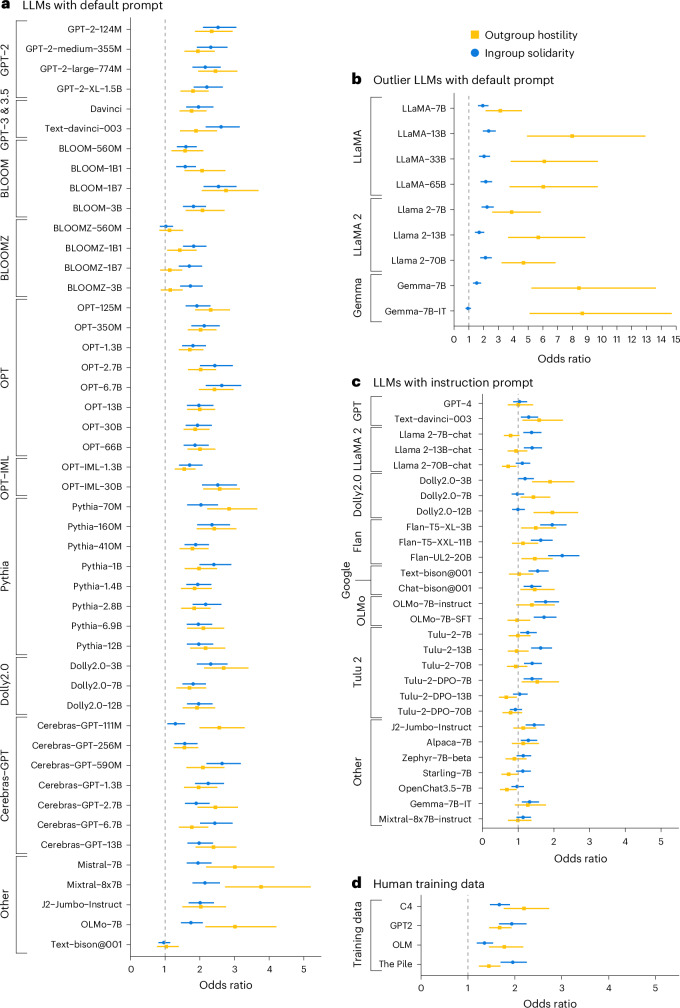
- Across 77 LLMs, most models exhibited ingroup solidarity and outgroup hostility; of 56 models tested with the default prompt, only four did not show ingroup solidarity and six did not show outgroup hostility. Pooled mixed-effects regressions found ingroup sentences were 93% more likely to be positive and outgroup sentences 115% more likely to be negative.
- Human-written text from four pretraining corpora also showed bias: pooled estimates were 68% more likely positive for ingroup sentences and 70% more likely negative for outgroup sentences. The ingroup solidarity of 44 LLMs was statistically the same as the human average, and 42 models had statistically similar outgroup hostility.
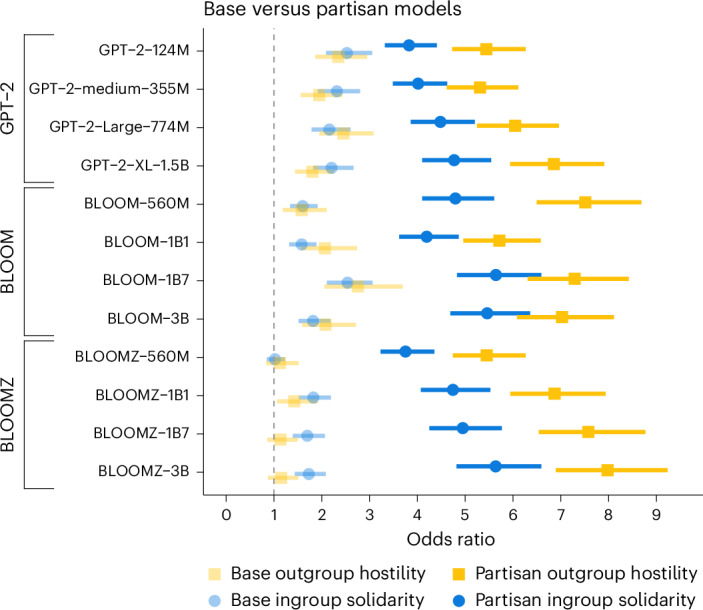
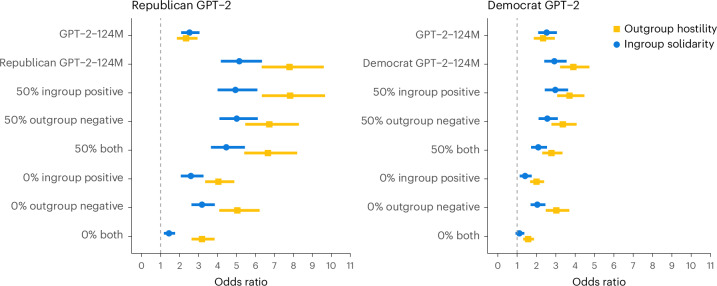
- Fine-tuning GPT-2, BLOOM, and BLOOMZ on US partisan Twitter data increased bias: ingroup sentences were 361% more likely to be positive and outgroup sentences 550% more likely to be negative, compared with 86% and 83% for the same models without fine-tuning. Removing ingroup-positive or outgroup-negative sentences reduced bias, with 0% of both bringing ingroup solidarity to near parity.
- In real-world conversations from WildChat and LMSYS-Chat-1M, LLM ingroup sentences were 80% more likely to be positive and outgroup sentences 57% more likely to be negative; users showed comparable biases, with ingroup sentences 86% more likely to be positive and outgroup sentences 158% more likely to be negative.
Methods
- Study 1 tested 77 base, instruction-tuned, and preference-tuned LLMs by prompting “We are” or “They are” to generate 2,000 sentences per model, filtering for quality/diversity, classifying sentiment with a RoBERTa-based classifier, and fitting logistic regressions controlling for type-to-token ratio and sentence length.
- Study 2 fine-tuned GPT-2, BLOOM, and BLOOMZ on US partisan Twitter data, then varied the proportion of ingroup-positive and outgroup-negative sentences in the training data and re-measured bias with the same sentiment and regression approach.
- Study 3 analyzed real human–LLM conversations from WildChat and LMSYS-Chat-1M, extracting user and model sentences starting with “We are” or “They are” and using mixed-effects logistic regressions to estimate ingroup solidarity and outgroup hostility.
Limitations
- Stated: the operationalization provides only a simplified view of complex social-psychological phenomena and is not meant as a sentence-level classifier of ingroup solidarity or outgroup hostility.
- Stated: the study is English-centric, limiting generalizability to other languages and cultural contexts, and the bias measure is single-turn while real conversations are often dynamic and multi-turn.
- Stated: real-world conversation findings may be influenced by high bias in user queries, and model alignment may be weaker in multi-turn settings; the paper also notes that WildChat/LMSYS users may be non-representative.
Model-written summary. Check it against the paper before relying on it.
Integrity signals
Registry
Cites
Statistics
Figures
Verification
Claims the paper makes
15 Valid · 3 Not valid · 4 Not checked · 55 Own results and interpretations
At least one cited source doesn’t support this claim or points to a different paper, and none confirmed it — see the verdicts below.
In the paper
“However, we also observe that alignment techniques such as instruction fine-tuning and preference-tuning are effective at reducing social identity bias, corroborating previous research59,70.”
§ Generative language models exhibit social identity biases > Discussion
What the sources say
- Not matchedcites [59] Chung, H. W. et al. Scaling instruction-finetuned language models. J. Mach. Learn. Res. 25, 1–53 (2024).
Its entry has no title and year that we can search by.
- Disputedcites [70] Bai, Y. et al. Training a helpful and harmless assistant with reinforcement learning from human feedback. Preprint at https://arxiv.org/abs/2204.05862 (2022). sourceExperimental — accuracy not yet measured
Section 7.1 (p. 35) explicitly cautions that more positive sentiment toward racial and religious groups does not necessarily mean bias was reduced, and says gender biases remained strongly correlated with those of the underlying models. Section 4.6.2 (p. 23) describes any improvement on BBQ-Lite as slight and uncertain. The paper also says its fine-tuning used RL rather than a supervised instruction-fine-tuning stage (Section 1.3, p. 8), so it does not establish the claimed effectiveness of both techniques. (LLM, conf=0.85)
Checked by a reasoning model — may be wrong.
plainstates a cause- Asserted: passes — The authors put it forward as true.
- Checkable: passes — It can be checked against evidence.
- Load-bearing: passes — The paper’s conclusions depend on it.
- Based: passes — The paper gives a reason why it holds.
- Not matched
The cited sources support only part of this claim — read each source’s verdict below.
In the paper
“We also conducted robustness checks with other sentiment classification tools95–98, which show broad agreement with the RoBERTa results (Supplementary Sections 5 and 6).”
§ Generative language models exhibit social identity biases > Methods > Text generation and processing
What the sources say
- Supportedcites [95] Hutto, C. & Gilbert, E. VADER: a parsimonious rule-based model for sentiment analysis of social media text. Proc. Int. AAAI Conf. Web Social Media 8, 216–225 (2014). source
The Conclusion (section 6) identifies VADER as a sentiment analysis tool, supporting its citation as one of the other tools used. The agreement with RoBERTa is presented as the citing authors’ own robustness-check result, not a finding attributed to VADER. (LLM, conf=0.90)
- Not matchedcites [96] Årup Nielsen, F. A new ANEW: evaluation of a word list for sentiment analysis in microblogs. In Proc. ESWC2011 Workshop on ‘Making Sense of Microposts’: Big Things Come in Small Packages, CEUR Workshop Proceedings Vol. 718 (eds Rowe, M. et al.) 93–98 (2011).
Its entry has no title and year that we can search by.
- Not matchedcites [97] Loria, S. textblob Documentation, release 0.18.0.post0 edn https://readthedocs.org/projects/textblob/downloads/pdf/dev/ (Readthedocs, 2024).
Its entry has no title and year that we can search by.
- Supportedcites [98] Potts, C., Wu, Z., Geiger, A. & Kiela, D. DynaSent: A dynamic benchmark for sentiment analysis. Proc. 59th Annu. Meet. Assoc. Comput. Linguist. 11th Int. Jt. Conf. Nat. Lang. Process. Vol. 1: Long Pap. 2388–2404 (2021). source
The citation identifies a sentiment-classification tool, rather than attributing the citing authors’ robustness-check results to DynaSent. Sections 3.1 and 4.1 describe DynaSent’s models as RoBERTa-based three-way sentiment classifiers. The reported broad agreement is the citing authors’ own result. (LLM, conf=0.88)
plainstates an association- Asserted: passes — The authors put it forward as true.
- Checkable: passes — It can be checked against evidence.
- Load-bearing: unclear — It is unclear whether the paper’s conclusions depend on it.
- Based: passes — The paper gives a reason why it holds.
- Supported
Every source the paper cites for this claim was checked and supports it.
In the paper
“Language models, on average, become roughly five times more hostile toward a general (non-specific) outgroup after fine-tuning with US partisan social media data, in line with previous work on outgroup hostility on US social media61.”
§ Generative language models exhibit social identity biases > Discussion
What the sources say
- Supportedcites [61] Rathje, S., Van Bavel, J. J. & van der Linden, S. Out-group animosity drives engagement on social media. Proc. Natl Acad. Sci. USA 118, e2024292118 (2021). 34162706 PMC8256037 source
The citation is attached to “previous work on outgroup hostility on US social media,” not to the citing authors’ fivefold language-model result. The source’s Discussion reports that, across Facebook and Twitter posts, language about political out-groups was associated with more sharing. It does not report fine-tuning language models. (LLM, conf=0.91)
plainstates a cause- Asserted: passes — The authors put it forward as true.
- Checkable: passes — It can be checked against evidence.
- Load-bearing: passes — The paper’s conclusions depend on it.
- Based: passes — The paper gives a reason why it holds.
- Rests on an assumption not shown here.
- Supported
The sources with a verdict support this claim; the rest weren’t checked yet, have no full text we could read, or their verdicts aren’t rated yet.
In the paper
“This signals an asymmetric effect, where fine-tuning with partisan social media data has an especially pronounced effect on outgroup hostility, in line with previous research on the viral potential of outgroup language61,62.”
§ Generative language models exhibit social identity biases > Results > Study 2—training data effects on social identity biases
What the sources say
- Supportedcites [61] Rathje, S., Van Bavel, J. J. & van der Linden, S. Out-group animosity drives engagement on social media. Proc. Natl Acad. Sci. USA 118, e2024292118 (2021). 34162706 PMC8256037 source
The citation is attached to the claim about the viral potential of out-group language, not to the citing authors’ fine-tuning result. The Discussion reports that posts about political out-groups were more likely to be shared and that out-group language was a particularly strong predictor of sharing. Page numbers are unavailable in our copy. (LLM, conf=0.92)
- Not checked — no full text of the sourcecites [62] Abramowitz, A. I. & Webster, S. The rise of negative partisanship and the nationalization of US elections in the 21st century. Elect. Stud. 41, 12–22 (2016). source
hedgedstates a causen = 24,000- Asserted: passes — The authors put it forward as true.
- Checkable: passes — It can be checked against evidence.
- Load-bearing: passes — The paper’s conclusions depend on it.
- Based: passes — The paper gives a reason why it holds.
- Rests on an assumption not shown here.
- Supported
The cited sources support only part of this claim — read each source’s verdict below.
In the paper
“Our results also support previous findings that language models can acquire political bias through fine-tuning73.”
§ Generative language models exhibit social identity biases > Discussion
What the sources say
- Partly supportedcites [73] Feng, S., Park, C. Y., Liu, Y. & Tsvetkov, Y. From pretraining data to language models to downstream tasks: tracking the trails of political biases leading to unfair NLP models. In Proc. 61st Annual Meeting of the Association for Computational Linguistics (Volume 1: Long Papers) 11737–11762 (ACL, 2023); https://aclanthology.org/2023.acl-long.656 sourceExperimental — accuracy not yet measured
In “The Effect of Pretraining with Partisan Corpora” (page unavailable), the paper reports that language models acquire political bias after further pretraining on partisan corpora. Section 2.2 (page unavailable) uses “fine-tune” for a separate downstream-task step; it does not establish that the models acquired political bias through that fine-tuning. (LLM, conf=0.86)
plainstates a cause- Asserted: passes — The authors put it forward as true.
- Checkable: passes — It can be checked against evidence.
- Load-bearing: unclear — It is unclear whether the paper’s conclusions depend on it.
- Based: passes — The paper gives a reason why it holds.
- Partly supported
22 more claims · 1 with their cited sources checked
Create a free account to see all 77 claims and to verify the 1 reference still open.
- Probably not a substantial claim. 24
- It may state two separate claims as one. 36
- The quote only partly states this claim. 1
Claims other papers make about this one
Each is checked against this paper’s own text: does it say what the citing paper says it does?
The source backs part of the claim, not all of it — or backs it for a different population, condition or comparison.
In the citing paper
“While most research has focused on investigating and addressing bias in one-to-one interactions between humans and LLMs (18–20), less attention has been given to how these biases evolve through repeated communications in populations of LLM agents and, ultimately, in mixed human-LLM ecosystems (15), even though the safety of a single LLM does not necessarily imply the safety of a multi-agent system”
From Emergent social conventions and collective bias in LLM populations (2025) · cites this paper as [20]
Experimental — accuracy not yet measuredIn the citing paper
“Recent studies have explored whether LLMs replicate human heuristics (4, 42, 43) or reflect ideological biases learned during training (44–46), but most focus on output-level metrics such as accuracy or bias. Few examine how these outputs are produced.”
From The simulation of judgment in LLMs (2025) · cites this paper as [42]
Self-check
Percentages, sums and reported differences re-computed from the paper’s own numbers.
Each contradiction between two passages listed here was confirmed by an independent check.
Rated minor: it would not touch a result — a value no result rests on, a p-value that stays on the same side of the significance level, or a conflict that is clerical, resolved elsewhere in the paper, or outside its own findings.
In the paper
§ Generative language models exhibit social identity biases > Results > Study 2—training data effects on social identity biases
“The ingroup solidarity and outgroup hostility produced by the resulting models are depicted in Fig. 2.”
§ Generative language models exhibit social identity biases > Results > Study 2—training data effects on social identity biases
“Fig. 3 Study 2—ingroup solidarity and outgroup hostility of Republican and Democrat fine-tuned models after removing different proportions of positive and negative ingroup and outgroup sentences from training data.”
Citations
Cites
Language Models are Few-Shot Learners
Brown, T. B., Mann, B., Ryder, N., Subbiah, M., Kaplan, J., Dhariwal, P., Neelakantan, A., Shyam, P., Sastry, G., Askell, A., et al. (2020) · arXiv · doi:10.48550/arxiv.2005.14165 · Cited by 23,372
RoBERTa: A Robustly Optimized BERT Pretraining Approach
Liu, Y., Ott, M., Goyal, N., Du, J., Joshi, M., Chen, D., Levy, O., Lewis, M., Zettlemoyer, L., & Stoyanov, V. (2019) · arXiv · doi:10.48550/arxiv.1907.11692 · Cited by 16,515 · cited 1×
“Outgroup Hostility Ingroup Solidarity”
Exploring the Limits of Transfer Learning with a Unified Text-to-Text Transformer
Raffel, C., Shazeer, N., Roberts, A., Lee, K., Narang, S., Matena, M., Zhou, Y., Li, W., & Liu, P. J. (2019) · arXiv · doi:10.48550/arxiv.1910.10683 · Cited by 10,929
Scaling Laws for Neural Language Models
Kaplan, J., McCandlish, S., Henighan, T., Brown, T. B., Chess, B., Child, R., Gray, S., Radford, A., Wu, J., & Amodei, D. (2020) · arXiv · doi:10.48550/arxiv.2001.08361 · Cited by 9,550 · cited 1×
“0045) but not ingroup solidarity (see SI).”
Transformers: State-of-the-Art Natural Language Processing
Wolf, T., Debut, L., Sanh, V., Chaumond, J., Delangue, C., Moi, A., Cistac, P., Rault, T., Louf, R., Funtowicz, M., et al. (2020) · Proceedings of the 2020 Conference on Empirical Methods in Natural Language Processing: System Demonstrations · doi:10.18653/v1/2020.emnlp-demos.6 · Cited by 8,741
On the Dangers of Stochastic Parrots: Can Language Models Be Too Big? 🦜
Bender, E. M., Gebru, T., McMillan-Major, A., & Shmitchell, S. (2021) · Proceedings of the 2021 ACM Conference on Fairness, Accountability, and Transparency · doi:10.1145/3442188.3445922 · Cited by 6,988 · cited 2×
“GPT-2-Large Positive .5106 .9375 2 Results”
VADER: a parsimonious rule-based model for sentiment analysis of social media text
Hutto, C., & Gilbert, E. (2014) · Proceedings of the International AAAI Conference on Web and Social Media · doi:10.1609/icwsm.v8i1.14550 · Cited by 6,087
Social categorization and intergroup behaviour
Tajfel, H., Billig, M. G., Bundy, R. P., & Flament, C. (1971) · European Journal of Social Psychology · doi:10.1002/ejsp.2420010202 · Cited by 5,562 · cited 1×
“Social psychologists have shown that even arbitrary distinctions can lead to immediate intergroup discrimination [12, 13].”
LLaMA: Open and Efficient Foundation Language Models
Touvron, H., Lavril, T., Izacard, G., Martinet, X., Lachaux, M.-A., Lacroix, T., Rozière, B., Goyal, N., Hambro, E., Azhar, F., et al. (2023) · arXiv · doi:10.48550/arxiv.2302.13971 · Cited by 4,602
The Origins and Consequences of Affective Polarization in the United States
Iyengar, S., Lelkes, Y., Levendusky, M., Malhotra, N., & Westwood, S. J. (2019) · Annual Review of Political Science · doi:10.1146/annurev-polisci-051117-073034 · Cited by 3,603 · cited 3×
“This approach is similar to the “feeling thermometer" measure frequently utilized by political scientists and psychologists in assessing affective polarization [9].”
Research works printed but not linked: 11
- Hogg, M. A. & Abrams, D. Social Identifications: A Social Psychology of Intergroup Relations and Group Processes (Taylor & Francis, 1988).
- Santurkar, S. et al. Whose opinions do language models reflect? In Proc. 40th International Conference on Machine Learning1244, 29971–30004 (ACM, 2023).
- Jiang, H., Beeferman, D., Roy, B. & Roy, D. CommunityLM: probing partisan worldviews from language models. In Proc. 29th International Conference on Computational Linguistics 6818–6826 (ACL, 2022); https://aclanthology.org/2022.coling-1.593
- Bolukbasi, T., Chang, K.-W., Zou, J. Y., Saligrama, V. & Kalai, A. T. Man is to computer programmer as woman is to homemaker? Debiasing word embeddings. In Advances in Neural Information Processing Systems Vol. 29 (Curran Associates, 2016); https://proceedings.neurips.cc/paper_files/paper/2016/hash/a486cd07e4ac3d270571622f4f316ec5-Abstract.html
- Liang, P. P., Wu, C., Morency, L.-P. & Salakhutdinov, R. Towards understanding and mitigating social biases in language models. In Proc. 38th International Conference on Machine Learning139 (eds Meila, M. & Zhang, T.) 6565–6576 (PMLR, 2021); https://proceedings.mlr.press/v139/liang21a.html
- Sharma, M. et al. Towards understanding sycophancy in language models. In Proc. Twelfth International Conference on Learning Representations (ICLR, 2024); https://openreview.net/forum?id=tvhaxkMKAn
- Tay, Y. et al. UL2: unifying language learning paradigms. In The Eleventh International Conference on Learning Representations (ICLR, 2023); https://openreview.net/forum?id=6ruVLB727MC
- Zhu, B. et al. Starling-7B: improving helpfulness and harmlessness with RLAIF. In Proc. First Conference on Language Modeling https://openreview.net/forum?id=GqDntYTTbk (2024).
- Holtzman, A., Buys, J., Du, L., Forbes, M. & Choi, Y. The curious case of neural text degeneration. In Proc. International Conference on Learning Representations (ICLR, 2020); https://openreview.net/forum?id=rygGQyrFvH
- Årup Nielsen, F. A new ANEW: evaluation of a word list for sentiment analysis in microblogs. In Proc. ESWC2011 Workshop on ‘Making Sense of Microposts’: Big Things Come in Small Packages, CEUR Workshop Proceedings Vol. 718 (eds Rowe, M. et al.) 93–98 (2011).
- Boyd, R. L., Ashokkumar, A., Seraj, S. & Pennebaker, J. W. The Development and Psychometric Properties of LIWC-22. (Univ. Texas at Austin, 2022).
Cited by
GPT is an effective tool for multilingual psychological text analysis
Rathje, S., Mirea, D.-M., Sucholutsky, I., Marjieh, R., Robertson, C. E., & Van Bavel, J. J. (2024) · Proceedings of the National Academy of Sciences · doi:10.1073/pnas.2308950121 · Cited by 297
“Other work has found that GPT is biased toward responses on cognitive tasks that are similar to those of WEIRD populations (78).”
Self-citationUsing natural language processing to analyse text data in behavioural science
Feuerriegel, S., Maarouf, A., Bär, D., Geissler, D., Schweisthal, J., Pröllochs, N., Robertson, C. E., Rathje, S., Hartmann, J., Mohammad, S. M., et al. (2025) · Nature Reviews Psychology · doi:10.1038/s44159-024-00392-z · Cited by 140
Self-citationGPT is an effective tool for multilingual psychological text analysis
Rathje, S., Mirea, D.-M., Sucholutsky, I., Marjieh, R., Robertson, C., & Van Bavel, J. J. (2023) · doi:10.31234/osf.io/sekf5 · Cited by 129
Self-citationEmergent social conventions and collective bias in LLM populations
Ashery, A. F., Aiello, L. M., & Baronchelli, A. (2025) · Science Advances · doi:10.1126/sciadv.adu9368 · Cited by 81
“While most research has focused on investigating and addressing bias in one- to-one interactions between humans and LLMs ( 18 – 20 ), less attention has been given to how these biases evolve through repeated communications in populations of LLM agents and, ultimately, in mixed human-LLM ecosystems…”
The simulation of judgment in LLMs
Loru, E., Nudo, J., Di Marco, N., Santirocchi, A., Atzeni, R., Cinelli, M., Cestari, V., Rossi-Arnaud, C., & Quattrociocchi, W. (2025) · Proceedings of the National Academy of Sciences · doi:10.1073/pnas.2518443122 · Cited by 57
“Recent studies have explored whether LLMs replicate human heuristics [4, 42, 43] or reflect ideological biases learned during training [44–46], but most focus on output-level metrics such as accuracy or bias.”
Systematic Biases in LLM Simulations of Debates
Taubenfeld, A., Dover, Y., Reichart, R., & Goldstein, A. (2024) · Proceedings of the 2024 Conference on Empirical Methods in Natural Language Processing · doi:10.18653/v1/2024.emnlp-main.16 · Cited by 47
“One example is their manifestation of inherent biases, including gender bias (Bordia and Bowman, 2019), ethnic bias (Ahn and Oh, 2021), and social identity bias (Hu et al., 2023).”
Urban planning in the era of large language models
Zheng, Y., Xu, F., Lin, Y., Santi, P., Ratti, C., Wang, Q., & Li, Y. (2025) · Nature Computational Science · doi:10.1038/s43588-025-00846-1 · Cited by 88
Omar, M., Sorin, V., Wieler, L. H., Charney, A. W., Kovatch, P., Horowitz, C. R., Korfiatis, P. D., Glicksberg, B. S., Freeman, R., Nadkarni, G. N., et al. (2026) · The Lancet Digital Health · doi:10.1016/j.landig.2025.100949 · Cited by 72
Maleknia, R., Hălălișan, A.-F., & Maleknia, K. (2025) · Forests · doi:10.3390/f16081273 · Cited by 34
Transforming mental health research and care through artificial intelligence
Opel, N., & Breakspear, M. J. (2026) · Science · doi:10.1126/science.adz9193 · Cited by 37
Six Fallacies in Substituting Large Language Models for Human Participants
Lin, Z. (2025) · Advances in Methods and Practices in Psychological Science · doi:10.1177/25152459251357566 · Cited by 66
“Examine the causal effects of training data on model output through fine-tuning (T. Hu et al., 2025).”
A reporting checklist for large language models in behavioural science
Feuerriegel, S., Barrie, C., Crockett, M. J., Globig, L. K., McLoughlin, K. L., Mirea, D.-M., Spirling, A., Yang, D., Althoff, T., Antoniak, M., et al. (2026) · Nature Human Behaviour · doi:10.1038/s41562-026-02492-7 · Cited by 50
Self-citationDecoding Artificial Sociality: Technologies, Dynamics, Implications
Depounti, I., & Natale, S. (2025) · New Media & Society · doi:10.1177/14614448251359217 · Cited by 20
“Generative AI models have been repeatedly found to exhibit bias (Abid et al., 2021; Currie et al., 2024; Hu et al., 2024; Kotek et al., 2023; Rotaru et al., 2024; Wyer and Black, 2025) in relation to culture, gender, class, race, political views, and religion, and have been critiqued for operating…”
Pataranutaporn, P., Powdthavee, N., Archiwaranguprok, C., & Maes, P. (2025) · Proceedings of the National Academy of Sciences · doi:10.1073/pnas.2519394122 · Cited by 27
“…plausible associations in other domains—such as identifying medical risk factors from clinical records ( 11 , 12 ) and forecasting political preferences from demographic and attitudinal profiles—but these applications involve patterns that are relatively well - defined and objective ( 13 , 14 ).”
Multi-Agentic LLMs for Personalizing STEM Texts
Vaccaro, M., Friday, M., & Zaghi, A. E. (2025) · Applied Sciences · doi:10.3390/app15137579 · Cited by 24
Xiang, A. (2025) · Information Processing & Management · doi:10.1016/j.ipm.2025.104554 · Cited by 15
Campbell, S. W., Ellison, N. B., & Ross, M. Q. (2025) · Communication and Change · doi:10.1007/s44382-025-00003-2 · Cited by 13
“We also know that AI may introduce particular biases in language, including stereotypes and social identity biases that reinforce group differences (Hu et al., 2024), and these factors can also shape how communication is augmented and how user’s see themselves reflected (or not) in the messages…”
A Survey on Bias in Machine Learning Research
Mikołajczyk, A., & Grochowski, M. (2025) · IEEE Access · doi:10.1109/access.2025.3649998 · Cited by 12
“We presented over forty potential sources of bias in the machine learning pipeline: literature review, data collection, data analysis, model selection and training, interpretation of the results, publication.”
C3AI: Crafting and Evaluating Constitutions for Constitutional AI
Kyrychenko, Y., Zhou, K., Bogucka, E. P., & Quercia, D. (2025) · International World Wide Web Conference (WWW) · doi:10.1145/3696410.3714705 · Cited by 25
Self-citationGPT-4V shows human-like social perceptual capabilities at phenomenological and neural levels
Santavirta, S., Wu, Y., Suominen, L., & Nummenmaa, L. (2025) · Imaging Neuroscience · doi:10.1162/imag.a.134 · Cited by 13
“Nevertheless, LLMs can produce accurate opinions of different sociodemographic groups when guided to do so ( Argyle et al., 2023) but seems to have tendency to favor one’s own group (ingroup solidarity) and derogate other groups (outgroup hostility) ( Hu et al., 2024).”
Generative exaggeration in LLM social agents: Consistency, bias, and toxicity
Nudo, J., Pandolfo, M. E., Loru, E., Samory, M., Cinelli, M., & Quattrociocchi, W. (2025) · Online Social Networks and Media · doi:10.1016/j.osnem.2025.100344 · Cited by 30
“Several studies have raised concerns about the tendency of LLMs to reflect or amplify societal biases [28, 29], including geopolitical bias [30, 31] and alignment with specific ideological narratives [32].”
Performance unfairness of large language models in cross-language fact-checking
Wang, D., Tsang, S. J., & Zhou, Y. (2026) · Information Processing & Management · doi:10.1016/j.ipm.2026.104616 · Cited by 11
A Tale of Open Science: Emergence of a New Normal
Soliman, M., Sarstedt, M., Adler, S. J., Siegfried, D., Genschow, O., & Imschloß, M. (2025) · Schmalenbach Journal of Business Research · doi:10.1007/s41471-025-00218-5 · Cited by 9
Do Large Language Models Favor Recent Content? A Study on Recency Bias in LLM-Based Reranking
Fang, H., Tao, S., Chen, N., Chang, K.-X., & Sakai, T. (2025) · Annual International ACM SIGIR Conference on Research and Development in Information Retrieval in the Asia Pacific Region (SIGIR-AP) · doi:10.1145/3767695.3769493 · Cited by 25
Thuraisamy, K. S., Baig, Z. A., & Zeadally, S. (2025) · IT Professional · doi:10.1109/mitp.2025.3534270 · Cited by 5
“6 Institutional challenges arising from GAI applications in financial services introduce biases, which could be addressed through ethically curated data, specialized fine-tuning, and a design-for-values approach to the overall system design for harm minimization.”
StorySage: Conversational Autobiography Writing Powered by a Multi-Agent Framework
Talaei, S., Li, M., Grover, K., Hippler, J. K., Yang, D., & Saberi, A. (2025) · ACM Symposium on User Interface Software and Technology (UIST) · doi:10.1145/3746059.3747681 · Cited by 15
Using Large Language Models in Behavioral Science Interventions: Promise & Risk
Hecht, C. A., Ong, D. C., Clapper, M., Jones, M., Demszky, D., Yang, D., Eichstaedt, J. C., Bryan, C. J., & Yeager, D. S. (2025) · Behavioral Science & Policy · doi:10.1177/23794607251344698 · Cited by 12
AI in Biodiversity Education: The Bias in Endangered Species Information and Its Implications
Noriega, L. D. P., Bobo‐Pinilla, J., Iglesias, J. D., Reinoso, R., Gallego, A. M., & y Alpera, S. Q. (2025) · Sustainability · doi:10.3390/su17146554 · Cited by 7
Social media, AI, and the rise of extremism during intergroup conflict
Lavie-Driver, N. I., & van der Linden, S. (2025) · Frontiers in Social Psychology · doi:10.3389/frsps.2025.1711791 · Cited by 11
“By mimicking in-group cues (Baele et al., 2024) and appealing to identity biases (Hu et al., 2025), they could ‘befriend’ users and exploit principles of persuasion (Cialdini, 2008), potentially more effectively than social media due to their personal, conversational nature.”
Dashti, M., Khosraviani, F., Meyari, A., Amirzade-Iranaq, M. H., Chaurasia, A., Hefzi, D., Ghadimi, N., Tichý, A., Khurshid, Z., & Schwendicke, F. (2026) · International Dental Journal · doi:10.1016/j.identj.2026.109609 · Cited by 8
Large language models act as if they are part of a group
Savcisens, G. (2025) · Nature Computational Science · doi:10.1038/s43588-024-00750-0 · Cited by 4
Intuitive Human–Artificial Intelligence Theranostic Complementarity
Turner, J. H. (2025) · Cancer Biotherapy and Radiopharmaceuticals · doi:10.1089/cbr.2025.0021 · Cited by 5
“59 It is the role of the nuclear physician, drawing upon intuition gained through expertise and clinical experience, to evaluate the AI predictions, validate them, and make an informed decision whether to offer a particular patient a radio-molecular treatment option.”
Sanders, J., Mobley, J., Miller, I., Sochacka, N. W., Jensen, P. A., & Jensen, K. (2025) · Journal of Engineering Education · doi:10.1002/jee.70037 · Cited by 5
“LLM literature supports this claim by describing inbuilt social identity biases (Hu et al., 2025) as influencing prompt responses (Garg et al., 2022; Huang et al., 2020).”
Leveraging experimental designs in tourism economics research
de Souza-Neto, V. R., Moyle, B., Santos, G. E. D. O., & Jiang, Y. (2025) · Tourism Economics · doi:10.1177/13548166251351277 · Cited by 4
“Furthermore, AI-generated synthetic samples, also known as silicon samples, have been found to exhibit similar social biases to human participants (Hu et al., 2024).”
Ward, E., Naughton, F., Belderson, P., Papakonstantinou, T., Ainsworth, B., Hanson, S., Notley, C. J., & Bondaronek, P. (2025) · British Journal of Health Psychology · doi:10.1111/bjhp.70017 · Cited by 4
Valuing time in silicon: Can large language models replicate human value of travel time
Yan, Y., Liu, T., & Yin, Y. (2026) · Travel Behaviour and Society · doi:10.1016/j.tbs.2026.101245 · Cited by 15
“Similarly, research has found that LLMs also exhibit social identity bias (Hu et al., 2025; Sun et al., 2023; Shin et al., 2024) and could not adequately represent the opinions of certain population groups (Santurkar et al., 2023; Wang et al., 2025).”
Drawing digital lines: pattern analysis of divisive rhetoric in social network discussions
Bassi, D., Martino, G. D. S., Vieira, R., & Pereira-Fariña, M. (2025) · Humanities and Social Sciences Communications · doi:10.1057/s41599-025-06277-7 · Cited by 7
Ren, R., Xu, Y., Yao, X., & Cole, S. T. (2025) · Current Issues in Tourism · doi:10.1080/13683500.2025.2609218 · Cited by 20
“As LLMs become increasingly prevalent across multiple industries and influence societal decision-making, concerns regarding embedded identity biases have attracted considerable scholarly attention (Dong et al., 2023; Hu et al., 2023; Zhao et al., 2024).”
The seven roles of generative AI: Potential & pitfalls in combatting misinformation
Nygren, T., Spearing, E. R., Fay, N., Vega, D., Hardwick, I. I., Roozenbeek, J., & Ecker, U. K. H. (2026) · Behavioral Science & Policy · doi:10.1177/23794607261417815 · Cited by 7
“122 Storytelling can be negatively affected by group stereotypes, 29 AI’s tendency to lose track of long-term interactions due to limited memory, 123 and lack of creativity and depth.”
Self-citationToo human to model: the uncanny valley of large language models in simulating human systems
Zeng, Y., Brown, C., & Rounsevell, M. (2026) · npj Complexity · doi:10.1038/s44260-026-00075-1 · Cited by 13
An Open-Source Large Language Model for Chinese Education Research
Liu, W., Hao, H., & Zhou, A. (2025) · Frontiers of digital education. · doi:10.1007/s44366-025-0060-0 · Cited by 2
Bilon, X. J. (2025) · Journal of HIV & Social Services · doi:10.1080/15381501.2025.2547229 · Cited by 3
“Although development techniques can mitigate some of the biases (Kamath et al., 2024), recent studies show that LLM-based technologies like ChatGPT still exhibit biased responses and discriminatory behavior (Bai et al., 2025; Hu et al., 2025; Qu & Wang, 2024).”
InfluentialTwitter recommendations across dialects: Seeing the big board through Faiss
Hammer, J. S., Theodoropoulos, K., Δρακόπουλος, Γ., Bardis, G., & Mylonas, P. (2025) · International Workshop on Semantic and Social Media Adaptation and Personalization (SMAP) · doi:10.1109/smap66932.2025.00012 · Cited by 2
“Finally identity bias in generative language models are explored in [22].”
Chang, H.-C. H., Weener, T., Chen, Y.-C., Noh, S., Zha, M., & Lo, H. (2025) · Harvard Kennedy School Misinformation Review · doi:10.37016/mr-2020-183 · Cited by 9
Rewriting Stories with LLMs: Gender Bias in Generated Portuguese-language Narratives
Silva, M. O., Brandão, M. A., & Moro, M. M. (2025) · Journal of the Brazilian Computer Society · doi:10.5753/jbcs.2025.5799 · Cited by 1
Lin, W., Yin, T., Chen, Z., Zeng, F., Chiclana, F., & Pedrycz, W. (2025) · Expert Systems with Applications · doi:10.1016/j.eswa.2025.130870 · Cited by 2
Cognitive networks identify AI biases on societal issues in Large Language Models
Duro, E. S. D., Franchino, E., Improta, R., Veltri, G., & Stella, M. (2025) · EPJ Data Science · doi:10.1140/epjds/s13688-025-00600-7 · Cited by 9
Human-Centered Artificial Social Intelligence (HC-ASI)
Hanxi, P. A. N., Xu, W., Shen, M., & Gao, Z. (2026) · Springer eBooks · doi:10.1007/978-981-97-8440-0_110-1 · Cited by 2
Gao, M., Liu, Y., & Lin, X. Y. (2026) · Adult Learning · doi:10.1177/10451595261436346 · Cited by 2
“Large language models and adaptive algorithms can re fl ect and perpetuate biases embedded in their training data, producing responses that may be culturally narrow, factually inaccurate, or inequitable across learner groups (Hu et al., 2025; Resnik, 2025).”
Klinger, S., Sackl-Sharif, S., & Jahn, J. (2026) · DiMe-Sozial | Soziale Arbeit Medien und Digitalisierung · doi:10.21240/dimesoz/2026/1/59 · Cited by 1
Lee, H., Seo, S., Park, S., Tam, L., Kim, S., & Jang, Y. (2026) · Public Relations Review · doi:10.1016/j.pubrev.2026.102709 · Cited by 1
Social technologies need societal alignment
Kyrychenko, Y., & van der Linden, S. (2026) · Nature Computational Science · doi:10.1038/s43588-026-01004-x · Cited by 5
Self-citationKim, Y., Kim, J., Cho, Y., & Choi, M. (2026) · BMC Nursing · doi:10.1186/s12912-026-04949-6 · Cited by 1
“Human–model interactions may prioritize clinically urgent patient problems over psychological manifestation, including patient feelings, fears, and suicidal ideation [31].”
Nakagawa, S., & Yamamoto, A. (2026) · Nutrients · doi:10.3390/nu18172892 · Cited by 1
Olivos, F., Kamelski, T., & Gac, S. A. (2025) · Teaching Sociology · doi:10.1177/0092055x251397371 · Cited by 4
“…race, and socioeconomic groups (Abid, Farooqi, and Zou 2021; Bai et al. 2025; Bianchi et al. 2023; Chu et al. 2022; Fang et al. 2024; Heikkilä 2023; Hu et al. 2024; Jenka 2023; Kamelski and Klinge 2024; Liu, Panwang, and Gu 2025; Luccioni et al. 2023; Naik and Nushi 2023; Stypinska 2023; Yang…”
Zhu, Y. (2025) · The Proceedings of the International Conference on Social Sciences in the Modern Era. · doi:10.33422/ssmeconf.v1i2.847
Deepfake detection in the era of large models
Peng, C., Li, J., Liu, D., Wang, N., Hu, R., & Gao, X. (2025) · Scientia Sinica Informationis · doi:10.1360/ssi-2025-0289
Political Ideology Shifts in Large Language Models
Bernardelle, P., Civelli, S., Fröhling, L., Lunardi, R., Roitero, K., & Demartini, G. (2026) · Information Processing & Management · doi:10.1016/j.ipm.2026.105124 · Cited by 14
Eine Leitlinie für die Menschen
Milkau, U. (2025) · Springer eBooks · doi:10.1007/978-3-658-48335-7_5
Personality-Aware Multiagent Large Language Models for Strategic Interactions in Polymatrix Games
Hadfi, R., & Huang, Y. J. (2025) · International Conference on Human-Agent Interaction (HAI) · doi:10.1145/3765766.3765856
“We emphasize the ethical dimensions of this work, noting that personality-aware agents may amplify stereotypes, re-inforce power asymmetries, exhibit social identity biases, or subtly influence decision-making in consequential ways [1, 8, 13].”
Ensuring Equitable Guidance: A Context-Based Approach to Bias Detection in AI Advisors
Augello, A., Sabatucci, L., Neroni, P., Casoria, L., & Caggianese, G. (2025) · IEEE International Conference on Metrology for eXtended Reality, Artificial Intelligence and Neural Engineering (MetroXRAINE) · doi:10.1109/metroxraine66377.2025.11340506
“Hu et al. [18] revealed ingroup favouritism and outgroup derogation in LLMs, observed both in controlled experiments and naturalistic conversations, showing that these biases can be mitigated through careful data curation and specialised fine-tuning.”
Lee, H., Seo, S., Park, S., Tam, L., Kim, S., & Jang, Y. (2026) · SSRN Electronic Journal · doi:10.2139/ssrn.6140247
Lee, H., Seo, S., Park, S., Tam, L., Kim, S., & Jang, Y. (2026) · SSRN Electronic Journal · doi:10.2139/ssrn.6140251
Thakur, A., Murray, T., Rodriguez, P., & Hilbert, M. (2026) · SSRN Electronic Journal · doi:10.2139/ssrn.6083909 · Cited by 2
Multi-objective joint optimization method for text classification
Ye, Z., Dai, M., Guan, Z., Ma, C., & Huang, H. (2026) · Journal of King Saud University - Computer and Information Sciences · doi:10.1007/s44443-026-00512-0
Wang, W., Yang, Y., & Luan, Z. (2026) · Design for Augmented Humanity · doi:10.1177/29776481261427591
“Such positive effects, improving ef fi ciency or boosting creativity, are limited and may also involve certain risks, such as design fi xation, hallucination, and bias (Hu et al., 2024; Sun et al., 2024; Wadinambiarachchi et al., 2024).”
From Prompts to Conventions: A Study of Multi-Agent LLM ConsensusPreprint
Saab, J. S., & Abdallah, C. T. (2026) · SSRN Electronic Journal · doi:10.2139/ssrn.6429193 · Cited by 1
Exploring attribution bias in LLMs: Social influences and prompt-based mitigation
Jiang, L., Cao, J., Zhu, G., & Wang, Y. (2026) · Technology in Society · doi:10.1016/j.techsoc.2026.103361 · Cited by 1
Karl, J. A., & Fischer, R. D. (2026) · Measurement Instruments for the Social Sciences · doi:10.5964/miss.16869
Sunitha, K., & Sharma, S. (2026) · Lecture notes in networks and systems · doi:10.1007/978-3-032-18346-0_23
Identity in the Digital Age: Artificial Intelligence and Institutional Changes
Shkalenko, A. V. (2026) · Ethical economy · doi:10.1007/978-3-032-23423-0_14
Trillo-Domínguez, M., Olvera‐Lobo, M., & Martín-Neira, J.-I. (2026) · Frontiers in Communication · doi:10.3389/fcomm.2026.1829451
Silvestri, C., & Silika, K. K. (2026) · Policing A Journal of Policy and Practice · doi:10.1093/police/paag023
When LLMs meet creativity: rethinking GFL writing through Human–LLM co-creation
Guo, X. (2026) · Innovation in Language Learning and Teaching · doi:10.1080/17501229.2026.2678315
Li, Z., Xue, Y., & Qiao, Y. (2026) · International Seminar on Artificial Intelligence, Networking and Information Technology (AINIT) · doi:10.1109/ainit70033.2026.11557612
“Existing scholarship has largely concentrated on AI bias in generic contexts [2] and general safety concerns, [3] while overlooking the distinctive ethical risks posed by AI's "procedural compliance–substantive transgression" behavioral pattern within highly regulated professional helping settings.”
Can you Help me Also to Write? Using LLMs to Evaluate Essays that Contain Filipino English Features
Ocumpaugh, J. L., Liu, X., Rodrigo, M. M. T., Kai, S., & Andres, J. M. A. (2026) · Communications in computer and information science · doi:10.1007/978-3-032-29791-4_14
Xu, S., Zhang, L., Jamison, A., Saiyed, S., Hou, A. B., Du, H., & Gardner, L. (2026) · npj Digital Public Health · doi:10.1038/s44482-026-00026-6 · Cited by 2
Guey, W., Zhang, W., Rau, P. P., Bougault, P., Moura, V., Ucar, B., & Gomes, J. O. (2026) · Work · doi:10.1177/10519815261469150
“As these models grow in scale and capability, they are increasingly deployed in contexts where their outputs influence real-world decisions, making their reliability, fairness, and alignment critical concerns[5 – 8].”
Toward explaining value concerns in software artifacts: A human-in-the-loop method
Mougouei, D., Pham, S. V., Azarnik, A., Fahmideh, M., Nurwidyantoro, A., Mougouei, E., Haque, A., Dam, H. K., Rafi, S., & Khan, J. A. (2026) · Information and Software Technology · doi:10.1016/j.infsof.2026.108254
Rajendran, V., & Lin, S.-P. (2026) · Communications in computer and information science · doi:10.1007/978-3-032-33381-0_22
Identifying gaps in students' knowledge of artificial intelligence in information literacy
Gotschall, T., Vierrether, T., & Misteri, C. (2026) · The Journal of Academic Librarianship · doi:10.1016/j.acalib.2026.103311 · Cited by 1
Multimodal natural language processing in ophthalmology: bridging clinical text and medical imaging
Qin, S., Zhao, N., Shen, L., Zhang, Y., & Ge, S. (2026) · Frontiers in Medicine · doi:10.3389/fmed.2026.1762586
“Demographic biases emerge when training data underrepresent certain populations (92–94).”
Xiao, H. (2026) · International Conference on Big Data & Artificial Intelligence & Software Engineering (ICBASE) · doi:10.1109/icbase70763.2026.11619439
“[7] Base models frequently exhibit stronger biases due to minimal safety tuning, and consequently see limited adoption in legal or enterprise environments.”
Chen, Z., Jiao, W.-C., Tsang, Y. P., Wu, C. H., & Wang, X.-J. (2026) · Group Decision and Negotiation · doi:10.1007/s10726-026-10017-w · Cited by 1
Li, X., Feng, A., Jing, N., Li, Z., Li, Y., Huang, K., & Du, X. (2026) · ACM SIGKDD Conference on Knowledge Discovery and Data Mining (KDD) · doi:10.1145/3770855.3817513
Operationalising the subjective: Coding visual art with AI
van Noord, N. (2026) · Current Opinion in Psychology · doi:10.1016/j.copsyc.2026.102386
Reframing Urban Transportation As Complex Systems: A Three-Dimensional Evolutionary Perspective
Lu, H., Shi, Z., Zhong, H., Yang, J., Shen, S., Zheng, X., Liang, Y., Lu, C., Li, Q., Xu, M., et al. (2026) · Engineering · doi:10.1016/j.eng.2026.08.012
Varol, A., Shaikh, A., Jalo, H., Muchenje, G., de Cerqueira, J. S., Kemell, K., Motlagh, N. H., Leino, M., Pirkkalainen, H., Abrahamsson, P., et al. (2026) · IEEE Access · doi:10.1109/access.2026.3727159
“Failure modes well documented in text-only settings—bias, stereotyping, and hallucination—represent not merely normative concerns; rather, they constitute potential precursors to unsafe actuation [60], [61], [62].”
AI safety is a system property, not a sum of individual defenses
Chen, X., Lin, C., Zhu, L., Xu, Y., Su, J., & Wu, C. (2026) · Patterns · doi:10.1016/j.patter.2026.101686
“8,11,12 AI safety filters can also remove lesbian, gay, bisexual, trans-gender, queer, and related (LGBTQ+) content unevenly.”
I Made the Choice, Did I? Exploring the Influence of Goal-Directed AI on Human Decision-Making
Wen, R., Cao, J., Gupta, K., Hoermann, S., Billinghurst, M., Nassani, A., Baghaei, N., Allan, D. D., & Piumsomboon, T. (2026) · International Journal of Human-Computer Interaction · doi:10.1080/10447318.2026.2719171 · Cited by 2
AI and the Reproduction of Health Inequity: Redistribution-Translation-Accumulation Framework
Nakagomi, A. (2026) · Journal of Medical Internet Research · doi:10.2196/98158
“…warns that generative AI can embed bias, exclude minority voices, and perpetuate stereotypes in education, and large language models can reproduce gender and educational stereotypes in generated content [8,24]—influencing who is encouraged toward particular educational or occupational pathways.”
Generative AI Technologies, Techniques and Tensions: A Primer
Behrens, J. T. (2026) · Springer eBooks · doi:10.1007/978-3-032-24819-0_2 · Cited by 2
Accelerating Data Insights with Generative AI for Emissions Reporting in Urban Systems
Fraser, T., Li, P., Niveyro, S., Lawrence, P., Dobransky, M., Kuang, L., Guo, Y., Murphy, E., & Gao, H. O. (2026) · Procedia Computer Science · doi:10.1016/j.procs.2026.08.195 · Cited by 1
Beyond the Black Box: A Point-Of-Care Framework for LLM Literacy and Critical Appraisal
Stephenson, C. R., Aakre, C. A., Croghan, I. T., Hurt, R. T., & West, C. P. (2026) · Journal of Primary Care & Community Health · doi:10.1177/21501319261491056
Transfer learning guided by cultural distance enables effective cross cultural content adaptation
Zhong, L. (2026) · Discover Artificial Intelligence · doi:10.1007/s44163-026-02267-z
“Hu et al. also showed that generative language models exhibit persistent social identity biases, suggesting that culturally uneven behavior is not incidental but structurally embedded in current model development pipelines [10].”
Yang, L., & Lyu, Y.-N. (2026) · International Conference on Information Technology for Social Good (GoodIT) · doi:10.1145/3794786.3830740
Liu, W., & Zhang, Y. (2026) · Internet Research · doi:10.1108/intr-10-2025-1717
A causal analytics approach for interpretable supply chain risk and supplier performance evaluation
Gupta, I., Konduru, H., Correa, S., & Wicaksono, H. (2026) · Supply Chain Analytics · doi:10.1016/j.sca.2026.100248
AUTOMATED EVALUATION OF ETHICAL ASPECTS IN LARGE LANGUAGE MODELS
Kolchenko, V., & Sabodashko, D. (2026) · Cybersecurity Education Science Technique · doi:10.28925/2663-4023.2026.34.1357
Metadata
- Authors
- Hu, T., Kyrychenko, Y., Rathje, S., Collier, N., van der Linden, S., & Roozenbeek, J.
- Affiliations
- University of Cambridge (GB)
- New York University (US)
- King's College London (GB)
- Corresponding author
- Hu, Tiancheng
- Kyrychenko, Yara
- Venue
- Nature Computational Science
- Published
- 2024-12-12
- Volume
- 5
- Issue
- 1
- Pages
- 65-75
- ISSN
- 2662-8457 (ISSN-L)
- PMC
- PMC11774750
- OpenAlex
- W4405298817
- Cited by
- 100
- References
- 75
- Citations by year
- 2026: 57 · 2025: 42
- FWCI
- 40.87
- Type
- journal article
- Language
- en
- Open access
- hybrid
- doi.org
- Licence
- cc-by
- creativecommons.org/licenses/by/4.0 (tdm)
- creativecommons.org/licenses/by/4.0 (vor)
- Locations
- Nature Computational Science (publishedVersion, cc-by)
- PubMed Central (publishedVersion, cc-by)
- PubMed (publishedVersion)
- arXiv (Cornell University) (submittedVersion, other-oa)
- Apollo (University of Cambridge) (submittedVersion, cc-by)
- arXiv (Cornell University)
- Funders
- Bill and Melinda Gates Foundation (OPP114)
- Topics
- Physical Sciences › Computer Science › Artificial Intelligence › Ethics and Social Impacts of AI
- Social Sciences › Sociology and Political Science › Social and Intergroup Psychology
- Physical Sciences › Computer Science › Artificial Intelligence › Topic Modeling
- Keywords
- in-group favoritism, outgroup derogation, large language models, algorithmic bias, human-LLM interaction, training data curation, preference tuning, instruction tuning, sentence completion
- MeSH terms
- Artificial Intelligence, Humans, Language, Social Behavior, Social Identification
About these checks
Registry, retraction, Cites and statistics results are computed, not judged, with one exception: a printed reference that no index lists is read once by a model before it counts as a citation error. Claims are extracted by a model and kept only when their quote appears verbatim in the text; each cited source is then checked, with a model’s help, for whether it says what the claim relies on. Those verdicts can be wrong — read the claim’s quote and the cited source before relying on one.
The claim verdicts this report counts are experimental: their accuracy is not yet measured.
A language model drew the claims from the paper on 2026-10-23, under version 3 of the claim definition (model deepseek-v4.1-flash, prompt extract-v3).
A second model labelled each claim on 2026-10-23 (model jev-1.13-20260917, definition revision gold-guideline-v0.2).
Cited sources are checked with a language model’s help (gpt-6-sol).
Statistics and arithmetic are recomputed, not judged.
Confidence bands are shown only for fields calibrated on our annotated test set. None is calibrated yet, so no band is shown.
What counts as a claim ›How we measure confidence ›How we check this ›
Are you an author, or do you see a problem with this page? Request a review
Data sources
Bibliographic data: Semantic Scholar, OpenAlex, Crossref.
Contains information from the Semantic Scholar Academic Graph Datasets, made available under the ODC Attribution License (ODC-BY 1.0).
Semantic Scholar’s data is described in: Kinney, R., et al. (2023). The Semantic Scholar Open Data Platform. arXiv:2301.10140.
