

Mitigating bias in machine learning for medicine
Open accessThe DOI matches its Crossref record; 13 of the 14 references it cites were found in a registry or an index; 10 of the 20 sources its claims cite were checked for support.
Abstract
Several sources of bias can affect the performance of machine learning systems used in medicine and potentially impact clinical care. Here, we discuss solutions to mitigate bias across the different development steps of machine learning-based systems for medical applications. Vokinger et al. discuss potential sources of bias in machine learning systems used in medicine. The authors propose solutions to mitigate bias across the different stages of model development, from data collection and preparation to model evaluation and application.
Overview
CoChat Summary
TL;DR
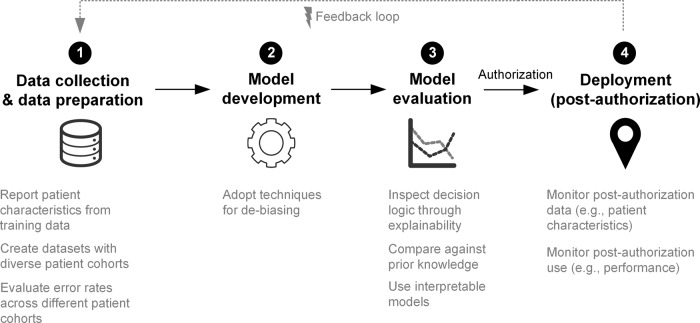
This commentary argues that bias in machine-learning systems for medicine can be introduced at each development stage—data collection and preparation, model development, model evaluation, and post-authorization deployment—and proposes mitigation strategies for each. It calls for these strategies to become best practice to prevent health-care inequality and ensure safe function for all patients.
Key findings
No original data are reported; the paper synthesizes proposed solutions across four development steps.
- Sampling bias in training data can be replicated clinically: a system trained on melanoma images from people with white skin "might misinterpret images from patients with a darker skin tone, and might fail to diagnose melanoma," which matters because melanoma causes most skin-cancer deaths and early diagnosis is critical for cure.
- The paper cites prior evidence of racial bias in a commercial prediction algorithm: Black patients assigned the same risk level were sicker than white patients, because the algorithm used health costs as a proxy for health needs and less money is spent on Black patients with equal need.
- Proposed mitigations include transparency about training-data demographics and baseline characteristics, compiling datasets "as diverse and large as possible," monitoring error rates across cohorts, reporting checklists such as PROBAST, mathematical de-biasing (adversarial de-biasing, oversampling), continual learning, interpretability/explainability tools (SHAP, LIME), and post-authorization monitoring for domain shift and feedback loops.
- The author recommends that for high-risk ML-based systems in medicine, models "might be better" limited to those that are interpretable, given that explainability can be inaccurate or non-meaningful.
Methods
This is a narrative commentary/perspective, not an empirical study; no dataset, sample, or statistical analysis is reported. The argument is organized around a four-step framework of ML system development (data collection and preparation, model development, model evaluation, deployment/post-authorization), with proposed solutions presented per step and summarized in Fig. 1. Evidence is drawn from cited prior literature and FDA policy documents (e.g., the January 2021 FDA Action Plan).
Limitations
The paper states no formal limitations section. Limitations evident in the text: the author notes that de-biasing techniques "have only recently emerged in computer science and more research is still needed to demonstrate proof-of-principle and show that de-biasing reliably achieves its intended purpose," and that ML explainability "can be inaccurate or non-meaningful due to the underlying mathematical assumptions." The recommendations are prescriptive proposals rather than validated interventions, and no quantitative evaluation of their effectiveness is provided.
Model-written summary. Check it against the paper before relying on it.
Integrity signals
Registry
Cites
Statistics
Figures
Verification
Claims the paper makes
8 Valid · 0 Not valid · 5 Not checked · 14 Own results and interpretations
The cited sources support only part of this claim — read each source’s verdict below.
In the paper
“These errors can be introduced across the various stages of development.”
§ Mitigating bias in machine learning for medicine > Abstract
What the sources say
- Not checked yetcites [4] Parikh RB Teeple S Navathe AS Addressing bias in artificial intelligence in health care J. Am. Med. Assoc. 2019 322 2377 10.1001/jama.2019.18058 31755905 source
- Partly supportedcites [5] Obermeyer Z Powers B Vogeli C Mullainathan S Dissecting racial bias in an algorithm used to manage the health of populations Science 2019 366 447 453 10.1126/science.aax2342 31649194 sourceExperimental — accuracy not yet measured
Our copy supports only in part: the introduction (p. 2) says algorithms 'may reproduce racial and gender disparities via the people building them or through the data used to train them', but that general concern is credited to references 1-3 and is not a stage-by-stage account. The paper's own argument locates the bias in a single development decision - label choice/problem formulation - stating that 'the choice of label is perhaps the single most important decision made in the development of a prediction algorithm' (p. 6) and that 'labels are the key determinant of both predictive quality and predictive bias' (Discussion, p. 8). It explicitly denies that the modelling/fitting stage is the culprit: 'Changing the procedures by which we fit algorithms ... is not required. Rather, we must change the data we feed the algorithm - specifically, the labels we give it' (Discussion, p. 8). So attributing to this source the claim that errors arise 'across the various stages of development' overstates it. (LLM, conf=0.68)
- Not checked yetcites [6] FDA. Artificial intelligence/machine learning (AI/ML)-based software as a medical device (SaMD) action plan. https://www.fda.gov/media/145022/download (2021).
plainstates a cause- Asserted: passes — The authors put it forward as true.
- Checkable: passes — It can be checked against evidence.
- Load-bearing: passes — The paper’s conclusions depend on it.
- Based: passes — The paper gives a reason why it holds.
Every source the paper cites for this claim was checked and supports it.
In the paper
“This bias occurred because the algorithm used health costs as a proxy for health needs.”
§ Mitigating bias in machine learning for medicine > Abstract
What the sources say
- Supportedcites [5] Obermeyer Z Powers B Vogeli C Mullainathan S Dissecting racial bias in an algorithm used to manage the health of populations Science 2019 366 447 453 10.1126/science.aax2342 31649194 source
The abstract (p. 2) states directly that 'The bias arises because the algorithm predicts health care costs rather than illness,' and that cost 'appear[ed] to be an effective proxy for health.' The Mechanism of bias section (pp. 4-5) confirms the label was total medical expenditures, so 'the algorithm's prediction on health needs is, in fact, a prediction on health costs,' and the Discussion (p. 8) reiterates that cost was used as a proxy for health needs. The claim's causal attribution is fully stated in our copy. (LLM, conf=0.95)
plainstates a cause- Asserted: passes — The authors put it forward as true.
- Checkable: passes — It can be checked against evidence.
- Load-bearing: passes — The paper’s conclusions depend on it.
- Based: passes — The paper gives a reason why it holds.
- Supported
Every source the paper cites for this claim was checked and supports it.
In the paper
“Beyond creating diverse datasets for model development, there are mathematical approaches for de-biasing that mitigate the risk of bias at this step, such as adversarial de-biasing9 or oversampling10.”
§ Mitigating bias in machine learning for medicine > Model development
What the sources say
- Supportedcites [9] Zhang, B. H., Lemoine, B. & Mitchell, M. Mitigating unwanted biases with adversarial learning. in Proceedings of the 2018 AAAI/ACM Conference on AI, Ethics, and Society. (ed. Furman, Jason, Marchant, Gary, Price, Huw, Rossi, Francesca) 335–340 (ACM, 2018). source
The citation is attached to 'adversarial de-biasing' as a mathematical approach that mitigates bias at the model-development/training step, and our copy of Zhang et al. (2018) is exactly that method: Section 3 'ADVERSARIAL DEBIASING' (p. n/a) describes jointly learning a predictor and an adversary whose gradient is folded into the predictor's weight update rule to reduce information about the protected variable Z transmitted through Y-hat, and the Abstract states the framework 'mitigat[es] such biases' with results on analogy completion and the UCI Adult dataset. The Additional information section adds that they 'demonstrate a general and powerful method for training unbiased machine learning models' yielding models 'demonstrably less biased than the original one' while still performing well. The 'oversampling' element carries a separate citation (ref 10) and is not attributed to this source; our copy does not discuss oversampling, which does not affect this judgement. (LLM, conf=0.90)
- Supportedcites [10] Kamiran F Calders T Data preprocessing techniques for classification without discrimination Knowl. Inf. Syst. 2012 33 1 33 10.1007/s10115-011-0463-8 source
Sect. 5 'Solutions: data preprocessing techniques' (p. 14) and Sect. 5.3 'Sampling' (p. 18) present an oversampling/undersampling (plus Uniform and Preferential Sampling, Intro p. 2) preprocessing approach that removes discrimination from the training dataset before a classifier is learned, i.e. at the model-development step. Sect. 6.6 (p. 28) and the Conclusion (p. 30) report that these preprocessing methods consistently reduce discrimination versus baselines, with an accuracy trade-off, supporting 'mitigate the risk of bias'. The adversarial de-biasing part of the citing sentence carries a separate citation (9) and is not attributed to this source, so it is not judged here. (LLM, conf=0.85)
plainstates a cause- Asserted: passes — The authors put it forward as true.
- Checkable: passes — It can be checked against evidence.
- Load-bearing: passes — The paper’s conclusions depend on it.
- Based: passes — The paper gives a reason why it holds.
- Supported
Every source the paper cites for this claim was checked and supports it.
In the paper
“Black patients assigned the same level of risk by the algorithm were sicker than white patients.”
§ Mitigating bias in machine learning for medicine > Abstract
What the sources say
- Supportedcites [5] Obermeyer Z Powers B Vogeli C Mullainathan S Dissecting racial bias in an algorithm used to manage the health of populations Science 2019 366 447 453 10.1126/science.aax2342 31649194 source
The abstract (p. 2) states that 'At a given risk score, Black patients are considerably sicker than White patients, as evidenced by signs of uncontrolled illnesses.' The Results section 'Health disparities conditional on risk score' (p. 3) quantifies this: at the same level of algorithm-predicted risk, Blacks have significantly more illness burden than Whites (e.g., 26.3% more chronic illnesses at the 97th percentile, 4.8 versus 3.8 conditions, P < 0.001), and biomarker evidence at p. 4 shows the same pattern across disease severity measures. The paraphrase matches the source exactly, including the conditioning on equal risk score. (LLM, conf=0.95)
plainstates an association- Asserted: passes — The authors put it forward as true.
- Checkable: passes — It can be checked against evidence.
- Load-bearing: passes — The paper’s conclusions depend on it.
- Based: passes — The paper gives a reason why it holds.
- Supported
Every source the paper cites for this claim was checked and supports it.
In the paper
“Systematic errors might also be reduced through continual learning11, whereby an ML-based system is continuously updated through new data while retaining previously learned knowledge12.”
§ Mitigating bias in machine learning for medicine > Model development
What the sources say
- Supportedcites [11] Vokinger KN Feuerriegel S Kesselheim AS Continual learning in medical devices: FDA’s action plan and beyond Lancet Digit. Health 2021 3 e337 e338 10.1016/S2589-7500(21)00076-5 33933404 source
The paper says continual learning could remove errors and improve accuracy (p. 2), and describes identifying and addressing specific errors through updates (p. 3). It also defines continual learning as updating a model with new data while retaining previously learned knowledge (p. 2). (LLM, conf=0.88)
- Supportedcites [12] Lee CS Lee AY Clinical applications of continual learning machine learning Lancet Digital Health 2020 2 e279 e281 10.1016/S2589-7500(20)30102-3 33328120 PMC8259323 source
The citation to this source is attached to the definition of continual learning, not the preceding claim about reducing systematic errors. In “Applications of continual learning machine learning in clinical practice,” the paper defines it as models learning from increasing amounts of data while retaining previously learned knowledge. (LLM, conf=0.95)
hedgedstates a possible cause- Asserted: passes — The authors put it forward as true.
- Checkable: passes — It can be checked against evidence.
- Load-bearing: unclear — It is unclear whether the paper’s conclusions depend on it.
- Based: passes — The paper gives a reason why it holds.
- Supported
13 more claims · 3 with their cited sources checked
Create a free account to see all 27 claims and to verify the 10 references still open.
- It may state two separate claims as one. 6
- Probably not a substantial claim. 4
Claims other papers make about this one
Each is checked against this paper’s own text: does it say what the citing paper says it does?
The cited source says what the claim attributes to it.
In the citing paper
“To reduce the risk of such biases, mathematical de-biasing approaches such as adversarial de-biasing or oversampling have been introduced [26].”
From Bias in artificial intelligence algorithms and recommendations for mitigation (2023) · cites this paper as [26]
The cited source says what the claim attributes to it.
In the citing paper
“With such techniques, the model is forced to account for underrepresented groups to achieve better performance.”
From Bias in artificial intelligence algorithms and recommendations for mitigation (2023) · cites this paper as [26]
The cited source says what the claim attributes to it.
In the citing paper
“Model interpretability is another important step in both validation and bias mitigation, offering insights into how decisions are generated (e.g., which features are most involved) or explaining the behavior of “black box” models (e.g., deep learning models with millions of parameters) [11].”
From Bias in medical AI: Implications for clinical decision-making (2024) · cites this paper as [11]
The cited source says what the claim attributes to it.
In the citing paper
“Bias can be generated across AI model development steps, including data collection/preparation, model development, model evaluation, and deployment in clinical settings9.”
From Bias in AI-based models for medical applications: challenges and mitigation strategies (2023) · cites this paper as [9]
The cited source says what the claim attributes to it.
In the citing paper
“Bias and unequal performance across demographic groups remain significant concerns [21,22].”
5 more claims about this paper
Create a free account to see every claim other papers make about this one.
Citations
Cites
A Unified Approach to Interpreting Model Predictions
Lundberg, S., & Lee, S.-I. (2017) · arXiv · doi:10.48550/arxiv.1705.07874 · Cited by 23,707
"Why Should I Trust You?": Explaining the Predictions of Any Classifier
Ribeiro, M. T., Singh, S., & Guestrin, C. (2016) · Proceedings of the 22nd ACM SIGKDD International Conference on Knowledge Discovery and Data Mining · doi:10.1145/2939672.2939778 · Cited by 17,555
Rudin, C. (2019) · Nature Machine Intelligence · doi:10.1038/s42256-019-0048-x · Cited by 10,561
Dissecting racial bias in an algorithm used to manage the health of populations
Obermeyer, Z., Powers, B., Vogeli, C., & Mullainathan, S. (2019) · Science · doi:10.1126/science.aax2342 · Cited by 7,137
PROBAST: A Tool to Assess the Risk of Bias and Applicability of Prediction Model Studies
Wolff, R. F., Moons, K. G. M., Riley, R. D., Whiting, P. F., Westwood, M., Collins, G. S., Reitsma, J. B., Kleijnen, J., Mallett, S., & for the PROBAST Group† (2019) · Annals of Internal Medicine · doi:10.7326/m18-1376 · Cited by 2,984
Mitigating Unwanted Biases with Adversarial Learning
Zhang, B. H., Lemoine, B., & Mitchell, M. (2018) · Proceedings of the 2018 AAAI/ACM Conference on AI, Ethics, and Society · doi:10.1145/3278721.3278779 · Cited by 1,387 · cited 1×
“Beyond creating diverse datasets for model development, there are mathematical approaches for de-biasing that mitigate the risk of bias at this step, such as adversarial de-biasing 9 or oversampling 10 .”
MethodData preprocessing techniques for classification without discrimination
Kamiran, F., & Calders, T. (2012) · Knowledge and Information Systems · doi:10.1007/s10115-011-0463-8 · Cited by 1,305
Addressing bias in artificial intelligence in health care
Parikh, R. B., Teeple, S., & Navathe, A. S. (2019) · JAMA · doi:10.1001/jama.2019.18058 · Cited by 764
Muehlematter, U. J., Daniore, P., & Vokinger, K. N. (2021) · The Lancet Digital Health · doi:10.1016/s2589-7500(20)30292-2 · Cited by 665
Self-citationMachine Learning and Health Care Disparities in Dermatology
Adamson, A. S., & Smith, A. (2018) · JAMA Dermatology · doi:10.1001/jamadermatol.2018.2348 · Cited by 639
Cited by
Acosta, J. N., Falcone, G. J., Rajpurkar, P., & Topol, E. J. (2022) · Nature Medicine · doi:10.1038/s41591-022-01981-2 · Cited by 1,365
Lekadir, K., Frangi, A. F., Porras, A. R., Glocker, B., Cintas, C., Langlotz, C. P., Weicken, E., Asselbergs, F. W., Prior, F., Collins, G. S., et al. (2025) · BMJ · doi:10.1136/bmj-2024-081554 · Cited by 957
“31 35 To correct for any identified biases, mitigation measures should be tested, such as data resampling, bias free representations, and equalised odds postprocessing, 36-40 to verify their impact on both the tool’s fairness and the model’s accuracy.”
Bias in artificial intelligence algorithms and recommendations for mitigation
Nazer, L. H., Zatarah, R., Waldrip, S., Ke, J. X. C., Moukheiber, M., Khanna, A. K., Hicklen, R. S., Moukheiber, L., Moukheiber, D., Ma, H., et al. (2023) · PLOS Digital Health · doi:10.1371/journal.pdig.0000278 · Cited by 621
Bias in medical AI: Implications for clinical decision-making
Cross, J. L., Choma, M. A., & Onofrey, J. A. (2024) · PLOS Digital Health · doi:10.1371/journal.pdig.0000651 · Cited by 607
Bias in AI-based models for medical applications: challenges and mitigation strategies
Mittermaier, M., Raza, M. M., & Kvedar, J. C. (2023) · npj Digital Medicine · doi:10.1038/s41746-023-00858-z · Cited by 372
“…challenges due to bias in AI and ML algorithms and released an action plan ( “ Arti fi cial Intelligence/Machine Learning (AI/ML)- Based Software as a Medical Device (SaMD) Action Plan ” ) in January 2021 9,19 , emphasizing the importance of identifying and mitigating bias in AI systems 9 .”
Causal machine learning for predicting treatment outcomes
Feuerriegel, S., Frauen, D., Melnychuk, V., Schweisthal, J., Hess, K., Curth, A., Bauer, S., Kilbertus, N., Kohane, I. S., & van der Schaar, M. (2024) · Nature Medicine · doi:10.1038/s41591-024-02902-1 · Cited by 343
Self-citationAI pitfalls and what not to do: mitigating bias in AI
Gichoya, J. W., Thomas, K., Celi, L. A., Safdar, N., Banerjee, I., Banja, J. D., Seyyed-Kalantari, L., Trivedi, H., & Purkayastha, S. (2023) · The British Journal of Radiology · doi:10.1259/bjr.20230023 · Cited by 277
Randomized Clinical Trials of Machine Learning Interventions in Health Care: A Systematic Review
Plana, D., Shung, D. L., Grimshaw, A. A., Saraf, A., Sung, J. J. Y., & Kann, B. H. (2022) · JAMA Network Open · doi:10.1001/jamanetworkopen.2022.33946 · Cited by 236
Chen, F., Wang, L., Hong, J., Jiang, J., & Zhou, L. (2024) · Journal of the American Medical Informatics Association · doi:10.1093/jamia/ocae060 · Cited by 178
Lukyanenko, R., Maass, W., & Storey, V. C. (2022) · Electronic Markets · doi:10.1007/s12525-022-00605-4 · Cited by 171
Decentralized federated learning through proxy model sharing
Kalra, S., Wen, J., Cresswell, J. C., Volkovs, M., & Tizhoosh, H. R. (2023) · Nature Communications · doi:10.1038/s41467-023-38569-4 · Cited by 160
A sociotechnical view of algorithmic fairness
Dolata, M., Feuerriegel, S., & Schwabe, G. (2022) · Information Systems Journal · doi:10.1111/isj.12370 · Cited by 160
Self-citationAI Fairness in Data Management and Analytics: A Review on Challenges, Methodologies and Applications
Chen, P., Wu, L., & Wang, L. (2023) · Applied Sciences · doi:10.3390/app131810258 · Cited by 155
Understanding and Mitigating Bias in Imaging Artificial Intelligence
Tejani, A. S., Ng, Y. S., Xi, Y., & Rayan, J. C. (2024) · RadioGraphics · doi:10.1148/rg.230067 · Cited by 138
Shreve, J. T., Khanani, S. A., & Haddad, T. C. (2022) · American Society of Clinical Oncology Educational Book · doi:10.1200/edbk_350652 · Cited by 172
A systematic review of federated learning applications for biomedical data
Crowson, M. G., Moukheiber, D., Arévalo, A. R., Lam, B. D., Mantena, S., Rana, A., Goss, D., Bates, D. W., & Celi, L. A. (2022) · PLOS Digital Health · doi:10.1371/journal.pdig.0000033 · Cited by 129
Fehr, J., Citro, B., Malpani, R., Lippert, C., & Madai, V. I. (2024) · Frontiers in Digital Health · doi:10.3389/fdgth.2024.1267290 · Cited by 188
A review of model evaluation metrics for machine learning in genetics and genomics
Miller, C., Portlock, T., Nyaga, D. M., & O'Sullivan, J. M. (2024) · Frontiers in Bioinformatics · doi:10.3389/fbinf.2024.1457619 · Cited by 205
Marko, J. G. O., Neagu, D. C., & Anand, P. B. (2025) · BMC Medical Informatics and Decision Making · doi:10.1186/s12911-025-02884-1 · Cited by 156
Algorithmic fairness in business analytics: Directions for research and practice
De‐Arteaga, M., Feuerriegel, S., & Saar‐Tsechansky, M. (2022) · Production and Operations Management · doi:10.1111/poms.13839 · Cited by 87
Self-citationSurvey on Machine Learning Biases and Mitigation Techniques
Siddique, S., Haque, M. A., George, R., Gupta, K. D., Gupta, D., & Faruk, M. J. H. (2023) · Digital · doi:10.3390/digital4010001 · Cited by 78
Analyzing Patient Trajectories With Artificial Intelligence
Allam, A., Feuerriegel, S., Rebhan, M., & Krauthammer, M. (2021) · Journal of Medical Internet Research · doi:10.2196/29812 · Cited by 77
Self-citationMachine Learning and Bias in Medical Imaging: Opportunities and Challenges
Vrudhula, A., Kwan, A. C., Ouyang, D., & Cheng, S. C. (2024) · Circulation Cardiovascular Imaging · doi:10.1161/circimaging.123.015495 · Cited by 106
Machine learning in computational histopathology: Challenges and opportunities
Cooper, M., Ji, Z., & Krishnan, R. G. (2023) · Genes, Chromosomes and Cancer · doi:10.1002/gcc.23177 · Cited by 79
Detecting and Remediating Harmful Data Shifts for the Responsible Deployment of Clinical AI Models
Subasri, V., Krishnan, A., Kore, A., Dhalla, A., Pandya, D., Wang, B., Malkin, D., Razak, F., Verma, A. A., Goldenberg, A., et al. (2025) · JAMA Network Open · doi:10.1001/jamanetworkopen.2025.13685 · Cited by 87
Mitigating the risk of artificial intelligence bias in cardiovascular care
Mihan, A., Pandey, A., & Van Spall, H. G. (2024) · The Lancet Digital Health · doi:10.1016/s2589-7500(24)00155-9 · Cited by 71
Li, Y., Wang, H., & Luo, Y. (2022) · Circulation: Heart Failure · doi:10.1161/circheartfailure.122.009473 · Cited by 64
Strategies to improve the impact of artificial intelligence on health equity: scoping review
Berdahl, C. T., Baker, L., Mann, S., Osoba, O., & Girosi, F. (2023) · JMIR AI · doi:10.2196/42936 · Cited by 68
Skin-interfaced electronics: A promising and intelligent paradigm for personalized healthcare
Zhu, Y., Li, J., Kim, J., Li, S., Zhao, Y., Bahari, J., Eliahoo, P., Li, G., Kawakita, S., Haghniaz, R., et al. (2023) · Biomaterials · doi:10.1016/j.biomaterials.2023.122075 · Cited by 66
Multimodal LLMs for Health Grounded in Individual-Specific Data
Belyaeva, A., Cosentino, J., Hormozdiari, F., Eswaran, K., Shetty, S., Corrado, G. S., Carroll, A. W., McLean, C. Y., & Furlotte, N. A. (2023) · Lecture notes in computer science · doi:10.1007/978-3-031-47679-2_7 · Cited by 129
Artificial intelligence and machine learning for clinical pharmacology
Ryan, D. K., Maclean, R., Balston, A. J., Scourfield, A., Shah, A. D., & Ross, J. (2023) · British Journal of Clinical Pharmacology · doi:10.1111/bcp.15930 · Cited by 80
Schindele, A., Krebold, A., Heiß, U., Nimptsch, K., Pfaehler, E. A. G., Berr, C., Bundschuh, R. A., Wendler, T., Kertels, O., Tran‐Gia, J., et al. (2025) · European Journal of Radiology · doi:10.1016/j.ejrad.2025.112049 · Cited by 76
Human visual explanations mitigate bias in AI-based assessment of surgeon skills
Kiyasseh, D., Laca, J., Haque, T. F., Otiato, M., Miles, B. J., Wagner, C., Donoho, D. A., Trinh, Q.-D., Anandkumar, A., & Hung, A. J. (2023) · npj Digital Medicine · doi:10.1038/s41746-023-00766-2 · Cited by 53
“Further, previous attempts to mitigate such bias are either ineffective 22 – 24 or are limited to a single AI system deployed in a single hospital 25 – 27 , casting doubt on their wider applicability.”
BackgroundArtificial intelligence bias in the prediction and detection of cardiovascular disease
Mihan, A., Pandey, A., & Van Spall, H. G. C. (2024) · npj Cardiovascular Health · doi:10.1038/s44325-024-00031-9 · Cited by 51
Colacci, M., Huang, Y. Q., Postill, G., Zhelnov, P., Fennelly, O., Verma, A. A., Straus, S. E., & Tricco, A. C. (2024) · Journal of Clinical Epidemiology · doi:10.1016/j.jclinepi.2024.111606 · Cited by 72
Applications of natural language processing at emergency department triage: A narrative review
Stewart, J. E., Lü, J., Goudie, A., Arendts, G., Meka, S., Freeman, S., Walker, K., Sprivulis, P., Sanfilippo, F. M., Bennamoun, M., et al. (2023) · PLoS ONE · doi:10.1371/journal.pone.0279953 · Cited by 70
Murray, J. D., Lange, J. J., Bennett-Lenane, H., Holm, R., Kuentz, M., O’Dwyer, P. J., & Griffin, B. T. (2023) · European Journal of Pharmaceutical Sciences · doi:10.1016/j.ejps.2023.106562 · Cited by 61
Artificial intelligence and machine learning: present and future applications in health sciences
Rodríguez, F. A. R., Flores, L. G., & Vitón-Castillo, A. A. (2022) · Seminars in Medical Writing and Education · doi:10.56294/mw20229 · Cited by 52
Current and Future Applications of Artificial Intelligence in Coronary Artery Disease
Gautam, N., Saluja, P., Malkawi, A., Rabbat, M., Al-Mallah, M. H., Pontone, G., Zhang, Y., Lee, B. C., & Alaref, S. J. (2022) · Healthcare · doi:10.3390/healthcare10020232 · Cited by 57
Balla, Y., Tirunagari, S., & Windridge, D. (2023) · Indian Pediatrics · doi:10.1007/s13312-023-2936-8 · Cited by 57
Bednarski, B. P., Singh, A. D., Zhang, W., Jones, W. M., Naeim, A., & Ramezani, R. (2022) · Scientific Reports · doi:10.1038/s41598-022-25472-z · Cited by 41
“Unlike random forest ensemble models (like the popular XGBoost algorithm 47 ), which have built-in interpretability, deep learning models are not equipped with feature importance scores by default.”
BackgroundVeritti, D., Rubinato, L., Sarao, V., Nardin, A. D., Foresti, G. L., & Lanzetta, P. (2023) · Graefe s Archive for Clinical and Experimental Ophthalmology · doi:10.1007/s00417-023-06245-4 · Cited by 52
Enhancing Ophthalmic Diagnosis and Treatment with Artificial Intelligence
Olawade, D. B., Weerasinghe, K., Mathugamage, M. D. D. E., Odetayo, A., Aderinto, N., Teke, J., & Boussios, S. (2025) · Medicina · doi:10.3390/medicina61030433 · Cited by 76
Towards evidence-based practice 2.0: leveraging artificial intelligence in healthcare
Nilsen, P., Sundemo, D., Heintz, F., Neher, M., Nygren, J., Svedberg, P., & Petersson, L. (2024) · Frontiers in Health Services · doi:10.3389/frhs.2024.1368030 · Cited by 39
“Bias can be generated across AI system development, from the preparation and collection of the data to the development and training of the algorithm, and the evaluation and deployment of the system in clinical settings (15, 63).”
BackgroundRoche, S. D., Ekwunife, O. I., Mendonca, R., Kwach, B., Omollo, V. O., Zhang, S., Ong’wen, P. A., Hattery, D. W., Smedinghoff, S., Morris, S., et al. (2024) · Frontiers in Public Health · doi:10.3389/fpubh.2024.1334881 · Cited by 45
Gray, M., Samala, R. K., Liu, Q., Skiles, D., Xu, J., Tong, W., & Wu, L. (2023) · Clinical Pharmacology & Therapeutics · doi:10.1002/cpt.3117 · Cited by 55
Raising awareness of sex and gender bias in artificial intelligence and health
Buslón, N., Cortés, À., Catuara‐Solarz, S., Cirillo, D., & Rementeria, M. J. (2023) · Frontiers in Global Women s Health · doi:10.3389/fgwh.2023.970312 · Cited by 55
Possible Bias in Supervised Deep Learning Algorithms for CT Lung Nodule Detection and Classification
Sourlos, N., Wang, J., Nagaraj, Y., van Ooijen, P. M. A., & Vliegenthart, R. (2022) · Cancers · doi:10.3390/cancers14163867 · Cited by 47
Returning Individual Research Results from Digital Phenotyping in Psychiatry
Shen, F. X., Baum, M. L., Martinez‐Martin, N., Miner, A. S., Abraham, M. E., Brownstein, C. A., Cortez, N. G., Evans, B. J., Germine, L. T., Glahn, D. C., et al. (2023) · The American Journal of Bioethics · doi:10.1080/15265161.2023.2180109 · Cited by 39
Schallmoser, S., Züger, T., Kraus, M., Saar‐Tsechansky, M., Stettler, C., & Feuerriegel, S. (2023) · Journal of Medical Internet Research · doi:10.2196/42181 · Cited by 42
Self-citationFuture Guidelines for Artificial Intelligence in Echocardiography
Tseng, A. S., López-Jiménez, F. A., & Pellikka, P. A. (2022) · Journal of the American Society of Echocardiography · doi:10.1016/j.echo.2022.04.005 · Cited by 34
Mittermaier, M., Raza, M., & Kvedar, J. C. (2023) · npj Digital Medicine · doi:10.1038/s41746-023-00889-6 · Cited by 32
Hempel, P., Ribeiro, A. H., Vollmer, M., Bender, T., Dörr, M., Krefting, D., & Spicher, N. (2025) · npj Digital Medicine · doi:10.1038/s41746-024-01428-7 · Cited by 31
Alter, I. L., Chan, K., Lechien, J. R., & Rameau, A. (2024) · European Archives of Oto-Rhino-Laryngology · doi:10.1007/s00405-024-08512-4 · Cited by 38
Jeffrey, M., Denny, K. J., Lipman, J., & Morris, A. C. (2023) · Intensive Care Medicine · doi:10.1007/s00134-023-07108-6 · Cited by 44
Artificial Intelligence for Radiation Oncology Applications Using Public Datasets
Wahid, K. A., Glerean, E., Sahlsten, J., Jaskari, J., Kaski, K. K., Naser, M. A., He, R., Mohamed, A., & Fuller, C. D. (2022) · Seminars in Radiation Oncology · doi:10.1016/j.semradonc.2022.06.009 · Cited by 29
Machine learning approaches for biomolecular, biophysical, and biomaterials research
Rickert, C. A., & Lieleg, O. (2022) · Biophysics Reviews · doi:10.1063/5.0082179 · Cited by 34
Vrudhula, A., Stern, L. K., Cheng, P. P., Ricchiuto, P., Daluwatte, C., Witteles, R. M., Patel, J. K., & Ouyang, D. (2024) · JACC Advances · doi:10.1016/j.jacadv.2024.100998 · Cited by 31
Jahfari, A. N., Tax, D. M. J., Reinders, M. J. T., & van der Bilt, I. (2022) · JMIR Medical Informatics · doi:10.2196/29434 · Cited by 43
The Way Forward to Embrace Artificial Intelligence in Public Health
Hattab, G., Irrgang, C., Körber, N., Kühnert, D., & Ladewig, K. (2024) · American Journal of Public Health · doi:10.2105/ajph.2024.307888 · Cited by 41
Santa-Rosario, J. C., Gustafson, E., Bellassai, D. E. S., Gustafson, P. E., & de Socarraz, M. (2024) · Journal of Pathology Informatics · doi:10.1016/j.jpi.2024.100378 · Cited by 33
Spagnolo, F., Depeursinge, A., Schädelin, S., Akbulut, A., Müller, H., Baraković, M., Melie‐García, L., Cuadra, M. B., & Granziera, C. (2023) · NeuroImage Clinical · doi:10.1016/j.nicl.2023.103491 · Cited by 32
Stroke mortality prediction using machine learning: systematic review
Schwartz, L., Anteby, R., Klang, E., & Soffer, S. (2022) · Journal of the Neurological Sciences · doi:10.1016/j.jns.2022.120529 · Cited by 35
A transformer-based deep learning approach for fairly predicting post-liver transplant risk factors
Li, C., Jiang, X., & Zhang, K. (2024) · Journal of Biomedical Informatics · doi:10.1016/j.jbi.2023.104545 · Cited by 25
Pathak, A., Theagarajan, R., Rizqi, M. M., Nugraha, A. S., Boruah, T., Pratiksha, Kumar, H., Naik, B., Yadav, S., Jha, A. K., et al. (2025) · Discover Molecules · doi:10.1007/s44345-025-00037-5 · Cited by 44
Pham, N., Hill, V. B., Rauschecker, A. M., Lui, Y. W., Niogi, S. N., Filippi, C. G., Chang, P., Zaharchuk, G., & Wintermark, M. (2023) · American Journal of Neuroradiology · doi:10.3174/ajnr.a7850 · Cited by 27
Bentwich, I. (2023) · Drug Discovery Today · doi:10.1016/j.drudis.2023.103515 · Cited by 22
Carpenter, H. J., Ghayesh, M. H., Zander, A. C., Giovanni, G. D., Li, J., & Psaltis, P. J. (2022) · Tomography · doi:10.3390/tomography8030108 · Cited by 26
Machine learning classification meets migraine: recommendations for study evaluation
Petrušić, I., Savić, A. M., Mitrović, K., Bačanin, N., Sebastianelli, G., Secci, D., & Coppola, G. (2024) · The Journal of Headache and Pain · doi:10.1186/s10194-024-01924-x · Cited by 31
Choi, B. K., Choi, Y. J., Sung, M., Ha, W., Chu, M. K., Kim, W., Heo, K., Kim, K. M., & Park, Y. R. (2023) · EClinicalMedicine · doi:10.1016/j.eclinm.2023.102051 · Cited by 25
Doolub, G., Mamalakis, M., Alabed, S., van der Geest, R. J., Swift, A. J., Rodrigues, J. C. L., Garg, P., Joshi, N. V., & Dastidar, A. G. (2023) · Medical Sciences · doi:10.3390/medsci11010020 · Cited by 41
Optimizing Equity: Working towards Fair Machine Learning Algorithms in Laboratory Medicine
Azimi, V., & Zaydman, M. A. (2023) · The Journal of Applied Laboratory Medicine · doi:10.1093/jalm/jfac085 · Cited by 25
Artificial intelligence and clinical deterioration
Malycha, J., Bacchi, S., & Redfern, O. (2022) · Current Opinion in Critical Care · doi:10.1097/mcc.0000000000000945 · Cited by 27
Deep learning for 3D cephalometric landmarking with heterogeneous multi-center CBCT dataset
Sahlsten, J., Järnstedt, J., Jaskari, J., Naukkarinen, H., Mahasantipiya, P. M., Charuakkra, A., Vasankari, K., Hietanen, A., Sundqvist, O., Lehtinen, A., et al. (2024) · PLoS ONE · doi:10.1371/journal.pone.0305947 · Cited by 27
A Survey on Blood Pressure Measurement Technologies: Addressing Potential Sources of Bias
Mousavi, S. S., Reyna, M. A., Clifford, G. D., & Sameni, R. (2024) · Sensors · doi:10.3390/s24061730 · Cited by 33
Serra‐Burriel, M., Locher, L., & Vokinger, K. N. (2023) · NEJM AI · doi:10.1056/aipc2300038 · Cited by 25
Self-citationHafner, L., Peifer, T. P., & Hafner, F. S. (2023) · AI & Society · doi:10.1007/s00146-022-01619-4 · Cited by 31
Artificial Intelligence for Outcome Modeling in Radiotherapy
Cui, S., Hope, A. J., Dilling, T. J., Dawson, L. A., Haken, R. K. T., & Naqa, I. E. (2022) · Seminars in Radiation Oncology · doi:10.1016/j.semradonc.2022.06.005 · Cited by 22
Galanty, M., Luitse, D. M. R., Noteboom, S. H., Croon, P. M., Vlaar, A. P. J., Poell, T., Sánchez, C. I., Blanke, T., & Išgum, I. (2024) · Scientific Reports · doi:10.1038/s41598-024-83218-5 · Cited by 29
Kim, J.-B., Kim, S., So, M., Kim, D., Noh, H. R., Kim, B. J., Choi, Y. R., Kim, D., Koo, H., Kim, T. Y., et al. (2024) · Biomedicine & Pharmacotherapy · doi:10.1016/j.biopha.2024.116442 · Cited by 24
Khosravi, M., Zare, Z., Mojtabaeian, S. M., & Izadi, R. (2024) · Journal of Public Health · doi:10.1007/s10389-024-02219-w · Cited by 25
Han, S., Lee, J. E., Kang, S., So, M., Jin, H. K., Lee, J. H., Baek, S., Jun, H., Kim, T. Y., & Lee, Y. (2024) · Briefings in Bioinformatics · doi:10.1093/bib/bbae035 · Cited by 19
Inherent Bias in Electronic Health Records: A Scoping Review of Sources of Bias
Perets, O., Stagno, E., Yehuda, E. B., McNichol, M. C., Celi, L. A., Rappoport, N., & Dorotić, M. (2026) · ACM Transactions on Intelligent Systems and Technology · doi:10.1145/3757924 · Cited by 76
Awada, H., Gurnari, C., Durmaz, A., Awada, H. K., Pagliuca, S., & Visconte, V. (2022) · International Journal of Molecular Sciences · doi:10.3390/ijms23052802 · Cited by 16
Singh, S. S., Kumar, S., Ahuja, R., & Barua, J. (2025) · Information Fusion · doi:10.1016/j.inffus.2025.103217 · Cited by 25
Artificial intelligence guidance of advanced heart failure therapies: A systematic scoping review
Al‐Ani, M. A., Bai, C., Hashky, A., Parker, A. M., Vilaro, J. R., Aranda, J. M., Shickel, B., Rashidi, P., Bihorac, A., Ahmed, M. M., et al. (2023) · Frontiers in Cardiovascular Medicine · doi:10.3389/fcvm.2023.1127716 · Cited by 18
Yu, J., Peng, X., Zhou, R., Zhu, T., & Hao, X. (2024) · International Journal of Surgery · doi:10.1097/js9.0000000000002203 · Cited by 16
The Pivotal Role of Baseline LDCT for Lung Cancer Screening in the Era of Artificial Intelligence
Luca, G. R. D., Diciotti, S., & Mascalchi, M. (2024) · Archivos de Bronconeumología · doi:10.1016/j.arbres.2024.11.001 · Cited by 20
Ismail, I. N., Subramaniam, P. K., Adam, K. B. C., & Ghazali, A. B. (2024) · Diagnostics · doi:10.3390/diagnostics14171917 · Cited by 21
Folguera-Blasco, N., Boshier, F. A. T., Uatay, A., Pichardo-Almarza, C., Lai, M., Biasetti, J., Dearden, R., Gibbs, M., & Kimko, H. (2024) · Frontiers in Systems Biology · doi:10.3389/fsysb.2024.1380685 · Cited by 15
“…to minimise data leakage in ML/AI, datasets should attempt to counteract the potentially incidental correlations present in the training dataset (Vokinger et al., 2021), whilst any dataset used for QSP model construction should provide complementary perturbations of the system to allow…”
Promoting health equity through improved regulation of artificial intelligence medical devices
Dortche, K., McCarthy, G., Banbury, S., & Yannatos, I. (2023) · Journal of Science Policy & Governance · doi:10.38126/jspg210302 · Cited by 14
Supervised machine learning for microbiomics: Bridging the gap between current and best practices
Dudek, N. K., Chakhvadze, M., Kobakhidze, S., Kantidze, O. L., & Gankin, Y. V. (2024) · Machine Learning with Applications · doi:10.1016/j.mlwa.2024.100607 · Cited by 20
Systematic Review of Machine Learning Applied to the Secondary Prevention of Ischemic Stroke
Chen, M., Qian, D., Wang, Y., An, J., Meng, K., Xu, S., Liu, S., Sun, M., Li, M., & Pang, C. (2024) · Journal of Medical Systems · doi:10.1007/s10916-023-02020-4 · Cited by 17
Silva, P. C., Sun, H., Rodríguez-Brazzarola, P., Rezk, M. S. M., Zhang, X., Fliegenschmidt, J., Hulde, N., von Dossow, V., Meesseman, L., Depraetere, K., et al. (2024) · Journal of Biomedical Informatics · doi:10.1016/j.jbi.2024.104692 · Cited by 23
Wang, H. E., Weiner, J. P., Saria, S., Lehmann, H. P., & Kharrazi, H. H. K. (2024) · Journal of Biomedical Informatics · doi:10.1016/j.jbi.2024.104683 · Cited by 21
Table 0; documenting the steps to go from clinical database to research dataset
de Kok, J. W. T. M., van Bussel, B. C. T., Schnabel, R. M., van Herpt, T. T. W., Driessen, R., Meijs, D. A. M., Goossens, J. A., Mertens, H. J. M. M., van Kuijk, S. M. J., Wynants, L., et al. (2024) · Journal of Clinical Epidemiology · doi:10.1016/j.jclinepi.2024.111342 · Cited by 15
Learning fair models without sensitive attributes: A generative approach
Zhu, H., Dai, E., Liu, H., & Wang, S. (2023) · Neurocomputing · doi:10.1016/j.neucom.2023.126841 · Cited by 16
Nurzyǹska, K., Li, D., Walts, A. E., & Gertych, A. (2023) · Computer Methods and Programs in Biomedicine · doi:10.1016/j.cmpb.2023.107518 · Cited by 17
Post, B., Badea, C., Faisal, A. A., & Brett, S. J. (2022) · AI and Ethics · doi:10.1007/s43681-022-00230-z · Cited by 19
Artificial intelligence in pharmacovigilance: A regulatory perspective on explainability
Pinheiro, L. C., & Kurz, X. (2022) · Pharmacoepidemiology and Drug Safety · doi:10.1002/pds.5524 · Cited by 14
Metadata
- Authors
- Vokinger, K. N., Feuerriegel, S., & Kesselheim, A. S.
- Affiliations
- Brigham and Women's Hospital (US)
- ETH Zurich (CH)
- Corresponding author
- Vokinger, Kerstin N.
- Venue
- Communications Medicine
- Published
- 2021-08-23
- Volume
- 1
- Issue
- 1
- Pages
- 25-25
- ISSN
- 2730-664X (ISSN-L)
- PMC
- PMC7611652
- OpenAlex
- W3194979994
- Semantic Scholar
- 995781580ebeef01050ef234c14e46ba8aaca5d9
- Cited by
- 269
- References
- 14
- Citations by year
- 2026: 43 · 2025: 54 · 2024: 71 · 2023: 65 · 2022: 32 · 2021: 4
- FWCI
- 53.77
- Type
- journal article
- Language
- en
- Open access
- gold
- doi.org
- Licence
- cc-by
- creativecommons.org/licenses/by/4.0 (tdm)
- creativecommons.org/licenses/by/4.0 (vor)
- Locations
- Communications Medicine (publishedVersion, cc-by)
- PubMed Central (publishedVersion, cc-by)
- PubMed (publishedVersion)
- Repository for Publications and Research Data (ETH Zurich) (publishedVersion, cc-by)
- Zurich Open Repository and Archive (University of Zurich) (acceptedVersion, cc-by)
- Repository for Publications and Research Data (ETH Zurich) (submittedVersion, cc-by)
- Zurich Open Repository and Archive (University of Zurich) (submittedVersion, cc-by)
- ETH Zürich Research Collection (cc-by)
- Zurich Open Repository and Archive (University of Zurich)
- Funders
- Schweizerischer Nationalfonds zur Förderung der Wissenschaftlichen Forschung
- Topics
- Physical Sciences › Computer Science › Artificial Intelligence › Ethics and Social Impacts of AI
- Health Sciences › Medicine › Health Informatics › Artificial Intelligence in Healthcare and Education
- Physical Sciences › Computer Science › Artificial Intelligence › Machine Learning in Healthcare
- Keywords
- algorithmic bias, bias mitigation, machine learning in medicine, clinical decision support, model evaluation, fairness in healthcare
About these checks
Registry, retraction, Cites and statistics results are computed, not judged, with one exception: a printed reference that no index lists is read once by a model before it counts as a citation error. Claims are extracted by a model and kept only when their quote appears verbatim in the text; each cited source is then checked, with a model’s help, for whether it says what the claim relies on. Those verdicts can be wrong — read the claim’s quote and the cited source before relying on one.
The claim verdicts this report counts are experimental: their accuracy is not yet measured.
A language model drew the claims from the paper on 2026-10-04, under version 3 of the claim definition (model deepseek-v4.1-flash, prompt extract-v3).
A second model labelled each claim on 2026-10-04 (model jev-1.13-20260917, definition revision gold-guideline-v0.2).
Cited sources are checked with a language model’s help (qwen3.8-omni-flash and gpt-6-sol).
Statistics and arithmetic are recomputed, not judged.
Confidence bands are shown only for fields calibrated on our annotated test set. None is calibrated yet, so no band is shown.
What counts as a claim ›How we measure confidence ›How we check this ›
Are you an author, or do you see a problem with this page? Request a review
Data sources
Bibliographic data: Semantic Scholar, OpenAlex, Crossref.
Contains information from the Semantic Scholar Academic Graph Datasets, made available under the ODC Attribution License (ODC-BY 1.0).
Semantic Scholar’s data is described in: Kinney, R., et al. (2023). The Semantic Scholar Open Data Platform. arXiv:2301.10140.
