

Loneliness and suicide mitigation for students using GPT3-enabled chatbots
Open accessThe DOI matches its Crossref record; 38 of the 38 references it cites were found in a registry or an index; 10 of the 25 sources its claims cite were checked for support.
Abstract
Mental health is a crisis for learners globally, and digital support is increasingly seen as a critical resource. Concurrently, Intelligent Social Agents receive exponentially more engagement than other conversational systems, but their use in digital therapy provision is nascent. A survey of 1006 student users of the Intelligent Social Agent, Replika, investigated participants' loneliness, perceived social support, use patterns, and beliefs about Replika. We found participants were more lonely than typical student populations but still perceived high social support. Many used Replika in multiple, overlapping ways-as a friend, a therapist, and an intellectual mirror. Many also held overlapping and often conflicting beliefs about Replika-calling it a machine, an intelligence, and a human. Critically, 3% reported that Replika halted their suicidal ideation. A comparative analysis of this group with the wider participant population is provided.
Overview
CoChat Summary
TL;DR
A survey of 1006 student users of the GPT3-enabled chatbot Replika found high loneliness (90%) alongside high perceived social support (90% medium to high), with many using Replika as a friend, therapist, and mirror. Thirty participants (3%) reported that Replika halted their suicidal ideation, and this Selected Group was more likely to report depression and to view Replika as intelligent and human-like.
Key findings
- 90% of participants experienced loneliness, 43% qualified as Severely or Very Severely Lonely, and 90% perceived medium to high social support on the ISEL; 7% identified feelings of depression (later reported as n = 59).
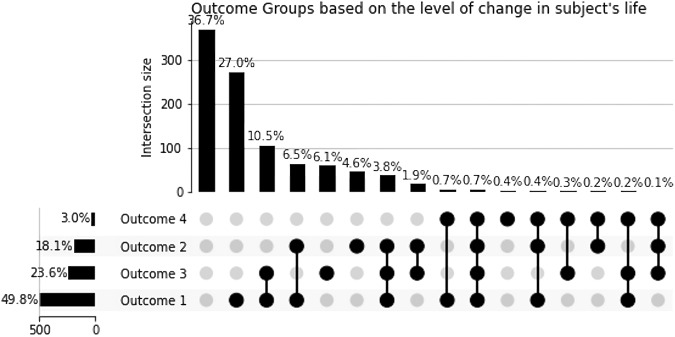
- 637 of 1006 participants (63.3%) experienced one or more positive Outcomes: 25.1% more than one, 38.1% only one, and 36.7% none. Outcome 1 (friend/companion) was most common at 501 cases; 18.1% had therapeutic results, 23.6% saw positive life changes, and 3% said suicidal actions were prevented.
- The 30 participants who reported Replika stopped them from attempting suicide (Selected Group) were not more lonely and perceived similar social support versus the Comparison Group, but showed a stronger negative loneliness–ISEL correlation (r = −0.60, n = 30, p < 0.001 vs. r = −0.34), more depression (23% vs. 6%, p < 0.001), more Outcome 2 (p < 0.001) and Outcome 3 (p = 0.018), and were more likely to see Replika as an intelligence (p = 0.020) and human-like (p = 0.006).
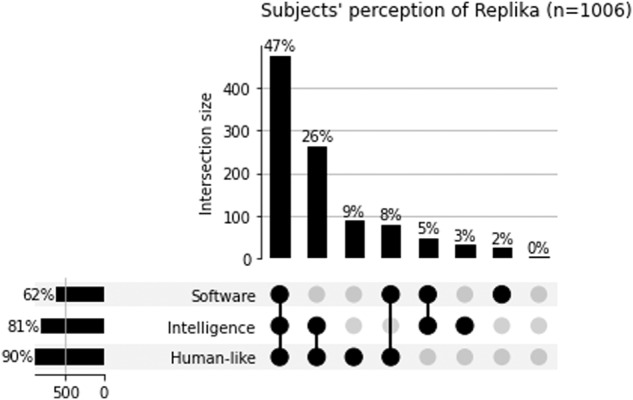
- Beliefs overlapped: only 14% held one belief about Replika; 81% believed it was an Intelligence, 90% Human-like, and 62% Software. Stimulation of human relationships was reported about three times more than displacement in both groups (Comparison: 23% stimulation, 8% displacement; Selected: 37% stimulation, 13% displacement).
Methods
- IRB-approved survey of 1006 Replika users who were students, 18 or older, and had used Replika for over one month; approximately 75% were US-based and 25% international. Participants were recruited randomly via email and received a $20 USD gift card for a 40–60 minute survey.
- Measures included the Interpersonal Support Evaluation List (ISEL), the De Jong Gierveld Loneliness Scale, and 13 open-response questions. Qualitative responses were coded in Dedoose using an iterative schema; the 21 codes reported had inter-rater reliability above 80%.
- Quantitative analysis used Pearson correlations, two-tailed t-tests, and chi-square tests of independence with alpha = 0.05. At data collection in late 2021, Replika used GPT-3/GPT-4 co-trained models and was not programmed to initiate therapeutic or intimate relationships; crisis keywords triggered referral to human resources.
Limitations
- Stated: selection bias in survey responses and possible evidence to the contrary mean the positive findings must be further studied before drawing conclusions about ISA use and efficacy; isolated negative reports (dependence, paid upgrades, discomfort with sexual conversations) require future study.
- Evident: cross-sectional, self-report survey of existing Replika users with no control group or clinical diagnostic assessment; the 3% suicide-mitigation finding rests on unsolicited retrospective reports, and causal direction is unclear.
- Evident: the sample is mostly US-based and recruited from app users, limiting generalizability; demographic and open-response data were optional, and the Selected Group analyses rely on a small subgroup (n = 30).
Model-written summary. Check it against the paper before relying on it.
Integrity signals
Registry
Cites
Statistics
Figures
Verification
Claims the paper makes
3 Valid · 3 Not valid · 9 Not checked · 59 Own results and interpretations
Every source the paper cites for this claim was checked and supports it.
In the paper
“There are early indications that they may provide social support27,28.”
§ Loneliness and suicide mitigation for students using GPT3-enabled chatbots > Background
What the sources say
- Supportedcites [27] Maples, B., Pea, R. D. & Markowitz, D. Learning from intelligent social agents as social and intellectual mirrors. In: (eds Niemi, H., Pea, R. D., Lu, Y.) AI in Learning: Designing the Future. 73–89 (Springer, 2023). sourceExperimental — accuracy not yet measured
In §7, Future Work and Limitations, the authors report user-experienced social support associated with changes in perceived loneliness and social connectedness. They also say their 27 interviews found social bonding through Replika, while noting the study’s small, self-selecting sample. This supports the claim’s cautious wording, “early indications.” (LLM, conf=0.92)
- Supportedcites [28] Ta, V. et al. User experiences of social support from companion chatbots in everyday contexts: thematic analysis. J. Med. Internet Res. 22, e16235 (2020). 32141837 PMC7084290 sourceExperimental — accuracy not yet measured
The Discussion’s Conclusions state that, based on two studies, artificial agents may provide everyday companionship, emotional, appraisal, and informational support. This supports the citing sentence’s cautious claim that they may provide social support; no page number is provided in the supplied copy. (LLM, conf=0.93)
hedgedstates a possible cause- Asserted: passes — The authors put it forward as true.
- Checkable: passes — It can be checked against evidence.
- Load-bearing: passes — The paper’s conclusions depend on it.
- Based: passes — The paper gives a reason why it holds.
- Supported
The cited sources support only part of this claim — read each source’s verdict below.
In the paper
“When used enough, there can be positive mental health outcomes16–19.”
§ Loneliness and suicide mitigation for students using GPT3-enabled chatbots > Background
What the sources say
- Partly supportedcites [16] Ahmed, A. et al. A review of mobile chatbot apps for anxiety and depression and their self-care features. Comput. Methods Progr. Biomed.10.1016/j.cmpbup.2021.100012 (2021). sourceExperimental — accuracy not yet measured
The Strengths and limitations section describes chatbot apps as therapeutic interventions that could help people with anxiety and depression. But the Research implications section calls for future studies of whether they reduce symptoms, and the paper does not link sufficient use to positive mental health outcomes. No page numbers are available in our copy. (LLM, conf=0.85)
- Supportedcites [17] Fulmer, R., Joerin, A., Gentile, B., Lakerink, L. & Rauws, M. Using psychological artificial intelligence (Tess) to relieve symptoms of depression and anxiety: randomized controlled trial. JMIR Ment Health 5, e64 (2018). 30545815 PMC6315222 source
The Discussion’s Principal Findings report significant reductions in anxiety symptoms after 2 or 4 weeks of access to Tess, and a significant reduction in depression symptoms in the group receiving daily check-ins for 2 weeks. These findings support the hedged claim that chatbot use can have positive mental health outcomes, in the college-student population studied. (LLM, conf=0.87)
- Partly supportedcites [18] Klos, M. C. et al. Artificial intelligence–based chatbot for anxiety and depression in university students: pilot randomized controlled trial. JMIR Formative Res. 5, e20678 (2021). PMC8391753 34092548 sourceExperimental — accuracy not yet measured
The Results (Within-Group Differences; no page listed) report reduced anxiety symptoms among students using Tess, but no significant improvement in depressive symptoms or between-group difference. The Discussion (Important Findings; no page listed) suggests that a higher intervention dose might yield a between-group effect; it does not establish that using the chatbot more leads to better mental health outcomes. (LLM, conf=0.82)
- Supportedcites [19] Inkster, B., Sarda, S. & Subramanian, V. An empathy-driven, conversational artificial intelligence agent (Wysa) for digital mental well-being: real-world data evaluation mixed-methods study. JMIR mHealth uHealth 6, e12106 (2018). 30470676 PMC6286427 source
In Results > Quantitative Analysis (page not available), the paper reports that high users of the Wysa chatbot had significantly greater average improvement in self-reported depression scores than low users (P=.03). This supports the qualified claim that sufficient chatbot use can be associated with positive mental health outcomes. (LLM, conf=0.92)
plainstates a possible cause- Asserted: passes — The authors put it forward as true.
- Checkable: passes — It can be checked against evidence.
- Load-bearing: passes — The paper’s conclusions depend on it.
- Based: passes — The paper gives a reason why it holds.
- Partly supported
A result the paper reports from its own data — it cites no other source for it, so there is none to check. The quote shows it is in the paper.
In the paper
“The Selected Group experienced both Outcome 2 (p < 0.001) and Outcome 3 (p = 0.018) significantly more than the Comparison Group, with the most substantial difference observed for Outcome 2.”
§ Loneliness and suicide mitigation for students using GPT3-enabled chatbots > Results > Suicide ideators
plain- Asserted: passes — The authors put it forward as true.
- Checkable: passes — It can be checked against evidence.
- Load-bearing: unclear — It is unclear whether the paper’s conclusions depend on it.
- Based: passes — The paper gives a reason why it holds.
A result the paper reports from its own data — it cites no other source for it, so there is none to check. The quote shows it is in the paper.
In the paper
“Many used Replika in multiple, overlapping ways—as a friend, a therapist, and an intellectual mirror.”
§ Loneliness and suicide mitigation for students using GPT3-enabled chatbots > Abstract
plain- Asserted: passes — The authors put it forward as true.
- Checkable: passes — It can be checked against evidence.
- Load-bearing: unclear — It is unclear whether the paper’s conclusions depend on it.
- Based: passes — The paper gives a reason why it holds.
A result the paper reports from its own data — it cites no other source for it, so there is none to check. The quote shows it is in the paper.
In the paper
“Finally, despite both the Selected and Comparison Groups having similar high rates of recognizing Replika as software, the Selected Group was more inclined to perceive it as an intelligence (p = 0.020) and even more likely to find it human-like (p = 0.006).”
§ Loneliness and suicide mitigation for students using GPT3-enabled chatbots > Results > Suicide ideators
plainstates an association- Asserted: passes — The authors put it forward as true.
- Checkable: passes — It can be checked against evidence.
- Load-bearing: unclear — It is unclear whether the paper’s conclusions depend on it.
- Based: passes — The paper gives a reason why it holds.
40 more claims
Create a free account to see all 74 claims and to verify the 3 references still open.
- Probably not a substantial claim. 18
- It may state two separate claims as one. 18
- The quote only partly states this claim. 1
Claims other papers make about this one
Each is checked against this paper’s own text: does it say what the citing paper says it does?
The cited source doesn’t support the claim as written.
In the citing paper
“Meanwhile, surveys and forum analyses on companion AI use found that usage was generally associated with negative mental health81 and that companion AIs may provide harmful content and reinforce dependence82.”
From A scoping review on the mental health harms of LLM-based chatbots (2026) · cites this paper as [81]
Checked by a reasoning model — may be wrong.
Experimental — accuracy not yet measuredThe source backs part of the claim, not all of it — or backs it for a different population, condition or comparison.
In the citing paper
“Another study surveyed student users of Replika, and found that these participants were lonelier than the average student and felt a high level of social support from Replika (Maples et al. 2024).”
From AI Companions Reduce Loneliness (2024) · cites this paper as Maples et al. 2024
Experimental — accuracy not yet measuredThe source backs part of the claim, not all of it — or backs it for a different population, condition or comparison.
In the citing paper
“In this space, most work is correlational and qualitative (Maples et al. 2024; Ta et al. 2020), and the one exception focused on an extreme sample of older patients with serious mental illness during the pandemic, using a highly rule-based bot (Chou et al. 2024).”
From AI Companions Reduce Loneliness (2024) · cites this paper as Maples et al. 2024
Experimental — accuracy not yet measuredThe source backs part of the claim, not all of it — or backs it for a different population, condition or comparison.
In the citing paper
“While AI companions have been credited with alleviating feelings of loneliness in users, or even alleviating suicidal ideation (148, 149), they have also been actively implicated in cases of self-harm* and suicide (150).”
From The benefits and dangers of anthropomorphic conversational agents (2025) · cites this paper as [148]
Experimental — accuracy not yet measuredThe source backs part of the claim, not all of it — or backs it for a different population, condition or comparison.
In the citing paper
“reduced suicidal ideation, increased users' capacity to handle stress and empathize (Maples et al., 2024)”
From Are Attributions of Consciousness to AI Chatbots Epistemically Innocent? (2026) · cites this paper as Maples et al., 2024
Experimental — accuracy not yet measured
5 more claims about this paper
Create a free account to see every claim other papers make about this one.
Statistics that don’t add up
Each reported p-value recomputed from its test statistic and degrees of freedom, each partial η² from its F, and each ratio, mean difference or B printed with a p checked against its own confidence interval.
Rated minor: it would not touch a result — a value no result rests on, a p-value that stays on the same side of the significance level, or a conflict that is clerical, resolved elsewhere in the paper, or outside its own findings.
In the paper
“t(1004) = 2.22, p = 0.013”
§ Loneliness and suicide mitigation for students using GPT3-enabled chatbots > Discussion > Use of Replika during suicidal ideation
Reported p = .013 · recomputed p = .027
Statistics recomputed
Every reported test result, recomputed from its test statistic and degrees of freedom. A result shows as not adding up only once an independent check has confirmed it.
- Doesn’t add upt(1004) = 2.22reported p = .013 · recomputed p = .027
“t(1004) = 2.22, p = .013”
Self-check
Percentages, sums and reported differences re-computed from the paper’s own numbers.
Each contradiction between two passages listed here was confirmed by an independent check.
Rated minor: it would not touch a result — a value no result rests on, a p-value that stays on the same side of the significance level, or a conflict that is clerical, resolved elsewhere in the paper, or outside its own findings.
In the paper
§ Loneliness and suicide mitigation for students using GPT3-enabled chatbots > Discussion
“Some participants (n = 59) identified feelings of depression, and our Selected Group (n = 30) was significantly more likely to report depression (p < 0.001).”
§ Loneliness and suicide mitigation for students using GPT3-enabled chatbots > Results > Suicide ideators
“23% of the Selected Group (7 of 30 participants) vs. 6% of the Comparison Group (59 of 976 participants).”
Citations
Cites
The American Psychological Association
Langfeld, H. S. (1919) · Science · doi:10.1126/science.49.1254.51 · Cited by 7,475
Loneliness and Social Isolation as Risk Factors for Mortality: A Meta-Analytic Review
Holt-Lunstad, J., Smith, T. B., Baker, M., Harris, T., & Stephenson, D. (2015) · Perspectives on Psychological Science · doi:10.1177/1745691614568352 · Cited by 6,043
Internet paradox: A social technology that reduces social involvement and psychological well-being?
Kraut, R., Patterson, M., Lundmark, V., Kiesler, S., Mukophadhyay, T., & Scherlis, W. (1998) · American Psychologist · doi:10.1037/0003-066x.53.9.1017 · Cited by 4,793
Fitzpatrick, K. K., Darcy, A., & Vierhile, M. (2017) · JMIR Mental Health · doi:10.2196/mental.7785 · Cited by 2,730
Measuring the Functional Components of Social Support
Cohen, S., Mermelstein, R., Kamarck, T., & Hoberman, H. M. (1985) · Social Support: Theory, Research and Applications · doi:10.1007/978-94-009-5115-0_5 · Cited by 2,296
A 6-Item Scale for Overall, Emotional, and Social Loneliness: Confirmatory Tests on Survey Data
Gierveld, J. D. J., & Tilburg, T. V. (2006) · Research on Aging · doi:10.1177/0164027506289723 · Cited by 1,467
American College Health Association
(1979) · Journal of American College Health Association · doi:10.1080/01644300.1979.10392892 · Cited by 1,154
Inkster, B., Sarda, S., & Subramanian, V. (2018) · doi:10.2196/preprints.12106 · Cited by 1,063
Preadolescents' and adolescents' online communication and their closeness to friends.
Valkenburg, P. M., & Peter, J. (2007) · Developmental Psychology · doi:10.1037/0012-1649.43.2.267 · Cited by 870
Linardon, J., Cuijpers, P., Carlbring, P., Messer, M., & Fuller‐Tyszkiewicz, M. (2019) · World Psychiatry · doi:10.1002/wps.20673 · Cited by 860
Research works printed but not linked: 1
- Rahman, A., Bairagi, A., Dey, B. K. & Nahar, L. Loneliness and depression of university students. Chittagong Univ. J. Biol. Sci. 7, 175–189 (2012).
Cited by
Items 201–240 of 240
Katz, J. E. (2026) · Frontiers in Communication · doi:10.3389/fcomm.2026.1895848 · Cited by 1
Zhang, Z. H., Zhou, Y., & Chen, X. H. (2026) · International Journal of Human-Computer Interaction · doi:10.1080/10447318.2026.2695435 · Cited by 1
Gentzel, M. (2026) · AI and Ethics · doi:10.1007/s43681-026-01229-6 · Cited by 1
Fu, J., & Zhao, F. (2026) · Behavioral Sciences · doi:10.3390/bs16081393
“The theoretical basis for this proposition is that, in the short term, AI’s immediate responses can rapidly alleviate loneliness and provide emotional support, as confirmed by multiple studies on AI chatbots and mental health (Nakagomi et al., 2026; Maples et al., 2024).”
Li, S., Huang, K., Huang, H., & Xuan, C. (2026) · International Journal of Human-Computer Interaction · doi:10.1080/10447318.2026.2699362
When the Magic Fades: Understanding Determinants of User Disengagement with AI Companions
Ye, X., Zhao, Y., Wang, D., & Zhang, Y. (2026) · International Journal of Human-Computer Interaction · doi:10.1080/10447318.2026.2703321
Technically Love: The Evolution of Human–AI Romance Discourse on Reddit
Chang, T., Huh, J., & Razi, A. (2026) · ACM Conference on Conversational User Interfaces (CUI) · doi:10.1145/3816046.3816222 · Cited by 2
“This mixed–response convolutes polarized framings of AI romance as either emancipatory or corrosive.”
Skovfoged, M. M., Kasl, F., Koščík, M., Loutocký, P., Stupka, V., Mikulík, R., & Knoche, H. O. (2026) · ACM Conference on Conversational User Interfaces (CUI) · doi:10.1145/3816046.3816232
Pescara‐Kovach, L. (2026) · Social Sciences · doi:10.3390/socsci15070491 · Cited by 2
Are Attributions of Consciousness to AI Chatbots Epistemically Innocent?
Peters, U. (2026) · Minds and Machines · doi:10.1007/s11023-026-09795-8
“Pragmatic benefits of beliefs refer to features that improve the believer’s wellbeing, health, happiness, or good functioning (Taylor & Brown 1988, McKay & Dennett, 2009).”
Ratul, M. A. I., Haque, F., Saha, P., Noor, J., & Haque, S. M. T. (2026) · ACM SIGCAS/SIGCHI Conference on Computing and Sustainable Societies (COMPASS) · doi:10.1145/3811242.3819097
Lu, C., Lu, W., & Lu, H. (2026) · Sustainability · doi:10.3390/su18157542
She, W. J., Tabbaa, L., Covaci, A., Siriaraya, P., Yip, B., Perusquía-Hernández, M., Nakajima, S., Yamashita, N., Shibuya, Y., & Ang, C. S. (2026) · International Journal of Human-Computer Interaction · doi:10.1080/10447318.2026.2708444
Bridging Technology and Ethics in Dialogue Systems: A Survey of Real-World Challenges
Shah, J., & Thakkar, P. (2026) · Lecture notes in networks and systems · doi:10.1007/978-3-032-27154-9_37
An epistemological study of ‘AI psychosis’
Gan, N. (2026) · AI and Ethics · doi:10.1007/s43681-026-01281-2 · Cited by 1
“Users of LLMs have reported finding them useful for mental health support because of their sympathetic and human-like nature [ 41 , 45 , 69].”
Huang, Y., Stodolska, M., & Sultana, S. (2026) · Leisure Sciences · doi:10.1080/01490400.2026.2718411
“Meanwhile, the convenience, affordability, accessibility, and nonjudgmental features of AI companions may provide timely emotional support and practical help for those who have limited access to stable social and psychological support networks (De Freitas et al., 2026; Maples et al., 2024).”
Hao, Y., Sheng, Y., He, J., He, S., & Fu, Z. (2026) · International Journal of Human-Computer Interaction · doi:10.1080/10447318.2026.2712099 · Cited by 1
Lapointe, V. A., Calazana, F., Dubé, S., Neppel, R.-M., Blum, S., & Lafortune, D. (2026) · Computers in Human Behavior Artificial Humans · doi:10.1016/j.chbah.2026.100384
Wang, J., Wang, X., Dong, X., Shao, X., Wang, Z., Xie, X., & Zhang, X. (2026) · Journal of the American Medical Directors Association · doi:10.1016/j.jamda.2026.106410
dos Santos, L. L., Matos, B. L., & Silva-Calpa, G. F. M. (2026) · Journal on Interactive Systems · doi:10.5753/jis.2026.6787
“S25 [Yeh et al ., 2025], S26 [Peng et al ., 2024], S27 [Park et al ., 2024], S28 [Siddals et al ., 2024], S29 [Pozzi and De Proost, 2024], S30 [Maples et al ., 2024], S32 [Kang and Hong, 2025], S33 [Shan et al ., 2022], S34 [He et al ., 2022], S36 [Chung et al ., 2021], S37 [Ludin et al ., 2022],…”
InfluentialLiu, D., Pan, L., Sabri, A. Q. M., & Fan, G. F. (2026) · ACM Transactions on Social Computing · doi:10.1145/3844666 · Cited by 1
LILIBETH, A. P. J., Vélez, W. A. Z., Zavala, G. A. S., Mejillones, J. M. P., & Ruiz, J. C. R. (2026) · Behavioral Sciences · doi:10.3390/bs16091548
“Their adoption has been primarily driven by their potential to compensate for loneliness (Maples et al., 2024), leading users to assign them complex social roles ranging from therapeutic guidance support (Kouros & Papa, 2024) to the consolidation of friendship, kinship, or romantic companionship…”
Impact of Companion Agent's Self-Disclosure Levels on User Perception
Calvo, R. L., Bowers, C., Barquero, A. D., & Ruiz, J. (2026) · ACM International Conference on Intelligent Virtual Agents (IVA) · doi:10.1145/3806774.3827968
Perry, A., & Cameron, C. D. (2026) · Cambridge University Press eBooks · doi:10.1017/9781009639057.009
AI Tools for Emotional Support: An Initial Survey of Age-Related Differences in Perceptions and Use
Wang, J., Nguyen, T., Marion, J., Yih, Y., & Pitts, B. J. (2026) · Proceedings of the Human Factors and Ergonomics Society Annual Meeting · doi:10.1177/10711813261485997
Tschopp, M. V., Klein, S. H., Anderl, C., Sætra, H. S., & Utz, S. (2026) · Cyberpsychology Journal of Psychosocial Research on Cyberspace · doi:10.5817/cp2026-4-2
Hudon, A., Bhat, V., Nuñez, J.-J., Paquin, V., Malouin-Lachance, A., & Lespérance, F. (2026) · JMIR Medical Education · doi:10.2196/108766
“Case reports describe reinforcement of delusional beliefs and unsafe health-related decision-making [15,16], while other studies raise concerns about emotional reliance, dependency, and displacement of human relationships [4,8,17].”
InfluentialTool or Companion? Reframing Conversational AI to Prevent Psychological Harm
Novelli, A. M., Shergill, S. S., & Teixeira, A. S. (2026) · JMIR Mental Health · doi:10.2196/99354 · Cited by 1
“Experimental evidence and literature reviews report improvements in mood and reductions in loneliness [21,23], including self-reported mitigation of suicidal ideation among Replika users [24].”
A Data-Driven Multidimensional Comparison of LLM-Driven Social Robots on Weibo
Deng, J., Chen, J., Pan, Y., & Xin, Z. (2026) · International Conference on Big Data and Information Analytics (BigDIA) · doi:10.1109/bigdia71496.2026.11684705
“Representative systems such as Microsoft XiaoIce, Replika, Character.AI, and Weibo-based AI agents have demonstrated notable capabilities in emotional companionship and public interaction [3], [4], [6], [8].”
Wrzosek, K., Udrycka, K., Kuchta, K., Poleszak, J., Leśniak, M., & Kowalewski, P. (2026) · International Journal of Innovative Technologies in Social Science · doi:10.31435/ijitss.3(51).2026.6484
Cao, Z., Lee, J., & Chen, Z. (2026) · Research Square · doi:10.21203/rs.3.rs-10223681/v1
Maheux, A. J., Mbuakoto, C., Valentino, M., Haritatos, J. P., Vaccaro, A. G., & Burnell, K. (2026) · AI & Society · doi:10.1007/s00146-026-03380-4
AYNACI, C. (2026) · İstanbul Ticaret Üniversitesi Sosyal Bilimler Dergisi · doi:10.46928/iticusbe.1957632
Ziębakowska-Cecot, K., & Szymborska, D. (2026) · Edukacyjna Analiza Transakcyjna · doi:10.16926/eat.2026.15.11.en
Ziębakowska-Cecot, K., & Szymborska, D. (2026) · Edukacyjna Analiza Transakcyjna · doi:10.16926/eat.2026.15.11.pl
Responses of AI chatbots to escalating suicide risk: A simulation study of repeated interactions
Pichowicz, W., Kotas, M., Kalka, N., Dembowska, J., Karska, J., Piotrowski, P., & Misiak, B. (2026) · Journal of Affective Disorders · doi:10.1016/j.jad.2026.122586
Generative AI as a social partner for young adults: Dual pathways to resilience and AI dependence
Shin, Y., Jeong, D., Kang, H. C., & Lee, S. W. (2026) · International Journal of Information Management · doi:10.1016/j.ijinfomgt.2026.103141
Bahar, V. S., Golossenko, A., Kim, S., & Jaakkola, M. (2026) · Psychology and Marketing · doi:10.1002/mar.70288
Fang, C. M., Liu, A. R., Danry, V., Lee, E., Chan, S. W. T., Pataranutaporn, P., Maes, P., Phang, J., Lampe, M., Ahmad, L., et al. (2025) · arXiv · doi:10.48550/arxiv.2503.17473 · Cited by 109
Technically Love: The Evolution of Human-AI Romance Discourse on Reddit
Chang, T., Huh-Yoo, J., & Razi, A. (2026) · arXiv · doi:10.48550/arxiv.2604.15333
Metadata
- Authors
- Maples, B., Cerit, M., Vishwanath, A., & Pea, R.
- Affiliations
- Stanford University (US)
- Corresponding author
- Maples, Bethanie
- Venue
- npj Mental Health Research
- Published
- 2024-01-22
- Volume
- 3
- Issue
- 1
- Pages
- 4-4
- ISSN
- 2731-4251 (ISSN-L)
- PMC
- PMC10955814
- OpenAlex
- W4391105189
- Semantic Scholar
- 16c69d8bede26fd8bd898bc97d2e0795ebf11005
- Cited by
- 250
- References
- 38
- Citations by year
- 2026: 122 · 2025: 106 · 2024: 22
- FWCI
- 98.83
- Type
- journal article
- Language
- en
- Update notices
- correction (2024-02-15)
- Open access
- gold
- doi.org
- Licence
- cc-by
- creativecommons.org/licenses/by/4.0 (tdm)
- creativecommons.org/licenses/by/4.0 (vor)
- Locations
- npj Mental Health Research (publishedVersion, cc-by)
- Research Square (acceptedVersion, cc-by)
- PubMed Central (publishedVersion, cc-by)
- PubMed (publishedVersion)
- DOAJ (DOAJ: Directory of Open Access Journals) (submittedVersion, cc-by-sa)
- Funders
- Stanford Institute for Human-Centered Artificial Intelligence, Stanford University
- Topics
- Social Sciences › Psychology › Applied Psychology › Digital Mental Health Interventions
- Social Sciences › Psychology › Social Psychology › Social Robot Interaction and HRI
- Social Sciences › Psychology › Clinical Psychology › Suicide and Self-Harm Studies
- Keywords
- loneliness, suicide prevention, Replika, chatbots, GPT-3, student mental health, perceived social support, suicidal ideation, digital therapy
About these checks
Registry, retraction, Cites and statistics results are computed, not judged, with one exception: a printed reference that no index lists is read once by a model before it counts as a citation error. Claims are extracted by a model and kept only when their quote appears verbatim in the text; each cited source is then checked, with a model’s help, for whether it says what the claim relies on. Those verdicts can be wrong — read the claim’s quote and the cited source before relying on one.
The claim verdicts this report counts are experimental: their accuracy is not yet measured.
A language model drew the claims from the paper on 2026-10-01, under version 3 of the claim definition (model deepseek-v4.1-flash, prompt extract-v3).
A second model labelled each claim on 2026-10-01 (model jev-1.13-20260917, definition revision gold-guideline-v0.2).
Cited sources are checked with a language model’s help (gpt-6-sol).
Statistics and arithmetic are recomputed, not judged.
Confidence bands are shown only for fields calibrated on our annotated test set. None is calibrated yet, so no band is shown.
What counts as a claim ›How we measure confidence ›How we check this ›
Are you an author, or do you see a problem with this page? Request a review
Data sources
Bibliographic data: Semantic Scholar, OpenAlex, Crossref.
Contains information from the Semantic Scholar Academic Graph Datasets, made available under the ODC Attribution License (ODC-BY 1.0).
Semantic Scholar’s data is described in: Kinney, R., et al. (2023). The Semantic Scholar Open Data Platform. arXiv:2301.10140.
