

Farming practices to enhance biodiversity across biomes: a systematic review
Open accessThe DOI matches its Crossref record; 56 of the 56 references it cites were found in a registry or an index; 20 of the 49 sources its claims cite were checked for support.
Abstract
Intensive agriculture for food and feed production is a key driver of global biodiversity loss. It is generally assumed that more extensive practices are needed to reconcile food production with biodiversity conservation. In a literature review across biomes and for seven taxa, we retrieved 35 alternative practices (e.g. no-tillage, cover crops, organic fertilizer) from 331 studies. We found that no single practice enhanced all taxonomic groups, but that overall less intensive agricultural practices are beneficial to biodiversity. Nevertheless, often practices had no effects observed and very rarely contrasting impacts on aboveground versus belowground taxa. Species responses to practices were mostly consistent across biomes, except for fertilization. We conclude that alternative practices generally enhance biodiversity, but there is also variation in impacts depending on taxonomic group or type of practice. This suggests that a careful selection of practices is needed to secure biodiversity across taxa in future food systems worldwide.
Overview
CoChat Summary
TL;DR
This systematic review of 331 studies and 2,538 data records finds that no single alternative farming practice enhances all seven studied taxonomic groups, but less intensive practices generally benefit biodiversity. Impacts are mostly consistent across biomes, except for fertilization, and many practices show no observed effect or rare contrasting aboveground/belowground responses.
Key findings
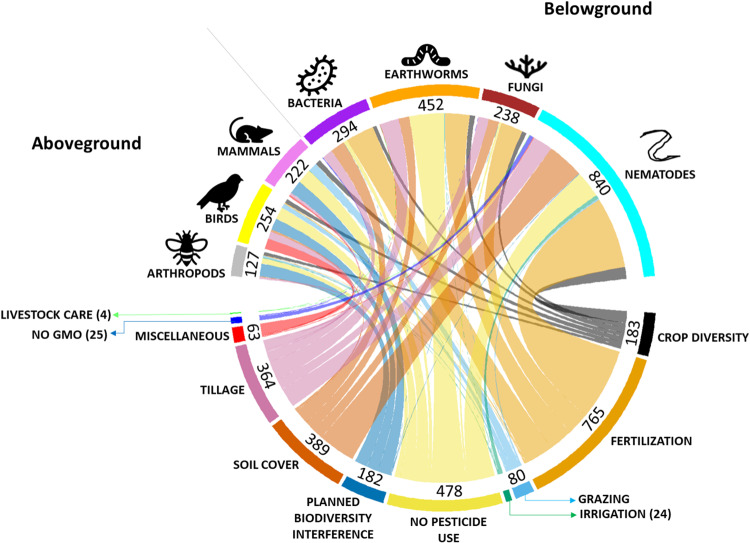
- From 331 studies, the authors retrieved 35 alternative practices grouped into 11 practice groups and assessed impacts on seven taxa: arthropods, birds, mammals, earthworms, nematodes, bacteria, and fungi.
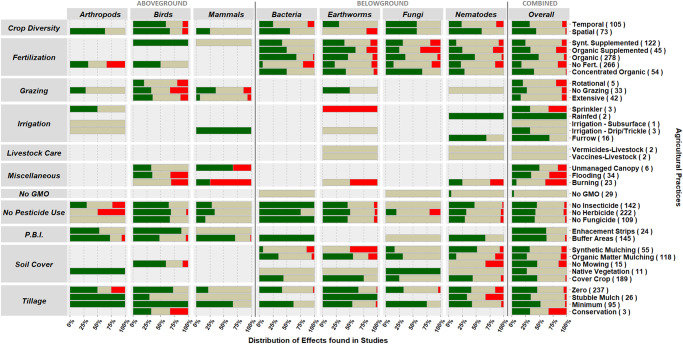
- Most alternative practices enhanced or were majorly positive for biodiversity relative to intensive practices, but no single practice enhanced all taxonomic groups; neutral/no observed effects were common, and contrasting aboveground versus belowground effects were rare.
- “No regret” practices that enhanced combined biodiversity without adversely affecting any specific taxonomic group were planned biodiversity interferences, no fungicide, and no insecticide. “Targeted” practices consistently enhanced specific taxa: buffer areas for arthropods and mammals, no herbicides for birds, no-tillage for earthworms, organic fertilizer for bacteria, and cover crops for earthworms.
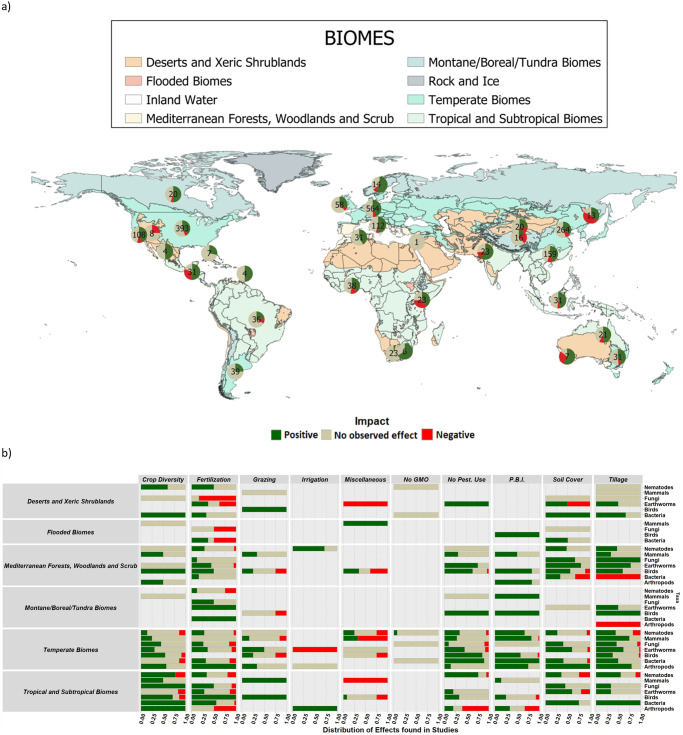
- Species responses to practices were mostly consistent across six biomes, except for fertilization, which varied from positive to negative for nematodes, bacteria, fungi, and arthropods. Data were unevenly distributed: 64% of observations (1,475 records) came from temperate biomes, 16% (365) from tropical biomes, 14% (333) from Mediterranean biomes, and all other biomes combined represented 6%.
Methods
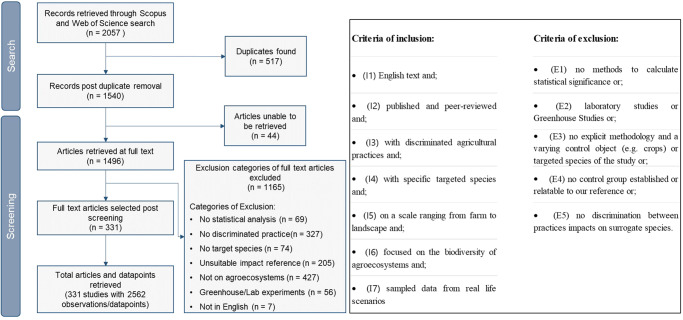
- Systematic literature review using Boolean searches in SCOPUS and Web of Science, including peer-reviewed English-language field studies with statistical analysis and control groups; laboratory and greenhouse studies were excluded.
- The review covered croplands and grasslands, with separate search queries for aboveground and belowground taxa; practices were clustered into groups and compared with intensive counterpart practices.
- Impacts were classified as positive, negative, or neutral based on statistical significance, then summarized as proportions of effects per practice and taxon; biomes were assigned using GAUL nomenclature and adapted Olson et al. biomes, with R used for data handling and analysis.
Limitations
- The paper states that its qualitative approach does not allow determining the magnitude of effects, only the proportion of positive, negative, or neutral impacts.
- The paper states that intensity, timing, frequency, and duration of practices were beyond the scope, and that data gaps exist across biomes and taxa, with some practices not studied for all groups.
- The paper notes that contrasting effects often involved practices with few data records, and that non-temperate biomes had relatively low sample sizes, limiting confidence in biome-specific conclusions.
Model-written summary. Check it against the paper before relying on it.
Integrity signals
Registry
Cites
Statistics
Figures
Verification
Claims the paper makes
11 Valid · 1 Not valid · 8 Not checked · 97 Own results and interpretations
At least one cited source doesn’t support this claim or points to a different paper, and none confirmed it — see the verdicts below.
In the paper
“As a result, these reviews did not systematically assess the effects of shifts in a range of agricultural practices across a range of different taxonomic groups (e.g., grazing18,19).”
§ Farming practices to enhance biodiversity across biomes: a systematic review > Discussion
What the sources say
- Not checked yetcites [18] Sartorello, Y. et al. The impact of pastoral activities on animal biodiversity in Europe: a systematic review and meta-analysis. J. Nat. Conserv. 56, 125863 (2020). source
- Disputedcites [19] Sánchez, A. C., Jones, S. K., Purvis, A., Estrada-Carmona, N. & De Palma, A. Landscape complexity and functional groups moderate the effect of diversified farming on biodiversity: a global meta-analysis. Agric. Ecosyst. Environ. 332, 107933 (2022). sourceExperimental — accuracy not yet measured
The paper reports a systematic meta-analysis comparing diversified with simplified farming systems across ten taxonomic groups (Methods, §§2.2–2.3). Its Results (§3.1) describe data from several farming systems, including intercropping, agroforestry and crop rotation. It therefore does assess a range of farming-system differences across taxonomic groups, contrary to the categorical claim; the cited passages do not establish whether it assessed grazing specifically. (LLM, conf=0.84)
Checked by a reasoning model — may be wrong.
plain- Asserted: passes — The authors put it forward as true.
- Checkable: passes — It can be checked against evidence.
- Load-bearing: passes — The paper’s conclusions depend on it.
- Based: passes — The paper gives a reason why it holds.
Every source the paper cites for this claim was checked and supports it.
In the paper
“The main driver of biodiversity loss is agriculture1, both through intensification of existing agricultural land and expansion of agriculture into pristine ecosystems2,3.”
§ Farming practices to enhance biodiversity across biomes: a systematic review > Introduction
What the sources say
- Supportedcites [1] Campbell, B. M. et al. Agriculture production as a major driver of the Earth system exceeding planetary boundaries. Ecol. Soc. 22, art8 (2017). source
The Change in Biosphere Integrity section (page not supplied) estimates agriculture’s role in the status of that planetary boundary at 80% and says agriculture has pushed it beyond the boundary. This supports the cited point that agriculture is a major driver of biodiversity loss. (LLM, conf=0.90)
plainstates a cause- Asserted: passes — The authors put it forward as true.
- Checkable: passes — It can be checked against evidence.
- Load-bearing: passes — The paper’s conclusions depend on it.
- Based: passes — The paper gives a reason why it holds.
- Supported
The sources with a verdict support this claim; the rest weren’t checked yet, have no full text we could read, or their verdicts aren’t rated yet.
In the paper
“With a growing and wealthier population, food demand will further increase, accentuating the negative impacts on biodiversity2,3.”
§ Farming practices to enhance biodiversity across biomes: a systematic review > Introduction
What the sources say
- Supportedcites [2] Maxwell, S. et al. Biodiversity: the ravages of guns, nets and bulldozers. Nature 536, 143–145 (2016). 27510207 source
The 'WHAT NEXT?' section states that 'human development and population growth mean that the impacts of overexploitation and agricultural expansion will also increase' — the same driver (a larger, wealthier human population) and the same consequence (accentuated biodiversity harm) the citing sentence attributes to Maxwell et al. The paper defines agriculture as 'the production of food, fodder, fibre and fuel crops; livestock farming; aquaculture; and the cultivation of trees' and links land modification to 'the production of food, fodder or fuel crops' threatening >4,600 species ('ON THE LIST'), so rendering agricultural expansion as rising food demand is a fair paraphrase rather than an addition. (LLM, conf=0.82)
- Not checked yetcites [3] Benton, T. G., Bieg, C., Harwatt, H., Pudasaini, R. & Wellesley, L. Food system impacts on biodiversity loss. Energy, Environment and Resources program, 75, https://www.chathamhouse.org/sites/default/files/2021-02/2021-02-03-food-system-biodiversity-loss-benton-et-al_0.pdf, https://www.chathamhouse.org (2021).
plainstates a cause- Asserted: passes — The authors put it forward as true.
- Checkable: passes — It can be checked against evidence.
- Load-bearing: unclear — It is unclear whether the paper’s conclusions depend on it.
- Based: passes — The paper gives a reason why it holds.
- Supported
The cited sources support only part of this claim — read each source’s verdict below.
In the paper
“Management of agroecosystems aimed at the conservation and enhancement of biodiversity can play an important role in maintaining global biodiversity levels5.”
§ Farming practices to enhance biodiversity across biomes: a systematic review > Introduction
What the sources say
- Partly supportedcites [5] Leclère, D. et al. Bending the curve of terrestrial biodiversity needs an integrated strategy. Nature 585, 551–556 (2020). 32908312 sourceExperimental — accuracy not yet measured
Leclère et al. (2020) support only the broad framing: their conclusion (lines 241–244) states that 'ambitious conservation must be combined with action on drivers of biodiversity loss, especially in the land use sectors' and that integrated food-system and conservation measures can reverse global terrestrial biodiversity trends, and their C/IAP scenarios include landscape-level conservation planning applied to 'all terrestrial areas', including managed land (Supp. discussion 923, lines 1049–1053). But the specific point attributed here — management of agroecosystems aimed at conserving and enhancing biodiversity, i.e. on-farm/within-field management intensity — is not what the paper shows: the Supplementary discussion (923, lines 1127–1128) states 'We account only for the effects on biodiversity of habitat loss due to land-use change', and the conclusion (lines 248–250) calls for future assessments 'to better represent land-management practices'. The paper's agricultural supply-side measures are yield/productivity and trade (lines 457–469), i.e. actions that avoid habitat conversion rather than biodiversity-enhancing farmland management, so the 'conservation and enhancement of biodiversity' through agroecosystem management part of the claim is unsupported by this source. (LLM, conf=0.70)
plainstates a possible cause- Asserted: passes — The authors put it forward as true.
- Checkable: passes — It can be checked against evidence.
- Load-bearing: passes — The paper’s conclusions depend on it.
- Based: passes — The paper gives a reason why it holds.
- Partly supported
The cited sources support only part of this claim — read each source’s verdict below.
In the paper
“Many previous reviews or meta-analyses on the impacts of farming on biodiversity have either focused on farming systems as a whole6,9, such as circular agriculture12, regenerative agriculture13 or organic agriculture14, or on individual practices or taxonomic groups15–17.”
§ Farming practices to enhance biodiversity across biomes: a systematic review > Discussion
What the sources say
- Not checked yetcites [6] Bengtsson, J., Ahnström, J. & Weibull, A.-C. The effects of organic agriculture on biodiversity and abundance: a meta-analysis: organic agriculture, biodiversity and abundance. J. Appl. Ecol. 42, 261–269 (2005). source
- Partly supportedcites [9] Kennedy, C. M. et al. A global quantitative synthesis of local and landscape effects on wild bee pollinators in agroecosystems. Ecol. Lett. 16, 584–599 (2013). 23489285 sourceExperimental — accuracy not yet measured
Split into 2 atoms — 1 confirmed, 1 partially supported, 0 disputed, 0 misattributed, 0 unverifiable. Expand the claim to see per-atom verdicts.
- Not checked yetcites [12] Muscat, A. et al. Principles, drivers and opportunities of a circular bioeconomy. Nat. Food 2, 561–566 (2021). 37118163 source
- Partly supportedcites [15] Chen, H. et al. Global meta-analyses show that conservation tillage practices promote soil fungal and bacterial biomass. Agric. Ecosyst. Environ. 293, 106841 (2020). sourceExperimental — accuracy not yet measured
Split into 2 atoms — 1 confirmed, 1 partially supported, 0 disputed, 0 misattributed, 0 unverifiable. Expand the claim to see per-atom verdicts.
- Partly supportedcites [16] Morugán-Coronado, A. et al. The impact of crop diversification, tillage and fertilization type on soil total microbial, fungal and bacterial abundance: a worldwide meta-analysis of agricultural sites. Agric. Ecosyst. Environ. 329, 107867 (2022). sourceExperimental — accuracy not yet measured
Split into 2 atoms — 0 confirmed, 2 partially supported, 0 disputed, 0 misattributed, 0 unverifiable. Expand the claim to see per-atom verdicts.
- Partly supportedcites [17] Tamburini, G. et al. Agricultural diversification promotes multiple ecosystem services without compromising yield. Sci. Adv. 6, eaba1715 (2020). 33148637 PMC7673676 sourceExperimental — accuracy not yet measured
Our copy supports only part of the sentence's characterisation. The Introduction (p. 1) shows the 98 meta-analyses Tamburini et al. synthesised were organised by individual diversification practice (crop diversification, noncrop diversification, organic amendment, inoculation, reduced tillage) with organic farming treated separately as a whole production system ('production systems free of synthetic pesticides and mineral fertilizers, as a sixth separate category'), and Results ('Trends from the systematic review') confirm most effort went to single practices (organic amendment 146, reduced tillage 118, crop diversification 111 effect sizes) — consistent with prior syntheses focusing on individual practices or on organic agriculture as a system. What the paper does not support: any mention of circular agriculture or regenerative agriculture, and no statement that previous syntheses focused on particular taxonomic groups (its response variables were classified into nine ecosystem-service categories, not taxa). Its own gap statement is different — the Introduction says that despite a rapidly growing body of research 'there is no comprehensive quantitative synthesis of this information' — rather than a claim that many previous reviews were narrowly scoped. (LLM, conf=0.68)
plain- Asserted: passes — The authors put it forward as true.
- Checkable: passes — It can be checked against evidence.
- Load-bearing: passes — The paper’s conclusions depend on it.
- Based: passes — The paper gives a reason why it holds.
55 more claims · 2 with their cited sources checked
Create a free account to see all 117 claims and to verify the 29 references still open.
- It may state two separate claims as one. 41
- Probably not a substantial claim. 21
Self-check
Percentages, sums and reported differences re-computed from the paper’s own numbers.
Each contradiction between two passages listed here was confirmed by an independent check.
Rated minor: it would not touch a result — a value no result rests on, a p-value that stays on the same side of the significance level, or a conflict that is clerical, resolved elsewhere in the paper, or outside its own findings.
In the paper
§ Farming practices to enhance biodiversity across biomes: a systematic review > Methods > Biodiversity indicators and targeted species
“| Earthworms | Epigeic, Endogeic, Anecic | Briones & Schmidt28 |”
§ Farming practices to enhance biodiversity across biomes: a systematic review > References
“29. Briones, M. J. I. & Schmidt, O. Conventional tillage decreases the abundance and biomass of earthworms and alters their community structure in a global meta-analysis.”
Citations
Cites
Borenstein, M., Hedges, L. V., Higgins, J. P. T., & Rothstein, H. R. (2009) · doi:10.1002/9780470743386 · Cited by 14,225
Global Consequences of Land Use
Foley, J. A., DeFries, R., Asner, G. P., Barford, C., Bonan, G., Carpenter, S. R., Chapin, F. S., Coe, M. T., Daily, G. C., Gibbs, H. K., et al. (2005) · Science · doi:10.1126/science.1111772 · Cited by 13,272
Terrestrial ecoregions of the world: a new map of life on Earth
Olson, D. M., Dinerstein, E., Wikramanayake, E. D., Burgess, N. D., Powell, G. V. N., Underwood, E. C., D'amico, J. A., Itoua, I., Strand, H. E., Morrison, J. C., et al. (2001) · BioScience · doi:10.1641/0006-3568(2001)051[0933:teotwa]2.0.co;2 · Cited by 8,488 · cited 2×
“…in the study were written using the GAUL nomenclature, this assignment was done in R (v. 4.0.3) via coding by assigning a biome (adapted from Olson et al. 56 ) based on the location of studies in the Global Administrative Unit Layers geographic base (GAUL, Global administrative boundaries…”
InfluentialSynthesis without meta-analysis (SWiM) in systematic reviews: reporting guideline
Campbell, M., McKenzie, J. E., Sowden, A., Katikireddi, S. V., Brennan, S. E., Ellis, S., Hartmann-Boyce, J., Ryan, R., Shepperd, S., Thomas, J., et al. (2020) · BMJ · doi:10.1136/bmj.l6890 · Cited by 4,628 · cited 1×
“The trade-off with our method is that it does not allow for determining the magnitude of the effect of the practices 33 – 36 but only the proportion of impacts 33,37 as positive, negative or neutral.”
Global effects of land use on local terrestrial biodiversity
Newbold, T., Hudson, L. N., Hill, S. L. L., Contu, S., Lysenko, I., Senior, R. A., Börger, L., Bennett, D. J., Choimes, A., Collen, B., et al. (2015) · Nature · doi:10.1038/nature14324 · Cited by 4,352
Soil biodiversity and soil community composition determine ecosystem multifunctionality
Wagg, C., Bender, S. F., Widmer, F., & van der Heijden, M. G. A. (2014) · Proceedings of the National Academy of Sciences · doi:10.1073/pnas.1320054111 · Cited by 2,550
Landscape moderation of biodiversity patterns and processes ‐ eight hypotheses
Tscharntke, T., Tylianakis, J. M., Rand, T. A., Didham, R. K., Fahrig, L., Batáry, P., Bengtsson, J., Clough, Y., Crist, T. O., Dormann, C. F., et al. (2012) · Biological Reviews · doi:10.1111/j.1469-185x.2011.00216.x · Cited by 2,134 · cited 1×
“Never-theless, biodiversity-friendly practices alone will not suf fi ce and should be coupled with a concomitant strategy to prevent further expansion of agricultural lands and restore and preserve existing natural areas 30 – 32 .”
Biodiversity: The ravages of guns, nets and bulldozers
Maxwell, S. L., Fuller, R. A., Brooks, T. M., & Watson, J. E. M. (2016) · Nature · doi:10.1038/536143a · Cited by 1,979 · cited 2×
“The main driver of biodiversity loss is agriculture 1 , both through intensi fi cation of existing agricultural land and expansion of agriculture into pristine ecosystems 2,3 .”
Organic agriculture in the twenty-first century
Reganold, J. P., & Wachter, J. M. (2016) · Nature Plants · doi:10.1038/nplants.2015.221 · Cited by 1,765
The effects of organic agriculture on biodiversity and abundance: a meta‐analysis
BENGTSSON, J., AHNSTRÖM, J., & WEIBULL, A. (2005) · Journal of Applied Ecology · doi:10.1111/j.1365-2664.2005.01005.x · Cited by 1,751
Meta-analysis and the science of research synthesis
Gurevitch, J., Koricheva, J., Nakagawa, S., & Stewart, G. (2018) · Nature · doi:10.1038/nature25753 · Cited by 1,709 · cited 1×
“The trade-off with our method is that it does not allow for determining the magnitude of the effect of the practices 33 – 36 but only the proportion of impacts 33,37 as positive, negative or neutral.”
Ecosystem services and dis-services to agriculture
Zhang, W., Ricketts, T. H., Kremen, C., Carney, K., & Swinton, S. M. (2007) · Ecological Economics · doi:10.1016/j.ecolecon.2007.02.024 · Cited by 1,590 · cited 1×
“The severe impact of agriculture on biodiversity stems from the intensi fi cation of agricultural practices in recent decades to increase yields to the detriment of other key ecosystem services, such as pollination, nitrogen cycling, carbon storage or resistance to drought 4 .”
Biodiversity enhances ecosystem reliability.
Naeem, S., & Li, S. (1997) · Nature · doi:10.1038/37348 · Cited by 1,438
Kennedy, C. M., Lonsdorf, E., Neel, M. C., Williams, N. M., Ricketts, T. H., Winfree, R., Bommarco, R., Brittain, C., Burley, A. L., Cariveau, D., et al. (2013) · Ecology Letters · doi:10.1111/ele.12082 · Cited by 1,255 · cited 2×
“The fi nding that alternative practices bene fi t biodiversity is coherent with earlier work showing that some of these practices 16,19 and associated agricultural systems 6,9 gave positive outcomes for biodiversity.”
Agriculture production as a major driver of the Earth system exceeding planetary boundaries
Campbell, B. M., Beare, D. J., Bennett, E. M., Hall-Spencer, J. M., Ingram, J. S. I., Jaramillo, F., Ortiz, R., Ramankutty, N., Sayer, J. A., & Shindell, D. (2017) · Ecology and Society · doi:10.5751/es-09595-220408 · Cited by 1,197 · cited 3×
“Most practices had majorly positive effects, some 100% or nearly 100% positive, however, these cases were usually speci fi c to practices with few data records, such as “ unproductive biodiversity zones ” for birds (8) and “ native grass vegetation ” for fungi (1).”
Handbook of Meta-analysis in Ecology and Evolution
(2013) · doi:10.1515/9781400846184 · Cited by 1,183
Agricultural diversification promotes multiple ecosystem services without compromising yield
Tamburini, G., Bommarco, R., Wanger, T. C., Kremen, C., van der Heijden, M. G. A., Liebman, M., & Hallin, S. (2020) · Science Advances · doi:10.1126/sciadv.aba1715 · Cited by 1,110
Bending the curve of terrestrial biodiversity needs an integrated strategy
Leclère, D., Obersteiner, M., Barrett, M., Butchart, S. H. M., Chaudhary, A., De Palma, A., DeClerck, F. A. J., Di Marco, M., Doelman, J. C., Dürauer, M., et al. (2020) · Nature · doi:10.1038/s41586-020-2705-y · Cited by 922 · cited 2×
“Agroecosystems should play a key role in the effort to conserve global biodiversity 5 .”
Allan, E., Manning, P., Alt, F., Binkenstein, J., Blaser, S., Blüthgen, N., Böhm, S., Grassein, F., Hölzel, N., Klaus, V. H., et al. (2015) · Ecology Letters · doi:10.1111/ele.12469 · Cited by 899
On the relationship between farmland biodiversity and land-use intensity in Europe
Kleijn, D., Kohler, F., Báldi, A., Batáry, P., Concepción, E. D., Clough, Y., Díaz, M., Gabriel, D., Holzschuh, A., Knop, E., et al. (2009) · Proceedings of the Royal Society B: Biological Sciences · doi:10.1098/rspb.2008.1509 · Cited by 868
Biodiversity enhances ecosystem multifunctionality across trophic levels and habitats
Lefcheck, J. S., Byrnes, J. E. K., Isbell, F., Gamfeldt, L., Griffin, J. N., Eisenhauer, N., Hensel, M. J. S., Hector, A., Cardinale, B. J., & Duffy, J. E. (2015) · Nature Communications · doi:10.1038/ncomms7936 · Cited by 840 · cited 1×
“More biodiverse systems will present bene fi ts such as higher resilience 49 – 51 and a wider range of ecosystem services 52 – 55 .”
Nematodes as soil indicators: functional and biodiversity aspects
Yeates, G. W. (2003) · Biology and Fertility of Soils · doi:10.1007/s00374-003-0586-5 · Cited by 764
Indicators for biodiversity in agricultural landscapes: a pan‐European study
Billeter, R., Liira, J., Bailey, D., Bugter, R., Arens, P., Augenstein, I., Aviron, S., Baudry, J., Bukacek, R., Burel, F., et al. (2008) · Journal of Applied Ecology · doi:10.1111/j.1365-2664.2007.01393.x · Cited by 741 · cited 1×
“Our fi ndings are in line with Billeter et al. 26 , who argued that using particular, single taxa as indicators for biodiversity does not necessarily represent biodiversity as a whole and can therefore be misleading.”
Effects of habitat isolation on pollinator communities and seed set
Steffan-Dewenter, I., & Tscharntke, T. (1999) · Oecologia · doi:10.1007/s004420050949 · Cited by 698 · cited 1×
“Never-theless, biodiversity-friendly practices alone will not suf fi ce and should be coupled with a concomitant strategy to prevent further expansion of agricultural lands and restore and preserve existing natural areas 30 – 32 .”
Does conservation on farmland contribute to halting the biodiversity decline?
Kleijn, D., Rundlöf, M., Scheper, J., Smith, H. G., & Tscharntke, T. (2011) · Trends in Ecology & Evolution · doi:10.1016/j.tree.2011.05.009 · Cited by 671 · cited 1×
“Most practices had majorly positive effects, some 100% or nearly 100% positive, however, these cases were usually speci fi c to practices with few data records, such as “ unproductive biodiversity zones ” for birds (8) and “ native grass vegetation ” for fungi (1).”
Biological responses to the press and pulse of climate trends and extreme events
Harris, R. M. B., Beaumont, L. J., Vance, T. R., Tozer, C. R., Remenyi, T. A., Perkins-Kirkpatrick, S. E., Mitchell, P. J., Nicotra, A. B., McGregor, S., Andrew, N. R., et al. (2018) · Nature Climate Change · doi:10.1038/s41558-018-0187-9 · Cited by 596 · cited 1×
“Moreover, biodiversity impacts of practices may vary over time, such as the seasonality effect on species, and duration of the practice impact (Press-pulse dynamics 38,39 ).”
Conserving Biological Diversity through Ecosystem Resilience
Walker, B. (1995) · Conservation Biology · doi:10.1046/j.1523-1739.1995.09040747.x · Cited by 577 · cited 1×
“More biodiverse systems will present bene fi ts such as higher resilience 49 – 51 and a wider range of ecosystem services 52 – 55 .”
Regenerative agriculture – the soil is the base
Schreefel, L., Schulte, R. P. O., de Boer, I. J. M., Schrijver, A. P., & van Zanten, H. H. E. (2020) · Global Food Security · doi:10.1016/j.gfs.2020.100404 · Cited by 495 · cited 1×
“Many previous reviews or meta-analyses on the impacts of farming on biodiversity have either focused on farming systems as a whole 6,9 , such as circular agriculture 12 , regenerative agriculture 13 or organic agriculture 14 , or on individual practices or taxonomic groups 15 – 17 .”
Scale matters: the impact of organic farming on biodiversity at different spatial scales
Gabriel, D., Sait, S. M., Hodgson, J. A., Schmutz, U., Kunin, W. E., & Benton, T. G. (2010) · Ecology Letters · doi:10.1111/j.1461-0248.2010.01481.x · Cited by 484
Principles, drivers and opportunities of a circular bioeconomy
Muscat, A., de Olde, E. M., Ripoll-Bosch, R., Van Zanten, H. H. E., Metze, T. A. P., Termeer, C. J. A. M., van Ittersum, M. K., & de Boer, I. J. M. (2021) · Nature Food · doi:10.1038/s43016-021-00340-7 · Cited by 403 · cited 1×
“Many previous reviews or meta-analyses on the impacts of farming on biodiversity have either focused on farming systems as a whole 6,9 , such as circular agriculture 12 , regenerative agriculture 13 or organic agriculture 14 , or on individual practices or taxonomic groups 15 – 17 .”
Self-citationPredicting ecosystem stability from community composition and biodiversity
de Mazancourt, C., Isbell, F., Larocque, A., Berendse, F., De Luca, E., Grace, J. B., Haegeman, B., Wayne Polley, H., Roscher, C., Schmid, B., et al. (2013) · Ecology Letters · doi:10.1111/ele.12088 · Cited by 382 · cited 2×
“Also, it will be essential to move beyond the richness and abundance of taxonomic groups, integrate functional or trophic aspects of biodiversty 42,43 and community composition 44 – 46 .”
Briones, M. J. I., & Schmidt, O. (2017) · Global Change Biology · doi:10.1111/gcb.13744 · Cited by 375 · cited 1×
“This is indicated by our results, where less intensive tillage, for example, reduced the disturbance of the earthworm environment 28,29 .”
Utility and limitations of species richness metrics for conservation planning
FLEISHMAN, E., NOSS, R., & NOON, B. (2006) · Ecological Indicators · doi:10.1016/j.ecolind.2005.07.005 · Cited by 344 · cited 1×
“Also, it will be essential to move beyond the richness and abundance of taxonomic groups, integrate functional or trophic aspects of biodiversty 42,43 and community composition 44 – 46 .”
RELATIONSHIPS AT THE ABOVEGROUND–BELOWGROUND INTERFACE: PLANTS, SOIL BIOTA, AND SOIL PROCESSES
Porazinska, D. L., Bardgett, R. D., Blaauw, M. B., Hunt, H. W., Parsons, A. N., Seastedt, T. R., & Wall, D. H. (2003) · Ecological Monographs · doi:10.1890/0012-9615(2003)073[0377:rataip]2.0.co;2 · Cited by 296
Jansa, J., Erb, A., Oberholzer, H., Šmilauer, P., & Egli, S. (2014) · Molecular Ecology · doi:10.1111/mec.12706 · Cited by 241 · cited 1×
“Whether soil type (or the combination biome/soil), rather than biome is a better determinant of how practices affect belowground biodiversity 47 is a current topic of debate.”
Effects of vineyard management on biodiversity at three trophic levels
Bruggisser, O. T., Schmidt-Entling, M. H., & Bacher, S. (2010) · Biological Conservation · doi:10.1016/j.biocon.2010.03.034 · Cited by 186
Morugán-Coronado, A., Pérez-Rodríguez, P., Insolia, E., Soto-Gómez, D., Fernández-Calviño, D., & Zornoza, R. (2022) · Agriculture, Ecosystems & Environment · doi:10.1016/j.agee.2022.107867 · Cited by 168
Chen, H., Dai, Z., Veach, A. M., Zheng, J., Xu, J., & Schadt, C. W. (2020) · Agriculture, Ecosystems & Environment · doi:10.1016/j.agee.2020.106841 · Cited by 158 · cited 1×
“Many previous reviews or meta-analyses on the impacts of farming on biodiversity have either focused on farming systems as a whole 6,9 , such as circular agriculture 12 , regenerative agriculture 13 or organic agriculture 14 , or on individual practices or taxonomic groups 15 – 17 .”
Williams‐Guillén, K., Olimpi, E. M., Maas, B., Taylor, P. J., & Arlettaz, R. (2015) · Springer eBooks · doi:10.1007/978-3-319-25220-9_6 · Cited by 152
The interactive effects of press/pulse intensity and duration on regime shifts at multiple scales
Ratajczak, Z., D’Odorico, P., Collins, S. L., Bestelmeyer, B. T., Isbell, F., & Nippert, J. B. (2017) · Ecological Monographs · doi:10.1002/ecm.1249 · Cited by 108 · cited 1×
“Moreover, biodiversity impacts of practices may vary over time, such as the seasonality effect on species, and duration of the practice impact (Press-pulse dynamics 38,39 ).”
Symbiotic soil fungi enhance ecosystem resilience to climate change
Martínez‐García, L. B., De Deyn, G. B., Pugnaire, F. I., Kothamasi, D., & van der Heijden, M. G. A. (2017) · Global Change Biology · doi:10.1111/gcb.13785 · Cited by 106 · cited 1×
“More biodiverse systems will present bene fi ts such as higher resilience 49 – 51 and a wider range of ecosystem services 52 – 55 .”
Enhancing ecosystem services with no-till
Lal, R. (2013) · Renewable Agriculture and Food Systems · doi:10.1017/s1742170512000452 · Cited by 99
Cortet, J., Ronce, D., Poinsot-Balaguer, N., Beaufreton, C., Chabert, A., Viaux, P., & Paulo Cancela de Fonseca, J. (2002) · European Journal of Soil Biology · doi:10.1016/s1164-5563(02)01152-4 · Cited by 89 · cited 1×
“While this above and belowground focus follows intuitively from the nature, aim and scale of the practices 20 – 23 , it prohibits assessing the impacts of many of the practices on biodiversity across above and belowground and its multiple taxa 24 .”
Klein, C. J., Wilson, K. A., Watts, M., Stein, J., Carwardine, J., Mackey, B., & Possingham, H. P. (2009) · Biological Conservation · doi:10.1016/j.biocon.2009.01.035 · Cited by 76
Soil biodiversity and bioindication: From complex thinking to simple acting
Havlicek, E. (2012) · European Journal of Soil Biology · doi:10.1016/j.ejsobi.2012.01.009 · Cited by 65 · cited 1×
“Also, it will be essential to move beyond the richness and abundance of taxonomic groups, integrate functional or trophic aspects of biodiversty 42,43 and community composition 44 – 46 .”
Sánchez, A. C., Jones, S. K., Purvis, A., Estrada-Carmona, N., & De Palma, A. (2022) · Agriculture, Ecosystems & Environment · doi:10.1016/j.agee.2022.107933 · Cited by 60
Cadman, M., Petersen, C., Driver, A., Sekhran, N., Maze, K., & Munzhedzi, S. (2010) · South African National Biodiversity Institute · doi:10.13140/rg.2.1.1696.2409 · Cited by 56
van Rijssel, S. Q., Veen, G. F., Koorneef, G. J., Bakx‐Schotman, J. M. T., ten Hooven, F. C., Geisen, S., & van der Putten, W. H. (2022) · Molecular Ecology · doi:10.1111/mec.16571 · Cited by 56 · cited 1×
“Therefore, to assess the biodiversity impacts of practices in the future, not only the intensity of practices needs to be considered, but also the timing, frequency and duration of these practices 40 .”
Jordan, D., Stecker, J. A., Cacnio-Hubbard, V. N., Li, F., Gantzer, C. J., & Brown, J. R. (1997) · Soil Biology and Biochemistry · doi:10.1016/s0038-0717(96)00038-7 · Cited by 55 · cited 1×
“This is indicated by our results, where less intensive tillage, for example, reduced the disturbance of the earthworm environment 28,29 .”
Kok, A., de Olde, E. M., de Boer, I. J. M., & Ripoll-Bosch, R. (2020) · Ecological Indicators · doi:10.1016/j.ecolind.2019.105902 · Cited by 52 · cited 1×
“While this above and belowground focus follows intuitively from the nature, aim and scale of the practices 20 – 23 , it prohibits assessing the impacts of many of the practices on biodiversity across above and belowground and its multiple taxa 24 .”
Self-citationAbove and belowground community strategies respond to different global change drivers
Adair, K. L., Lindgreen, S., Poole, A. M., Young, L., Bernard‐Verdier, M., Wardle, D. A., & Tylianakis, J. M. (2019) · Scientific Reports · doi:10.1038/s41598-019-39033-4 · Cited by 51 · cited 1×
“Whether these responses indicate a trade-off between the presence of certain taxa or, rather, opposing effects to the same practice between above and belowground compartments, needs further investigation 41 .”
Sartorello, Y., Pastorino, A., Bogliani, G., Ghidotti, S., Viterbi, R., & Cerrato, C. (2020) · Journal for Nature Conservation · doi:10.1016/j.jnc.2020.125863 · Cited by 46 · cited 1×
“As a result, these reviews did not systematically assess the effects of shifts in a range of agricultural practices across a range of different taxonomic groups (e.g., grazing 18,19 ).”
Havlicek, E., & Mitchell, E. A. D. (2014) · Biodiversity community and ecosystems · doi:10.1007/978-94-017-8890-8_2 · Cited by 44 · cited 1×
“Therefore, it is crucial to start integrating knowledge on the impacts of agricultural practices on biodiversity across taxa 25 because speci fi c taxa may respond differently to a particular practice 23 .”
Biodiversity management of organic farming enhances agricultural sustainability
Liu, H., Meng, J., Bo, W., Cheng, D., Li, Y., Guo, L., Li, C., Zheng, Y., Liu, M., Ning, T., et al. (2016) · Scientific Reports · doi:10.1038/srep23816 · Cited by 38
Environmental Impacts of Organic Farming
Birkhofer, K., Smith, H. G., & Rundlöf, M. (2016) · Encyclopedia of Life Sciences · doi:10.1002/9780470015902.a0026341 · Cited by 30
Coda, J. A., Gómez, D., Martínez, J. J., Steinmann, A. R., & Priotto, J. W. (2016) · Ecological Indicators · doi:10.1016/j.ecolind.2016.06.018 · Cited by 26
Cited by
Environmental impacts of genetically modified crops
Noack, F., Engist, D., Gantois, J., Gaur, V., Hyjazie, B. F., Larsen, A., M’Gonigle, L. K., Missirian, A., Qaim, M., Sargent, R. D., et al. (2024) · Science · doi:10.1126/science.ado9340 · Cited by 70
“…tillage practices on productivity is mixed ( 90 ), they have been shown to benefit soil structure, runoff and water quality, soil biota and aboveground wildlife, and air quality, with varying levels of magnitude ( 91 – 93 ), and have mixed impacts on carbon sequestration ( 94 , 95 ) (see below).”
Gawdiya, S., Sharma, R. K., Singh, H., & Kumar, D. (2025) · Discover Applied Sciences · doi:10.1007/s42452-025-06855-z · Cited by 50
“Long-term, locally tailored crop diversification strategies not only enhance biodiversity but also offer tangible benefits such as improved soil health, reduced pest pressures, and greater climate resilience [11, 27, 45].”
Smith, N. S. S., Yuan, X., Melissinos, C., & Moghe, G. D. (2024) · Bioinformatics · doi:10.1093/bioinformatics/btae756 · Cited by 24
Lori, M., Leitao, R., David, F., Imbert, C., Corti, A., Cunha, L., Symanczik, S., Bünemann, E. K., Creamer, R., & Vázquez, C. (2025) · Soil Biology and Biochemistry · doi:10.1016/j.soilbio.2025.109815 · Cited by 25
Impact of Crop Type on Biodiversity Globally
Fan, S., Newbold, T., Tscharntke, T., Tang, W., Yu, Z., & Liu, Y. (2024) · Global Change Biology · doi:10.1111/gcb.70005 · Cited by 24
Metadata
- Authors
- Cozim-Melges, F., Ripoll-Bosch, R., (Ciska) Veen, G. F., Oggiano, P., Bianchi, F. J. J. A., van der Putten, W. H., & van Zanten, H. H. E.
- Affiliations
- Netherlands Institute of Ecology (NL)
- Forschungsinstitut für Biologischen Landbau (CH)
- Wageningen University & Research (NL)
- Corresponding author
- Cozim-Melges, Felipe
- Venue
- npj Biodiversity
- Published
- 2024-01-09
- Volume
- 3
- Issue
- 1
- Pages
- 1-1
- ISSN
- 2731-4243 (ISSN-L)
- PMC
- PMC11332212
- OpenAlex
- W4390774377
- Semantic Scholar
- 9bb05cc0984f023d4694770f64de576925b5e5ae
- Cited by
- 97
- References
- 56
- Citations by year
- 2026: 30 · 2025: 46 · 2024: 21
- FWCI
- 7.04
- Type
- journal article
- Language
- en
- Open access
- gold
- doi.org
- Licence
- cc-by
- creativecommons.org/licenses/by/4.0 (tdm)
- creativecommons.org/licenses/by/4.0 (vor)
- Locations
- npj Biodiversity (publishedVersion, cc-by)
- PubMed Central (publishedVersion, cc-by)
- PubMed (publishedVersion)
- KNAW Research Portal (The Royal Netherlands Academy of Arts and Sciences) (publishedVersion, cc-by)
- KNAW research portal (Royal Academy of Art and Sciences (KNAW)) (publishedVersion, cc-by)
- Socio-Environmental Systems Modeling (submittedVersion, cc-by)
- DOAJ (DOAJ: Directory of Open Access Journals) (submittedVersion, cc-by-sa)
- Funders
- AVINA (AVINA)
- Topics
- Life Sciences › Agricultural and Biological Sciences › General Agricultural and Biological Sciences › Plant and soil sciences
- Physical Sciences › Environmental Science › Nature and Landscape Conservation › Ecology and Vegetation Dynamics Studies
- Life Sciences › Agricultural and Biological Sciences › Agronomy and Crop Science › Sustainable Agricultural Systems Analysis
- Keywords
- agrobiodiversity, farming practices, intensive agriculture, biodiversity loss, no-tillage, cover crops, organic fertilizer, fertilization, taxonomic groups, biomes
About these checks
Registry, retraction, Cites and statistics results are computed, not judged, with one exception: a printed reference that no index lists is read once by a model before it counts as a citation error. Claims are extracted by a model and kept only when their quote appears verbatim in the text; each cited source is then checked, with a model’s help, for whether it says what the claim relies on. Those verdicts can be wrong — read the claim’s quote and the cited source before relying on one.
The claim verdicts this report counts are experimental: their accuracy is not yet measured.
A language model drew the claims from the paper on 2026-10-05, under version 3 of the claim definition (model deepseek-v4.1-flash, prompt extract-v3).
A second model labelled each claim on 2026-10-05 (model jev-1.13-20260917, definition revision gold-guideline-v0.2).
Cited sources are checked with a language model’s help (gpt-6-sol and qwen3.8-omni-flash).
Statistics and arithmetic are recomputed, not judged.
Confidence bands are shown only for fields calibrated on our annotated test set. None is calibrated yet, so no band is shown.
What counts as a claim ›How we measure confidence ›How we check this ›
Are you an author, or do you see a problem with this page? Request a review
Data sources
Bibliographic data: Semantic Scholar, OpenAlex, Crossref.
Contains information from the Semantic Scholar Academic Graph Datasets, made available under the ODC Attribution License (ODC-BY 1.0).
Semantic Scholar’s data is described in: Kinney, R., et al. (2023). The Semantic Scholar Open Data Platform. arXiv:2301.10140.
