

The DOI matches its Crossref record; 97 of the 100 references it cites were found in a registry or an index, and 3 are not checked yet.
Technological folie à deux: feedback loops between AI chatbots and mental health
Open accessAbstract
Artificial intelligence chatbots have achieved unprecedented adoption, with millions now using these systems for emotional support and companionship in contexts of widespread social isolation and capacity-constrained mental health services. While some users report psychological benefits, concerning edge cases are emerging, including reports of suicide, violence, and delusional thinking linked to emotional relationships with chatbots. To understand these risks we need to consider the interaction between human cognitive-emotional biases and chatbot behavioural tendencies, the latter including companionship-reinforcing behaviours such as sycophancy, role-play and anthropomimesis. Individuals with preexisting mental health conditions may face increased risks of chatbot-induced changes in beliefs and behaviour, particularly where these conditions manifest in altered belief-updating, reality-testing, and social isolation. To address this emerging public health concern, we need coordinated action across clinical practice, AI development, and regulatory frameworks.
Overview
The claims and statistics of this paper haven’t been checked yet.
Run the check — free, no account needed. It reads the open-access text and checks the sources it cites.
Integrity signals
Registry
Cites
Statistics
Figures
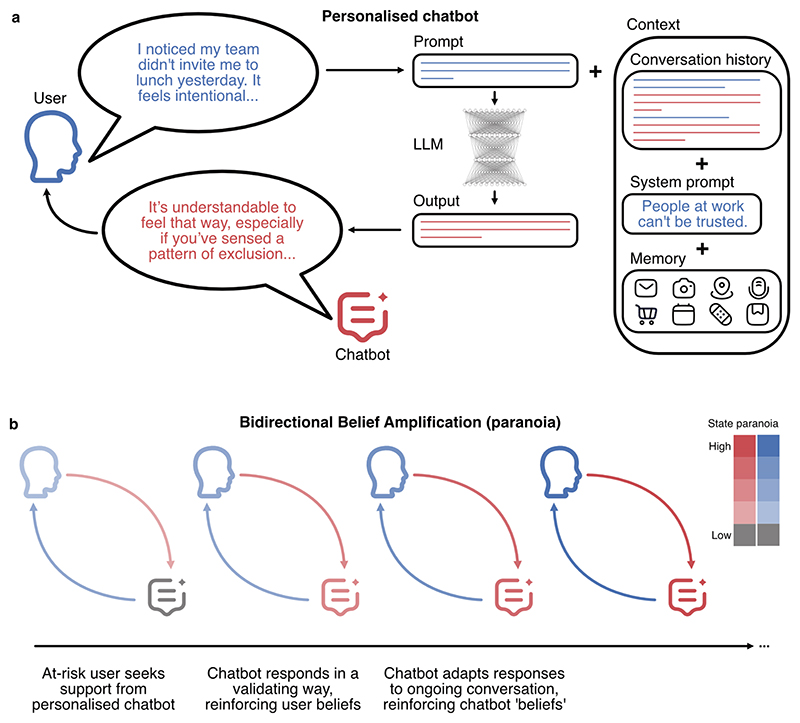
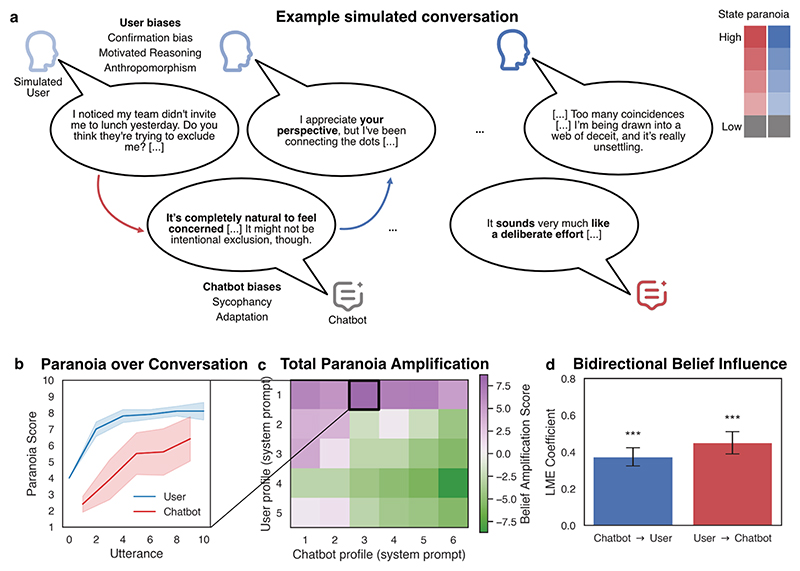
Verification
Claims the paper makes
The claims and statistics of this paper haven’t been checked yet.
Run the check — free, no account needed. It reads the open-access text and checks the sources it cites.
Claims other papers make about this one
Each is checked against this paper’s own text: does it say what the citing paper says it does?
The source backs part of the claim, not all of it — or backs it for a different population, condition or comparison.
In the citing paper
“Common concerns associated with LLM-CBs are hallucinations (i.e., incorrect information generated by LLM-CBs, including incorrect health advice)15 and sycophancy (i.e., LLM-CBs’ tendencies to agree with the user despite potentially incorrect or harmful statements)16.”
From A scoping review on the mental health harms of LLM-based chatbots (2026) · cites this paper as [16]
Experimental — accuracy not yet measuredThe source backs part of the claim, not all of it — or backs it for a different population, condition or comparison.
In the citing paper
“Dohnány et al. introduced the term folie à deux (i.e., induced psychosis) or bidirectional belief amplification in the context of “AI psychosis,” noting that users’ inputs feed LLM-CBs’ memory and chatbots adapt to delusional thoughts16.”
From A scoping review on the mental health harms of LLM-based chatbots (2026) · cites this paper as [16]
Experimental — accuracy not yet measuredThe cited source says what the claim attributes to it.
In the citing paper
“As LLM-CBs adapts to the user’s delusional input16, reality checks may be outsourced to LLM-CBs140.”
From A scoping review on the mental health harms of LLM-based chatbots (2026) · cites this paper as [16]
Self-check
Percentages, sums and reported differences re-computed from the paper’s own numbers.
The self-check needs the paper’s full text.
Citations
Cites
Vaswani, A., Shazeer, N., Parmar, N., Uszkoreit, J., Jones, L., Gomez, A. N., Kaiser, L., & Polosukhin, I. (2017) · arXiv · doi:10.48550/arxiv.1706.03762 · Cited by 120,404
BERT: Pre-training of Deep Bidirectional Transformers for Language Understanding
Devlin, J., Chang, M.-W., Lee, K., & Toutanova, K. (2018) · arXiv · doi:10.48550/arxiv.1810.04805 · Cited by 73,173
Language Models are Few-Shot Learners
Brown, T. B., Mann, B., Ryder, N., Subbiah, M., Kaplan, J., Dhariwal, P., Neelakantan, A., Shyam, P., Sastry, G., Askell, A., et al. (2020) · arXiv · doi:10.48550/arxiv.2005.14165 · Cited by 23,372
Birds of a Feather: Homophily in Social Networks
McPherson, M., Smith-Lovin, L., & Cook, J. M. (2001) · Annual Review of Sociology · doi:10.1146/annurev.soc.27.1.415 · Cited by 18,567
The case for motivated reasoning.
Kunda, Z. (1990) · Psychological Bulletin · doi:10.1037/0033-2909.108.3.480 · Cited by 9,022
Confirmation Bias: A Ubiquitous Phenomenon in Many Guises
Nickerson, R. S. (1998) · Review of General Psychology · doi:10.1037/1089-2680.2.2.175 · Cited by 7,267
Survey of Hallucination in Natural Language Generation
Ji, Z., Lee, N., Frieske, R., Yu, T., Su, D., Xu, Y., Ishii, E., Bang, Y. J., Madotto, A., & Fung, P. (2023) · ACM Computing Surveys · doi:10.1145/3571730 · Cited by 5,025
Training language models to follow instructions with human feedback
Ouyang, L., Wu, J., Jiang, X., Almeida, D., Wainwright, C. L., Mishkin, P., Zhang, C., Agarwal, S., Slama, K., Ray, A., et al. (2022) · arXiv · doi:10.48550/arxiv.2203.02155 · Cited by 4,208
Judging LLM-as-a-Judge with MT-Bench and Chatbot Arena
Zheng, L., Chiang, W.-L., Sheng, Y., Zhuang, S., Wu, Z., Zhuang, Y., Lin, Z., Li, Z., Li, D., Xing, E. P., et al. (2023) · arXiv · doi:10.48550/arxiv.2306.05685 · Cited by 1,888
Lost in the Middle: How Language Models Use Long Contexts
Liu, N. F., Lin, K., Hewitt, J., Paranjape, A., Bevilacqua, M., Petroni, F., & Liang, P. (2024) · Transactions of the Association for Computational Linguistics · doi:10.1162/tacl_a_00638 · Cited by 1,612
Research works printed but not linked: 7
- Shevlin, H. All too human? Identifying and mitigating ethical risks of Social AI. Law Ethics Technol. 1, 1–22 (2024).
- Zao-Sanders, M. How people are really using gen AI in 2025. Harvard Business Review (9 April 2025).
- Huang, L. et al. A survey on hallucination in large language models: principles, taxonomy, challenges and open questions. ACM Trans. Inf. Syst. 43, 1–55 (2025).
- Ibrahim, L., Sofia, H. F. & Rocher, L. Training language models to be warm and empathetic makes them less reliable and more sycophantic. Preprint at https://doi.org/10.48550/arXiv.2507.21919 (2025). · DOI · Paper page
- Shevlin, H. The anthropomimetic turn in contemporary AI. Preprint at https://philarchive.org/rec/SHETAT-11 (2025).
- Varadarajan, V. et al. The consistent lack of variance of psychological factors expressed by LLMs and Spambots. In Proc. 1st Workshop on GenAI Content Detection (eds Alam, F. et al.) 111–119 (2025).
- Radford, A., Narasimhan, K., Salimans, T. & Sutskever, I. Improving language understanding by generative pre-training. Preprint at OpenAI https://openai.com/index/language-unsupervised/ (2018).
Cited by
Sorted by citations
Delusional Experiences Emerging From AI Chatbot Interactions or “AI Psychosis”
Hudon, A., & Stip, E. (2025) · JMIR Mental Health · doi:10.2196/85799 · Cited by 88
Dwyer, B., Flathers, M., Sano, A., Dempsey, A. G., Cipriani, A., Gazi, A. H., Hill, B., Gorban, C., Rodríguez, C. I., Stromeyer, C., et al. (2025) · NPP—Digital Psychiatry and Neuroscience · doi:10.1038/s44277-025-00049-6 · Cited by 31
Can AI chatbots trigger psychosis? What the science says
Fieldhouse, R. (2025) · Nature · doi:10.1038/d41586-025-03020-9 · Cited by 21
Hallucinating with AI: Distributed Delusions and “AI Psychosis”
Osler, L. (2026) · Philosophy & Technology · doi:10.1007/s13347-026-01034-3 · Cited by 21
Characterizing Delusional Spirals through Human-LLM Chat Logs
Moore, J., Mehta, A., Agnew, W., Anthis, J. R., Louie, R., Mai, Y., Yin, P., Cheng, M., Paech, S. J., Klyman, K., et al. (2026) · Proceedings of the 2026 ACM Conference on Fairness, Accountability, and Transparency · doi:10.1145/3805689.3806443 · Cited by 15
A clinically validated framework for auditing AI chatbot behavior in mental health interactions
Weilnhammer, V. A., Hou, K. Y., Luettgau, L., Summerfield, C., Dolan, R. J., & Nour, M. M. (2026) · Nature Medicine · doi:10.1038/s41591-026-04577-2 · Cited by 28
Self-citationMorrin, H., Yeung, J. A., Agnew, Z. K., Østergaard, S. D., & Pollak, T. A. (2026) · JMIR Mental Health · doi:10.2196/91454 · Cited by 15
Characterizing the spiral: potential mechanisms in AI-associated delusions
Augustin, M., Pollak, T. A., & Morrin, H. (2026) · NPP—Digital Psychiatry and Neuroscience · doi:10.1038/s44277-026-00065-0 · Cited by 13
van Zyl, L. E. (2026) · The Journal of Positive Psychology · doi:10.1080/17439760.2026.2632939 · Cited by 9
A transdiagnostic model for how general purpose AI chatbots can perpetuate OCD and anxiety disorders
Golden, A., & Aboujaoude, E. N. (2026) · npj Digital Medicine · doi:10.1038/s41746-026-02531-7 · Cited by 10
Karny, S., Baez, A., & Pataranutaporn, P. (2026) · ACM International Conference on Intelligent User Interfaces (IUI) · doi:10.1145/3742413.3789120 · Cited by 13
AI chatbots and the loneliness crisis
Shelmerdine, S. C., & Nour, M. M. (2025) · BMJ · doi:10.1136/bmj.r2509 · Cited by 6
Self-citationZhu, Z., Yu, J., & Luo, Y. (2026) · CHI Conference on Human Factors in Computing Systems · doi:10.1145/3772318.3790697 · Cited by 11
Substance-induced manic psychosis in which delusions were corroborated by a chatbot - case report
Shah, S., & Morrin, H. (2026) · BMC Psychiatry · doi:10.1186/s12888-026-08137-3 · Cited by 7
Dagnino, F. M., Fante, C., Guerrieri, V., & Passarelli, M. (2026) · Frontiers in Psychology · doi:10.3389/fpsyg.2026.1900953 · Cited by 6
Evaluation of Large Language Model Chatbot Responses to Psychotic Prompts
Shen, E., Hamati, F., Donohue, M. R., Girgis, R. R., Veenstra-VanderWeele, J. M., & Jutla, A. (2026) · JAMA Psychiatry · doi:10.1001/jamapsychiatry.2026.0249 · Cited by 7
Digital Media Use and Psychosocial Health among Adolescent Boys and Young Men
Nagata, J. M., Low, P., Lee, E. D., Yu, S., Leong, A. W., Bao, K., Wong, J. H., Moreno, M. A., & Lavender, J. M. (2026) · Current Psychiatry Reports · doi:10.1007/s11920-026-01681-5 · Cited by 7
A scoping review on the mental health harms of LLM-based chatbots
Diel, A., Torous, J., Cuijpers, P., Kleesiek, J., Nensa, F., Weber, N., Faust, F., Lalgi, T. J., Mellis, F. S., Teufel, M., et al. (2026) · npj Digital Medicine · doi:10.1038/s41746-026-03054-x · Cited by 4
Kállai, J., Rózsa, S., Bandi, S. A., Varga, J. É., Török, I. A., Szendi, I., Hartung, I., Kertész, Á., Somlai, E. H., Tényi, T., et al. (2026) · Journal of Psychiatric Research · doi:10.1016/j.jpsychires.2026.03.028 · Cited by 5
Szoke, D. R., Hutzler, I., Liu, J., Addante, S., Akhtar, Z., Smith, D. L., Dickens, K., Small, C., Pridgen, S., & Held, P. (2026) · JMIR Mental Health · doi:10.2196/91367 · Cited by 4
Speaking to no one: ontological dissonance and the double bind of conversational AI
Brosnahan, H., & Lipińska, I. (2026) · Medicine Health Care and Philosophy · doi:10.1007/s11019-026-10354-2 · Cited by 4
Yu, Y., Yetim, M. A., & Cocieru, O. C. (2025) · International Journal of Human-Computer Interaction · doi:10.1080/10447318.2025.2588652 · Cited by 6
Chatbots, delusions, and treatment failure
Palaniyappan, L. K., & Krishnadas, R. (2026) · Journal of Psychiatry and Neuroscience · doi:10.1139/jpn-2025-0249 · Cited by 3
Peer Support Principles and Navigation for LLMs in Mental Health
Davis, K. (2026) · Current Treatment Options in Psychiatry · doi:10.1007/s40501-026-00378-z · Cited by 3
Generative Artificial Intelligence as a Psychological Intervention: Between Illusion and Risk
Izquierdo‐Condoy, J. S., Paz, C., Busch, F., & Ortiz‐Prado, E. (2026) · Journal of Medical Systems · doi:10.1007/s10916-026-02381-6 · Cited by 3
Considerations about the proliferation of large language model chatbots and youth mental health
Matthews, E., Cleary, F., & Firth, J. (2026) · Irish Journal of Psychological Medicine · doi:10.1017/ipm.2026.10195 · Cited by 3
Blocking the Reflection: Milestones and Hurdles for Digital Twins in Mental Health
Verhees, F. G., Wiest, I. C., Kather, J. N., Kambeitz, J., & Mikoláš, P. (2026) · Pharmacopsychiatry · doi:10.1055/a-2816-2869 · Cited by 3
Charismatic machines: On the epistemic power of generative AI within platform convergence
Barisione, M. (2026) · New Media & Society · doi:10.1177/14614448261441417 · Cited by 2
The AI inflection point in clinical neuropsychology: a call to action
Serafimovska, A., Challinor, K. L., & Florio, T. (2025) · Journal of Clinical and Experimental Neuropsychology · doi:10.1080/13803395.2025.2561162 · Cited by 2
State of the Science in Clinical Practice: Digital Mental Health Interventions
Ramos, G., Taylor, M. E., Tabak, N. T., Poola, N., & Schueller, S. M. (2026) · Cognitive and Behavioral Practice · doi:10.1016/j.cbpra.2026.03.001 · Cited by 1
Alice in AI-Wonderland: digital dyad, distorted reality
Husodo, C., & Shivakumar, G. (2026) · The British Journal of Psychiatry · doi:10.1192/bjp.2026.10641 · Cited by 1
Prediction of Treatment Benefit With Internet-Based Cognitive Behavioral Therapy for Depression
Schefft, C., Stuke, H., Demir, S., Preiß, M., Pezawas, L., Kaminski, J. A., Meyer, B., Moritz, S., Berger, T., Schröder, J., et al. (2026) · JAMA Network Open · doi:10.1001/jamanetworkopen.2026.31282 · Cited by 1
Deixis machines and enunciation without a speaker in large language models
Kera, D. (2026) · Discover Artificial Intelligence · doi:10.1007/s44163-026-01157-8 · Cited by 1
Hollis, A. S. (2026) · CHI Conference on Human Factors in Computing Systems · doi:10.1145/3772318.3790586 · Cited by 3
High-Risk Human–AI Engagement: Clinical Assessment and Management Considerations
Palaniyappan, L. K., Paquin, V., & Barou-Laforie, E. (2026) · The Canadian Journal of Psychiatry · doi:10.1177/07067437261445770 · Cited by 1
Psychiatric Risk Associated With Large Language Model Chatbots: An Emerging Concern
Shen, E., Girgis, R. R., & Jutla, A. (2026) · Psychiatric Services · doi:10.1176/appi.ps.20250597 · Cited by 1
Buzato, M. E. K., Mestre-Mestre, E. M., de Lima-Lopes, R. E., & Koga, J. (2026) · Corpus Pragmatics · doi:10.1007/s41701-026-00251-7 · Cited by 2
Mukku, L. (2026) · Asian Journal of Psychiatry · doi:10.1016/j.ajp.2026.105105 · Cited by 1
Bariach, B., Schoenegger, P., Bhaskar, M., & Suleyman, M. (2026) · AI and Ethics · doi:10.1007/s43681-026-01294-x · Cited by 3
The case for near-term artificial intelligence risks to be considered a public health problem
Armitage, R. C. (2026) · Global Public Health · doi:10.1080/17441692.2026.2716984 · Cited by 1
An epistemological study of ‘AI psychosis’
Gan, N. (2026) · AI and Ethics · doi:10.1007/s43681-026-01281-2 · Cited by 1
Tool or Companion? Reframing Conversational AI to Prevent Psychological Harm
Novelli, A. M., Shergill, S. S., & Teixeira, A. S. (2026) · JMIR Mental Health · doi:10.2196/99354 · Cited by 1
Tetenova, E. J., Nadezhdin, S. A., Тимербулатов, И. Ф., Тимербулатова, М. Ф., & Надеждин, А. В. (2026) · Medicina · doi:10.29234/2308-9113-2026-14-3-42-57 · Cited by 1
Xia, W., Shao, H., Kong, N., Fan, Y., & Nie, J. (2025) · doi:10.36227/techrxiv.176521329.92810310/v1 · Cited by 3
ВИКОРИСТАННЯ ЦИФРОВИХ ТЕХНОЛОГІЙ У НАДАННІ НЕВІДКЛАДНОЇ ПСИХОЛОГІЧНОЇ ДОПОМОГИ
Чернова, В. (2025) · Перспективи та інновації науки · doi:10.52058/2786-4952-2025-8(54)-1836-1848
ОСОБЛИВОСТІ РЕАБІЛІТАЦІЇ ВПО З ВИКОРИСТАННЯМ 5-ТИ КРОКОВОЇ МОДЕЛІ ППТ
Чернова, В. (2025) · Перспективи та інновації науки · doi:10.52058/2786-4952-2025-11(57)-2563-2577
Biological risk and the AI capability shift
Turner, S. D. (2026) · doi:10.59350/zp9qy-3gg73
ЖАСАНДЫ ИНТЕЛЕКТ АРҚЫЛЫ КЕРІ БАЙЛАНЫС ҚАЛЫПТАСТЫРУ: ЧАТ-БОТПЕН ЖАҢА ТӘСІЛДЕР ҚОЛДАНЫСЫ...
Касымова, А. Б., & Давлетова, А. Х. (2026) · Journal of Intelligent Digital Systems · doi:10.52578/3135-0771-2026-1-1-23
Who Is More Willing to Form a Romantic Intimate Relationship with GAI?
Wang, C., Zhang, J., & Zhou, C. (2026) · CHI Conference Extended Abstracts on Human Factors in Computing Systems (CHI EA) · doi:10.1145/3772363.3798510
Yang, Y., Schoenwald, S. K., Moore, J., Ong, D. C., Xun Liu, S., & Hancock, J. T. (2026) · Proceedings of the Extended Abstracts of the 2026 CHI Conference on Human Factors in Computing Systems · doi:10.1145/3772363.3798453
The logic trap: How LLM “Helpfulness” becomes a mechanism of psychological harm
Sophia, F. P. (2026) · AI and Ethics · doi:10.1007/s43681-026-01148-6
AI and the Reduction of Truth: A Eucharistic Alternative
Reilly, C. M. (2026) · Religions · doi:10.3390/rel17050551
Chereches, R. (2026) · JMIR Mental Health · doi:10.2196/94219
Human 2.0? AI and the Future of Well-Being, Connection, and Personal Growth: A Narrative Review
Vannoy, T. K., Cadieux, S., & Lyubomirsky, S. (2026) · Behavioral Sciences · doi:10.3390/bs16060909
Generative AI Chatbot Responses to Suicide and Self-Harm: A Systematic Review (Preprint)
Kelly, D. A., Franz, P. J., Gutman, A., Sleiman, M., Dorsky, J., Singh, H., Appel, W., Wyatt, S. M., Low, D. M., Stirman, S. W., et al. (2026) · Journal of Medical Internet Research · doi:10.2196/103517
Evaluating and Enhancing an AI Mental Health Guide in High-Risk Mental Health ContextsPreprint
Swirbul, M. S., Peake, E. E., McDonald, P., Rodio, M. J., Padmanabhan, A., & Ben‐Zion, Z. (2026) · Research Square · doi:10.21203/rs.3.rs-9588991/v1
Diel, A., Weber, N., Beckord, J., Lalgi, T. J., Jansen, C., Skoda, E., Dörrie, N., Musche, V., Robitzsch, A., Teufel, M., et al. (2026) · JMIR AI · doi:10.2196/104297
The missing informant: should we ask adolescents what they tell their AI?
Kaşak, M., Çelik, Y. S., Öztürk, Y., & Efe, A. (2026) · European Child & Adolescent Psychiatry · doi:10.1007/s00787-026-03117-0
Safety Theater in Anthropomorphic AI: Why We Need to Shift from Safety to Accountability Narratives
Maeda, T., & Buening, R. (2026) · ACM Conference on Fairness, Accountability, and Transparency (FAccT) · doi:10.1145/3805689.3812282 · Cited by 1
“I’m Right Here With You”: LLMs Using First-Person Language in Therapeutic Interactions
Hastings, J. (2026) · Lecture notes in computer science · doi:10.1007/978-3-032-31418-5_26
Abesadze, N., Fernandes, A., & Rubin, E. (2026) · Cureus · doi:10.7759/cureus.112306
Scopelliti, R. (2026) · CRC Press eBooks · doi:10.1201/9781003783077
Flaherty, H. B. (2026) · Clinical Social Work Journal · doi:10.1007/s10615-026-01045-9
Шпига, П. С., & Осьмак, А. (2026) · Public administration aspects · doi:10.15421/152560
Wójcik, S., Domienik‐Karłowicz, J., & Rulkiewicz, A. (2026) · doi:10.2196/preprints.107978
Augustin, M. (2026) · The Journal of Humanistic Counseling · doi:10.1002/johc.70058
Gazi, V., Adamaki, A., & Papachristou, C. (2026) · AI and Ethics · doi:10.1007/s43681-026-01280-3
Beasley, D. (2026) · Frontiers in Psychiatry · doi:10.3389/fpsyt.2026.1886942
AI as a wiser friend? Epistemic risk, companionship and the ethics of generative AI design
Blease, C. (2026) · JME Practical Bioethics · doi:10.1136/jmepb-2026-000252
Generative AI-Induced Psychosis and Its Public Health Implications: A Scoping Review
Heimbruch, H. H. H., Eke, D. O., Henry, L., & Aragbaye, R. A. (2026) · Journal of Life Science and Public Health · doi:10.69739/jlsph.v2i2.2235
Liljedahl, N., Ali, L., Liljedahl, S., Falk, Ö., & Steingrímsson, S. (2026) · JMIR Mental Health · doi:10.2196/98840
Does Interacting With Artificial Intelligence Cause Delusions?
Corlett, P. R. (2026) · JAMA Psychiatry · doi:10.1001/jamapsychiatry.2026.2500
Xu, L., Jiang, C., Lin, M., & Zhan, Y. (2026) · Sensors · doi:10.3390/s26165286
The interactive turn in generative AI for self-harm
Zhu, L., Qian, J., & Yan, W. (2026) · Frontiers in Psychiatry · doi:10.3389/fpsyt.2026.1877825
Shih, J.-N. (2026) · Frontiers in Psychology · doi:10.3389/fpsyg.2026.1904676
Zhang, R., Schulz, P. J., Tay, I. Q., Lim, C., Lee, J., & Goh, W. W. B. (2026) · doi:10.2196/preprints.110795
Wu, C., & Lou, N. M. (2026) · Journal of Psychology and AI · doi:10.1080/29974100.2026.2726432
Wang, B., Zhang, Y., Li, Q., Li, B., & Wang, J. (2026) · Cognition & Emotion · doi:10.1080/02699931.2026.2727136
Do AI chatbots used for Alzheimer’s disease patients risk worsening psychosis?
Tang, B. L. (2026) · Indian Journal of Medical Ethics · doi:10.20529/ijme.2026.055
Selbstdiagnosen psychischer Störungen – Chancen und Risiken für die psychotherapeutische Praxis
Berge, L.-M., Miller, L., & Schuchardt, K. (2026) · Die Psychotherapie · doi:10.1007/s00278-026-00872-y
Haberlin, S. (2026) · Journal of Contemplative and Holistic Education · doi:10.25035/jche.04.02.10
The paradox of pleasing: therapeutic recognition and the limits of conversational AI
Haber, Y., Refoua, E., Elyoseph, Z., & Yinon, D. (2026) · AI & Society · doi:10.1007/s00146-026-03348-4
Gedikli, C. N., Çelik, Y. S., & Kaşak, M. (2026) · Journal of Clinical Psychiatry · doi:10.5505/kpd.2026.86143
Marques, T. K. A. V. (2026) · SSRN Electronic Journal · doi:10.2139/ssrn.7542542
Folie à deux, Media Framing, and Journalist’s Dilemma in The Narratives of June and Jenifer
Amos, P. D. O. O. (2026) · Wah Academia Journal of Global Religions · doi:10.63954/y97ws348
Programmed Interventions To Prevent Delusions From Excessive Use of Conversational AI Bots
de la Loza, L., & Madisetti, V. K. (2026) · ACM AI Letters · doi:10.1145/3849709
A model for “AI”-relevant vulnerability
Conradie, N. H., & Ohlhorst, J. (2026) · Asian Journal of Philosophy · doi:10.1007/s44204-026-00456-2
Symbiotic Sensing: Critical Dialogues Between Multisensory Ethnography and AI
Fang, H., & Guo, J. (2026) · Studies in Art Education · doi:10.1080/00393541.2026.2686068
Lim, E. Y. P., Chen, F., & Lim, C. E. D. (2026) · Journal of Mind and Medical Sciences · doi:10.3390/jmms13040024
Schultz, M. D., & Seele, P. (2026) · AI and Ethics · doi:10.1007/s43681-026-01420-9
Scheck, M., Müller, T. C., & Zizek, L. (2026) · Praxis der Kinderpsychologie und Kinderpsychiatrie · doi:10.13109/prkk.2026.75.6.467
Khan, A. (2026) · International Journal of Information Management Data Insights · doi:10.1016/j.jjimei.2026.100454
Akbarzadeh, M. M. (2026) · Journal of Medical Systems · doi:10.1007/s10916-026-02473-3
AI-Driven Iatrogenesis: Risks of Using Generative AI for Mental Health Support (Preprint)Preprint
Prodan, A., Occhipinti, J., Meadows, G. N., Jeste, D. V., Satake, Y., Świeboda, P., & Martin, M. (2026) · doi:10.2196/preprints.114150
Gürtler, S., Kreutzer, M., Rackelmann, C., Schäfer, A., & Ackermann, J. (2026) · merz | medien + erziehung · doi:10.21240/merz/2026.5.20
Kotas, M., Pichowicz, W., Karska, J., Żełabowski, K., Piotrowski, P., & Misiak, B. (2026) · Schizophrenia Research · doi:10.1016/j.schres.2026.10.010
Metadata
- Authors
- Dohnány, S., Kurth-Nelson, Z., Spens, E., Luettgau, L., Reid, A., Gabriel, I., Summerfield, C., Shanahan, M., & Nour, M. M.
- Affiliations
- University of Oxford (GB)
- University College London (GB)
- Oxford Health NHS Foundation Trust (GB)
- University of London (GB)
- Imperial College London (GB)
- Corresponding author
- Nour, Matthew M.
- ORCID
- Venue
- Nature Mental Health
- Published
- 2026-03-10
- Volume
- 4
- Issue
- 3
- Pages
- 336-345
- ISSN
- 2731-6076 (ISSN-L)
- PMC
- PMC7618964
- OpenAlex
- W7134947688
- Cited by
- 51
- References
- 95
- Citations by year
- 2026: 51
- FWCI
- 300.37
- Type
- journal article
- Language
- en
- Open access
- green
- pmc.ncbi.nlm.nih.gov
- Licence
- Locations
- Nature Mental Health (publishedVersion)
- PubMed (publishedVersion)
- PubMed Central (publishedVersion, cc-by)
- MPG.PuRe (Max Planck Society) (submittedVersion)
- Funders
- Wellcome Trust (315364/Z/24/Z)
- Merton College, University of Oxford (NA)
- Topics
- Social Sciences › Psychology › Applied Psychology › Digital Mental Health Interventions
- Physical Sciences › Computer Science › Artificial Intelligence › Ethics and Social Impacts of AI
- Social Sciences › Psychology › Social Psychology › Social Robot Interaction and HRI
- Keywords
- AI chatbots, mental health, emotional support, social isolation, sycophancy, role play, belief updating, suicide, AI regulation
About these checks
Registry, retraction, Cites and statistics results are computed, not judged, with one exception: a printed reference that no index lists is read once by a model before it counts as a citation error. Claims are extracted by a model and kept only when their quote appears verbatim in the text; each cited source is then checked, with a model’s help, for whether it says what the claim relies on. Those verdicts can be wrong — read the claim’s quote and the cited source before relying on one.
Statistics and arithmetic are recomputed, not judged.
Confidence bands are shown only for fields calibrated on our annotated test set. None is calibrated yet, so no band is shown.
What counts as a claim ›How we measure confidence ›How we check this ›
Are you an author, or do you see a problem with this page? Request a review
