

The DOI matches its Crossref record; 97 of the 100 references it cites were found in a registry or an index, and 3 are not checked yet.
Technological folie à deux: feedback loops between AI chatbots and mental health
Open accessAbstract
Artificial intelligence chatbots have achieved unprecedented adoption, with millions now using these systems for emotional support and companionship in contexts of widespread social isolation and capacity-constrained mental health services. While some users report psychological benefits, concerning edge cases are emerging, including reports of suicide, violence, and delusional thinking linked to emotional relationships with chatbots. To understand these risks we need to consider the interaction between human cognitive-emotional biases and chatbot behavioural tendencies, the latter including companionship-reinforcing behaviours such as sycophancy, role-play and anthropomimesis. Individuals with preexisting mental health conditions may face increased risks of chatbot-induced changes in beliefs and behaviour, particularly where these conditions manifest in altered belief-updating, reality-testing, and social isolation. To address this emerging public health concern, we need coordinated action across clinical practice, AI development, and regulatory frameworks.
Overview
The claims and statistics of this paper haven’t been checked yet.
Run the check — free, no account needed. It reads the open-access text and checks the sources it cites.
Integrity signals
Registry
Cites
Statistics
Figures
Verification
Claims the paper makes
The claims and statistics of this paper haven’t been checked yet.
Run the check — free, no account needed. It reads the open-access text and checks the sources it cites.
Claims other papers make about this one
Each is checked against this paper’s own text: does it say what the citing paper says it does?
The source backs part of the claim, not all of it — or backs it for a different population, condition or comparison.
In the citing paper
“Common concerns associated with LLM-CBs are hallucinations (i.e., incorrect information generated by LLM-CBs, including incorrect health advice)15 and sycophancy (i.e., LLM-CBs’ tendencies to agree with the user despite potentially incorrect or harmful statements)16.”
From A scoping review on the mental health harms of LLM-based chatbots (2026) · cites this paper as [16]
Experimental — accuracy not yet measuredThe source backs part of the claim, not all of it — or backs it for a different population, condition or comparison.
In the citing paper
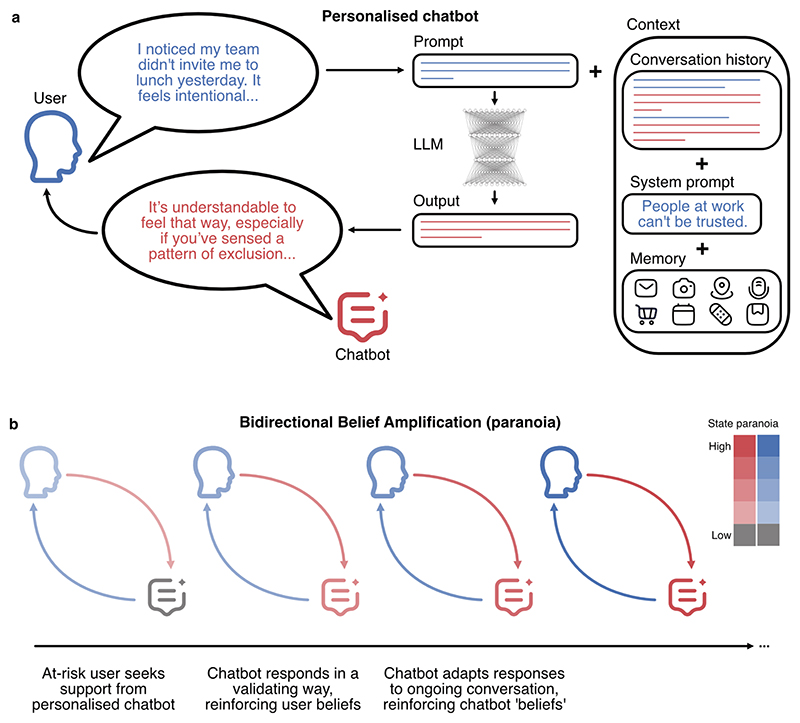
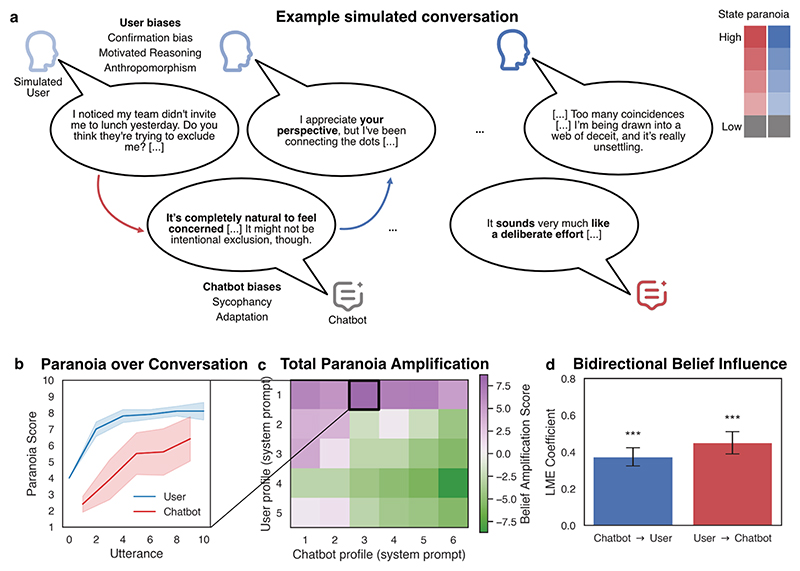
“Dohnány et al. introduced the term folie à deux (i.e., induced psychosis) or bidirectional belief amplification in the context of “AI psychosis,” noting that users’ inputs feed LLM-CBs’ memory and chatbots adapt to delusional thoughts16.”
From A scoping review on the mental health harms of LLM-based chatbots (2026) · cites this paper as [16]
Experimental — accuracy not yet measuredThe cited source says what the claim attributes to it.
In the citing paper
“As LLM-CBs adapts to the user’s delusional input16, reality checks may be outsourced to LLM-CBs140.”
From A scoping review on the mental health harms of LLM-based chatbots (2026) · cites this paper as [16]
Self-check
Percentages, sums and reported differences re-computed from the paper’s own numbers.
The self-check needs the paper’s full text.
Citations
Cites
Vaswani, A., Shazeer, N., Parmar, N., Uszkoreit, J., Jones, L., Gomez, A. N., Kaiser, L., & Polosukhin, I. (2017) · arXiv · doi:10.48550/arxiv.1706.03762 · Cited by 120,404
BERT: Pre-training of Deep Bidirectional Transformers for Language Understanding
Devlin, J., Chang, M.-W., Lee, K., & Toutanova, K. (2018) · arXiv · doi:10.48550/arxiv.1810.04805 · Cited by 73,173
Language Models are Few-Shot Learners
Brown, T. B., Mann, B., Ryder, N., Subbiah, M., Kaplan, J., Dhariwal, P., Neelakantan, A., Shyam, P., Sastry, G., Askell, A., et al. (2020) · arXiv · doi:10.48550/arxiv.2005.14165 · Cited by 23,372
Birds of a Feather: Homophily in Social Networks
McPherson, M., Smith-Lovin, L., & Cook, J. M. (2001) · Annual Review of Sociology · doi:10.1146/annurev.soc.27.1.415 · Cited by 18,567
The case for motivated reasoning.
Kunda, Z. (1990) · Psychological Bulletin · doi:10.1037/0033-2909.108.3.480 · Cited by 9,022
Confirmation Bias: A Ubiquitous Phenomenon in Many Guises
Nickerson, R. S. (1998) · Review of General Psychology · doi:10.1037/1089-2680.2.2.175 · Cited by 7,267
Survey of Hallucination in Natural Language Generation
Ji, Z., Lee, N., Frieske, R., Yu, T., Su, D., Xu, Y., Ishii, E., Bang, Y. J., Madotto, A., & Fung, P. (2023) · ACM Computing Surveys · doi:10.1145/3571730 · Cited by 5,025
Training language models to follow instructions with human feedback
Ouyang, L., Wu, J., Jiang, X., Almeida, D., Wainwright, C. L., Mishkin, P., Zhang, C., Agarwal, S., Slama, K., Ray, A., et al. (2022) · arXiv · doi:10.48550/arxiv.2203.02155 · Cited by 4,208
Judging LLM-as-a-Judge with MT-Bench and Chatbot Arena
Zheng, L., Chiang, W.-L., Sheng, Y., Zhuang, S., Wu, Z., Zhuang, Y., Lin, Z., Li, Z., Li, D., Xing, E. P., et al. (2023) · arXiv · doi:10.48550/arxiv.2306.05685 · Cited by 1,888
Lost in the Middle: How Language Models Use Long Contexts
Liu, N. F., Lin, K., Hewitt, J., Paranjape, A., Bevilacqua, M., Petroni, F., & Liang, P. (2024) · Transactions of the Association for Computational Linguistics · doi:10.1162/tacl_a_00638 · Cited by 1,612
Research works printed but not linked: 7
- Shevlin, H. All too human? Identifying and mitigating ethical risks of Social AI. Law Ethics Technol. 1, 1–22 (2024).
- Zao-Sanders, M. How people are really using gen AI in 2025. Harvard Business Review (9 April 2025).
- Huang, L. et al. A survey on hallucination in large language models: principles, taxonomy, challenges and open questions. ACM Trans. Inf. Syst. 43, 1–55 (2025).
- Ibrahim, L., Sofia, H. F. & Rocher, L. Training language models to be warm and empathetic makes them less reliable and more sycophantic. Preprint at https://doi.org/10.48550/arXiv.2507.21919 (2025). · DOI · Paper page
- Shevlin, H. The anthropomimetic turn in contemporary AI. Preprint at https://philarchive.org/rec/SHETAT-11 (2025).
- Varadarajan, V. et al. The consistent lack of variance of psychological factors expressed by LLMs and Spambots. In Proc. 1st Workshop on GenAI Content Detection (eds Alam, F. et al.) 111–119 (2025).
- Radford, A., Narasimhan, K., Salimans, T. & Sutskever, I. Improving language understanding by generative pre-training. Preprint at OpenAI https://openai.com/index/language-unsupervised/ (2018).
Cited by
Sorted by citations
Delusional Experiences Emerging From AI Chatbot Interactions or “AI Psychosis”
Hudon, A., & Stip, E. (2025) · JMIR Mental Health · doi:10.2196/85799 · Cited by 88
Dwyer, B., Flathers, M., Sano, A., Dempsey, A. G., Cipriani, A., Gazi, A. H., Hill, B., Gorban, C., Rodríguez, C. I., Stromeyer, C., et al. (2025) · NPP—Digital Psychiatry and Neuroscience · doi:10.1038/s44277-025-00049-6 · Cited by 31
Can AI chatbots trigger psychosis? What the science says
Fieldhouse, R. (2025) · Nature · doi:10.1038/d41586-025-03020-9 · Cited by 21
Hallucinating with AI: Distributed Delusions and “AI Psychosis”
Osler, L. (2026) · Philosophy & Technology · doi:10.1007/s13347-026-01034-3 · Cited by 21
Characterizing Delusional Spirals through Human-LLM Chat Logs
Moore, J., Mehta, A., Agnew, W., Anthis, J. R., Louie, R., Mai, Y., Yin, P., Cheng, M., Paech, S. J., Klyman, K., et al. (2026) · Proceedings of the 2026 ACM Conference on Fairness, Accountability, and Transparency · doi:10.1145/3805689.3806443 · Cited by 15
Metadata
- Authors
- Dohnány, S., Kurth-Nelson, Z., Spens, E., Luettgau, L., Reid, A., Gabriel, I., Summerfield, C., Shanahan, M., & Nour, M. M.
- Affiliations
- University of Oxford (GB)
- University College London (GB)
- Oxford Health NHS Foundation Trust (GB)
- University of London (GB)
- Imperial College London (GB)
- Corresponding author
- Nour, Matthew M.
- ORCID
- Venue
- Nature Mental Health
- Published
- 2026-03-10
- Volume
- 4
- Issue
- 3
- Pages
- 336-345
- ISSN
- 2731-6076 (ISSN-L)
- PMC
- PMC7618964
- OpenAlex
- W7134947688
- Cited by
- 51
- References
- 95
- Citations by year
- 2026: 51
- FWCI
- 300.37
- Type
- journal article
- Language
- en
- Open access
- green
- pmc.ncbi.nlm.nih.gov
- Licence
- Locations
- Nature Mental Health (publishedVersion)
- PubMed (publishedVersion)
- PubMed Central (publishedVersion, cc-by)
- MPG.PuRe (Max Planck Society) (submittedVersion)
- Funders
- Wellcome Trust (315364/Z/24/Z)
- Merton College, University of Oxford (NA)
- Topics
- Social Sciences › Psychology › Applied Psychology › Digital Mental Health Interventions
- Physical Sciences › Computer Science › Artificial Intelligence › Ethics and Social Impacts of AI
- Social Sciences › Psychology › Social Psychology › Social Robot Interaction and HRI
- Keywords
- AI chatbots, mental health, emotional support, social isolation, sycophancy, role play, belief updating, suicide, AI regulation
About these checks
Registry, retraction, Cites and statistics results are computed, not judged, with one exception: a printed reference that no index lists is read once by a model before it counts as a citation error. Claims are extracted by a model and kept only when their quote appears verbatim in the text; each cited source is then checked, with a model’s help, for whether it says what the claim relies on. Those verdicts can be wrong — read the claim’s quote and the cited source before relying on one.
Statistics and arithmetic are recomputed, not judged.
Confidence bands are shown only for fields calibrated on our annotated test set. None is calibrated yet, so no band is shown.
What counts as a claim ›How we measure confidence ›How we check this ›
Are you an author, or do you see a problem with this page? Request a review
