

The replication crisis has led to positive structural, procedural, and community changes
Open accessThe DOI matches its Crossref record; 209 of the 209 references it cites were found in a registry or an index.
Abstract
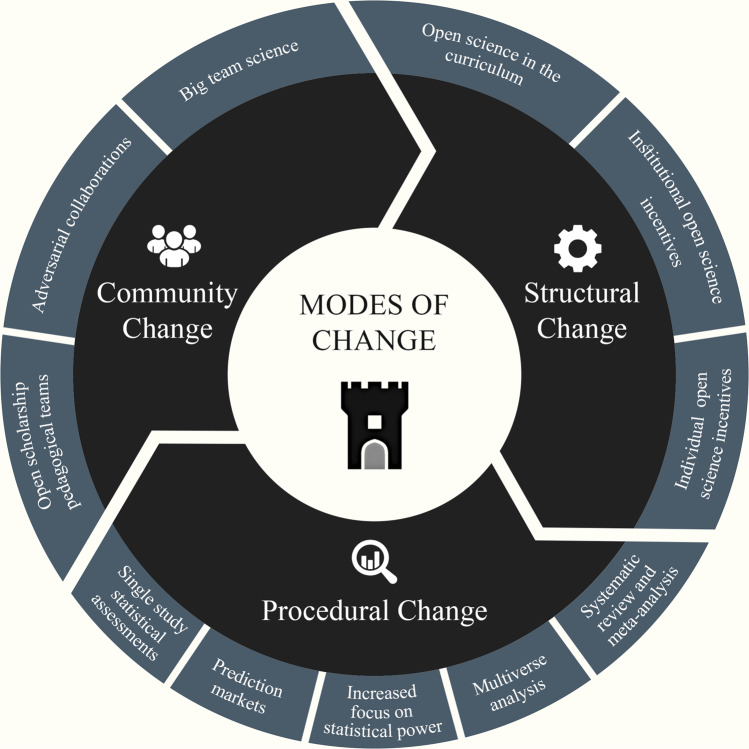
The emergence of large-scale replication projects yielding successful rates substantially lower than expected caused the behavioural, cognitive, and social sciences to experience a so-called ‘replication crisis’. In this Perspective, we reframe this ‘crisis’ through the lens of a credibility revolution, focusing on positive structural, procedural and community-driven changes. Second, we outline a path to expand ongoing advances and improvements. The credibility revolution has been an impetus to several substantive changes which will have a positive, long-term impact on our research environment.
Overview
The claims and statistics of this paper haven’t been checked yet.
Free: it reads the open-access text and checks the first 5 claims that cite a source we can check. Create a free account to check every claim.
Integrity signals
Registry
Cites
Statistics
Figures
Verification
Claims the paper makes
The claims and statistics of this paper haven’t been checked yet.
Free: it reads the open-access text and checks the first 5 claims that cite a source we can check. Create a free account to check every claim.
Self-check
Percentages, sums and reported differences re-computed from the paper’s own numbers.
The self-check needs the paper’s full text.
Citations
Cites
The weirdest people in the world?
Henrich, J., Heine, S. J., & Norenzayan, A. (2010) · Behavioral and Brain Sciences · doi:10.1017/s0140525x0999152x · Cited by 12,641
The PRISMA 2020 Statement: An Updated Guideline for Reporting Systematic Reviews
Page, M. J., McKenzie, J. E., Bossuyt, P. M., Boutron, I., Hoffmann, T. C., Mulrow, C. D., Shamseer, L., Tetzlaff, J. M., Akl, E. A., Brennan, S. E., et al. (2021) · International Journal of Surgery · doi:10.1016/j.ijsu.2021.105906 · Cited by 11,748
Borenstein, M., Hedges, L. V., Higgins, J. P. T., & Rothstein, H. R. (2021) · doi:10.1002/9781119558378 · Cited by 9,799
Estimating the reproducibility of psychological science
Open Science Collaboration (2015) · Science · doi:10.1126/science.aac4716 · Cited by 8,515
Simmons, J. P., Nelson, L. D., & Simonsohn, U. (2011) · Psychological Science · doi:10.1177/0956797611417632 · Cited by 6,567
A manifesto for reproducible science
Munafò, M. R., Nosek, B. A., Bishop, D. V. M., Button, K. S., Chambers, C. D., Percie du Sert, N., Simonsohn, U., Wagenmakers, E.-J., Ware, J. J., & Ioannidis, J. P. A. (2017) · Nature Human Behaviour · doi:10.1038/s41562-016-0021 · Cited by 3,397 · cited 1×
“After several notable scandals and controversies in 2011 [2–4], skepticism regarding claims in psychological science increased, and inspired the development of projects examining the replicability and reproducibility of past findings [5].”
BackgroundRedefine statistical significance
Benjamin, D. J., Berger, J. O., Johannesson, M., Nosek, B. A., Wagenmakers, E.-J., Berk, R., Bollen, K. A., Brembs, B., Brown, L., Camerer, C., et al. (2017) · Nature Human Behaviour · doi:10.1038/s41562-017-0189-z · Cited by 2,772
Conditions for intuitive expertise: A failure to disagree.
Kahneman, D., & Klein, G. (2009) · American Psychologist · doi:10.1037/a0016755 · Cited by 2,443 · cited 1×
“…collaborations ’ of this kind are arguably one of the most important developments in procedures to advance research because they allow for a consensus-based resolution of scienti fi c debates and they facilitate more ef fi cient knowledge production and self-correction by reducing bias 3,167 .”
BackgroundMeasuring the Prevalence of Questionable Research Practices With Incentives for Truth Telling
John, L. K., Loewenstein, G., & Prelec, D. (2012) · Psychological Science · doi:10.1177/0956797611430953 · Cited by 2,239 · cited 1×
“Researchers continue to employ a variety of QRPs, which are signi fi cant contributors to low replicability 202,204,207 – 209 , and a lack of transparency in reporting can mask and exacerbate these issues 14 .”
BackgroundHARKing: Hypothesizing after the results are known
Kerr, N. L. (1998) · Personality and Social Psychology Review · doi:10.1207/s15327957pspr0203_4 · Cited by 1,989 · cited 1×
“Researchers continue to employ a variety of QRPs, which are signi fi cant contributors to low replicability 202,204,207 – 209 , and a lack of transparency in reporting can mask and exacerbate these issues 14 .”
Background
Research works printed but not linked: 11
- 24. Azevedo, F. et al. Introducing a framework for open and reproducible research training (FORRT). Preprint at https://osf.io/bnh7p/ (2019). This paper describes the importance of integrating open scholarship into higher education, its benefits and challenges, as well as about FORRT initiatives aiming to support educators in this endeavor.
- 41. Pownall, M. et al. The impact of open and reproducible scholarship on students' scientific literacy, engagement, and attitudes towards science: a review and synthesis of the evidence. Roy. Soc. Open Sci., 10, 221255 (2023). This review article describes the available (empirical) evidence of the impact (and importance) of integrating open scholarship into higher education, its benefits and challenges on three specific areas: students' (a) scientific literacy; (b) engagement with science; and (c) attitudes towards science.
- 91. Elife. https://elifesciences.org/for-the-press/b2329859/elife-ends-accept-reject- decisions-following-peer-review (2023).
- 104. Higgins, J. P. et al. Cochrane Handbook for Systematic Reviews of Interventions (John Wiley & Sons, 2022). 130.
- 107. So, T. Classroom experiments as a replication device. J. Behav. Exp. Econ. 86, 101525 (2020). 146. Ebersole, C. R. et al. Many labs 3: evaluating participant pool quality across the academic semester via replication. J. Exp. Soc. Psychol. 67, 68-82 (2016). 147. Klein, R. et al. Investigating variation in replicability: a "many labs" replication project. Soc. Psychol. 45, 142-152 (2014). 148. Glöckner, A. et al. Hagen Cumulative Science Project. Project overview at osf. io/d7za8 (2015). 149. Moshontz, H. et al. The psychological science accelerator: advancing psychology through a distributed collaborative network. Adv. Meth. Pract. Psychol. Sci. 1, 501-515 (2018). 150. Forscher, P. S. et al. The Benefits, Barriers, and Risks of Big-Team Science. Perspect. Psychol. Sci. 17456916221082970 (2020). The paper discusses the advantages and challenges of conducting large-scale collaborative research projects, highlighting the potential for increased innovation and impact, as well as the difficulties in managing complex collaborations and addressing issues related to authorship and credit. 151.
- Humphreys, L., Lewis Jr, N. A., Sender, K. & Won, A. S. Integrating qualitative methods and open science: five principles for more trustworthy research. J. Commun. 71, 855–874 (2021).
- Bergmann, C. How to integrate open science into language acquisition research? Student workshop at BUCLD 43 (2018).
- Candela, A. G. Exploring the function of member checking. Qual. Rep. 24, 619–628 (2019).
- Checchi, D., De Fraja, G. & Verzillo, S. Incentives and careers in academia: theory and empirical analysis. Rev. Econ. Stat. 103, 786–802 (2021).
- Grove, L. The Effects of Funding Policies on Academic Research. Ph.D. thesis, University College London (2017).
- Devezer, B. & Buzbas, E. Minimum viable experiment to replicate (2021). Preprint at http://philsci-archive.pitt.edu/21475/.
Cited by
Items 101–137 of 137
Palermo, T. M., Bouhassira, D., Davis, K. D., Hemmings, H. C., Hurley, R. W., Katz, J. D., Pandit, J. J., Price, T. J., Schatman, M. E., Schwarz, S. K. W., et al. (2025) · Neurobiology of Pain · doi:10.1016/j.ynpai.2025.100187
Mendiola, M. S. (2025) · Investigación en Educación Médica · doi:10.22201/fm.20075057e.2025.55.25726
Palermo, T. M., Bouhassira, D., Davis, K. D., Hemmings, H. C., Hurley, R. W., Katz, J. D., Pandit, J. J., Price, T. J., Schatman, M. E., Schwarz, S. K. W., et al. (2025) · Clinical Journal of Pain · doi:10.1097/ajp.0000000000001304
Yeung, S. K., Tong, A. C. Y., Zhao, H., & Mak, W. W. S. (2025) · doi:10.2196/preprints.80662
Self-citationPalermo, T. M., Bouhassira, D., Davis, K. D., Hemmings, H. C., Hurley, R. W., Katz, J. D., Pandit, J. J., Price, T. J., Schatman, M. E., Schwarz, S. K. W., et al. (2025) · European Journal of Anaesthesiology · doi:10.1097/eja.0000000000002237 · Cited by 1
“…the Study of Pain’s Early Career Network (https://www.iasp-pain.org/early-career-net-work/), and by setting expectations for presenting and sharing research at scientific meetings (e.g. checking for retractions of any published studies discussed in presentations 30 values of openness and integrity.”
Anikin, A. (2025) · Psychonomic Bulletin & Review · doi:10.3758/s13423-025-02740-3
“There is hope that this is possible: people are good at guessing which studies will fail to replicate (Camerer et al., 2018), and large prediction markets yield replicability predictions with accuracy between 61% and 86% (Korbmacher et al., 2023).”
Experimenting on AI can (sometimes) teach us about ourselves
van Loon, A., & Heidenry, Z. (2025) · Nature Computational Science · doi:10.1038/s43588-025-00838-1
Palermo, T. M., Bouhassira, D., Davis, K. D., Hemmings, H. C., Hurley, R. W., Katz, J. D., Pandit, J. J., Price, T. J., Schatman, M. E., Schwarz, S. K. W., et al. (2025) · Frontiers in Pain Research · doi:10.3389/fpain.2025.1653869 · Cited by 1
Creating a path to meaningful public participation: the case of heritable human genome editing
Güttinger, S. (2025) · Zeitschrift für Ethik und Moralphilosophie · doi:10.1007/s42048-025-00232-6
“Turning these crises into opportunities (Fanelli 2018; Munafò et al. 2022; Korbmacher et al. 2023) could help us to change the decision-making culture within science itself, thus paving the way for a more inclusive decision-making process.”
Pittner, K., Meyer, K., Moog, N. K., Sket, G., Bentz, L. K., Spaegele, N., Rasmussen, J. M., Winter, S., Heim, C. C., Wadhwa, P. D., et al. (2026) · European Child & Adolescent Psychiatry · doi:10.1007/s00787-026-03134-z
Registration and multiple outcome testing in the HEALing communities study
Gorman, D. M., & Fitzpatrick, B. G. (2025) · International Journal of Drug Policy · doi:10.1016/j.drugpo.2025.105028
Theoretical Bases of Differential Learning
Schöllhorn, W. I., & Slapšinskaitė, A. (2025) · Springer eBooks · doi:10.1007/978-3-031-98787-8_2
Systema psyches: A temporal taxonomy of mental phenomena
Kent, L., Doorn, G. H. V., Badcock, P. B., & Klein, B. (2025) · Personality and Individual Differences · doi:10.1016/j.paid.2025.113531 · Cited by 1
Koch, T., Seeger, C., & Müller, P. (2025) · Studienbücher zur Kommunikations- und Medienwissenschaft · doi:10.1007/978-3-658-49131-4_10
Palermo, T. M., Bouhassira, D., Davis, K. D., Hemmings, H. C., Hurley, R. W., Katz, J., Pandit, J. J., Price, T. J., Schatman, M. E., Schwarz, S. K. W., et al. (2025) · Canadian Journal of Anesthesia/Journal canadien d anesthésie · doi:10.1007/s12630-025-03052-9 · Cited by 1
“Our journals can help disseminate information on tools targeting researchers directly 30 that can be made available to authors in a toolkit to assist them in pursuing values of openness and integrity.”
Dawes, G. W. (2026) · Springer eBooks · doi:10.1007/978-3-032-10641-4_2
Blum, F. (2026) · Linguistic Typology · doi:10.1515/lingty-2025-0050
“We should embrace such contradictory results as signs of scienti fi c progress (Ioannidis 2012; Korbmacher et al. 2023; Laudan 1978) and fi nd the best way to tackle those cases in discussion as well as collaboration.”
Teaching Psychological Literacy Through a New PhD Programme in Open and Credible Science in Norway
Kalandadze, T., & Korbmacher, M. (2026) · International and cultural psychology/International and cultural psychology series · doi:10.1007/978-3-032-09977-8_24
Self-citationIs neurofeedback A reliable therapy for managing Parkinson’s Disease?
Mirabella, G., Borboni, A., Guerreschi, M., Suppa, A., & Amici, C. (2026) · Clinical Neurophysiology · doi:10.1016/j.clinph.2026.2111890
Korbmacher, M., Myhr, K., Wergeland, S., Wesnes, K., & Torkildsen, Ø. (2026) · Frontiers in Neurology · doi:10.3389/fneur.2026.1796427
“Replication is a cornerstone of scientific progress (8), particularly in biomarker research, where independent confirmation is essential for establishing robustness and generalizability of reported effects.”
Self-citationCosta, T. (2026) · Frontiers in Psychology · doi:10.3389/fpsyg.2026.1799078 · Cited by 1
“Through this lens, replication failures are not crises but recalibrations: instances in which accumulated data revise our odds toward coherence [see also recent discussions of belief updating in the context of replication, e.g., (Korbmacher et al., 2023)].”
How Does the Lack of Diversity in Psychological Science Research Affect Undergraduate Students?
Thomas, C. R., Figueroa, J., Lugo-Martinez, V., Cantu, D. E., Branch, J., & Williamson, H. C. (2026) · Teaching of Psychology · doi:10.1177/00986283261456691
Howard, M. C., Henderson, J., & Simonson, P. D. (2026) · Supply Chain Analytics · doi:10.1016/j.sca.2026.100214 · Cited by 1
Creating common virtual ground: Protocols to democratize open VR research
Zelderen, A. P. A. V., Masters-Waage, T. C., Affinito, S. J., Bekbergenova, A., Cowan, K. L., Hartmann, T., Hausfeld, M. M., Jolink, A., Korbel, J. J., Lynn, T., et al. (2026) · Proceedings of the National Academy of Sciences · doi:10.1073/pnas.2524991123
Mayr, M., Ophoff, J. G., Merk, S., & Rott, B. (2026) · SAGE Open · doi:10.1177/21582440261461971
“These challenges reflect broader issues highlighted by the replication crisis, underscoring the need for more robust and transparent methodological practices (Korbmacher et al., 2023).”
Should Qualitative Researchers in Health and Medicine be Concerned About Replication?
Shih, P., & Carter, S. M. (2026) · Patient · doi:10.1007/s40271-026-00832-3
“These concerns have spread beyond psychology, and has implications for public trust in science and evidence-based policy and practice more generally [5].”
Psychological Exploration of Human Understanding of Divine Realities: From Well-Being to Imagination
Sharp, C. A., Daughton, A., & Watanabe, S. (2026) · Journal of Psychology and Theology · doi:10.1177/00916471261461582
“…research field that aim at mitigating bias, particularly when it comes to methodology, data analysis, and publishing practices (Kavanagh & Kapitány, 2021; Korbmacher et al., 2023), but rarely do these involve introspection regarding a researcher’s own assumptions and subjective perspectives.”
Mayr, M., Wisenöcker, A. S., & Ophoff, J. G. (2026) · Educational Research Review · doi:10.1016/j.edurev.2026.100819
Supplementing Remedies to the Replication Crisis
Hyman, M. R. (2026) · Social Epistemology · doi:10.1080/02691728.2026.2697184
Neuropsychological research in obsessive–compulsive disorder: mechanisms, debates, and ways forward
Kashyap, H., Bhattacharya, M., & Ganesh, U. M. (2026) · Elsevier eBooks · doi:10.1016/b978-0-443-27446-6.00012-1
Revisiting the Replication Study Design Used in Computing Education Research
Garcia, R., Lovellette, E., Wu, X., & Bernuy, A. Z. (2026) · ACM Conference on International Computing Education Research (ICER) · doi:10.1145/3765964.3811649 · Cited by 1
The cost of reproducibility in artificial intelligence
Snelleman, T., Hoos, H. H., & Gundersen, O. E. (2026) · Patterns · doi:10.1016/j.patter.2026.101640 · Cited by 1
“In 2023, Korbmacher et al. 13 determined that replication improved in the social sciences through positive structural, procedural, and community-driven changes.”
Dissecting an interview about astronomical distances using three models
Anonymous, Samuelsson, C. R., Eriksson, U., Barth-Cohen, L. A., & Sermeus, J. (2026) · Physical Review Physics Education Research · doi:10.1103/9vhd-fbfv
“For quantitative work progress has been made after the replication crisis [91] to structure collaboration.”
Mayer, K. (2026) · Cambridge Forum on AI Culture and Society · doi:10.1017/cfc.2026.10022 · Cited by 2
Benkendorff, A., Sina, E., Bergt, A. C., Stadelmaier, J., & Meerpohl, J. J. (2026) · BMJ Open · doi:10.1136/bmjopen-2026-117895
“17–22 Individual participant data can also be used to test post hoc hypotheses and has advantages when used for meta-analysis of different clinical trials.”
Prejudicial essentialist bias in cognitive neuroscience studies with people who use drugs
Oldfield, C. J., Owens, M., & Hogarth, L. (2026) · Drug and Alcohol Dependence · doi:10.1016/j.drugalcdep.2026.113402
Belief Traps Hinder Small Business Climate Action
Lees, J. M., Constantino, S. M., Cushen, J., Dahlmann, F., de Bakker, F. G. A., Torre, E. D., Frigotto, M. L., Hackenbuchner, M., Heuvinck, N., Kypraios, E., et al. (2026) · Entrepreneurship Theory and Practice · doi:10.1177/10422587261485958
Metadata
- Authors
- Korbmacher, M., Azevedo, F., Pennington, C. R., Hartmann, H., Pownall, M., Schmidt, K., Elsherif, M., Breznau, N., Robertson, O., Kalandadze, T., Yu, S., Baker, B. J., O’Mahony, A., Olsnes, J. Ø. S., Shaw, J. J., Gjoneska, B., Yamada, Y., Röer, J. P., Murphy, J., Alzahawi, S., Grinschgl, S., Oliveira, C. M., Wingen, T., Yeung, S. K., Liu, M., König, L. M., Albayrak-Aydemir, N., Lecuona, O., Micheli, L., & Evans, T.
- Affiliations
- Oslo University Hospital (NO)
- Aston University (GB)
- Essen University Hospital (DE)
- University of Leeds (GB)
- Ashland University (US)
- University of Birmingham (GB)
- University of Bremen (DE)
- University of Oxford (GB)
- Østfold University of Applied Sciences (NO)
- Temple University (US)
- Cardiff University (GB)
- Norwegian University of Science and Technology (NO)
- De Montfort University (GB)
- Macedonian Academy of Sciences and Arts (MK)
- Kyushu University (JP)
- Witten/Herdecke University (DE)
- Technological University Dublin (IE)
- Stanford University (US)
- University of Graz (AT)
- University of York (GB)
- University of Bonn (DE)
- Chinese University of Hong Kong (HK)
- University of Cambridge (GB)
- University of Bayreuth (DE)
- Universidad Rey Juan Carlos (ES)
- University of Greenwich (GB)
- ORCID
- Korbmacher, Max
- Azevedo, Flavio
- Pennington, Charlotte R.
- Hartmann, Helena
- Pownall, Madeleine
- Schmidt, Kathleen
- Elsherif, Mahmoud
- Breznau, Nate
- Robertson, Olly
- Kalandadze, Tamara
- Yu, Shijun
- Baker, Bradley J.
- O’Mahony, Aoife
- Shaw, John J.
- Gjoneska, Biljana
- Yamada, Yuki
- Röer, Jan P.
- Murphy, Jennifer
- Alzahawi, Shilaan
- Grinschgl, Sandra
- Oliveira, Catia M.
- Wingen, Tobias
- Yeung, Siu Kit
- Liu, Meng
- König, Laura M.
- Albayrak-Aydemir, Nihan
- Lecuona, Oscar
- Micheli, Leticia
- Evans, Thomas
- Venue
- Communications Psychology
- Published
- 2023-07-25
- Volume
- 1
- Issue
- 1
- Pages
- 3-3
- ISSN
- 2731-9121 (ISSN-L)
- PMC
- PMC11290608
- OpenAlex
- W4385240232
- Cited by
- 137
- References
- 204
- Citations by year
- 2026: 36 · 2025: 64 · 2024: 27 · 2023: 10
- FWCI
- 5.80
- Type
- journal article
- Language
- en
- Open access
- gold
- doi.org
- Licence
- cc-by
- creativecommons.org/licenses/by/4.0 (tdm)
- creativecommons.org/licenses/by/4.0 (vor)
- Locations
- Communications Psychology (publishedVersion, cc-by)
- PubMed Central (publishedVersion, cc-by)
- PubMed (publishedVersion)
- Leiden Repository (Leiden University) (publishedVersion, cc-by)
- Edge Hill University Research Information Repository (Edge Hill University) (publishedVersion, cc-by)
- ORCA Online Research @Cardiff (Cardiff University) (acceptedVersion, other-oa)
- Open Research Online (The Open University) (acceptedVersion, other-oa)
- London School of Economics and Political Science Research Online (London School of Economics and Political Science) (acceptedVersion, other-oa)
- University of Birmingham Research Portal (University of Birmingham) (submittedVersion, other-oa)
- Leiden Repository (Leiden University) (submittedVersion, cc-by)
- NORA - Norwegian Open Research Archives (submittedVersion, cc-by)
- Topics
- Social Sciences › Psychology › Experimental and Cognitive Psychology › Psychology Research and Bibliometrics
- Social Sciences › Decision Sciences › Statistics, Probability and Uncertainty › Meta-analysis and systematic reviews
- Social Sciences › Library and Information Sciences › Academic Publishing and Open Access
- Keywords
- replication crisis, credibility revolution, replication study, research credibility, research practices
About these checks
Registry, retraction, Cites and statistics results are computed, not judged, with one exception: a printed reference that no index lists is read once by a model before it counts as a citation error. Claims are extracted by a model and kept only when their quote appears verbatim in the text; each cited source is then checked, with a model’s help, for whether it says what the claim relies on. Those verdicts can be wrong — read the claim’s quote and the cited source before relying on one.
Statistics and arithmetic are recomputed, not judged.
Confidence bands are shown only for fields calibrated on our annotated test set. None is calibrated yet, so no band is shown.
What counts as a claim ›How we measure confidence ›How we check this ›
Are you an author, or do you see a problem with this page? Request a review
Data sources
Bibliographic data: Semantic Scholar, OpenAlex, Crossref.
Contains information from the Semantic Scholar Academic Graph Datasets, made available under the ODC Attribution License (ODC-BY 1.0).
Semantic Scholar’s data is described in: Kinney, R., et al. (2023). The Semantic Scholar Open Data Platform. arXiv:2301.10140.
