

The DOI matches its Crossref record; 30 of the 30 references it cites were found in a registry or an index.
Adjusting to life after treatment: distress and quality of life following treatment for breast cancer
Open accessAbstract
Clinical and anecdotal findings suggest that the completion of cancer treatment may be marked by heightened distress and disrupted adjustment. The present study examined psychological adjustment during the 3 months following treatment among 89 women with stages 0-III breast cancer. Participants completed measures of depression, cancer-related anxiety, cancer concerns, and quality of life at three time points: during treatment, 3 weeks following the end of treatment, and 3 months post-treatment. Post-treatment scores were suggestive of good psychological adjustment among the majority of women. Moreover, distress did not increase following treatment; longitudinal analyses showed no significant changes in depression or recurrence worry, while intrusive thoughts decreased, and quality of life improved. Younger age predicted greater distress across measures. A history of depression or anxiety predicted greater depressive symptomatology, while more extensive treatment predicted greater cancer-related anxiety. Despite the lack of distress endorsed on general depression and anxiety indices, participants reported moderate distress associated with cancer-related concerns, including physical problems, fear of cancer recurrence, and resuming normal life. In sum, while breast cancer survivors demonstrate good adjustment on general distress indices following treatment, some women are at risk for sustained distress. Moreover, significant cancer-related concerns are prevalent and may be important intervention targets.
Overview
The claims and statistics of this paper haven’t been checked yet.
Run the check — free, no account needed. It reads the open-access text and checks the sources it cites.
Integrity signals
Registry
Cites
Statistics
Figures
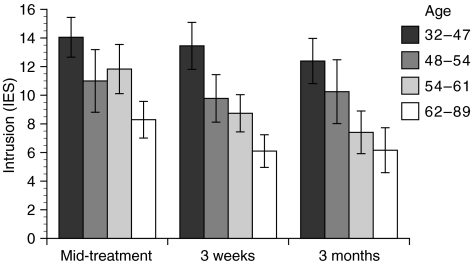
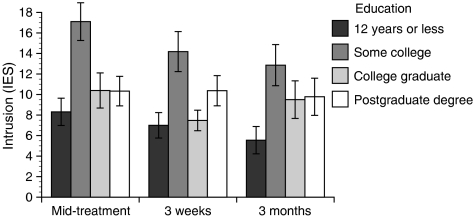
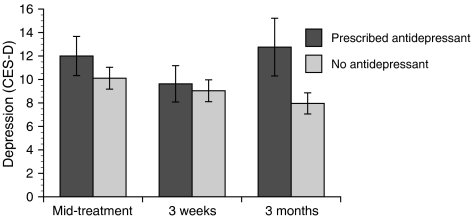
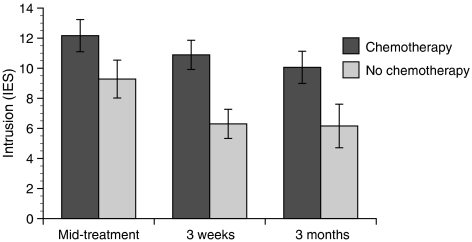
Verification
Claims the paper makes
The claims and statistics of this paper haven’t been checked yet.
Run the check — free, no account needed. It reads the open-access text and checks the sources it cites.
Claims other papers make about this one
Each is checked against this paper’s own text: does it say what the citing paper says it does?
The cited source says what the claim attributes to it.
In the citing paper
“A systematic review by Crist and Grunfeld [5] revealed that younger age was associated in almost every study with higher FCR for different cancer types, including breast cancer [53–55].”
From Fear of cancer recurrence in breast cancer survivors carrying a BRCA1 or 2 genetic mutation : a cross-sectional study (2024) · cites this paper as [54]
In the citing paper
“Cancer survivors recently discharged from the care of their cancer team and no longer receiving cancer treatment cite a number of unmet needs after completing cancer treatment [7–9] (e.g., for psychosocial and informational support [7–10]) and describe the first 6–12 months after treatment as the most difficult [7].”
From Coping during COVID-19: A mixed methods study of older cancer survivors (2021) · cites this paper as [9]
Self-check
Percentages, sums and reported differences re-computed from the paper’s own numbers.
The self-check needs the paper’s full text.
Citations
Cites
The CES-D Scale: A Self-Report Depression Scale for Research in the General Population
Radloff, L. S. (1977) · Applied Psychological Measurement · doi:10.1177/014662167700100306 · Cited by 53,267
SF-36 health survey: Manual and interpretation guide
Ware, J. (2003) · Medical Entomology and Zoology · Cited by 11,424
Spitzer, R. L. (1999) · JAMA · doi:10.1001/jama.282.18.1737 · Cited by 9,802
Impact of Event Scale: A Measure of Subjective Stress
Horowitz, M., Wilner, N., & Alvarez, W. (1979) · Psychosomatic Medicine · doi:10.1097/00006842-197905000-00004 · Cited by 7,813
Portenoy, R. K., Thaler, H. T., Kornblith, A. B., Lepore, J. M., Friedlander-Klar, H., Kiyasu, E., Sobel, K., Coyle, N., Kemeny, N. E., Norton, L., et al. (1994) · European Journal of Cancer · doi:10.1016/0959-8049(94)90182-1 · Cited by 1,580
Handbook of Stress: Theoretical and Clinical Aspects
Tyrer, P. J. (1983) · Journal of Neurology Neurosurgery & Psychiatry · doi:10.1136/jnnp.46.10.970-a · Cited by 1,217
Ganz, P. A., Rowland, J. H., Desmond, K., Meyerowitz, B. E., & Wyatt, G. E. (1998) · Journal of Clinical Oncology · doi:10.1200/jco.1998.16.2.501 · Cited by 962
Handbook of Aging and the Social Sciences
Stewart, M. M. (1977) · JAMA · doi:10.1001/jama.1977.03280120076026 · Cited by 887
Measurement of depressive symptoms in cancer patients
Hann, D., Winter, K., & Jacobsen, P. (1999) · Journal of Psychosomatic Research · doi:10.1016/s0022-3999(99)00004-5 · Cited by 822
Seasons of Survival: Reflections of a Physician with Cancer
Mullan, F. (1985) · New England Journal of Medicine · doi:10.1056/nejm198507253130421 · Cited by 809
Research works printed but not linked: 2
- SF-36.org (1998) 1998 SF-36 Normative Data Vol. 2006
- Ware JE, Kosinski M, Dewey JE (2000) How to Score Version Two of the SF-36 Health Survey. Lincoln, RI: QualityMetric, Incorporated
Cited by
Sorted by citations
Fear of cancer recurrence in adult cancer survivors: a systematic review of quantitative studies
Simard, S., Thewes, B., Humphris, G., Dixon, M., Hayden, C., Mireskandari, S., & Ozakinci, G. (2013) · Journal of Cancer Survivorship · doi:10.1007/s11764-013-0272-z · Cited by 1,217
Howard-Anderson, J., Ganz, P. A., Bower, J. E., & Stanton, A. L. (2012) · JNCI Journal of the National Cancer Institute · doi:10.1093/jnci/djr541 · Cited by 830
Montazeri, A. (2008) · Journal of Experimental & Clinical Cancer Research · doi:10.1186/1756-9966-27-32 · Cited by 773
de Moor, J. S., Mariotto, A. B., Parry, C., Alfano, C. M., Padgett, L., Kent, E. E., Forsythe, L., Scoppa, S., Hachey, M., & Rowland, J. H. (2013) · Cancer Epidemiology, Biomarkers & Prevention · doi:10.1158/1055-9965.epi-12-1356 · Cited by 670
“In many cases, the acute effects of treatment begin to subside as time since diagnosis increases (15, 20, 21); however, a proportion of survivors will experience lingering side effects of their treatment that can persist for many years, negatively affecting quality of life (14–16, 21–23).”
BackgroundIt's Not over When it's Over: Long-Term Symptoms in Cancer Survivors—A Systematic Review
Harrington, C. B., Hansen, J. A., Moskowitz, M. C., Todd, B. L., & Feuerstein, M. (2010) · The International Journal of Psychiatry in Medicine · doi:10.2190/pm.40.2.c · Cited by 655
Metadata
- Authors
- Costanzo, E. S., Lutgendorf, S. K., Mattes, M. L., Trehan, S., Robinson, C. B., Tewfik, F., & Roman, S. L.
- Affiliations
- University of Wisconsin–Madison (US)
- University of Iowa (US)
- Aultman Hospital (US)
- Trinity Medical Center (US)
- Corresponding author
- Costanzo, E S
- ORCID
- Lutgendorf, S K
- Venue
- British Journal of Cancer
- Published
- 2007-11-13
- Volume
- 97
- Issue
- 12
- Pages
- 1625-1631
- ISSN
- 0007-0920 (ISSN-L)
- 1532-1827
- PMC
- PMC2360272
- OpenAlex
- W1968391143
- Cited by
- 297
- References
- 29
- Citations by year
- 2026: 6 · 2025: 13 · 2024: 19 · 2023: 10 · 2022: 14 · 2021: 20 · 2020: 17 · 2019: 17 · 2018: 13 · 2017: 12 · 2016: 19 · 2015: 27 · 2014: 26 · 2013: 22 · 2012: 23
- FWCI
- 5.04
- Type
- journal article
- Language
- en
- Open access
- hybrid
- doi.org
- Licence
- cc-by-nc-sa
- www.springer.com/tdm (unspecified)
- Locations
- British Journal of Cancer (publishedVersion, cc-by-nc-sa)
- PubMed Central (publishedVersion, cc-by)
- PubMed (publishedVersion)
- Funders
- American Psychological Foundation
- Topics
- Health Sciences › Medicine › Oncology › Cancer survivorship and care
- Health Sciences › Medicine › Pediatrics, Perinatology and Child Health › Childhood Cancer Survivors' Quality of Life
- Health Sciences › Medicine › Public Health, Environmental and Occupational Health › Women's cancer prevention and management
- Keywords
- breast cancer survivors, psychological adjustment, quality of life, depression, cancer-related anxiety, fear of cancer recurrence, intrusive thoughts, age as risk factor, treatment burden
- MeSH terms
- Adaptation, Psychological, Adult, Aged, Aged, 80 and over, Anxiety, Breast Neoplasms, Depression, Female, Forecasting, Humans, Middle Aged, Quality of Life, Risk Factors, Time Factors
About these checks
Registry, retraction, Cites and statistics results are computed, not judged, with one exception: a printed reference that no index lists is read once by a model before it counts as a citation error. Claims are extracted by a model and kept only when their quote appears verbatim in the text; each cited source is then checked, with a model’s help, for whether it says what the claim relies on. Those verdicts can be wrong — read the claim’s quote and the cited source before relying on one.
Statistics and arithmetic are recomputed, not judged.
Confidence bands are shown only for fields calibrated on our annotated test set. None is calibrated yet, so no band is shown.
What counts as a claim ›How we measure confidence ›How we check this ›
Are you an author, or do you see a problem with this page? Request a review
