

Effect of Internet peer-support groups on psychosocial adjustment to cancer: a randomised study
Open accessThe DOI matches its Crossref record; 19 of the 20 references it cites were found in a registry or an index.
Abstract
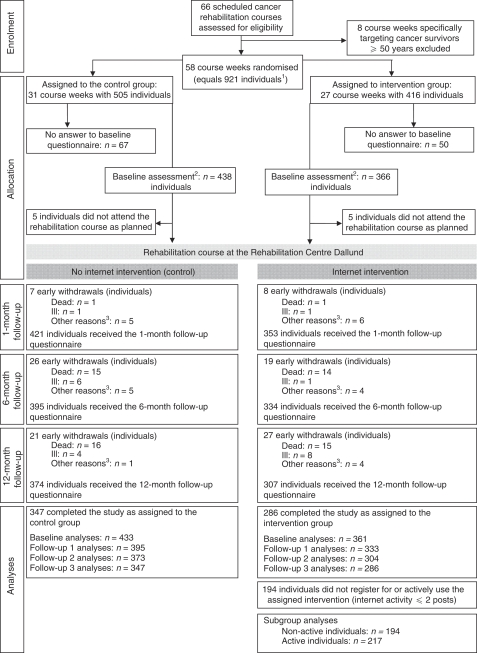
BACKGROUND: We conducted a randomised study to investigate whether providing a self-guided Internet support group to cancer patients affected mood disturbance and adjustment to cancer. METHODS: Baseline and 1-, 6- and 12-month assessments were conducted from 2004 to 2006 at a national rehabilitation centre in Denmark. A total of 58 rehabilitation course weeks including 921 survivors of various cancers were randomly assigned to a control or an intervention group by cluster randomisation. The intervention was a lecture on the use of the Internet for support and information followed by participation in an Internet support group. Outcome measures included self-reported mood disturbance, adjustment to cancer and self-rated health. Differences in scores were compared between the control group and the intervention group. RESULTS: The effect of the intervention on mood disturbance and adjustment to cancer showed a transient difference at the 6-month follow-up, where the intervention group reported less reduction in anxious preoccupation (P=0.04), helplessness (P=0.002), confusion (P=0.001) and depression (P=0.04). Otherwise no significant effects were observed. CONCLUSION: We conclude that use of Internet-based support groups in cancer patients still needs to confirm long-lasting psychological effects.
Overview
The claims and statistics of this paper haven’t been checked yet.
Free: it reads the open-access text and checks the first 5 claims that cite a source we can check. Create a free account to check every claim.
Integrity signals
Registry
Cites
Statistics
Figures
Verification
Claims the paper makes
The claims and statistics of this paper haven’t been checked yet.
Free: it reads the open-access text and checks the first 5 claims that cite a source we can check. Create a free account to check every claim.
Claims other papers make about this one
Each is checked against this paper’s own text: does it say what the citing paper says it does?
In the citing paper
“However, findings of unmoderated support groups have tended to show either no benefits relative to control arms (32, 33) or some worsening of symptoms (34, 35).”
From Behavioral Intervention Technologies: Evidence review and recommendations for future research in mental health (2013) · cites this paper as [33]
Self-check
Percentages, sums and reported differences re-computed from the paper’s own numbers.
The self-check needs the paper’s full text.
Citations
Cites
Self-rated health and mortality: a review of twenty-seven community studies.
Idler, E. L., & Benyamini, Y. (1997) · Journal of Health and Social Behavior · doi:10.2307/2955359 · Cited by 8,598 · cited 1×
“lifestyle risk factors (Idler and Benyamini, 1997).”
Eysenbach, G., Powell, J., Englesakis, M., Rizo, C., & Stern, A. (2004) · BMJ · doi:10.1136/bmj.328.7449.1166 · Cited by 1,268
A Shortened Version of the Profile of Mood States
Shacham, S. (1983) · Journal of Personality Assessment · doi:10.1207/s15327752jpa4703_14 · Cited by 1,231 · cited 1×
“Primary end points POMS-SF (Shacham, 1983; Curran et al, 1995) Self-report Measures psychological distress.”
MethodShort Form of the Profile of Mood States (POMS-SF): Psychometric information.
Curran, S. L., Andrykowski, M. A., & Studts, J. L. (1995) · Psychological Assessment · doi:10.1037//1040-3590.7.1.80 · Cited by 808
Influence of psychological response on survival in breast cancer: a population-based cohort study
Watson, M., Haviland, J., Greer, S., Davidson, J., & Bliss, J. (1999) · The Lancet · doi:10.1016/s0140-6736(98)11392-2 · Cited by 705
Evaluation of an internet support group for women with primary breast cancer
Winzelberg, A. J., Classen, C., Alpers, G. W., Roberts, H., Koopman, C., Adams, R. E., Ernst, H., Dev, P., & Taylor, C. B. (2003) · Cancer · doi:10.1002/cncr.11174 · Cited by 485 · cited 5×
“…Internet-based support to cancer survivors may result in significant positive outcomes regarding social support, competence in finding information (Gustafson et al, 2001), depression (Winzelberg et al, 2003) and self-perceived health status (Owen et al, 2005) (Online Supplementary Table 1).”
BackgroundResultInfluentialEffect of computer support on younger women with breast cancer
Gustafson, D. H., Hawkins, R., Pingree, S., McTavish, F., Arora, N. K., Mendenhall, J., Cella, D. F., Serlin, R. C., Apantaku, F. M., Stewart, J., et al. (2001) · Journal of General Internal Medicine · doi:10.1046/j.1525-1497.2001.016007435.x · Cited by 387 · cited 7×
“…Internet-based support to cancer survivors may result in significant positive outcomes regarding social support, competence in finding information (Gustafson et al, 2001), depression (Winzelberg et al, 2003) and self-perceived health status (Owen et al, 2005) (Online Supplementary Table 1).”
BackgroundResultInfluentialThe Mini-MAC: Further Development of the Mental Adjustment to Cancer Scale
Watson, M., Law, M. G., Santos, M. D., Greer, S., Baruch, J., & Bliss, J. (1994) · Journal of Psychosocial Oncology · doi:10.1300/j077v12n03_03 · Cited by 382
Group support interventions for women with breast cancer: Who benefits from what?
Helgeson, V. S., Cohen, S., Schulz, R., & Yasko, J. (2000) · Health Psychology · doi:10.1037/0278-6133.19.2.107 · Cited by 341 · cited 1×
“Women with high emotional support from partners have previously shown adverse effects of a peer-support intervention, suggesting a possible association of social resources with effects of the peer-support groups (Helgeson et al, 2000).”
BackgroundOnline interaction. Effects of storytelling in an internet breast cancer support group
Høybye, M. T., Johansen, C., & Tjørnhøj-Thomsen, T. (2005) · Psycho-Oncology · doi:10.1002/pon.837 · Cited by 317
Self-citation
Research works printed but not linked: 1
- McNair DM, Lorr M, Droppleman LF (1992) EdiTS Manual for the Profile of Mood States. Educational and Industrial Testing Service: San Diego, California
Cited by
Items 101–127 of 127
Pretorius, C. (2016) · Tydskrif vir Geesteswetenskappe · doi:10.17159/2224-7912/2016/v56n3a6 · Cited by 6
Eckert, R., Huberty, J., Kosiorek, H., Clark-Sienkiewicz, S., Larkey, L., & Mesa, R. A. (2020) · Journal for the Measurement of Physical Behaviour · doi:10.1123/jmpb.2019-0051 · Cited by 3
Mazzoni, D., & Alberici, A. I. (2016) · Advances in medical diagnosis, treatment, and care (AMDTC) book series · doi:10.4018/978-1-4666-9992-2.ch007 · Cited by 3
Empowerment of Cancer Survivors Through Information Technology: A Review
Groen, W. G., Kuijpers, W., Wouters, M. W. J. M., Aaronson, N. K., & van Harten, W. H. (2015) · Cited by 3
Online Cognitive Behavioral Stress Management Program for Breast Cancer PatientsPreprint
Savaş, E., Keleş, M., & Tin, O. (2023) · Research Square · doi:10.21203/rs.3.rs-2814540/v1 · Cited by 3
Mohr, D. C., Burns, M. N., Schueller, S. M., Clarke, G. N., & Klinkman, M. S. (2013) · Cited by 2
Lange, L., Schulz, H., Endsin, G., & Bleich, C. (2023) · JMIR Cancer · doi:10.2196/39246 · Cited by 2
“Web-based peer support programs used in a study setting can have a positive influence on the psychosocial well-being of patients with cancer, including quality of life and distress [26,45].”
Baydoun, M., Speca, M., Taylor‐Brown, J., Stephen, J. E., Piedalue, K.-A. L., Turner, J., & Carlson, L. E. (2021) · Journal of Psychosocial Oncology Research and Practice · doi:10.1097/or9.0000000000000058 · Cited by 3
Baník, G., Dědová, M., & Vargová, L. (2022) · doi:10.31234/osf.io/5shrd · Cited by 2
Zhang, Y., Haiyan, H. E., Zhang, Y., ZHONG, Y., Luo, C., Chen, J., Chen, L., Zhang, N., Sun, S., ZHANG, B., et al. (2026) · Journal of Medical Internet Research · doi:10.2196/86097 · Cited by 4
“A similar trial by Høybye et al [49] found improvements in helplessness and depression, though without affecting broader mental adjustment or mood disturbance.”
Self-reported patient experiences in a peer-support community: What do cancer patients value?
Horicks, F., Lalova-Spinks, T., Léonard, S., Remy, D., Taels, B., & Stevens, H. (2026) · Frontiers in Psychology · doi:10.3389/fpsyg.2026.1724101 · Cited by 1
Classen, C. C., & Brotto, A. D. L. A. (2015) · Journal of Clinical Trials · doi:10.4172/2167-0870.1000234 · Cited by 1
“, with no professional facilitators) found that cancer survivors receiving online peer (only) support became more psychologically distressed compared to a control condition [33,34].”
BackgroundMazzoni, D., & Alberici, A. I. (2017) · IGI Global eBooks · doi:10.4018/978-1-5225-3926-1.ch060 · Cited by 1
Haris, H., Rahayuwati, L., & Yamin, A. (2019) · IOP Conference Series Earth and Environmental Science · doi:10.1088/1755-1315/248/1/012066 · Cited by 1
“Health And Quality of Life Outcomes,8 74 [36] Høybye MT, Dalton SO, Deltour I and Bidstrup 2010.”
BackgroundCriado‐Álvarez, J. J., Romo‐Barrientos, C., Zabala-Baños, M. D. C., Martínez-Lorca, M., Viñuela, A., Úbeda‐Bañón, I., Flores‐Cuadrado, A., Martínez-Lorca, A., López, B. P., & Mohedano‐Moriano, A. (2022) · Healthcare · doi:10.3390/healthcare10112192 · Cited by 5
“Here, this consisted of a visualization process [35,36,42] to work on reducing anxiety”
MethodSanjida, S. (2020) · Queensland University of Technology · doi:10.5204/thesis.eprints.192103
Members' experiences of a neuromuscular disorder online support group
Meade, O. (2013) · Nottingham ePrints (University of Nottingham) · Cited by 1
Børøsund, E. (2015) · NVA (Nasjonalt vitenarkiv)
Computational Approaches to Characterizing Online Health Communities
Zhang, S. (2016) · Columbia Academic Commons (Columbia University) · doi:10.7916/d82z15jx
Peer Support Program for Cancer Clients – South Indian Experience
Subbarayalu, Y. (2016) · TEXILA INTERNATIONAL JOURNAL OF NURSING · doi:10.21522/tijnr.2015.02.01.art013
Evaluating Use of an Online Intervention for Cancer Patients with Distress
Gorlick, A. (2013) · The Scholars Repository - LLU (Loma Linda University)
Who is Likely to Benefit Most from Online Cancer Support Communities? The Role of Personality Traits
Ren, Y., & An, X. (2018) · Emerald Group Publishing Limited eBooks · doi:10.1108/s2050-206020180000015004
Kelly, K. J., Doucet, S. A., Luke, A., Azar, R., & Montelpare, W. J. (2019) · doi:10.2196/preprints.16271
Apoio social on-line: questões teóricas, metodológicas, benefícios sociais e recomendações
Rénaud, L., & Cherba, M. (2023) · Saúde em Debate · doi:10.1590/0103-1104202313718 · Cited by 2
“…comunicar) 33,39 , o nível de alfabetização (pessoas mais educadas usam mais a palavra escrita) 66 e a experiência anterior de redes sociais (os usuários mais jovens permaneceram muito mais propensos do que seus colegas mais velhos a usar mídias sociais e ganharam uma experiência melhor) 26,66,71 .”
BackgroundFujisawa, D., Yoshikawa, E., Fujimori, M., 幸子, 荒., Kobayakawa, M., Kurata, A., Kayano, A., Ichikura, K., Igarashi, Y., Otani, H., et al. (2025) · Japanese Journal of Clinical Oncology · doi:10.1093/jjco/hyaf209 · Cited by 1
“Three studies evaluated general psychological distress [84, 87, 91], of which one study demonstrated significant between-group difference, where the intervention group experienced worsening of symptoms [91].”
Metadata
- Authors
- Høybye, M. T., Dalton, S. O., Deltour, I., Bidstrup, P. E., Frederiksen, K., & Johansen, C.
- Affiliations
- Danish Cancer Society (DK)
- Corresponding author
- Høybye, M T
- Venue
- British Journal of Cancer
- Published
- 2010-04
- Volume
- 102
- Issue
- 9
- Pages
- 1348-1354
- ISSN
- 0007-0920 (ISSN-L)
- 1532-1827
- PMC
- PMC2865756
- OpenAlex
- W1974553900
- Cited by
- 128
- References
- 20
- Citations by year
- 2026: 2 · 2025: 2 · 2024: 8 · 2023: 8 · 2022: 7 · 2021: 6 · 2020: 9 · 2019: 8 · 2018: 8 · 2017: 10 · 2016: 19 · 2015: 13 · 2014: 9 · 2013: 10 · 2012: 5
- FWCI
- 3.01
- Type
- journal article
- Language
- en
- Open access
- hybrid
- doi.org
- Licence
- cc-by-nc-sa
- www.springer.com/tdm (unspecified)
- Locations
- British Journal of Cancer (publishedVersion, cc-by-nc-sa)
- Europe PMC (PubMed Central) (publishedVersion, cc-by)
- PubMed Central (publishedVersion, cc-by)
- PubMed (publishedVersion)
- Funders
- Kræftens Bekæmpelse (PP 07024)
- IMK Almene Fond
- Topics
- Health Sciences › Medicine › Oncology › Cancer survivorship and care
- Health Sciences › Health Professions › General Health Professions › Health Literacy and Information Accessibility
- Social Sciences › Psychology › Applied Psychology › Digital Mental Health Interventions
- Keywords
- cancer survivors, psychosocial adjustment, mood disturbance, depression, anxiety, self-rated health, rehabilitation
- MeSH terms
- Adult, Affect, Aged, Anger, Attitude to Health, Confusion, Denmark, Educational Status, Female, Humans, Male, Middle Aged, Neoplasms, Surveys and Questionnaires, Self-Help Groups, Social Adjustment, Stress, Psychological, Treatment Outcome, Marital Status, Survivors, Patient Selection, Internet
About these checks
Registry, retraction, Cites and statistics results are computed, not judged, with one exception: a printed reference that no index lists is read once by a model before it counts as a citation error. Claims are extracted by a model and kept only when their quote appears verbatim in the text; each cited source is then checked, with a model’s help, for whether it says what the claim relies on. Those verdicts can be wrong — read the claim’s quote and the cited source before relying on one.
Statistics and arithmetic are recomputed, not judged.
Confidence bands are shown only for fields calibrated on our annotated test set. None is calibrated yet, so no band is shown.
What counts as a claim ›How we measure confidence ›How we check this ›
Are you an author, or do you see a problem with this page? Request a review
Data sources
Bibliographic data: Semantic Scholar, OpenAlex, Crossref.
Contains information from the Semantic Scholar Academic Graph Datasets, made available under the ODC Attribution License (ODC-BY 1.0).
Semantic Scholar’s data is described in: Kinney, R., et al. (2023). The Semantic Scholar Open Data Platform. arXiv:2301.10140.
