

Effect of Internet peer-support groups on psychosocial adjustment to cancer: a randomised study
Open accessThe DOI matches its Crossref record; 19 of the 20 references it cites were found in a registry or an index.
Abstract
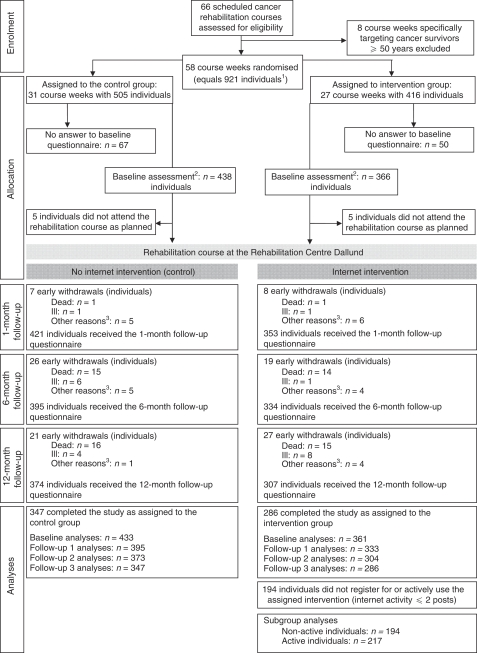
BACKGROUND: We conducted a randomised study to investigate whether providing a self-guided Internet support group to cancer patients affected mood disturbance and adjustment to cancer. METHODS: Baseline and 1-, 6- and 12-month assessments were conducted from 2004 to 2006 at a national rehabilitation centre in Denmark. A total of 58 rehabilitation course weeks including 921 survivors of various cancers were randomly assigned to a control or an intervention group by cluster randomisation. The intervention was a lecture on the use of the Internet for support and information followed by participation in an Internet support group. Outcome measures included self-reported mood disturbance, adjustment to cancer and self-rated health. Differences in scores were compared between the control group and the intervention group. RESULTS: The effect of the intervention on mood disturbance and adjustment to cancer showed a transient difference at the 6-month follow-up, where the intervention group reported less reduction in anxious preoccupation (P=0.04), helplessness (P=0.002), confusion (P=0.001) and depression (P=0.04). Otherwise no significant effects were observed. CONCLUSION: We conclude that use of Internet-based support groups in cancer patients still needs to confirm long-lasting psychological effects.
Overview
The claims and statistics of this paper haven’t been checked yet.
Free: it reads the open-access text and checks the first 5 claims that cite a source we can check. Create a free account to check every claim.
Integrity signals
Registry
Cites
Statistics
Figures
Verification
Claims the paper makes
The claims and statistics of this paper haven’t been checked yet.
Free: it reads the open-access text and checks the first 5 claims that cite a source we can check. Create a free account to check every claim.
Claims other papers make about this one
Each is checked against this paper’s own text: does it say what the citing paper says it does?
In the citing paper
“However, findings of unmoderated support groups have tended to show either no benefits relative to control arms (32, 33) or some worsening of symptoms (34, 35).”
From Behavioral Intervention Technologies: Evidence review and recommendations for future research in mental health (2013) · cites this paper as [33]
Self-check
Percentages, sums and reported differences re-computed from the paper’s own numbers.
The self-check needs the paper’s full text.
Citations
Cites
Self-rated health and mortality: a review of twenty-seven community studies.
Idler, E. L., & Benyamini, Y. (1997) · Journal of Health and Social Behavior · doi:10.2307/2955359 · Cited by 8,598 · cited 1×
“lifestyle risk factors (Idler and Benyamini, 1997).”
Eysenbach, G., Powell, J., Englesakis, M., Rizo, C., & Stern, A. (2004) · BMJ · doi:10.1136/bmj.328.7449.1166 · Cited by 1,268
A Shortened Version of the Profile of Mood States
Shacham, S. (1983) · Journal of Personality Assessment · doi:10.1207/s15327752jpa4703_14 · Cited by 1,231 · cited 1×
“Primary end points POMS-SF (Shacham, 1983; Curran et al, 1995) Self-report Measures psychological distress.”
MethodShort Form of the Profile of Mood States (POMS-SF): Psychometric information.
Curran, S. L., Andrykowski, M. A., & Studts, J. L. (1995) · Psychological Assessment · doi:10.1037//1040-3590.7.1.80 · Cited by 808
Influence of psychological response on survival in breast cancer: a population-based cohort study
Watson, M., Haviland, J., Greer, S., Davidson, J., & Bliss, J. (1999) · The Lancet · doi:10.1016/s0140-6736(98)11392-2 · Cited by 705
Evaluation of an internet support group for women with primary breast cancer
Winzelberg, A. J., Classen, C., Alpers, G. W., Roberts, H., Koopman, C., Adams, R. E., Ernst, H., Dev, P., & Taylor, C. B. (2003) · Cancer · doi:10.1002/cncr.11174 · Cited by 485 · cited 5×
“…Internet-based support to cancer survivors may result in significant positive outcomes regarding social support, competence in finding information (Gustafson et al, 2001), depression (Winzelberg et al, 2003) and self-perceived health status (Owen et al, 2005) (Online Supplementary Table 1).”
BackgroundResultInfluentialEffect of computer support on younger women with breast cancer
Gustafson, D. H., Hawkins, R., Pingree, S., McTavish, F., Arora, N. K., Mendenhall, J., Cella, D. F., Serlin, R. C., Apantaku, F. M., Stewart, J., et al. (2001) · Journal of General Internal Medicine · doi:10.1046/j.1525-1497.2001.016007435.x · Cited by 387 · cited 7×
“…Internet-based support to cancer survivors may result in significant positive outcomes regarding social support, competence in finding information (Gustafson et al, 2001), depression (Winzelberg et al, 2003) and self-perceived health status (Owen et al, 2005) (Online Supplementary Table 1).”
BackgroundResultInfluentialThe Mini-MAC: Further Development of the Mental Adjustment to Cancer Scale
Watson, M., Law, M. G., Santos, M. D., Greer, S., Baruch, J., & Bliss, J. (1994) · Journal of Psychosocial Oncology · doi:10.1300/j077v12n03_03 · Cited by 382
Group support interventions for women with breast cancer: Who benefits from what?
Helgeson, V. S., Cohen, S., Schulz, R., & Yasko, J. (2000) · Health Psychology · doi:10.1037/0278-6133.19.2.107 · Cited by 341 · cited 1×
“Women with high emotional support from partners have previously shown adverse effects of a peer-support intervention, suggesting a possible association of social resources with effects of the peer-support groups (Helgeson et al, 2000).”
BackgroundOnline interaction. Effects of storytelling in an internet breast cancer support group
Høybye, M. T., Johansen, C., & Tjørnhøj-Thomsen, T. (2005) · Psycho-Oncology · doi:10.1002/pon.837 · Cited by 317
Self-citation
Research works printed but not linked: 1
- McNair DM, Lorr M, Droppleman LF (1992) EdiTS Manual for the Profile of Mood States. Educational and Industrial Testing Service: San Diego, California
Cited by
Mohr, D. C., Burns, M. N., Schueller, S. M., Clarke, G., & Klinkman, M. (2013) · General Hospital Psychiatry · doi:10.1016/j.genhosppsych.2013.03.008 · Cited by 693
“However, findings of unmoderated support groups have tended to show either no benefits relative to control arms [32,33] or some worsening of symptoms [34,35].”
Interventions to enhance return-to-work for cancer patients
de Boer, A. G., Taskila, T. K., Tamminga, S. J., Feuerstein, M., Frings-Dresen, M. H., & Verbeek, J. H. (2015) · Cochrane Database of Systematic Reviews · doi:10.1002/14651858.cd007569.pub3 · Cited by 428
Merolli, M., Gray, K., & Martin-Sanchez, F. (2013) · Journal of Biomedical Informatics · doi:10.1016/j.jbi.2013.04.010 · Cited by 320
“Of the included studies focussing solely on a single chronic condition (N = 11), five explore cancer [28,30,32,33,37] (two specifically breast cancer), three examine chronic pain related conditions [22,24,27], one HIV/AIDS [36], one diabetes [21] and one rheumatoid arthritis [26].”
BackgroundTelemental Health Care, an Effective Alternative to Conventional Mental Care: a Systematic Review
Langarizadeh, M., Tabatabaei, M., Tavakol, K., Naghipour, M., & Moghbeli, F. (2017) · Acta Informatica Medica · doi:10.5455/aim.2017.25.240-246 · Cited by 314
Park, A., Conway, M., & Chen, A. T. (2018) · Computers in Human Behavior · doi:10.1016/j.chb.2017.09.001 · Cited by 204
“Online interactions have been shown to improve depression [10, 11, 12, 13, 14], anxiety [12, 13, 15], stress [12, 13], and negative mood [16], as well as facilitate coping [17] and empowerment [10, 11, 13, 15, 17, 6].”
Backgroundvan den Berg, S. W., Gielissen, M. F. M., Custers, J. A. E., van der Graaf, W. T. A., Ottevanger, P. B., & Prins, J. B. (2015) · Journal of Clinical Oncology · doi:10.1200/jco.2013.54.9386 · Cited by 201
Leykin, Y., Thekdi, S. M., Shumay, D. M., Muñoz, R. F., Riba, M., & Dunn, L. B. (2012) · Psycho-Oncology · doi:10.1002/pon.1993 · Cited by 192
“A subsequent study involving cancer survivors found a transient difference in mood and adjustment scores, but sustained benefit was not confirmed [29].”
BackgroundA systematic review of types and efficacy of online interventions for cancer patients.
McAlpine, H., Joubert, L., Martin-Sanchez, F., Merolli, M., & Drummond, K. J. (2015) · Patient Education and Counseling · doi:10.1016/j.pec.2014.11.002 · Cited by 160
“However, the intervention group demonstrated less reduction in helplessness, and increased anxious preoccupation, confusion and depression at 6 months compared with controls [42].”
BackgroundInfluentialEmpowerment in cancer patients: Does peer support make a difference? A systematic review
Ziegler, E., Hill, J., Lieske, B., Klein, J., dem, O. V., & Kofahl, C. (2022) · Psycho-Oncology · doi:10.1002/pon.5869 · Cited by 153
“Less than a third did not find any associations,(49,52,55,60,62,66,67) and only three negative associations were observed.(51,57,74) Notably, these negative effects were either transient(51,57) or even stronger in the control group,(74) suggesting that coping would deteriorate less with peer support.”
BackgroundResultInfluentialOutcomes of online support and resources for cancer survivors: A systematic literature review
Hong, Y., Peña-Purcell, N. C., & Ory, M. G. (2012) · Patient Education and Counseling · doi:10.1016/j.pec.2011.06.014 · Cited by 155
“study, the 27-week online support system led to no positive effects on mood distance, adjustment to cancer, or self-related health status; however, psychological wellbeing improved in both intervention and control groups [38].”
BackgroundMethodInfluentialKent, E. E., Smith, A. W., Keegan, T. H. M., Lynch, C. F., Wu, X.-C., Hamilton, A. S., Kato, I., Schwartz, S. M., & Harlan, F. T. A. H. S. G. (2013) · Journal of Adolescent and Young Adult Oncology · doi:10.1089/jayao.2012.0029 · Cited by 133
McPeake, J., Hirshberg, E. L., Christie, L. M., Drumright, K., Haines, K., Hough, C. L., Meyer, J., Wade, D., Andrews, A., Bakhru, R., et al. (2019) · Critical Care Medicine · doi:10.1097/ccm.0000000000003497 · Cited by 128
“Online Model Using dedicated websites (or forums) to provide support for survivors of critical care is another potential model, with some positive benefits of this approach being reported in other specialties (35).”
Empowerment of Cancer Survivors Through Information Technology: An Integrative Review
Groen, W. G., Kuijpers, W., Oldenburg, H. S., Wouters, M. W., Aaronson, N. K., & van Harten, W. H. (2015) · Journal of Medical Internet Research · doi:10.2196/jmir.4818 · Cited by 126
“An example is the Internet peer support offered to a large group of cancer survivors as described by Hoybye et al [58].”
Expressive writing interventions in cancer patients: a systematic review
Merz, E. L., Fox, R. S., & Malcarne, V. L. (2014) · Health Psychology Review · doi:10.1080/17437199.2014.882007 · Cited by 108
“Interventions including psychotherapy (Hart et al., 2012), peer groups (Hoey, Ieropoli, White, & Jefford, 2008) and Internet-based support (Høybye et al., 2010) have been used in cancer patients with some benefits.”
BackgroundZhang, S., Bantum, E. O., Owen, J., Bakken, S., & Elhadad, N. (2017) · Journal of the American Medical Informatics Association · doi:10.1093/jamia/ocw093 · Cited by 104
“In addition, biases were reported in these studies that may also affect their validity, such as suboptimal strategy in randomization, 49 sample size too small to account for the larger-than-expected variation, 19 and reliance on self-reported data.”
BackgroundBradford, N. K., & Chan, R. J. (2017) · Cancer Treatment Reviews · doi:10.1016/j.ctrv.2017.02.011 · Cited by 97
“not useful for delivering interventions to young survivors.[39, 40] It is possible some young people view the”
BackgroundPark, A., & Conway, M. (2017) · Journal of Medical Internet Research · doi:10.2196/jmir.6826 · Cited by 113
“Research on the benefits of online health communities highlights psychosocial benefits—such as reduced depression [2,3], anxiety [3,4], stress [3], and negative mood [5]—as well as the development of a higher level of coping [6] and patient empowerment [2,6,7].”
Wang, Y., Lin, Y., Chen, J., Wang, C., Hu, R., & Wu, Y. (2020) · Supportive Care in Cancer · doi:10.1007/s00520-020-05383-3 · Cited by 91
Online support groups for women with breast cancer
McCaughan, E., Parahoo, K., Hueter, I., Northouse, L., & Bradbury, I. (2017) · Cochrane Database of Systematic Reviews · doi:10.1002/14651858.cd011652.pub2 · Cited by 90
Project onward: an innovative e-health intervention for cancer survivors
Duffecy, J., Sanford, S., Wagner, L., Begale, M., Nawacki, E., & Mohr, D. C. (2013) · Psycho-Oncology · doi:10.1002/pon.3075 · Cited by 89
Lee, K., Kim, S., Kim, S. H., Yoo, S., Sung, J. H., Oh, E. G., Kim, N. W., & Lee, J. (2023) · Journal of Medical Internet Research · doi:10.2196/38333 · Cited by 95
“…did not include mindfulness [72,259] and strength [39,80,96] in Tables 1 and 2 A negative effect of web-based communicate interventions on distress [119,144] and of web-based self-manage interventions on self-efficacy [209] as well as a few adverse events that occurred while conducting digital…”
Wootten, A. C., Abbott, J.-A. M., Meyer, D., Chisholm, K., Austin, D. W., Klein, B., McCabe, M., Murphy, D. G., & Costello, A. J. (2015) · European Urology · doi:10.1016/j.eururo.2014.10.024 · Cited by 77
How effective is peer-to-peer support in cancer patients and survivors? A systematic review
Kiemen, A., Czornik, M., & Weis, J. (2023) · Journal of Cancer Research and Clinical Oncology · doi:10.1007/s00432-023-04753-8 · Cited by 96
Sanjida, S., McPhail, S. M., Shaw, J., Couper, J., Kissane, D., Price, M. A., & Janda, M. (2018) · Psycho-Oncology · doi:10.1002/pon.4794 · Cited by 74
“Characteristics of each study are presented in Supplementary Table 1.(5,14-20,40-102) More than half of the included studies (n = 38/71) were published after 2010.”
BackgroundSmith, T. B., Workman, C. D., Andrews, C., Barton, B., Cook, M., Layton, R. G., Morrey, A., Petersen, D., & Holt‐Lunstad, J. (2021) · PLoS Medicine · doi:10.1371/journal.pmed.1003595 · Cited by 97
Chee, W., Lee, Y., Im, E.-O., Chee, E., Tsai, H.-M., Nishigaki, M., Yeo, S. A., Schapira, M. M., & Mao, J. J. (2017) · Journal of Telemedicine and Telecare · doi:10.1177/1357633x16658369 · Cited by 69
KLEMM, P. (2012) · CIN: Computers, Informatics, Nursing · doi:10.1097/ncn.0b013e3182343efa · Cited by 62
van Eenbergen, M. C., van de Poll-Franse, L. V., Heine, P., & Mols, F. (2017) · JMIR Cancer · doi:10.2196/cancer.7312 · Cited by 60
“The study populations ranged from 27 [17] to 794 [23] respondents.”
BackgroundMethodInfluentialLee, R., Lee, K. S., Oh, E. G., & Kim, S. H. (2012) · Cancer Nursing · doi:10.1097/ncc.0b013e3182642d7c · Cited by 63
Naveh, S., & Bronstein, J. (2019) · Aslib Journal of Information Management · doi:10.1108/ajim-02-2019-0049 · Cited by 65
Internet-delivered treatment to promote health
Andersson, G., Ljótsson, B., & Weise, C. (2011) · Current Opinion in Psychiatry · doi:10.1097/yco.0b013e3283438028 · Cited by 52
Paul, C. L., Carey, M. L., Sanson-Fisher, R. W., Houlcroft, L. E., & Turon, H. E. (2013) · Health Education Research · doi:10.1093/her/cyt053 · Cited by 51
Kroenke, C. H. (2018) · Translational Behavioral Medicine · doi:10.1093/tbm/ibx061 · Cited by 55
Batenburg, A., & Das, E. (2014) · Journal of Medical Internet Research · doi:10.2196/jmir.2831 · Cited by 58
“The current study might explain null findings in previous studies [11,12].”
BackgroundResultBatenburg, A., & Das, E. (2014) · Journal of Medical Internet Research · doi:10.2196/jmir.3517 · Cited by 47
“However, other studies reported no significant major effects [15,16] or negative effects [17].”
Web-based interventions for caregivers of cancer patients: A review of literatures
Tang, W. P., Chan, C. W., So, W. K., & Leung, D. Y. (2014) · Asia-Pacific Journal of Oncology Nursing · doi:10.4103/2347-5625.135811 · Cited by 45
“In addition, depression and stress level were significantly reduced with web-based interventions.([18,19]) Despite the documented effectiveness and benefits of Internet there is a concern about the quality and accuracy of health information in the web.”
BackgroundEngagement of young adult cancer survivors within a Facebook-based physical activity intervention
Valle, C. G., & Tate, D. F. (2017) · Translational Behavioral Medicine · doi:10.1007/s13142-017-0483-3 · Cited by 50
“Although previous research has demonstrated that cancer survivors may derive benefits from peer-led online support communities, such as improvements in well-being, depression, empowerment, and hope [58–60], some have shown no improvements [61] or worse outcomes associated with participation in peer-led online communit…”
BackgroundDavid, N., Schlenker, P., Prudlo, U., & Larbig, W. (2013) · Psycho-Oncology · doi:10.1002/pon.3104 · Cited by 42
“Cancer patients who participated in unmoderated support groups even tended to show over timemore distress [6,10] and less quality of life [10], suggesting that online peer-to-peer interaction should not be assumed to provide benefits.”
BackgroundInfluentialThe effect of social network site use on the psychological well‐being of cancer patients
Erfani, S. S., Abedin, B., & Blount, Y. (2016) · Journal of the Association for Information Science and Technology · doi:10.1002/asi.23702 · Cited by 57
“This finding aligns with previous studies that suggested a positive relationship between participation in Internet-based support groups and obtaining social support (Kroenke et al., 2013; Rubenstein, 2015) and ultimately improved psychological well-being of cancer patients (Høybye et al., 2010).”
BackgroundResultInfluentialNon-medical interventions to enhance return to work for people with cancer
de Boer, A. G. E. M., Tamminga, S. J., Boschman, J. S., & Hoving, J. L. (2024) · Cochrane Database of Systematic Reviews · doi:10.1002/14651858.cd007569.pub4 · Cited by 68
Allison, K. R., Patterson, P., Guilbert, D., Noke, M., & Husson, O. (2021) · Proceedings of the ACM on Human-Computer Interaction · doi:10.1145/3449169 · Cited by 34
“130](4) surveys, although eight studies were randomised-controlled trials (RCTs)[21, 96, 104, 123, 125, 126, 128, 129].”
BackgroundResultInfluentialZhang, Y., Flannery, M. A., Zhang, Z., Underhill-Blazey, M. L., Bobry, M. D., Leblanc, N. M., Rodriguez, D., & Zhang, C. (2024) · JMIR Cancer · doi:10.2196/46116 · Cited by 50
“[35-37,39-50, 53,55,59-62,64,67,68,70,72,75,77,81,82,85,88-91,93,95-99] or smart device app (n=8) [43,52,56,57,63,69,80,87].”
van Rosmalen-Nooijens, K. A. W. L., Wong, S. L. F., Prins, J. B., & Lagro‐Janssen, A. L. M. (2017) · Journal of Medical Internet Research · doi:10.2196/jmir.6004 · Cited by 36
“Provision of information, sharing experiences, and peer modeling are known to increase self-management [47-49] and peer- and social support are effective methods to change behavior, both offline and on the Web [49-55].”
BackgroundOwen, J. E., Bantum, E. O., Criswell, K. R., Bazzo, J., Gorlick, A., & Stanton, A. L. (2013) · Journal of Behavioral Medicine · doi:10.1007/s10865-013-9509-6 · Cited by 34
“, 2003), whereas results from trials that incorporate a systematic sample have yielded inconsistent findings, including worse outcomes associated with Internet-based intervention (Hoybe et al., 2010) or benefits for only select subgroups (Gustafson et al.”
BackgroundResultMattsson, S., Alfonsson, S., Carlsson, M., Nygren, P., Olsson, E., & Johansson, B. (2013) · BMC Cancer · doi:10.1186/1471-2407-13-414 · Cited by 31
“These findings were contradicted by the results of a recently published randomized trial in mixed diagnoses that did not show any positive effects of a non-moderated web-based discussion forum, but rather, a tendency towards poorer psychological wellbeing in the intervention group compared with the control group [17].”
ResultGorlick, A., Bantum, E. O., & Owen, J. E. (2014) · Psycho-Oncology · doi:10.1002/pon.3443 · Cited by 30
“Some studies have shown positive effects [1,7] and null effects [4], whereas others have reported negative effects [3,5].”
BackgroundMontalescot, L., Baussard, L., & Charbonnier, É. (2024) · Journal of Medical Internet Research · doi:10.2196/52542 · Cited by 43
“%) studies [33,43], it was not associated with higher use of specific modules [60].”
Influential“How Did We Get Here?”: Topic Drift in Online Health Discussions
Park, A., Hartzler, A. L., Huh, J., Hsieh, G., McDonald, D. W., & Pratt, W. (2016) · Journal of Medical Internet Research · doi:10.2196/jmir.6297 · Cited by 38
“Previous studies have shown a correlation between participating in online health communities and improvement of depression [12-16], anxiety [14,16,17], stress [14,15], negative mood [18], and health outcomes [19,20].”
BackgroundLu, Y., Pan, T., Liu, J., & Wu, J. (2021) · Frontiers in Public Health · doi:10.3389/fpubh.2020.581088 · Cited by 38
Hauffman, A., Alfonsson, S., Mattsson, S., Forslund, M., Bill‐Axelson, A., Nygren, P., & Johansson, B. (2016) · Cancer Nursing · doi:10.1097/ncc.0000000000000402 · Cited by 34
Thenral, M., & Annamalai, A. (2020) · Indian Journal of Psychological Medicine · doi:10.1177/0253717620952160 · Cited by 33
Emotional Contagion in the Online Depression Community
Tang, J., Yu, G., & Yao, X. (2021) · Healthcare · doi:10.3390/healthcare9121609 · Cited by 32
“This emotional longitudinal change was different from results of previous studies based on online healthy communities [33,35,36] that found that online interaction can improve depression and anxiety.”
BackgroundResultAmann, J., Zanini, C., & Rubinelli, S. (2016) · PLoS ONE · doi:10.1371/journal.pone.0156175 · Cited by 36
Paul, C. L., Carey, M. L., Hall, A. E., Lynagh, M., Sanson‐Fisher, R., & Henskens, F. A. (2011) · Journal of Medical Internet Research · doi:10.2196/jmir.1894 · Cited by 27
“The single study that included hematologic cancer survivors [15] also involved participants with other types of cancer diagnoses and suggested that those who were single, older, and less educated were less likely to use the Web-based intervention.”
BackgroundResultLu, Y., Luo, S., & Liu, X. (2021) · JMIR Medical Informatics · doi:10.2196/24618 · Cited by 37
“On the one hand, the anonymity of online communities may make depressed patients feel more open when disclosing their illness to others [7,8].”
BackgroundWHITE, V. M., Young, M., Farrelly, A., Meiser, B., Jefford, M., Williamson, E., Ieropoli, S., Duffy, J., & Winship, I. (2014) · Journal of Clinical Oncology · doi:10.1200/jco.2013.54.1607 · Cited by 30
“Although the lack of blinding may have influenced IG participants to respond more positively at follow-up, we do not believe this likely, because previous unblinded RCTs of peer support have failed to find positive intervention effects on distress.(18,20,21) Finally, because only approximately 27% of women approached…”
ResultEngagement with a Social Networking Intervention for Cancer-Related Distress
Owen, J. E., Bantum, E. O., Gorlick, A., & Stanton, A. L. (2014) · Annals of Behavioral Medicine · doi:10.1007/s12160-014-9643-6 · Cited by 28
Characterizing Social Networks and Communication Channels in a Web-Based Peer Support Intervention
Owen, J. E., Curran, M., Bantum, E. O., & Hanneman, R. A. (2016) · Cyberpsychology Behavior and Social Networking · doi:10.1089/cyber.2015.0359 · Cited by 28
Gibson, D. G., Tamrat, T., & Mehl, G. L. (2018) · Global Health Science and Practice · doi:10.9745/ghsp-d-18-00165 · Cited by 31
Use of the mini-MAC scale in the evaluation of mental adjustment to cancer
Czerw, A. I., Marek, E. M., & Deptała, A. (2015) · Współczesna Onkologia · doi:10.5114/wo.2015.54900 · Cited by 23
“5) The effect of Internet support groups on psychosocial adjustment to cancer [21].”
BackgroundWestmaas, J. L., Fallon, E. A., McDonald, B., Driscoll, D., Richardson, K., Portier, K. M., & Smith, T. G. (2019) · Supportive Care in Cancer · doi:10.1007/s00520-019-05193-2 · Cited by 21
Siew, L. E. D., Teo, N. R., Ang, W. H. D., & Lau, Y. (2023) · Journal of Cancer Survivorship · doi:10.1007/s11764-022-01244-6 · Cited by 19
Engagement with INSPIRE, an Online Program for Hematopoietic Cell Transplantation Survivors
Syrjala, K. L., Crouch, M.-L., Leisenring, W. M., Flowers, M. E. D., Artherholt, S. B., Fiscalini, A. S., Romano, E. M., Romano, J. M., Martin, P. J., & Yi, J. C. (2018) · Transplantation and Cellular Therapy · doi:10.1016/j.bbmt.2018.05.004 · Cited by 20
Abu‐Odah, H., Su, J. J., Wang, M., Sheffield, D., & Molassiotis, A. (2023) · Supportive Care in Cancer · doi:10.1007/s00520-023-08255-8 · Cited by 27
“Numerous interventions have been applied in cancer patients to ease psychological repercussions with some benefits, including psychotherapy [4], peer support groups [5], and Internet-based support [6].”
McAlpine, H., Sejka, M., & Drummond, K. J. (2020) · Patient Education and Counseling · doi:10.1016/j.pec.2020.07.012 · Cited by 17
Peer support in patients with hematologic malignancies: a systematic review
Amonoo, H. L., Harnedy, L. E., Staton, S. C., Longley, R. M., Daskalakis, E. P., El-Jawahri, A. R., & Huffman, J. C. (2022) · Bone Marrow Transplantation · doi:10.1038/s41409-022-01709-3 · Cited by 15
Hemming, L., Duijts, S. F. A., Zomerdijk, N., Cockburn, C., Yuen, E., Hardman, R. J., Vuuren, J. V., Farrugia, T., Wilson, C., & Spelten, E. R. (2024) · Orphanet Journal of Rare Diseases · doi:10.1186/s13023-024-03477-3 · Cited by 22
“Of the twenty-three studies included in this review, twelve were conducted in the United States [30–33, 35, 38, 40, 42–44, 49, 50], three in Japan [34, 39, 46], two in The Netherlands [37, 48] and one each in Australia [45], Canada [28], Denmark [36], Finland [47], Switzerland [29] and the UK [27].”
InfluentialLumbar Spine Fusion Patients’ Use of an Internet Support Group: Mixed Methods Study
Strøm, J., Høybye, M. T., Laursen, M., Jørgensen, L. B., & Nielsen, C. V. (2019) · Journal of Medical Internet Research · doi:10.2196/jmir.9805 · Cited by 16
“Other studies have mixed results or no positive results [12-14].”
Self-citationMartin, S. C., Roderick, M. C., Lockridge, R., Toledo‐Tamula, M. A., Baldwin, A., Knight, P. B., & Wolters, P. L. (2016) · Journal of Genetic Counseling · doi:10.1007/s10897-016-0031-1 · Cited by 18
Understanding Computer-Mediated Support Groups: A Revisit Using a Meta-Analytic Approach
Yang, Q. (2018) · Health Communication · doi:10.1080/10410236.2018.1551751 · Cited by 17
“These studies focused on a variety of populations, such as cancer survivors (e.g., Duffecy et al., 2013; Høybye et al., 2010), caregivers of mental health patients (e.g., Clifford & Minnes, 2013; O ’ Connor, Arizmendi, & Kaszniak, 2014), and college students (e.g., Ellis, Campbell, Sethi, & O ’…”
BackgroundCherba, M., Thoër, C., Turbide, O., Denault, V., Rénaud, L., Valderrama, A., Courcy, I., Cordelier, B., Laquerre, M.-E., Cyr, C., et al. (2019) · Santé Publique · doi:10.3917/spub.191.0083 · Cited by 22
Abu‐Odah, H., Sheffield, D., Hogan, S., Yorke, J., & Molassiotis, A. (2024) · Supportive Care in Cancer · doi:10.1007/s00520-024-08582-4 · Cited by 20
“Various complementary interventions, such as psychotherapy [4], peer support groups [5], and internet-based support [6] have been used to help patients with cancer alleviate its impacts.”
Price, A., de Bell, S., Shaw, N., Bethel, A. C., Anderson, R., & Coon, J. T. (2022) · Campbell Systematic Reviews · doi:10.1002/cl2.1264 · Cited by 18
Chee, W., Kim, S., Chu, T., Tsai, H., Ji, X., Zhang, J., Chee, E., & Im, E. (2016) · Journal of Medical Internet Research · doi:10.2196/jmir.6454 · Cited by 15
Smart technologies for older people
Morris, M. E. (2012) · Cited by 15
Griffiths, K. M., Carron‐Arthur, B., Reynolds, J., Bennett, K., & Bennett, A. (2016) · Internet Interventions · doi:10.1016/j.invent.2016.11.003 · Cited by 13
The Construction of Peer Support Among Recently Diagnosed Breast Cancer Patients
Toija, A., Kettunen, T., & Kasila, K. (2024) · Cancer Nursing · doi:10.1097/ncc.0000000000001319 · Cited by 10
Dědová, M., Baník, G., & Vargová, L. (2022) · Supportive Care in Cancer · doi:10.1007/s00520-022-07454-z · Cited by 19
“Other authors [18, 44] have also highlighted the positive importance of cancer support groups in coping with cancer.”
BackgroundHøybye, M. T., Olsen, P. R., Hansson, H., Spiegel, D., Bennetsen, H., & Cheslack-Postava, E. (2016) · Health Informatics Journal · doi:10.1177/1460458216678442 · Cited by 11
Self-citationThe Effects of Peer Support on Depression, Anxiety, and Stress Among Patients Receiving Hemodialysis
Irajpour, A., Hashemi, M. S., Abazari, P., Shahidi, S., & Fayazi, M. (2019) · Iranian Red Crescent Medical Journal · doi:10.5812/ircmj.66321 · Cited by 19
Can Mental Health Care Become More Human by Becoming More Digital?
Galatzer‐Levy, I. R., Aranovich, G. J., & Insel, T. R. (2023) · Daedalus · doi:10.1162/daed_a_02040 · Cited by 15
“23 Which parts of the clinical interaction can be automated through improved conventional artificial intelligence and which require human interaction remains an open and important question.”
BackgroundSocial Interest, Empathy, and Online Support Groups
Hammond, H. (2015) · The Journal of Individual Psychology · doi:10.1353/jip.2015.0008 · Cited by 11
“In regard to the efficacy of online support groups, certain studies have not shown significant or differential effectiveness (Freeman, Barker, & Pistrang, 2008; Høybye et al., 2010; van der Houwen et al., 2010).”
BackgroundBaumann, E., & Link, E. (2016) · Springer eBooks · doi:10.1007/978-3-662-49504-9_21 · Cited by 19
Im, E., Kim, S., Jang, M., & Chee, W. (2020) · Western Journal of Nursing Research · doi:10.1177/0193945920974028 · Cited by 10
Ross, L., Rottmann, N., Andersen, K. K., Høybye, M. T., Johansen, C., & Dalton, S. O. (2015) · Acta Oncologica · doi:10.3109/0284186x.2014.998278 · Cited by 9
“This hypothesis is supported by fi ndings from a randomised study of Internet groups formed by participants at the Dallund Rehabilitation Centre, in which participants in the peer-support groups reported less reduction in anxious preoccupation, helplessness, confusion and depression than participants who were not allo…”
MethodSelf-citationInformation Needs of Asian American Breast Cancer Survivors: a Decision Tree Analysis
Chee, W., Yi, J., & Im, E. (2021) · Journal of Cancer Education · doi:10.1007/s13187-021-02059-2 · Cited by 12
Implementing a telephone based peer support intervention for women with a BRCA1/2 mutation
Farrelly, A., WHITE, V. M., Young, M., Jefford, M., Ieropoli, S., Duffy, J., Winship, I., & Meiser, B. (2015) · Familial Cancer · doi:10.1007/s10689-015-9797-9 · Cited by 9
Tolby, L. T., Hofmeister, E. N., Fisher, S. E., Chao, S., Benedict, C., Kurian, A. W., Berek, J. S., Schapira, L., & Palesh, O. G. (2020) · Journal of Cancer Survivorship · doi:10.1007/s11764-020-00959-8 · Cited by 8
Bender, J. L. (2017) · Advances in healthcare information systems and administration book series · doi:10.4018/978-1-5225-2958-3.ch003 · Cited by 7
Social Dynamics of the Online Health Communities for Mental Health
Xu, R., & Zhang, Q. (2016) · Lecture notes in computer science · doi:10.1007/978-3-319-29175-8_25 · Cited by 7
Gesundheitskommunikation mittels Gesundheitsportalen und Online-Communitys
Link, E. (2019) · Springer eBooks · doi:10.1007/978-3-658-10727-7_13 · Cited by 16
The Teen Impact Experience: A Webcast Pilot Project for Teens With Cancer and Blood Diseases
Gonzalez‐Morkos, B., Zavala, O., Malogolowkin, M. H., & Kuperberg, A. (2014) · Journal of Pediatric Oncology Nursing · doi:10.1177/1043454214529369 · Cited by 8
“Current literature also points to the rapid growth of the World Wide Web for support groups (Battles & Wiener, 2002; Hanley, 2009; Høybye et al., 2010; Suzuki & Kato, 2003; Till, 2004; Treadgold & Kuperberg, 2010; White & Dorman, 2001).”
BackgroundButow, P., & Smith, A. ‘. (2015) · Patient Education and Counseling · doi:10.1016/j.pec.2015.01.003 · Cited by 6
“[13] Høybye MT, Dalton SO, Deltour I, Bidstrup PE, Frederiksen K, Johansen C.”
BackgroundResultE-Health-Angebote in der Onkologie
Lange, L., Schulz, H., & Bleich, C. (2018) · Der Onkologe · doi:10.1007/s00761-018-0348-5 · Cited by 6
“eines Online-Angebots einhergingen [3], konnten in weiteren Studien diesbezüglich keine Unterschiede zwischen Teilnehmern und Nichtteilnehmern gefunden werden [18].”
BackgroundEngaging the Social Texture of Internet Cancer Support Groups
Høybye, M. T. (2015) · Journal of Contemporary Ethnography · doi:10.1177/0891241615574287 · Cited by 8
“For further details about the procedure and characteristics of the groups, see Høybye et al. (2010).”
MethodSelf-citationTrachtenberg, L., Wong, J., Rennie, H., & Esplen, M. J. (2020) · International Journal of Group Psychotherapy · doi:10.1080/00207284.2020.1751639 · Cited by 6
“However, not all studies found significant positive effects (Høybye et al., 2010; Owen et al., 2005).”
BackgroundGnagnarella, P., Misotti, A. M., Santoro, L., Akoumianakis, D., Milolidakis, G., Lorenzo, F. D., Lombardo, C., Sullivan, R. J., & Mcvie, G. J. (2016) · ecancermedicalscience · doi:10.3332/ecancer.2011.228 · Cited by 6
Lee, S. G., & Kim, S. R. (2024) · European Journal of Oncology Nursing · doi:10.1016/j.ejon.2024.102571 · Cited by 5
Im, E., Chee, W., Paul, S., Choi, M., Kim, S. Y., Yeo, S., Ulrich, C. M., Schapira, M. M., Nguyen, G. T., Meghani, S. H., et al. (2024) · Journal of Cancer Education · doi:10.1007/s13187-024-02415-y · Cited by 5
“However, few technology-based interventions currently exist for racial/ethnic minority breast cancer survivors including Asian Americans [10, 12, 13].”
Gesundheitskommunikation mittels Gesundheitsportalen und Online-Communitys
Link, E. (2016) · Springer eBooks · doi:10.1007/978-3-658-10948-6_13-1 · Cited by 5
Metadata
- Authors
- Høybye, M. T., Dalton, S. O., Deltour, I., Bidstrup, P. E., Frederiksen, K., & Johansen, C.
- Affiliations
- Danish Cancer Society (DK)
- Corresponding author
- Høybye, M T
- Venue
- British Journal of Cancer
- Published
- 2010-04
- Volume
- 102
- Issue
- 9
- Pages
- 1348-1354
- ISSN
- 0007-0920 (ISSN-L)
- 1532-1827
- PMC
- PMC2865756
- OpenAlex
- W1974553900
- Cited by
- 128
- References
- 20
- Citations by year
- 2026: 2 · 2025: 2 · 2024: 8 · 2023: 8 · 2022: 7 · 2021: 6 · 2020: 9 · 2019: 8 · 2018: 8 · 2017: 10 · 2016: 19 · 2015: 13 · 2014: 9 · 2013: 10 · 2012: 5
- FWCI
- 3.01
- Type
- journal article
- Language
- en
- Open access
- hybrid
- doi.org
- Licence
- cc-by-nc-sa
- www.springer.com/tdm (unspecified)
- Locations
- British Journal of Cancer (publishedVersion, cc-by-nc-sa)
- Europe PMC (PubMed Central) (publishedVersion, cc-by)
- PubMed Central (publishedVersion, cc-by)
- PubMed (publishedVersion)
- Funders
- Kræftens Bekæmpelse (PP 07024)
- IMK Almene Fond
- Topics
- Health Sciences › Medicine › Oncology › Cancer survivorship and care
- Health Sciences › Health Professions › General Health Professions › Health Literacy and Information Accessibility
- Social Sciences › Psychology › Applied Psychology › Digital Mental Health Interventions
- Keywords
- cancer survivors, psychosocial adjustment, mood disturbance, depression, anxiety, self-rated health, rehabilitation
- MeSH terms
- Adult, Affect, Aged, Anger, Attitude to Health, Confusion, Denmark, Educational Status, Female, Humans, Male, Middle Aged, Neoplasms, Surveys and Questionnaires, Self-Help Groups, Social Adjustment, Stress, Psychological, Treatment Outcome, Marital Status, Survivors, Patient Selection, Internet
About these checks
Registry, retraction, Cites and statistics results are computed, not judged, with one exception: a printed reference that no index lists is read once by a model before it counts as a citation error. Claims are extracted by a model and kept only when their quote appears verbatim in the text; each cited source is then checked, with a model’s help, for whether it says what the claim relies on. Those verdicts can be wrong — read the claim’s quote and the cited source before relying on one.
Statistics and arithmetic are recomputed, not judged.
Confidence bands are shown only for fields calibrated on our annotated test set. None is calibrated yet, so no band is shown.
What counts as a claim ›How we measure confidence ›How we check this ›
Are you an author, or do you see a problem with this page? Request a review
Data sources
Bibliographic data: Semantic Scholar, OpenAlex, Crossref.
Contains information from the Semantic Scholar Academic Graph Datasets, made available under the ODC Attribution License (ODC-BY 1.0).
Semantic Scholar’s data is described in: Kinney, R., et al. (2023). The Semantic Scholar Open Data Platform. arXiv:2301.10140.
