

New androgen receptor genomic targets show an interaction with the ETS1 transcription factor
Open accessThe DOI matches its Crossref record; 26 of the 26 references it cites were found in a registry or an index.
Abstract
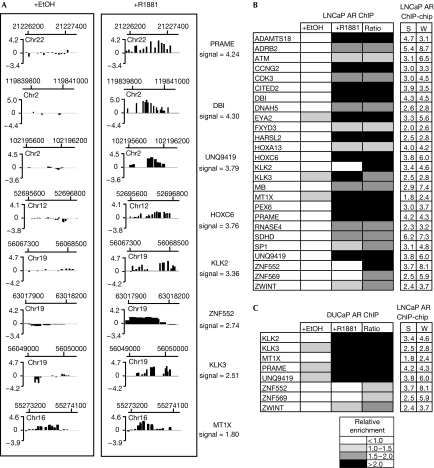
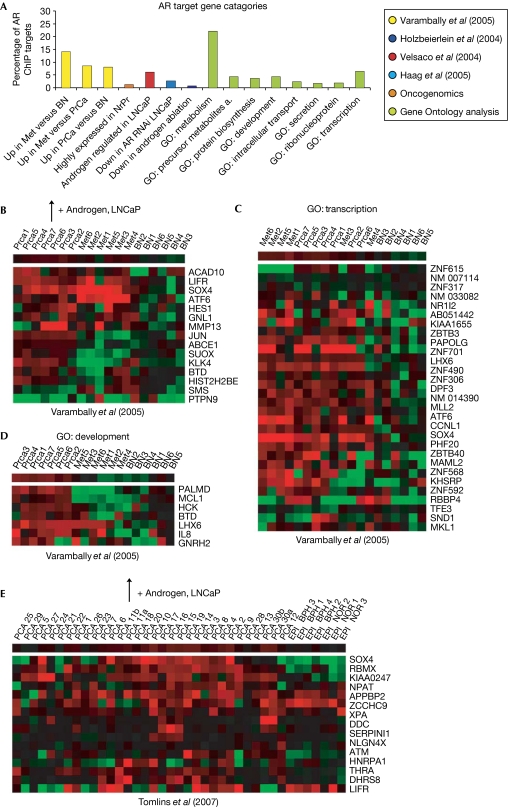
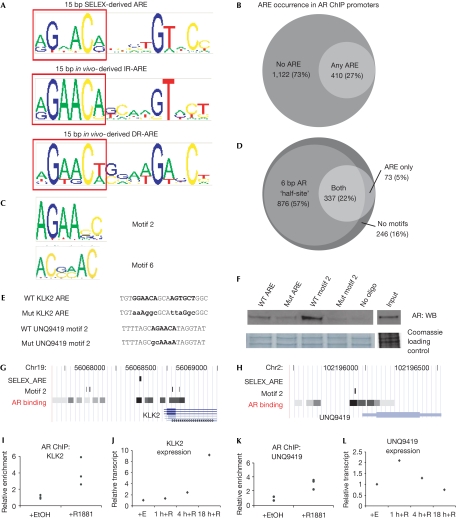
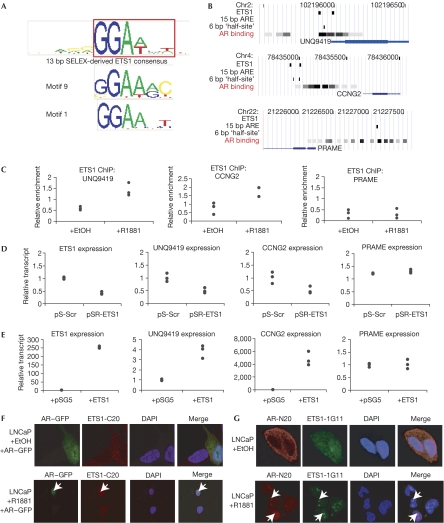
The androgen receptor (AR) initiates important developmental and oncogenic transcriptional pathways. The AR is known to bind as a homodimer to 15-base pair bipartite palindromic androgen-response elements; however, few direct AR gene targets are known. To identify AR promoter targets, we used chromatin immunoprecipitation with on-chip detection of genomic fragments. We identified 1,532 potential AR-binding sites, including previously known AR gene targets. Many of the new AR target genes show altered expression in prostate cancer. Analysis of sequences underlying AR-binding sites showed that more than 50% of AR-binding sites did not contain the established 15 bp AR-binding element. Unbiased sequence analysis showed 6-bp motifs, which were significantly enriched and were bound directly by the AR in vitro. Binding sequences for the avian erythroblastosis virus E26 homologue (ETS) transcription factor family were also highly enriched, and we uncovered an interaction between the AR and ETS1 at a subset of AR promoter targets.
Overview
The claims and statistics of this paper haven’t been checked yet.
Free: it reads the open-access text and checks the first 5 claims that cite a source we can check. Create a free account to check every claim.
Integrity signals
Registry
Cites
Statistics
Figures
Verification
Claims the paper makes
The claims and statistics of this paper haven’t been checked yet.
Free: it reads the open-access text and checks the first 5 claims that cite a source we can check. Create a free account to check every claim.
Claims other papers make about this one
Each is checked against this paper’s own text: does it say what the citing paper says it does?
In the citing paper
“Such a situation has also been observed for similar studies on the androgen receptor and may suggest compensation or redundancy in transcriptional control (Massie et al., 2007).”
From Dissecting the Unique Role of the Retinoblastoma Tumor Suppressor during Cellular Senescence (2010) · cites this paper as Massie et al., 2007
In the citing paper
“The involvement of the AR in normal prostate development, coupled with the prevalence of ETS-binding sequences at AR-bound regions (177), implies a cooperative interaction that could play a role in ETS-mediated prostate oncogenesis (Figure 7).”
From Genomic and biochemical insights into the specificity of ETS transcription factors (2011) · cites this paper as [177]
In the citing paper
“AR has evolved in a manner that allows it to tolerate levels of sequence degeneracy for proper development, with this enhanced flexibility conferred through a plastic dimer interface and an extended hinge, both serving as regulatory mechanisms that allow AR to bind primarily half sites and other degenerate sequences in vivo”
From Allosteric interactions prime androgen receptor dimerization and activation (2022) · cites this paper as Massie et al., 2007
Self-check
Percentages, sums and reported differences re-computed from the paper’s own numbers.
The self-check needs the paper’s full text.
Citations
Cites
Recurrent Fusion of TMPRSS2 and ETS Transcription Factor Genes in Prostate Cancer
Tomlins, S. A., Rhodes, D. R., Perner, S., Dhanasekaran, S. M., Mehra, R., Sun, X.-W., Varambally, S., Cao, X., Tchinda, J., Kuefer, R., et al. (2005) · Science · doi:10.1126/science.1117679 · Cited by 3,846
Molecular determinants of resistance to antiandrogen therapy
Chen, C. D., Welsbie, D. S., Tran, C., Baek, S. H., Chen, R., Vessella, R., Rosenfeld, M. G., & Sawyers, C. L. (2004) · Nature Medicine · doi:10.1038/nm972 · Cited by 2,278 · cited 3×
“EMBO open New androgen receptor genomic targets show an interaction with the ETS1 transcription factor”
BackgroundMatInspector and beyond: promoter analysis based on transcription factor binding sites
Cartharius, K., Frech, K., Grote, K., Klocke, B., Haltmeier, M., Klingenhoff, A., Frisch, M., Bayerlein, M., & Werner, T. (2005) · Bioinformatics · doi:10.1093/bioinformatics/bti473 · Cited by 1,979
Carroll, J. S., Liu, X. S., Brodsky, A. S., Li, W., Meyer, C. A., Szary, A. J., Eeckhoute, J., Shao, W., Hestermann, E. V., Geistlinger, T. R., et al. (2005) · Cell · doi:10.1016/j.cell.2005.05.008 · Cited by 1,384
Cancer incidence and mortality in Europe, 2004
Boyle, P., & Ferlay, J. (2005) · Annals of Oncology · doi:10.1093/annonc/mdi098 · Cited by 1,217
Cancer incidence and mortality in Europe
Levi, F., Maisonneuve, P., Filiberti, R., La Vecchia, C., & Boyle, P. (1989) · Sozial- und Präventivmedizin · doi:10.1007/bf02148558 · Cited by 968
Integrative molecular concept modeling of prostate cancer progression
Tomlins, S. A., Mehra, R., Rhodes, D. R., Cao, X., Wang, L., Dhanasekaran, S. M., Kalyana-Sundaram, S., Wei, J. T., Rubin, M. A., Pienta, K. J., et al. (2007) · Nature Genetics · doi:10.1038/ng1935 · Cited by 922
Varambally, S., Yu, J., Laxman, B., Rhodes, D. R., Mehra, R., Tomlins, S. A., Shah, R. B., Chandran, U., Monzon, F. A., Becich, M. J., et al. (2005) · Cancer Cell · doi:10.1016/j.ccr.2005.10.001 · Cited by 800
Holzbeierlein, J., Lal, P., LaTulippe, E., Smith, A., Satagopan, J., Zhang, L., Ryan, C., Smith, S., Scher, H., Scardino, P., et al. (2004) · The American Journal of Pathology · doi:10.1016/s0002-9440(10)63112-4 · Cited by 577 · cited 1×
“Gene Ontology analysis Oncogenomics Haag et al (2005) Velsaco et al (2004) Holzbeierlein et al (2004) Varambally et al (2005) A”
Hata, A., Seoane, J., Lagna, G., Montalvo, E., Hemmati-Brivanlou, A., & Massagué, J. (2000) · Cell · doi:10.1016/s0092-8674(00)81561-5 · Cited by 420
Cited by
Benchmark and integration of resources for the estimation of human transcription factor activities
Garcia-Alonso, L., Holland, C. H., Ibrahim, M. M., Turei, D., & Saez-Rodriguez, J. (2019) · Genome Research · doi:10.1101/gr.240663.118 · Cited by 1,122
Yu, J., Yu, J., Mani, R.-S., Cao, Q., Brenner, C. J., Cao, X., Wang, X., Wu, L., Li, J., Hu, M., et al. (2010) · Cancer Cell · doi:10.1016/j.ccr.2010.03.018 · Cited by 850
“Interestingly, ETS motifs were found enriched in the androgen receptor (AR) binding sites determined by chromatin immunoprecipitation (ChIP)-on-chip analysis and ETS1, another member of the ETS family transcription factors, was shown to physically interact with AR (Massie et al., 2007).”
BackgroundHeemers, H. V., & Tindall, D. J. (2007) · Endocrine Reviews · doi:10.1210/er.2007-0019 · Cited by 753
The androgen receptor fuels prostate cancer by regulating central metabolism and biosynthesis
Massie, C. E., Lynch, A., Ramos‐Montoya, A., Boren, J., Stark, R., Fazli, L., Warren, A., Scott, H., Madhu, B., Sharma, N., et al. (2011) · The EMBO Journal · doi:10.1038/emboj.2011.158 · Cited by 624
“Over the last 5 years a number of groups have employed ChIP to map genomic binding sites for the AR as a stepping stone to explain the contribution of the AR to prostate cancer (Jariwala et al, 2007; Massie et al, 2007; Takayama et al, 2007; Wang et al, 2007, 2009; Jia et al, 2008).”
BackgroundMethodInfluentialSelf-citationGenomic and biochemical insights into the specificity of ETS transcription factors
Hollenhorst, P. C., McIntosh, L. P., & Graves, B. J. (2011) · Annual Review of Biochemistry · doi:10.1146/annurev.biochem.79.081507.103945 · Cited by 490
“The involvement of the AR in normal prostate development, coupled with the prevalence of ETS-binding sequences at AR-bound regions (177), implies a cooperative interaction that could play a role in ETSmediated prostate oncogenesis (Figure 7).”
Metadata
- Authors
- Massie, C. E., Adryan, B., Barbosa‐Morais, N. L., Lynch, A. G., Tran, M. G., Neal, D. E., & Mills, I. G.
- Affiliations
- University of Cambridge (GB)
- MRC Laboratory of Molecular Biology (GB)
- Corresponding author
- Massie, Charles E
- Mills, Ian G
- ORCID
- Venue
- The EMBO Reports
- Published
- 2007-08-17
- Volume
- 8
- Issue
- 9
- Pages
- 871-878
- ISSN
- 1469-221X (ISSN-L)
- 1469-3178
- PMC
- PMC1950328
- OpenAlex
- W2030465046
- Cited by
- 259
- References
- 25
- Citations by year
- 2026: 3 · 2025: 3 · 2024: 6 · 2023: 8 · 2022: 10 · 2021: 6 · 2020: 5 · 2019: 6 · 2018: 9 · 2017: 15 · 2016: 13 · 2015: 12 · 2014: 14 · 2013: 27 · 2012: 24
- FWCI
- 19.95
- Type
- journal article
- Language
- en
- Open access
- green
- www.ncbi.nlm.nih.gov
- Licence
- cc-by-nc-nd
- www.springer.com/tdm (tdm)
- www.springer.com/tdm (vor)
- Locations
- EMBO Reports (publishedVersion)
- PubMed Central (publishedVersion, cc-by-nc-nd)
- PubMed (publishedVersion)
- Research Portal (Queen's University Belfast) (submittedVersion)
- Funders
- National Institute for Health and Care Research (CL-2006-14-006)
- Topics
- Life Sciences › Biochemistry, Genetics and Molecular Biology › Cancer Research › Prostate Cancer Treatment and Research
- Life Sciences › Biochemistry, Genetics and Molecular Biology › Molecular Biology › Genomics and Chromatin Dynamics
- Life Sciences › Biochemistry, Genetics and Molecular Biology › Molecular Biology › Chromatin Remodeling and Cancer
- Keywords
- androgen receptor, ETS1, transcription factor binding sites, androgen response element, prostate cancer, transcriptional regulation, protein-protein interaction
- MeSH terms
- Base Sequence, Binding Sites, Humans, Molecular Sequence Data, Promoter Regions, Genetic, Protein Binding, Receptors, Androgen, Genome, Human, Sequence Analysis, DNA, Cell Line, Tumor, Chromatin Immunoprecipitation, Proto-Oncogene Protein c-ets-1
About these checks
Registry, retraction, Cites and statistics results are computed, not judged, with one exception: a printed reference that no index lists is read once by a model before it counts as a citation error. Claims are extracted by a model and kept only when their quote appears verbatim in the text; each cited source is then checked, with a model’s help, for whether it says what the claim relies on. Those verdicts can be wrong — read the claim’s quote and the cited source before relying on one.
Statistics and arithmetic are recomputed, not judged.
Confidence bands are shown only for fields calibrated on our annotated test set. None is calibrated yet, so no band is shown.
What counts as a claim ›How we measure confidence ›How we check this ›
Are you an author, or do you see a problem with this page? Request a review
Data sources
Bibliographic data: Semantic Scholar, OpenAlex, Crossref.
Contains information from the Semantic Scholar Academic Graph Datasets, made available under the ODC Attribution License (ODC-BY 1.0).
Semantic Scholar’s data is described in: Kinney, R., et al. (2023). The Semantic Scholar Open Data Platform. arXiv:2301.10140.
