

Network Cosmology
Open accessThe DOI matches its Crossref record; 74 of the 75 references it cites were found in a registry or an index; 7 of the 21 sources its claims cite were checked for support.
Abstract
Prediction and control of the dynamics of complex networks is a central problem in network science. Structural and dynamical similarities of different real networks suggest that some universal laws might accurately describe the dynamics of these networks, albeit the nature and common origin of such laws remain elusive. Here we show that the causal network representing the large-scale structure of spacetime in our accelerating universe is a power-law graph with strong clustering, similar to many complex networks such as the Internet, social, or biological networks. We prove that this structural similarity is a consequence of the asymptotic equivalence between the large-scale growth dynamics of complex networks and causal networks. This equivalence suggests that unexpectedly similar laws govern the dynamics of complex networks and spacetime in the universe, with implications to network science and cosmology.
Overview
CoChat Summary
TL;DR
The paper shows that the causal network representing the large-scale structure of spacetime in an accelerating universe is a power-law graph with strong clustering, similar to many complex networks. It proves asymptotic equivalence between de Sitter causet growth and a hyperbolic popularity×similarity network model, suggesting shared dynamical laws.
Key findings
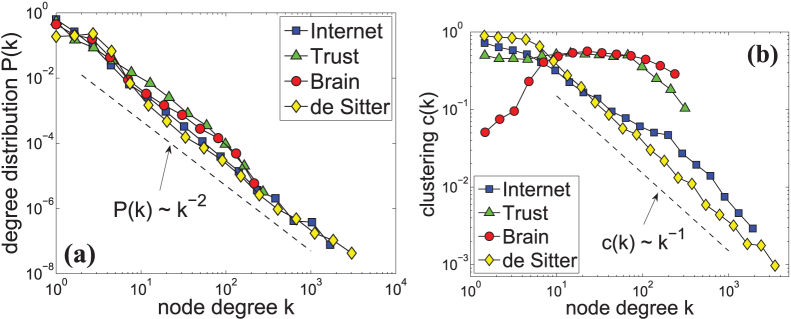
- De Sitter causets have a power-law degree distribution \(P(k) \sim k^{-\gamma}\) with \(\gamma = 2\); in \((d+1)\)-dimensional de Sitter, temporal node density scales as \(e^{\alpha t}\) and expected in-degree as \(e^{-\beta t}\) with \(\alpha = \beta = d/a\), yielding \(\gamma = 1 + \alpha/\beta = 2\).
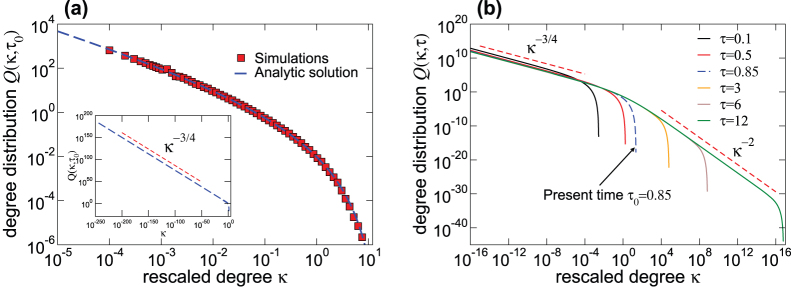
- The present universe causet is also a power-law graph but with exponent \(\gamma = 3/4\); at rescaled time \(\tau \sim 1\) (today) the distribution transitions to a \(\gamma = 2\) regime, with crossover at \(k_{\rm cr} \sim \delta a^4\), and at future infinity it becomes a perfect double power law with exponents \(3/4\) and \(2\). The paper reports \(\delta a^4 \sim 10^{244}\).
- Many real technological, social, and biological networks have \(\gamma \approx 2\) and strong clustering; the de Sitter causet also has strong clustering, and the growing hyperbolic network model yields \(\gamma = 2\) and the strongest possible clustering for that degree distribution.
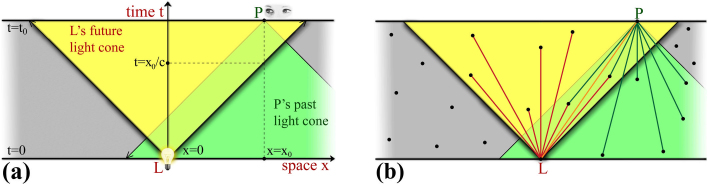
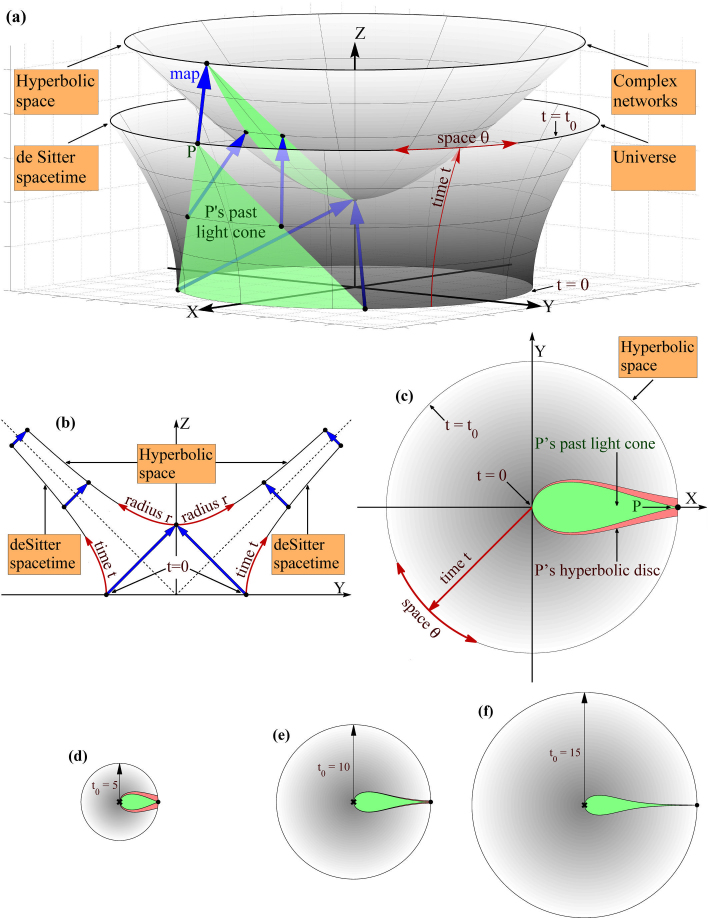
- The growth dynamics of de Sitter causets and complex networks are asymptotically identical: past light cones of new causet nodes are asymptotically equal to hyperbolic discs in the popularity×similarity network model.
Methods
- Theoretical/mathematical construction: causets are built by Poisson sprinkling nodes uniformly into de Sitter spacetime and connecting pairs if they lie within each other’s light cones; degree distributions and clustering are computed analytically using conformal time and light-cone volumes, extended to \((d+1)\)-dimensional de Sitter.
- Comparison to real networks: paradigmatic technological, social, and biological networks with reliable data are juxtaposed against a de Sitter causet; author contributions mention simulations.
- Proof of asymptotic equivalence: a mapping from de Sitter spacetime to hyperbolic space is used to show that the connection condition for new causet nodes matches that of a growing hyperbolic network model.
Limitations
- Stated: degree distributions in some complex networks deviate from clean power laws, and exponents, clustering, correlations, and other structural properties vary widely across real networks.
- Stated: de Sitter causets allow control only of the number of nodes and average degree, whereas the hyperbolic network model has tunable parameters for degree exponent, clustering strength, node fitness, and other properties; the physical meaning of dual parameters and their modeling versatility remain open.
- Stated: node density in growing hyperbolic networks with default de Sitter parameters is not uniform, so these networks are not random geometric graphs and their structure does not exactly reflect the underlying hyperbolic geometry; the real universe is only asymptotically de Sitter and contains matter, introducing smaller-scale inhomogeneities and anisotropies.
Model-written summary. Check it against the paper before relying on it.
Integrity signals
Registry
Cites
Statistics
Figures
Verification
Claims the paper makes
4 Valid · 2 Not valid · 8 Not checked · 24 Own results and interpretations
The cited sources that could be checked couldn’t confirm or dispute this claim.
In the paper
“the node density in growing hyperbolic networks with the default parameters corresponding to de Sitter causets, is not uniform in the hyperbolic space32.”
§ Network Cosmology > Discussion
What the sources say
- Could not verifycites [32] Papadopoulos F., Kitsak M., Serrano M. A., Boguñá M. & Krioukov D. Popularity versus similarity in growing networks. Nature 489, 537– 540 (2012). 22972194 sourceExperimental — accuracy not yet measured
Our copy of Papadopoulos et al. (2012) never mentions de Sitter causets or a correspondence of its default parameters to them, and makes no statement about whether the node density in the hyperbolic space is uniform or not (searched: 'node density not uniform', 'de Sitter', 'causet', 'uniform distribution in the hyperbolic disk'). The only uniformity statements it contains concern the angular coordinate — θ_t uniformly distributed on [0, 2π] in the model definition (Section IV, p. 12) and the uniform distribution p(θ)=δ/π used as a reference line for empirical/inferred angular distances (Fig. S12/S14, pp. 16, 28). Its radial placement rule r_t = ln t (Section IV, p. 12; r_t = 2ζ ln t for general curvature, Section VI, p. 23) is given without any characterization of the resulting spatial density, so the claim's point is not addressed in this paper. (LLM, conf=0.65)
plain- Asserted: passes — The authors put it forward as true.
- Checkable: passes — It can be checked against evidence.
- Load-bearing: passes — The paper’s conclusions depend on it.
- Based: passes — The paper gives a reason why it holds.
- Could not verify
The cited sources support only part of this claim — read each source’s verdict below.
In the paper
“Therefore it is only asymptotically de Sitter2627, meaning that only at large times , or rescaled times , space in the universe expands asymptotically the same way as in de Sitter spacetime.”
§ Network Cosmology > Results > Structure of the universe and complex networks
What the sources say
- Not checked yetcites [26] Griffiths J. B. & Podolský J. Exact Space-Times in Einstein's General Relativity (Cambridge University Press, Cambridge, 2009). source
- Partly supportedcites [27] Galloway G. J. & Solis D. A. Uniqueness of de Sitter space. Classical Quant Grav 24, 3125– 3138 (2007). sourceExperimental — accuracy not yet measured
The Introduction and §2.1 describe asymptotically de Sitter spacetimes in terms of a spacelike conformal boundary at infinity and give cosmological examples. They do not say that space expands at the same rate as de Sitter space at large times, so the proposed explanation of the term goes beyond what this paper states. (LLM, conf=0.78)
plain- Asserted: passes — The authors put it forward as true.
- Checkable: passes — It can be checked against evidence.
- Load-bearing: passes — The paper’s conclusions depend on it.
- Based: passes — The paper gives a reason why it holds.
Every source the paper cites for this claim was checked and supports it.
In the paper
“The networks in the model also have strongest possible clustering, i.e. the largest possible number of triangular subgraphs, for graphs with this degree distribution.”
§ Network Cosmology > Results > Dynamics of de Sitter causets and complex networks
What the sources say
- Supportedcites [32] Papadopoulos F., Kitsak M., Serrano M. A., Boguñá M. & Krioukov D. Popularity versus similarity in growing networks. Nature 489, 537– 540 (2012). 22972194 source
The main text (p. 3) states that 'the described optimization model leads to clustering that is strongest possible for networks with a given average degree and degree distribution', and the supplement Section IV B (p. 14) defines this clustering as 'the large number of triangular subgraphs'. The simulations (p. 17, Fig. S5) confirm it by rewiring links while preserving the degree distribution and finding only a minor, saturating increase in clustering, and p. 19 (Fig. S8) verifies maximum possible clustering at T = 0. The claim's 'for graphs with this degree distribution' matches the source's qualifier (average degree follows from the degree distribution), so nothing attributed here is unsupported. (LLM, conf=0.88)
plain- Asserted: passes — The authors put it forward as true.
- Checkable: passes — It can be checked against evidence.
- Load-bearing: unclear — It is unclear whether the paper’s conclusions depend on it.
- Based: passes — The paper gives a reason why it holds.
- Supported
The sources with a verdict support this claim; the rest weren’t checked yet, have no full text we could read, or their verdicts aren’t rated yet.
In the paper
“Strong clustering is another structural property often observed in complex networks: average clustering in random graphs of similar size and average degree is lower by orders of magnitude8910.”
§ Network Cosmology > Results > Structure of the universe and complex networks
What the sources say
- Not checked yetcites [8] Dorogovtsev S. N. & Mendes J. F. F. Evolution of Networks: From Biological Nets to the Internet and WWW (Oxford University Press, Oxford, 2003). source
- Supportedcites [9] Newman M. E. J. The Structure and Function of Complex Networks. SIAM Rev 45, 167– 256 (2003). source
In “Transitivity or clustering” (p. 12), Newman says clustering coefficients tend to be considerably higher than those of random graphs with similar numbers of vertices and edges. He adds that their values can differ by a factor of order n, supporting the claim that the difference can be orders of magnitude. (LLM, conf=0.94)
- Not checked yetcites [10] Boccaletti S., Latora V., Moreno Y., Chavez M. & Hwanga D.-U. Complex Networks: Structure and Dynamics. Phys Rep 424, 175– 308 (2006). source
plainstates an association- Asserted: passes — The authors put it forward as true.
- Checkable: passes — It can be checked against evidence.
- Load-bearing: unclear — It is unclear whether the paper’s conclusions depend on it.
- Based: passes — The paper gives a reason why it holds.
Every source the paper cites for this claim was checked and supports it.
In the paper
“The matter and dark energy densities happen to be of the same order of magnitude in the universe today.”
§ Network Cosmology > Results > Structure of the universe and complex networks
What the sources say
- Supportedcites [28] Garriga J., Livio M. & Vilenkin A. Cosmological constant and the time of its dominance. Phys Rev D 61, 023503 (1999). source
The Introduction says that vacuum energy contributes about 70% of the critical density and matter about 30%. It also explicitly describes the present as a time when the matter and vacuum-energy densities are comparable. (LLM, conf=0.94)
- Supportedcites [29] Sorkin R., Rajantie A., Contaldi C., Dauncey P. & Stoica H. Is the cosmological ”constant” a nonlocal quantum residue of discreteness of the causal set type? In AIP Conf Proc, vol. 957, 142– 153 (AIP, 2007). source
In “Spatial flatness and missing mass” (p. 3), the paper says that Λ or something like it carries twice the effective mass density of matter, including dark matter. That places the two densities at the same order of magnitude in the universe today. (LLM, conf=0.93)
- Supportedcites [30] Barrow J. & Shaw D. New Solution of the Cosmological Constant Problems. Phys Rev Lett 106, 101302 (2011). 21469784 source
On p. 4, the paper explicitly describes ΩΛ/Ωm being of order one as the cosmological coincidence. These parameters represent dark energy and matter densities relative to the same critical density, so their ratio supports the claim about densities today. (LLM, conf=0.94)
plainstates an association- Asserted: passes — The authors put it forward as true.
- Checkable: passes — It can be checked against evidence.
- Load-bearing: passes — The paper’s conclusions depend on it.
- Based: passes — The paper gives a reason why it holds.
- Supported
26 more claims
Create a free account to see all 38 claims and to verify the 14 references still open.
- It may state two separate claims as one. 6
- Probably not a substantial claim. 1
Claims other papers make about this one
Each is checked against this paper’s own text: does it say what the citing paper says it does?
The cited source says what the claim attributes to it.
In the citing paper
“On the one hand, the connection between hyperbolic complex networks and causal sets [63,64] used in quantum gravity has been explored in a recent paper [66], and causal sets have been used to analyse complex networks [67].”
From Interdisciplinary and physics challenges of network theory (2015) · cites this paper as [66]
Citations
Cites
Observational Evidence from Supernovae for an Accelerating Universe and a Cosmological Constant
Riess, A. G., Filippenko, A. V., Challis, P., Clocchiatti, A., Diercks, A., Garnavich, P. M., Gilliland, R. L., Hogan, C. J., Jha, S., Kirshner, R. P., et al. (1998) · The Astronomical Journal · doi:10.1086/300499 · Cited by 19,704
The Structure and Function of Complex Networks
Newman, M. E. J. (2003) · SIAM Review · doi:10.1137/s003614450342480 · Cited by 18,719
Complex brain networks: graph theoretical analysis of structural and functional systems
Bullmore, E., & Sporns, O. (2009) · Nature Reviews Neuroscience · doi:10.1038/nrn2575 · Cited by 11,820
Complex networks: structure and dynamics
BOCCALETTI, S., LATORA, V, MORENO, Y., CHAVEZ, M., & HWANG, D. (2006) · Physics Reports · doi:10.1016/j.physrep.2005.10.009 · Cited by 11,010
SEVEN-YEAR WILKINSON MICROWAVE ANISOTROPY PROBE(WMAP) OBSERVATIONS: COSMOLOGICAL INTERPRETATION
Komatsu, E., Smith, K. M., Dunkley, J., Bennett, C. L., Gold, B., Hinshaw, G., Jarosik, N., Larson, D., Nolta, M. R., Page, L., et al. (2011) · The Astrophysical Journal Supplement Series · doi:10.1088/0067-0049/192/2/18 · Cited by 8,802 · cited 3×
“There are also a variety of other models with non-constant Λ, yet the standard ΛCDM model with constant Λ is a baseline describing accurately many observed properties of the real universe [52], partly justifying our simplifying assumption.”
InfluentialNetwork biology: understanding the cell's functional organization
Barabási, A.-L., & Oltvai, Z. N. (2004) · Nature Reviews Genetics · doi:10.1038/nrg1272 · Cited by 7,903 · cited 1×
“…seems to experience certain difficulties in application to complex systems in general, and to complex networks in particular, where it remains unclear if there exist some unique universal laws explaining a variety of structural and dynamical similarities found in many different real networks [1–7].”
Lazer, D., Pentland, A., Adamic, L., Aral, S., Barabási, A.-L., Brewer, D., Christakis, N., Contractor, N., Fowler, J., Gutmann, M., et al. (2009) · Science · doi:10.1126/science.1167742 · Cited by 3,365
Controllability of complex networks
Liu, Y.-Y., Slotine, J.-J., & Barabási, A.-L. (2011) · Nature · doi:10.1038/nature10011 · Cited by 3,215
Kiefer, C. (2004) · Cited by 2,992
Discovery of a supernova explosion at half the age of the Universe
Perlmutter, S., Aldering, G., Valle, M. D., Deustua, S., Ellis, R. S., Fabbro, S., Fruchter, A., Goldhaber, G., Groom, D. E., Hook, I. M., et al. (1998) · Nature · doi:10.1038/34124 · Cited by 2,544
Cited by
Items 101–154 of 154
Artificial Intelligence IQ Test
Shi, Y. (2022) · Springer eBooks · doi:10.1007/978-981-16-3607-3_12 · Cited by 2
NDDN: A Cloud-Based Neuroinformation Database for Developing Neuronal Networks
Pu, J., & Li, X. (2018) · Journal of Healthcare Engineering · doi:10.1155/2018/3839094 · Cited by 2
Ferdowsi, A. (2022) · Annals of Computer Science and Information Systems · doi:10.15439/2022f64 · Cited by 2
Spatial social networks: exploring theoretical and methodological challenges
Sarkar, D. (2018) · doi:10.82308/16389 · Cited by 2
Day-Ahead Anticipation of Complex Network Vulnerability
Stefanov, S. Z., & Wang, P. P. (2016) · New Mathematics and Natural Computation · doi:10.1142/s1793005716500149 · Cited by 2
Dimensionality of Social Networks Using Motifs and Eigenvalues
Bonato, A., Gleich, D. F., Kim, M., Mitsche, D., Prałat, P., Tian, A., & Young, S. J. (2014) · HAL · doi:10.1371/journal.pone.0106052.s001 · Cited by 2
Link Prediction in Complex Network: Nature Inspired Gravitation Force Approach
Kumar, S., Chaudhary, U., Kedia, R., & Singhal, T. (2020) · Advances in intelligent systems and computing · doi:10.1007/978-981-15-5148-2_28 · Cited by 2
An effective community detection method based on one-dimensional “attraction” in network science
Yu, Y., Xu, C., & Cao, K. (2020) · International Journal of Modern Physics C · doi:10.1142/s0129183120500710 · Cited by 2
Definition and Research of Internet NeurologyPreprint
Liu, F. (2015) · arXiv (Cornell University) · doi:10.48550/arxiv.1504.02842 · Cited by 2
Causal Sets and Generalizations
Dribus, B. F. (2017) · Springer eBooks · doi:10.1007/978-3-319-50083-6_3 · Cited by 1
Energy transfer and thermodynamics of quantum gravity computation
Gyöngyösi, L. (2020) · Chaos Solitons & Fractals X · doi:10.1016/j.csfx.2020.100050 · Cited by 1
Connectalism: A new paradigm for human choice
Faugère, C. (2020) · Systems Research and Behavioral Science · doi:10.1002/sres.2730 · Cited by 1
Superstripes landscape in perovskites high Tc superconductors
Campi, G., & Bianconi, A. (2023) · Elsevier eBooks · doi:10.1016/b978-0-323-90800-9.00222-5 · Cited by 1
A Day-Ahead Wave Healing in a Power Grid
Stefanov, S. Z., & Wang, P. P. (2016) · New Mathematics and Natural Computation · doi:10.1142/s1793005716500058 · Cited by 1
High-Density Fiberless Optoelectrodes with Integrated Waveguides and μLEDs
Kim, K., Wu, F., Kampasi, K., Seymour, J. P., Wise, K. D., & Yoon, E. (2023) · Handbook of Neuroengineering · doi:10.1007/978-981-16-5540-1_22 · Cited by 1
Similarities between basic mechanisms of cosmic and biologic systems
Raphael, K. (2016) · International Journal of the Physical Sciences · doi:10.5897/ijps2015.4396 · Cited by 1
Emperical study and modelling of the internet topology dynamics
Kirgizov, S. (2014) · theses.fr (ABES) · doi:10.70675/c30ee3d1zd910z4a8bz8501z18dddcbe2ad9 · Cited by 1
Scale-Invariant Random Graphs: a multiscale approach to network modeling
Lalli, M. (2024) · doi:10.13118/imtlucca/e-theses/414 · Cited by 1
Projective limits of probabilistic symmetries and their applications to random graph limitsPreprint
van der Hoorn, P., Stepanyants, H., & Krioukov, D. (2025) · arXiv (Cornell University) · doi:10.48550/arxiv.2512.02208 · Cited by 1
Self-citationResearch on the Neurology-based Internet Architecture
Liu, F., & Shi, Y. (2014) · Procedia Computer Science · doi:10.1016/j.procs.2014.05.378 · Cited by 1
Nikonov, A., & von Müller, A. (2015) · On thinking · doi:10.1007/978-3-319-10446-1_2 · Cited by 1
A Geometric Graph Model of Citation Networks with Linearly Growing Node-Increment
Qi, L., Zheng, X., En-Ming, D., & Jian-Ping, L. (2016) · Frontiers in artificial intelligence and applications · doi:10.3233/978-1-61499-722-1-605 · Cited by 1
A Structural Analysis of the Internet AS-level topology
ORSINI, C. (2013) · Electronic Theses and Dissertations Repository (University of Pisa) · Cited by 1
Dribus, B. F. (2017) · Springer eBooks · doi:10.1007/978-3-319-50083-6_4
Liashkov, M. (2025) · OSF Preprints (OSF Preprints) · doi:10.31219/osf.io/waf5m_v1
Dribus, B. F. (2017) · Springer eBooks · doi:10.1007/978-3-319-50083-6_1
Dribus, B. F. (2017) · Springer eBooks · doi:10.1007/978-3-319-50083-6_8
Network Horizon Dynamics I: Qualitative AspectsPreprint
Dribus, B. F., Sumner, A. C., Bist, K., Regmi, N., Sircar, J., & Upreti, S. (2019) · arXiv (Cornell University) · doi:10.48550/arxiv.1903.10268
Sarbah-Yalley, J. (2015) · Digital Commons - Andrews University (Andrews University) · doi:10.32597/theses/83/
On The Influence of Consciousness On Space-Time: THE GRAND UNIFIED THEORYPreprint
KIRDAĞ, M. C. (2025) · doi:10.14293/pr2199.002419.v1
On The Influence of Consciousness On Space-Time: THE GRAND UNIFIED THEORYPreprint
KIRDAĞ, M. C. (2025) · doi:10.14293/pr2199.002419.v2
On The Influence of Consciousness On Space-Time: THE GRAND UNIFIED THEORYPreprint
KIRDAĞ, M. C. (2025) · doi:10.14293/pr2199.002419.v3
Fernández-Salazar, M. (2015) · theses.fr (ABES) · doi:10.70675/d93cb49cz1c0fz43c6zaaeczf5dbe5d21c90
Alakhras, M., & Movahed, M. S. (2026) · The Astrophysical Journal · doi:10.3847/1538-4357/ae4342
Curvature of an arbitrary surface for discrete gravity and for $$d=2$$ pure simplicial complexes
Chamseddine, A. H., Malaeb, O., & Najem, S. (2025) · The European Physical Journal C · doi:10.1140/epjc/s10052-025-15038-4
Probabilistic Word Embeddings in Kinematic Space
Jamadandi, A., Tigadoli, R., Tabib, R. A., & Mudenagudi, U. (2021) · Proceedings - International Conference on Pattern Recognition/Proceedings/International Conference on Pattern Recognition · doi:10.1109/icpr48806.2021.9412050
Rastogi, A. (2016) · TSpace (University of Toronto)
High-Density Fiberless Optoelectrodes with Integrated Waveguides and μLEDs
Kim, K., Wu, F., Kampasi, K., Seymour, J. P., Wise, K. D., & Yoon, E. (2021) · Handbook of Neuroengineering · doi:10.1007/978-981-15-2848-4_22-2
Wu, F. (2015) · Deep Blue (University of Michigan)
Гречанник, К., & АлисаиДипсик, А. (2026) · doi:10.24108/preprints-3116100
A Journey Into Quantization in Astrophysics: a Collection of Scientific Papers
Christianto, V., & Smarandache, F. (2013) · UNM’s Digital Repository (University of New Mexico)
Network approaches to community detection in nanoscale connectomics
Wang, Q., Gutierrez, G. J., Kunin, A. B., Vogelstein, J. T., Bassler, K. E., Josic, K., & Betzel, R. F. (2026) · Nature reviews. Neuroscience · doi:10.1038/s41583-026-01094-6
Matter-antimatter models in cosmic and biologic systems
Raphael, K. (2016) · International Journal of the Physical Sciences · doi:10.5897/ijps2016.4496
Ferreira Do Prado, P. (2020) · Repository of Digital Objects for Teaching Research and Culture (University of Valencia)
Modeling the time-periodicity of in-degree distributions in scientific citation networksPreprint
Liu, Q., Xie, Z. Y., Xie, Z., Dong, E., & Li, J. (2016) · arXiv (Cornell University) · doi:10.48550/arxiv.1610.03145
Kuznetsov, A. M. (n.d.) · PhilPapers (PhilPapers Foundation)
Pseudo-Riemannian Embedding Models for Multi-Relational Graph RepresentationsPreprint
Paliwal, S., Brayne, A., Fabian, B., Wiatrak, M., & Sim, A. (2022) · arXiv (Cornell University) · doi:10.48550/arxiv.2212.03720
Information Propagation in Complex Networks: Structures and Dynamics
Märtens, M. (2018) · Research Repository (Delft University of Technology) · doi:10.4233/uuid:b1a1ead7-a631-4f05-b9a9-17a1be6e15e1
On Using Graph Structures in Network Communications for Peer-to-Peer Botnet Detection.
Joshi, H. P. (2020) · NCSU Libraries Repository (North Carolina State University Libraries)
Топологическая модель масс элементарных частиц 22.07.2026Preprint
Гречанник, К., & АлисаиДипсик, А. (2026) · doi:10.24108/preprints-3115971
Asymmetries on mobility networks : (PMR 2021/4)
Kosztyán, Z. T., & Kurbucz, M. T. (2023) · Repository of the Academy's Library (Library of the Hungarian Academy of Sciences)
Metadata
- Authors
- Krioukov, D., Kitsak, M., Sinkovits, R. S., Rideout, D., Meyer, D., & Boguñá, M.
- Affiliations
- University of California San Diego (US)
- San Diego Supercomputer Center (US)
- Universitat de Barcelona (ES)
- Corresponding author
- Krioukov, Dmitri
- Venue
- Scientific Reports
- Published
- 2012-11-16
- Volume
- 2
- Issue
- 1
- Pages
- 793-793
- ISSN
- 2045-2322 (ISSN-L)
- PMC
- PMC3499772
- OpenAlex
- W3037110710
- Semantic Scholar
- 6f2cb141df472a334116d2e08641eb0a29b242be
- Cited by
- 128
- References
- 75
- Citations by year
- 2026: 3 · 2025: 10 · 2024: 1 · 2023: 9 · 2022: 5 · 2021: 6 · 2020: 9 · 2019: 8 · 2018: 9 · 2017: 17 · 2016: 16 · 2015: 21 · 2014: 8 · 2013: 5 · 2012: 1
- FWCI
- 8.47
- Type
- journal article
- Language
- en
- Open access
- gold
- doi.org
- Licence
- cc-by-nc-nd
- creativecommons.org/licenses/by-nc-nd/3.0/ (tdm)
- creativecommons.org/licenses/by-nc-nd/3.0/ (vor)
- Locations
- Scientific Reports (publishedVersion, cc-by-nc-nd)
- PubMed Central (publishedVersion, cc-by-nc-nd)
- PubMed (publishedVersion)
- arXiv (Cornell University) (submittedVersion)
- Dipòsit Digital de la Universitat de Barcelona (Universitat de Barcelona) (submittedVersion, cc-by)
- arXiv (Cornell University)
- Funders
- National Science Foundation (1039646, 0964236)
- Cisco Systems
- Foundational Questions Institute
- San Diego Supercomputer Center
- Generalitat de Catalunya (FIS2010-21781-C02-02)
- Institució Catalana de Recerca i Estudis Avançats (FIS2010-21781-C02-02)
- Ministerio de Ciencia e Innovación
- Defense Advanced Research Projects Agency (HR0011, HR0011-12-1-0012)
- University of California, San Diego
- Topics
- Physical Sciences › Physics and Astronomy › Statistical and Nonlinear Physics › Complex Network Analysis Techniques
- Physical Sciences › Physics and Astronomy › Astronomy and Astrophysics › Cosmology and Gravitation Theories
- Physical Sciences › Physics and Astronomy › Nuclear and High Energy Physics › Noncommutative and Quantum Gravity Theories
- Keywords
- causal networks, power-law graphs, network growth dynamics, clustering, complex networks, cosmic acceleration, network dynamics
About these checks
Registry, retraction, Cites and statistics results are computed, not judged, with one exception: a printed reference that no index lists is read once by a model before it counts as a citation error. Claims are extracted by a model and kept only when their quote appears verbatim in the text; each cited source is then checked, with a model’s help, for whether it says what the claim relies on. Those verdicts can be wrong — read the claim’s quote and the cited source before relying on one.
The claim verdicts this report counts are experimental: their accuracy is not yet measured.
A language model drew the claims from the paper on 2026-10-08, under version 3 of the claim definition (model deepseek-v4.1-flash, prompt extract-v3).
A second model labelled each claim on 2026-10-08 (model jev-1.13-20260917, definition revision gold-guideline-v0.2).
Cited sources are checked with a language model’s help (qwen3.8-omni-flash and gpt-6-sol).
Statistics and arithmetic are recomputed, not judged.
Confidence bands are shown only for fields calibrated on our annotated test set. None is calibrated yet, so no band is shown.
What counts as a claim ›How we measure confidence ›How we check this ›
Are you an author, or do you see a problem with this page? Request a review
Data sources
Bibliographic data: Semantic Scholar, OpenAlex, Crossref.
Contains information from the Semantic Scholar Academic Graph Datasets, made available under the ODC Attribution License (ODC-BY 1.0).
Semantic Scholar’s data is described in: Kinney, R., et al. (2023). The Semantic Scholar Open Data Platform. arXiv:2301.10140.
