

Network Cosmology
Open accessThe DOI matches its Crossref record; 74 of the 75 references it cites were found in a registry or an index; 7 of the 21 sources its claims cite were checked for support.
Abstract
Prediction and control of the dynamics of complex networks is a central problem in network science. Structural and dynamical similarities of different real networks suggest that some universal laws might accurately describe the dynamics of these networks, albeit the nature and common origin of such laws remain elusive. Here we show that the causal network representing the large-scale structure of spacetime in our accelerating universe is a power-law graph with strong clustering, similar to many complex networks such as the Internet, social, or biological networks. We prove that this structural similarity is a consequence of the asymptotic equivalence between the large-scale growth dynamics of complex networks and causal networks. This equivalence suggests that unexpectedly similar laws govern the dynamics of complex networks and spacetime in the universe, with implications to network science and cosmology.
Overview
CoChat Summary
TL;DR
The paper shows that the causal network representing the large-scale structure of spacetime in an accelerating universe is a power-law graph with strong clustering, similar to many complex networks. It proves asymptotic equivalence between de Sitter causet growth and a hyperbolic popularity×similarity network model, suggesting shared dynamical laws.
Key findings
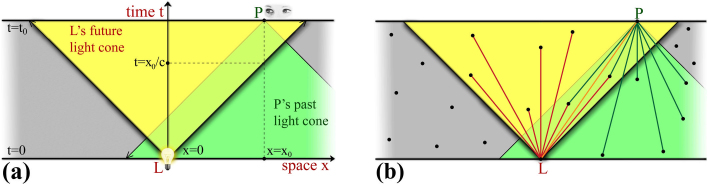
- De Sitter causets have a power-law degree distribution \(P(k) \sim k^{-\gamma}\) with \(\gamma = 2\); in \((d+1)\)-dimensional de Sitter, temporal node density scales as \(e^{\alpha t}\) and expected in-degree as \(e^{-\beta t}\) with \(\alpha = \beta = d/a\), yielding \(\gamma = 1 + \alpha/\beta = 2\).
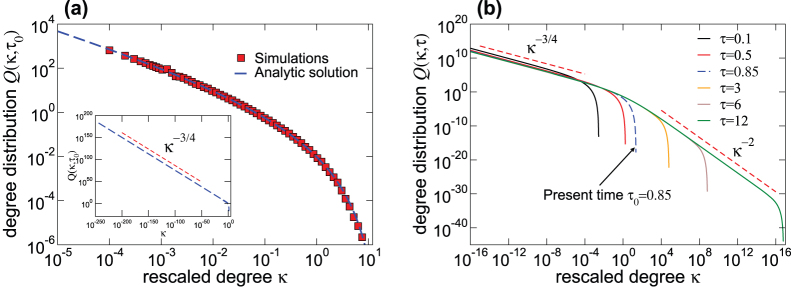
- The present universe causet is also a power-law graph but with exponent \(\gamma = 3/4\); at rescaled time \(\tau \sim 1\) (today) the distribution transitions to a \(\gamma = 2\) regime, with crossover at \(k_{\rm cr} \sim \delta a^4\), and at future infinity it becomes a perfect double power law with exponents \(3/4\) and \(2\). The paper reports \(\delta a^4 \sim 10^{244}\).
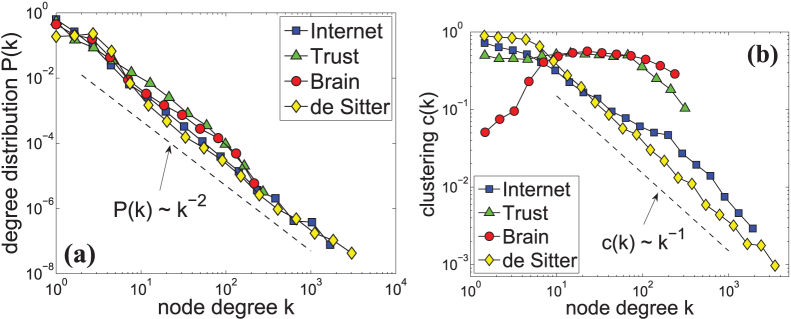
- Many real technological, social, and biological networks have \(\gamma \approx 2\) and strong clustering; the de Sitter causet also has strong clustering, and the growing hyperbolic network model yields \(\gamma = 2\) and the strongest possible clustering for that degree distribution.
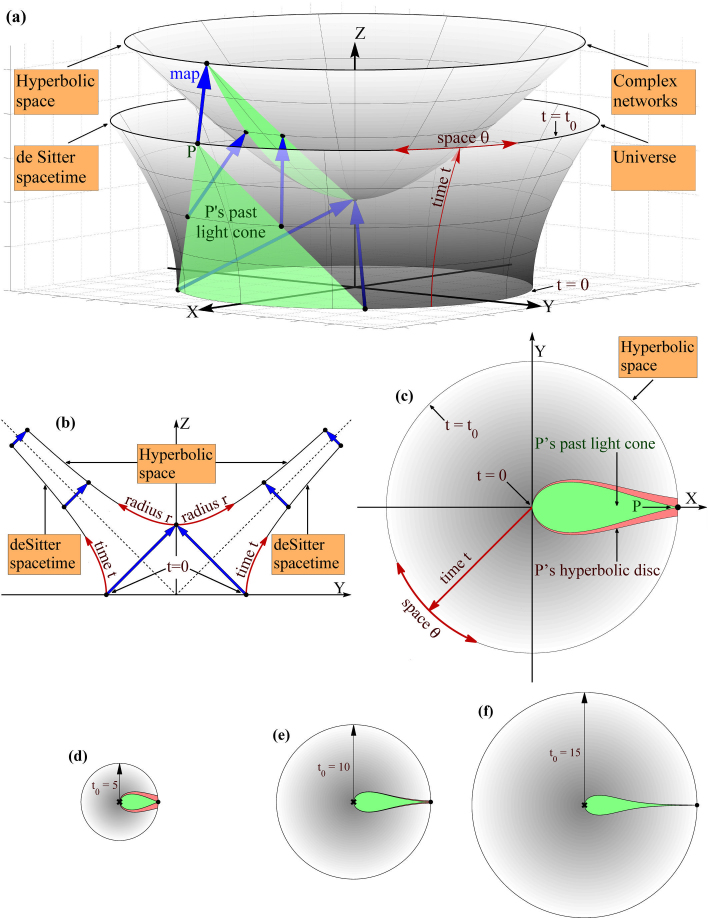
- The growth dynamics of de Sitter causets and complex networks are asymptotically identical: past light cones of new causet nodes are asymptotically equal to hyperbolic discs in the popularity×similarity network model.
Methods
- Theoretical/mathematical construction: causets are built by Poisson sprinkling nodes uniformly into de Sitter spacetime and connecting pairs if they lie within each other’s light cones; degree distributions and clustering are computed analytically using conformal time and light-cone volumes, extended to \((d+1)\)-dimensional de Sitter.
- Comparison to real networks: paradigmatic technological, social, and biological networks with reliable data are juxtaposed against a de Sitter causet; author contributions mention simulations.
- Proof of asymptotic equivalence: a mapping from de Sitter spacetime to hyperbolic space is used to show that the connection condition for new causet nodes matches that of a growing hyperbolic network model.
Limitations
- Stated: degree distributions in some complex networks deviate from clean power laws, and exponents, clustering, correlations, and other structural properties vary widely across real networks.
- Stated: de Sitter causets allow control only of the number of nodes and average degree, whereas the hyperbolic network model has tunable parameters for degree exponent, clustering strength, node fitness, and other properties; the physical meaning of dual parameters and their modeling versatility remain open.
- Stated: node density in growing hyperbolic networks with default de Sitter parameters is not uniform, so these networks are not random geometric graphs and their structure does not exactly reflect the underlying hyperbolic geometry; the real universe is only asymptotically de Sitter and contains matter, introducing smaller-scale inhomogeneities and anisotropies.
Model-written summary. Check it against the paper before relying on it.
Integrity signals
Registry
Cites
Statistics
Figures
Verification
Claims the paper makes
4 Valid · 2 Not valid · 8 Not checked · 24 Own results and interpretations
The cited sources that could be checked couldn’t confirm or dispute this claim.
In the paper
“the node density in growing hyperbolic networks with the default parameters corresponding to de Sitter causets, is not uniform in the hyperbolic space32.”
§ Network Cosmology > Discussion
What the sources say
- Could not verifycites [32] Papadopoulos F., Kitsak M., Serrano M. A., Boguñá M. & Krioukov D. Popularity versus similarity in growing networks. Nature 489, 537– 540 (2012). 22972194 sourceExperimental — accuracy not yet measured
Our copy of Papadopoulos et al. (2012) never mentions de Sitter causets or a correspondence of its default parameters to them, and makes no statement about whether the node density in the hyperbolic space is uniform or not (searched: 'node density not uniform', 'de Sitter', 'causet', 'uniform distribution in the hyperbolic disk'). The only uniformity statements it contains concern the angular coordinate — θ_t uniformly distributed on [0, 2π] in the model definition (Section IV, p. 12) and the uniform distribution p(θ)=δ/π used as a reference line for empirical/inferred angular distances (Fig. S12/S14, pp. 16, 28). Its radial placement rule r_t = ln t (Section IV, p. 12; r_t = 2ζ ln t for general curvature, Section VI, p. 23) is given without any characterization of the resulting spatial density, so the claim's point is not addressed in this paper. (LLM, conf=0.65)
plain- Asserted: passes — The authors put it forward as true.
- Checkable: passes — It can be checked against evidence.
- Load-bearing: passes — The paper’s conclusions depend on it.
- Based: passes — The paper gives a reason why it holds.
- Could not verify
The cited sources support only part of this claim — read each source’s verdict below.
In the paper
“Therefore it is only asymptotically de Sitter2627, meaning that only at large times , or rescaled times , space in the universe expands asymptotically the same way as in de Sitter spacetime.”
§ Network Cosmology > Results > Structure of the universe and complex networks
What the sources say
- Not checked yetcites [26] Griffiths J. B. & Podolský J. Exact Space-Times in Einstein's General Relativity (Cambridge University Press, Cambridge, 2009). source
- Partly supportedcites [27] Galloway G. J. & Solis D. A. Uniqueness of de Sitter space. Classical Quant Grav 24, 3125– 3138 (2007). sourceExperimental — accuracy not yet measured
The Introduction and §2.1 describe asymptotically de Sitter spacetimes in terms of a spacelike conformal boundary at infinity and give cosmological examples. They do not say that space expands at the same rate as de Sitter space at large times, so the proposed explanation of the term goes beyond what this paper states. (LLM, conf=0.78)
plain- Asserted: passes — The authors put it forward as true.
- Checkable: passes — It can be checked against evidence.
- Load-bearing: passes — The paper’s conclusions depend on it.
- Based: passes — The paper gives a reason why it holds.
Every source the paper cites for this claim was checked and supports it.
In the paper
“The networks in the model also have strongest possible clustering, i.e. the largest possible number of triangular subgraphs, for graphs with this degree distribution.”
§ Network Cosmology > Results > Dynamics of de Sitter causets and complex networks
What the sources say
- Supportedcites [32] Papadopoulos F., Kitsak M., Serrano M. A., Boguñá M. & Krioukov D. Popularity versus similarity in growing networks. Nature 489, 537– 540 (2012). 22972194 source
The main text (p. 3) states that 'the described optimization model leads to clustering that is strongest possible for networks with a given average degree and degree distribution', and the supplement Section IV B (p. 14) defines this clustering as 'the large number of triangular subgraphs'. The simulations (p. 17, Fig. S5) confirm it by rewiring links while preserving the degree distribution and finding only a minor, saturating increase in clustering, and p. 19 (Fig. S8) verifies maximum possible clustering at T = 0. The claim's 'for graphs with this degree distribution' matches the source's qualifier (average degree follows from the degree distribution), so nothing attributed here is unsupported. (LLM, conf=0.88)
plain- Asserted: passes — The authors put it forward as true.
- Checkable: passes — It can be checked against evidence.
- Load-bearing: unclear — It is unclear whether the paper’s conclusions depend on it.
- Based: passes — The paper gives a reason why it holds.
- Supported
The sources with a verdict support this claim; the rest weren’t checked yet, have no full text we could read, or their verdicts aren’t rated yet.
In the paper
“Strong clustering is another structural property often observed in complex networks: average clustering in random graphs of similar size and average degree is lower by orders of magnitude8910.”
§ Network Cosmology > Results > Structure of the universe and complex networks
What the sources say
- Not checked yetcites [8] Dorogovtsev S. N. & Mendes J. F. F. Evolution of Networks: From Biological Nets to the Internet and WWW (Oxford University Press, Oxford, 2003). source
- Supportedcites [9] Newman M. E. J. The Structure and Function of Complex Networks. SIAM Rev 45, 167– 256 (2003). source
In “Transitivity or clustering” (p. 12), Newman says clustering coefficients tend to be considerably higher than those of random graphs with similar numbers of vertices and edges. He adds that their values can differ by a factor of order n, supporting the claim that the difference can be orders of magnitude. (LLM, conf=0.94)
- Not checked yetcites [10] Boccaletti S., Latora V., Moreno Y., Chavez M. & Hwanga D.-U. Complex Networks: Structure and Dynamics. Phys Rep 424, 175– 308 (2006). source
plainstates an association- Asserted: passes — The authors put it forward as true.
- Checkable: passes — It can be checked against evidence.
- Load-bearing: unclear — It is unclear whether the paper’s conclusions depend on it.
- Based: passes — The paper gives a reason why it holds.
Every source the paper cites for this claim was checked and supports it.
In the paper
“The matter and dark energy densities happen to be of the same order of magnitude in the universe today.”
§ Network Cosmology > Results > Structure of the universe and complex networks
What the sources say
- Supportedcites [28] Garriga J., Livio M. & Vilenkin A. Cosmological constant and the time of its dominance. Phys Rev D 61, 023503 (1999). source
The Introduction says that vacuum energy contributes about 70% of the critical density and matter about 30%. It also explicitly describes the present as a time when the matter and vacuum-energy densities are comparable. (LLM, conf=0.94)
- Supportedcites [29] Sorkin R., Rajantie A., Contaldi C., Dauncey P. & Stoica H. Is the cosmological ”constant” a nonlocal quantum residue of discreteness of the causal set type? In AIP Conf Proc, vol. 957, 142– 153 (AIP, 2007). source
In “Spatial flatness and missing mass” (p. 3), the paper says that Λ or something like it carries twice the effective mass density of matter, including dark matter. That places the two densities at the same order of magnitude in the universe today. (LLM, conf=0.93)
- Supportedcites [30] Barrow J. & Shaw D. New Solution of the Cosmological Constant Problems. Phys Rev Lett 106, 101302 (2011). 21469784 source
On p. 4, the paper explicitly describes ΩΛ/Ωm being of order one as the cosmological coincidence. These parameters represent dark energy and matter densities relative to the same critical density, so their ratio supports the claim about densities today. (LLM, conf=0.94)
plainstates an association- Asserted: passes — The authors put it forward as true.
- Checkable: passes — It can be checked against evidence.
- Load-bearing: passes — The paper’s conclusions depend on it.
- Based: passes — The paper gives a reason why it holds.
- Supported
26 more claims
Create a free account to see all 38 claims and to verify the 14 references still open.
- It may state two separate claims as one. 6
- Probably not a substantial claim. 1
Claims other papers make about this one
Each is checked against this paper’s own text: does it say what the citing paper says it does?
The cited source says what the claim attributes to it.
In the citing paper
“On the one hand, the connection between hyperbolic complex networks and causal sets [63,64] used in quantum gravity has been explored in a recent paper [66], and causal sets have been used to analyse complex networks [67].”
From Interdisciplinary and physics challenges of network theory (2015) · cites this paper as [66]
Citations
Cites
Observational Evidence from Supernovae for an Accelerating Universe and a Cosmological Constant
Riess, A. G., Filippenko, A. V., Challis, P., Clocchiatti, A., Diercks, A., Garnavich, P. M., Gilliland, R. L., Hogan, C. J., Jha, S., Kirshner, R. P., et al. (1998) · The Astronomical Journal · doi:10.1086/300499 · Cited by 19,704
The Structure and Function of Complex Networks
Newman, M. E. J. (2003) · SIAM Review · doi:10.1137/s003614450342480 · Cited by 18,719
Complex brain networks: graph theoretical analysis of structural and functional systems
Bullmore, E., & Sporns, O. (2009) · Nature Reviews Neuroscience · doi:10.1038/nrn2575 · Cited by 11,820
Complex networks: structure and dynamics
BOCCALETTI, S., LATORA, V, MORENO, Y., CHAVEZ, M., & HWANG, D. (2006) · Physics Reports · doi:10.1016/j.physrep.2005.10.009 · Cited by 11,010
SEVEN-YEAR WILKINSON MICROWAVE ANISOTROPY PROBE(WMAP) OBSERVATIONS: COSMOLOGICAL INTERPRETATION
Komatsu, E., Smith, K. M., Dunkley, J., Bennett, C. L., Gold, B., Hinshaw, G., Jarosik, N., Larson, D., Nolta, M. R., Page, L., et al. (2011) · The Astrophysical Journal Supplement Series · doi:10.1088/0067-0049/192/2/18 · Cited by 8,802 · cited 3×
“There are also a variety of other models with non-constant Λ, yet the standard ΛCDM model with constant Λ is a baseline describing accurately many observed properties of the real universe [52], partly justifying our simplifying assumption.”
InfluentialNetwork biology: understanding the cell's functional organization
Barabási, A.-L., & Oltvai, Z. N. (2004) · Nature Reviews Genetics · doi:10.1038/nrg1272 · Cited by 7,903 · cited 1×
“…seems to experience certain difficulties in application to complex systems in general, and to complex networks in particular, where it remains unclear if there exist some unique universal laws explaining a variety of structural and dynamical similarities found in many different real networks [1–7].”
Lazer, D., Pentland, A., Adamic, L., Aral, S., Barabási, A.-L., Brewer, D., Christakis, N., Contractor, N., Fowler, J., Gutmann, M., et al. (2009) · Science · doi:10.1126/science.1167742 · Cited by 3,365
Controllability of complex networks
Liu, Y.-Y., Slotine, J.-J., & Barabási, A.-L. (2011) · Nature · doi:10.1038/nature10011 · Cited by 3,215
Kiefer, C. (2004) · Cited by 2,992
Discovery of a supernova explosion at half the age of the Universe
Perlmutter, S., Aldering, G., Valle, M. D., Deustua, S., Ellis, R. S., Fabbro, S., Fruchter, A., Goldhaber, G., Groom, D. E., Hook, I. M., et al. (1998) · Nature · doi:10.1038/34124 · Cited by 2,544
Cited by
Random Graphs and Complex Networks
Hofstad, R. V. D. (2016) · Cambridge University Press eBooks · doi:10.1017/9781316779422 · Cited by 840
Boguñá, M., Bonamassa, I., De Domenico, M., Havlin, S., Krioukov, D., & Serrano, M. Á. (2021) · Nature Reviews Physics · doi:10.1038/s42254-020-00264-4 · Cited by 213
Self-citationBörner, K., Scrivner, O., Gallant, M., Ma, S., Liu, X., Chewning, K., Wu, L., & Evans, J. A. (2018) · Proceedings of the National Academy of Sciences · doi:10.1073/pnas.1804247115 · Cited by 182
Emergent Hyperbolic Network Geometry
Bianconi, G., & Rahmede, C. (2017) · Scientific Reports · doi:10.1038/srep41974 · Cited by 164
Voitalov, I., van der Hoorn, P., van der Hofstad, R., & Krioukov, D. (2019) · Physical Review Research · doi:10.1103/physrevresearch.1.033034 · Cited by 162
Self-citationNetwork geometry with flavor: From complexity to quantum geometry
Bianconi, G., & Rahmede, C. (2016) · Physical Review E · doi:10.1103/physreve.93.032315 · Cited by 150
Emergence of Soft Communities from Geometric Preferential Attachment
Zuev, K. M., Boguñá, M., Bianconi, G., & Krioukov, D. (2015) · Scientific Reports · doi:10.1038/srep09421 · Cited by 134
Self-citationInterdisciplinary and physics challenges of network theory
Bianconi, G. (2015) · EPL (Europhysics Letters) · doi:10.1209/0295-5075/111/56001 · Cited by 126
Muscoloni, A., & Cannistraci, C. V. (2018) · New Journal of Physics · doi:10.1088/1367-2630/aac06f · Cited by 120
Emergent Complex Network Geometry
Wu, Z., Menichetti, G., Rahmede, C., & Bianconi, G. (2015) · Scientific Reports · doi:10.1038/srep10073 · Cited by 98
Complex quantum networks: a topical review
Nokkala, J., Piilo, J., & Bianconi, G. (2024) · Journal of Physics A Mathematical and Theoretical · doi:10.1088/1751-8121/ad41a6 · Cited by 74
Complex quantum network geometries: Evolution and phase transitions
Bianconi, G., Rahmede, C., & Wu, Z. (2015) · Physical Review E · doi:10.1103/physreve.92.022815 · Cited by 63
Complex Quantum Network Manifolds in Dimension d > 2 are Scale-Free
Bianconi, G., & Rahmede, C. (2015) · Scientific Reports · doi:10.1038/srep13979 · Cited by 61
Co-Evolutionary Mechanisms of Emotional Bursts in Online Social Dynamics and Networks
Tadić, B., Gligorijević, V., Dankulov, M. M., & Šuvakov, M. (2013) · Entropy · doi:10.3390/e15125084 · Cited by 60
Law of large numbers for the largest component in a hyperbolic model of complex networks
Fountoulakis, N., & Müller, T. (2018) · The Annals of Applied Probability · doi:10.1214/17-aap1314 · Cited by 53
Filho, E. (2018) · Sport Sciences for Health · doi:10.1007/s11332-018-0519-1 · Cited by 52
The latent geometry of the human protein interaction network
Alanis‐Lobato, G., Mier, P., & Andrade-Navarro, M. A. (2018) · Bioinformatics · doi:10.1093/bioinformatics/bty206 · Cited by 51
What is the dimension of citation space?
Clough, J. R., & Evans, T. (2015) · Physica A Statistical Mechanics and its Applications · doi:10.1016/j.physa.2015.12.053 · Cited by 49
Embedding graphs in Lorentzian spacetime
Clough, J. R., & Evans, T. (2017) · PLoS ONE · doi:10.1371/journal.pone.0187301 · Cited by 47
How to predict social relationships — Physics-inspired approach to link prediction
Ashraf, A. W. U., Budka, M., & Musiał, K. (2019) · Physica A Statistical Mechanics and its Applications · doi:10.1016/j.physa.2019.04.246 · Cited by 45
Hyperbrain features of team mental models within a juggling paradigm: a proof of concept
Filho, E., Bertollo, M., Tamburro, G., Schinaia, L., Chatel-Goldman, J., di Fronso, S., Robazza, C., & Comani, S. (2016) · PeerJ · doi:10.7717/peerj.2457 · Cited by 39
An Ontological Solution to the Mind-Body Problem
Kastrup, B. (2017) · Philosophies · doi:10.3390/philosophies2020010 · Cited by 38
Dimensionality of Social Networks Using Motifs and Eigenvalues
Bonato, A., Gleich, D. F., Kim, M., Mitsche, D., Prałat, P., Tian, Y., & Young, S. J. (2014) · PLoS ONE · doi:10.1371/journal.pone.0106052 · Cited by 38
Multiscale network renormalization: Scale-invariance without geometry
Garuccio, E., Lalli, M., & Garlaschelli, D. (2023) · Physical Review Research · doi:10.1103/physrevresearch.5.043101 · Cited by 37
The Shortest Path to Network Geometry: A Practical Guide to Basic Models and Applications
Serrano, M. Á., & Boguñá, M. (2021) · Cambridge University Press eBooks · doi:10.1017/9781108865791 · Cited by 36
Self-citationCampi, G., & Bianconi, A. (2015) · Journal of Superconductivity and Novel Magnetism · doi:10.1007/s10948-015-3326-9 · Cited by 36
On the Plausibility of Idealism: Refuting Criticisms
Kastrup, B. (2017) · Disputatio · doi:10.2478/disp-2017-0025 · Cited by 35
A geometric graph model for coauthorship networks
Xie, Z. Y., Ouyang, Z., & Li, J. (2016) · Journal of Informetrics · doi:10.1016/j.joi.2016.02.001 · Cited by 35
Networks in Learning Analytics: Where Theory, Methodology, and Practice Intersect
Chen, B., & Poquet, O. (2022) · Journal of Learning Analytics · doi:10.18608/jla.2022.7697 · Cited by 34
Evolution of the Internet $k$ -Dense Structure
Orsini, C., Gregori, E., Lenzini, L., & Krioukov, D. (2013) · IEEE/ACM Transactions on Networking · doi:10.1109/tnet.2013.2282756 · Cited by 33
Self-citationToward a Theory of Understanding
Zagzebski, L. T. (2019) · Oxford University Press eBooks · doi:10.1093/oso/9780190860974.003.0007 · Cited by 33
The probability of connectivity in a hyperbolic model of complex networks
Bode, M., Fountoulakis, N., & Müller, T. (2016) · Random Structures and Algorithms · doi:10.1002/rsa.20626 · Cited by 33
Supersymmetric multiplex networks described by coupled Bose and Fermi statistics
Bianconi, G. (2015) · Physical Review E · doi:10.1103/physreve.91.012810 · Cited by 32
The Space of Possible Mind Designs
Yampolskiy, R. V. (2015) · Lecture notes in computer science · doi:10.1007/978-3-319-21365-1_23 · Cited by 31
Social centralization and semantic collapse: Hyperbolic embeddings of networks and text
Li, L., Wu, L., & Evans, J. A. (2020) · Poetics · doi:10.1016/j.poetic.2019.101428 · Cited by 29
Modelling transition phenomena of scientific coauthorship networks
Xie, Z. Y., Ouyang, Z.-Z., Li, J., Dong, E., & Yi, D. (2017) · Journal of the Association for Information Science and Technology · doi:10.1002/asi.23935 · Cited by 27
Moura, G. C. M. (2012) · doi:10.3990/1.9789036534604 · Cited by 26
Modeling the Citation Network by Network Cosmology
Xie, Z. Y., Ouyang, Z., Zhang, P., Yi, D., & Kong, D.-X. (2015) · PLoS ONE · doi:10.1371/journal.pone.0120687 · Cited by 25
The Search Engine IQ Test based on the Internet IQ Evaluation Algorithm
Liu, F., & Shi, Y. (2014) · Procedia Computer Science · doi:10.1016/j.procs.2014.05.361 · Cited by 24
Network neuroscience and the connectomics revolution
Betzel, R. F. (2021) · Elsevier eBooks · doi:10.1016/b978-0-12-821861-7.00002-6 · Cited by 23
Clustering spectrum of scale-free networks
Stegehuis, C., van der Hofstad, R., Janssen, A. J. E. M., & van Leeuwaarden, J. S. H. (2017) · Physical review. E · doi:10.1103/physreve.96.042309 · Cited by 23
Duality between equilibrium and growing networks
Krioukov, D., & Ostilli, M. (2013) · Physical Review E · doi:10.1103/physreve.88.022808 · Cited by 22
Self-citationComplex architecture of primes and natural numbers
García-Pérez, G., Serrano, M. Á., & Boguñá, M. (2014) · Physical Review E · doi:10.1103/physreve.90.022806 · Cited by 22
Self-citationA geometric graph model for citation networks of exponentially growing scientific papers
Xie, Z. Y., Ouyang, Z., Liu, Q., & Li, J. (2016) · Physica A Statistical Mechanics and its Applications · doi:10.1016/j.physa.2016.03.018 · Cited by 22
Newton’s Gravitational Law for Link Prediction in Social Networks
Ashraf, A. W. U., Budka, M., & Musial-Gabrys, K. (2017) · Studies in computational intelligence · doi:10.1007/978-3-319-72150-7_8 · Cited by 22
Alanis‐Lobato, G. (2015) · Frontiers in Genetics · doi:10.3389/fgene.2015.00296 · Cited by 20
Detecting spatio-temporal modes in multivariate data by entropy field decomposition
Frank, L. R., & Galinsky, V. L. (2016) · Journal of Physics A Mathematical and Theoretical · doi:10.1088/1751-8113/49/39/395001 · Cited by 20
Limit theory for isolated and extreme points in hyperbolic random geometric graphs
Fountoulakis, N., & Yukich, J. E. (2020) · Electronic Journal of Probability · doi:10.1214/20-ejp531 · Cited by 19
Internet of Things\/Internet of Everything: Structure and Ingredients
Nezami, Z., & Zamanifar, K. (2019) · IEEE Potentials · doi:10.1109/mpot.2018.2855439 · Cited by 19
The physics origin of the hierarchy of bodies in space
Bejan, A., & Wagstaff, R. W. (2016) · Journal of Applied Physics · doi:10.1063/1.4941986 · Cited by 19
Quantitative Analysis of the Interdisciplinarity of Applied Mathematics
Xie, Z. Y., Duan, X., Ouyang, Z., & Zhang, P. (2015) · PLoS ONE · doi:10.1371/journal.pone.0137424 · Cited by 18
Information sharing in quantum complex networks
Cardillo, A., Galve, F., Zueco, D., & Gómez-Gardeñes, J. (2013) · Physical Review A · doi:10.1103/physreva.87.052312 · Cited by 17
A graph-based modeling framework for tracing hydrological pollutant transport in surface waters
Cole, D. L., Ruiz‐Mercado, G. J., & Zavala, V. M. (2023) · Computers & Chemical Engineering · doi:10.1016/j.compchemeng.2023.108457 · Cited by 17
Modeling the coevolution between citations and coauthorship of scientific papers
Xie, Z. Y., Xie, Z., Li, M., Li, J., & Yi, D. (2017) · Scientometrics · doi:10.1007/s11192-017-2359-1 · Cited by 17
Scale-invariant geometric random graphs
Xie, Z. Y., & Rogers, T. (2016) · Physical review. E · doi:10.1103/physreve.93.032310 · Cited by 16
Scale-free network clustering in hyperbolic and other random graphs
Stegehuis, C., van der Hofstad, R., & van Leeuwaarden, J. S. H. (2019) · Journal of Physics A Mathematical and Theoretical · doi:10.1088/1751-8121/ab2269 · Cited by 16
High Dimensional Hyperbolic Geometry of Complex Networks
Yang, W., & Rideout, D. (2020) · Mathematics · doi:10.3390/math8111861 · Cited by 16
Self-citationRobustness of functional networks at criticality against structural defects
Goodarzinick, A., Niry, M. D., Valizadeh, A., & Perc, M. (2018) · Physical review. E · doi:10.1103/physreve.98.022312 · Cited by 16
Counting Triangles in Power-Law Uniform Random Graphs
Gao, P., van der Hofstad, R., Southwell, A., & Stegehuis, C. (2020) · The Electronic Journal of Combinatorics · doi:10.37236/9239 · Cited by 16
Analytic Idealism: A consciousness-only ontology
Kastrup, B. (2019) · PhilPapers (PhilPapers Foundation) · Cited by 15
Kovács, B., Balogh, S. G., & Palla, G. (2022) · Scientific Reports · doi:10.1038/s41598-021-04379-1 · Cited by 15
The Universe of MindsPreprint
Yampolskiy, R. V. (2014) · arXiv (Cornell University) · doi:10.48550/arxiv.1410.0369 · Cited by 14
Edge anisotropy and the geometric perspective on flow networks
Molkenthin, N., Kutza, H., Tupikina, L., Marwan, N., Donges, J. F., Feudel, U., Kurths, J., & Donner, R. V. (2017) · Chaos An Interdisciplinary Journal of Nonlinear Science · doi:10.1063/1.4971785 · Cited by 13
Lee, Z. Q., Hsu, W.-J., & Lin, M. (2014) · PLoS ONE · doi:10.1371/journal.pone.0093348 · Cited by 12
Navigability of Random Geometric Graphs in the Universe and Other Spacetimes
Cunningham, W. J., Zuev, K. M., & Krioukov, D. (2017) · Scientific Reports · doi:10.1038/s41598-017-08872-4 · Cited by 12
Self-citationBoguñá, M., Kitsak, M., & Krioukov, D. (2014) · New Journal of Physics · doi:10.1088/1367-2630/16/9/093031 · Cited by 12
Self-citationA cooperative game model for the multimodality of coauthorship networks
Xie, Z. Y. (2019) · Scientometrics · doi:10.1007/s11192-019-03183-z · Cited by 12
Dimension matters when modeling network communities in hyperbolic spaces
Désy, B., Desrosiers, P., & Allard, A. (2023) · PNAS Nexus · doi:10.1093/pnasnexus/pgad136 · Cited by 11
Hamiltonian dynamics of preferential attachment
Zuev, K. M., Papadopoulos, F., & Krioukov, D. (2016) · Journal of Physics A Mathematical and Theoretical · doi:10.1088/1751-8113/49/10/105001 · Cited by 11
Self-citationBootstrapping on Undirected Binary Networks Via Statistical Mechanics
Hsieh, F., Chen, C., Liu, S.-Y., & Koehl, P. (2014) · Journal of Statistical Physics · doi:10.1007/s10955-014-1043-6 · Cited by 10
World Search Engine IQ Test Based on the Internet IQ Evaluation Algorithms
Liu, F., Shi, Y., & Wang, B. (2015) · International Journal of Information Technology & Decision Making · doi:10.1142/s0219622015500030 · Cited by 10
Study of interaction and complete merging of binary cyclones using complex networks
De, S., Gupta, S., Unni, V. R., Ravindran, R., Kasthuri, P., Marwan, N., Kurths, J., & Sujith, R. I. (2023) · Chaos An Interdisciplinary Journal of Nonlinear Science · doi:10.1063/5.0101714 · Cited by 10
High performance algorithms for quantum gravity and cosmology
Cunningham, W. J. (2018) · Digital Repository Service (Northeastern University) · doi:10.17760/d20289557 · Cited by 9
GADFly: A Fast and Robust Algorithm to Detect P2P Botnets in Communication Graphs
Joshi, H. P., & Dutta, R. (2018) · Globecom · doi:10.1109/glocom.2018.8647234 · Cited by 9
A random geometric graph built on a time-varying Riemannian manifold
Xie, Z. Y., Zhu, J., Kong, D.-X., & Li, J. (2015) · Physica A Statistical Mechanics and its Applications · doi:10.1016/j.physa.2015.05.076 · Cited by 8
Closure coefficients in scale-free complex networks
Stegehuis, C. (2020) · Journal of Complex Networks · doi:10.1093/comnet/cnaa020 · Cited by 8
Cosmological flux noise and measured noise power spectra in SQUIDs
Beck, C. (2016) · Scientific Reports · doi:10.1038/srep28275 · Cited by 8
Exploring Cooperative Game Mechanisms of Scientific Coauthorship Networks
Xie, Z. Y., Li, J., & Li, M. (2018) · Complexity · doi:10.1155/2018/9173186 · Cited by 8
Krioukov, D. (2014) · Frontiers in Computational Neuroscience · doi:10.3389/fncom.2014.00114 · Cited by 7
Self-citationGreedy routing optimisation in hyperbolic networks
Sulyok, B., & Palla, G. (2023) · Scientific Reports · doi:10.1038/s41598-023-50244-8 · Cited by 7
Discovering Communities in Networks: A Linear Programming Approach Using Max-Min Modularity
Ferdowsi, A., & Khanteymoori, A. (2021) · Annals of Computer Science and Information Systems · doi:10.15439/2021f65 · Cited by 7
Combinatorial Quantum Gravity and Emergent 3D Quantum Behaviour
Trugenberger, C. A. (2023) · Universe · doi:10.3390/universe9120499 · Cited by 6
Trugenberger, C. A. (2022) · Journal of High Energy Physics · doi:10.1007/jhep04(2022)019 · Cited by 6
Counting Graphs and Null Models of Complex Networks: Configuration Model and Extensions
van der Hofstad, R. (2017) · Lecture notes in computer science · doi:10.1007/978-3-319-68705-6_1 · Cited by 6
Simple indicators for Lorentzian causets
Bolognesi, T., & Lamb, A. G. D. (2016) · Classical and Quantum Gravity · doi:10.1088/0264-9381/33/18/185004 · Cited by 5
Liashkov, M. (2025) · Preprints.org · doi:10.20944/preprints202504.1057.v1 · Cited by 5
Assortativity and bidegree distributions on Bernoulli random graph superpositions
Bloznelis, M., Karjalainen, J., & Leskelä, L. (2021) · Probability in the Engineering and Informational Sciences · doi:10.1017/s0269964821000310 · Cited by 5
New Phenomena in Large-Scale Internet TrafficPreprint
Kepner, J., Cho, K., claffy, K., Gadepally, V. N., McGuire, S., Milechin, L., Arcand, W., Bestor, D., Bergeron, W., Byun, C., et al. (2022) · arXiv (Cornell University) · doi:10.48550/arxiv.2201.06096 · Cited by 5
Model reduction for complex hyperbolic networks
Himpe, C., & Ohlberger, M. (2014) · European Control Conference (ECC) · doi:10.1109/ecc.2014.6862188 · Cited by 5
Agency of Life, Entropic Gravity and Phenomena Attributed to “Dark Matter”
McCoss, A. M. (2017) · Journal of Quantum Information Science · doi:10.4236/jqis.2017.72007 · Cited by 4
Clustering Does Not Always Imply Latent Geometry
Aliakbarisani, R., Boguñá, M., & Serrano, M. Á. (2025) · Physical Review Letters · doi:10.1103/ycwq-92ms · Cited by 4
Self-citationNetwork entropy as a key to the past: A quantitative approach to complex social networks
Jiménez‐Puerto, J., Trull-Domínguez, Ó., & Devlin, E. (2025) · Journal of Archaeological Science · doi:10.1016/j.jas.2025.106329 · Cited by 4
Wu, L., Li, L., & Evans, J. A. (2018) · arXiv (Cornell University) · doi:10.48550/arxiv.1807.10216 · Cited by 3
The Pendulum Arrangement: Maximizing the Escape Time of Heterogeneous Random WalksPreprint
Cassel, A., Mannor, S., & Tennenholtz, G. (2020) · arXiv (Cornell University) · doi:10.48550/arxiv.2007.13232 · Cited by 3
Shells structure in uncorrelated scale-free networks
Lachgar, A., & Achahbar, A. (2019) · Physica A Statistical Mechanics and its Applications · doi:10.1016/j.physa.2019.122407 · Cited by 3
Suresh, K., Ramasamy, V., Daniel, R. V., & Chandra, S. (2021) · Intelligent systems reference library · doi:10.1007/978-3-030-79161-2_2 · Cited by 3
A sprinkling of hybrid-signature discrete spacetimes in real-world networksPreprint
Eichhorn, A., & Pauly, M. (2021) · arXiv (Cornell University) · doi:10.48550/arxiv.2107.07325 · Cited by 3
Breadth, depth, and flux of course-prerequisite networks
Zuev, K. M., & Stavrinides, P. (2025) · Network Science · doi:10.1017/nws.2025.10013 · Cited by 3
Toward an Optimal Solution to the Network Partitioning Problem
Ferdowsi, A., & Chenary, M. D. (2023) · Annals of Computer Science and Information Systems · doi:10.15439/2023f2832 · Cited by 3
A Universal Process: How Mind and Matter Seem to Work
Yaşar, O. (2015) · Science Discovery · doi:10.11648/j.sd.20150306.16 · Cited by 2
Metadata
- Authors
- Krioukov, D., Kitsak, M., Sinkovits, R. S., Rideout, D., Meyer, D., & Boguñá, M.
- Affiliations
- University of California San Diego (US)
- San Diego Supercomputer Center (US)
- Universitat de Barcelona (ES)
- Corresponding author
- Krioukov, Dmitri
- Venue
- Scientific Reports
- Published
- 2012-11-16
- Volume
- 2
- Issue
- 1
- Pages
- 793-793
- ISSN
- 2045-2322 (ISSN-L)
- PMC
- PMC3499772
- OpenAlex
- W3037110710
- Semantic Scholar
- 6f2cb141df472a334116d2e08641eb0a29b242be
- Cited by
- 128
- References
- 75
- Citations by year
- 2026: 3 · 2025: 10 · 2024: 1 · 2023: 9 · 2022: 5 · 2021: 6 · 2020: 9 · 2019: 8 · 2018: 9 · 2017: 17 · 2016: 16 · 2015: 21 · 2014: 8 · 2013: 5 · 2012: 1
- FWCI
- 8.47
- Type
- journal article
- Language
- en
- Open access
- gold
- doi.org
- Licence
- cc-by-nc-nd
- creativecommons.org/licenses/by-nc-nd/3.0/ (tdm)
- creativecommons.org/licenses/by-nc-nd/3.0/ (vor)
- Locations
- Scientific Reports (publishedVersion, cc-by-nc-nd)
- PubMed Central (publishedVersion, cc-by-nc-nd)
- PubMed (publishedVersion)
- arXiv (Cornell University) (submittedVersion)
- Dipòsit Digital de la Universitat de Barcelona (Universitat de Barcelona) (submittedVersion, cc-by)
- arXiv (Cornell University)
- Funders
- National Science Foundation (1039646, 0964236)
- Cisco Systems
- Foundational Questions Institute
- San Diego Supercomputer Center
- Generalitat de Catalunya (FIS2010-21781-C02-02)
- Institució Catalana de Recerca i Estudis Avançats (FIS2010-21781-C02-02)
- Ministerio de Ciencia e Innovación
- Defense Advanced Research Projects Agency (HR0011, HR0011-12-1-0012)
- University of California, San Diego
- Topics
- Physical Sciences › Physics and Astronomy › Statistical and Nonlinear Physics › Complex Network Analysis Techniques
- Physical Sciences › Physics and Astronomy › Astronomy and Astrophysics › Cosmology and Gravitation Theories
- Physical Sciences › Physics and Astronomy › Nuclear and High Energy Physics › Noncommutative and Quantum Gravity Theories
- Keywords
- causal networks, power-law graphs, network growth dynamics, clustering, complex networks, cosmic acceleration, network dynamics
About these checks
Registry, retraction, Cites and statistics results are computed, not judged, with one exception: a printed reference that no index lists is read once by a model before it counts as a citation error. Claims are extracted by a model and kept only when their quote appears verbatim in the text; each cited source is then checked, with a model’s help, for whether it says what the claim relies on. Those verdicts can be wrong — read the claim’s quote and the cited source before relying on one.
The claim verdicts this report counts are experimental: their accuracy is not yet measured.
A language model drew the claims from the paper on 2026-10-08, under version 3 of the claim definition (model deepseek-v4.1-flash, prompt extract-v3).
A second model labelled each claim on 2026-10-08 (model jev-1.13-20260917, definition revision gold-guideline-v0.2).
Cited sources are checked with a language model’s help (qwen3.8-omni-flash and gpt-6-sol).
Statistics and arithmetic are recomputed, not judged.
Confidence bands are shown only for fields calibrated on our annotated test set. None is calibrated yet, so no band is shown.
What counts as a claim ›How we measure confidence ›How we check this ›
Are you an author, or do you see a problem with this page? Request a review
Data sources
Bibliographic data: Semantic Scholar, OpenAlex, Crossref.
Contains information from the Semantic Scholar Academic Graph Datasets, made available under the ODC Attribution License (ODC-BY 1.0).
Semantic Scholar’s data is described in: Kinney, R., et al. (2023). The Semantic Scholar Open Data Platform. arXiv:2301.10140.
