

Network Cosmology
Open accessThe DOI matches its Crossref record; 74 of the 75 references it cites were found in a registry or an index; 7 of the 21 sources its claims cite were checked for support.
Abstract
Prediction and control of the dynamics of complex networks is a central problem in network science. Structural and dynamical similarities of different real networks suggest that some universal laws might accurately describe the dynamics of these networks, albeit the nature and common origin of such laws remain elusive. Here we show that the causal network representing the large-scale structure of spacetime in our accelerating universe is a power-law graph with strong clustering, similar to many complex networks such as the Internet, social, or biological networks. We prove that this structural similarity is a consequence of the asymptotic equivalence between the large-scale growth dynamics of complex networks and causal networks. This equivalence suggests that unexpectedly similar laws govern the dynamics of complex networks and spacetime in the universe, with implications to network science and cosmology.
Overview
CoChat Summary
TL;DR
The paper shows that the causal network representing the large-scale structure of spacetime in an accelerating universe is a power-law graph with strong clustering, similar to many complex networks. It proves asymptotic equivalence between de Sitter causet growth and a hyperbolic popularity×similarity network model, suggesting shared dynamical laws.
Key findings
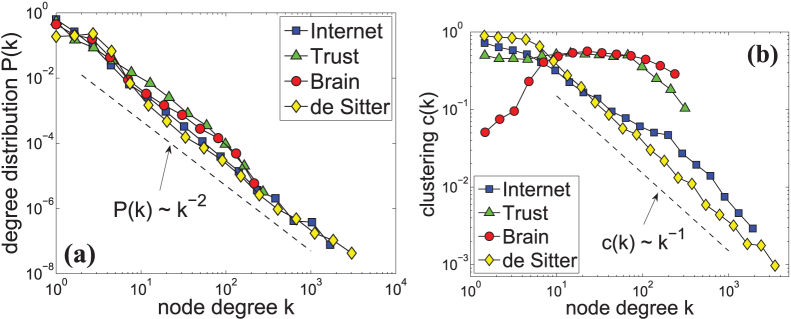
- De Sitter causets have a power-law degree distribution \(P(k) \sim k^{-\gamma}\) with \(\gamma = 2\); in \((d+1)\)-dimensional de Sitter, temporal node density scales as \(e^{\alpha t}\) and expected in-degree as \(e^{-\beta t}\) with \(\alpha = \beta = d/a\), yielding \(\gamma = 1 + \alpha/\beta = 2\).
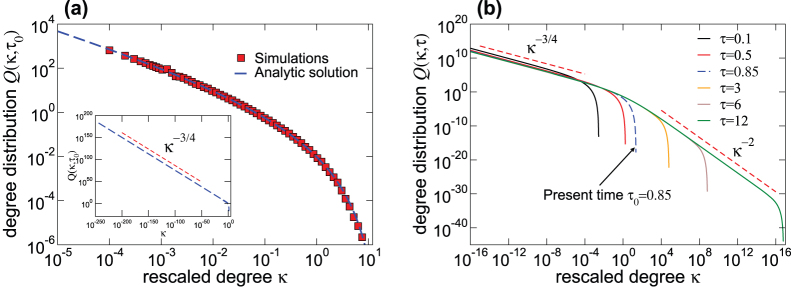
- The present universe causet is also a power-law graph but with exponent \(\gamma = 3/4\); at rescaled time \(\tau \sim 1\) (today) the distribution transitions to a \(\gamma = 2\) regime, with crossover at \(k_{\rm cr} \sim \delta a^4\), and at future infinity it becomes a perfect double power law with exponents \(3/4\) and \(2\). The paper reports \(\delta a^4 \sim 10^{244}\).
- Many real technological, social, and biological networks have \(\gamma \approx 2\) and strong clustering; the de Sitter causet also has strong clustering, and the growing hyperbolic network model yields \(\gamma = 2\) and the strongest possible clustering for that degree distribution.
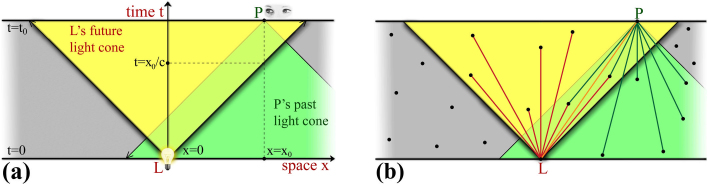
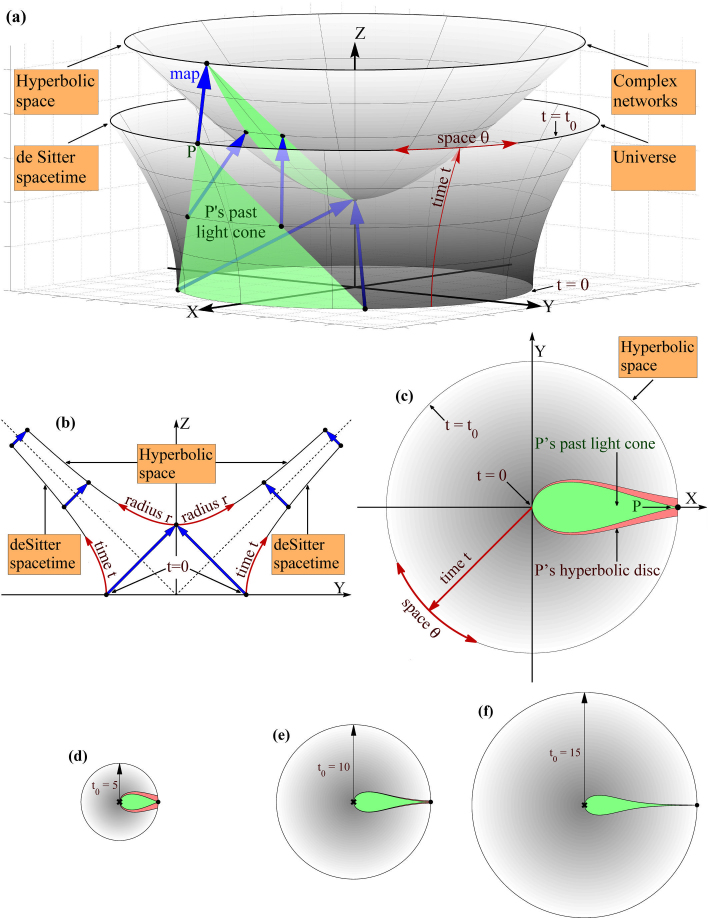
- The growth dynamics of de Sitter causets and complex networks are asymptotically identical: past light cones of new causet nodes are asymptotically equal to hyperbolic discs in the popularity×similarity network model.
Methods
- Theoretical/mathematical construction: causets are built by Poisson sprinkling nodes uniformly into de Sitter spacetime and connecting pairs if they lie within each other’s light cones; degree distributions and clustering are computed analytically using conformal time and light-cone volumes, extended to \((d+1)\)-dimensional de Sitter.
- Comparison to real networks: paradigmatic technological, social, and biological networks with reliable data are juxtaposed against a de Sitter causet; author contributions mention simulations.
- Proof of asymptotic equivalence: a mapping from de Sitter spacetime to hyperbolic space is used to show that the connection condition for new causet nodes matches that of a growing hyperbolic network model.
Limitations
- Stated: degree distributions in some complex networks deviate from clean power laws, and exponents, clustering, correlations, and other structural properties vary widely across real networks.
- Stated: de Sitter causets allow control only of the number of nodes and average degree, whereas the hyperbolic network model has tunable parameters for degree exponent, clustering strength, node fitness, and other properties; the physical meaning of dual parameters and their modeling versatility remain open.
- Stated: node density in growing hyperbolic networks with default de Sitter parameters is not uniform, so these networks are not random geometric graphs and their structure does not exactly reflect the underlying hyperbolic geometry; the real universe is only asymptotically de Sitter and contains matter, introducing smaller-scale inhomogeneities and anisotropies.
Model-written summary. Check it against the paper before relying on it.
Integrity signals
Registry
Cites
Statistics
Figures
Verification
Claims the paper makes
4 Valid · 2 Not valid · 8 Not checked · 24 Own results and interpretations
The cited sources that could be checked couldn’t confirm or dispute this claim.
In the paper
“the node density in growing hyperbolic networks with the default parameters corresponding to de Sitter causets, is not uniform in the hyperbolic space32.”
§ Network Cosmology > Discussion
What the sources say
- Could not verifycites [32] Papadopoulos F., Kitsak M., Serrano M. A., Boguñá M. & Krioukov D. Popularity versus similarity in growing networks. Nature 489, 537– 540 (2012). 22972194 sourceExperimental — accuracy not yet measured
Our copy of Papadopoulos et al. (2012) never mentions de Sitter causets or a correspondence of its default parameters to them, and makes no statement about whether the node density in the hyperbolic space is uniform or not (searched: 'node density not uniform', 'de Sitter', 'causet', 'uniform distribution in the hyperbolic disk'). The only uniformity statements it contains concern the angular coordinate — θ_t uniformly distributed on [0, 2π] in the model definition (Section IV, p. 12) and the uniform distribution p(θ)=δ/π used as a reference line for empirical/inferred angular distances (Fig. S12/S14, pp. 16, 28). Its radial placement rule r_t = ln t (Section IV, p. 12; r_t = 2ζ ln t for general curvature, Section VI, p. 23) is given without any characterization of the resulting spatial density, so the claim's point is not addressed in this paper. (LLM, conf=0.65)
plain- Asserted: passes — The authors put it forward as true.
- Checkable: passes — It can be checked against evidence.
- Load-bearing: passes — The paper’s conclusions depend on it.
- Based: passes — The paper gives a reason why it holds.
- Could not verify
The cited sources support only part of this claim — read each source’s verdict below.
In the paper
“Therefore it is only asymptotically de Sitter2627, meaning that only at large times , or rescaled times , space in the universe expands asymptotically the same way as in de Sitter spacetime.”
§ Network Cosmology > Results > Structure of the universe and complex networks
What the sources say
- Not checked yetcites [26] Griffiths J. B. & Podolský J. Exact Space-Times in Einstein's General Relativity (Cambridge University Press, Cambridge, 2009). source
- Partly supportedcites [27] Galloway G. J. & Solis D. A. Uniqueness of de Sitter space. Classical Quant Grav 24, 3125– 3138 (2007). sourceExperimental — accuracy not yet measured
The Introduction and §2.1 describe asymptotically de Sitter spacetimes in terms of a spacelike conformal boundary at infinity and give cosmological examples. They do not say that space expands at the same rate as de Sitter space at large times, so the proposed explanation of the term goes beyond what this paper states. (LLM, conf=0.78)
plain- Asserted: passes — The authors put it forward as true.
- Checkable: passes — It can be checked against evidence.
- Load-bearing: passes — The paper’s conclusions depend on it.
- Based: passes — The paper gives a reason why it holds.
Every source the paper cites for this claim was checked and supports it.
In the paper
“The networks in the model also have strongest possible clustering, i.e. the largest possible number of triangular subgraphs, for graphs with this degree distribution.”
§ Network Cosmology > Results > Dynamics of de Sitter causets and complex networks
What the sources say
- Supportedcites [32] Papadopoulos F., Kitsak M., Serrano M. A., Boguñá M. & Krioukov D. Popularity versus similarity in growing networks. Nature 489, 537– 540 (2012). 22972194 source
The main text (p. 3) states that 'the described optimization model leads to clustering that is strongest possible for networks with a given average degree and degree distribution', and the supplement Section IV B (p. 14) defines this clustering as 'the large number of triangular subgraphs'. The simulations (p. 17, Fig. S5) confirm it by rewiring links while preserving the degree distribution and finding only a minor, saturating increase in clustering, and p. 19 (Fig. S8) verifies maximum possible clustering at T = 0. The claim's 'for graphs with this degree distribution' matches the source's qualifier (average degree follows from the degree distribution), so nothing attributed here is unsupported. (LLM, conf=0.88)
plain- Asserted: passes — The authors put it forward as true.
- Checkable: passes — It can be checked against evidence.
- Load-bearing: unclear — It is unclear whether the paper’s conclusions depend on it.
- Based: passes — The paper gives a reason why it holds.
- Supported
The sources with a verdict support this claim; the rest weren’t checked yet, have no full text we could read, or their verdicts aren’t rated yet.
In the paper
“Strong clustering is another structural property often observed in complex networks: average clustering in random graphs of similar size and average degree is lower by orders of magnitude8910.”
§ Network Cosmology > Results > Structure of the universe and complex networks
What the sources say
- Not checked yetcites [8] Dorogovtsev S. N. & Mendes J. F. F. Evolution of Networks: From Biological Nets to the Internet and WWW (Oxford University Press, Oxford, 2003). source
- Supportedcites [9] Newman M. E. J. The Structure and Function of Complex Networks. SIAM Rev 45, 167– 256 (2003). source
In “Transitivity or clustering” (p. 12), Newman says clustering coefficients tend to be considerably higher than those of random graphs with similar numbers of vertices and edges. He adds that their values can differ by a factor of order n, supporting the claim that the difference can be orders of magnitude. (LLM, conf=0.94)
- Not checked yetcites [10] Boccaletti S., Latora V., Moreno Y., Chavez M. & Hwanga D.-U. Complex Networks: Structure and Dynamics. Phys Rep 424, 175– 308 (2006). source
plainstates an association- Asserted: passes — The authors put it forward as true.
- Checkable: passes — It can be checked against evidence.
- Load-bearing: unclear — It is unclear whether the paper’s conclusions depend on it.
- Based: passes — The paper gives a reason why it holds.
Every source the paper cites for this claim was checked and supports it.
In the paper
“The matter and dark energy densities happen to be of the same order of magnitude in the universe today.”
§ Network Cosmology > Results > Structure of the universe and complex networks
What the sources say
- Supportedcites [28] Garriga J., Livio M. & Vilenkin A. Cosmological constant and the time of its dominance. Phys Rev D 61, 023503 (1999). source
The Introduction says that vacuum energy contributes about 70% of the critical density and matter about 30%. It also explicitly describes the present as a time when the matter and vacuum-energy densities are comparable. (LLM, conf=0.94)
- Supportedcites [29] Sorkin R., Rajantie A., Contaldi C., Dauncey P. & Stoica H. Is the cosmological ”constant” a nonlocal quantum residue of discreteness of the causal set type? In AIP Conf Proc, vol. 957, 142– 153 (AIP, 2007). source
In “Spatial flatness and missing mass” (p. 3), the paper says that Λ or something like it carries twice the effective mass density of matter, including dark matter. That places the two densities at the same order of magnitude in the universe today. (LLM, conf=0.93)
- Supportedcites [30] Barrow J. & Shaw D. New Solution of the Cosmological Constant Problems. Phys Rev Lett 106, 101302 (2011). 21469784 source
On p. 4, the paper explicitly describes ΩΛ/Ωm being of order one as the cosmological coincidence. These parameters represent dark energy and matter densities relative to the same critical density, so their ratio supports the claim about densities today. (LLM, conf=0.94)
plainstates an association- Asserted: passes — The authors put it forward as true.
- Checkable: passes — It can be checked against evidence.
- Load-bearing: passes — The paper’s conclusions depend on it.
- Based: passes — The paper gives a reason why it holds.
- Supported
26 more claims
Create a free account to see all 38 claims and to verify the 14 references still open.
- It may state two separate claims as one. 6
- Probably not a substantial claim. 1
Claims other papers make about this one
Each is checked against this paper’s own text: does it say what the citing paper says it does?
The cited source says what the claim attributes to it.
In the citing paper
“On the one hand, the connection between hyperbolic complex networks and causal sets [63,64] used in quantum gravity has been explored in a recent paper [66], and causal sets have been used to analyse complex networks [67].”
From Interdisciplinary and physics challenges of network theory (2015) · cites this paper as [66]
Citations
Cites
Observational Evidence from Supernovae for an Accelerating Universe and a Cosmological Constant
Riess, A. G., Filippenko, A. V., Challis, P., Clocchiatti, A., Diercks, A., Garnavich, P. M., Gilliland, R. L., Hogan, C. J., Jha, S., Kirshner, R. P., et al. (1998) · The Astronomical Journal · doi:10.1086/300499 · Cited by 19,704
The Structure and Function of Complex Networks
Newman, M. E. J. (2003) · SIAM Review · doi:10.1137/s003614450342480 · Cited by 18,719
Complex brain networks: graph theoretical analysis of structural and functional systems
Bullmore, E., & Sporns, O. (2009) · Nature Reviews Neuroscience · doi:10.1038/nrn2575 · Cited by 11,820
Complex networks: structure and dynamics
BOCCALETTI, S., LATORA, V, MORENO, Y., CHAVEZ, M., & HWANG, D. (2006) · Physics Reports · doi:10.1016/j.physrep.2005.10.009 · Cited by 11,010
SEVEN-YEAR WILKINSON MICROWAVE ANISOTROPY PROBE(WMAP) OBSERVATIONS: COSMOLOGICAL INTERPRETATION
Komatsu, E., Smith, K. M., Dunkley, J., Bennett, C. L., Gold, B., Hinshaw, G., Jarosik, N., Larson, D., Nolta, M. R., Page, L., et al. (2011) · The Astrophysical Journal Supplement Series · doi:10.1088/0067-0049/192/2/18 · Cited by 8,802 · cited 3×
“There are also a variety of other models with non-constant Λ, yet the standard ΛCDM model with constant Λ is a baseline describing accurately many observed properties of the real universe [52], partly justifying our simplifying assumption.”
InfluentialNetwork biology: understanding the cell's functional organization
Barabási, A.-L., & Oltvai, Z. N. (2004) · Nature Reviews Genetics · doi:10.1038/nrg1272 · Cited by 7,903 · cited 1×
“…seems to experience certain difficulties in application to complex systems in general, and to complex networks in particular, where it remains unclear if there exist some unique universal laws explaining a variety of structural and dynamical similarities found in many different real networks [1–7].”
Lazer, D., Pentland, A., Adamic, L., Aral, S., Barabási, A.-L., Brewer, D., Christakis, N., Contractor, N., Fowler, J., Gutmann, M., et al. (2009) · Science · doi:10.1126/science.1167742 · Cited by 3,365
Controllability of complex networks
Liu, Y.-Y., Slotine, J.-J., & Barabási, A.-L. (2011) · Nature · doi:10.1038/nature10011 · Cited by 3,215
Kiefer, C. (2004) · Cited by 2,992
Discovery of a supernova explosion at half the age of the Universe
Perlmutter, S., Aldering, G., Valle, M. D., Deustua, S., Ellis, R. S., Fabbro, S., Fruchter, A., Goldhaber, G., Groom, D. E., Hook, I. M., et al. (1998) · Nature · doi:10.1038/34124 · Cited by 2,544
The Large Scale Structure of Space–Time
Woodhouse, N. (1974) · Physics Bulletin · doi:10.1088/0031-9112/25/6/029 · Cited by 2,542
Penrose, M. (2003) · doi:10.1093/acprof:oso/9780198506263.001.0001 · Cited by 2,480
Dorogovtsev, S. N., & Mendes, J. F. F. (2003) · doi:10.1093/acprof:oso/9780198515906.001.0001 · Cited by 1,563
A universal model for mobility and migration patterns
Simini, F., González, M. C., Maritan, A., & Barabási, A.-L. (2012) · Nature · doi:10.1038/nature10856 · Cited by 1,502
Scale-Free Brain Functional Networks
Eguíluz, V. M., Chialvo, D. R., Cecchi, G. A., Baliki, M., & Apkarian, A. V. (2005) · Physical Review Letters · doi:10.1103/physrevlett.94.018102 · Cited by 1,460
Structure of Growing Networks with Preferential Linking
Dorogovtsev, S. N., Mendes, J. F. F., & Samukhin, A. N. (2000) · Physical Review Letters · doi:10.1103/physrevlett.85.4633 · Cited by 1,307
Virtual Time and Global States of Distributed Systems
Mattern, F. (2002) · Cited by 1,277
Connectivity of Growing Random Networks
Krapivsky, P. L., Redner, S., & Leyvraz, F. (2000) · Physical Review Letters · doi:10.1103/physrevlett.85.4629 · Cited by 1,197
Hyperbolic geometry of complex networks
Krioukov, D., Papadopoulos, F., Kitsak, M., Vahdat, A., & Boguñá, M. (2010) · Physical Review E · doi:10.1103/physreve.82.036106 · Cited by 1,059
Self-citationBombelli, L., Lee, J., Meyer, D., & Sorkin, R. D. (1987) · Physical Review Letters · doi:10.1103/physrevlett.59.521 · Cited by 1,012 · cited 1×
“The mathematical fact that the structure of a relativistic spacetime is almost fully determined by its causal structure alone [16–18] motivates the causal set approach to quantum gravity [19].”
Self-citationExact Space-Times in Einstein's General Relativity
Griffiths, J. B., & Podolský, J. (2009) · doi:10.1017/cbo9780511635397 · Cited by 872
Popularity versus similarity in growing networks
Papadopoulos, F., Kitsak, M., Serrano, M. Á., Boguñá, M., & Krioukov, D. (2012) · Nature · doi:10.1038/nature11459 · Cited by 634 · cited 7×
“The model and its extensions describe the large-scale structure and growth dynamics of different real networks, e.g. the Internet, metabolic networks, and social networks, with a remarkable accuracy [35].”
InfluentialSelf-citationTopological and causal structure of the yeast transcriptional regulatory network
Guelzim, N., Bottani, S., Bourgine, P., & Képès, F. (2002) · Nature Genetics · doi:10.1038/ng873 · Cited by 608
Callas, J., Donnerhacke, L., Finney, H., & Thayer, R. (1998) · doi:10.17487/rfc2440 · Cited by 514
Predicting the Behavior of Techno-Social Systems
Vespignani, A. (2009) · Science · doi:10.1126/science.1171990 · Cited by 495
Navigability of complex networks
Boguñá, M., Krioukov, D., & Claffy, K. C. (2009) · Nature Physics · doi:10.1038/nphys1130 · Cited by 486 · cited 1×
“In particular, de Sitter causal sets have exactly the same graph structure that maximizes network navigability [39].”
Self-citationSustaining the Internet with hyperbolic mapping
Boguñá, M., Papadopoulos, F., & Krioukov, D. (2010) · Nature Communications · doi:10.1038/ncomms1063 · Cited by 463 · cited 1×
“De Sitter spacetime is homogeneous and isotropic, as is the hyperbolic space, but if we take a real network, e.g. the Internet, and map it to this homogeneous space, then after the mapping, the node density in the space is non-uniform [38].”
Self-citationClass of correlated random networks with hidden variables
Boguñá, M., & Pastor-Satorras, R. (2003) · Physical Review E · doi:10.1103/physreve.68.036112 · Cited by 452
Self-citationAmbjørn, J., Jurkiewicz, J., & Loll, R. (2005) · Physical Review D · doi:10.1103/physrevd.72.064014 · Cited by 422
Anderson, J. W. (1999) · Springer Undergraduate Mathematics Series · doi:10.1007/978-1-4471-3987-4 · Cited by 415
Causality Implies the Lorentz Group
Zeeman, E. C. (1964) · Journal of Mathematical Physics · doi:10.1063/1.1704140 · Cited by 400
Classical sequential growth dynamics for causal sets
Rideout, D. P., & Sorkin, R. D. (1999) · Physical Review D · doi:10.1103/physrevd.61.024002 · Cited by 372
Self-citationPower laws and the AS-level internet topology
Siganos, G., Faloutsos, M., Faloutsos, P., & Faloutsos, C. (2003) · IEEE/ACM Transactions on Networking · doi:10.1109/tnet.2003.815300 · Cited by 369
The class of continuous timelike curves determines the topology of spacetime
Malament, D. B. (1977) · Journal of Mathematical Physics · doi:10.1063/1.523436 · Cited by 357 · cited 1×
“The mathematical fact that the structure of a relativistic spacetime is almost fully determined by its causal structure alone [16–18] motivates the causal set approach to quantum gravity [19].”
The internet AS-level topology: three data sources and one definitive metric
Mahadevan, P., Krioukov, D., Fomenkov, M., Dimitropoulos, X., claffy, K. C., & Vahdat, A. (2006) · ACM SIGCOMM Computer Communication Review · doi:10.1145/1111322.1111328 · Cited by 338
Self-citationEvolution of Networks: From Biological Nets to the Internet and WWWPreprint
Dorogovtsev, S. N., & Mendes, J. F. F. (2003) · RePEc: Research Papers in Economics · Cited by 330
Kiefer, C. (2007) · doi:10.1093/acprof:oso/9780199212521.001.0001 · Cited by 316
Hawking, S. W., King, A. R., & McCarthy, P. J. (1976) · Journal of Mathematical Physics · doi:10.1063/1.522874 · Cited by 294
Collecting the internet AS-level topology
Zhang, B., Liu, R., Massey, D., & Zhang, L. (2005) · ACM SIGCOMM Computer Communication Review · doi:10.1145/1052812.1052825 · Cited by 285
Report of the Dark Energy Task Force
Albrecht, A., Bernstein, G., Cahn, R., Freedman, W. L., Hewitt, J., Hu, W., Huth, J., Kamionkowski, M., Kolb, E. W., Knox, L., et al. (2006) · doi:10.2172/897600 · Cited by 262
Evolution of biomolecular networks — lessons from metabolic and protein interactions
Yamada, T., & Bork, P. (2009) · Nature Reviews Molecular Cell Biology · doi:10.1038/nrm2787 · Cited by 252
Barbour, A. D., & Reinert, G. (2004) · Networks · doi:10.1017/9781009651752.019 · Cited by 225
How far are we from the quantum theory of gravity?
Woodard, R. P. (2009) · Reports on Progress in Physics · doi:10.1088/0034-4885/72/12/126002 · Cited by 206
Ising-like dynamics in large-scale functional brain networks
Fraiman, D., Balenzuela, P., Foss, J., & Chialvo, D. R. (2009) · Physical Review E · doi:10.1103/physreve.79.061922 · Cited by 204
Quantum graphity: A model of emergent locality
Konopka, T., Markopoulou, F., & Severini, S. (2008) · Physical Review D · doi:10.1103/physrevd.77.104029 · Cited by 197
DISCRETENESS WITHOUT SYMMETRY BREAKING: A THEOREM
BOMBELLI, L., HENSON, J., & Sorkin, R. D. (2009) · Modern Physics Letters A · doi:10.1142/s0217732309031958 · Cited by 183
Planckian Birth of a Quantum de Sitter Universe
Ambjørn, J., Görlich, A., Jurkiewicz, J., & Loll, R. (2008) · Physical Review Letters · doi:10.1103/physrevlett.100.091304 · Cited by 172
The Large Scale Structure of Space-Time
Hawking, S. W., Ellis, G. F. R., & Sachs, R. K. (1974) · Physics Today · doi:10.1063/1.3128542 · Cited by 166
Exact Space-Times in Einstein's General Relativity
Lake, K. (2010) · Classical and Quantum Gravity · doi:10.1088/0264-9381/27/24/249001 · Cited by 163
Suppressing Roughness of Virtual Times in Parallel Discrete-Event Simulations
Korniss, G., Novotny, M. A., Guclu, H., Toroczkai, Z., & Rikvold, P. A. (2003) · Science · doi:10.1126/science.1079382 · Cited by 155
Postnikov, M. M. (2001) · Encyclopaedia of mathematical sciences · doi:10.1007/978-3-662-04433-9 · Cited by 153
Ten years in the evolution of the internet ecosystem
Dhamdhere, A., & Dovrolis, C. (2008) · Proceedings of the 8th ACM SIGCOMM conference on Internet measurement · doi:10.1145/1452520.1452543 · Cited by 149
Internet Mapping: From Art to Science
Claffy, K., Hyun, Y., Keys, K., Fomenkov, M., & Krioukov, D. (2009) · 2009 Cybersecurity Applications & Technology Conference for Homeland Security · doi:10.1109/catch.2009.38 · Cited by 141
Self-citationCosmological constant and the time of its dominance
Garriga, J., Livio, M., & Vilenkin, A. (1999) · Physical Review D · doi:10.1103/physrevd.61.023503 · Cited by 115 · cited 2×
“” puzzle in cosmology [28–31].”
Discreteness without symmetry breaking: a theorem
Bombelli, L., Henson, J., & Sorkin, R. D. (2006) · CERN Document Server (European Organization for Nuclear Research) · Cited by 109
Discreteness without symmetry breaking: a theorem
Bombelli, L., Henson, J., & Sorkin, R. D. (2006) · arXiv · doi:10.48550/arxiv.gr-qc/0605006 · Cited by 97
Geometry of loop quantum gravity on a graph
Rovelli, C., & Speziale, S. (2010) · Physical Review D · doi:10.1103/physrevd.82.044018 · Cited by 91
Geometry VI: Riemannian Geometry
Postnikov, M. M. (2001) · Cited by 87
Tree-like structure of eternal inflation: A solvable model
Harlow, D., Shenker, S. H., Stanford, D., & Susskind, L. (2012) · Physical Review D · doi:10.1103/physrevd.85.063516 · Cited by 79
New Solution of the Cosmological Constant Problems
Barrow, J. D., & Shaw, D. J. (2011) · Physical Review Letters · doi:10.1103/physrevlett.106.101302 · Cited by 64
Revitalizing causality: realism about causality in philosophy and social science
DesRoches, C. T. (2009) · Journal of Economic Methodology · doi:10.1080/13501780902943707 · Cited by 54
Bonahon, F. (2009) · Student mathematical library · doi:10.1090/stml/049 · Cited by 53
Kleban, M. (2011) · Classical and Quantum Gravity · doi:10.1088/0264-9381/28/20/204008 · Cited by 52
Exact Expressions for the Properties of the Zero-Pressure Friedmann Models
Edwards, D. (1972) · Monthly Notices of the Royal Astronomical Society · doi:10.1093/mnras/159.1.51 · Cited by 51
Is the cosmological “constant” a nonlocal quantum residue of discreteness of the causal set type?
Sorkin, R. D., Rajantie, A., Contaldi, C., Dauncey, P., & Stoica, H. (2007) · AIP Conference Proceedings · doi:10.1063/1.2823750 · Cited by 49 · cited 1×
“[29] Rafael Sorkin, Arttu Rajantie, Carlo Contaldi, Paul Dauncey, and Horace Stoica.”
The Self-Organizing Quantum Universe
Ambjørn, J., Jurkiewicz, J., & Loll, R. (2008) · Scientific American · doi:10.1038/scientificamerican0708-42 · Cited by 49
Mumford, S. (2007) · Routledge eBooks · doi:10.4324/9780203932636 · Cited by 46
Indications of de Sitter spacetime from classical sequential growth dynamics of causal sets
Ahmed, M., & Rideout, D. (2010) · Physical review. D. Particles, fields, gravitation, and cosmology/Physical review. D. Particles and fields · doi:10.1103/physrevd.81.083528 · Cited by 46
Self-citationInitial conditions and unitarity in unimodular quantum cosmologyPreprint
Daughton, A., Louko, J., & Sorkin, R. D. (1993) · arXiv (Cornell University) · doi:10.48550/arxiv.gr-qc/9305016 · Cited by 30
Emergence of space–time from topologically homogeneous causal networks
D’Ariano, G. M., & Tosini, A. (2013) · Studies in History and Philosophy of Science Part B Studies in History and Philosophy of Modern Physics · doi:10.1016/j.shpsb.2013.04.003 · Cited by 19
Scale Free Small World Networks and the Structure of Quantum Space-TimePreprint
Requardt, M. (2003) · arXiv (Cornell University) · doi:10.48550/arxiv.gr-qc/0308089 · Cited by 14
Galloway, G. J., & Solis, D. A. (2007) · Classical and Quantum Gravity · doi:10.1088/0264-9381/24/11/021 · Cited by 10 · cited 1×
“We first consider the structure of causets sprinkled onto de Sitter spacetime, then quantify how different this structure is for the real universe, and finally prove the asymptotic equivalence between the growth dynamics of de Sitter causets and complex networks.”
Galloway, G. J., Solis, D. A., & Matemáticas, F. D. (2007) · CERN Document Server (European Organization for Nuclear Research) · Cited by 8
Whalley, K. (2009) · Nature reviews. Neuroscience · doi:10.1038/nrn2597 · Cited by 4
Cited by
Random Graphs and Complex Networks
Hofstad, R. V. D. (2016) · Cambridge University Press eBooks · doi:10.1017/9781316779422 · Cited by 840
Boguñá, M., Bonamassa, I., De Domenico, M., Havlin, S., Krioukov, D., & Serrano, M. Á. (2021) · Nature Reviews Physics · doi:10.1038/s42254-020-00264-4 · Cited by 213
Self-citationBörner, K., Scrivner, O., Gallant, M., Ma, S., Liu, X., Chewning, K., Wu, L., & Evans, J. A. (2018) · Proceedings of the National Academy of Sciences · doi:10.1073/pnas.1804247115 · Cited by 182
Emergent Hyperbolic Network Geometry
Bianconi, G., & Rahmede, C. (2017) · Scientific Reports · doi:10.1038/srep41974 · Cited by 164
Voitalov, I., van der Hoorn, P., van der Hofstad, R., & Krioukov, D. (2019) · Physical Review Research · doi:10.1103/physrevresearch.1.033034 · Cited by 162
Self-citation
Metadata
- Authors
- Krioukov, D., Kitsak, M., Sinkovits, R. S., Rideout, D., Meyer, D., & Boguñá, M.
- Affiliations
- University of California San Diego (US)
- San Diego Supercomputer Center (US)
- Universitat de Barcelona (ES)
- Corresponding author
- Krioukov, Dmitri
- Venue
- Scientific Reports
- Published
- 2012-11-16
- Volume
- 2
- Issue
- 1
- Pages
- 793-793
- ISSN
- 2045-2322 (ISSN-L)
- PMC
- PMC3499772
- OpenAlex
- W3037110710
- Semantic Scholar
- 6f2cb141df472a334116d2e08641eb0a29b242be
- Cited by
- 128
- References
- 75
- Citations by year
- 2026: 3 · 2025: 10 · 2024: 1 · 2023: 9 · 2022: 5 · 2021: 6 · 2020: 9 · 2019: 8 · 2018: 9 · 2017: 17 · 2016: 16 · 2015: 21 · 2014: 8 · 2013: 5 · 2012: 1
- FWCI
- 8.47
- Type
- journal article
- Language
- en
- Open access
- gold
- doi.org
- Licence
- cc-by-nc-nd
- creativecommons.org/licenses/by-nc-nd/3.0/ (tdm)
- creativecommons.org/licenses/by-nc-nd/3.0/ (vor)
- Locations
- Scientific Reports (publishedVersion, cc-by-nc-nd)
- PubMed Central (publishedVersion, cc-by-nc-nd)
- PubMed (publishedVersion)
- arXiv (Cornell University) (submittedVersion)
- Dipòsit Digital de la Universitat de Barcelona (Universitat de Barcelona) (submittedVersion, cc-by)
- arXiv (Cornell University)
- Funders
- National Science Foundation (1039646, 0964236)
- Cisco Systems
- Foundational Questions Institute
- San Diego Supercomputer Center
- Generalitat de Catalunya (FIS2010-21781-C02-02)
- Institució Catalana de Recerca i Estudis Avançats (FIS2010-21781-C02-02)
- Ministerio de Ciencia e Innovación
- Defense Advanced Research Projects Agency (HR0011, HR0011-12-1-0012)
- University of California, San Diego
- Topics
- Physical Sciences › Physics and Astronomy › Statistical and Nonlinear Physics › Complex Network Analysis Techniques
- Physical Sciences › Physics and Astronomy › Astronomy and Astrophysics › Cosmology and Gravitation Theories
- Physical Sciences › Physics and Astronomy › Nuclear and High Energy Physics › Noncommutative and Quantum Gravity Theories
- Keywords
- causal networks, power-law graphs, network growth dynamics, clustering, complex networks, cosmic acceleration, network dynamics
About these checks
Registry, retraction, Cites and statistics results are computed, not judged, with one exception: a printed reference that no index lists is read once by a model before it counts as a citation error. Claims are extracted by a model and kept only when their quote appears verbatim in the text; each cited source is then checked, with a model’s help, for whether it says what the claim relies on. Those verdicts can be wrong — read the claim’s quote and the cited source before relying on one.
The claim verdicts this report counts are experimental: their accuracy is not yet measured.
A language model drew the claims from the paper on 2026-10-08, under version 3 of the claim definition (model deepseek-v4.1-flash, prompt extract-v3).
A second model labelled each claim on 2026-10-08 (model jev-1.13-20260917, definition revision gold-guideline-v0.2).
Cited sources are checked with a language model’s help (qwen3.8-omni-flash and gpt-6-sol).
Statistics and arithmetic are recomputed, not judged.
Confidence bands are shown only for fields calibrated on our annotated test set. None is calibrated yet, so no band is shown.
What counts as a claim ›How we measure confidence ›How we check this ›
Are you an author, or do you see a problem with this page? Request a review
Data sources
Bibliographic data: Semantic Scholar, OpenAlex, Crossref.
Contains information from the Semantic Scholar Academic Graph Datasets, made available under the ODC Attribution License (ODC-BY 1.0).
Semantic Scholar’s data is described in: Kinney, R., et al. (2023). The Semantic Scholar Open Data Platform. arXiv:2301.10140.
