

Imbalanced functional link between executive control network and reward network explain the online-game seeking behaviors in Internet gaming disorder
Open accessThe DOI matches its Crossref record; 61 of the 61 references it cites were found in a registry or an index.
Abstract
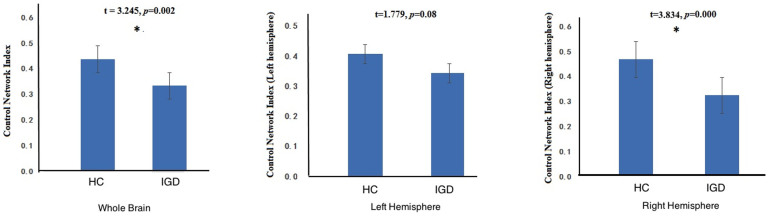
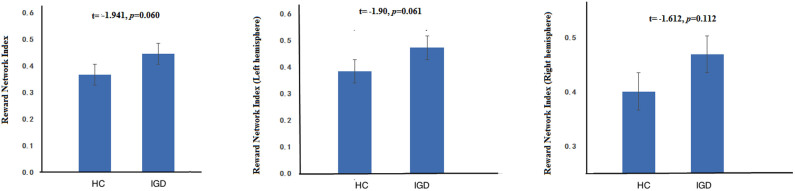
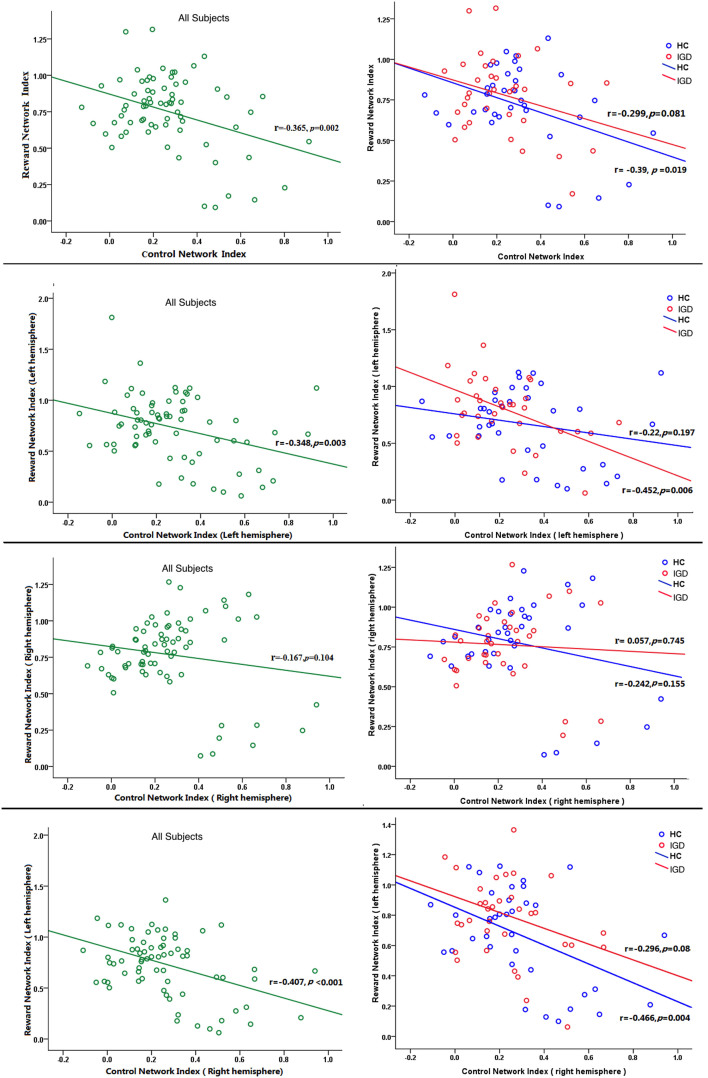
Literatures have shown that Internet gaming disorder (IGD) subjects show impaired executive control and enhanced reward sensitivities than healthy controls. However, how these two networks jointly affect the valuation process and drive IGD subjects' online-game-seeking behaviors remains unknown. Thirty-five IGD and 36 healthy controls underwent a resting-states scan in the MRI scanner. Functional connectivity (FC) was examined within control and reward network seeds regions, respectively. Nucleus accumbens (NAcc) was selected as the node to find the interactions between these two networks. IGD subjects show decreased FC in the executive control network and increased FC in the reward network when comparing with the healthy controls. When examining the correlations between the NAcc and the executive control/reward networks, the link between the NAcc - executive control network is negatively related with the link between NAcc - reward network. The changes (decrease/increase) in IGD subjects' brain synchrony in control/reward networks suggest the inefficient/overly processing within neural circuitry underlying these processes. The inverse proportion between control network and reward network in IGD suggest that impairments in executive control lead to inefficient inhibition of enhanced cravings to excessive online game playing. This might shed light on the mechanistic understanding of IGD.
Overview
The claims and statistics of this paper haven’t been checked yet.
Free: it reads the open-access text and checks the first 5 claims that cite a source we can check. Create a free account to check every claim.
Integrity signals
Registry
Cites
Statistics
Figures

Verification
Claims the paper makes
The claims and statistics of this paper haven’t been checked yet.
Free: it reads the open-access text and checks the first 5 claims that cite a source we can check. Create a free account to check every claim.
Claims other papers make about this one
Each is checked against this paper’s own text: does it say what the citing paper says it does?
The source backs part of the claim, not all of it — or backs it for a different population, condition or comparison.
In the citing paper
“the fMRI study by Dong et al. (2015) have shown that individuals with internet gaming disorders are in a state of imbalance between executive control and the reward network, and a decrease in executive control leads to an increase in motivation-seeking and craving.”
From The effect of short-form video addiction on undergraduates' academic procrastination: a moderated mediation model (2023) · cites this paper as Dong et al., 2015
Experimental — accuracy not yet measuredThe cited source says what the claim attributes to it.
In the citing paper
“Dong and colleagues propose that the imbalance between executive control and reward networks represent a mechanism seen in individuals with Internet-gaming disorder, with reductions in executive control leading to a diminished inhibition of motivation-seeking and craving, resulting in excessive Internet gaming.”
From Integrating psychological and neurobiological considerations regarding the development and maintenance of specific Internet-use disorders: An Interaction of Person-Affect-Cognition-Execution (I-PACE) model (2016) · cites this paper as Dong et al., 2015
The cited source says what the claim attributes to it.
In the citing paper
“In addition, the individuals with Internet-gaming disorder showed increased functional connectivity in reward-associated networks (including ventral striatum and orbitofrontal cortex).”
From Integrating psychological and neurobiological considerations regarding the development and maintenance of specific Internet-use disorders: An Interaction of Person-Affect-Cognition-Execution (I-PACE) model (2016) · cites this paper as Dong et al., 2015
Self-check
Percentages, sums and reported differences re-computed from the paper’s own numbers.
The self-check needs the paper’s full text.
Citations
Cites
Diagnostic and Statistical Manual of Mental Disorders
American Psychiatric Association (2013) · doi:10.1176/appi.books.9780890425596 · Cited by 116,369
An inventory for measuring depression
BECK, A. T. (1961) · Archives of General Psychiatry · doi:10.1001/archpsyc.1961.01710120031004 · Cited by 38,032 · cited 1×
“We further assessed ‘depression’ with the Beck Depression Inventory 34 and only participants scoring less than 5 were included.”
An Integrative Theory of Prefrontal Cortex Function
Miller, E. K., & Cohen, J. D. (2001) · Annual Review of Neuroscience · doi:10.1146/annurev.neuro.24.1.167 · Cited by 12,803 · cited 1×
“These two network interact in a pull and push fashion where strong motivation will lead to the disturbance of the executive control circuit, and the strong executive control will lead to the inhibition of the motivational desires 53 .”
The organization of the human cerebral cortex estimated by intrinsic functional connectivity
Thomas Yeo, B. T., Krienen, F. M., Sepulcre, J., Sabuncu, M. R., Lashkari, D., Hollinshead, M., Roffman, J. L., Smoller, J. W., Zöllei, L., Polimeni, J. R., et al. (2011) · Journal of Neurophysiology · doi:10.1152/jn.00338.2011 · Cited by 9,182
Dissociable intrinsic connectivity networks for salience processing and executive control
Seeley, W. W., Menon, V., Schatzberg, A. F., Keller, J., Glover, G. H., Kenna, H., Reiss, A. L., & Greicius, M. D. (2007) · The Journal of Neuroscience · doi:10.1523/jneurosci.5587-06.2007 · Cited by 7,426 · cited 3×
“These temporal correlations are presumed to reflect intrinsic functional connectivity (FC) and have been demonstrated across several distinct networks 28–30 .”
Scoville, W. B. (1949) · Journal of neurosurgery · doi:10.3171/jns.1949.6.1.0065 · Cited by 7,380
The organization of the human cerebellum estimated by intrinsic functional connectivity
Buckner, R. L., Krienen, F. M., Castellanos, A., Diaz, J. C., & Yeo, B. T. T. (2011) · Journal of Neurophysiology · doi:10.1152/jn.00339.2011 · Cited by 7,304
Spontaneous fluctuations in brain activity observed with functional magnetic resonance imaging
Fox, M. D., & Raichle, M. E. (2007) · Nature Reviews Neuroscience · doi:10.1038/nrn2201 · Cited by 6,700
Consistent resting-state networks across healthy subjects
Damoiseaux, J. S., Rombouts, S. A. R. B., Barkhof, F., Scheltens, P., Stam, C. J., Smith, S. M., & Beckmann, C. F. (2006) · Proceedings of the National Academy of Sciences · doi:10.1073/pnas.0601417103 · Cited by 4,326
Neural systems of reinforcement for drug addiction: from actions to habits to compulsion
Everitt, B. J., & Robbins, T. W. (2005) · Nature Neuroscience · doi:10.1038/nn1579 · Cited by 3,785
Cited by
Brand, M., Young, K. S., Laier, C., Wölfling, K., & Potenza, M. N. (2016) · Neuroscience & Biobehavioral Reviews · doi:10.1016/j.neubiorev.2016.08.033 · Cited by 2,416
“…by eeking a short-term attractive behavior that results in the expeience of gratification despite negative long-term consequences. his hypothesized type of dysfunctional interaction between exective control and reward-seeking has been emphasized recently y the fMRI study of Dong et al. (2015).”
Neuroscience of Internet Pornography Addiction: A Review and Update
Love, T., Laier, C., Brand, M., Hatch, L., & Hajela, R. (2015) · Behavioral Sciences · doi:10.3390/bs5030388 · Cited by 262
“Categorized by technology, these brain studies comprise 44 fMRI studies [103,132,134,135,160–199],”
MethodSugaya, N., Shirasaka, T., Takahashi, K., & Kanda, H. (2019) · BioPsychoSocial Medicine · doi:10.1186/s13030-019-0144-5 · Cited by 194
Dong, G., & Potenza, M. N. (2016) · Journal of Psychiatric Research · doi:10.1016/j.jpsychires.2015.11.011 · Cited by 163
Self-citationDong, G., Li, H., Wang, L., & Potenza, M. N. (2017) · European Psychiatry · doi:10.1016/j.eurpsy.2017.03.004 · Cited by 139
“Studies suggest enhanced reward sensitivity and decreased loss sensitivity in IGD subjects [28,41–43].”
BackgroundResultInfluentialSelf-citation
Metadata
- Authors
- Dong, G., Lin, X., Hu, Y., Xie, C., & Du, X.
- Affiliations
- Zhejiang Normal University (CN)
- University of Reading (GB)
- Southeast University (CN)
- East China Normal University (CN)
- Corresponding author
- Dong, Guangheng
- Venue
- Scientific Reports
- Published
- 2015-03-17
- Volume
- 5
- Issue
- 1
- Pages
- 9197-9197
- ISSN
- 2045-2322 (ISSN-L)
- PMC
- PMC4361884
- OpenAlex
- W1983375484
- Cited by
- 76
- References
- 61
- Citations by year
- 2026: 6 · 2025: 9 · 2024: 3 · 2023: 5 · 2022: 9 · 2021: 4 · 2020: 6 · 2019: 9 · 2018: 3 · 2017: 10 · 2016: 8 · 2015: 4
- FWCI
- 27.65
- Type
- journal article
- Language
- en
- Open access
- gold
- doi.org
- Licence
- cc-by
- creativecommons.org/licenses/by/4.0 (tdm)
- creativecommons.org/licenses/by/4.0 (vor)
- Locations
- Scientific Reports (publishedVersion, cc-by)
- PubMed Central (publishedVersion, cc-by)
- PubMed (publishedVersion)
- CentAUR (University of Reading) (acceptedVersion)
- London Met Repository (London Metropolitan University) (acceptedVersion)
- Funders
- National Natural Science Foundation of China (31371023)
- Topics
- Social Sciences › Sociology and Political Science › Impact of Technology on Adolescents
- Life Sciences › Neuroscience › Cognitive Neuroscience › Functional Brain Connectivity Studies
- Social Sciences › Psychology › Clinical Psychology › Gambling Behavior and Treatments
- Keywords
- internet gaming disorder, frontoparietal network, reward network, functional connectivity, nucleus accumbens, craving, resting-state functional connectivity, reward sensitivity
- MeSH terms
- Adult, Mental Disorders, Brain, Brain Mapping, Humans, Magnetic Resonance Imaging, Male, Play and Playthings, Case-Control Studies, Behavior, Addictive, Internet, Young Adult, Executive Function
About these checks
Registry, retraction, Cites and statistics results are computed, not judged, with one exception: a printed reference that no index lists is read once by a model before it counts as a citation error. Claims are extracted by a model and kept only when their quote appears verbatim in the text; each cited source is then checked, with a model’s help, for whether it says what the claim relies on. Those verdicts can be wrong — read the claim’s quote and the cited source before relying on one.
Statistics and arithmetic are recomputed, not judged.
Confidence bands are shown only for fields calibrated on our annotated test set. None is calibrated yet, so no band is shown.
What counts as a claim ›How we measure confidence ›How we check this ›
Are you an author, or do you see a problem with this page? Request a review
Data sources
Bibliographic data: Semantic Scholar, OpenAlex, Crossref.
Contains information from the Semantic Scholar Academic Graph Datasets, made available under the ODC Attribution License (ODC-BY 1.0).
Semantic Scholar’s data is described in: Kinney, R., et al. (2023). The Semantic Scholar Open Data Platform. arXiv:2301.10140.
