

The DOI matches its Crossref record; 6 of the 6 references it cites were found in a registry or an index.
Genetic affinities of the Jewish populations of India
Abstract
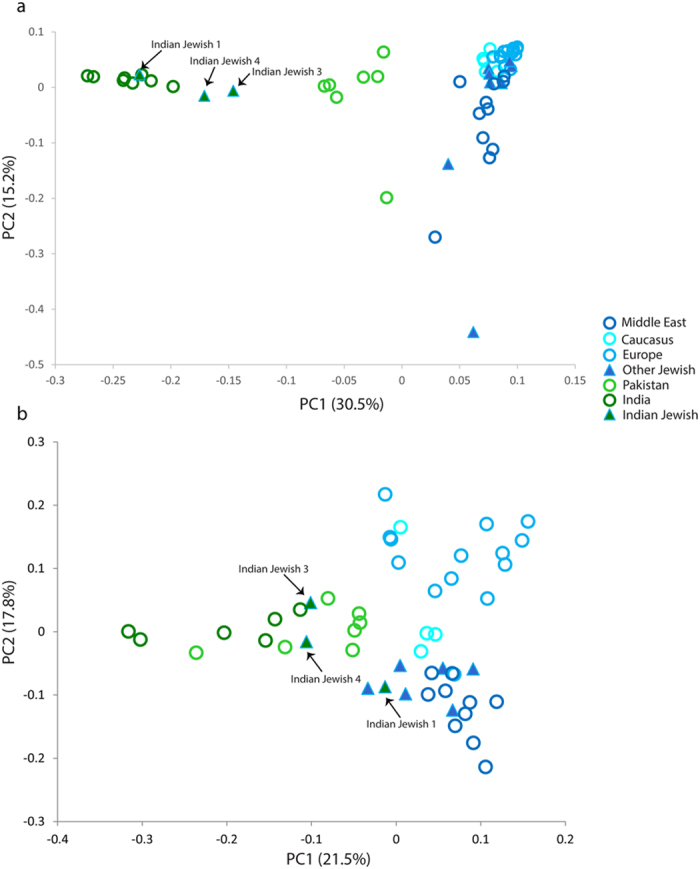
Due to the lack of written records or inscription, the origin and affiliation of Indian Jewish populations with other world populations remain contentious. Previous genetic studies have found evidence for a minor shared ancestry of Indian Jewish with Middle Eastern (Jewish) populations. However, these studies (relied on limited individuals), haven’t explored the detailed temporal and spatial admixture process of Indian Jewish populations with the local Indian populations. Here, using large sample size with combination of high resolution biparental (autosomal) and uniparental markers (Y chromosome and mitochondrial DNA), we reconstructed genetic history of Indian Jewish by investigating the patterns of genetic diversity. Consistent with the previous observations, we detected minor Middle Eastern specific ancestry component among Indian Jewish communities, but virtually negligible in their local neighbouring Indian populations. The temporal test of admixture suggested that the first admixture of migrant Jewish populations from Middle East to South India (Cochin) occurred during fifth century. Overall, we concluded that the Jewish migration and admixture in India left a record in their genomes, which can link them to the ‘Jewish Diaspora’.
Overview
The claims and statistics of this paper haven’t been checked yet.
Run the check — free, no account needed. It reads the open-access text and checks the sources it cites.
Integrity signals
Registry
Cites
Statistics
Figures
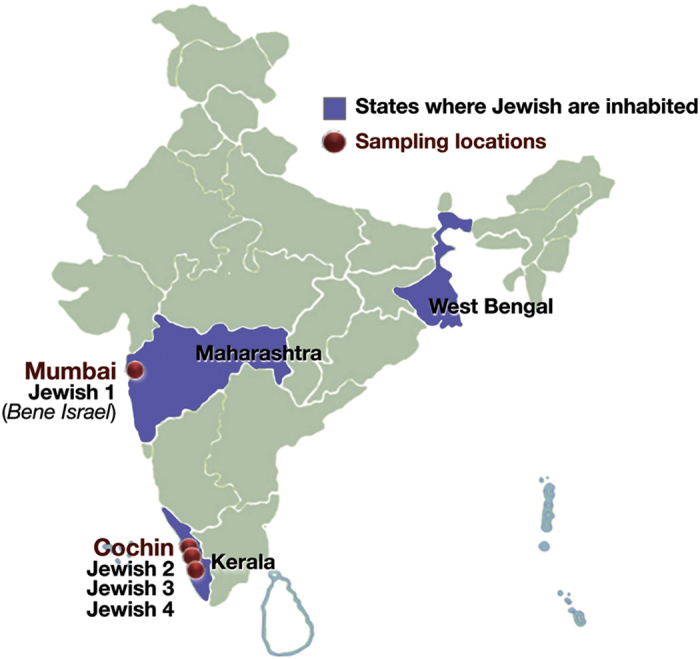
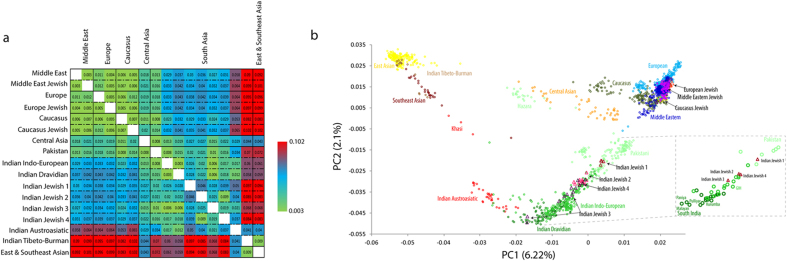
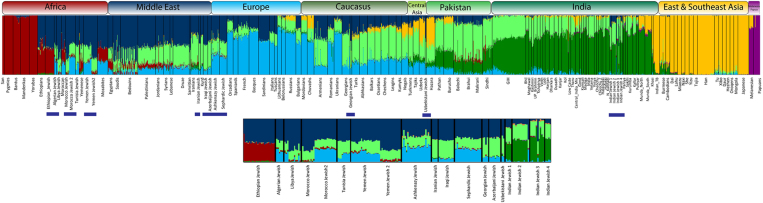
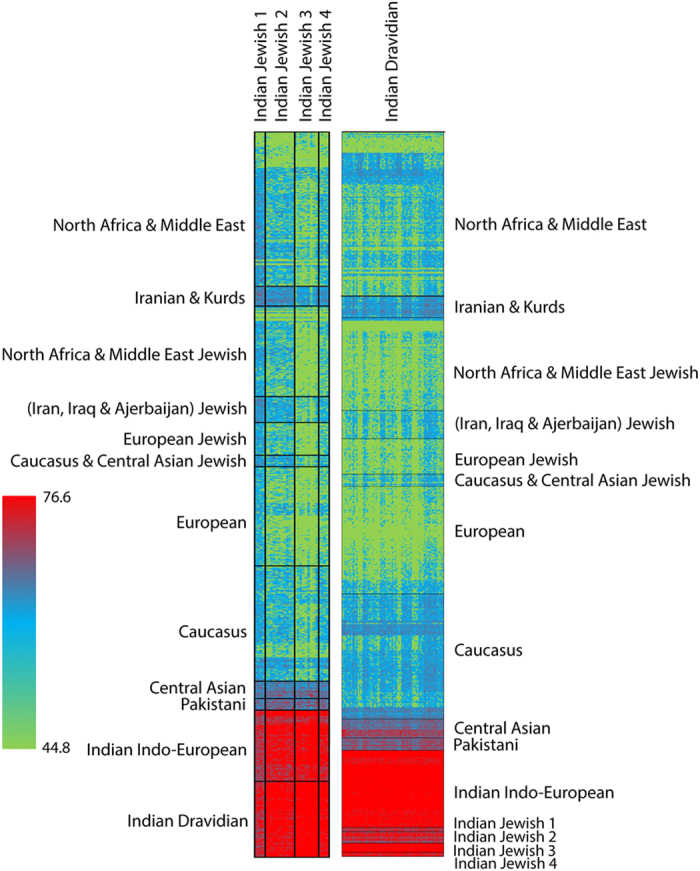
Verification
Claims the paper makes
The claims and statistics of this paper haven’t been checked yet.
Run the check — free, no account needed. It reads the open-access text and checks the sources it cites.
Claims other papers make about this one
Each is checked against this paper’s own text: does it say what the citing paper says it does?
In the citing paper
“Previous Y-chromosome studies showed that haplogroups J, R and Q3a1 had certain proportions in Jewish populations and spread over Europe (Nogueiro et al. 2010; Chaubey et al. 2016; Balanovsky et al. 2017).”
From Dispersals of the Siberian Y-chromosome haplogroup Q in Eurasia (2018) · cites this paper as Chaubey et al. 2016
Self-check
Percentages, sums and reported differences re-computed from the paper’s own numbers.
The self-check needs the paper’s full text.
Citations
Cites
Updated comprehensive phylogenetic tree of global human mitochondrial DNA variation
van Oven, M., & Kayser, M. (2009) · Human Mutation · doi:10.1002/humu.20921 · Cited by 1,810
Reconstructing Indian population history
Reich, D., Thangaraj, K., Patterson, N., Price, A. L., & Singh, L. (2009) · Nature · doi:10.1038/nature08365 · Cited by 1,674
Self-citationInference of Population Structure using Dense Haplotype Data
Lawson, D. J., Hellenthal, G., Myers, S., & Falush, D. (2012) · PLoS Genetics · doi:10.1371/journal.pgen.1002453 · Cited by 1,188
Genetic Evidence for Recent Population Mixture in India
Moorjani, P., Thangaraj, K., Patterson, N., Lipson, M., Loh, P.-R., Govindaraj, P., Berger, B., Reich, D., & Singh, L. (2013) · The American Journal of Human Genetics · doi:10.1016/j.ajhg.2013.07.006 · Cited by 350
Self-citationAtzmon, G., Hao, L., Pe'er, I., Velez, C., Pearlman, A., Palamara, P. F., Morrow, B., Friedman, E., Oddoux, C., Burns, E., et al. (2010) · The American Journal of Human Genetics · doi:10.1016/j.ajhg.2010.04.015 · Cited by 260
Carmi, S., Hui, K. Y., Kochav, E., Liu, X., Xue, J., Grady, F., Guha, S., Upadhyay, K., Ben-Avraham, D., Mukherjee, S., et al. (2014) · Nature Communications · doi:10.1038/ncomms5835 · Cited by 188
Research works printed but not linked: 33
- Ehrlich, M. A. Encyclopedia of the Jewish Diaspora (ABC-CLIO, 2009). · DOI
- Katz, N. Who Are the Jews of India? (Univ of California Press, 2000). · DOI
- Behar, D. M. et al. The matrilineal ancestry of Ashkenazi Jewry: portrait of a recent founder event. Am J Hum Genet. 78, 487–497 (2006). · DOI
- Sutton, W. K. et al. Toward resolution of the debate regarding purported crypto-Jews in a Spanish-American population: evidence from the Y chromosome. Ann Hum Biol. 33, 100–111 (2006). · DOI
- Feder, J., Ovadia, O., Glaser, B. & Mishmar, D. Ashkenazi Jewish mtDNA haplogroup distribution varies among distinct subpopulations: lessons of population substructure in a closed group. Eur J Hum Genet. 15, 498–500 (2007). · DOI
- Behar, D. M. et al. The genome-wide structure of the Jewish people. Nature. 466, 238–242 (2010). · DOI
- Moorjani, P. et al. The history of african gene flow into southern europeans, levantines and jews. PLoS Genet. 7, e1001373 (2011). · DOI
- Campbell, C. L. et al. North African Jewish and non-Jewish populations form distinctive, orthogonal clusters. Proc Natl Acad Sci USA. 109, 13865–13870 (2012). · DOI
- Metspalu, M. et al. Most of the extant mtDNA boundaries in south and southwest Asia were likely shaped during the initial settlement of Eurasia by anatomically modern humans. BMC Genet. 5, 26 (2004). · DOI
- Costa, M. D. et al. A substantial prehistoric European ancestry amongst Ashkenazi maternal lineages. Nature communications. 4, 2543 (2013). · DOI
- Cohen, T. et al. Genetic studies on Cochin Jews in Israel: 1. Population data, blood groups, isoenzymes and HLA determinants. Am J Med Genet. 6, 61–73 (1980). · DOI
- Behar, D. M. et al. Counting the founders: the matrilineal genetic ancestry of the Jewish Diaspora. PLoS ONE. 3, e2062 (2008). · DOI
- Rootsi, S. et al. Phylogenetic applications of whole Y-chromosome sequences and the Near Eastern origin of Ashkenazi Levites. Nature communications. 4, 2928 (2013). · DOI
- Li, J. Z. et al. Worldwide human relationships inferred from genome-wide patterns of variation. Science. 319, 1100–1104 (2008). · DOI
- Yunusbayev, B. et al. The Caucasus as an Asymmetric Semipermeable Barrier to Ancient Human Migrations. Mol Biol Evol. 29, 359–365 (2012). · DOI
- International HapMap 3 Consortium et al. Integrating common and rare genetic variation in diverse human populations. Nature. 467, 52–58 (2010). · DOI · Paper page
- Chaubey, G. et al. Population Genetic Structure in Indian Austroasiatic speakers: The Role of Landscape Barriers and Sex-specific Admixture. Mol Biol Evol. 28, 1013–1024 (2011). · DOI
- Metspalu, M. et al. Shared and unique components of human population structure and genome-wide signals of positive selection in South Asia. Am J Hum Genet. 89, 731–744 (2011). · DOI
- Patterson, N. et al. Ancient admixture in human history. Genetics. 192, 1065–1093 (2012). · DOI · Paper page
- Loh, P. R. et al. Inferring admixture histories of human populations using linkage disequilibrium. Genetics. 193, 1233–1254 (2013). · DOI · Paper page
- Rieder, M. J., Taylor, S. L., Tobe, V. O. & Nickerson, D. A. Automating the identification of DNA variations using quality-based fluorescence re-sequencing: analysis of the human mitochondrial genome. Nucleic Acids Res. 26, 967–73 (1998). · DOI
- Andrews, R. M. et al. Reanalysis and revision of the Cambridge reference sequence for human mitochondrial DNA. Nat Genet. 23, 147 (1999). · DOI · Paper page
- Behar, D. M. et al. A “Copernican” reassessment of the human mitochondrial DNA tree from its root. The American Journal of Human Genetics. 90, 675–684 (2012). · DOI
- Karafet, T. M. et al. New binary polymorphisms reshape and increase resolution of the human Y chromosomal haplogroup tree. Genome Res. 18, 830–838 (2008). · DOI · Paper page
- Purcell, S. et al. PLINK: a tool set for whole-genome association and population-based linkage analyses. Am J Hum Genet. 81, 559–575 (2007). · DOI · Paper page
- Patterson, N., Price, A. L. & Reich, D. Population structure and eigenanalysis. PLoS Genet. 2, e190 (2006). · DOI · Paper page
- Alexander, D. H., Novembre, J. & Lange, K. Fast model-based estimation of ancestry in unrelated individuals. Genome Res. 19, 1655–1664 (2009). · DOI · Paper page
- Cockerham, C. C. & Weir, B. S. Covariances of relatives stemming from a population undergoing mixed self and random mating. Biometrics. 40, 157–164 (1984). · DOI
- Browning, S. R. & Browning, B. L. Rapid and accurate haplotype phasing and missing-data inference for whole-genome association studies by use of localized haplotype clustering. Am J Hum Genet. 81, 1084–1097 (2007). · DOI
- Thangaraj, K. et al. The influence of natural barriers in shaping the genetic structure of Maharashtra populations. PloS one. 5, e15283 (2010). · DOI
- Kivisild, T. et al. The genetic heritage of the earliest settlers persists both in Indian tribal and caste populations. Am J Hum Genet. 72, 313–332 (2003). · DOI
- Sengupta, S. et al. Polarity and temporality of high-resolution y-chromosome distributions in India identify both indigenous and exogenous expansions and reveal minor genetic influence of Central Asian pastoralists. Am J Hum Genet. 78, 202–221 (2006). · DOI · Paper page
- Trivedi, R. et al. Genetic Imprints of Pleistocene Origin of Indian Populations: A Comprehensive Phylogeographic Sketch of Indian Y-Chromosomes. Int J Hum Genet. 8, 97–118 (2008). · DOI
Cited by
Dispersals of the Siberian Y-chromosome haplogroup Q in Eurasia
Huang, Y.-Z., Pamjav, H., Flegontov, P., Stenzl, V., Wen, S.-Q., Tong, X.-Z., Wang, C.-C., Wang, L.-X., Wei, L.-H., Gao, J.-Y., et al. (2018) · Molecular Genetics and Genomics · doi:10.1007/s00438-017-1363-8 · Cited by 34
Metadata
- Authors
- Chaubey, G., Singh, M., Rai, N., Kariappa, M., Singh, K., Singh, A., Pratap Singh, D., Tamang, R., Selvi Rani, D., Reddy, A. G., Kumar Singh, V., Singh, L., & Thangaraj, K.
- Venue
- Scientific Reports
- Published
- 2016-01-13
- Volume
- 6
- Issue
- 1
- ISSN
- 2045-2322
- PMC
- PMC4725824
- Cited by
- 19
- References
- 6
- Language
- en
- Update notices
- correction (2016-05-23)
About these checks
Registry, retraction, Cites and statistics results are computed, not judged, with one exception: a printed reference that no index lists is read once by a model before it counts as a citation error. Claims are extracted by a model and kept only when their quote appears verbatim in the text; each cited source is then checked, with a model’s help, for whether it says what the claim relies on. Those verdicts can be wrong — read the claim’s quote and the cited source before relying on one.
Statistics and arithmetic are recomputed, not judged.
Confidence bands are shown only for fields calibrated on our annotated test set. None is calibrated yet, so no band is shown.
What counts as a claim ›How we measure confidence ›How we check this ›
Are you an author, or do you see a problem with this page? Request a review
