

Food supply confers calcifiers resistance to ocean acidification
Open accessThe DOI matches its Crossref record; 55 of the 55 references it cites were found in a registry or an index.
Abstract
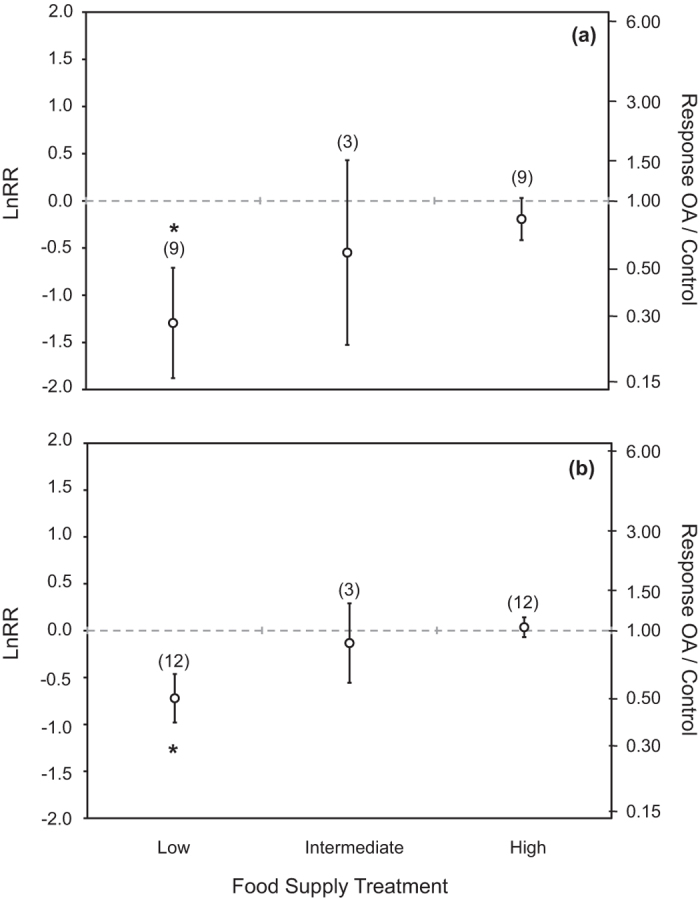
Invasion of ocean surface waters by anthropogenic CO 2 emitted to the atmosphere is expected to reduce surface seawater pH to 7.8 by the end of this century compromising marine calcifiers. A broad range of biological and mineralogical mechanisms allow marine calcifiers to cope with ocean acidification, however these mechanisms are energetically demanding which affect other biological processes (trade-offs) with important implications for the resilience of the organisms against stressful conditions. Hence, food availability may play a critical role in determining the resistance of calcifiers to OA. Here we show, based on a meta-analysis of existing experimental results assessing the role of food supply in the response of organisms to OA, that food supply consistently confers calcifiers resistance to ocean acidification.
Overview
The claims and statistics of this paper haven’t been checked yet.
Free: it reads the open-access text and checks the first 5 claims that cite a source we can check. Create a free account to check every claim.
Integrity signals
Registry
Cites
Statistics
Figures
Verification
Claims the paper makes
The claims and statistics of this paper haven’t been checked yet.
Free: it reads the open-access text and checks the first 5 claims that cite a source we can check. Create a free account to check every claim.
Claims other papers make about this one
Each is checked against this paper’s own text: does it say what the citing paper says it does?
The source backs part of the claim, not all of it — or backs it for a different population, condition or comparison.
In the citing paper
“Marine organisms are often more susceptible to ocean acidification when food is limited (Thomsen et al., 2013;Pansch et al., 2014;Ramajo et al., 2016;Gobler et al., 2018).”
From Harmful algal blooms: A climate change co-stressor in marine and freshwater ecosystems (2020) · cites this paper as Ramajo et al., 2016
Experimental — accuracy not yet measured
Self-check
Percentages, sums and reported differences re-computed from the paper’s own numbers.
The self-check needs the paper’s full text.
Citations
Cites
(2014) · Cambridge University Press eBooks · doi:10.1017/cbo9781107415379 · Cited by 11,249
Statistical Methods for Meta-Analysis
Wasserman, S., Hedges, L. V., & Olkin, I. (1988) · Journal of Educational Statistics · doi:10.2307/1164953 · Cited by 10,326
The meta-analysis of response ratios in experimental ecology
Hedges, L. V., Gurevitch, J., & Curtis, P. S. (1999) · Ecology · doi:10.1890/0012-9658(1999)080[1150:tmaorr]2.0.co;2 · Cited by 4,704
Anthropogenic carbon and ocean pH
Caldeira, K., & Wickett, M. E. (2003) · Nature · doi:10.1038/425365a · Cited by 3,549
Kroeker, K. J., Kordas, R. L., Crim, R., Hendriks, I. E., Ramajo, L., Singh, G. S., Duarte, C. M., & Gattuso, J. (2013) · Global Change Biology · doi:10.1111/gcb.12179 · Cited by 2,298
Self-citationPrimary production required to sustain global fisheries
Pauly, D., & Christensen, V. (1995) · Nature · doi:10.1038/374255a0 · Cited by 1,888
Meta-analysis reveals negative yet variable effects of ocean acidification on marine organisms
Kroeker, K. J., Kordas, R. L., Crim, R. N., & Singh, G. G. (2010) · Ecology Letters · doi:10.1111/j.1461-0248.2010.01518.x · Cited by 1,621
An estimate of global primary production in the ocean from satellite radiometer data
Longhurst, A., Sathyendranath, S., Platt, T., & Caverhill, C. (1995) · Journal of Plankton Research · doi:10.1093/plankt/17.6.1245 · Cited by 1,480
Evidence for Upwelling of Corrosive "Acidified" Water onto the Continental Shelf
Feely, R. A., Sabine, C. L., Hernandez-Ayon, J. M., Ianson, D., & Hales, B. (2008) · Science · doi:10.1126/science.1155676 · Cited by 1,450
Global Climate Change and Intensification of Coastal Ocean Upwelling
Bakun, A. (1990) · Science · doi:10.1126/science.247.4939.198 · Cited by 1,288
Research works printed but not linked: 1
- Findlay H. S., Kendall M. A., Spicer J. I., Turley C. & Widdicombe S. Novel microcosm system for investigating the effects of elevated carbon dioxide and temperature on intertidal organisms. Aquat Biol 3, 51– 62 (2008). · DOI · Paper page
Cited by
Harmful algal blooms: A climate change co-stressor in marine and freshwater ecosystems
Griffith, A. W., & Gobler, C. J. (2020) · Harmful Algae · doi:10.1016/j.hal.2019.03.008 · Cited by 598
Changing Ocean, Marine Ecosystems, and Dependent Communities
(2022) · The Ocean and Cryosphere in a Changing Climate · doi:10.1017/9781009157964.007 · Cited by 286
Wahl, M., Schneider Covachã, S., Saderne, V., Hiebenthal, C., Müller, J. D., Pansch, C., & Sawall, Y. (2018) · Limnology and Oceanography · doi:10.1002/lno.10608 · Cited by 172
“On the other hand, the increased supply of suspended food renders calcifying filter feeders more robust to OA (e.g., Thomsen et al. 2013; Ramajo et al. 2016).”
BackgroundInfluentialOcean acidification refugia in variable environments
Kapsenberg, L., & Cyronak, T. J. (2019) · Global Change Biology · doi:10.1111/gcb.14730 · Cited by 169
Reef-building corals thrive within hot-acidified and deoxygenated waters
Camp, E. F., Nitschke, M. R., Rodolfo‐Metalpa, R., Houlbrèque, F., Gardner, S. G., Smith, D. J., Zampighi, M., & Suggett, D. J. (2017) · Scientific Reports · doi:10.1038/s41598-017-02383-y · Cited by 146
Metadata
- Authors
- Ramajo, L., Pérez-León, E., Hendriks, I. E., Marbà, N., Krause-Jensen, D., Sejr, M. K., Blicher, M. E., Lagos, N. A., Olsen, Y. S., & Duarte, C. M.
- Affiliations
- Consejo Superior de Investigaciones Científicas (ES)
- Aarhus University (DK)
- Grønlands Naturinstitut (GL)
- Universidad Santo Tomás (CL)
- The University of Western Australia (AU)
- Corresponding author
- Ramajo, Laura
- ORCID
- Venue
- Scientific Reports
- Published
- 2016-01-18
- Volume
- 6
- Issue
- 1
- Pages
- 19374-19374
- ISSN
- 2045-2322 (ISSN-L)
- PMC
- PMC4726000
- OpenAlex
- W2413757367
- Cited by
- 161
- References
- 55
- Citations by year
- 2026: 6 · 2025: 16 · 2024: 13 · 2023: 17 · 2022: 11 · 2021: 15 · 2020: 21 · 2019: 21 · 2018: 18 · 2017: 14 · 2016: 9
- FWCI
- 16.75
- Type
- journal article
- Language
- en
- Open access
- gold
- doi.org
- Licence
- cc-by
- creativecommons.org/licenses/by/4.0 (tdm)
- creativecommons.org/licenses/by/4.0 (vor)
- Locations
- Scientific Reports (publishedVersion, cc-by)
- PubMed Central (publishedVersion, cc-by)
- PubMed (publishedVersion)
- UWA Profiles and Research Repository (UWA) (submittedVersion, cc-by)
- DIGITAL.CSIC (Spanish National Research Council (CSIC)) (submittedVersion, cc-by)
- Scopus (Elsevier) (submittedVersion)
- King Abdullah University of Science and Technology Repository (King Abdullah University of Science and Technology) (submittedVersion, cc-by)
- Funders
- Ministerio de Economía y Competitividad (CTM2012-32603)
- Miljøstyrelsen
- Comisión Nacional de Investigación Científica y Tecnológica
- Topics
- Physical Sciences › Earth and Planetary Sciences › Oceanography › Ocean Acidification Effects and Responses
- Physical Sciences › Materials Science › Biomaterials › Calcium Carbonate Crystallization and Inhibition
- Physical Sciences › Environmental Science › Ecology › Coral and Marine Ecosystems Studies
- Keywords
- ocean acidification, marine calcifiers, food supply, trade-offs, energetic cost, calcification, anthropogenic CO2, seawater pH
- MeSH terms
- Food Supply, Hydrogen-Ion Concentration, Oceans and Seas, Seawater, Physical Phenomena, Aquatic Organisms
About these checks
Registry, retraction, Cites and statistics results are computed, not judged, with one exception: a printed reference that no index lists is read once by a model before it counts as a citation error. Claims are extracted by a model and kept only when their quote appears verbatim in the text; each cited source is then checked, with a model’s help, for whether it says what the claim relies on. Those verdicts can be wrong — read the claim’s quote and the cited source before relying on one.
Statistics and arithmetic are recomputed, not judged.
Confidence bands are shown only for fields calibrated on our annotated test set. None is calibrated yet, so no band is shown.
What counts as a claim ›How we measure confidence ›How we check this ›
Are you an author, or do you see a problem with this page? Request a review
How to cite
Cite CoChat for the checks on this page, and the paper for its own findings.
- This page
- CoChat. (2026). Citation check: Food supply confers calcifiers resistance to ocean acidification. https://app.cochat.ai/papers/10.1038/srep19374
- The paper
- Ramajo, L., Pérez-León, E., Hendriks, I. E., Marbà, N., Krause-Jensen, D., Sejr, M. K., Blicher, M. E., Lagos, N. A., Olsen, Y. S., & Duarte, C. M. (2016). Food supply confers calcifiers resistance to ocean acidification. Scientific Reports. https://doi.org/10.1038/srep19374
Data sources
Bibliographic data: Semantic Scholar, OpenAlex, Crossref.
Contains information from the Semantic Scholar Academic Graph Datasets, made available under the ODC Attribution License (ODC-BY 1.0).
Semantic Scholar’s data is described in: Kinney, R., et al. (2023). The Semantic Scholar Open Data Platform. arXiv:2301.10140.
