

Food supply confers calcifiers resistance to ocean acidification
Open accessThe DOI matches its Crossref record; 55 of the 55 references it cites were found in a registry or an index.
Abstract
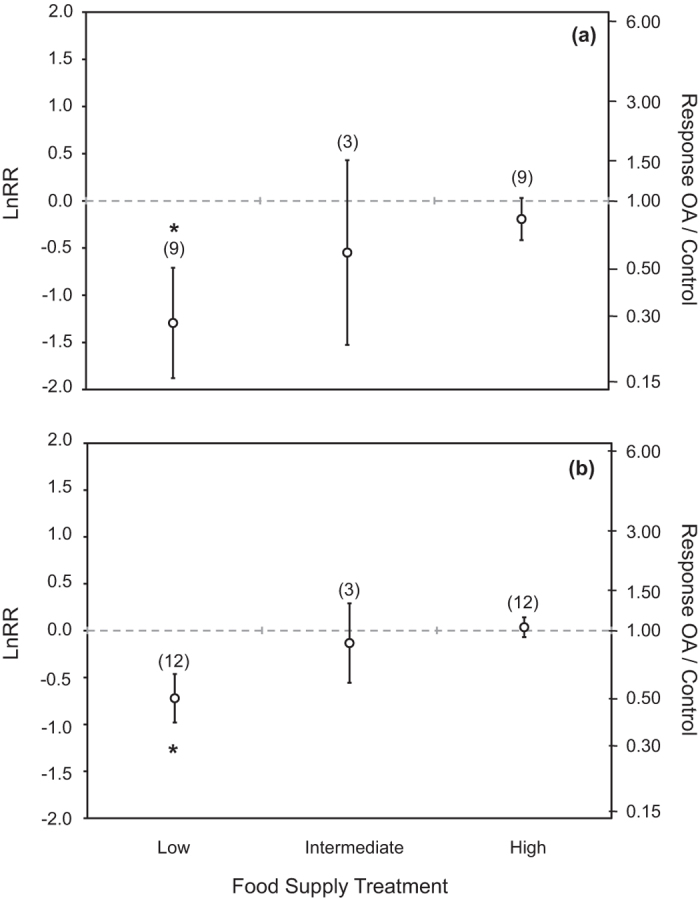
Invasion of ocean surface waters by anthropogenic CO 2 emitted to the atmosphere is expected to reduce surface seawater pH to 7.8 by the end of this century compromising marine calcifiers. A broad range of biological and mineralogical mechanisms allow marine calcifiers to cope with ocean acidification, however these mechanisms are energetically demanding which affect other biological processes (trade-offs) with important implications for the resilience of the organisms against stressful conditions. Hence, food availability may play a critical role in determining the resistance of calcifiers to OA. Here we show, based on a meta-analysis of existing experimental results assessing the role of food supply in the response of organisms to OA, that food supply consistently confers calcifiers resistance to ocean acidification.
Overview
The claims and statistics of this paper haven’t been checked yet.
Free: it reads the open-access text and checks the first 5 claims that cite a source we can check. Create a free account to check every claim.
Integrity signals
Registry
Cites
Statistics
Figures
Verification
Claims the paper makes
The claims and statistics of this paper haven’t been checked yet.
Free: it reads the open-access text and checks the first 5 claims that cite a source we can check. Create a free account to check every claim.
Claims other papers make about this one
Each is checked against this paper’s own text: does it say what the citing paper says it does?
The source backs part of the claim, not all of it — or backs it for a different population, condition or comparison.
In the citing paper
“Marine organisms are often more susceptible to ocean acidification when food is limited (Thomsen et al., 2013;Pansch et al., 2014;Ramajo et al., 2016;Gobler et al., 2018).”
From Harmful algal blooms: A climate change co-stressor in marine and freshwater ecosystems (2020) · cites this paper as Ramajo et al., 2016
Experimental — accuracy not yet measured
Self-check
Percentages, sums and reported differences re-computed from the paper’s own numbers.
The self-check needs the paper’s full text.
Citations
Cites
(2014) · Cambridge University Press eBooks · doi:10.1017/cbo9781107415379 · Cited by 11,249
Statistical Methods for Meta-Analysis
Wasserman, S., Hedges, L. V., & Olkin, I. (1988) · Journal of Educational Statistics · doi:10.2307/1164953 · Cited by 10,326
The meta-analysis of response ratios in experimental ecology
Hedges, L. V., Gurevitch, J., & Curtis, P. S. (1999) · Ecology · doi:10.1890/0012-9658(1999)080[1150:tmaorr]2.0.co;2 · Cited by 4,704
Anthropogenic carbon and ocean pH
Caldeira, K., & Wickett, M. E. (2003) · Nature · doi:10.1038/425365a · Cited by 3,549
Kroeker, K. J., Kordas, R. L., Crim, R., Hendriks, I. E., Ramajo, L., Singh, G. S., Duarte, C. M., & Gattuso, J. (2013) · Global Change Biology · doi:10.1111/gcb.12179 · Cited by 2,298
Self-citationPrimary production required to sustain global fisheries
Pauly, D., & Christensen, V. (1995) · Nature · doi:10.1038/374255a0 · Cited by 1,888
Meta-analysis reveals negative yet variable effects of ocean acidification on marine organisms
Kroeker, K. J., Kordas, R. L., Crim, R. N., & Singh, G. G. (2010) · Ecology Letters · doi:10.1111/j.1461-0248.2010.01518.x · Cited by 1,621
An estimate of global primary production in the ocean from satellite radiometer data
Longhurst, A., Sathyendranath, S., Platt, T., & Caverhill, C. (1995) · Journal of Plankton Research · doi:10.1093/plankt/17.6.1245 · Cited by 1,480
Evidence for Upwelling of Corrosive "Acidified" Water onto the Continental Shelf
Feely, R. A., Sabine, C. L., Hernandez-Ayon, J. M., Ianson, D., & Hales, B. (2008) · Science · doi:10.1126/science.1155676 · Cited by 1,450
Global Climate Change and Intensification of Coastal Ocean Upwelling
Bakun, A. (1990) · Science · doi:10.1126/science.247.4939.198 · Cited by 1,288
Guide to best practices for ocean acidification research and data reporting
Riebesell, U., Fabry, V. J., Hansson, L., & Gattuso, J. (2011) · Helmholtz Centre for Ocean Research Kiel (GEOMAR) · doi:10.2777/66906 · Cited by 899
Control and Design Principles in Biological Mineralization
Addadi, L., & Weiner, S. (1992) · Angewandte Chemie International Edition in English · doi:10.1002/anie.199201531 · Cited by 890
Is Ocean Acidification an Open-Ocean Syndrome? Understanding Anthropogenic Impacts on Seawater pH
Duarte, C. M., Hendriks, I. E., Moore, T. S., Olsen, Y. S., Steckbauer, A., Ramajo, L., Carstensen, J., Trotter, J. A., & McCulloch, M. (2013) · Estuaries and Coasts · doi:10.1007/s12237-013-9594-3 · Cited by 725
Self-citationOcean acidification may increase calcification rates, but at a cost
Wood, H. L., Spicer, J. I., & Widdicombe, S. (2008) · Proceedings of the Royal Society B: Biological Sciences · doi:10.1098/rspb.2008.0343 · Cited by 612
Warming up, turning sour, losing breath: ocean biogeochemistry under global change
Gruber, N. (2011) · Philosophical Transactions of the Royal Society A: Mathematical, Physical and Engineering Sciences · doi:10.1098/rsta.2011.0003 · Cited by 588
Coral resilience to ocean acidification and global warming through pH up-regulation
McCulloch, M., Falter, J., Trotter, J., & Montagna, P. (2012) · Nature Climate Change · doi:10.1038/nclimate1473 · Cited by 584
Harvey, B. P., Gwynn‐Jones, D., & Moore, P. J. (2013) · Ecology and Evolution · doi:10.1002/ece3.516 · Cited by 515
Saturation-state sensitivity of marine bivalve larvae to ocean acidification
Waldbusser, G. G., Hales, B., Langdon, C. J., Haley, B. A., Schrader, P., Brunner, E. L., Gray, M. W., Miller, C. A., & Gimenez, I. (2015) · Nature Climate Change · doi:10.1038/nclimate2479 · Cited by 474
Coral and mollusc resistance to ocean acidification adversely affected by warming
Rodolfo-Metalpa, R., Houlbrèque, F., Tambutté, É., Boisson, F., Baggini, C., Patti, F. P., Jeffree, R., Fine, M., Foggo, A., Gattuso, J.-P., et al. (2011) · Nature Climate Change · doi:10.1038/nclimate1200 · Cited by 471
Vulnerability of marine biodiversity to ocean acidification: A meta-analysis
Hendriks, I. E., Duarte, C. M., & Álvarez, M. (2010) · Estuarine, Coastal and Shelf Science · doi:10.1016/j.ecss.2009.11.022 · Cited by 465
Self-citationThomsen, J., Casties, I., Pansch, C., Körtzinger, A., & Melzner, F. (2013) · Global Change Biology · doi:10.1111/gcb.12109 · Cited by 446
Geochemical Perspectives on Coral Mineralization
Cohen, A. L. (2003) · Reviews in Mineralogy and Geochemistry · doi:10.2113/0540151 · Cited by 422
Waldbusser, G. G., & Salisbury, J. E. (2014) · Annual Review of Marine Science · doi:10.1146/annurev-marine-121211-172238 · Cited by 390
Biomineralisation in reef-building corals: from molecular mechanisms to environmental control
Allemand, D., Ferrier-Pagès, C., Furla, P., Houlbrèque, F., Puverel, S., Reynaud, S., Tambutté, É., Tambutté, S., & Zoccola, D. (2004) · Comptes Rendus Palevol · doi:10.1016/j.crpv.2004.07.011 · Cited by 386
Predicting the Response of Molluscs to the Impact of Ocean Acidification
Parker, L., Ross, P., O'Connor, W., Pörtner, H., Scanes, E., & Wright, J. (2013) · Biology · doi:10.3390/biology2020651 · Cited by 365
Calcification in marine molluscs: how costly is it?
Palmer, A. R. (1992) · Proceedings of the National Academy of Sciences · doi:10.1073/pnas.89.4.1379 · Cited by 364
(2011) · Oxford University Press eBooks · doi:10.1093/oso/9780199591091.001.0001 · Cited by 351
Experimental ocean acidification alters the allocation of metabolic energy
Pan, T.-C. F., Applebaum, S. L., & Manahan, D. T. (2015) · Proceedings of the National Academy of Sciences · doi:10.1073/pnas.1416967112 · Cited by 337
Paine, R. T. (1971) · Ecology · doi:10.2307/1933819 · Cited by 307
Coastal upwelling, primary production and mussel growth in the Rías Baixas of Galicia
Figueiras, F. G., Labarta, U., & Fernández Reiriz, M. J. (2002) · Hydrobiologia · doi:10.1023/a:1021309222459 · Cited by 292
Role of molecular charge and hydrophilicity in regulating the kinetics of crystal growth
Elhadj, S., De Yoreo, J. J., Hoyer, J. R., & Dove, P. M. (2006) · Proceedings of the National Academy of Sciences · doi:10.1073/pnas.0605748103 · Cited by 270
Lischka, S., Büdenbender, J., Boxhammer, T., & Riebesell, U. (2011) · Biogeosciences · doi:10.5194/bg-8-919-2011 · Cited by 232
Waldbusser, G. G., Brunner, E. L., Haley, B. A., Hales, B., Langdon, C. J., & Prahl, F. G. (2013) · Geophysical Research Letters · doi:10.1002/grl.50449 · Cited by 227
Fortier, M., Fortier, L., Michel, C., & Legendre, L. (2002) · Marine Ecology Progress Series · doi:10.3354/meps225001 · Cited by 201
Calosi, P., Rastrick, S. P. S., Lombardi, C., de Guzman, H. J., Davidson, L., Jahnke, M., Giangrande, A., Hardege, J. D., Schulze, A., Spicer, J. I., et al. (2013) · Philosophical Transactions of the Royal Society B: Biological Sciences · doi:10.1098/rstb.2012.0444 · Cited by 199
Direct effects of CO2 concentration on growth and isotopic composition of marine plankton
Wolf-Gladrow, D. A., Riebesell, U., Burkhardt, S., & Bijma, J. (1999) · Tellus B: Chemical and Physical Meteorology · doi:10.3402/tellusb.v51i2.16324 · Cited by 197
Slagstad, D., Ellingsen, I. H., & Wassmann, P. (2011) · Progress in Oceanography · doi:10.1016/j.pocean.2011.02.009 · Cited by 193
Dissolution mortality of juvenile bivalves in coastal marine deposits
Green, M. A., Jones, M. E., Boudreau, C. L., Moore, R. L., & Westman, B. A. (2004) · Limnology and Oceanography · doi:10.4319/lo.2004.49.3.0727 · Cited by 186
Response of the Arctic Pteropod Limacina helicina to Projected Future Environmental Conditions
Comeau, S., Jeffree, R., Teyssié, J.-L., & Gattuso, J.-P. (2010) · PLoS ONE · doi:10.1371/journal.pone.0011362 · Cited by 172
ENVIRONMENTAL AND BIOLOGICAL CONTROLS ON BIVALVE SHELL MINERALOGY
KENNEDY, W. J., TAYLOR, J. D., & HALL, A. (1969) · Biological Reviews · doi:10.1111/j.1469-185x.1969.tb00610.x · Cited by 164
Palmer, A. R. (1983) · Marine Biology · doi:10.1007/bf00406014 · Cited by 154
Biological mechanisms supporting adaptation to ocean acidification in coastal ecosystems
Hendriks, I. E., Duarte, C. M., Olsen, Y. S., Steckbauer, A., Ramajo, L., Moore, T. S., Trotter, J., & McCulloch, M. T. (2014) · Estuarine Coastal and Shelf Science · doi:10.1016/j.ecss.2014.07.019 · Cited by 150
Self-citationJURY, C. P., WHITEHEAD, R. F., & SZMANT, A. M. (2010) · Global Change Biology · doi:10.1111/j.1365-2486.2009.02057.x · Cited by 149
Tolerance of juvenile Mytilus galloprovincialis to experimental seawater acidification
Fernández-Reiriz, M., Range, P., Álvarez–Salgado, X. A., Espinosa, J., & Labarta, U. (2012) · Marine Ecology Progress Series · doi:10.3354/meps09660 · Cited by 121
Synergistic effects of ocean acidification and warming on overwintering pteropods in the Arctic
Lischka, S., & Riebesell, U. (2012) · Global Change Biology · doi:10.1111/gcb.12020 · Cited by 116
Extreme climatic events reduce ocean productivity and larval supply in a tropical reef ecosystem
Lo-Yat, A., Simpson, S. D., Meekan, M. G., Lecchini, D., Martinez, É., & Galzin, R. (2010) · Global Change Biology · doi:10.1111/j.1365-2486.2010.02355.x · Cited by 116
de Putron, S. J., McCorkle, D. C., Cohen, A. L., & Dillon, A. B. (2010) · Coral Reefs · doi:10.1007/s00338-010-0697-z · Cited by 113
Reconsidering the role of carbonate ion concentration in calcification by marine organisms
Bach, L. T. (2015) · Biogeosciences · doi:10.5194/bg-12-4939-2015 · Cited by 100
Heinemann, A., Fietzke, J., Melzner, F., Böhm, F., Thomsen, J., Garbe‐Schönberg, D., & Eisenhauer, A. (2012) · Geochemistry Geophysics Geosystems · doi:10.1029/2011gc003790 · Cited by 80
Findlay, H., Kendall, M., Spicer, J., Turley, C., & Widdicombe, S. (2008) · Aquatic Biology · doi:10.3354/ab00061 · Cited by 76
Ocean acidification: Separating evidence from judgment – A reply to Dupont et al.
Hendriks, I. E., & Duarte, C. M. (2010) · Estuarine Coastal and Shelf Science · doi:10.1016/j.ecss.2010.06.007 · Cited by 39
Self-citationWood, H. L., Widdicombe, S., & Spicer, J. I. (2009) · Biogeosciences · doi:10.5194/bg-6-2015-2009 · Cited by 38
Ramajo, L., Rodríguez‐Navarro, A. B., Duarte, C. M., Lardies, M. A., & Lagos, N. A. (2015) · Marine and Freshwater Research · doi:10.1071/mf14232 · Cited by 33
Self-citationOlsson, L., Chadee, D. D., Hoegh‐Guldberg, O., Oppenheimer, M., Porter, J. R., Pörtner, H.-O., Satterthwaite, D., Smith, K. R., Travasso, M. I., & Tschakert, P. (2014) · Lund University Publications (Lund University) · Cited by 29
45Calcium uptake and dissolution in the shell of Scrobicularia plana (da Costa)
Akberali, H. B. (1980) · Journal of Experimental Marine Biology and Ecology · doi:10.1016/0022-0981(80)90143-4 · Cited by 23
Research works printed but not linked: 1
- Findlay H. S., Kendall M. A., Spicer J. I., Turley C. & Widdicombe S. Novel microcosm system for investigating the effects of elevated carbon dioxide and temperature on intertidal organisms. Aquat Biol 3, 51– 62 (2008). · DOI · Paper page
Cited by
Harmful algal blooms: A climate change co-stressor in marine and freshwater ecosystems
Griffith, A. W., & Gobler, C. J. (2020) · Harmful Algae · doi:10.1016/j.hal.2019.03.008 · Cited by 598
Changing Ocean, Marine Ecosystems, and Dependent Communities
(2022) · The Ocean and Cryosphere in a Changing Climate · doi:10.1017/9781009157964.007 · Cited by 286
Wahl, M., Schneider Covachã, S., Saderne, V., Hiebenthal, C., Müller, J. D., Pansch, C., & Sawall, Y. (2018) · Limnology and Oceanography · doi:10.1002/lno.10608 · Cited by 172
“On the other hand, the increased supply of suspended food renders calcifying filter feeders more robust to OA (e.g., Thomsen et al. 2013; Ramajo et al. 2016).”
BackgroundInfluentialOcean acidification refugia in variable environments
Kapsenberg, L., & Cyronak, T. J. (2019) · Global Change Biology · doi:10.1111/gcb.14730 · Cited by 171
Reef-building corals thrive within hot-acidified and deoxygenated waters
Camp, E. F., Nitschke, M. R., Rodolfo‐Metalpa, R., Houlbrèque, F., Gardner, S. G., Smith, D. J., Zampighi, M., & Suggett, D. J. (2017) · Scientific Reports · doi:10.1038/s41598-017-02383-y · Cited by 146
Metadata
- Authors
- Ramajo, L., Pérez-León, E., Hendriks, I. E., Marbà, N., Krause-Jensen, D., Sejr, M. K., Blicher, M. E., Lagos, N. A., Olsen, Y. S., & Duarte, C. M.
- Affiliations
- Consejo Superior de Investigaciones Científicas (ES)
- Aarhus University (DK)
- Grønlands Naturinstitut (GL)
- Universidad Santo Tomás (CL)
- The University of Western Australia (AU)
- Corresponding author
- Ramajo, Laura
- ORCID
- Venue
- Scientific Reports
- Published
- 2016-01-18
- Volume
- 6
- Issue
- 1
- Pages
- 19374-19374
- ISSN
- 2045-2322 (ISSN-L)
- PMC
- PMC4726000
- OpenAlex
- W2413757367
- Semantic Scholar
- dabe0b9adf7db6b0edff33c69f586ee2a42c9f76
- Cited by
- 161
- References
- 55
- Citations by year
- 2026: 6 · 2025: 16 · 2024: 13 · 2023: 17 · 2022: 11 · 2021: 15 · 2020: 21 · 2019: 21 · 2018: 18 · 2017: 14 · 2016: 9
- FWCI
- 16.75
- Type
- journal article
- Language
- en
- Open access
- gold
- doi.org
- Licence
- cc-by
- creativecommons.org/licenses/by/4.0 (tdm)
- creativecommons.org/licenses/by/4.0 (vor)
- Locations
- Scientific Reports (publishedVersion, cc-by)
- PubMed Central (publishedVersion, cc-by)
- PubMed (publishedVersion)
- UWA Profiles and Research Repository (UWA) (submittedVersion, cc-by)
- DIGITAL.CSIC (Spanish National Research Council (CSIC)) (submittedVersion, cc-by)
- Scopus (Elsevier) (submittedVersion)
- King Abdullah University of Science and Technology Repository (King Abdullah University of Science and Technology) (submittedVersion, cc-by)
- Funders
- Ministerio de Economía y Competitividad (CTM2012-32603)
- Miljøstyrelsen
- Comisión Nacional de Investigación Científica y Tecnológica
- Topics
- Physical Sciences › Earth and Planetary Sciences › Oceanography › Ocean Acidification Effects and Responses
- Physical Sciences › Materials Science › Biomaterials › Calcium Carbonate Crystallization and Inhibition
- Physical Sciences › Environmental Science › Ecology › Coral and Marine Ecosystems Studies
- Keywords
- ocean acidification, marine calcifiers, food supply, trade-offs, energetic cost, calcification, anthropogenic CO2, seawater pH
- MeSH terms
- Food Supply, Hydrogen-Ion Concentration, Oceans and Seas, Seawater, Physical Phenomena, Aquatic Organisms
About these checks
Registry, retraction, Cites and statistics results are computed, not judged, with one exception: a printed reference that no index lists is read once by a model before it counts as a citation error. Claims are extracted by a model and kept only when their quote appears verbatim in the text; each cited source is then checked, with a model’s help, for whether it says what the claim relies on. Those verdicts can be wrong — read the claim’s quote and the cited source before relying on one.
Statistics and arithmetic are recomputed, not judged.
Confidence bands are shown only for fields calibrated on our annotated test set. None is calibrated yet, so no band is shown.
What counts as a claim ›How we measure confidence ›How we check this ›
Are you an author, or do you see a problem with this page? Request a review
Data sources
Bibliographic data: Semantic Scholar, OpenAlex, Crossref.
Contains information from the Semantic Scholar Academic Graph Datasets, made available under the ODC Attribution License (ODC-BY 1.0).
Semantic Scholar’s data is described in: Kinney, R., et al. (2023). The Semantic Scholar Open Data Platform. arXiv:2301.10140.
