

Food supply confers calcifiers resistance to ocean acidification
Open accessThe DOI matches its Crossref record; 55 of the 55 references it cites were found in a registry or an index.
Abstract
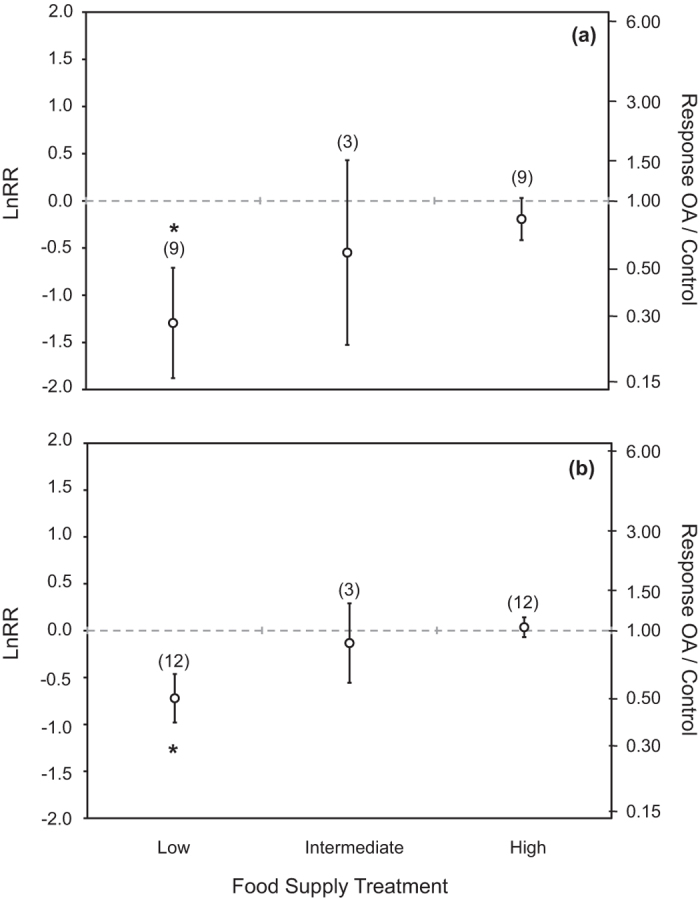
Invasion of ocean surface waters by anthropogenic CO 2 emitted to the atmosphere is expected to reduce surface seawater pH to 7.8 by the end of this century compromising marine calcifiers. A broad range of biological and mineralogical mechanisms allow marine calcifiers to cope with ocean acidification, however these mechanisms are energetically demanding which affect other biological processes (trade-offs) with important implications for the resilience of the organisms against stressful conditions. Hence, food availability may play a critical role in determining the resistance of calcifiers to OA. Here we show, based on a meta-analysis of existing experimental results assessing the role of food supply in the response of organisms to OA, that food supply consistently confers calcifiers resistance to ocean acidification.
Overview
The claims and statistics of this paper haven’t been checked yet.
Free: it reads the open-access text and checks the first 5 claims that cite a source we can check. Create a free account to check every claim.
Integrity signals
Registry
Cites
Statistics
Figures
Verification
Claims the paper makes
The claims and statistics of this paper haven’t been checked yet.
Free: it reads the open-access text and checks the first 5 claims that cite a source we can check. Create a free account to check every claim.
Claims other papers make about this one
Each is checked against this paper’s own text: does it say what the citing paper says it does?
The source backs part of the claim, not all of it — or backs it for a different population, condition or comparison.
In the citing paper
“Marine organisms are often more susceptible to ocean acidification when food is limited (Thomsen et al., 2013;Pansch et al., 2014;Ramajo et al., 2016;Gobler et al., 2018).”
From Harmful algal blooms: A climate change co-stressor in marine and freshwater ecosystems (2020) · cites this paper as Ramajo et al., 2016
Experimental — accuracy not yet measured
Self-check
Percentages, sums and reported differences re-computed from the paper’s own numbers.
The self-check needs the paper’s full text.
Citations
Cites
(2014) · Cambridge University Press eBooks · doi:10.1017/cbo9781107415379 · Cited by 11,249
Statistical Methods for Meta-Analysis
Wasserman, S., Hedges, L. V., & Olkin, I. (1988) · Journal of Educational Statistics · doi:10.2307/1164953 · Cited by 10,326
The meta-analysis of response ratios in experimental ecology
Hedges, L. V., Gurevitch, J., & Curtis, P. S. (1999) · Ecology · doi:10.1890/0012-9658(1999)080[1150:tmaorr]2.0.co;2 · Cited by 4,704
Anthropogenic carbon and ocean pH
Caldeira, K., & Wickett, M. E. (2003) · Nature · doi:10.1038/425365a · Cited by 3,549
Kroeker, K. J., Kordas, R. L., Crim, R., Hendriks, I. E., Ramajo, L., Singh, G. S., Duarte, C. M., & Gattuso, J. (2013) · Global Change Biology · doi:10.1111/gcb.12179 · Cited by 2,298
Self-citationPrimary production required to sustain global fisheries
Pauly, D., & Christensen, V. (1995) · Nature · doi:10.1038/374255a0 · Cited by 1,888
Meta-analysis reveals negative yet variable effects of ocean acidification on marine organisms
Kroeker, K. J., Kordas, R. L., Crim, R. N., & Singh, G. G. (2010) · Ecology Letters · doi:10.1111/j.1461-0248.2010.01518.x · Cited by 1,621
An estimate of global primary production in the ocean from satellite radiometer data
Longhurst, A., Sathyendranath, S., Platt, T., & Caverhill, C. (1995) · Journal of Plankton Research · doi:10.1093/plankt/17.6.1245 · Cited by 1,480
Evidence for Upwelling of Corrosive "Acidified" Water onto the Continental Shelf
Feely, R. A., Sabine, C. L., Hernandez-Ayon, J. M., Ianson, D., & Hales, B. (2008) · Science · doi:10.1126/science.1155676 · Cited by 1,450
Global Climate Change and Intensification of Coastal Ocean Upwelling
Bakun, A. (1990) · Science · doi:10.1126/science.247.4939.198 · Cited by 1,288
Research works printed but not linked: 1
- Findlay H. S., Kendall M. A., Spicer J. I., Turley C. & Widdicombe S. Novel microcosm system for investigating the effects of elevated carbon dioxide and temperature on intertidal organisms. Aquat Biol 3, 51– 62 (2008). · DOI · Paper page
Cited by
Items 101–167 of 167
Phenotypic responses in fish behaviour narrow as climate ramps up
Rodríguez-Domínguez, A., Connell, S. D., Coni, E. O. C., Sasaki, M., Booth, D. J., & Nagelkerken, I. (2022) · Climatic Change · doi:10.1007/s10584-022-03341-y · Cited by 10
“The scarcity of predators at CO2 vents and the increase in food resources could have aided individuals in maintaining their physiological homeostasis (Thomsen et al. 2013; Ramajo et al. 2016; Gobler et al. 2018).”
BackgroundRobustness of Adamussium colbecki shell to ocean acidification in a short-term exposure
Dell’Acqua, O., Trębala, M., Chiantore, M., & Hannula, S. (2019) · Marine Environmental Research · doi:10.1016/j.marenvres.2019.06.010 · Cited by 9
The impacts of past, present and future ocean chemistry on predatory planktonic snails
Wall-Palmer, D., Mekkes, L., Ramos‐Silva, P., Dämmer, L. K., Goetze, E., Bakker, K., Duijm, E. J., & Peijnenburg, K. T. C. A. (2021) · Royal Society Open Science · doi:10.1098/rsos.202265 · Cited by 11
Labra, F. A., Martín, V. A. S., Jahnsen-Guzmán, N., Fernández, C., Zapata, J., García‐Huidobro, M. R., Duarte, C., García‐Herrera, C., Vivanco, J. F., Lardies, M. A., et al. (2022) · Marine Pollution Bulletin · doi:10.1016/j.marpolbul.2022.114149 · Cited by 8
Self-citationRoberts, E., & Bell, E. C. (2022) · Marine Ecology Progress Series · doi:10.3354/meps14234 · Cited by 10
Decreasing carbonate load of seagrass leaves with increasing latitude
Mazarrasa, I., Marbà, N., Krause‐Jensen, D., Kennedy, H. A., Santos, R., Lovelock, C. E., & Duarte, C. M. (2019) · Aquatic Botany · doi:10.1016/j.aquabot.2019.103147 · Cited by 8
Self-citationReed, A. J., Godbold, J. A., Solan, M., & Grange, L. J. (2021) · Frontiers in Marine Science · doi:10.3389/fmars.2021.576746 · Cited by 9
Shell dissolution rates differ fourfold between mussel species
Carlson, R. R., Lewis, M. A., Ninokawa, A. T., Saley, A. M., Hill, T. M., & Gaylord, B. (2025) · Royal Society Open Science · doi:10.1098/rsos.250664 · Cited by 8
“Food subsidies may otherwise contribute to compensatory mechanisms under ocean acidification (e.g. increasing protective membranes and accelerating calcium and proton pumps [52]).”
Pernet, F., Richard, M., Brodu, N., Villeneuve, R., Poi, C. D., Urrutti, P., Koechlin, H., & Gazeau, F. (2025) · Earth s Future · doi:10.1029/2025ef005992 · Cited by 7
Fernández, M., Duarte, C., Aldana, M., Delgado-Rioseco, J., Blanco‐Herrera, F., Varas, O., Quijón, P. A., Quintanilla-Ahumada, D., García‐Huidobro, M. R., & Pulgar, J. (2024) · Marine Environmental Research · doi:10.1016/j.marenvres.2024.106896 · Cited by 8
Self-citationMcMahon, T. E., Thatcher, D. L., Williams, B., Wanamaker, A. D., Jellison, B. M., Franklin, H., Guay, K. A., Whitney, N. M., Stewart, J., & LaVigne, M. (2024) · PLOS Climate · doi:10.1371/journal.pclm.0000509 · Cited by 7
Seagrass meadows as ocean acidification refugia for sea urchin larvae
Ravaglioli, C., Marchi, L. D., Giannessi, J., Pretti, C., & Bulleri, F. (2023) · The Science of The Total Environment · doi:10.1016/j.scitotenv.2023.167465 · Cited by 6
From Individual Calcifiers to Ecosystem Dynamics: Ocean Acidification Effects on Urchins and Abalone
deVries, M. S., Ly, N., Ebner, C., & Hallisey, R. (2024) · Integrative and Comparative Biology · doi:10.1093/icb/icae096 · Cited by 7
Piwoni‐Piórewicz, A., Strekopytov, S., Humphreys-Williams, E. R., Najorka, J., Szymczycha, B., & Kukliński, P. (2022) · Geobiology · doi:10.1111/gbi.12496 · Cited by 6
Increased temperature and acidification elevate the risk of starvation in American lobster larvae
Niemisto, M., Contreras, A., Wahle, R. A., & Fields, D. M. (2025) · ICES Journal of Marine Science · doi:10.1093/icesjms/fsaf088 · Cited by 5
Bio-enhanced mortar using scallop shell powder for sustainable marine infrastructure
Álvarez-Carrasco, F., Lagos, N. A., Leppes, N., Moscoso, F., Ávila, P., Torres, G., Lardies, M. A., Peceño, B., Morris, R. L., Vasco, D. A., et al. (2025) · Construction and Building Materials · doi:10.1016/j.conbuildmat.2025.143787 · Cited by 5
Self-citationMejias-Rivera, C. L., Armstrong, R. A., Balint, S., García-Troche, E., McKinney, R. A., Morell, J. M., Oczkowski, A., & Courtney, T. A. (2023) · Coral Reefs · doi:10.1007/s00338-023-02435-y · Cited by 5
“Adequate nutrition also appears to maintain coral growth rates under reduced pH conditions projected for near future ocean acidification (Towle et al. 2015; Ramajo et al. 2016; Courtney et al. 2017).”
BackgroundSordo, L., Esteves, E., Valente, J. F. A., Aníbal, J., Duarte, C., Alves, N., Baptista, T., & Gaspar, M. B. (2024) · Marine Environmental Research · doi:10.1016/j.marenvres.2024.106746 · Cited by 5
Self-citationSeasonality modulates coral trophic plasticity in an extreme, multi‐stressor environment
Solomon, S. L., de Goeij, J. M., Croasdale, E. M., & Schoepf, V. (2025) · Limnology and Oceanography · doi:10.1002/lno.70046 · Cited by 4
“…ocean conditions because heterotrophic plasticity can increase resilience to multiple climate change stressors, including heat stress (Grottoli et al. 2006; Tremblay et al. 2016), acidi fi cation (Drenkard et al. 2013; Ramajo et al. 2015; Towle et al. 2015), and hypoxia (Wijgerde et al. 2012).”
Schwaner, C., Farhat, S., Boutet, I., Tanguy, A., Barbosa, M., Grouzdev, D. S., Espinosa, E. P., & Allam, B. (2023) · Marine Biotechnology · doi:10.1007/s10126-023-10255-y · Cited by 6
“The velum organ and ciliary movement is important for larval feeding (Gallager 1988), and studies have shown that increased feeding can offset impacts of OA (Hettinger et al. 2013; Thomsen et al. 2013; Ramajo et al. 2016).”
Vulnerability and Resilience of Tropical Coastal Ecosystems to Ocean Acidification
Alongi, D. M. (2020) · Examines in Marine Biology & Oceanography · doi:10.31031/eimbo.2020.03.000562 · Cited by 4
Sperfeld, E., Mangor‐Jensen, A., & Dalpadado, P. (2017) · Marine Biology · doi:10.1007/s00227-017-3203-0 · Cited by 4
Clements, J. C. (2016) · bioRxiv (Cold Spring Harbor Laboratory) · doi:10.1101/066076 · Cited by 6
Body-size evolution in gastropods across the Plio-Pleistocene extinction in the western Atlantic
Anderson, B. M., Petsios, E., Behn, J. R., Betz, A., Allmon, W. D., Lieberman, B. S., & Hendricks, J. R. (2024) · PLoS ONE · doi:10.1371/journal.pone.0313060 · Cited by 3
Wang, S., Li, L., Yang, Q., Wang, W., Wang, L.-P., Zhang, S., & Zhang, G. (2025) · Environmental Pollution · doi:10.1016/j.envpol.2025.126411 · Cited by 3
Ramajo, L., Hendriks, I. E., Lagos, N. A., Krause‐Jensen, D., Marbà, N., Sejr, M. K., & Duarte, C. M. (2018) · Scientific Reports · doi:10.1038/s41598-018-27670-0 · Cited by 3
Self-citationEffects of multiple stressors on the development and performance of decapod crustaceans
Curry, A. (2020) · Cited by 3
McLaskey, A. K., & Keister, J. E. (2021) · Marine Biology · doi:10.1007/s00227-021-03845-8 · Cited by 2
Dumbauld, B. R., & McIntyre, B. F. (2023) · Aquaculture Environment Interactions · doi:10.3354/aei00466 · Cited by 2
Gurr, S. J., McFarland, K., Bernatchez, G., Dixon, M., Guy, L., Milke, L., Poach, M. E., Hart, D. R., Plough, L. V., Redman, D. H., et al. (2024) · Marine Ecology Progress Series · doi:10.3354/meps14624 · Cited by 2
Sensitivity of pteropod calcification to multi stressor variability in coastal habitats
Bednaršek, N., Pelletier, G., Kimoto, K., MacCready, P., Klinger, T., & Newton, J. A. (2024) · Marine Environmental Research · doi:10.1016/j.marenvres.2024.106868 · Cited by 2
Phenotypic responses of the giant mussel Choromytilus chorus to prolonged upwelling conditions
Martel, S. I., Leppes, N., Lagos, N. A., Vargas, C. A., & Lardies, M. A. (2025) · Aquaculture Reports · doi:10.1016/j.aqrep.2025.102680 · Cited by 2
Self-citationDixon‐Anderson, I. S., & Smith, A. M. (2025) · Biogeochemistry · doi:10.1007/s10533-025-01214-x · Cited by 1
“…salinity (Har-riss and Pilkey 1966; Richter and Bruckschen 1998), pH (Porter 2007; Ries 2011; Byrne et al. 2014; Dubois 2014), food concentration (Ramajo et al. 2016a, b), seawater Mg/Ca ratios (Ries 2004; Ries et al. 2008; Barrientos et al. 2018), aragonite saturation states (Lebrato et al.…”
Infaunal bivalves exhibit resilience to ocean acidification but remain sensitive to food supply
Antivero, M., Caballero, P., Leppes, N., & Lardies, M. A. (2025) · Frontiers in Marine Science · doi:10.3389/fmars.2025.1568035 · Cited by 1
Oswalt, H. E., Amsler, M. O., Amsler, C. D., Schram, J. B., McClintock, J. B., & Baker, P. A. (2025) · Polar Biology · doi:10.1007/s00300-025-03393-7 · Cited by 1
“One common invertebrate response to higher energy demands is increasing food intake (Saba et al. 2012; Ramajo et al. 2016).”
Ramajo, L., Rodríguez‐Navarro, A. B., Brokordt, K., Barry-Sosa, A., Jeno, K., Sola-Hidalgo, C., Valladares, M., & Inostroza, J. (2025) · Marine Environmental Research · doi:10.1016/j.marenvres.2025.107322 · Cited by 1
Self-citationWaller, A., Webb, M., Sommer, B., Byrne, M., & Foo, S. A. (2026) · Marine Environmental Research · doi:10.1016/j.marenvres.2026.108333 · Cited by 1
Schram, J. B., Hayes, H. G., Street, E., Thompson, N., Yoshioka, R. M., & Galloway, A. W. E. (2023) · Journal of Experimental Marine Biology and Ecology · doi:10.1016/j.jembe.2023.151897 · Cited by 2
“Previous studies have highlighted the role food availability has played in a reduction in or resistance to the impacts of ocean acidification conditions on physiological trade-offs, including on calcification, and metabolic rates (Pansch et al., 2014; Ramajo et al., 2016; Thomsen et al., 2013).”
BackgroundAltered temperature and restricted food supply reduce pH tolerance in both young and adult ascidians
Matikinca, P., & Robinson, T. B. (2024) · Marine Biology Research · doi:10.1080/17451000.2024.2390528 · Cited by 1
“…tolerance); (2) Unrestricted food supply would moderate the negative e ff ects of decreasing pH, resulting in lower CpH min (i.e. higher pH tolerance) (Ramajo et al. 2016b; Brown et al. 2018); (3) Together cooling and restricted food supply would amplify the e ff ect of acid-i fi cation on both…”
InfluentialLimitations and outlook of research in ecophysiology and ocean acidification in marine mollusks
Chen, Z., Shang, Y., Khan, F. U., & Wang, Y. (2024) · Elsevier eBooks · doi:10.1016/b978-0-443-15938-1.00008-8 · Cited by 1
Effects of ocean acidification on the growth and development of marine mollusks
Li, S., & Huang, J. (2024) · Elsevier eBooks · doi:10.1016/b978-0-443-15938-1.00003-9 · Cited by 2
Paredes-Molina, F. J., Chaparro, Ó. R., Navarro, J. M., Büchner‐Miranda, J. A., Salas-Yanquin, L. P., Cubillos, V. M., Jaramillo, H. N., Pechenik, J. A., Averbuj, A., & Bökenhans, V. (2024) · Marine Environmental Research · doi:10.1016/j.marenvres.2024.106855 · Cited by 1
How marine organisms cope with changing climate
Dominguez, A. R. (2020) · Adelaide Research & Scholarship (AR&S) (University of Adelaide)
The impact of climate change on larvae of oysters
Gibbs, M. C. (2020) · The Sydney eScholarship Repository (The University of Sydney)
Alongi, D. M. (2021) · Wiley eBooks · doi:10.1002/9781119568919.ch13
Cameron, L. P. (2020) · Digital Repository Service (Northeastern University) · doi:10.17760/d20361357 · Cited by 2
Cornwall, C., Comeau, S., & Harvey, B. (2023) · Earth System Dynamics · doi:10.5194/esd-2023-24-rc1
Cornwall, C. E., Comeau, S., & Harvey, B. P. (2023) · Earth System Dynamics · doi:10.5194/esd-2023-24-rc2
Cornwall, C. E. (2023) · Earth System Dynamics · doi:10.5194/esd-2023-24-ac2
Cornwall, C. E. (2023) · Earth System Dynamics · doi:10.5194/esd-2023-24-ac1
Cornwall, C. (2023) · Earth System Dynamics · doi:10.5194/esd-2023-24-ac3
Czajka, C. R. (2025) · doi:10.5194/egusphere-2024-3359-ac2
Jahnsen-Guzmán, N., Lagos, N. A., Lardies, M. A., Quijón, P. A., Quintanilla-Ahumada, D., García‐Huidobro, M. R., García‐Herrera, C., Zúñiga-Cueto, N., & Duarte, C. (2025) · Estuarine Coastal and Shelf Science · doi:10.1016/j.ecss.2025.109531
Self-citationShell Proteome Plasticity Assists Oyster Larval Biomineralization in Adverse Carbonate Chemistry
Carini, A., Gaitán‐Espitía, J. D., & Thiyagarajan, V. (2025) · Journal of Experimental Zoology Part B Molecular and Developmental Evolution · doi:10.1002/jezb.70003
Reinitiated FAA SpaceX Starship-Super Heavy Increased Launch Cadence with Starship Addendum
United States. National Marine Fisheries Service. Office of Protected Resources (2025) · NOAA Institutional Repository · doi:10.25923/jwq8-r642
FAA SpaceX Starship-Super Heavy increased launch cadence
United States. National Marine Fisheries Service. Office of Protected Resources (2024) · NOAA Institutional Repository · doi:10.25923/2qp2-1j22
Sesno, E. E. (2020) · ScholarSpace (University of Hawaii at Manoa)
Keil, K. E. (2019) · ResearchWorks at the University of Washington (University of Washington) · Cited by 1
NSF Cascadia Survey 2025 and PR1 Incidental Harassment Authorization
United States. National Marine Fisheries Service. Office of Protected Resources (2025) · NOAA Institutional Repository · doi:10.25923/0b33-bb39
Auzoux-Bordenave, S., Kavousi, J., Nédélec, K., Martin, S., Badou, A., Dubois, P., M’Zoudi, S., Hubas, C., Huchette, S. M. H., & Roussel, S. (2026) · Marine Pollution Bulletin · doi:10.1016/j.marpolbul.2026.119412
Combined effects of temperature and food on ribbed mussel larvae (Geukensia demissa)
Anderson, N. S., Dovi, J. M., & Padilla, D. K. (2026) · Journal of Experimental Marine Biology and Ecology · doi:10.1016/j.jembe.2026.152177
Legrand, E. (2017) · theses.fr (ABES) · doi:10.70675/75411f54ze94cz4f73z9734z2c5a22ca4b0f · Cited by 4
“exasperatus to climate change, as reported for several marine taxa (Ramajo et al., 2016).”
Caillon, C. (2023) · theses.fr (ABES) · doi:10.70675/b1557f6ezfac8z4047z9dedz053f0c8738e6 · Cited by 2
Shirley, M., & Stubler, A. D. (2026) · PLoS ONE · doi:10.1371/journal.pone.0347347
“Beyond the physiological capacity for shell formation, nutritional state has been shown to be a key component in the ability of calcifiers to modulate shell formation under varying environmental conditions [42].”
Pereira, R. R. D. C., Parker, L. M., O’Connor, W. A., & Ross, P. (2026) · Marine and Freshwater Research · doi:10.1071/mf25220 · Cited by 1
Kelp-driven changes in seawater chemistry do not always buffer mussels from ocean acidificationPreprint
Gilson, A. R., Aspell, G. M., Gao, V., Hunter, W. R., & O’Connor, N. E. (2026) · SSRN Electronic Journal · doi:10.2139/ssrn.7383327
Metadata
- Authors
- Ramajo, L., Pérez-León, E., Hendriks, I. E., Marbà, N., Krause-Jensen, D., Sejr, M. K., Blicher, M. E., Lagos, N. A., Olsen, Y. S., & Duarte, C. M.
- Affiliations
- Consejo Superior de Investigaciones Científicas (ES)
- Aarhus University (DK)
- Grønlands Naturinstitut (GL)
- Universidad Santo Tomás (CL)
- The University of Western Australia (AU)
- Corresponding author
- Ramajo, Laura
- ORCID
- Venue
- Scientific Reports
- Published
- 2016-01-18
- Volume
- 6
- Issue
- 1
- Pages
- 19374-19374
- ISSN
- 2045-2322 (ISSN-L)
- PMC
- PMC4726000
- OpenAlex
- W2413757367
- Semantic Scholar
- dabe0b9adf7db6b0edff33c69f586ee2a42c9f76
- Cited by
- 161
- References
- 55
- Citations by year
- 2026: 6 · 2025: 16 · 2024: 13 · 2023: 17 · 2022: 11 · 2021: 15 · 2020: 21 · 2019: 21 · 2018: 18 · 2017: 14 · 2016: 9
- FWCI
- 16.75
- Type
- journal article
- Language
- en
- Open access
- gold
- doi.org
- Licence
- cc-by
- creativecommons.org/licenses/by/4.0 (tdm)
- creativecommons.org/licenses/by/4.0 (vor)
- Locations
- Scientific Reports (publishedVersion, cc-by)
- PubMed Central (publishedVersion, cc-by)
- PubMed (publishedVersion)
- UWA Profiles and Research Repository (UWA) (submittedVersion, cc-by)
- DIGITAL.CSIC (Spanish National Research Council (CSIC)) (submittedVersion, cc-by)
- Scopus (Elsevier) (submittedVersion)
- King Abdullah University of Science and Technology Repository (King Abdullah University of Science and Technology) (submittedVersion, cc-by)
- Funders
- Ministerio de Economía y Competitividad (CTM2012-32603)
- Miljøstyrelsen
- Comisión Nacional de Investigación Científica y Tecnológica
- Topics
- Physical Sciences › Earth and Planetary Sciences › Oceanography › Ocean Acidification Effects and Responses
- Physical Sciences › Materials Science › Biomaterials › Calcium Carbonate Crystallization and Inhibition
- Physical Sciences › Environmental Science › Ecology › Coral and Marine Ecosystems Studies
- Keywords
- ocean acidification, marine calcifiers, food supply, trade-offs, energetic cost, calcification, anthropogenic CO2, seawater pH
- MeSH terms
- Food Supply, Hydrogen-Ion Concentration, Oceans and Seas, Seawater, Physical Phenomena, Aquatic Organisms
About these checks
Registry, retraction, Cites and statistics results are computed, not judged, with one exception: a printed reference that no index lists is read once by a model before it counts as a citation error. Claims are extracted by a model and kept only when their quote appears verbatim in the text; each cited source is then checked, with a model’s help, for whether it says what the claim relies on. Those verdicts can be wrong — read the claim’s quote and the cited source before relying on one.
Statistics and arithmetic are recomputed, not judged.
Confidence bands are shown only for fields calibrated on our annotated test set. None is calibrated yet, so no band is shown.
What counts as a claim ›How we measure confidence ›How we check this ›
Are you an author, or do you see a problem with this page? Request a review
Data sources
Bibliographic data: Semantic Scholar, OpenAlex, Crossref.
Contains information from the Semantic Scholar Academic Graph Datasets, made available under the ODC Attribution License (ODC-BY 1.0).
Semantic Scholar’s data is described in: Kinney, R., et al. (2023). The Semantic Scholar Open Data Platform. arXiv:2301.10140.
